REVIEW 5 minor 1 cited by
Pulse-induced memory-like effect in cyclotron motion?
T0 review · 0 major / 5 minor · reviewed 2026-08-11 · deepseek-v4-flash
Pith's one-line read A short electric pulse permanently shifts the center and radius of a charged particle's cyclotron orbit, a non-relativistic analogue of electromagnetic memory.
desk verdict Correct textbook derivation of a pulse-induced orbit change, honestly framed as 'memory-like'; worth refereeing for a teaching journal, not a research claim. read the letter →
The pith
A machine-rendered reading of the paper's core claim, the machinery that carries it, and where it could break.
The reading
What carries the argument
The argument is carried by a three-region solution of the Lorentz force equations—before, during, and after the pulse—matched at the two switching times $t=0$ and $t=T$. The central object is the difference in the vector potential between the far future and the far past: $\Delta\mathbf A = -ET(\cos\alpha\,\hat i+\sin\alpha\,\hat j)$, a constant vector that survives after the electric and magnetic fields themselves have returned to their initial values. This difference is a pure gauge transformation with generator $\Lambda=-ET(x\cos\alpha+y\sin\alpha)$, yet it produces observable changes in the orbit; the general relation $\Delta\mathbf v = -\frac{q}{m}\Delta\mathbf A(t)+\omega_B\Delta\tilde{\mathbf r}$, with $\tilde{\mathbf r}=y\hat i-x\hat j$, encodes how the vector-potential shift and the position shift together give the velocity kick. The complex-velocity representation $\tilde w=v_x+iv_y$ is used to derive the kick compactly.
What would settle it
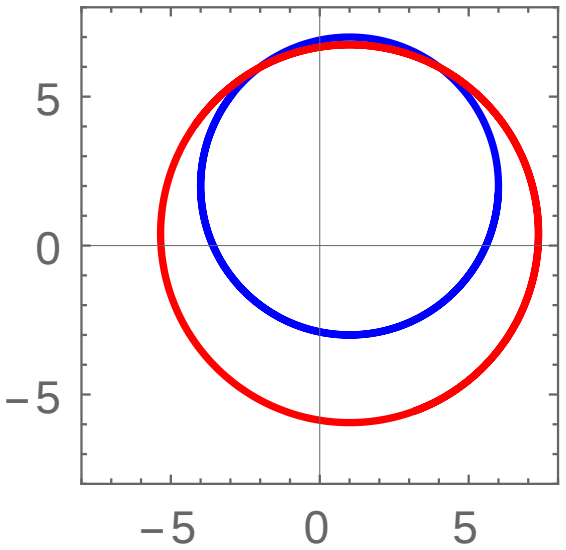
Set up a cyclotron-like apparatus with $B=1.5$ T and a deuteron beam whose initial orbit has center $(0.60,-0.10)$ m and radius $0.50$ m, and apply a nominally square, 50 MV/m, 10 ns electric pulse. The paper predicts the post-pulse center $(0.60,-0.43)$ m and radius $0.79$ m; observing any significant deviation from both values, or finding that the orbit returns to its original circle for a nonzero pulse, would refute the central claim. A cleaner separator is pulse-shape independence: the theory predicts the center shift depends only on $\int\mathbf E\,dt$, so using a Gaussian or triangular pulse of the same area should leave the center shift unchanged while altering the radius according to the shape-dependent terms.
Extended reading notes
Core claim
On the paper's own terms, the central discovery is that a square electric pulse $\mathbf E = E[\Theta(t)-\Theta(t-T)](\cos\alpha\,\hat i+\sin\alpha\,\hat j)$ superimposed on a uniform magnetic field $B\hat k$ changes the asymptotic cyclotron orbit. Writing the pre-pulse orbit with center $(C_0,C'_0)$ and radius $\sqrt{A_0^2+D_0^2}$, the post-pulse orbit is again a circle, with center shifted by $(E/B)(\sin\alpha\,T,\,-\cos\alpha\,T)$ and radius equal to the square root of $\left(A_0+\frac{2E}{\omega_B B}\sin\frac{\omega_B T}{2}\cos(\frac{\omega_B T}{2}+\alpha)\right)^2 + \left(D_0+\frac{2E}{\omega_B B}\sin\frac{\omega_B T}{2}\sin(\frac{\omega_B T}{2}+\alpha)\right)^2$. The velocity difference between future and past is the complex quantity $-i\frac{E}{B}e^{-i\omega_B t}(e^{i(\omega_B T+\alpha)}-e^{i\alpha})$, so the particle's speed as well as its direction changes. The paper identifies the origin of this persistence in the nonzero difference of vector potentials, $\Delta \mathbf A = -ET(\cos\alpha\,\hat i+\sin\alpha\,\hat j)$, which is related to $-\nabla\Lambda$ with $\Lambda=-ET(x\cos\alpha+y\sin\alpha)$, and it provides a generalized velocity-kick formula $\Delta\mathbf v = -\frac{q}{m}\Delta\mathbf A(t)+\omega_B\Delta\tilde{\mathbf r}$ for the case with a uniform magnetic field.
Load-bearing premise
The load-bearing premise is that the pulse is an idealized square wave that is spatially uniform, turns on and off instantaneously, and can be superposed on the magnetic field without radiation, edge effects, or back-reaction from the moving charge; if that idealization fails, the quantitative formulas for the center shift and radius change would need modification.
Editorial extensions
If this is right
- After the pulse leaves, the particle is on a new circle forever; the old circle is not recovered, and no choice of initial constants keeps both the center and the radius unchanged.
- For $\omega_B T=2n\pi$ the radius is unchanged but the center still shifts; for $\omega_B T=(2n+1)\pi$ the radius changes in a way controlled by $\alpha$, and with specially tuned initial conditions the particle can be left completely at rest.
- A pair of identical charges with different initial conditions ends up with a different relative separation and relative velocity after the pulse, giving a two-particle marker of the memory-like effect.
- The generalized kick formula $\Delta\mathbf v=-\frac{q}{m}\Delta\mathbf A(t)+\omega_B\Delta\tilde{\mathbf r}$ reduces to the familiar $\Delta\mathbf v=q\int \mathbf E\,dt$ when the magnetic field is switched off, so the pure-electric memory formula is recovered as a special case.
- The paper's illustrative parameters (deuteron, $B=1.5$ T, $E=50$ MV/m, $T=10$ ns) shift the center by about $0.33$ m and increase the speed from $0.12c$ to $0.19c$, which places the predicted effect at a scale a modified cyclotron could in principle resolve.
Reading between the lines
- If the vector-potential difference is truly the mechanism, then the center shift should depend only on the time integral of the electric field, while the radius change should carry pulse-shape information; numerically comparing square, Gaussian, and triangular pulses would test this separation directly.
- The idealized calculation ignores radiation reaction; including it should turn the 'permanent' circle into a very slowly decaying spiral, so the effect is really a long-lived memory rather than an exact one under more complete physics.
- The same two-region matching applied to a nonuniform magnetic field would overlay the guiding-center drift on the memory shift, possibly giving a new way to distinguish the pulse-induced part of the motion.
Editorial analysis
A structured set of objections, weighed in public.
Referee Report
Summary. The paper studies a non-relativistic charged particle in a uniform magnetic field, subject to a short, spatially homogeneous, square electric pulse in the plane perpendicular to the field. It derives the exact piecewise solution of the Lorentz force equation in three time regions, matches the boundary conditions at the pulse edges, and obtains explicit formulas for the post-pulse orbit: a shifted guiding center, a changed radius, and a velocity kick. The author interprets these permanent changes as a memory-like effect and argues that they are related to the difference in vector potentials before and after the pulse, which are connected by a gauge transformation.
Significance. The calculation is a clean, parameter-free exact solution of a standard problem in classical electrodynamics. The main formulas, in particular the velocity kick (Eq. 20) and the post-pulse orbital invariants (Eq. 22), are internally consistent and reproduce the stated center shift and radius change. The paper is honest that this is not a wave-memory effect at null infinity, but a simple analogue with 'persistent observables'. The derivation is self-contained and does not depend on the cited memory literature, so there is no circularity concern. The main value is pedagogical and interpretive: it provides a concrete, exactly solvable model that illustrates how a transient field can leave a permanent imprint on a charged particle's orbit.
minor comments (5)
- [II (Current source)] Equation (29) has a sign error. From the Ampere-Maxwell law with ∇×B = 0, J = -ε0 ∂E/∂t, so for the pulse in Eq. (28) one obtains J = -ε0 E [δ(t) - δ(t-T)](cos α i + sin α j), not the expression with a plus sign. The stated current source would, if used as an input, generate an electric pulse of the opposite sign. This should be corrected and the surrounding paragraph adjusted accordingly.
- [II (Velocities)] The claim that 'for no pair of values of ti and tf is the difference Δvα = 0' is too strong. Equation (20) gives a complex velocity difference that rotates with frequency ωB, so for each Cartesian component there will generally be many pairs (ti, tf) for which that component's difference vanishes. The correct statement is that the difference is not identically zero and is generically nonzero, or that the asymptotic difference is nonzero for a nonvanishing pulse. This overstatement is not needed for the orbit-memory result but should be revised.
- [III (Role of the vector potential)] The wording that the vector potential difference (34) is 'responsible for a memory-like effect' is an overinterpretation. The electric and magnetic fields are identical before and after the pulse, and the gauge transformation (35) with Λ = -ET(x cos α + y sin α) is a regular, small gauge transformation. The physical cause of the permanent change is the time-integrated Lorentz force during the pulse. The quantitative relation (41) is correct, but the interpretive sentences should be softened to present the vector potential difference as a mathematical characterization rather than a causal mechanism.
- [II (Experimental possibility)] The paper correctly acknowledges that the practical implementation needs more thought, but it should also state explicitly that a perfectly homogeneous electric pulse filling all space is an idealization with infinite energy. A real pulse would have finite spatial extent, and edge effects would modify the idealized predictions. This does not invalidate the exact solution for the idealized configuration, but it should be labeled as an idealization in the experimental section.
- [General] The data availability statement reads 'No Data associated in the manuscript'; the phrasing should be 'No data are associated with the manuscript' or similar.
Circularity Check
No significant circularity: the predicted orbit changes are direct consequences of the Lorentz-force solution, with no fitted parameters or load-bearing self-citations.
full rationale
The paper's central claim is an exact, parameter-free solution of the Lorentz force for a prescribed square electric pulse in a uniform magnetic field. Equations (15)-(18) are obtained by direct integration and boundary matching, the velocity-kick formula (20) follows algebraically from the complex-velocity equation (19), and the final-circle invariants (22) are rearrangements of the solved trajectories. No parameter is fitted to the predicted final orbit; the constants A0, D0, C0, C0' are initial conditions chosen for plots. The vector-potential discussion in Section III computes A from E = -∂A/∂t, forms ΔA, and derives the gauge function Λ from A_after = A_before + ∇Λ; the relation Δv = -q/m ΔA + ωB Δr̃ is obtained by integrating the equations of motion and then verified, not assumed. The paper's self-citations (e.g., [19], [21]-[23], [53]) appear only in background or analogical contexts and are not load-bearing for the derivation. The paper explicitly concedes the experimental limitation ('The practical implementation of this idea in a possible experiment will surely require more detailed thought'), and the Ampere-Maxwell source expression in Eq. (29) has a sign error; these concern realizability and correctness of the source model, not circularity. Defining 'memory' as a permanent change is a labeling convention, not a circular derivation. The result is self-contained against the stated idealized pulse. Score 0.
Assumptions & free parameters
assumptions (3)
- domain assumption The electric pulse is a prescribed, spatially uniform square wave, E(t) = E for 0 <= t <= T and zero otherwise, independent of the particle's motion.
- domain assumption The magnetic field is exactly uniform, constant, and along z, B = B k, and the particle moves non-relativistically with vz = 0.
- standard math The standard Lorentz force and Maxwell equations are used without radiative or back-reaction corrections.
Cite this review
Pith. "Pith review of Pulse-induced memory-like effect in cyclotron motion?." pith.science (2026). https://pith.science/paper/IYUW7BY4
@misc{pith2026241219460,
  author       = {Pith},
  title        = {Pith review of: Pulse-induced memory-like effect in cyclotron motion?},
  year         = {2026},
  howpublished = {\url{https://pith.science/paper/IYUW7BY4}},
  note         = {Machine review of arXiv:2412.19460}
}
read the original abstract
We study how a charged particle moving in a uniform magnetic field along its standard circular path (cyclotron motion) reacts to a short-duration, homogeneous, uniform electric field pulse injected in the plane perpendicular to the magnetic field. A `permanent' change in the radius of the initial circle and a shift of its centre is noted at later times, after the pulse is switched off. The velocity vector (components and magnitude) undergoes a change too, akin to a `velocity kick'. The cause behind this permanent change appears to be linked to the difference between the vector potentials before and after the duration of the electric pulse. Further, we show how such vector potentials in the past and future are related through a gauge transformation. In summary, our results suggest a pulse-induced `electromagnetic memory-like effect', which is not quite a `wave memory', but, nevertheless, has similar features within a simple, non-relativistic context.
Figures


Figures from the paper (4 more)


Forward citations
Cited by 1 Pith paper
-
Memory-like effects and kinematics of trajectories in Cyclotron motion
An electric pulse leaves a permanent shear restructuring (complex-shear phase rotation) on a cyclotron trajectory congruence without changing focusing times.
Reference graph
Works this paper leans on
-
[1]
The effect of the pulse is manifest in the modified trajectories in regions II and III
and its radius is p A2 0 + D2 0. The effect of the pulse is manifest in the modified trajectories in regions II and III. In III, we find that the trajectory is still a circle but with a shifted centre and a different radius. The equation of this new circle at times t ≥ T is given as: x(III ) − C0 + E B (sin α) T 2 + y(III ) − C ′ 0 − E B (cos α) T 2 = A0 ...
-
[2]
After the pulse has interacted and departed, we have different radii and velocities
Hence the difference in the magnitudes of the radii and velocities are given as: ∆Ri = |Ri2 − Ri1| , ∆ vi = |vi2 − vi1| = ωB∆Ri. After the pulse has interacted and departed, we have different radii and velocities. In particular, we have, R2 f 1 = A01 + 2E ωBB sin ωBT 2 cos ωBT 2 + α 2 + D01 + 2E ωBB sin ωBT 2 sin ωBT 2 + α 2 . (26) R2 f 2 = A02 + 2E ωBB s...
-
[3]
Y. B. Zel’dovich and A. G. Polnarev, Sov. Astron 18, 17 (1974)
work page 1974
-
[4]
V. B. Braginsky and L. P. Grishchuk, Sov. Phys. JETP 62, 427 (1985)
work page 1985
-
[5]
Christodoulou, Phys
D. Christodoulou, Phys. Rev. Lett. 67, 1486 (1991)
1991
-
[6]
O. M. Boersma, D. A. Nichols, P. Schmidt, Phys. Rev. D 101, 083026 (2020)
work page 2020
- [7]
-
[8]
H. Inchausp´ e, S. Gasparotto, D. Blas, L. Heisenberg, J. Zosso, S. Tiwari, arXiv:2406.09228
Show all 57 references
-
[9]
Bieri and D
L. Bieri and D. Garfinkle, Phys. Rev. D 89, 084039 (2014)
2014
-
[10]
Tolish, L
A. Tolish, L. Bieri, D. Garfinkle, and R. M. Wald, Phys. Rev. D 90, 044060 (2014)
2014
-
[11]
Tolish and R
A. Tolish and R. M. Wald, Phys. Rev. D 89, 064008 (2014)
2014
-
[12]
M¨ adler and J
T. M¨ adler and J. Winicour, Class. Quant. Grav. 33, 175006 (2016)
2016
-
[13]
M¨ adler and J
T. M¨ adler and J. Winicour, Class. Quant. Grav. 34, 115009 (2017)
2017
-
[14]
Strominger and A
A. Strominger and A. Zhiboedov, J. High Energy Phys. 01 (2016), 86. 19
2016
-
[15]
Strominger, Lectures on the Infrared Structure of Gravity and Gauge Theory (2017) arXiv:1703.05448 [hep-th]
A. Strominger, Lectures on the Infrared Structure of Gravity and Gauge Theory (2017) arXiv:1703.05448 [hep-th]
2017 arXiv
-
[16]
Zhang, C
P.-M. Zhang, C. Duval, G. W. Gibbons, and P. A. Horvathy, Phys. Lett. B 772, 743 (2017)
2017
-
[17]
Zhang, C
P.-M. Zhang, C. Duval, G. W. Gibbons, and P. A. Horvathy, Phys. Rev. D 96, 064013 (2017)
2017
-
[18]
P. M. Zhang, C. Duval, G. W. Gibbons, and P. A. Horvathy, JCAP 05, 030
-
[19]
Zhang, C
P.-M. Zhang, C. Duval, and P. A. Horvathy, Class. Qtm. Grav. 35, 065011 (2018)
2018
-
[20]
P. M. Zhang, M. Elbistan, G. W. Gibbons, and P. A. Horvathy, Gen. Rel. Grav.50,107 (2018)
2018
-
[21]
Chakraborty and S
I. Chakraborty and S. Kar, Phys. Rev. D 101, 064022 (2020)
2020
-
[22]
Cvetkovi´ c and D
B. Cvetkovi´ c and D. Simi´ c, Eur. Phys. J. C82, 127 (2022)
2022
-
[23]
Chakraborty and S
I. Chakraborty and S. Kar, Phys. Lett. B 808, 135611 (2020)
2020
-
[24]
Siddhant, I
S. Siddhant, I. Chakraborty, and S. Kar, Eur. Phys. J. C 81, 350 (2021)
2021
-
[25]
Chakraborty and S
I. Chakraborty and S. Kar, Eur. Phys. J. Plus 137, 418 (2022)
2022
-
[26]
P. -M. Zhang, P. A. Horvathy, arXiv:2405.12928. Annals of Physics 470, 169784 (2024)
2024 arXiv
-
[27]
P. -M. Zhang, Q. -L. Zhao, J. Balog and P. A. Horvathy, Annals of Physics 473, 169890 (2025)
2025
-
[28]
Ben Achour and J-P Uzan, JCAP 08,004 (2024),
J. Ben Achour and J-P Uzan, JCAP 08,004 (2024),
2024
-
[29]
E. E. Flanagan, A. M. Grant, A. I. Harte, and D. A. Nichols.Phys. Rev. D 99, 084004 (2019)
2019
-
[30]
E. E. Flanagan, A. M. Grant, A. I. Harte, and D. A. Nichols, Phys. Rev. D 101, 104033 (2020)
2020
-
[31]
A. M. Grant and D. A. Nichols, Phys. Rev. D 105, 024056 (2022)
2022
-
[32]
O’Loughlin and H
M. O’Loughlin and H. Demirchian, Phys. Rev. D 99, 024031 (2019)
2019
-
[33]
A. K. Divakarla and B. F. Whiting, Phys. Rev. D 104, 064001 (2021)
2021
-
[34]
G. M. Shore, JHEP 12, 133 (2018)
2018
-
[35]
H. Hadi, A. R. Akbarieh, David F. Mota, Class. Quantum Grav. 41, 105005 (2024)
2024
-
[36]
Favata, Class
M. Favata, Class. Quant. Grav. 27, 084036 (2010)
2010
-
[37]
Mitman, M
K. Mitman, M. Boyle, L. C. Stein, N. Deppe, L. E. Kidder, J. Moxon, H. P. Pfeiffer, M. A. Scheel, S. A. Teukolsky, W. Throwe, N. L. Vu, Class. Quantum Grav. 41, 223001 (2024)
2024
-
[38]
L. P. Grishchuk and A. G. Polnarev, Sov. Phys. JETP 69, 653 (1989)
1989
-
[39]
Bieri, D
L. Bieri, D. Garfinkle, Class. Quantum Grav. 30, 195009 (2013)
2013
-
[40]
Jokela, K
N. Jokela, K. Kajantie and M. Sarkkinen, Phys. Rev. D99, 11603 (2019)
2019
-
[41]
Winicour, Class
J. Winicour, Class. Quant. Grav. 31, 205003 (2014)
2014
- [42]
-
[43]
Pasterski, JHEP 154 (2017)
S. Pasterski, JHEP 154 (2017)
2017
-
[44]
Pate, A-M Raclariu, and A
M. Pate, A-M Raclariu, and A. Strominger, Phys. Rev. Lett. 119, 261602 (2017)
2017
-
[45]
Satishchandran, R
G. Satishchandran, R. M. Wald, Phys. Rev. D99 084007 (2019)
2019
-
[46]
Campoleoni, D
A. Campoleoni, D. Francia, and C. Heissenberg, Phys. Rev. D 100, 085015 (2019)
2019
-
[47]
Garfinkle, Class
D. Garfinkle, Class. Quant. Grav. 39, 135010 (2022)
2022
-
[48]
Bieri and D
L. Bieri and D. Garfinkle, Class. Quantum Grav. 41, 225009 (2024)
2024
-
[49]
Oblak, A
B. Oblak, A. Seraj Phys. Rev. D 109, 044037 (2024)
2024
-
[50]
Chautard, Beam dynamics for cyclotrons, CERN Particle Accelerator School: 209–229 (2006) doi:10.5170/CERN-2006-012.209
F. Chautard, Beam dynamics for cyclotrons, CERN Particle Accelerator School: 209–229 (2006) doi:10.5170/CERN-2006-012.209
2006 doi
-
[51]
Shaikh, S
R. Shaikh, S. Kar and A. DasGupta, Eur. Phys. Jr. Plus 129, 90 (2014)
2014
-
[52]
R. W. Gould, Am. J. Phys. 37, 585 (1969)
1969
-
[53]
Iimori, T
T. Iimori, T. Naito and N. Ohta, JACS 129, 3458 (2007)
2007
-
[54]
S-Jui, C-Ye, C-Wen, C-Jung and H-C Tseng, ACS Applied Materials and Interfaces 11, 33525 (2019)
2019
-
[55]
Dey and S
A. Dey and S. Kar, Phys. Rev. D 110, 084056 (2024)
2024
-
[56]
Mashhoon, Gravitoelectromagnetism: A Brief Review, in L
B. Mashhoon, Gravitoelectromagnetism: A Brief Review, in L. Iorio (ed.), The Measurement of Gravitomagnetism: A Challenging Enterprise, Nova Science Publishers (2007)
2007
-
[57]
M. L. Ruggiero and D. Astesiano, J. Phys. Commun. 7 112001 (2023). 21
2023
Reviewed August 11, 2026 · model on record in the stance chip above.
Discussion (0). Continue with ORCID to comment.