REVIEW 4 major objections 5 minor 75 references
Revealing Local Structures through Machine-Learning- Fused Multimodal Spectroscopy
T0 review · 4 major / 5 minor · reviewed 2026-08-10 · deepseek-v4-flash
Pith's one-line read A machine-learning model that fuses oxygen and transition-metal core-level spectra can infer local composition and detect defects in NMC battery cathodes, a capability single-edge spectra do not provide.
desk verdict Useful Li-content inference from multimodal spectra, but the antisite defect claim is likely an artifact of a DFT functional mismatch and should not be accepted without reanalysis. read the letter →
The pith
A machine-rendered reading of the paper's core claim, the machinery that carries it, and where it could break.
The reading
What carries the argument
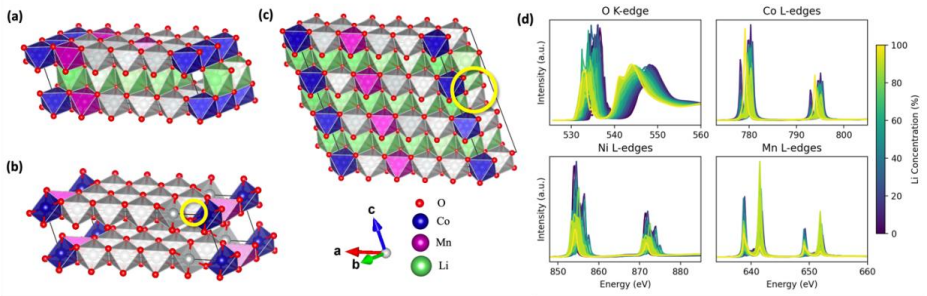
The central object is the multimodal spectrum vector: for each local site, the O K-edge and the Ni, Mn, and Co L2,3-edge spectra, converted into cumulative distribution functions (CDFs) to reduce sensitivity to energy-axis shifts and fed together to gradient-boosted decision trees. Training spectra are computed from first-principles structures of 851 NMC configurations, including pristine, oxygen-vacant, and Ni/Li antisite structures, using a spectral simulation method selected by comparison with experimental reference spectra; the simulated curves are then aligned to experiment by manual energy shifting and broadening. The fusion itself carries the argument: defect classification reaches 100% only when all four edges are supplied, and feature-importance maps assign physical meaning to the channels, with the Ni L3 edge dominating Li-content prediction and the O K-edge reporting oxygen–transition-metal bonding and charge compensation.
What would settle it
A decisive check would compare the model's per-pixel defect predictions with independently determined defect maps on the same particles: for example, oxygen-vacancy predictions from the multimodal model versus atomically resolved STEM imaging or quantified EELS reference standards on Si-doped Li-rich NMC. If the model flags vacancies where the independent structure shows a stoichiometric lattice, or misses them where the lattice clearly has vacancies, the simulation-to-experiment transfer premise collapses.
Extended reading notes
Core claim
The central claim is that fusing element-specific spectral edges changes what spectroscopy can say about a material: a gradient-boosted tree trained on the O K-edge together with the Ni, Mn, and Co L2,3 edges classifies oxygen vacancies and Ni/Li antisite defects with perfect accuracy on simulated test cases, while single-edge models miss them. The same multimodal model predicts local Li, Ni, Mn, and Co counts inside a roughly 0.3 nm coordination shell, and it infers bulk Li content from experimental soft X-ray spectra of cycled NMC cathodes with root mean square error below 0.1, beating single-edge inference by 30–50%. When applied without retraining to a Si-doped Li-rich NMC sample, the model's predicted oxygen-vacancy pixels overlap with the measured Si L-edge signal, matching a prior experimental finding that silicon promotes oxygen vacancies. The paper reads this as evidence that multimodal core-level spectroscopy, after calibrating simulated spectra to experimental energy scales, can reveal local defects that a single spectrum or other experimental techniques cannot.
Load-bearing premise
The load-bearing premise is that simulated core-level spectra, after manually chosen energy shifts and broadening, are faithful stand-ins for real experimental spectra for every composition, lithiation state, and defect type used here.
Editorial extensions
If this is right
- Local Li content can be mapped directly from XAS or EELS spectrum images, with a reported root mean square error under 0.1 for cycled NMC cathodes, instead of relying on bulk capacity averages.
- Oxygen vacancies and Ni/Li antisites become detectable from core-level spectra when several edges are fused; in this study single-edge models cannot achieve that detection.
- A model trained on simulated spectra can be applied without retraining to a chemically related but different system, Si-doped Li-rich NMC, and its defect predictions agree with an independent experimental report.
- Feature-importance analysis yields physically interpretable channels: the Ni L3 edge tracks nickel redox and lithium content, while the two O K-edge features report oxygen–transition-metal bonding and charge compensation.
Reading between the lines
- The 100% defect-classification accuracies are simulated-test-set numbers; real experimental ground truth for defects is harder to certify, so the transfer to arbitrary samples is the least-tested part of the pipeline, with the Si-doped co-localization serving as an indirect check.
- Because CDF inputs are robust to energy-axis shifts, the framework may transfer across instruments with different energy calibrations with little or no recalibration, an extension the paper does not test.
- The same training recipe could be adapted to neighboring layered-oxide chemistries, such as sodium analogues or other dopant variants, using a small transfer-learning dataset as the paper lists for future work.
- The local-environment definition of a 0.3 nm sphere ties predictions to a specific spatial scale; probing atomic-column resolution would reveal whether the multimodal advantage persists when the coordination shell contains far fewer atoms.
Editorial analysis
A structured set of objections, weighed in public.
Referee Report
Summary. The paper proposes a machine-learning workflow that fuses multimodal core-level spectroscopy (O K-edge and Ni/Mn/Co L2,3-edges) with ab initio simulations to infer local structure and defects in NMC cathode materials. The authors train XGBoost models on FDMNES-simulated spectra of pristine, oxygen-vacancy, and Ni/Li antisite structures, using CDF featurization and Bayesian hyperparameter optimization. They report accurate Li-content inference on experimental sXAS data, improved local-composition inference over unimodal approaches, and 100% classification accuracy for oxygen vacancies and antisite defects. The paper also includes a permutation-importance analysis and a qualitative validation on Si-doped Li-rich NMC via EELS mapping.
Significance. If the main claims hold, the work would be a valuable demonstration that combining multiple spectroscopic edges improves ML-based inference of local composition and defects, with a practical pathway from simulations to experimental EELS/XAS data. The manuscript has several concrete strengths: a systematic benchmarking of five spectrum simulation codes against experimental spectra, a thoughtful comparison of featurization and ML models, and a clear attempt to test the trained model on experimental data and on a doped material system. The interpretability analysis (feature importance mapped to energy domain) also adds physical insight. However, the defect-detection claims, especially for antisites, are currently under-supported because of a simulation-level confound and very small, inconsistent dataset sizes. The experimental Li-content validation also lacks error bars and calibration details. The central claim that the approach detects defects that are 'impossible' for other techniques is overstated relative to the evidence presented.
major comments (4)
- [Methods, DFT and Spectra Simulations; Local defect; Figure 4(d)] The antisite-defect classification is undermined by a functional mismatch between the training classes. Pristine and oxygen-vacancy structures are relaxed with SCAN+U (U_Ni=2.43 eV, U_Mn=2.93 eV, U_Co=2.86 eV), while antisite structures use PBE+U with much larger U values (6.7, 4.2, 4.9 eV). The FDMNES core-level spectra inherit these differences, so a classifier can separate the classes by recognizing the exchange-correlation functional rather than the physical defect. This is a load-bearing issue for the abstract's claim that the model 'determine[s] whether local defects such as ... antisites are present.' The authors should provide a control: for example, compute a set of pristine (or oxygen-vacancy) structures with the same PBE+U settings as the antisite structures and show that the classifier still distinguishes antisites from these matched controls. Without such a control, the 100% accuracy in Figure 4(d) cannot be attributed to the antisite defect itself.
- [Structures and Spectra; Local defect; Figure 4(c,d)] The defect classification results are reported as exact '100% accuracy' on datasets that are very small and are not described with a clear evaluation protocol. The text gives 14 antisite structures in 'Structures and Spectra' but 18 in the 'Local defect' subsection, and it does not state how many structures were used for training versus testing, whether repeated train/test splits or cross-validation were performed, or how class weighting affected the reported accuracy. The oxygen-vacancy result is similarly based on 136 defective structures against 701 pristine, with no error bars or confidence intervals. The authors should provide the full classification details: the number of test instances, the train/test split method (e.g., leave-one-out or stratified k-fold), the distribution of predicted probabilities, and confusion matrices. I also recommend reporting precision/recall rather than only a single accuracy number, since the class imbalance and the very small antisite count could make the 100% value an artifact of the split.
- [Li Content Inference; Figure 3] The experimental Li-content validation lacks sufficient quantitative detail. The text reports 'RMSE value of less than 0.1' but does not specify the number of data points, the composition/cycle states covered, or the uncertainty in either the predicted or the capacity-derived Li content. The capacity-derived 'ground truth' relies on the assumptions in the equation (e.g., one electron per Li, no side reactions), and the manual shift/broadening calibration applied to simulated data is described only qualitatively. To support the claim of quantitative agreement, the authors should list the individual Li% values with uncertainties for the points in Figure 3, state how the calibration parameters were chosen (e.g., grid search or fixed offsets), and ideally report the per-condition errors. The stronger claim that the method yields local Li content from EELS/XAS mapping is not demonstrated here, since the comparison in Figure 3 is only against bulk-averaged capacity-derived values; a validation on spatially resolved experimental data would be needed to support that extension.
- [Local Environment Inference; Figure 4(a,b)] The local environment inference uses a hand-set placeholder for absent elements: a constant line at y=0.1 with 2% Poisson noise. The choice of 0.1 is not justified, and no sensitivity analysis is provided for this value. Since the absent-element spectra constitute part of the input features for predicting the counts of Mn and Co, the reported accuracy gains of the multimodal method over unimodal ones may depend on this arbitrary placeholder. The authors should vary this placeholder (e.g., 0.0, 0.01, 0.5) and show that the qualitative conclusion of multimodal superiority is unchanged, or replace the placeholder with a physically motivated baseline (e.g., a flat pre-edge spectrum from a dilute reference).
minor comments (5)
- [Li Content Inference] The term 'RSME' is a typo; it should be 'RMSE' (root mean square error). Please also check for other typos throughout the manuscript, including the duplicated paragraph about BO-TPE that appears twice in the 'Machine Learning Model' and 'Model Construction and Training' sections.
- [Figure 1 and workflow description] The figure and text contrast multimodal (red) and unimodal (black/gray) workflows, but the caption and text do not define which edges are used in each unimodal baseline (e.g., only O K-edge vs. only Ni L-edge). Please specify the exact unimodal feature sets for all comparisons in Figures 3 and 4.
- [Data and code availability] No data or code availability statement is included. I would encourage the authors to share the training data (simulated spectra and structure labels) and the trained models, as this would strengthen reproducibility and allow the community to build on the workflow.
- [Model Interpretation, Figure 6] The feature importance plot is mapped back to the energy domain, but the text only qualitatively discusses the Ni L3 and O K-edge peaks. Please state the exact energy ranges highlighted in the plot and, if possible, provide a quantitative measure (e.g., integrated importance over a window) to support the claim that Ni L3 is 'the most important feature.'
- [Local defect subsection] The claim that defect detection is 'impossible for single mode spectra or other experimental techniques' is too strong and is not evidenced by the data presented. The paper only compares to two unimodal ML baselines (O K-edge and one representative TM L-edge) and does not compare to, for example, combined O K + one TM edge or to non-ML experimental analysis methods. Please soften the wording or provide a more systematic baseline comparison.
Circularity Check
Local composition inference partly reduces by construction: absent Mn/Co are encoded as constant spectra, so predicting their absence reads the placeholder rather than physics.
-
self definitional
[Results, 'Local Environment Inference', 2nd paragraph (p. 7)]
"For each shell, the spectra of each element are calculated using site-average ensemble. In instances where an element (specifically for Mn and Co in our case) is absent within this shell, its spectrum is approximated by a constant line at y=0.1 with 2% Poisson noise added."
The input feature for Mn and Co is defined by the target label: when the true count is zero, the spectrum is replaced by a constant; when nonzero, the actual simulated spectrum is used. A classifier can therefore 'predict' zero Mn/Co by recognizing the constant placeholder, without learning any physical spectroscopic signature of absence. The reported local-environment accuracy and the multimodal-over-unimodal advantage in Figure 4(a) are partly inflated by this label leakage, since the multimodal input contains the extra constant channel while the unimodal O K-edge does not. This is a self-definitional construction: the answer for absence is already written into the input.
full rationale
The paper's main external-validation chain is not circular: simulated spectra carry known structural labels, the model is trained on those labels, and the Li-content prediction is checked against capacity-derived Li content on real sXAS data, which is an independent benchmark. The oxygen-vacancy application to Si-doped NMC provides a separate qualitative experimental check. The defect classifications are supervised fits to simulated labels rather than derivations, and the antisite PBE+U vs SCAN+U functional mismatch is a serious confound but not a circularity. The one genuine circular step is in Local Environment Inference: when Mn or Co is absent from a 0.3 nm shell, the paper sets that element's spectrum to a constant line with noise, so the model's input already contains the absence label. Predicting zero Mn/Co from a constant spectrum is reading back the construction, and the reported multimodal advantage is partly an artifact of this placeholder. The self-citation to Chen et al. for CDF featurization is minor and not load-bearing. Net: partial circularity in one prediction task, while the central defect-detection claim retains independent content, yielding a score of 6.
Assumptions & free parameters
free parameters (4)
- Simulated-to-experimental spectral calibration (shift, broadening) =
not reported
- XGBoost/BO-TPE hyperparameters =
not reported
- Absent-element placeholder intensity =
0.1 with 2% Poisson noise
- Oxygen-vacancy class weights =
low weights for pristine high-Li structures
assumptions (5)
- domain assumption DFT (SCAN+U and PBE+U) structures and FDMNES spectra are accurate enough proxies for real NMC local environments
- domain assumption The 0.3 nm spherical coordination shell with site-averaged ensemble spectra represents the local environment probed by EELS/XAS
- domain assumption Electrochemical capacity gives ground-truth Li content via Li% = 1 - Cm/Ct with n=1
- domain assumption CDF features are robust to energy shifts and preserve information after simulated-to-experimental calibration
- domain assumption FDMNES benchmarking on NMC333 transfers to NMC622/721/811 and defective structures
Cite this review
Pith. "Pith review of Revealing Local Structures through Machine-Learning- Fused Multimodal Spectroscopy." pith.science (2026). https://pith.science/paper/G2SUSVIU
@misc{pith2026250108919,
  author       = {Pith},
  title        = {Pith review of: Revealing Local Structures through Machine-Learning- Fused Multimodal Spectroscopy},
  year         = {2026},
  howpublished = {\url{https://pith.science/paper/G2SUSVIU}},
  note         = {Machine review of arXiv:2501.08919}
}
read the original abstract
Atomistic structures of materials offer valuable insights into their functionality. Determining these structures remains a fundamental challenge in materials science, especially for systems with defects. While both experimental and computational methods exist, each has limitations in resolving nanoscale structures. Core-level spectroscopies, such as x-ray absorption (XAS) or electron energy-loss spectroscopies (EELS), have been used to determine the local bonding environment and structure of materials. Recently, machine learning (ML) methods have been applied to extract structural and bonding information from XAS/EELS, but most of these frameworks rely on a single data stream, which is often insufficient. In this work, we address this challenge by integrating multimodal ab initio simulations, experimental data acquisition, and ML techniques for structure characterization. Our goal is to determine local structures and properties using EELS and XAS data from multiple elements and edges. To showcase our approach, we use various lithium nickel manganese cobalt (NMC) oxide compounds which are used for lithium ion batteries, including those with oxygen vacancies and antisite defects, as the sample material system. We successfully inferred local element content, ranging from lithium to transition metals, with quantitative agreement with experimental data. Beyond improving prediction accuracy, we find that ML model based on multimodal spectroscopic data is able to determine whether local defects such as oxygen vacancy and antisites are present, a task which is impossible for single mode spectra or other experimental techniques. Furthermore, our framework is able to provide physical interpretability, bridging spectroscopy with the local atomic and electronic structures.
Figures
Reference graph
Works this paper leans on
-
[1]
Albella, P.; Alcaraz de la Osa, R.; Moreno, F.; Maier, S. A. Electric and magnetic field enhancement with ultralow heat radiation dielectric nanoantennas: considerations for surface-enhanced spectroscopies. Acs Photonics 2014, 1, 524–529
work page 2014
-
[2]
Semeraro, F.; Ferguson, J. C.; Panerai, F.; King, R. J.; Mansour, N. N. Anisotropic analysis of fibrous and woven materials part 1: Estimation of local orientation. Computational Materials Science 2020, 178, 109631
work page 2020
-
[3]
Yang, S.; Wang, C.; Sahin, H.; Chen, H.; Li, Y.; Li, S.; Suslu, A.; Peeters, F. M.; Liu, Q.; Li, J. Tuning the optical, magnetic, and electrical properties of ReSe2 by nanoscale strain engineering. Nano letters 2015, 15, 1660–1666
work page 2015
-
[4]
Tuning of thermal stability in layered Li(NixMnyCoz)O2
Zheng, J.; Liu, T.; Hu, Z.; Wei, Y.; Song, X.; Ren, Y.; Wang, W.; Rao, M.; Lin, Y.; Chen, Z. Tuning of thermal stability in layered Li(NixMnyCoz)O2. J. Am. Chem. Soc. 2016, 138, 13326–13334
work page 2016
-
[5]
Ultrahigh piezoelectricity in ferroelectric ceramics by design
Li, F.; Lin, D.; Chen, Z.; Cheng, Z.; Wang, J.; Li, C.; Xu, Z.; Huang, Q.; Liao, X.; Chen, L. Ultrahigh piezoelectricity in ferroelectric ceramics by design. Nature materials 2018, 17, 349–354
work page 2018
-
[6]
Jung, S.; Hwang, I.; Chang, D.; Park, K.; Kim, S. J.; Seong, W. M.; Eum, D.; Park, J.; Kim, B.; Kim, J. Nanoscale phenomena in lithium-ion batteries. Chem. Rev. 2019, 120, 6684– 6737
work page 2019
-
[7]
Nanomaterials: A review of synthesis methods, properties, recent progress, and challenges
Baig, N.; Kammakakam, I.; Falath, W. Nanomaterials: A review of synthesis methods, properties, recent progress, and challenges. Materials Advances 2021, 2, 1821–1871
work page 2021
-
[8]
Pofelski, A.; Jia, H.; Deng, S.; Yu, H.; Park, T. J.; Manna, S.; Chan, M. K. Y.; Sankaranarayanan, S. K. R. S.; Ramanathan, S.; Zhu, Y. Subnanometer Scale Mapping of Hydrogen Doping in Vanadium Dioxide. Nano letters 2024, 24, 1974–1980
work page 2024
Show all 75 references
-
[9]
Fingerprinting the vibrational signatures of dopants and defects in a fully random alloy: An ab initio case study of Si, Se, and vacancies in In0
Jia, H.; Wang, J.; Clancy, P. Fingerprinting the vibrational signatures of dopants and defects in a fully random alloy: An ab initio case study of Si, Se, and vacancies in In0. 5Ga0. 5As. J. Appl. Phys. 2020, 127
2020
-
[10]
H.; Liu, P
Li, Y. H.; Liu, P. F.; Pan, L. F.; Wang, H. F.; Yang, Z. Z.; Zheng, L. R.; Hu, P.; Zhao, H. J.; Gu, L.; Yang, H. G. Local atomic structure modulations activate metal oxide as electrocatalyst for hydrogen evolution in acidic water. Nature communications 2015, 6, 8064
2015
-
[11]
Review on anionic redox for high- capacity lithium-and sodium-ion batteries
Zhao, C.; Wang, Q.; Lu, Y.; Hu, Y.; Li, B.; Chen, L. Review on anionic redox for high- capacity lithium-and sodium-ion batteries. J. Phys. D 2017, 50, 183001. 18
2017
-
[12]
A reflection on lithium-ion battery cathode chemistry
Manthiram, A. A reflection on lithium-ion battery cathode chemistry. Nature communications 2020, 11, 1550
2020
-
[13]
Max von Laue and the discovery of X‐ray diffraction in 1912
Eckert, M. Max von Laue and the discovery of X‐ray diffraction in 1912. Annalen der Physik 2012, 524, A83–A85
1912
-
[14]
Review of Recent Development of In Situ/Operando Characterization Techniques for Lithium Battery Research
Liu, D.; Shadike, Z.; Lin, R.; Qian, K.; Li, H.; Li, K.; Wang, S.; Yu, Q.; Liu, M.; Ganapathy, S.; Qin, X.; Yang, Q.; Wagemaker, M.; Kang, F.; Yang, X.; Li, B. Review of Recent Development of In Situ/Operando Characterization Techniques for Lithium Battery Research. Advanced M...
2019
-
[15]
A.; Aaron, D
Gandomi, Y. A.; Aaron, D. S.; Houser, J. R.; Daugherty, M. C.; Clement, J. T.; Pezeshki, A. M.; Ertugrul, T. Y.; Moseley, D. P.; Mench, M. M. Critical Review-Experimental Diagnostics and Material Characterization Techniques Used on Redox Flow Batteries. Journal of the Electroc...
2018
-
[16]
Sibilia, J. P. A guide to materials characterization and chemical analysis; VCH, New York, NY, 1996
1996
-
[17]
Machine Learning Approach to Enable Spectral Imaging Analysis for Particularly Complex Nanomaterial Systems
Jia, H.; Wang, C.; Wang, C.; Clancy, P. Machine Learning Approach to Enable Spectral Imaging Analysis for Particularly Complex Nanomaterial Systems. ACS nano 2022, 17, 453–460
2022
-
[18]
E.; Suresh, S
Zhang, E.; Dao, M.; Karniadakis, G. E.; Suresh, S. Analyses of internal structures and defects in materials using physics-informed neural networks. Science advances 2022, 8, eabk0644
2022
-
[19]
Zimmermann, N
R. Zimmermann, N. E.; Jain, A. Local structure order parameters and site fingerprints for quantification of coordination environment and crystal structure similarity. RSC Advances 2020, 10, 6063–6081
2020
-
[20]
M.; Lanceros-Mendez, S
Miranda, D.; Costa, C. M.; Lanceros-Mendez, S. Lithium ion rechargeable batteries: State of the art and future needs of microscopic theoretical models and simulations. Journal of Electroanalytical Chemistry 2015, 739, 97–110
2015
-
[21]
Opportunities and Challenges for Machine Learning in Materials Science
Morgan, D.; Jacobs, R. Opportunities and Challenges for Machine Learning in Materials Science. Annual Review of Materials Research 2020, 50, 71–103
2020
-
[22]
Challenges in computational materials science: Multiple scales, multi- physics and evolving discontinuities
de Borst, R. Challenges in computational materials science: Multiple scales, multi- physics and evolving discontinuities. Computational materials science 2008, 43, 1–15
2008
-
[23]
Ab Initio modeling of Near-Edge EELS spectra for chemisorbed molecules
Jia, H.; Wang, C.; Wang, C.; Clancy, P. Ab Initio modeling of Near-Edge EELS spectra for chemisorbed molecules. Nanotechnology 2021, 32, 355702. 19
2021
-
[24]
J.; Yang, W.; Sun, C.; Lee, G.; McReynolds, D.; Allan, D.; Marulanda Arias, J
Chen, Y.; Chen, C.; Hwang, I.; Davis, M. J.; Yang, W.; Sun, C.; Lee, G.; McReynolds, D.; Allan, D.; Marulanda Arias, J. Robust machine learning inference from X-ray absorption near edge spectra through featurization. Chemistry of Materials 2024, 36, 2304–2313
2024
-
[25]
Kong, L.; Ji, Z.; Xin, H. L. Electron energy loss spectroscopy database synthesis and automation of core-loss edge recognition by deep-learning neural networks. Scientific reports 2022, 12, 22183
2022
-
[26]
D.; Pate, C
Hollenbach, J. D.; Pate, C. M.; Jia, H.; Hart, J. L.; Clancy, P.; Taheri, M. L. Real-time tracking of structural evolution in 2D MXenes using theory-enhanced machine learning. Scientific Reports 2024, 14, 17881
2024
-
[27]
Deep learning for automated materials characterisation in core-loss electron energy loss spectroscopy
Annys, A.; Jannis, D.; Verbeeck, J. Deep learning for automated materials characterisation in core-loss electron energy loss spectroscopy. Scientific Reports 2023, 13, 13724
2023
-
[28]
Machine learning in materials science
Wei, J.; Chu, X.; Sun, X.; Xu, K.; Deng, H.; Chen, J.; Wei, Z.; Lei, M. Machine learning in materials science. InfoMat 2019, 1, 338–358
2019
-
[29]
A.; Greenop, M.; Ashton, L.; Rehman, I
Meza Ramirez, C. A.; Greenop, M.; Ashton, L.; Rehman, I. u. Applications of machine learning in spectroscopy. Applied spectroscopy reviews 2021, 56, 733–763
2021
-
[30]
G.; Ramprasad, R
Mueller, T.; Kusne, A. G.; Ramprasad, R. Machine Learning in Materials Science. In Reviews in Computational Chemistry 2016; pp 186–273
2016
-
[31]
N.; Gunsolus, I
Hang, M. N.; Gunsolus, I. L.; Wayland, H.; Melby, E. S.; Mensch, A. C.; Hurley, K. R.; Pedersen, J. A.; Haynes, C. L.; Hamers, R. J. Impact of nanoscale lithium nickel manganese cobalt oxide (NMC) on the bacterium Shewanella oneidensis MR-1. Chemistry of Materials 2016, 28, 1092–1100
2016
-
[32]
M.; Manthiram, A
Li, W.; Erickson, E. M.; Manthiram, A. High-nickel layered oxide cathodes for lithium- based automotive batteries. Nature Energy 2020, 5, 26–34
2020
-
[33]
Stephan, A. K. A pathway to understand NMC cathodes. Joule 2020, 4, 1632–1633
2020
-
[34]
Electron energy-loss spectroscopy (EELS) with a cold-field emission scanning electron microscope at low accelerating voltage in transmission mode
Brodusch, N.; Demers, H.; Gellé, A.; Moores, A.; Gauvin, R. Electron energy-loss spectroscopy (EELS) with a cold-field emission scanning electron microscope at low accelerating voltage in transmission mode. Ultramicroscopy 2019, 203, 21–36
2019
-
[35]
L.; Dellby, N.; Hachtel, J
Krivanek, O. L.; Dellby, N.; Hachtel, J. A.; Idrobo, J.; Hotz, M. T.; Plotkin-Swing, B.; Bacon, N. J.; Bleloch, A. L.; Corbin, G. J.; Hoffman, M. V. Progress in ultrahigh energy resolution EELS. Ultramicroscopy 2019, 203, 60–67
2019
-
[36]
Snoek, J.; Larochelle, H.; Adams, R. P. Practical bayesian optimization of machine learning algorithms. Advances in neural information processing systems 2012, 25. 20
2012
-
[37]
Oxygen release degradation in Li‐ ion battery cathode materials: mechanisms and mitigating approaches
Sharifi‐Asl, S.; Lu, J.; Amine, K.; Shahbazian‐Yassar, R. Oxygen release degradation in Li‐ ion battery cathode materials: mechanisms and mitigating approaches. Advanced Energy Materials 2019, 9, 1900551
2019
-
[38]
Muller, D. A. Structure and bonding at the atomic scale by scanning transmission electron microscopy. Nature materials 2009, 8, 263–270
2009
-
[39]
T.; Seidler, G
Fister, T. T.; Seidler, G. T.; Rehr, J. J.; Kas, J. J.; Elam, W. T.; Cross, J. O.; Nagle, K. P. Deconvolving instrumental and intrinsic broadening in core-shell x-ray spectroscopies. Physical Review B 2007, 75, 174106
2007
-
[40]
EELS detection limits revisited: Ruby—a case study
Riegler, K.; Kothleitner, G. EELS detection limits revisited: Ruby—a case study. Ultramicroscopy 2010, 110, 1004–1013
2010
-
[41]
Mn versus Al in layered oxide cathodes in lithium‐ion batteries: a comprehensive evaluation on long‐ term cyclability
Li, W.; Liu, X.; Celio, H.; Smith, P.; Dolocan, A.; Chi, M.; Manthiram, A. Mn versus Al in layered oxide cathodes in lithium‐ion batteries: a comprehensive evaluation on long‐ term cyclability. Advanced Energy Materials 2018, 8, 1703154
2018
-
[42]
Oxygen Vacancies Driven by Co in the Deeply Charged State Inducing Intragranular Cracking of Ni‐Rich Cathodes
Guo, F.; Chen, Y.; Song, Y.; Deng, Y.; Hua, W.; Yang, W.; Chen, T.; Wu, Z.; Qiu, L.; Guo, X. Oxygen Vacancies Driven by Co in the Deeply Charged State Inducing Intragranular Cracking of Ni‐Rich Cathodes. Small 2024, 2310321
2024
-
[43]
H.; Azimi, G
Malik, M.; Chan, K. H.; Azimi, G. Review on the synthesis of LiNixMnyCo1-x-yO2 (NMC) cathodes for lithium-ion batteries. Materials Today Energy 2022, 28, 101066
2022
-
[44]
Nation, L.; Wu, Y.; Liu, X.; Chi, M.; Wu, Y.; Qi, Y.; Sheldon, B. W. Redox-couple investigations in Si-doped Li-rich cathode materials. Physical chemistry chemical physics : PCCP 2021, 23, 278–2791
2021
-
[45]
S.; Kaya, S.; Viswanathan, V.; Miller, D
Casalongue, H. S.; Kaya, S.; Viswanathan, V.; Miller, D. J.; Friebel, D.; Hansen, H. A.; Nørskov, J. K.; Nilsson, A.; Ogasawara, H. Direct observation of the oxygenated species during oxygen reduction on a platinum fuel cell cathode. Nature communications 2013, 4, 2817
2013
-
[46]
Anionic redox in rechargeable lithium batteries
Li, B.; Xia, D. Anionic redox in rechargeable lithium batteries. Adv Mater 2017, 29, 1701054
2017
-
[47]
Efficient iterative schemes for ab initio total-energy calculations using a plane-wave basis set
Kresse, G.; Furthmüller, J. Efficient iterative schemes for ab initio total-energy calculations using a plane-wave basis set. Physical review B 1996, 54, 11169
1996
-
[48]
Blöchl, P. E. Projector augmented-wave method. Phys. Rev. B 1994, 50, 17953–17979
1994
-
[49]
Strongly Constrained and Appropriately Normed Semilocal Density Functional
Sun, J.; Ruzsinszky, A.; Perdew, J. Strongly Constrained and Appropriately Normed Semilocal Density Functional. Phys. Rev. Lett. 2015, 115, 036402. 21
2015
-
[50]
Wang, Z.; Guo, X.; Montoya, J.; Nørskov, J. K. Predicting aqueous stability of solid with computed Pourbaix diagram using SCAN functional. npj Computational Materials 2020, 6, 160
2020
-
[51]
P.; Burke, K.; Ernzerhof, M
Perdew, J. P.; Burke, K.; Ernzerhof, M. Generalized Gradient Approximation Made Simple. Phys. Rev. Lett. 1996, 77, 3865–3868
1996
-
[52]
S.; Zheng, J.; Zhao, W.; Omenya, F.; Fang, C.; Li, W.; Li, J.; Xie, Q
Yin, L.; Li, Z.; Mattei, G. S.; Zheng, J.; Zhao, W.; Omenya, F.; Fang, C.; Li, W.; Li, J.; Xie, Q. Thermodynamics of antisite defects in layered NMC cathodes: systematic insights from high-precision powder diffraction analyses. Chemistry of Materials 2019, 32, 1002– 1010
2019
-
[53]
Evaluation of tavorite-structured cathode materials for lithium-ion batteries using high-throughput computing
Mueller, T.; Hautier, G.; Jain, A.; Ceder, G. Evaluation of tavorite-structured cathode materials for lithium-ion batteries using high-throughput computing. Chemistry of materials 2011, 23, 3854–3862
2011
-
[54]
Tang, H.; Deng, Z.; Lin, Z.; Wang, Z.; Chu, I.; Chen, C.; Zhu, Z.; Zheng, C.; Ong, S. P. Probing solid–solid interfacial reactions in all-solid-state sodium-ion batteries with first- principles calculations. Chemistry of Materials 2018, 30, 163–173
2018
-
[55]
P.; Richards, W
Ong, S. P.; Richards, W. D.; Jain, A.; Hautier, G.; Kocher, M.; Cholia, S.; Gunter, D.; Chevrier, V. L.; Persson, K. A.; Ceder, G. Python Materials Genomics (pymatgen): A robust, open- source python library for materials analysis. Computational Materials Science 2013, 68, 314–319
2013
-
[56]
Jung, R.; Metzger, M.; Maglia, F.; Stinner, C.; Gasteiger, H. A. Oxygen Release and Its Effect on the Cycling Stability of LiNixMnyCozO2 (NMC) Cathode Materials for Li-Ion Batteries. Journal of The Electrochemical Society 2017, 164, A1361–A1377
2017
-
[57]
Rationalizing the Effect of Oxygen Vacancy on Oxygen Electrocatalysis in Li–O2 Battery
Li, J.; Shu, C.; Liu, C.; Chen, X.; Hu, A.; Long, J. Rationalizing the Effect of Oxygen Vacancy on Oxygen Electrocatalysis in Li–O2 Battery. Small 2020, 16, 2001812
2020
-
[58]
Tuning of Thermal Stability in Layered Li(NixMnyCoz)O2
Zheng, J.; Liu, T.; Hu, Z.; Wei, Y.; Song, X.; Ren, Y.; Wang, W.; Rao, M.; Lin, Y.; Chen, Z.; Lu, J.; Wang, C.; Amine, K.; Pan, F. Tuning of Thermal Stability in Layered Li(NixMnyCoz)O2. J Am Chem Soc 2016, 138, 13326–13334
2016
-
[59]
Role of Superexchange Interaction on Tuning of Ni/Li Disordering in Layered Li(Ni x Mn y Co z )O2
Zheng, J.; Teng, G.; Xin, C.; Zhuo, Z.; Liu, J.; Li, Q.; Hu, Z.; Xu, M.; Yan, S.; Yang, W.; Pan, F. Role of Superexchange Interaction on Tuning of Ni/Li Disordering in Layered Li(Ni x Mn y Co z )O2. The journal of physical chemistry letters 2017, 8, 5537–5542
2017
-
[60]
Egerton, R. F. Electron energy-loss spectroscopy in the electron microscope; Springer: New York, NY, 2011
2011
-
[61]
Ab initio simulation of the electron energy-loss near-edge structures at the LiK edge in Li, Li2O, and LiMn2O4
Mauchamp, V.; Boucher, F.; Ouvrard, G.; Moreau, P. Ab initio simulation of the electron energy-loss near-edge structures at the LiK edge in Li, Li2O, and LiMn2O4. Physical review. B, Condensed matter and materials physics 2006, 74. 22
2006
-
[62]
Self-consistent aspects of x-ray absorption calculations
Bunău, O.; Joly, Y. Self-consistent aspects of x-ray absorption calculations. Journal of Physics: Condensed Matter 2009, 21, 345501–345501 (11)
2009
-
[63]
P.; Mauri, F
Gougoussis, C.; Calandra, M.; Seitsonen, A. P.; Mauri, F. First-principles calculations of x- ray absorption in a scheme based on ultrasoft pseudopotentials: From α-quartz to high-T c compounds. Physical Review B—Condensed Matter and Materials Physics 2009, 80, 075102
2009
-
[64]
L.; Cococcioni, M.; Dabo, I.; Corso, A
Giannozzi, P.; Baroni, S.; Bonini, N.; Calandra, M.; Car, R.; Cavazzoni, C.; Ceresoli, D.; Chiarotti, G. L.; Cococcioni, M.; Dabo, I.; Corso, A. D.; Gironcoli, S. d.; Fabris, S.; Fratesi, G.; Gebauer, R.; Gerstmann, U.; Gougoussis, C.; Kokalj, A.; Lazzeri, M.; Martin-Samos, L....
2009
-
[65]
J.; Kas, J
Vinson, J.; Rehr, J. J.; Kas, J. J.; Shirley, E. L. Bethe-Salpeter equation calculations of core excitation spectra. Phys. Rev. B 2011, 83, 115106
2011
-
[66]
Advances in the OCEAN-3 spectroscopy package
Vinson, J. Advances in the OCEAN-3 spectroscopy package. Phys. Chem. Chem. Phys. 2022, 24, 12787–12803
2022
-
[67]
J.; Kas, J
Rehr, J. J.; Kas, J. J.; Prange, M. P.; Sorini, A. P.; Takimoto, Y.; Vila, F. Ab initio theory and calculations of X-ray spectra. Comptes Rendus. Physique 2009, 10, 548–559
2009
-
[68]
http://elk.sourceforge.net/
The Elk Code. http://elk.sourceforge.net/
-
[69]
B.; Carbone, M
Torrisi, S. B.; Carbone, M. R.; Rohr, B. A.; Montoya, J. H.; Ha, Y.; Yano, J.; Suram, S. K.; Hung, L. Random forest machine learning models for interpretable X-ray absorption near-edge structure spectrum-property relationships. npj Computational Materials 2020, 6, 109
2020
-
[70]
Bergstra, J.; Yamins, D.; Cox, D. In In Making a science of model search: Hyperparameter optimization in hundreds of dimensions for vision architectures; International conference on machine learning; PMLR, 2013; pp 115–123
2013
-
[71]
In In Towards an empirical foundation for assessing bayesian optimization of hyperparameters; NIPS workshop on Bayesian Optimization in Theory and Practice; 2013; Vol
Eggensperger, K.; Feurer, M.; Hutter, F.; Bergstra, J.; Snoek, J.; Hoos, H.; Leyton-Brown, K. In In Towards an empirical foundation for assessing bayesian optimization of hyperparameters; NIPS workshop on Bayesian Optimization in Theory and Practice; 2013; Vol. 10
2013
-
[72]
R.; Talwalkar, A.; Haas, D.; Franklin, M
Sparks, E. R.; Talwalkar, A.; Haas, D.; Franklin, M. J.; Jordan, M. I.; Kraska, T. In In Automating model search for large scale machine learning; Proceedings of the Sixth ACM Symposium on Cloud Computing; 2015; pp 368–380. 23
2015
-
[73]
Atomic resolution structural and chemical imaging revealing the sequential migration of Ni, Co, and Mn upon the battery cycling of layered cathode
Yan, P.; Zheng, J.; Zhang, J.; Wang, C. Atomic resolution structural and chemical imaging revealing the sequential migration of Ni, Co, and Mn upon the battery cycling of layered cathode. Nano letters 2017, 17, 3946–3951
2017
-
[74]
Oxygen Activities Governing Structural Reversibility in Industrial Ni-Rich Layered Cathodes
Lee, G.; Lee, S.; Zhang, J.; Rinkel, B.; Crafton, M.; Zhuo, Z.; Choi, Y.; Yang, J.; Heo, J.; Park, B. Oxygen Activities Governing Structural Reversibility in Industrial Ni-Rich Layered Cathodes. 2024
2024
-
[75]
R.; Sheldon, B
Nation, L.; Wu, Y.; James, C.; Qi, Y.; Powell, B. R.; Sheldon, B. W. Si-doped high-energy Li1. 2Mn0. 54Ni0. 13Co0. 13O2 cathode with improved capacity for lithium-ion batteries. J. Mater. Res. 2018, 33, 4182–4191
2018
Reviewed August 10, 2026 · model on record in the stance chip above.
Discussion (0). Continue with ORCID to comment.