REVIEW 3 major objections 6 minor 1 cited by
Andreev spin relaxation time in a shadow-evaporated InAs weak link
T0 review · 3 major / 6 minor · reviewed 2026-08-10 · deepseek-v4-flash
Pith's one-line read A shadow-evaporated InAs weak link shows Andreev spin relaxation near 30 microseconds, matching etched devices and suggesting atomic-scale disorder does not limit the spin lifetime.
desk verdict Solid time-domain T1 study with real new readout capability, but the disorder/QP conclusion outruns what one device can establish. read the letter →
The pith
A machine-rendered reading of the paper's core claim, the machinery that carries it, and where it could break.
The reading
What carries the argument
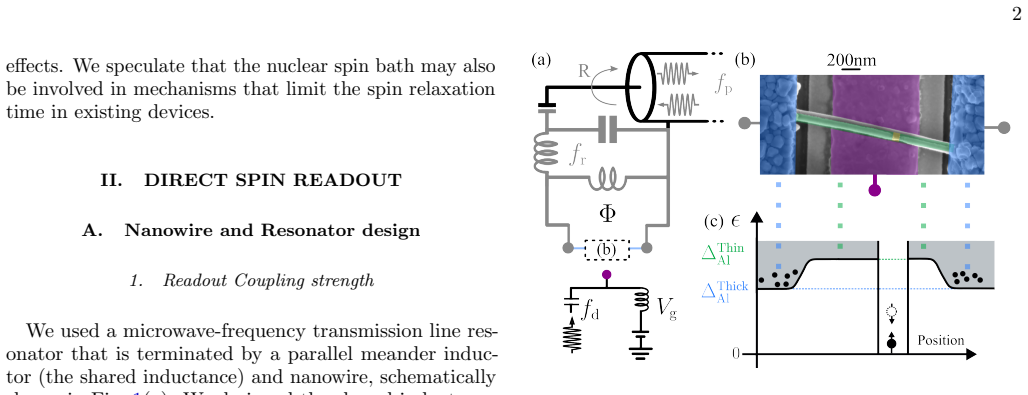
The load-bearing piece is the spin-dependent energy-phase relation of the Andreev level, $E_s(\varphi) = E_\sigma \sigma_z \sin\varphi$, whose second derivative sets the inverse inductance seen by the microwave resonator. The design chooses a shared inductance of about $200$ pH (sensitivity $S = 803$ MHz/nH) so the dispersive readout responds directly to the spin part of the energy-phase relation, removing the need for higher orbital states. Two mechanisms support the measurement: gap engineering, in which the $25$ nm epitaxial Al on the nanowire has a larger gap than the $100/200$ nm Al resonator and contacts, creating a $\sim 13$ GHz barrier that traps quasiparticles away from the weak link; and shadow evaporation, which produces the $\sim 136$ nm weak link without etching the semiconductor. The even-parity branch is fit with a resonant-level model and the odd-parity branch with the minimal $E_0\cos\varphi + E_\sigma\sigma_z\sin\varphi$ model; a four-state model including an ancillary dot level captures the observed parity-flipping transition.
What would settle it
Measure the same shadow-evaporated weak link, then deliberately introduce controlled surface damage (for example a light argon mill) and watch whether $T_1$ drops; if it does, the paper's conclusion is false. Alternatively, run a shadow-evaporated and an etched weak link on the same chip with identical readout and gap engineering, and check whether their $T_1$ values differ.
Extended reading notes
Core claim
The central claim is that in a weak link made by in situ shadow evaporation — which prior microscopy and transport work ties to reduced atomic-scale disorder — the Andreev spin relaxation time is not improved relative to etched devices, peaking near $T_1 \approx 30\,\mu\mathrm{s}$ (with single scans up to $40\,\mu\mathrm{s}$) at the centre of an odd-parity stability window, $V_g \approx -1.786$ V and $\Phi \approx -0.25\Phi_0$. The readout, tuned to the spin-dependent inductance, gives a spin-orbit energy $E_\sigma/h \approx 230$–$255$ MHz from two independent routes, and the paper maps $T_1$ across the full gate-flux range of that bias point, finding the same qualitative flux trend as earlier work: relaxation slows as flux detunes from the Kramers degeneracy. A higher-frequency transition is observed whose gate and flux dependence matches a model of quasiparticle transfer between the Andreev level and an ancillary sub-gap dot — a parity-flipping process rather than a transition within the odd-parity manifold. The authors state the disorder/poisoning conclusion as suggestive, since the comparison rests on literature baselines measured in different setups.
Load-bearing premise
The conclusion that surface disorder and quasiparticle poisoning do not limit $T_1$ assumes that this particular shadow-evaporated nanowire really has lower atomic-scale disorder than the etched wires in earlier work, and that the earlier relaxation times are a fair same-setup baseline.
Editorial extensions
If this is right
- If the conclusion holds, improving the atomic-scale quality of the weak-link surface will not, by itself, extend Andreev spin relaxation times.
- The direct spin-inductance readout removes the need for orbital-state access, making relaxation measurements feasible in short weak links and in material platforms with widely spaced orbitals such as germanium and carbon.
- The gap-engineering scheme with thickness-mismatched aluminum gives a quasiparticle-poisoning lower bound of about 0.7 ms, one to two orders of magnitude better than earlier devices without intentional strong charging energy.
- The observed parity-flipping transition, fit with $U+\epsilon_{qd}-\epsilon_A(\varphi,V_g)-E_0\cos\varphi+|E_\sigma\sin\varphi|$, implies that microwave driving can flip parity via ancillary sub-gap states, a process that must be accounted for in future qubit control.
- The flux dependence of $T_1$ around both Kramers points is inconsistent with or opposite to predictions from $1/f$ charge or flux noise and phonon-mediated relaxation, narrowing the set of candidate relaxation mechanisms.
Reading between the lines
- If the paper is right, a same-chip comparison between a shadow-evaporated and a deliberately etched weak link with identical readout and gap engineering is the direct test; a difference in $T_1$ there would overturn the conclusion.
- The paper's ancillary-level model yields a testable signature: an extra gate that tunes the dot energy should move the parity-flipping transition frequency quadratically in gate voltage, and the transition should disappear when the dot is drained or pushed out of resonance.
- A single-shot parity readout, which this experiment lacked, could turn the 0.7 ms poisoning lower bound into a direct poisoning-rate measurement and quantitatively test the gap-engineering mechanism.
- The paper's speculation that the nuclear spin bath may limit relaxation suggests a direct experiment: repeat the measurement in a nuclear-spin-free host material (e.g., a carbon-based weak link) and look for a lengthened $T_1$ with the same readout and gap engineering.
Signed reviews
Editorial analysis
A structured set of objections, weighed in public.
Referee Report
Summary. The manuscript reports measurements on an InAs nanowire weak link fabricated with in situ shadow-defined junctions, using a microwave resonator designed to be directly sensitive to the spin-dependent inductance of the weak link, together with superconducting gap engineering intended to trap quasiparticles. The authors identify stable odd-parity bias points, map the spin-flip transition by two-tone EDSR, and measure the spin relaxation time T1 over a wide gate-voltage and flux range, finding a maximum near 30 microseconds, comparable to the best previously reported values for etched weak links. They also observe a higher-frequency transition that they attribute to parity flipping via an ancillary sub-gap state. From the lack of T1 improvement relative to literature values, they suggest that atomic-scale disorder induced by etching and quasiparticle poisoning are not limiting spin relaxation in InAs nanowires. The appendices provide resonator design, fabrication, additional bias points, temperature dependence, and an estimate of the quasiparticle-poisoning bound.
Significance. The experimental contributions are substantial: the direct inductance-based readout is validated by the approximately 10% agreement between the spin-orbit energy E_sigma extracted from the readout shift and from two-tone EDSR; T1 is measured in the time domain with reported uncertainties; the gap-engineering approach yields an estimated poisoning bound of 0.7 ms; and the data and code are publicly available. If the null result is accepted, it provides an important constraint on relaxation mechanisms in Andreev spin qubits and supports the transferability of the design strategies to other materials. The interpretation, however, rests on a single-device comparison to a literature baseline from a different setup and on an assumed lower-disorder property imported from Ref. [16]; the causal claim in Sec. IV is therefore stronger than the evidence supports. The paper's hedged language ('suggestive') is appropriate, but the abstract and Sec. IV should be brought in line with the demonstrated scope. No circularity issue is present: T1 is a direct time-domain measurement and E_sigma is independently cross-checked.
major comments (3)
- [Sec. IV; Appendix H] Section IV concludes that the similar T1 'suggest[s] that the atomic-scale disorder induced by the etch process in previous experiments does not induce new spin relaxation mechanisms.' This is a causal negative that requires that (i) the measured shadow-evaporated weak link actually realizes the lower-disorder regime and (ii) the only relevant difference from the etched-device baseline is disorder and quasiparticle poisoning. Neither is demonstrated for this device: the lower-disorder property is imported from Ref. [16] without disorder-sensitive characterization of this wire or a co-processed sister device, and the comparison baseline (Hays et al., Ref. [4]) comes from a different setup with different E_sigma/h (1.4-1.5 GHz in Appendix H columns a and b versus 230 MHz in column c), charging energy, microwave environment, and cooldown. Appendix H row (iv) itself shows a dependence of T1 on spin-transition frequency, so matching a single point near 470-580 MHz does not control these confounds. With n=1 and no same-setup etched control, the null result is also consistent with this particular weak link being no less disordered or with a different dominant relaxation channel. I recommend either softening the causal claim to an explicit hypothesis or adding supporting evidence, such as normal-state conductance fluctuations, a same-setup etched control, or a quantitative treatment of the frequency dependence.
- [Appendix F; Sec. III B] The main-text T1 values are obtained from single-exponential fits to the first 250 microseconds (Sec. III B and Fig. 3(c)), but Appendix F shows that long saturation pulses produce double-exponential decays with a slow component of 138-212 microseconds (Fig. S5(e)-(f)). The authors state that the double-exponential appears less frequently with the short Gaussian pulse, but they do not show representative short-pulse decay curves over the full time range or test the sensitivity of the extracted T1 to the choice of fit window. Without such a check, the reported approximately 30 microsecond time constant could be a truncation artifact of the 250 microsecond window. Please provide the full short-pulse decay data and quantify how T1 changes with the fit range.
- [Sec. III B; Appendix F] The stated maximum T1 of approximately 30 microseconds in Sec. III B and Fig. 3(c) is inconsistent with the value T1 = 40.3 +/- 1.8 microseconds reported in Appendix F, Fig. S5(d) at Vg = -1.786 V and Phi = -0.27 Phi0. The main text notes that Fig. 3(c) is averaged over repeated scans, but the discrepancy is not explained. Please clarify whether the appendix value is from a single scan, whether a different E_sigma was used for the drive frequency, and why the averaged map shows a lower maximum. The abstract's headline value ('about 30 microseconds') should be reconciled with the appendix.
minor comments (6)
- [Sec. II B] The sentence 'about 2% of the total 'active' gate voltage range ... exhibits a stable odd parity state for for all flux' contains a duplicated 'for', and the Fig. 2 caption contains 'mayb' instead of 'maybe'.
- [Appendices B and C] There are typographical errors: 'Ultrasonicaton' in Appendix B and 'attenuaors' in Appendix C should be corrected to 'Ultrasonication' and 'attenuators', respectively.
- [Sec. III A; Appendix E] The value of E_sigma/h is quoted as 255 MHz from single-tone readout, approximately 240 MHz from two-tone spectroscopy, and 237 MHz for the relaxation-time measurements; please state explicitly which value is used for each figure and why the value used for the relaxation measurements differs from the two-tone value.
- [Sec. III C; Eq. (2)] Equation (2) uses both phi and varphi for the superconducting phase; please use a single symbol and define the sign convention for the |E_sigma sin(phi)| term.
- [Sec. III A] The statement that the spin is 'thermalized down to near 15 mK' is stronger than the evidence (visibility of the transition down to 250 MHz); consider rephrasing to 'consistent with an effective temperature near 15 mK'.
- [Abstract; Appendix B] The abstract uses 'in situ shadow evaporation' to describe the weak-link formation, while Appendix B explains that the weak link is defined by shadows from other nanowires during Al deposition; consider clarifying the terminology to avoid confusion with metal shadow evaporation.
Circularity Check
No significant circularity: the T1 measurement is a direct time-domain decay, Eσ is cross-checked by independent EDSR spectroscopy, and the self-cited disorder premise is external empirical support rather than a definitional input.
full rationale
The central result — the Andreev spin relaxation time T1 ≈ 30 µs — is obtained by a direct pulsed-drive experiment: a Gaussian pulse excites the spin transition and the readout pulse after a variable delay yields a single-exponential decay (Sec. III B, Appendix F). T1 is therefore not derived from the model parameters that are fitted elsewhere. The spin-dependent energy scale Eσ is extracted from the single-tone readout frequency shift via the inductance–EPR relation (Eqs. D1–D2, E1–E2) and independently from two-tone EDSR spectroscopy; the two values agree to within about 10% (Sec. III A), which is a consistency check on the readout calibration rather than a circular construction. The higher-frequency transition is explicitly modelled as a fit: the paper states it cannot quantify U+ε_qd−ε_A individually and chooses ε_qd=450 MHz for demonstration (Sec. III C), so it is not presented as a parameter-free prediction. The interpretation that disorder and quasiparticle poisoning do not limit T1 (Sec. IV) does lean on the assumption, taken from the separate shadow-junction study [16], that this shadow-evaporated weak link has lower atomic-scale disorder, and the baseline comparison is literature data from Hays et al. [4] rather than a same-setup etched control. That is a legitimate scope/causal-inference limitation of a null result, but it is not circular: [16] is an externally published microscopy/transport result, not a restatement of the present T1 measurement, and the T1 comparison is not built out of the fitted parameters. No load-bearing step reduces, by the paper's own equations or by self-citation, to its own inputs.
Assumptions & free parameters
free parameters (10)
- Spin-orbit energy E_sigma/h =
230-255 MHz (bias-point dependent; 237 MHz used for T1 analysis)
- Spin-independent EPR coefficient E0/h =
-291 MHz (main bias point); 0.4 GHz in Fig. 2(c)
- Effective gap Delta_eff/h =
28.2 GHz (Fig. 2c), 31.8 GHz (Fig. 2d)
- Effective transparency tau_eff =
0.85 (Fig. 2c), 0.7 (Fig. 2d)
- Charging energy U/h =
7 GHz
- U + epsilon_qd - epsilon_A(0, -1.755 V) =
900 MHz
- Ancillary level offset epsilon_qd =
450 MHz (chosen for demonstration, not independently extracted)
- Gate-dependence curvature alpha =
80 MHz/mV^2
- Resonator sensitivity S =
803 MHz/nH
- Poisoning bound threshold n =
5 standard deviations
assumptions (7)
- domain assumption Resonant level model for the even-parity energy-phase relation (Appendix D, Eqs. D5-D8)
- standard math Inverse inductance is proportional to the second derivative of the energy-phase relation (Eqs. D1-D2)
- standard math Time-reversal symmetry imposes E'(n*pi) = 0 (Appendix D)
- domain assumption Superconducting gap of aluminum increases with decreasing film thickness (Sec. II.A.2)
- domain assumption Shadow-evaporated weak links have lower atomic-scale disorder than etched weak links (Sec. I)
- domain assumption Spin-dependent energy-phase relation E_s(phi) = E_sigma * sigma_z * sin(phi) (Eq. 1)
- domain assumption Ancillary sub-gap state model of Sahu et al. [20] applies to this device (Sec. III.C)
Cite this review
Pith. "Pith review of Andreev spin relaxation time in a shadow-evaporated InAs weak link." pith.science (2026). https://pith.science/paper/XGNVLRFG
@misc{pith2026250111627,
  author       = {Pith},
  title        = {Pith review of: Andreev spin relaxation time in a shadow-evaporated InAs weak link},
  year         = {2026},
  howpublished = {\url{https://pith.science/paper/XGNVLRFG}},
  note         = {Machine review of arXiv:2501.11627}
}
read the original abstract
Andreev spin qubits are a new qubit platform that merges superconductivity with semiconductor physics. The mechanisms dominating observed energy relaxation remain unidentified. We report here on three steps taken to address these questions in an InAs nanowire weak link. First, we designed a microwave readout circuit tuned to be directly sensitive to the spin-dependent inductance of the weak link so that higher orbital states are not necessary for readout -- this resulted in larger windows in parameter space in which the spin state properties can be probed. Second, we implemented a successful gap-engineering strategy to mitigate quasiparticle poisoning. Third, the weak link was fabricated by \textit{in situ} shadow evaporation, which has been shown to improve atomic-scale disorder. We show how our design allows characterization of the spin stability and coherence over the full range of magnetic flux and gate voltage of an odd parity bias point. The spin relaxation and dephasing rates are comparable with the best devices previously reported, suggestive that surface atomic-scale disorder and QP poisoning are not linked to spin relaxation in InAs nanowires. Our design strategies are transferrable to novel materials platforms for Andreev qubits such as germanium and carbon.
Figures


Figures from the paper (1 more)

Forward citations
Cited by 1 Pith paper
-
Fast readout of quantum dot spin qubits via Andreev spins
A switchable quantum-dot-plus-Andreev-spin coupler can read a germanium dot-spin qubit in under a microsecond with theoretical fidelity above 99.9%.
Reference graph
Works this paper leans on
-
[16]
G. Scappucci, C. Kloeffel, F. A. Zwanenburg, D. Loss, M. Myronov, J.-J. Zhang, S. De Franceschi, G. Kat- saros, and M. Veldhorst, Nature Reviews Materials 6, 926 (2021)
work page 2021
-
[4]
Two-tone spectroscopy The two-tone spectroscopy in this work is collected using pulsed LO of 8 µs duration time, defined by a homemade fast switch. In Fig. 3 (b) we use low LO power and obtained Eσ/h = 230 MHz. Fig. S6 shows the difference between high and low power two-tone spec- troscopy, with orange curve representing a faithful fit using Eσ/h = 230 MH...
-
[1]
Readout Coupling strength We used a microwave-frequency transmission line res- onator that is terminated by a parallel meander induc- tor (the shared inductance) and nanowire, schematically shown in Fig. 1(a). We designed the shared inductance to be sufficiently large to obtain a direct spin-dependent dispersive shift of order MHz. The spin-dependent con-...
-
[2]
The shadow-evaporated weak link and quasiparticle gap engineering We used InAs nanowires grown by Molecular Beam Epitaxy. The epitaxial aluminum was deposited in situ after the growth of the nanowire, covering three facets of the nanowire. The shadowing process resulted in a 136 nm mean length of uncovered nanowire. The epitaxial aluminum is 25 nm thick. ...
-
[3]
We start from extracting fr from Fig
Single-tone spectroscopy In the main text, we mention that we extract Eσ from single-tone readout spectroscopy, which allows choosing proper spin-split energy in multi-ASQ experiments with- out two-tone spectroscopy. We start from extracting fr from Fig. 3 b), for both spin states, as shown in Fig. S4 in red and orange dots. With data for both spin states...
-
[5]
N. M. Chtchelkatchev and Y. V. Nazarov, Physical Review Letters 90, 226806 (2003)
work page 2003
- [6]
-
[7]
L. Tosi, C. Metzger, M. Goffman, C. Urbina, H. Poth- ier, S. Park, A. L. Yeyati, J. Nyg ˚ ard, and P. Krogstrup, Physical Review X 9, 011010 (2019)
work page 2019
Show all 68 references
-
[8]
M. Hays, V. Fatemi, K. Serniak, D. Bouman, S. Diamond, G. de Lange, P. Krogstrup, J. Nyg ˚ ard, A. Geresdi, and M. H. Devoret, Nature Physics 16, 1103 (2020)
2020
-
[9]
M. Hays, V. Fatemi, D. Bouman, J. Cerrillo, S. Diamond, K. Serniak, T. Connolly, P. Krogstrup, J. Nyg ˚ ard, A. L. Yeyati, A. Geresdi, and M. H. Devoret, Science 373, 430 (2021)
2021
-
[10]
Pita-Vidal, A
M. Pita-Vidal, A. Bargerbos, R. ˇZitko, L. J. Splitthoff, L. Gr¨ unhaupt, J. J. Wesdorp, Y. Liu, L. P. Kouwenhoven, R. Aguado, B. van Heck, A. Kou, and C. K. Andersen, Nature Physics 19, 1110 (2023)
2023
-
[11]
Pita-Vidal, J
M. Pita-Vidal, J. J. Wesdorp, L. J. Splitthoff, A. Barg- erbos, Y. Liu, L. P. Kouwenhoven, and C. K. Andersen, Nature Physics , 1 (2024)
2024
-
[12]
Pita-Vidal, J
M. Pita-Vidal, J. J. Wesdorp, and C. K. Andersen, PRX Quantum 6, 010308 (2025)
2025
-
[13]
H. Lu, I. A. Day, A. R. Akhmerov, B. v. Heck, and V. Fatemi, Kramers-protected hardware-efficient error correction with Andreev spin qubits (2024), 10.48550/arXiv.2412.16116
2024 doi
-
[14]
Nadj-Perge, S
S. Nadj-Perge, S. M. Frolov, E. P. a. M. Bakkers, and L. P. Kouwenhoven, Nature 468, 1084 (2010)
2010
-
[15]
N. P. de Leon, K. M. Itoh, D. Kim, K. K. Mehta, T. E. Northup, H. Paik, B. S. Palmer, N. Samarth, S. Sangtawesin, and D. W. Steuerman, Science 372, eabb2823 (2021)
2021
-
[17]
Aliferis and J
P. Aliferis and J. Preskill, Physical Review A 78, 052331 (2008)
2008
-
[18]
Webster, S
P. Webster, S. D. Bartlett, and D. Poulin, Physical Review A 92, 062309 (2015)
2015
-
[19]
D. K. Tuckett, S. D. Bartlett, and S. T. Flammia, Physical Review Letters 120, 050505 (2018)
2018
-
[20]
J. E. Sestoft, M. Marnauza, D. Olsteins, T. Kanne, R. D. Schlosser, I.-J. Chen, K. Grove-Rasmussen, and J. Nyg ˚ ard, Nano Letters 10.1021/acs.nanolett.4c02055 (2024)
2024 doi
-
[21]
Diamond, V
S. Diamond, V. Fatemi, M. Hays, H. Nho, P. D. Kurilovich, T. Connolly, V. R. Joshi, K. Serniak, L. Frunzio, L. I. Glazman, and M. H. Devoret, PRX Quantum 3, 040304 (2022)
2022
-
[22]
Connolly, P
T. Connolly, P. D. Kurilovich, S. Diamond, H. Nho, C. G. Bøttcher, L. I. Glazman, V. Fatemi, and M. H. Devoret, Physical Review Letters 132, 217001 (2024)
2024
-
[23]
Glazman and G
L. Glazman and G. Catelani, SciPost Physics Lecture Notes 10.21468/SciPostPhysLectNotes.31 (2021)
2021 doi
-
[24]
M. R. Sahu, F. J. Matute-Ca˜ nadas, M. Benito, P. Krogstrup, J. Nyg ˚ ard, M. F. Goffman, C. Urbina, A. L. Yeyati, and H. Pothier, Physical Review B 109, 134506 (2024), publisher: American Physical Society
2024
-
[25]
Metzger, S
C. Metzger, S. Park, L. Tosi, C. Janvier, A. A. Reynoso, M. F. Goffman, C. Urbina, A. Levy Yeyati, and H. Pothier, Physical Review Research 3, 013036 (2021)
2021
-
[26]
P. D. Kurilovich, V. D. Kurilovich, V. Fatemi, M. H. Devoret, and L. I. Glazman, Physical Review B 104, 174517 (2021)
2021
-
[27]
Fatemi, P
V. Fatemi, P. Kurilovich, M. Hays, D. Bouman, T. Connolly, S. Diamond, N. Frattini, V. Kurilovich, P. Krogstrup, J. Nyg ˚ ard, A. Geresdi, L. Glazman, and M. Devoret, Physical Review Letters 129, 227701 (2022)
2022
-
[28]
Padurariu and Y
C. Padurariu and Y. V. Nazarov, Physical Review B 81, 144519 (2010)
2010
-
[29]
Marchegiani, L
G. Marchegiani, L. Amico, and G. Catelani, PRX Quan- tum 3, 040338 (2022)
2022
-
[30]
O. A. E. Cherney and J. Shewchun, Canadian Journal of Physics 47, 1101 (1969)
1969
-
[31]
N. A. Court, A. J. Ferguson, and R. G. Clark, Supercon- ductor Science and Technology 21, 015013 (2007)
2007
-
[32]
W. M. van Weerdenburg, A. Kamlapure, E. H. Fyhn, X. Huang, N. P. van Mullekom, M. Steinbrecher, P. Krogstrup, J. Linder, and A. A. Khajetoorians, Science Advances 9, eadf5500 (2023)
2023
-
[33]
Aumentado, M
J. Aumentado, M. W. Keller, J. M. Martinis, and M. H. Devoret, Physical Review Letters 92, 066802 (2004)
2004
-
[34]
Serniak, S
K. Serniak, S. Diamond, M. Hays, V. Fatemi, S. Shankar, L. Frunzio, R. Schoelkopf, and M. Devoret, Physical Re- view Applied 12, 014052 (2019)
2019
-
[35]
Bargerbos, M
A. Bargerbos, M. Pita-Vidal, R. ˇZitko, L. J. Splitthoff, L. Gr¨ unhaupt, J. J. Wesdorp, Y. Liu, L. P. Kouwenhoven, R. Aguado, C. K. Andersen, A. Kou, and B. van Heck, Physical Review Letters 131, 097001 (2023)
2023
-
[36]
J. J. Wesdorp, F. J. Matute-Ca˜ nadas, A. Vaartjes, L. Gr¨ unhaupt, T. Laeven, S. Roelofs, L. J. Splitthoff, M. Pita-Vidal, A. Bargerbos, D. J. van Woerkom, P. Krogstrup, L. P. Kouwenhoven, C. K. Andersen, A. L. Yeyati, B. van Heck, and G. de Lange, Physical Review B 109, 0453...
2024
-
[37]
Bargerbos, M
A. Bargerbos, M. Pita-Vidal, R. ˇZitko, J. ´Avila, L. J. Splitthoff, L. Gr¨ unhaupt, J. J. Wesdorp, C. K. Andersen, Y. Liu, L. P. Kouwenhoven, R. Aguado, A. Kou, and B. van Heck, PRX Quantum 3, 030311 (2022)
2022
-
[38]
Kringhøj, L
A. Kringhøj, L. Casparis, M. Hell, T. W. Larsen, F. Kuem- meth, M. Leijnse, K. Flensberg, P. Krogstrup, J. Nyg ˚ ard, K. D. Petersson, and C. M. Marcus, Physical Review B 97, 060508 (2018)
2018
-
[39]
Fatemi, P
V. Fatemi, P. D. Kurilovich, A. R. Akhmerov, and B. van Heck, Nonlinearity of transparent SNS weak links de- creases sharply with length (2024)
2024
-
[40]
A. M. Whiticar, A. Fornieri, A. Banerjee, A. C. C. Drach- mann, S. Gronin, G. C. Gardner, T. Lindemann, M. J. Manfra, and C. M. Marcus, Phys. Rev. B 103, 245308 (2021)
2021
-
[41]
J. A. van Dam, Y. V. Nazarov, E. P. A. M. Bakkers, S. De Franceschi, and L. P. Kouwenhoven, Nature 442, 667 (2006)
2006
-
[42]
Cleuziou, W
J.-P. Cleuziou, W. Wernsdorfer, V. Bouchiat, T. On- dar¸ cuhu, and M. Monthioux, Nature Nanotechnology1, 53 (2006)
2006
-
[43]
H. I. Jorgensen, T. Novotny, K. Grove-Rasmussen, K. Flensberg, and P. E. Lindelof, Nano Letters 7, 2441 (2007)
2007
-
[44]
H. I. Jørgensen, K. Grove-Rasmussen, K. Flensberg, and P. E. Lindelof, Phys. Rev. B 79, 155441 (2009). 18
2009
-
[45]
Eichler, R
A. Eichler, R. Deblock, M. Weiss, C. Karrasch, V. Meden, C. Sch¨ onenberger, and H. Bouchiat, Phys. Rev. B 79, 161407 (2009)
2009
-
[46]
E. J. H. Lee, X. Jiang, R. Aguado, G. Katsaros, C. M. Lieber, and S. De Franceschi, Phys. Rev. Lett.109, 186802 (2012)
2012
-
[47]
Maurand, T
R. Maurand, T. Meng, E. Bonet, S. Florens, L. Marty, and W. Wernsdorfer, Physical Review X 2, 011009 (2012), publisher: American Physical Society
2012
-
[48]
Kumar, M
A. Kumar, M. Gaim, D. Steininger, A. L. Yeyati, A. Mart ´ ın-Rodero, A. K. H¨ uttel, and C. Strunk, Phys. Rev. B 89, 075428 (2014)
2014
-
[49]
D. B. Szombati, S. Nadj-Perge, D. Car, S. R. Plissard, E. P. a. M. Bakkers, and L. P. Kouwenhoven, Nature Physics 12, 568 (2016)
2016
-
[50]
Delagrange, D
R. Delagrange, D. J. Luitz, R. Weil, A. Kasumov, V. Meden, H. Bouchiat, and R. Deblock, Physical Re- view B 91, 241401 (2015)
2015
-
[51]
Delagrange, R
R. Delagrange, R. Weil, A. Kasumov, M. Ferrier, H. Bouchiat, and R. Deblock, Physica B: Condensed Mat- ter 536, 211 (2018)
2018
-
[52]
Garc ´ ıa Corral, D
A. Garc ´ ıa Corral, D. M. T. van Zanten, K. J. Franke, H. Courtois, S. Florens, and C. B. Winkelmann, Physical Review Research 2, 012065 (2020), publisher: American Physical Society
2020
-
[53]
Mayer, J
W. Mayer, J. Yuan, K. S. Wickramasinghe, T. Nguyen, M. C. Dartiailh, and J. Shabani, Applied Physics Letters 114, 103104 (2019), https://pubs.aip.org/aip/apl/article- pdf/doi/10.1063/1.5067363/19772789/103104 1 online.pdf
2019 doi
-
[54]
S. A. Khan, C. Lampadaris, A. Cui, L. Stampfer, Y. Liu, S. J. Pauka, M. E. Cachaza, E. M. Fiordaliso, J.-H. Kang, S. Korneychuk, et al., ACS nano 14, 14605 (2020)
2020
-
[55]
We found that a long saturation pulse may result in double-exponential decay – we show this in Appendix F
-
[56]
Matute-Ca˜ nadas, C
F. Matute-Ca˜ nadas, C. Metzger, S. Park, L. Tosi, P. Krogstrup, J. Nyg ˚ ard, M. Goffman, C. Urbina, H. Poth- ier, and A. L. Yeyati, Physical Review Letters128, 197702 (2022)
2022
-
[57]
S. I. Erlingsson and Y. V. Nazarov, Physical Review B 66, 155327 (2002)
2002
-
[58]
Fujisawa, T
T. Fujisawa, T. H. Oosterkamp, W. G. van der Wiel, B. W. Broer, R. Aguado, S. Tarucha, and L. P. Kouwenhoven, Science 282, 932 (1998)
1998
-
[59]
V. N. Golovach, A. Khaetskii, and D. Loss, Physical Review Letters 93, 016601 (2004)
2004
-
[60]
M. Trif, V. N. Golovach, and D. Loss, Physical Review B 77, 045434 (2008)
2008
-
[61]
Kornich, Physical Review B 89, 10.1103/Phys- RevB.89.085410 (2014)
V. Kornich, Physical Review B 89, 10.1103/Phys- RevB.89.085410 (2014)
2014 doi
- [62]
-
[63]
R. D. Schlosser, Shadow Engineering Semiconductor- Superconductor Hybrid Nanowires for Quantum Devices, Master’s thesis, University of Copenhagen, Copenhagen (2021)
2021
-
[64]
Titov, P
M. Titov, P. Jacquod, and C. W. J. Beenakker, Physical Review B 65, 012504 (2001)
2001
-
[65]
C. W. J. Beenakker and H. v. Houten, in Single-Electron Tunneling and Mesoscopic Devices, Springer Series in Electronics and Photonics (Springer, Berlin, Heidelberg,
-
[66]
Maiti, V
A. Maiti, V. Jain, L. Frunzio, and R. Schoelkopf, Cryo- genic Thermalization Measurements of Microwave Atten- uators (2020), x16.00009, APS March Meeting
2020
-
[67]
Ibabe, G
A. Ibabe, G. O. Steffensen, I. Casal, M. Gomez, T. Kanne, J. Nygard, A. Levy Yeyati, and E. J. H. Lee, Nano Letters 24, 6488 (2024)
2024
-
[68]
M. S. Khalil, M. J. A. Stoutimore, F. C. Wellstood, and K. D. Osborn, Journal of Applied Physics 111, 054510 (2012), https://pubs.aip.org/aip/jap/article- pdf/doi/10.1063/1.3692073/15093308/054510 1 online.pdf
2012 doi
Reviewed August 10, 2026 · model on record in the stance chip above.
Discussion (0). Continue with ORCID to comment.