REVIEW 3 major objections 5 minor 67 references
Black Strings and String Clouds Embedded in Anisotropic Quintessence: Solutions for Scalar Particles and Implications
T0 review · 3 major / 5 minor · reviewed 2026-08-08 · deepseek-v4-flash
Pith's one-line read An exact cylindrically symmetric anti-de Sitter spacetime with a black string, a cloud of strings, and anisotropic quintessence yields a near-horizon scalar wave function carrying a quintessence-dependent dark phase.
desk verdict Honest, workmanlike exact-solution paper: the metric and Heun solution check out, but the 'dark phase' is an order-of-magnitude guess bolted onto the physics by an ad hoc calibration of NQ. read the letter →
The pith
A machine-rendered reading of the paper's core claim, the machinery that carries it, and where it could break.
The reading
What carries the argument
The load-bearing object is the metric function $A(\rho)$ of (18), obtained by combining the Einstein-tensor components (3)-(4) with the conserved energy-momentum tensor $T^t_t=T^\rho_\rho=\rho_Q+a/\rho^2$, $T^\phi_\phi=T^z_z=\alpha_Q\rho_Q$. This turns the field equations into the nonhomogeneous Cauchy-Euler equation (17), whose homogeneous part supplies the $\rho_S/\rho$ and $N_Q\rho^{2\alpha_Q}$ terms and whose particular solution supplies the constant cloud term and the AdS term $\rho^2/l^2$. For the quantum calculation, the Klein-Gordon radial equation is put in Liouville normal form (59) with effective potential (60); near the horizon $A(x)\simeq\beta_+(x-1)$, with $\beta_+=\rho_+\,dA/d\rho|_{\rho_+}$, and the normal equation matches the confluent Heun equation (a second-order linear ODE with regular singular points at $0$ and $1$ and an irregular singularity at infinity). The Heun parameters (67), especially $\gamma=\pm i\,2\epsilon\rho_+/\beta_+$, encode the geometry, and the factorization of the $N_Q$-dependent part into $\delta_{D\pm}$ produces the dark phase.
What would settle it
A direct check is to integrate the Klein-Gordon equation numerically in the full metric (18), without the near-horizon linearization $A\simeq\beta_+(x-1)$, and compare the phase of the radial function with the predicted $\gamma=i\,\epsilon\rho_+/\beta_+$: a different logarithmic exponent would falsify the Heun-based claim. A second check is astrophysical: an independent determination of $N_Q$ from large-scale-structure or dark-energy data that disagrees with eq. (30) by more than an order of magnitude would invalidate the quantitative dark-phase prediction.
Extended reading notes
Core claim
The central claim is that the combined spacetime is an exact solution: equations (15)-(17) reduce Einstein's equations to a nonhomogeneous Cauchy-Euler equation whose solution is the metric function in (18), with energy density $\rho_Q=(2\alpha_Q+1)N_Q\rho^{2\alpha_Q-2}/(8\pi G/c^4)$ and pressures $p_\phi=p_z=-\alpha_Q\rho_Q$. The horizon analysis shows the cloud parameter $a$ controls the horizon size; in the physically relevant regime the horizon radius is $\rho_+\approx\rho_S/a$, and removing the cloud makes $\rho_+$ grow drastically. For the quantum sector, the paper claims that a spin-0 particle near the horizon has a radial wave function $$R(x)=\bigl(\rho_+^2\beta_+\bigr)^{-1/2}$x^{{(\beta-1)/2}}$(x-1)^{\gamma/2}\bigl[c_1\,\mathrm{HeunC}(\$\alpha$,\$\beta$,\gamma,\delta,\eta;x)+$c_2x^{{-\beta}}$\mathrm{HeunC}(\$\alpha$,-\$\beta$,\gamma,\delta,\eta;x)\bigr],$$ whose leading near-horizon behavior is $(x-1)^{\gamma/2}$, so the real part oscillates as $\cos[(\epsilon\rho_+/\beta_+)\ln(x-1)]$. The quintessence dependence of the phase is isolated in the 'dark phase' $\delta_{D\pm}$, defined in eq. (75), making dark energy a candidate source of a measurable quantum phase shift.
Load-bearing premise
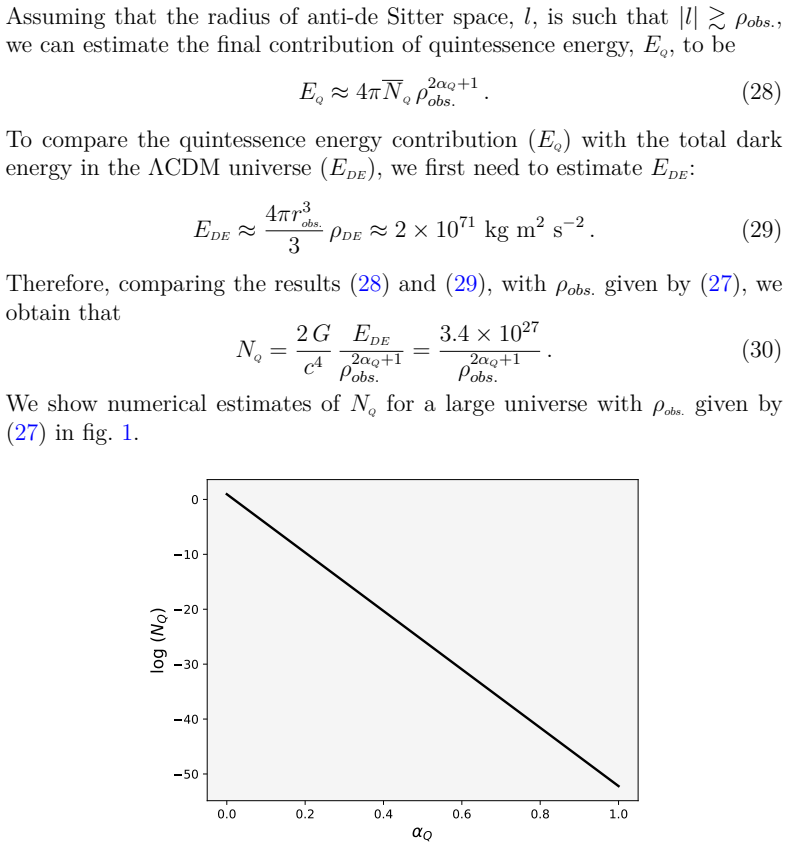
The load-bearing premise is the calibration in eq. (30), which fixes $N_Q$ by equating the total quintessence energy of a cylindrical model universe to the $\Lambda$CDM dark-energy content $E_{DE}\approx2\times10^{71}$ J with $|l|\approx\rho_{\mathrm{obs}}=3.8\times10^{26}$ m; if that cylindrical-volume conversion or the input $E_{DE}$ is wrong, $N_Q$ changes by orders of magnitude and the dark-phase size changes with it.
Editorial extensions
If this is right
- The metric (18) is an exact solution, so the horizon and wave-function results follow from a single self-consistent spacetime model containing a black string, a string cloud, and quintessence.
- For $\alpha_Q\ge 1/2$ and typical parameters, the horizon radius is approximately $\rho_S/a$: stronger string clouds shrink the horizon, while cloudless configurations have much larger horizons.
- Except near $\alpha_Q=0$, the quintessence term $N_Q\rho^{2\alpha_Q}$ is negligible until distances comparable to the observable-universe radius, so in this model dark energy's backreaction is a large-scale effect.
- Near the event horizon, scalar wave functions oscillate as $\cos[(\epsilon\rho_+/\beta_+)\ln(x-1)]$, meaning the black-string spacetime acts as a logarithmic phase shifter for quantum matter.
- The quintessence contribution to the wave function is isolated in the dark phase $\delta_{D\pm}$, which is the paper's concrete candidate observable.
Reading between the lines
- Editorial inference: because the dark phase scales with $N_Q\rho_S/a^2$, a precise measurement of the phase of scalar or atomic waves near a massive cylindrical object could constrain $N_Q$ independently of cosmology; the paper does not develop this experimental route.
- Editorial inference: the conclusion that quintessence is negligible except near $\alpha_Q=0$ rests on the cylindrical-volume calibration in eq. (30); a different mapping from the spherical observable universe to a cylinder would rescale $N_Q$ and could make quintessence relevant at smaller radii.
- Editorial inference: the paper derives the wave solution only in the near-horizon region $x\approx1$ (Section 6.2) and defers full radial solutions to future work, so the dark phase is established as a local near-horizon effect rather than a complete global prediction.
- Editorial inference: the same confluent-Heun construction should extend to rotating black strings, other values of $\alpha_Q$, and regions far from the horizon; those extensions would turn the dark phase into a full scattering or quasinormal-mode observable.
Editorial analysis
A structured set of objections, weighed in public.
Referee Report
Summary. The paper constructs a cylindrically symmetric AdS spacetime containing a black string, a cloud of strings, and an anisotropic quintessence fluid. The authors solve the Einstein equations to obtain the metric function A(ρ)=a+ρ²/l²−ρ_S/ρ+N_Qρ^{2α_Q}, analyze event-horizon formation for selected values of the state parameter α_Q, and reduce the Klein-Gordon equation for a spin-0 particle near the horizon to a confluent Heun equation. They then define a quintessence-induced phase, the "dark phase," and use a calibration of N_Q to the observed dark-energy density to estimate its magnitude.
Significance. The exact metric construction is a legitimate extension of the black-string-plus-quintessence literature, and the Heun-function solution is internally consistent: substituting A(ρ) from Eq. (18) into Eqs. (15)-(16) reproduces the stated energy density (21), and the Heun parameters in Eq. (67) are compatible with the near-horizon form of the effective potential. The horizon analysis for α_Q=0,1/2,1 is systematic. However, the quantitative physical conclusions—especially the magnitude and observability of the "dark phase"—are not derived from the theory alone; they rest on an external calibration that can change the results by orders of magnitude. The paper should be revised to separate the exact solution and the Heun solution from the calibration-dependent estimates.
major comments (3)
- [Section 3, Eq. (17)] The derivation of the Cauchy-Euler equation for A(ρ) drops the (1−α_Q)Λ term. Subtracting α_Q times Eq. (15) from Eq. (16) and multiplying by 2ρ² yields ρ²A''+2(1−α_Q)ρA'−2α_QA+2(1−α_Q)Λρ²=−(16πG/c⁴)α_Qa, not Eq. (17) as printed. As printed, Eq. (17) does not admit the particular solution c₁+ρ²/l². The final metric (18) does satisfy the original field equations, so the error is a derivation defect that can be repaired, but it must be corrected before publication.
- [Section 4.3, Eqs. (28)-(30)] The calibration of N_Q by equating the integrated quintessence energy in a cylinder of radius ρ_obs and height 2ρ_obs to the ΛCDM dark-energy content E_DE is an input assumption, not a prediction. Every quantitative statement downstream—N_Q≈4.1×10⁻⁵³ m⁻² in Eq. (26), the claim that quintessence is negligible except near α_Q≈0, and the dark-phase magnitude in Eq. (75)—scales with this choice. A different volume conversion or a different E_DE changes N_Q by orders of magnitude. Moreover, the spacetime already contains a cosmological constant Λ=−3/l² with a similar geometric role; equating quintessence to the full dark-energy budget double-counts dark energy unless the Λ term is ignored. The authors should either derive N_Q from a boundary condition within the model or clearly present the numerical results as illustrations of a chosen calibration.
- [Section 6.3, Eq. (75)] The "dark phase" δD± is linear in N_Q, and since N_Q is fixed by the ad hoc Eq. (30), the dark phase is not a robust, falsifiable prediction. The paper also does not specify a concrete observational or experimental setup that would isolate a phase of a scalar wave function near a black-string horizon. I recommend rephrasing the claims to state that the phase shift is a theoretical quantity whose magnitude is set by an external calibration, not a demonstrated observable.
minor comments (5)
- [Section 4.3, Notation] The symbol N_Q is used for both the integration constant in A(ρ) and the rescaled coefficient N_Q = N_Q/(8πG/c⁴). This is confusing because the two quantities have different dimensions; please introduce a distinct symbol for the rescaled coefficient.
- [Section 6.3, Eq. (75)] The bracket in δD± appears to have a dimensional inconsistency: the first term ϵρ_S/a is missing a factor of 1/a if δD± is to be the N_Q-dependent part of the phase derived from β_+. Please check the expansion leading to Eq. (75).
- [Section 6.2, Eqs. (70)-(71)] The transition from x^{β/2} to exp[±β(x−1)/2] near x=1 is inaccurate; for x→1, x^{β/2}≈1+(β/2)(x−1), not an exponential. The exponential form is a valid approximation only in a different regime, so the presentation should be clarified.
- [Figure 2 Caption] The caption says "observable universe radius of l=ρ_obs," conflating the AdS radius l with the cylinder radius ρ_obs. The text later assumes |l|≳ρ_obs, not equality; the caption should be corrected.
- [Section 4.1, Table 2] The text states that typical values of a range from 10⁻⁷ to 10⁻⁵, but the table includes entries as large as 10⁰. Please reconcile the statement with the table or explain that the range is only for the objects listed in the first part of the table.
Circularity Check
No significant circularity: the metric and Heun solution are self-contained, and the NQ calibration is an external input rather than a prediction that reduces to its own input.
full rationale
The derivation chain is self-contained. The metric A(rho)=a+rho^2/l^2-rho_S/rho+NQ rho^(2 alpha_Q) (eq. 18) is obtained by solving the Einstein equations (15)-(16) for the stated energy-momentum tensors; the consistency check (21) reproduces the quintessence density from A(rho), and the Heun parameters (67) match the Liouville-normal form (B.5)-(B.6) of the confluent Heun equation. Prior work is cited for the metric ansatz [26] and string clouds [29], but these are external sources, not self-citations; the authors' own earlier papers are cited only as background examples of quantum systems in curved spacetimes and carry no load-bearing weight here. The calibration of NQ in eq. (30) fixes an integration constant by equating the integrated quintessence energy of a cylindrical model to the observed Lambda-CDM dark-energy content. That is an external input designed to give order-of-magnitude estimates, not a quantity the paper claims to predict from first principles. Consequently, the 'dark phase' in eq. (75), being linear in NQ, inherits the numerical value of this calibration, but it is not identical to the input nor statistically forced by it: it is a derived phase shift in a new physical setting (a spin-0 particle near a black-string horizon). A separate, non-circular correctness concern is that eq. (17) omits the 2 Lambda (1-alpha_Q) rho^2 term needed to justify the rho^2/l^2 particular solution, and calibrating NQ to the full dark-energy budget while retaining Lambda=-3/l^2 with l=rho_obs would double-count dark energy; these issues are correctness risks, not circularity.
Assumptions & free parameters
free parameters (4)
- NQ (quintessence strength) =
8.95 at αQ=0; 2.35e-26 m^-1 at αQ=1/2; 6.2e-53 m^-2 at αQ→1
- a (dimensionless string cloud parameter) =
Ranges from 10^-12 to 10^0 for different objects in Table 2, e.g., 3.0e-5 for the Sun
- αQ (quintessence state parameter) =
Varied in the interval (0,1)
- l (AdS radius) =
3.8e26 m in the plots
assumptions (6)
- standard math Einstein field equations with a cosmological constant, G_μν + Λ g_μν = (8πG/c⁴) T_μν.
- domain assumption The line element has the cylindrical AdS black-string form given in eq. (1).
- domain assumption The quintessence fluid has the anisotropic Kiselev form T^t_t=T^ρ_ρ=ρQ, T^φ_φ=T^z_z=αQρQ.
- domain assumption The cloud of strings has T^t_t=T^ρ_ρ=a/ρ² and T^φ_φ=T^z_z=0.
- domain assumption Near the horizon, A(ρ) is approximated by β+(x-1) and the confluent Heun function is approximated by 1.
- ad hoc to paper The total quintessence energy in the cylindrical model is set equal to the ΛCDM dark energy content of the observable universe.
invented entities (1)
-
dark phase (δD±)
Cite this review
Pith. "Pith review of Black Strings and String Clouds Embedded in Anisotropic Quintessence: Solutions for Scalar Particles and Implications." pith.science (2026). https://pith.science/paper/LL3S4QTP
@misc{pith2026250204894,
  author       = {Pith},
  title        = {Pith review of: Black Strings and String Clouds Embedded in Anisotropic Quintessence: Solutions for Scalar Particles and Implications},
  year         = {2026},
  howpublished = {\url{https://pith.science/paper/LL3S4QTP}},
  note         = {Machine review of arXiv:2502.04894}
}
abstract
We analyze the spacetime metric associated with a black string surrounded by a cloud of strings and an anisotropic fluid of quintessence in cylindrically symmetric AdS spacetime. We solve Einstein's equation to obtain the explicit form of the metric, investigate typical values for its parameters, and determine their role in the event horizon formation. Within our findings, we show that the intensity of the cloud of strings regulates the size of the event horizon and, when the cloud is absent, the horizon increases drastically for larger values of the quintessence's state parameter $\alpha_{Q}$. Additionally, the metric shows that, unless $\alpha_{Q}$ is close to its lower bound, the contribution from the quintessence fluid is only significant at large distances from the black string. Finally, to explore the quantum implications of this dark energy candidate, we use the confluent Heun function to solve the Klein-Gordon equation for a spin-0 particle near the event horizon. Our results indicate that the presence of quintessence alters the particle's radial wave function. This modification, in principle, could give rise to an observable that we termed as \enquote{dark phase}.
Figures


Figures from the paper (4 more)


Reference graph
Works this paper leans on
-
[1]
A. G. Riess, et al., Observational evidence from supernovae for an ac- celerating universe and a cosmological constant, Astron. J. 116 (1998) 1009–1038. arXiv:astro-ph/9805201, doi:10.1086/300499
arXiv 1998
-
[2]
Perlmutter, et al., Measurements of Ω and Λ from 42 High Red- shift Supernovae, Astrophys
S. Perlmutter, et al., Measurements of Ω and Λ from 42 High Red- shift Supernovae, Astrophys. J. 517 (1999) 565–586.arXiv:astro-ph/ 9812133, doi:10.1086/307221
doi:10.1086/307221 1999
-
[3]
E. J. COPELAND, M. SAMI, S. TSUJIKAWA, Dynamics of dark en- ergy, International Journal of Modern Physics D 15 (11) (2006) 1753–
work page 2006
-
[4]
L. Amendola, S. Tsujikawa, Dark Energy: Theory and Observations, Cambridge University Press, 2010
work page 2010
- [5]
-
[6]
Einstein, Cosmological Considerations in the General Theory of Rel- ativity, Sitzungsber
A. Einstein, Cosmological Considerations in the General Theory of Rel- ativity, Sitzungsber. Preuss. Akad. Wiss. Berlin (Math. Phys. ) 1917 (1917) 142–152
work page 1917
-
[7]
DESI Collaboration, DESI 2024 III: Baryon Acoustic Oscillations from Galaxies and Quasars, arXiv e-prints (2024) arXiv:2404.03000arXiv: 2404.03000, doi:10.48550/arXiv.2404.03000. 33
-
[8]
DESI Collaboration, DESI 2024 IV: Baryon Acoustic Oscillations from the Lyman Alpha Forest, arXiv e-prints (2024) arXiv:2404.03001arXiv: 2404.03001, doi:10.48550/arXiv.2404.03001
Show all 67 references
- [9]
-
[10]
R. R. Caldwell, R. Dave, P. J. Steinhardt, Cosmological imprint of an energy component with general equation of state, Physical Review Let- ters 80 (8) (1998) 1582–1585.doi:10.1103/physrevlett.80.1582
1998 doi
-
[11]
A. H. Guth, The Inflationary Universe: A Possible Solution to the Horizon and Flatness Problems, Phys. Rev. D 23 (1981) 347–356. doi:10.1103/PhysRevD.23.347
1981 doi
-
[12]
A. A. Starobinsky, A New Type of Isotropic Cosmological Models Without Singularity, Phys. Lett. B 91 (1980) 99–102. doi:10.1016/ 0370-2693(80)90670-X
1980
-
[13]
A. D. Linde, A New Inflationary Universe Scenario: A Possible So- lution of the Horizon, Flatness, Homogeneity, Isotropy and Primor- dial Monopole Problems, Phys. Lett. B 108 (1982) 389–393. doi: 10.1016/0370-2693(82)91219-9
1982 doi
-
[14]
M. W. Hossain, R. Myrzakulov, M. Sami, E. N. Saridakis, Unification of inflation and dark energy à la quintessential inflation, International Journal of Modern Physics D 24 (05) (2015) 1530014.doi:10.1142/ s0218271815300141
2015
-
[15]
P. M. Sá, Triple unification of inflation, dark energy, and dark matter in two-scalar-field cosmology, Physical Review D 102 (10) (2020) 103519. doi:10.1103/physrevd.102.103519
2020 doi
-
[16]
Jiménez-Aguilar, A unified model of inflation and dark energy based on the holographic spacetime foam, Physics of the Dark Universe 40 (2023) 101229
D. Jiménez-Aguilar, A unified model of inflation and dark energy based on the holographic spacetime foam, Physics of the Dark Universe 40 (2023) 101229. doi:https://doi.org/10.1016/j.dark.2023.101229. URL https://www.sciencedirect.com/science/article/pii/ S2212686423000638 34
2023
-
[17]
Capozziello, S
S. Capozziello, S. Nojiri, S. Odintsov, Unified phantom cosmology: In- flation, dark energy and dark matter under the same standard, Physics Letters B 632 (5–6) (2006) 597–604.doi:10.1016/j.physletb.2005. 11.012
2006 doi
-
[18]
V. V. Kiselev, Quintessence and black holes, Classical and Quantum Gravity 20 (6) (2003) 1187–1197.doi:10.1088/0264-9381/20/6/310
2003 doi
-
[19]
Saadati, F
R. Saadati, F. Shojai, Thin shell collapse in kiselev geometry, Classical andQuantumGravity38(13)(2021)135025. doi:10.1088/1361-6382/ abfed5
2021 doi
-
[20]
J. d. M. Toledo, V. B. Bezerra, Black holes with cloud of strings and quintessenceinlovelockgravity, TheEuropeanPhysicalJournalC78(7) (Jun. 2018). doi:10.1140/epjc/s10052-018-6001-z
2018 doi
-
[22]
Javed, D
F. Javed, D. Arora, M. Yasir, H. Chaudhary, G. Mustafa, X. Tiecheng, F. Atamurotov, Impact of chaplygin-like equation of state on joule–thomson expansion and tidal forces of ads black holes, Physics of the Dark Universe (2024) 101654doi:10.1016/j.dark.2024.101654
2024
-
[23]
Chaudhary, M
S. Chaudhary, M. D. Sultan, A. Malik, A. ur Rehman, A. Övgün, A. A. Ghfar, Images and stability of black hole with cloud of strings and quintessence in egup framework, Nuclear Physics B 1006 (2024) 116635. doi:10.1016/j.nuclphysb.2024.116635
2024
-
[24]
Zahid, F
M. Zahid, F. Sarikulov, C. Shen, S. Ahmedov, J. Rayimbaev, Shadow of rotating black holes surrounded by dark fluid with chaplygin-like equa- tion of state and constraints from eht results, Classical and Quantum Gravity 41 (20) (2024) 205004.doi:10.1088/1361-6382/ad721f
2024 doi
-
[25]
Toshmatov, Z
B. Toshmatov, Z. Stuchlík, B. Ahmedov, Rotating black hole solutions with quintessential energy, The European Physical Journal Plus 132 (2) (Feb. 2017). doi:10.1140/epjp/i2017-11373-4. 35
2017 doi
-
[26]
M. S. Ali, F. Ahmed, S. G. Ghosh, Black string surrounded by a static anisotropic quintessence fluid, Annals of Physics 412 (2020) 168024. doi:10.1016/j.aop.2019.168024
2020
-
[27]
J. P. Lemos, Three dimensional black holes and cylindrical general relativity, Physics Letters B 353 (1) (1995) 46–51. doi:10.1016/ 0370-2693(95)00533-q
1995
-
[28]
J. P. S. Lemos, V. T. Zanchin, Rotating charged black strings and three- dimensional black holes, Physical Review D 54 (6) (1996) 3840–3853. doi:10.1103/physrevd.54.3840
1996 doi
-
[29]
P. S. Letelier, Clouds of strings in general relativity, Physical Review D 20 (6) (1979) 1294–1302.doi:10.1103/physrevd.20.1294
1979 doi
-
[30]
Parker, One-Electron Atom in Curved Space-Time, Phys
L. Parker, One-Electron Atom in Curved Space-Time, Phys. Rev. Lett. 44 (23) (1980) 1559.doi:10.1103/PhysRevLett.44.1559
1980 doi
-
[32]
L. C. N. Santos, C. C. Barros Jr., Scalar bosons under the influence of noninertial effects in the cosmic string spacetime, Eur. Phys. J. C 77 (3) (2017) 186. doi:10.1140/epjc/s10052-017-4732-x
2017 doi
-
[33]
R. L. L. Vitória, K. Bakke, Rotating effects on the scalar field in the cosmic string spacetime, in the spacetime with space-like dislocation and in the spacetime with a spiral dislocation, Eur. Phys. J. C 78 (3) (2018)
2018
-
[34]
S. Chandrasekhar, The solution of dirac’s equation in kerr geometry, ProceedingsoftheRoyalSocietyofLondon.A.MathematicalandPhysi- cal Sciences 349 (1659) (1976) 571–575.doi:10.1098/rspa.1976.0090
1976
-
[35]
Elizalde, Series solutions for the klein-gordon equation in schwarzschild space-time, Physical review D: Particles and fields 36 (1987) 1269–1272
E. Elizalde, Series solutions for the klein-gordon equation in schwarzschild space-time, Physical review D: Particles and fields 36 (1987) 1269–1272. doi:10.1103/PhysRevD.36.1269. 36
1987 doi
-
[36]
Sedaghatnia, H
P. Sedaghatnia, H. Hassanabadi, F. Ahmed, Dirac fermions in Som–Raychaudhuri space-time with scalar and vector potential and the energy momentum distributions, Eur. Phys. J. C 79 (6) (2019) 541. doi:10.1140/epjc/s10052-019-7051-6
2019 doi
-
[37]
Guvendi, S
A. Guvendi, S. Zare, H. Hassanabadi, Exact solution for a fermion–antifermion system with Cornell type nonminimal coupling in the topological defect-generated spacetime, Phys. Dark Univ. 38 (2022) 101133. doi:10.1016/j.dark.2022.101133
2022
-
[38]
R. L. L. Vitória, K. Bakke, On the interaction of the scalar field with a Coulomb-type potential in a spacetime with a screw dislocation and the Aharonov-Bohm effect for bound states, Eur. Phys. J. Plus 133 (11) (2018) 490. doi:10.1140/epjp/i2018-12310-9
2018 doi
-
[39]
Maniccia, G
G. Maniccia, G. Montani, S. Antonini, QFT in curved spacetime from quantum gravity: Proper WKB decomposition of the gravitational com- ponent, Phys. Rev. D 107 (6) (2023) L061901. arXiv:2302.10832, doi:10.1103/PhysRevD.107.L061901
2023 arXiv
-
[40]
L. C. N. Santos, C. C. Barros Jr., Rotational effects on the Casimir energy in the space–time with one extra compactified dimension, Int. J. Mod. Phys. A 33 (20) (2018) 1850122. doi:10.1142/ S0217751X18501221
2018
-
[41]
E. O. Pinho, C. C. Barros Jr., Spin-0 bosons near rotating stars, Eur. Phys. J. C 83 (8) (2023) 745. doi:10.1140/epjc/ s10052-023-11907-y
2023 doi
-
[42]
Ahmed, Gravitational field effects produced by topologically non- trivial rotating space–time under magnetic and quantum flux fields on quantum oscillator, Int
F. Ahmed, Gravitational field effects produced by topologically non- trivial rotating space–time under magnetic and quantum flux fields on quantum oscillator, Int. J. Mod. Phys. A 37 (28n29) (2022) 2250186. doi:10.1142/S0217751X2250186X
2022 doi
-
[43]
Ahmed, Klein–Gordon oscillator with magnetic and quantum flux fields in non-trivial topological space-time, Commun
F. Ahmed, Klein–Gordon oscillator with magnetic and quantum flux fields in non-trivial topological space-time, Commun. Theor. Phys. 75 (2) (2023) 025202.doi:10.1088/1572-9494/aca650
2023 doi
-
[44]
L. C. N. Santos, C. E. Mota, C. C. Barros Jr., Klein–Gordon Oscillator in a Topologically Nontrivial Space-Time, Adv. High Energy Phys. 2019 (2019) 2729352. doi:10.1155/2019/2729352. 37
2019 doi
-
[45]
Yang, Z.-W
Y. Yang, Z.-W. Long, Q.-K. Ran, H. Chen, Z.-L. Zhao, C.-Y. Long, The generalized Klein–Gordon oscillator with position-dependent mass in a particular Gödel-type space–time, Int. J. Mod. Phys. A 36 (03) (2021) 2150023. arXiv:2106.12225, doi:10.1142/S0217751X21500238
2021 arXiv
-
[46]
A. R. Soares, R. L. L. Vitória, H. Aounallah, On the Klein–Gordon os- cillator in topologically charged Ellis–Bronnikov-type wormhole space- time, Eur. Phys. J. Plus 136 (9) (2021) 966. doi:10.1140/epjp/ s13360-021-01965-0
2021 doi
-
[47]
T. I. Rouabhia, A. Boumali, H. Hassanabadi, Effect of the Acceler- ation of the Rindler Spacetime on the Statistical Properties of the Klein–Gordon Oscillator in One Dimension, Phys. Part. Nucl. Lett. 20 (2) (2023) 112–119.doi:10.1134/S154747712302019X
2023 doi
-
[48]
Ronveaux, F
A. Ronveaux, F. M. Arscott, Heun’s differential equations, Clarendon Press, 1995
1995
-
[49]
Olver, Asymptotics and special functions, AK Peters/CRC Press, 1997
F. Olver, Asymptotics and special functions, AK Peters/CRC Press, 1997
1997
-
[50]
Olver, N
F. Olver, N. I. of Standards, T. (U.S.), NIST Handbook of Mathematical Functions Hardback and CD-ROM, Cambridge University Press, 2010. URL https://books.google.com.br/books?id=3I15Ph1Qf38C
2010
-
[51]
Hortaçsu, Heun functions and some of their applications in physics, Advances in High Energy Physics 2018 (2018) 1–14
M. Hortaçsu, Heun functions and some of their applications in physics, Advances in High Energy Physics 2018 (2018) 1–14. doi:10.1155/ 2018/8621573
2018
-
[52]
E. S. Cheb-Terrab, Solutions for the general, confluent and biconfluent heun equations and their connection with abel equations, Journal of Physics A: Mathematical and General 37 (42) (2004) 9923–9949.doi: 10.1088/0305-4470/37/42/007
2004 doi
-
[53]
Tiesinga, P
E. Tiesinga, P. J. Mohr, D. B. Newell, B. N. Taylor, The 2022 codata recommended values of the fundamental physical constants, Database developed by J. Baker, M. Douma, and S. Kotochigova. Available at https://physics.nist.gov/constants (2024). 38
2024
-
[54]
Davidson, R
K. Davidson, R. A. Fesen, Recent developments concerning the crab nebula, Annual Review of Astronomy and Astrophysics 23 (1) (1985) 119–146. doi:10.1146/annurev.aa.23.090185.001003
1985
-
[55]
J. J. Hester, The crab nebula: An astrophysical chimera, Annual Review of Astronomy and Astrophysics 46 (1) (2008) 127–155.doi:10.1146/ annurev.astro.45.051806.110608
2008 arXiv
-
[56]
Navas, et al., Review of particle physics, Phys
S. Navas, et al., Review of particle physics, Phys. Rev. D 110 (3) (2024) 030001. doi:10.1103/PhysRevD.110.030001
2024 doi
-
[57]
doi:10.3847/1538-4357/abb8db
M.Joyce, S.-C.Leung, L.Molnár, M.Ireland, C.Kobayashi, K.Nomoto, Standing on the shoulders of giants: New mass and distance estimates for betelgeuse through combined evolutionary, asteroseismic, and hy- drodynamic simulations with mesa, The Astrophysical Journal 902 (1) (2020)...
2020 doi
-
[58]
Shultz, G
M. Shultz, G. A. Wade, V. Petit, J. Grunhut, C. Neiner, D. Hanes, An observational evaluation of magnetic confinement in the winds of ba supergiants, Monthly Notices of the Royal Astronomical Society 438 (2) (2013) 1114–1126. doi:10.1093/mnras/stt2260
2013 doi
-
[59]
E. K. Baines, J. T. Armstrong, H. R. Schmitt, R. T. Zavala, J. A. Ben- son, D. J. Hutter, C. Tycner, G. T. v. Belle, Fundamental parameters of 87 stars from the navy precision optical interferometer, The Astro- nomical Journal 155 (1) (2017) 30.doi:10.3847/1538-3881/aa9d8b
2017 doi
-
[60]
Kervella, F
P. Kervella, F. Thevenin, C. Lovis, Proxima’s orbit around alpha cen- tauri, Astronomy and Astrophysics 598 (2017) L7. doi:10.1051/ 0004-6361/201629930
2017
-
[61]
J. G. Cohen, A. Ryzhov, The dynamics of the m87 globular cluster system, The Astrophysical Journal 486 (1) (1997) 230–241. doi:10. 1086/304518
1997
-
[62]
V. M. Kalari, E. P. Horch, R. Salinas, J. S. Vink, M. Andersen, J. M. Bestenlehner, M. Rubio, Resolving the core of r136 in the optical, The Astrophysical Journal 935 (2) (2022) 162. doi:10.3847/1538-4357/ ac8424. 39
2022 doi
-
[63]
S. A. Brands, A. de Koter, J. M. Bestenlehner, P. A. Crowther, J. O. Sundqvist, J. Puls, S. M. Caballero-Nieves, M. Abdul-Masih, F. A. Driessen, M. García, S. Geen, G. Gräfener, C. Hawcroft, L. Kaper, Z. Keszthelyi, N. Langer, H. Sana, F. R. N. Schneider, T. Shenar, J. S. Vink...
2022 doi
-
[64]
S. O. Kepler, S. J. Kleinman, A. Nitta, D. Koester, B. G. Castanheira, O. Giovannini, A. F. M. Costa, L. Althaus, White dwarf mass distri- bution in the sdss: White dwarf mass distribution in the sdss, Monthly Notices of the Royal Astronomical Society 375 (4) (2007) 1315–1324....
2007
-
[65]
H. L. Shipman, Masses and radii of white-dwarf stars. iii. results for 110 hydrogen-rich and 28 helium-rich stars, The Astrophysical Journal 228 (1979) 240–256
1979
-
[66]
Planck Collaboration, Planck 2013 results. xvi. cosmological param- eters, Astronomy and Astrophysics 571 (2014) A16. doi:10.1051/ 0004-6361/201321591
2014
-
[67]
Titchmarsh, Eigenfunction Expansions Associated with Second-order Differential Equations, no
E. Titchmarsh, Eigenfunction Expansions Associated with Second-order Differential Equations, no. pt. 1 in Eigenfunction Expansions Associated with Second-order Differential Equations, Clarendon Press, 1962. URL https://books.google.com.br/books?id=jv9QAAAAMAAJ 40
1962
-
[175]
doi:10.1140/epjc/s10052-018-5658-7
-
[1935]
doi:10.1142/s021827180600942x
Reviewed August 8, 2026 · model on record in the stance chip above.
Discussion (0). Continue with ORCID to comment.