REVIEW 3 major objections 4 minor 61 references
Language Agents as Digital Representatives in Collective Decision-Making
T0 review · 3 major / 4 minor · reviewed 2026-08-07 · deepseek-v4-flash
Pith's one-line read Fine-tuned language models can act as digital representatives of individual people in a consensus-finding task, producing group outcomes that are roughly equivalent in expected payoff and judged similarity to those from the humans…
desk verdict Clean formalization of digital representation, an honest feasibility study, and a proxy-evaluation caveat that has to be taken seriously before the empirical claim is accepted. read the letter →
The pith
A machine-rendered reading of the paper's core claim, the machinery that carries it, and where it could break.
The reading
What carries the argument
The load-bearing object is a vector-valued Bellman operator $B_{\pi,\tau}$ acting on payoff-value functions $Q: \mathcal{X}\times\mathcal{U}\to\mathbb{R}^n$. The paper defines three equivalence classes of policy profiles through these operators: identical conditionals (clones), equal one-step Bellman effects on a function class $\mathcal{Q}$, and equal $T$-step compositions (trajectory-based value equivalence). Proposition 1 shows $\Pi(\pi^*)\subseteq \Pi(\pi^*,\mathcal{T},\mathcal{Q}) \subseteq \Pi_T(\pi^*,\mathcal{T},\mathcal{Q})$, with the second inclusion proper when mechanisms ignore an irrelevant action subspace $\mathcal{U}_\perp$; this motivates the representativity measure of Equation (16): the worst-case discrepancy, over mechanisms and payoff functions, between the expected outcomes of the true and model profiles.
What would settle it
Recruit a fresh panel of human raters to score the revised consensus statements produced by digital representatives versus those produced by ground-truth critiques, and compare their agreement scores and preference win-rates against the model-based measures; if the human ratings diverge substantially from the payoff model and autorater, the representativity claim would be falsified.
Extended reading notes
Core claim
Fine-tuned large language models can serve as digital representatives of individual humans in consensus-finding: when their critiques replace the human critiques in the mediator mechanism, the revised consensus statements are roughly equivalent in expected payoff (measured by a learned agreement model) and in automated-judged similarity to the consensuses produced with the humans' own critiques. This holds even though the models were trained only on a standard likelihood objective, not on the equivalence criterion itself. The formal backbone is Proposition 1, which orders the equivalence classes of digital clones (identical conditional behavior), transition-based equivalence (equal one-step Bellman operators), and trajectory-based value equivalence (equal expected payoffs after unrolling the interaction). Under a mechanism class that ignores certain utterance dimensions, the trajectory-based class is strictly larger than the transition-based class, so a representative may freely vary in style as long as the final outcomes coincide.
Load-bearing premise
The evaluation rests on the assumption that the payoff model's agreement scores and the automated judge's win-rates faithfully capture how real humans would rate the consensus statements; if those proxies are biased toward the language models' own output, the measured equivalence could come from model self-similarity rather than fidelity to the person.
Editorial extensions
If this is right
- Digital representatives could replace human participants in large-scale simulations of consensus-finding, making mechanism design and scenario studies substantially cheaper and faster.
- The trajectory-based value equivalence criterion provides a principled, task-level definition of representativity that is applicable beyond consensus-finding to other collective decision settings.
- Fine-tuning on an individual's own past opinions and critiques is the key ingredient: demographic prompting alone performs markedly worse in capturing individual-level style and preferences.
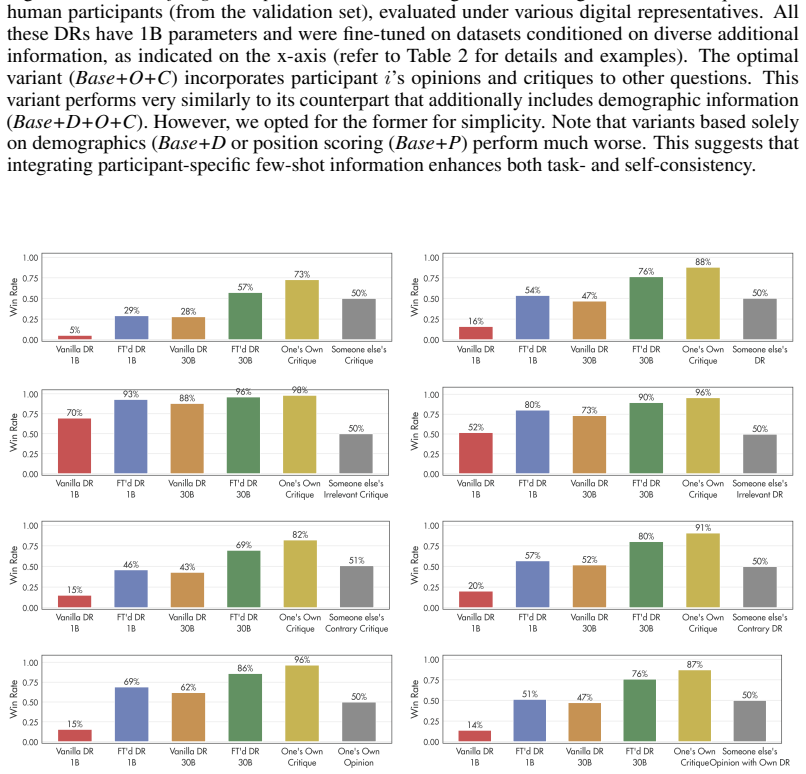
- Scale helps: the 30B fine-tuned representative reaches win-rates close to the human ground-truth ceiling, while the 1B fine-tuned model still improves over vanilla baselines.
- The mediation mechanism tolerates a single outlier critique, so full-group substitution is the more sensitive test of representativity; single substitutions tend to wash out differences between models.
Reading between the lines
- If human validation confirms the model-based equivalence, the same framework could support 'digital citizens' in deliberative democracy simulations, letting policymakers explore the effect of different deliberation rules before running costly human assemblies.
- The formal framework is mechanism-agnostic: it should transfer to other collective decision mechanisms such as voting rules or auction formats, where the state-action space is not language but ballot choices or bids.
- The success of likelihood-based training suggests that directly optimizing the trajectory-equivalence objective (rather than one-step likelihood) could yield better sample efficiency, or may become necessary in settings where the mechanism is not smooth in actions.
- A natural stress test is distribution shift: evaluate representatives on questions far from the training corpus or on participants with more extreme views to see whether outcome equivalence degrades when the model's prior must do more work.
Editorial analysis
A structured set of objections, weighed in public.
Referee Report
Summary. The paper formalizes collective decision-making as an episodic interaction between participants and a decision mechanism, defines digital representation through equivalence classes of policy profiles (clones, transition-based equivalence, and trajectory-based value equivalence), and proves an ordering result (Proposition 1). It then presents an empirical case study in consensus-finding, fine-tuning 1B and 30B Chinchilla models to generate critiques in place of human participants and evaluating them with log-likelihood, a PaLM2 autorater, and a learned payoff model. The central claim is that fine-tuned language models can act as digital representatives of individual humans, in the sense that substituting their critiques for human critiques yields consensus outcomes with roughly equivalent expected payoff and judged similarity.
Significance. If the central claim is supported, the paper makes a useful conceptual contribution by giving a formal, mechanism-aware definition of what it means for a language agent to represent a human in collective decision-making, and by showing that trajectory-based value equivalence is the right notion. The proof of Proposition 1 is clean in intent, and the empirical study uses a held-out split by both participants and questions, which is a strength. However, the empirical demonstration of feasibility currently rests on model-based proxies from the same research ecosystem (a Chinchilla 1B payoff model from prior work and a PaLM2 autorater), with no human validation of the consensus outcomes. The paper's own formal representativity objective is also not the objective used for training. These gaps are load-bearing for the title claim, even though the authors acknowledge them in Section 5.
major comments (3)
- [4.3, Eqs. (21)-(22)] The feasibility claim depends entirely on two model-based proxies: the 1B-parameter Chinchilla payoff model from the authors' prior work and the PaLM2 autorater. No human endorsement data are reported for the consensus statements; Section 5 explicitly defers human validation to future work. If either proxy systematically prefers fluent, mediator-like statements, the reported equivalence between human and digital-representative consensus outcomes could be an artifact of self-similarity among language models rather than fidelity to the represented individuals. This is load-bearing for the central claim, and I request human evaluations on a held-out subset (e.g., human agreement ratings and pairwise preference judgments) or, at minimum, a validation of the payoff model and autorater against human judgments.
- [4.1, Eq. (18) vs. Eq. (16)] The digital representatives are trained with a standard log-likelihood objective, i.e., to clone the human critique conditionals, whereas the paper's proposed notion of representativity in Eq. (16) is trajectory-based value equivalence. This mismatch is acknowledged in Section 5, but it means the experiments do not directly instantiate the theoretical framework. The authors should either train with an approximation to the value-equivalence objective or provide evidence that likelihood-trained models also satisfy the trajectory-equivalence criterion in a way that is not solely mediated by the unvalidated proxies.
- [Appendix A, Eqs. (29)-(30)] The proof of Proposition 1 factorizes the joint policy as π*((u'||,u'⊥)|x') = π*(u'|||x')π*(u'⊥|x'), which is an independence assumption not stated in the proposition. The intended result can be obtained directly from the invariance hypothesis on Q^t without this factorization, so the statement is likely correct, but the proof as written is invalid at this step. Please revise the proof to avoid the unjustified factorization.
minor comments (4)
- [Eq. (16)] In Eq. (16), Q^T is written as Q^T(ω), but Q^T was defined as a function of state and action, Q^T: X × U → R^n; please clarify the notation for evaluating the terminal value function at outcomes.
- [Figures 2 and 3] The text reports differences such as "13% difference between ceiling and Vanilla 1B DRs" but does not report confidence intervals or statistical tests; please add error bars and significance tests, or explicitly state their absence and interpret the results accordingly.
- [Section 4.3, Eq. (20)] The term "autoreter" appears to be a typo for "autorater"; please correct it for consistency with the rest of the text.
- [Section 3.1] The phrase "Expression 10 is simply the singleton class" is slightly misleading, since Π(π*) is an equivalence class of policies, not necessarily a singleton unless Π contains only one policy with the same conditionals; please rephrase.
Circularity Check
No significant circularity: formal result is a proof from definitions, and empirical claims are anchored by held-out human critiques; proxy-based consensus evaluation is an acknowledged limitation, not a circular reduction.
full rationale
The paper's claimed derivation chain is self-contained. Definition 3 and Proposition 1 are a mathematical statement about three equivalence classes, proved in Appendix A directly from the definitions (Eqs. 10-12) without importing the conclusion; the proof constructs a policy and verifies the inclusions, so there is no definitional circularity. The training objective (Eq. 18) maximizes log-likelihood of held-out human critiques, and the first evaluation (Eq. 19, Fig. 2 left) measures log-likelihood on held-out human critiques, an external benchmark that does not depend on the authors' models. The consensus-level evaluation (Eqs. 21-22) uses a payoff model from the authors' prior work [5,6] and a PaLM2 autorater, and Section 5 explicitly acknowledges that human validation is future work; while this is a validity limitation, it is not a circular reduction because the payoff model is a fixed external evaluator, the DRs are not trained to optimize Eq. 21 or Eq. 22, and no equation in the paper defines the reported equivalence in terms of the trained DRs' own outputs. The cited prior work [5,6] contains human data and external validation, so the self-citations are independent support rather than a load-bearing chain.
Assumptions & free parameters
assumptions (5)
- standard math The group decision process is an episodic Markov decision process with a fixed horizon and a terminal-state outcome.
- ad hoc to paper The action space can be decomposed into relevant and irrelevant dimensions U = U|| x U⊥, with mechanisms and value functions invariant to U⊥.
- domain assumption The mediator mechanism τ is a fixed black-box function (a fine-tuned 70B Chinchilla) that maps critiques to consensus statements.
- domain assumption A 1B-parameter payoff model trained by the authors' prior work provides a valid proxy for human agreement scores.
- domain assumption Participants do not observe each other's opinions or critiques, so individual behaviors can be treated as independent policies.
Cite this review
Pith. "Pith review of Language Agents as Digital Representatives in Collective Decision-Making." pith.science (2026). https://pith.science/paper/IRX5WUIE
@misc{pith2026250209369,
  author       = {Pith},
  title        = {Pith review of: Language Agents as Digital Representatives in Collective Decision-Making},
  year         = {2026},
  howpublished = {\url{https://pith.science/paper/IRX5WUIE}},
  note         = {Machine review of arXiv:2502.09369}
}
read the original abstract
Consider the process of collective decision-making, in which a group of individuals interactively select a preferred outcome from among a universe of alternatives. In this context, "representation" is the activity of making an individual's preferences present in the process via participation by a proxy agent -- i.e. their "representative". To this end, learned models of human behavior have the potential to fill this role, with practical implications for multi-agent scenario studies and mechanism design. In this work, we investigate the possibility of training \textit{language agents} to behave in the capacity of representatives of human agents, appropriately expressing the preferences of those individuals whom they stand for. First, we formalize the setting of \textit{collective decision-making} -- as the episodic process of interaction between a group of agents and a decision mechanism. On this basis, we then formalize the problem of \textit{digital representation} -- as the simulation of an agent's behavior to yield equivalent outcomes from the mechanism. Finally, we conduct an empirical case study in the setting of \textit{consensus-finding} among diverse humans, and demonstrate the feasibility of fine-tuning large language models to act as digital representatives.
Figures


Figures from the paper (3 more)


Reference graph
Works this paper leans on
-
[1]
Thomas Bose, Andreagiovanni Reina, and James AR Marshall. Collective decision-making. Current opinion in behavioral sciences, 16:30–34, 2017
work page 2017
-
[2]
Collective decision making by rational individuals
Richard P Mann. Collective decision making by rational individuals. Proceedings of the National Academy of Sciences, 115(44):E10387–E10396, 2018
work page 2018
-
[3]
Game theory and mechanism design, volume 4
Yadati Narahari. Game theory and mechanism design, volume 4. World Scientific, 2014
work page 2014
-
[4]
When freedom is not an endless meeting: A new look at efficiency in consensus- based decision making
Darcy K Leach. When freedom is not an endless meeting: A new look at efficiency in consensus- based decision making. The Sociological Quarterly, 57(1):36–70, 2016
work page 2016
-
[5]
Fine-tuning language models to find agreement among humans with diverse preferences
Michiel Bakker, Martin Chadwick, Hannah Sheahan, Michael Tessler, Lucy Campbell- Gillingham, Jan Balaguer, Nat McAleese, Amelia Glaese, John Aslanides, Matt Botvinick, et al. Fine-tuning language models to find agreement among humans with diverse preferences. Advances in Neural Information Processing Systems, 35:38176–38189, 2022
work page 2022
-
[6]
Bakker, Daniel Jarrett, Hannah Sheahan, Martin J
Michael Henry Tessler, Michiel A. Bakker, Daniel Jarrett, Hannah Sheahan, Martin J. Chadwick, Raphael Koster, Georgina Evans, Lucy Campbell-Gillingham, Tantum Collins, David C. Parkes, Matthew Botvinick, and Christopher Summerfield. AI can help humans find common ground in democratic deliberation. Science, 386(6719):eadq2852, 2024
work page 2024
-
[7]
Suzanne Dovi. Political representation. The Stanford Encyclopedia of Philosophy, 2006
work page 2006
-
[8]
Smooth imitation learning for online sequence prediction
Hoang M Le, Andrew Kang, Yisong Yue, and Peter Carr. Smooth imitation learning for online sequence prediction. International Conference on Machine Learning (ICML), 2016
work page 2016
Show all 61 references
-
[9]
Imitation learning (presentation)
Yisong Yue and Hoang M Le. Imitation learning (presentation). International Conference on Machine Learning (ICML), 2018
2018
-
[10]
An algorithmic perspective on imitation learning
Takayuki Osa, Joni Pajarinen, Gerhard Neumann, J Andrew Bagnell, Pieter Abbeel, and Jan Peters. An algorithmic perspective on imitation learning. Foundations and Trends in Robotics, 2018
2018
-
[11]
Explaining by imitating: Understanding decisions by interpretable policy learning
Alihan Hüyük, Daniel Jarrett, Cem Tekin, and Mihaela van der Schaar. Explaining by imitating: Understanding decisions by interpretable policy learning. International Conference on Learning Representations (ICLR), 2021
2021
-
[12]
Generating faithful synthetic data with large language models: A case study in computational social science
Veniamin Veselovsky, Manoel Horta Ribeiro, Akhil Arora, Martin Josifoski, Ashton Anderson, and Robert West. Generating faithful synthetic data with large language models: A case study in computational social science. arXiv preprint arXiv:2305.15041, 2023
2023 arXiv
-
[13]
Does synthetic data generation of llms help clinical text mining? arXiv preprint arXiv:2303.04360, 2023
Ruixiang Tang, Xiaotian Han, Xiaoqian Jiang, and Xia Hu. Does synthetic data generation of llms help clinical text mining? arXiv preprint arXiv:2303.04360, 2023
2023 arXiv
-
[14]
The medkit-learn (ing) environment: Medical decision modelling through simulation
Alex J Chan, Ioana Bica, Alihan Huyuk, Daniel Jarrett, and Mihaela van der Schaar. The medkit-learn (ing) environment: Medical decision modelling through simulation. arXiv preprint arXiv:2106.04240, 2021
2021 arXiv
-
[15]
Carla: An open urban driving simulator
Alexey Dosovitskiy, German Ros, Felipe Codevilla, Antonio Lopez, and Vladlen Koltun. Carla: An open urban driving simulator. In Conference on robot learning, pages 1–16. PMLR, 2017
2017
-
[16]
Social simulacra: Creating populated prototypes for social computing systems
Joon Sung Park, Lindsay Popowski, Carrie Cai, Meredith Ringel Morris, Percy Liang, and Michael S Bernstein. Social simulacra: Creating populated prototypes for social computing systems. In Proceedings of the 35th Annual ACM Symposium on User Interface Software and Technology, ...
2022
-
[17]
Using large language models to simulate multiple humans and replicate human subject studies
Gati V Aher, Rosa I Arriaga, and Adam Tauman Kalai. Using large language models to simulate multiple humans and replicate human subject studies. In International Conference on Machine Learning, pages 337–371. PMLR, 2023
2023
-
[18]
Ai language models cannot replace human research participants
Jacqueline Harding, William D’Alessandro, NG Laskowski, and Robert Long. Ai language models cannot replace human research participants. AI & SOCIETY, pages 1–3, 2023
2023
-
[19]
Out of one, many: Using language models to simulate human samples
Lisa P Argyle, Ethan C Busby, Nancy Fulda, Joshua R Gubler, Christopher Rytting, and David Wingate. Out of one, many: Using language models to simulate human samples. Political Analysis, 31(3):337–351, 2023
2023
-
[20]
Large language models as simulated economic agents: What can we learn from homo silicus? Technical report, National Bureau of Economic Research, 2023
John J Horton. Large language models as simulated economic agents: What can we learn from homo silicus? Technical report, National Bureau of Economic Research, 2023. 10
2023
-
[21]
Generative agents: Interactive simulacra of human behavior
Joon Sung Park, Joseph C O’Brien, Carrie J Cai, Meredith Ringel Morris, Percy Liang, and Michael S Bernstein. Generative agents: Interactive simulacra of human behavior. arXiv preprint arXiv:2304.03442, 2023
2023 arXiv
-
[22]
Training compute-optimal large language models
Jordan Hoffmann, Sebastian Borgeaud, Arthur Mensch, Elena Buchatskaya, Trevor Cai, Eliza Rutherford, Diego de Las Casas, Lisa Anne Hendricks, Johannes Welbl, Aidan Clark, et al. Training compute-optimal large language models. arXiv preprint arXiv:2203.15556, 2022
2022 arXiv
-
[23]
The effectiveness of data augmentation in image classification using deep learning
Jason Wang, Luis Perez, et al. The effectiveness of data augmentation in image classification using deep learning. Convolutional Neural Networks Vis. Recognit, 11(2017):1–8, 2017
2017
-
[24]
Semantic uncertainty: Linguistic invariances for uncertainty estimation in natural language generation
Lorenz Kuhn, Yarin Gal, and Sebastian Farquhar. Semantic uncertainty: Linguistic invariances for uncertainty estimation in natural language generation. arXiv preprint arXiv:2302.09664, 2023
2023 arXiv
-
[25]
Value-aware loss function for model-based reinforcement learning
Amir-massoud Farahmand, Andre Barreto, and Daniel Nikovski. Value-aware loss function for model-based reinforcement learning. In Artificial Intelligence and Statistics, pages 1486–1494. PMLR, 2017
2017
-
[26]
Iterative value-aware model learning
Amir-massoud Farahmand. Iterative value-aware model learning. Advances in Neural Informa- tion Processing Systems, 31, 2018
2018
-
[27]
The value equivalence principle for model-based reinforcement learning
Christopher Grimm, André Barreto, Satinder Singh, and David Silver. The value equivalence principle for model-based reinforcement learning. Advances in Neural Information Processing Systems, 33:5541–5552, 2020
2020
-
[28]
Proper value equivalence
Christopher Grimm, André Barreto, Greg Farquhar, David Silver, and Satinder Singh. Proper value equivalence. Advances in Neural Information Processing Systems, 34:7773–7786, 2021
2021
-
[29]
Approximate value equivalence
Christopher Grimm, Andre Barreto, and Satinder Singh. Approximate value equivalence. Advances in Neural Information Processing Systems, 35:33029–33040, 2022
2022
-
[30]
Deciding what to model: Value-equivalent sampling for reinforcement learning
Dilip Arumugam and Benjamin Van Roy. Deciding what to model: Value-equivalent sampling for reinforcement learning. Advances in Neural Information Processing Systems, 35:9024–9044, 2022
2022
-
[31]
Whose opinions do language models reflect? arXiv preprint arXiv:2303.17548, 2023
Shibani Santurkar, Esin Durmus, Faisal Ladhak, Cinoo Lee, Percy Liang, and Tatsunori Hashimoto. Whose opinions do language models reflect? arXiv preprint arXiv:2303.17548, 2023
2023 arXiv
-
[32]
Moral mimicry: Large language models produce moral rationalizations tailored to political identity
Gabriel Simmons. Moral mimicry: Large language models produce moral rationalizations tailored to political identity. arXiv preprint arXiv:2209.12106, 2022
2022 arXiv
-
[33]
How (not) to use sociode- mographic information for subjective nlp tasks
Tilman Beck, Hendrik Schuff, Anne Lauscher, and Iryna Gurevych. How (not) to use sociode- mographic information for subjective nlp tasks. arXiv preprint arXiv:2309.07034, 2023
2023 arXiv
-
[34]
Decoupled weight decay regularization
Ilya Loshchilov and Frank Hutter. Decoupled weight decay regularization. arXiv preprint arXiv:1711.05101, 2019
2019 arXiv
-
[35]
Palm 2 technical report
Rohan Anil, Andrew M Dai, Orhan Firat, Melvin Johnson, Dmitry Lepikhin, Alexandre Passos, Siamak Shakeri, Emanuel Taropa, Paige Bailey, Zhifeng Chen, et al. Palm 2 technical report. arXiv preprint arXiv:2305.10403, 2023
2023 arXiv
-
[36]
A reduction from apprenticeship learning to classification
Umar Syed and Robert E Schapire. A reduction from apprenticeship learning to classification. Advances in neural information processing systems (NeurIPS), 2010
2010
-
[37]
Apprenticeship learning via inverse reinforcement learning
Pieter Abbeel and Andrew Y Ng. Apprenticeship learning via inverse reinforcement learning. International conference on Machine learning (ICML), 2004
2004
-
[38]
Apprenticeship learning using irl and gradient methods
Gergely Neu and Csaba Szepesvári. Apprenticeship learning using irl and gradient methods. Conference on Uncertainty in Artificial Intelligence (UAI), 2007
2007
-
[39]
Apprenticeship learning about multiple intentions
Monica Babes, Vukosi Marivate, and Michael L Littman. Apprenticeship learning about multiple intentions. International conference on Machine learning (ICML), 2011
2011
-
[40]
Maximum entropy inverse reinforcement learning
Brian D Ziebart, Andrew L Maas, J Andrew Bagnell, and Anind K Dey. Maximum entropy inverse reinforcement learning. AAAI Conference on Artificial Intelligence (AAAI), 2008
2008
-
[41]
Guided cost learning: Deep inverse optimal control via policy optimization
Chelsea Finn, Sergey Levine, and Pieter Abbeel. Guided cost learning: Deep inverse optimal control via policy optimization. International conference on machine learning (ICML), 2016. 11
2016
-
[42]
Generative adversarial imitation learning
Jonathan Ho and Stefano Ermon. Generative adversarial imitation learning. Advances in neural information processing systems (NeurIPS), 2016
2016
-
[43]
Inverse decision modeling: Learning interpretable representations of behavior
Daniel Jarrett, Alihan Hüyük, and Mihaela Van Der Schaar. Inverse decision modeling: Learning interpretable representations of behavior. In International Conference on Machine Learning, pages 4755–4771. PMLR, 2021
2021
-
[44]
Generative multi-agent behavioral cloning
Eric Zhan, Stephan Zheng, Yisong Yue, Long Sha, and Patrick Lucey. Generative multi-agent behavioral cloning. arXiv, 2018
2018
-
[45]
Exploring the limitations of behavior cloning for autonomous driving
Felipe Codevilla, Eder Santana, Antonio M López, and Adrien Gaidon. Exploring the limitations of behavior cloning for autonomous driving. In Proceedings of the IEEE/CVF International Conference on Computer Vision, pages 9329–9338, 2019
2019
-
[46]
Multi-agent generative adver- sarial imitation learning
Jiaming Song, Hongyu Ren, Dorsa Sadigh, and Stefano Ermon. Multi-agent generative adver- sarial imitation learning. Advances in neural information processing systems, 31, 2018
2018
-
[47]
Conditional imitation learning for multi-agent games
Andy Shih, Stefano Ermon, and Dorsa Sadigh. Conditional imitation learning for multi-agent games. In 2022 17th ACM/IEEE International Conference on Human-Robot Interaction (HRI), pages 166–175. IEEE, 2022
2022
-
[48]
Multi-agent imitation learning for driving simulation
Raunak P Bhattacharyya, Derek J Phillips, Blake Wulfe, Jeremy Morton, Alex Kuefler, and Mykel J Kochenderfer. Multi-agent imitation learning for driving simulation. In 2018 IEEE/RSJ International Conference on Intelligent Robots and Systems (IROS), pages 1534–1539. IEEE, 2018
2018
-
[49]
Generating high-fidelity, synthetic time series datasets with doppelganger.ACM Internet Measurement Conference (IMC), 2019
Zinan Lin, Alankar Jain, Chen Wang, Giulia Fanti, and Vyas Sekar. Generating high-fidelity, synthetic time series datasets with doppelganger.ACM Internet Measurement Conference (IMC), 2019
2019
-
[50]
Cot-gan: Generating sequential data via causal optimal transport
Tianlin Xu, Li K Wenliang, Michael Munn, and Beatrice Acciaio. Cot-gan: Generating sequential data via causal optimal transport. Advances in Neural Information Processing Systems (NeurIPS), 2020
2020
-
[51]
Time-series generation by contrastive imitation
Daniel Jarrett, Ioana Bica, and Mihaela van der Schaar. Time-series generation by contrastive imitation. Advances in Neural Information Processing Systems, 34:28968–28982, 2021
2021
-
[52]
Real-valued (medical) time series generation with recurrent conditional gans
Cristóbal Esteban, Stephanie L Hyland, and Gunnar Rätsch. Real-valued (medical) time series generation with recurrent conditional gans. arXiv preprint arXiv:1706.02633, 2017
2017 arXiv
-
[53]
Harnessing large-language models to generate private synthetic text
Alexey Kurakin, Natalia Ponomareva, Umar Syed, Liam MacDermed, and Andreas Terzis. Harnessing large-language models to generate private synthetic text. arXiv preprint arXiv:2306.01684, 2023
2023 arXiv
-
[54]
Towards measuring the representation of subjective global opinions in language models
Esin Durmus, Karina Nyugen, Thomas I Liao, Nicholas Schiefer, Amanda Askell, Anton Bakhtin, Carol Chen, Zac Hatfield-Dodds, Danny Hernandez, Nicholas Joseph, et al. Towards measuring the representation of subjective global opinions in language models. arXiv preprint arXiv:2306...
2023 arXiv
-
[55]
The political ideology of conver- sational ai: Converging evidence on chatgpt’s pro-environmental, left-libertarian orientation
Jochen Hartmann, Jasper Schwenzow, and Maximilian Witte. The political ideology of conver- sational ai: Converging evidence on chatgpt’s pro-environmental, left-libertarian orientation. arXiv preprint arXiv:2301.01768, 2023
2023 arXiv
-
[56]
Communitylm: Probing partisan worldviews from language models
Hang Jiang, Doug Beeferman, Brandon Roy, and Deb Roy. Communitylm: Probing partisan worldviews from language models. arXiv preprint arXiv:2209.07065, 2022
2022 arXiv
-
[57]
Opiniongpt: Modelling explicit biases in instruction-tuned llms
Patrick Haller, Ansar Aynetdinov, and Alan Akbik. Opiniongpt: Modelling explicit biases in instruction-tuned llms. arXiv preprint arXiv:2309.03876, 2023
2023 arXiv
-
[58]
Toward a deliberative global citizens’ assembly
John S Dryzek, André Bächtiger, and Karolina Milewicz. Toward a deliberative global citizens’ assembly. Global Policy, 2(1):33–42, 2011
2011
-
[59]
The assignment of political office by lot
Fredrik Engelstad. The assignment of political office by lot. Social Science Information , 28(1):23–50, 1989
1989
-
[60]
The mild voice of reason: Deliberative democracy and American national government
Joseph M Bessette. The mild voice of reason: Deliberative democracy and American national government. University of Chicago Press, 1994
1994
-
[61]
A proposal for importing society’s values
Jan Leike. A proposal for importing society’s values. Musings on the Alignment Problem, 2023. 12 A Proof of Proposition 1 Proposition 1 (Representational Equivalence) Fix Π and T , and let Q be closed under Bellman updates. Consider the equivalence classes of policy profiles i...
2023
Reviewed August 7, 2026 · model on record in the stance chip above.
Discussion (0). Continue with ORCID to comment.