REVIEW 4 major objections 4 minor 45 references
Linking Cryptoasset Attribution Tags to Knowledge Graph Entities: An LLM-based Approach
T0 review · 4 major / 4 minor · reviewed 2026-08-08 · deepseek-v4-flash
Pith's one-line read An LLM pipeline links messy cryptoasset tags to knowledge-graph actors, beating baselines by up to 37.4% in F1.
desk verdict Solid, reproducible LLM entity linking for crypto forensics; the reported gains are real, but the small manually annotated test sets need reliability work. read the letter →
The pith
A machine-rendered reading of the paper's core claim, the machinery that carries it, and where it could break.
The reading
What carries the argument
The central mechanism is a two-module entity linking pipeline. The candidate set generator first applies related-concept filtering, which uses the taxonomy hierarchy to exclude actors whose category is unrelated to the tag's category, then BM25 blocking over trigram-tokenized strings to keep only the k=5 most similar actor labels, reducing comparison cost from O(nm) to O(nk). The candidate selector then feeds each tag and its candidates to an LLM prompt that asks for the matching entity by index or 'none', optionally with few-shot examples. The prompt template is load-bearing: zero-shot performance swings from near zero to over 90% F1 depending on template structure, so the output-format instructions matter as much as the model.
What would settle it
Re-label the WatchYourBack (126 records, 67 with actor links) and DeFi Rekt (100 records, 32 with actor links) samples with two or more independent annotators who do not see the paper's labels, and measure inter-annotator agreement; low agreement or materially different labels would show the 37.4% F1 gain is an artifact of the original annotation.
Extended reading notes
Core claim
On its own terms, this paper establishes that a two-stage pipeline, a cheap candidate generator followed by an LLM candidate selector, maps attribution tags to knowledge-graph actors more reliably than existing approaches. The generator combines related-concept filtering with BM25 trigram blocking to shrink each tag's candidate pool to five entities, reaching 93% recall without any labeled data. The selector then uses an LLM prompt to pick the matching actor or say 'none'; with GPT-4o it reaches 94% F1 in isolation and 79 to 85% F1 end-to-end across the three datasets, while the local Mistral 7B-Instruct reaches 90% F1 in isolation. Against the BM25-threshold and the mixture-of-experts baselines, the reported end-to-end improvements are up to 37.4% in F1.
Load-bearing premise
The evaluation assumes the ground-truth actor links are correct, including the manually annotated labels for WatchYourBack and DeFi Rekt; if those labels are noisy, the reported F1 improvements are not measuring what they claim.
Editorial extensions
If this is right
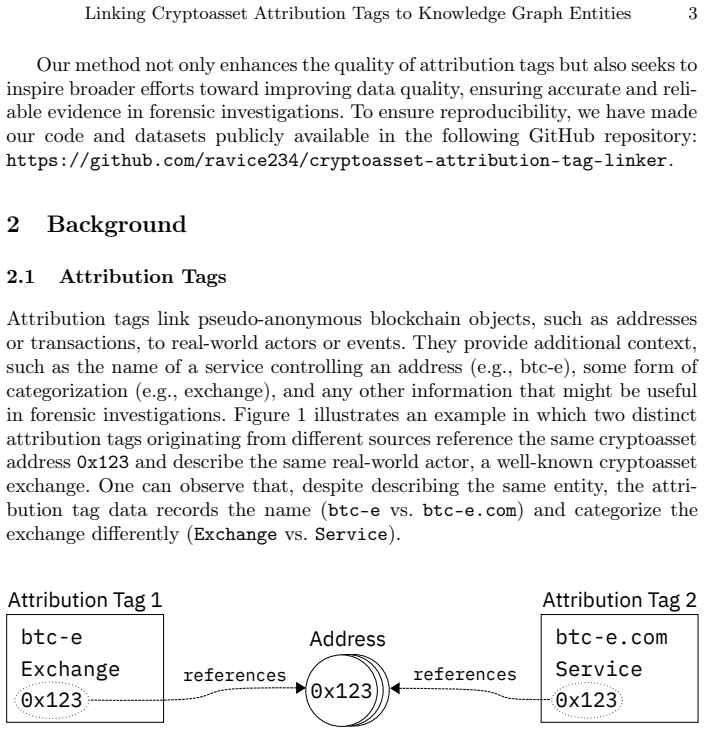
- Tracing tools can automatically harmonize tags from different sources against a shared knowledge graph, so btc-e and btc-e.com resolve to the same actor.
- Candidate sets of five with 93% recall mean the approach works without labeled training data, which is rare in forensic settings.
- A local model reaches 90% F1, so the pipeline can run on consumer hardware without sending sensitive investigative data to a remote API.
- Choosing the cheapest prompt template cuts API costs by about 90% for roughly a 1% F1 drop, making large-scale tag cleaning affordable.
- The same end-to-end setup exceeds 79% F1 on all three datasets, suggesting the method generalizes beyond the dataset it was tuned on.
Reading between the lines
- The error analysis suggests a practical ranking: wrong-entity links are rarer but more dangerous than missed links for GPT-4o, so a deployment could treat 'none' outputs as needing human review rather than as failures.
- A natural extension is to use the pipeline to flag mislabeled tags in existing databases, since a confident mismatch between a tag and its current actor link is itself a data-quality signal.
- The related-concept filter only helps when a shared taxonomy exists; if the crypto forensics field adopts the INTERPOL/DWVA taxonomy, this component becomes portable to other datasets and jurisdictions.
- Comparing the LLM selector against a simple string-similarity ranker on the same candidate sets would isolate whether the model adds semantic understanding beyond the blocker.
Editorial analysis
A structured set of objections, weighed in public.
Referee Report
Summary. The paper proposes a two-stage LLM-based entity linking pipeline for cryptoasset attribution tags: a candidate set generator (BM253 blocking with optional related-concept filtering) and an LLM-based candidate selector. The pipeline is evaluated on three datasets—GraphSense TagPacks, WatchYourBack, and DeFi Rekt—against BM253-threshold, UnicornPlus, and fine-tuned UnicornPlus baselines. The authors report that their approach outperforms baselines by up to 37.4% in F1, achieves 93% recall at candidate set size 5 without labeled data, and that local LLMs (e.g., Mistral 7B-Instruct) are comparable to remote models (GPT-4o). They also provide a cost-performance analysis of prompt templates and models.
Significance. If the results hold, the paper addresses a practical need in cryptoasset forensics: inconsistent attribution tags can be linked to a shared knowledge graph automatically. The experimental design covers multiple datasets, several LLMs, and a clear comparison to established baselines. The authors also make code and data publicly available, which supports reproducibility. The main uncertainty is the reliability of the manual ground-truth labels for the two smaller datasets, and some abstract-level claims that do not exactly match the quantitative results in the body. These issues are fixable and do not invalidate the core approach, but they are load-bearing for the paper's strongest claims.
major comments (4)
- [Sections 3.2 and 3.3, Table 6] The ground-truth labels for WatchYourBack (126 records, 67 positive actor links) and DeFi Rekt (100 records, 32 positive links) are manual annotations by the authors. The paper does not provide an annotation protocol, inter-annotator agreement, or any independent verification of these labels. With only 32 positive examples in DeFi Rekt, a single mislabeled record changes recall by roughly 3 percentage points, and macro-F1 averaged over actors is similarly sensitive. Since the largest reported F1 gains over baselines (e.g., GPT-4o 0.793 vs. BM253 0.393 on DeFi Rekt) rest on these labels, the paper should supply a detailed annotation guideline, a second annotator, agreement metrics (e.g., Cohen's kappa), and a sensitivity analysis showing how F1 changes if a small fraction of positive labels is removed or corrected.
- [Abstract and Section 5.4] The abstract states that the approach outperforms baselines 'by up to 37.4% in F1-score' across the three datasets. This number is not traceable to any pairwise comparison in Table 6 or Table 7. For instance, comparing GPT-4o to BM253 yields absolute percentage-point improvements of 13.5 (GraphSense), 30.6 (WatchYourBack), and 40.0 (DeFi Rekt); relative improvements are 18.8%, 61.8%, and 101.8%, respectively. The paper should specify exactly which models are compared and whether the improvement is relative or absolute, and correct the number if it does not match any valid comparison.
- [Abstract, Introduction, and Experiments 2 vs. 3] The abstract and Introduction claim that 'local LLM models can achieve F1-scores of 90%, comparable to remote models which achieve 94%.' These figures come from Experiment 2 (Table 4), which evaluates candidate selection on the validation set where the correct actor is known to be within the candidate set. In the end-to-end Experiment 3 (Table 6), the best local model (Mistral 7B-Instruct) achieves 0.821 F1 on GraphSense vs. 0.853 for GPT-4o, and the gap is larger on WatchYourBack (0.692 vs. 0.801) and DeFi Rekt (0.547 vs. 0.793). The abstract and introduction should clearly distinguish the sub-task result from the end-to-end result.
- [Section 5.4] The BM253 baseline threshold is optimized on the GraphSense TagPack validation set and then applied unchanged to WatchYourBack and DeFi Rekt. If the score distributions differ across datasets, this choice could understate the baseline's performance and inflate the reported improvement of the LLM approach. Please tune the threshold per dataset using a small validation split, or report results across a range of thresholds, to ensure a fair comparison.
minor comments (4)
- [Throughout] The method is called 'BM253' in the text and tables (e.g., Table 3), but the equation in Section 4.1 is labeled 'BM25' and the rank_bm25 library is referenced. This naming inconsistency should be fixed for clarity.
- [Abstract and Section 5.2] The claim of 'recall of 93% without the need for labeled data' refers specifically to the GraphSense TagPack validation set with related-concept filtering and k=5. Since the other two datasets do not have category information, the claim should be qualified as applying to the GraphSense dataset only.
- [Section 3.1 and Section 5.1] There are several typos: 'blockhain' in Section 3.1, 'detailled' in Section 5.1, and 'Aditionally' in Section 5.3. These should be corrected.
- [Section 2.2, reference [3]] Reference [3] is a change.org petition rather than a peer-reviewed source. Replacing it with a peer-reviewed study on the reliability of cryptoasset tracing tools would strengthen the motivation.
Circularity Check
No significant circularity: the reported F1 scores are measured on held-out data, and the 37.4% figure is an absolute percentage-point gap rather than a derived quantity.
full rationale
The paper is an empirical evaluation, not a derivation: all headline F1 scores are measured on held-out splits (GraphSense test set, WatchYourBack, DeFi Rekt) against ground-truth actor links. The GraphSense ground truth consists of the existing actor links in the same GraphSense knowledge graph used as the candidate pool, but that is the standard entity-linking task definition rather than a circular reduction: the LLM must select among candidates, and the labels are not fed into the model as answers. The only fitted quantities are the BM253 baseline threshold (chosen on the GraphSense validation set) and validation-based hyperparameter choices (candidate set size k=5, best prompt template per model), and these are subsequently applied to unseen test data, so no fitted parameter is renamed as a prediction. The abstract's '37.4% improvement' is traceable as an absolute percentage-point gap between GPT-4o (F1 0.793) and UnicornPlusFT (F1 0.419) on DeFi Rekt, not as a relative improvement; this is a wording inconsistency, not circularity. The manual annotations for WatchYourBack (67 actor links) and DeFi Rekt (32 actor links) lack inter-annotator agreement and are a validity and robustness concern, but noisy labels are not a self-referential input. The self-citations ([10], [16], [30], [31]) support background motivation only and are not load-bearing. The paper's stated limitations, such as domain specificity and the shared-knowledge-graph assumption, are explicit and do not conceal a circular step. No equation or claim reduces to its own input by construction.
Assumptions & free parameters
free parameters (4)
- BM253 baseline threshold =
15.7238
- Candidate set size k =
5
- Per-model prompt template and shot count =
GPT-4o: template 7, 5 shots; GPT-3.5: template 9, 5 shots; Mistral 7B-Instruct: template 0, 5 shots
- Related-concept filtering on/off =
on for GraphSense, off for others
assumptions (4)
- domain assumption GraphSense actor links provide correct ground truth for the linked tags used in training, validation, and test splits.
- domain assumption Manual annotations for WatchYourBack and DeFi Rekt are correct.
- domain assumption For every test tag with an actor, that actor exists in the 2,862-entity knowledge graph.
- domain assumption The INTERPOL DWVA taxonomy's related-concept relations reflect true semantic relatedness.
Cite this review
Pith. "Pith review of Linking Cryptoasset Attribution Tags to Knowledge Graph Entities: An LLM-based Approach." pith.science (2026). https://pith.science/paper/COBONHBA
@misc{pith2026250210453,
  author       = {Pith},
  title        = {Pith review of: Linking Cryptoasset Attribution Tags to Knowledge Graph Entities: An LLM-based Approach},
  year         = {2026},
  howpublished = {\url{https://pith.science/paper/COBONHBA}},
  note         = {Machine review of arXiv:2502.10453}
}
read the original abstract
Attribution tags form the foundation of modern cryptoasset forensics. However, inconsistent or incorrect tags can mislead investigations and even result in false accusations. To address this issue, we propose a novel computational method based on Large Language Models (LLMs) to link attribution tags with well-defined knowledge graph concepts. We implemented this method in an end-to-end pipeline and conducted experiments showing that our approach outperforms baseline methods by up to 37.4% in F1-score across three publicly available attribution tag datasets. By integrating concept filtering and blocking procedures, we generate candidate sets containing five knowledge graph entities, achieving a recall of 93% without the need for labeled data. Additionally, we demonstrate that local LLM models can achieve F1-scores of 90%, comparable to remote models which achieve 94%. We also analyze the cost-performance trade-offs of various LLMs and prompt templates, showing that selecting the most cost-effective configuration can reduce costs by 90%, with only a 1% decrease in performance. Our method not only enhances attribution tag quality but also serves as a blueprint for fostering more reliable forensic evidence.
Figures


Figures from the paper (5 more)


Reference graph
Works this paper leans on
-
[1]
Future Generation Computer Sys- tems 102, 259–277 (Jan 2020)
Bartoletti, M., Carta, S., Cimoli, T., Saia, R.: Dissecting ponzi schemes on ethereum: Identification, analysis, and impact. Future Generation Computer Sys- tems 102, 259–277 (Jan 2020). https://doi.org/10.1016/j.future.2019.08. 014, http://dx.doi.org/10.1016/j.future.2019.08.014
-
[2]
Brinkmann, A., Shraga, R., Bizer, C.: SC-Block: Supervised Contrastive Block- ing Within Entity Resolution Pipelines, p. 121–142. Springer Nature Switzerland (2024). https://doi.org/10.1007/978-3-031-60626-7_7 , http://dx.doi.org/ 10.1007/978-3-031-60626-7_7
-
[3]
Tell congress: Stop the use of chainalysis services,https://www.change.org/p/ tell-congress-stop-the-use-of-chainalysis-services
-
[4]
IEEE Access7, 37575–37586 (2019)
Chen, W., Zheng, Z., Ngai, E.C.H., Zheng, P., Zhou, Y.: Exploiting blockchain data to detect smart ponzi schemes on ethereum. IEEE Access7, 37575–37586 (2019). https://doi.org/10.1109/access.2019.2905769, http://dx.doi.org/ 10.1109/ACCESS.2019.2905769
arXiv 2019
-
[5]
2306.12338, http://arxiv.org/abs/2306.12338, arXiv:2306.12338 [cs]
David, I., Zhou, L., Qin, K., Song, D., Cavallaro, L., Gervais, A.: Do you still need a manual smart contract audit? (Jun 2023).https://doi.org/10.48550/arXiv. 2306.12338, http://arxiv.org/abs/2306.12338, arXiv:2306.12338 [cs]
-
[6]
https://de.fi/rekt-database (2024), https://de.fi/rekt-database
De.Fi: Top Crypto Hacks - REKT Database. https://de.fi/rekt-database (2024), https://de.fi/rekt-database
work page 2024
-
[7]
Proceedings of the VLDB Endowment 14(3), 307–319 (Nov 2020)
Deng, X., Sun, H., Lees, A., Wu, Y., Yu, C.: Turl: table understanding through representation learning. Proceedings of the VLDB Endowment 14(3), 307–319 (Nov 2020). https://doi.org/10.14778/3430915.3430921, http://dx.doi.org/ 10.14778/3430915.3430921
arXiv 2020
-
[8]
Efthymiou, V., Hassanzadeh, O., Rodriguez-Muro, M., Christophides, V.: Matching Web Tables with Knowledge Base Entities: From En- tity Lookups to Entity Embeddings, p. 260–277. Springer International Publishing (2017). https://doi.org/10.1007/978-3-319-68288-4_16 , http://dx.doi.org/10.1007/978-3-319-68288-4_16
Show all 45 references
-
[9]
IEEE Transactions on Knowledge and Data Engineering19(1), 1–16 (Jan 2007)
Elmagarmid, A.K., Ipeirotis, P.G., Verykios, V.S.: Duplicate record detection: A survey. IEEE Transactions on Knowledge and Data Engineering19(1), 1–16 (Jan 2007). https://doi.org/10.1109/tkde.2007.250581, http://dx.doi.org/ 10.1109/TKDE.2007.250581
2007
-
[10]
Forensic Science Inter- national: Digital Investigation33, 200902 (Jun 2020).https://doi.org/10.1016/ j.fsidi.2019.200902, http://dx.doi.org/10.1016/j.fsidi.2019.200902
Fröwis, M., Gottschalk, T., Haslhofer, B., Rückert, C., Pesch, P.: Safeguarding the evidential value of forensic cryptocurrency investigations. Forensic Science Inter- national: Digital Investigation33, 200902 (Jun 2020).https://doi.org/10.1016/ j.fsidi.2019.200902, http://dx....
2020
- [11]
-
[12]
LIPIcs, Volume 316, AFT 2024 316, 7:1–7:24 (2024)
Gan, R., Zhou, L., Wang, L., Qin, K., Lin, X.: DeFiAligner: Leveraging Symbolic Analysis and Large Language Models for Inconsistency Detection in Decentral- ized Finance. LIPIcs, Volume 316, AFT 2024 316, 7:1–7:24 (2024). https:// doi.org/10.4230/LIPICS.AFT.2024.7, https://dro...
2024 doi
-
[13]
In: Proceedings of the 2022 ACM SIGSAC Conference on Computer and Communi- cations Security
Gomez, G., Moreno-Sanchez, P., Caballero, J.: Watch your back: Identifying cy- bercrime financial relationships in bitcoin through back-and-forth exploration. In: Proceedings of the 2022 ACM SIGSAC Conference on Computer and Communi- cations Security. p. 1291–1305. CCS ’22, AC...
2022
-
[14]
Google: Introducing the knowledge graph: Things, not strings (2012),https:// blog.google/products/search/introducing-knowledge-graph-things-not/ , accessed: 2024-08-30
2012
-
[15]
In: Proceedings of the 51st Hawaii International Conference on Sys- tem Sciences 2018
Harlev, M., Sun Yin, H., Langenheldt, K., Mukkamala, R., Vatrapu, R.: Breaking bad: De-anonymising entity types on the bitcoin blockchain using supervised ma- chine learning. In: Proceedings of the 51st Hawaii International Conference on Sys- tem Sciences 2018. pp. 3497–3506. ...
2018
-
[16]
ACM Computing Surveys42(2), 1–37 (Feb 2010).https://doi.org/10
Haslhofer, B., Klas, W.: A survey of techniques for achieving metadata interoper- ability. ACM Computing Surveys42(2), 1–37 (Feb 2010).https://doi.org/10. 1145/1667062.1667064, http://dx.doi.org/10.1145/1667062.1667064
2010
-
[17]
ACM Computing Surveys54(4), 1–37 (Jul 2021).https: //doi.org/10.1145/3447772, http://dx.doi.org/10.1145/3447772
Hogan, A., Blomqvist, E., Cochez, M., D’amato, C., Melo, G.D., Gutierrez, C., Kirrane, S., Gayo, J.E.L., Navigli, R., Neumaier, S., Ngomo, A.C.N., Polleres, A., Rashid, S.M., Rula, A., Schmelzeisen, L., Sequeda, J., Staab, S., Zimmermann, A.: Knowledge graphs. ACM Computing Su...
2021 doi
-
[18]
In: Proceedings of the ACM Web Conference
Hu, S., Zhang, Z., Luo, B., Lu, S., He, B., Liu, L.: Bert4eth: A pre-trained trans- former for ethereum fraud detection. In: Proceedings of the ACM Web Conference
-
[19]
In: 2018 IEEE Symposium on Security and Privacy (SP)
Huang, D.Y., Aliapoulios, M.M., Li, V.G., Invernizzi, L., Bursztein, E., McRoberts, K., Levin, J., Levchenko, K., Snoeren, A.C., McCoy, D.: Tracking ransomware end-to-end. In: 2018 IEEE Symposium on Security and Privacy (SP). IEEE (May 2018). https://doi.org/10.1109/sp.2018.00...
2018
-
[20]
Konda, P., Das, S., Suganthan G. C., P., Doan, A., Ardalan, A., Ballard, J.R., Li, H., Panahi, F., Zhang, H., Naughton, J., Prasad, S., Krishnan, G., Deep, R., Raghavendra, V.: Magellan: toward building entity matching man- agement systems. Proceedings of the VLDB Endowment 9(...
2016
-
[21]
In: Proceedings of the 29th Symposium on Operating Sys- temsPrinciples.SOSP’23,ACM(Oct2023)
Kwon, W., Li, Z., Zhuang, S., Sheng, Y., Zheng, L., Yu, C.H., Gonzalez, J., Zhang, H., Stoica, I.: Efficient memory management for large language model serving with pagedattention. In: Proceedings of the 29th Symposium on Operating Sys- temsPrinciples.SOSP’23,ACM(Oct2023). htt...
-
[22]
In: Proceedings of the ACM Web Conference 2022
Li, S., Gou, G., Liu, C., Hou, C., Li, Z., Xiong, G.: Ttagn: Temporal transaction aggregation graph network for ethereum phishing scams detection. In: Proceedings of the ACM Web Conference 2022. WWW ’22, ACM (Apr 2022).https://doi. org/10.1145/3485447.3512226, http://dx.doi.or...
2022
-
[23]
Proceedings of the VLDB Endowment 14(1), 50–60 (Sep 2020)
Li, Y., Li, J., Suhara, Y., Doan, A., Tan, W.C.: Deep entity matching with pre- trained language models. Proceedings of the VLDB Endowment 14(1), 50–60 (Sep 2020). https://doi.org/10.14778/3421424.3421431, http://dx.doi.org/ 10.14778/3421424.3421431
2020
-
[24]
In: Gibbons, P., Pekhimenko, G., Sa, C.D
Lin, J., Tang, J., Tang, H., Yang, S., Chen, W.M., Wang, W.C., Xiao, G., Dang, X., Gan, C., Han, S.: Awq: Activation-aware weight quantization Linking Cryptoasset Attribution Tags to Knowledge Graph Entities 23 for on-device llm compression and acceleration. In: Gibbons, P., P...
2024
-
[25]
IEEE Transactions on Emerging Topics in Computing10(1), 438–449 (Jan 2022).https://doi.org/ 10.1109/tetc.2020.3027309, http://dx.doi.org/10.1109/TETC.2020.3027309
Liu, X., Tang, Z., Li, P., Guo, S., Fan, X., Zhang, J.: A graph learning based approach for identity inference in dapp platform blockchain. IEEE Transactions on Emerging Topics in Computing10(1), 438–449 (Jan 2022).https://doi.org/ 10.1109/tetc.2020.3027309, http://dx.doi.org/...
2022
-
[26]
In: Proceedings of the 2013 conference on Internet measurement conference
Meiklejohn, S., Pomarole, M., Jordan, G., Levchenko, K., McCoy, D., Voelker, G.M., Savage, S.: A fistful of bitcoins: characterizing payments among men with no names. In: Proceedings of the 2013 conference on Internet measurement conference. IMC’13, ACM (Oct 2013). https://doi...
2013
-
[27]
In: Proceedings of the 2018 International Conference on Man- agement of Data
Mudgal, S., Li, H., Rekatsinas, T., Doan, A., Park, Y., Krishnan, G., Deep, R., Arcaute, E., Raghavendra, V.: Deep learning for entity matching: A design space exploration. In: Proceedings of the 2018 International Conference on Man- agement of Data. SIGMOD/PODS ’18, ACM (May ...
2018
-
[28]
https://doi.org/10.14778/3574245.3574258, http://dx.doi.org/10
Narayan, A., Chami, I., Orr, L., Ré, C.: Can foundation models wran- gle your data? Proceedings of the VLDB Endowment 16(4), 738–746 (Dec 2022). https://doi.org/10.14778/3574245.3574258, http://dx.doi.org/10. 14778/3574245.3574258
2022
-
[29]
ACM Computing Surveys 53(2), 1–42 (Mar 2020)
Papadakis, G., Skoutas, D., Thanos, E., Palpanas, T.: Blocking and filtering tech- niques for entity resolution: A survey. ACM Computing Surveys 53(2), 1–42 (Mar 2020). https://doi.org/10.1145/3377455, http://dx.doi.org/10.1145/ 3377455
2020 doi
-
[30]
Journal of Cybersecurity5(1) (Jan 2019)
Paquet-Clouston, M., Haslhofer, B., Dupont, B.: Ransomware payments in the bitcoin ecosystem. Journal of Cybersecurity5(1) (Jan 2019). https://doi.org/ 10.1093/cybsec/tyz003, http://dx.doi.org/10.1093/cybsec/tyz003
2019 doi
-
[31]
In: Proceedings of the 1st ACM Conference on Advances in Financial Technologies
Paquet-Clouston, M., Romiti, M., Haslhofer, B., Charvat, T.: Spams meet cryptocurrencies: Sextortion in the bitcoin ecosystem. In: Proceedings of the 1st ACM Conference on Advances in Financial Technologies. AFT ’19, ACM (Oct 2019). https://doi.org/10.1145/3318041.3355466, htt...
2019
-
[32]
Proceedings of the VLDB Endowment16(6), 1507–1519 (Feb 2023)
Paulsen, D., Govind, Y., Doan, A.: Sparkly: A simple yet surprisingly strong tf/idf blocker for entity matching. Proceedings of the VLDB Endowment16(6), 1507–1519 (Feb 2023). https://doi.org/10.14778/3583140.3583163, http:// dx.doi.org/10.14778/3583140.3583163
2023
-
[33]
Peeters, R., Bizer, C.: Entity matching using large language models (Feb 2024), https://arxiv.org/abs/2310.11244v2
2024 arXiv
-
[34]
In: Proceed- ings of the 5th International Conference on Web Intelligence, Mining and Seman- tics
Ritze, D., Lehmberg, O., Bizer, C.: Matching html tables to dbpedia. In: Proceed- ings of the 5th International Conference on Web Intelligence, Mining and Seman- tics. WIMS ’15, ACM (Jul 2015).https://doi.org/10.1145/2797115.2797118, http://dx.doi.org/10.1145/2797115.2797118
2015
-
[35]
Robertson, S.E., Walker, S.: Some Simple Effective Approximations to the 2- Poisson Model for Probabilistic Weighted Retrieval, p. 232–241. Springer London (1994). https://doi.org/10.1007/978-1-4471-2099-5_24 , http://dx.doi.org/ 10.1007/978-1-4471-2099-5_24
1994 doi
-
[36]
IEEE Transactions on Knowledge and Data Engineer- 24 R
Shen, W., Wang, J., Han, J.: Entity linking with a knowledge base: Issues, tech- niques, and solutions. IEEE Transactions on Knowledge and Data Engineer- 24 R. Avice et al. ing 27(2), 443–460 (Feb 2015). https://doi.org/10.1109/tkde.2014.2327028, http://dx.doi.org/10.1109/TKDE...
2015
-
[37]
Proceedings of the VLDB Endowment14(11), 2459–2472 (Jul 2021)
Thirumuruganathan, S., Li, H., Tang, N., Ouzzani, M., Govind, Y., Paulsen, D., Fung, G., Doan, A.: Deep learning for blocking in entity matching: a de- sign space exploration. Proceedings of the VLDB Endowment14(11), 2459–2472 (Jul 2021). https://doi.org/10.14778/3476249.34762...
2021
-
[38]
Proceedings of the ACM on Management of Data1(1), 1–26 (May 2023).https: //doi.org/10.1145/3588938, http://dx.doi.org/10.1145/3588938
Tu, J., Fan, J., Tang, N., Wang, P., Li, G., Du, X., Jia, X., Gao, S.: Unicorn: A unified multi-tasking model for supporting matching tasks in data integration. Proceedings of the ACM on Management of Data1(1), 1–26 (May 2023).https: //doi.org/10.1145/3588938, http://dx.doi.or...
2023 doi
-
[39]
Com- munications of the ACM57(10), 78–85 (2014)
Vrandečić, D., Krötzsch, M.: Wikidata: a free collaborative knowledgebase. Com- munications of the ACM57(10), 78–85 (2014)
2014
-
[40]
In: 2023 IEEE 39th Inter- national Conference on Data Engineering (ICDE)
Wang, R., Li, Y., Wang, J.: Sudowoodo: Contrastive self-supervised learning for multi-purpose data integration and preparation. In: 2023 IEEE 39th Inter- national Conference on Data Engineering (ICDE). vol. 14, p. 1502–1515. IEEE (Apr 2023). https://doi.org/10.1109/icde55515.2...
2023
-
[41]
Wang, T., Chen, X., Lin, H., Chen, X., Han, X., Wang, H., Zeng, Z., Sun, L.: Match, compare, or select? an investigation of large language models for entity matching (2024), https://arxiv.org/abs/2405.16884
2024 arXiv
-
[42]
IEEE Transactions on Systems, Man, and Cybernetics: Systems52(2), 1156–1166 (Feb 2022)
Wu, J., Yuan, Q., Lin, D., You, W., Chen, W., Chen, C., Zheng, Z.: Who are the phishers? phishing scam detection on ethereum via network embedding. IEEE Transactions on Systems, Man, and Cybernetics: Systems52(2), 1156–1166 (Feb 2022). https://doi.org/10.1109/tsmc.2020.3016821...
2022
-
[43]
Zhang, H., Dong, Y., Xiao, C., Oyamada, M.: Jellyfish: A large language model for data preprocessing (Mar 2024),https://arxiv.org/abs/2312.01678v4
2024 arXiv
-
[44]
IEEE Transactions on Information Forensics and Security 17, 3433–3448 (2022)
Zhou, J., Hu, C., Chi, J., Wu, J., Shen, M., Xuan, Q.: Behavior-aware account de- anonymization on ethereum interaction graph. IEEE Transactions on Information Forensics and Security 17, 3433–3448 (2022). https://doi.org/10.1109/tifs. 2022.3208471, http://dx.doi.org/10.1109/TI...
2022
-
[2023]
WWW ’23, ACM (Apr 2023).https://doi.org/10.1145/3543507.3583345, http://dx.doi.org/10.1145/3543507.3583345
2023
Reviewed August 8, 2026 · model on record in the stance chip above.
Discussion (0). Continue with ORCID to comment.