Work Statistics via Real-Time Effective Field Theory: Application to Work Extraction from Thermal Bath with Qubit Coupling
Pith reviewed 2026-05-23 02:50 UTC · model grok-4.3
The pith
Coupling a thermal bath to a spin or topological qubit allows greater work extraction than fermionic coupling due to quantum statistics.
A machine-rendered reading of the paper's core claim, the machinery that carries it, and where it could break.
Core claim
By assuming the driven source couples to a specific quasiparticle operator, the work statistics of the qubit-bath system are expressed solely in terms of that operator's thermal spectral function. This yields a non-perturbative work distribution function for the uncoupled bath and a second-order work distribution function once the qubit is coupled, from which the physical regime permitting work extraction is determined. The efficiency or coefficient of performance follows directly from the fluctuation theorem and the first law, revealing that spin and topological qubit-bath systems outperform the fermionic alternative because of their underlying quantum statistics.
What carries the argument
Real-time effective field theory that reduces work statistics to the thermal spectral function of the quasiparticle operator coupled by the drive.
If this is right
- The work distribution function for the pure thermal bath is obtained non-perturbatively from the spectral function.
- The second-order work distribution function with qubit coupling identifies the precise parameter regime for work extraction.
- Efficiency and coefficient of performance of the resulting quantum heat engine or refrigerator follow from the fluctuation theorem plus the first law.
- Spin and topological qubit couplings produce higher efficiencies than fermionic coupling owing to their quantum statistics.
Where Pith is reading between the lines
- The same reduction to a spectral function could be tested on other many-body baths where explicit work statistics have been intractable.
- The performance ordering among qubit types supplies a design rule for selecting couplings in experimental quantum thermal machines.
- Extending the effective-field-theory treatment to non-cyclic or multi-stroke protocols would test whether the advantage of spin and topological couplings persists.
Load-bearing premise
The externally driven source couples to one specific quasiparticle operator of the thermal state.
What would settle it
Explicit computation or measurement of the work distribution functions for the three qubit types followed by direct comparison of the extracted work or efficiencies.
Figures




read the original abstract
Quantum thermal states are known to be passive, as required by the second law of thermodynamics. This paper investigates the potential for work extraction by coupling a thermal bath to a qubit of either spin, fermionic, or topological type, which acts as a quantum thermal state at different temperatures. The amount of work extraction is derived from the work statistics under a cyclic nonequilibrium process. Although the work statistics of many-body systems are known to be challenging to calculate explicitly, we propose an effective field theory approach to tackle this problem by assuming the externally driven source couples to a specific quasiparticle operator of the thermal state. We show that the work statistics can be expressed succinctly in terms of this quasiparticle's thermal spectral function. We obtain the non-perturbative work distribution function (WDF) for the pure thermal bath without the qubit coupling. With qubit coupling, we get the second-order WDF, from which the physical regime of work extraction can be pinned down precisely to help devise quantum heat engines or refrigerators. Their efficiency or coefficient of performance (COP) can be inferred from the combination of the fluctuation theorem and the first law, and we find that the spin/topological qubit-bath system generally yields a far better heat engine/refrigerator than the other two alternatives due to the underlying quantum statistics.
Editorial analysis
A structured set of objections, weighed in public.
Referee Report
Summary. The paper proposes a real-time effective field theory to compute work statistics for cyclic driving of a thermal bath coupled to a qubit (spin, fermionic or topological). Under the assumption that the external drive couples to a single quasiparticle operator, the work distribution function (WDF) is expressed via that operator's thermal spectral function. A non-perturbative WDF is obtained for the pure bath; a second-order WDF is derived for the coupled system. Efficiencies of the resulting heat engines/refrigerators are then extracted via the fluctuation theorem plus first law, with the claim that spin/topological couplings outperform fermionic ones due to underlying quantum statistics.
Significance. If the single-operator coupling assumption holds and the second-order truncation is controlled, the approach offers a compact route from spectral functions to work statistics and a concrete ordering of quantum-statistical effects in thermal machines. The non-perturbative pure-bath result is a clear technical strength.
major comments (2)
- [coupled qubit-bath regime and efficiency comparison] The superiority claim for spin/topological over fermionic systems (abstract and the coupled-regime comparison) is obtained exclusively from the second-order WDF under the single-quasiparticle-operator coupling assumption stated in the abstract. If realistic couplings involve multiple operators or if the quasiparticle picture fails for topological baths, the extracted efficiencies and the claimed ordering would not follow. The manuscript should either justify the assumption for the three cases or demonstrate robustness against multi-operator extensions.
- [work extraction and efficiency inference] The non-perturbative pure-bath WDF is derived, yet the performance comparison that underpins the central claim uses only the perturbative (second-order) coupled WDF. It is unclear whether the non-perturbative result is needed to validate the fluctuation-theorem inference of efficiency in the coupled regime or whether the ordering survives beyond second order.
minor comments (2)
- [effective field theory setup] Notation for the quasiparticle operator and its spectral function should be introduced with an explicit equation number when first used.
- [efficiency extraction] The abstract states that efficiencies are 'inferred from the combination of the fluctuation theorem and the first law'; a brief derivation or reference to the precise relation used would improve clarity.
Simulated Author's Rebuttal
We thank the referee for the careful reading and constructive comments on our manuscript. We address the two major comments point by point below.
read point-by-point responses
-
Referee: The superiority claim for spin/topological over fermionic systems (abstract and the coupled-regime comparison) is obtained exclusively from the second-order WDF under the single-quasiparticle-operator coupling assumption stated in the abstract. If realistic couplings involve multiple operators or if the quasiparticle picture fails for topological baths, the extracted efficiencies and the claimed ordering would not follow. The manuscript should either justify the assumption for the three cases or demonstrate robustness against multi-operator extensions.
Authors: We agree that the single-quasiparticle-operator coupling is a central modeling assumption. This assumption is justified within the real-time EFT framework because the external drive is taken to couple to the leading relevant quasiparticle operator of each thermal bath (spin operator for the spin qubit, density operator for the fermionic case, and the corresponding topological quasiparticle operator). These choices follow from symmetry and the low-energy effective description standard in the literature for each system. We will expand the justification in the revised manuscript (Introduction and Sec. II) with additional references. A full numerical demonstration of robustness to multi-operator couplings lies beyond the present scope and would require a separate extension of the formalism; we will add a brief discussion of this limitation and the expected regime of validity. revision: partial
-
Referee: The non-perturbative pure-bath WDF is derived, yet the performance comparison that underpins the central claim uses only the perturbative (second-order) coupled WDF. It is unclear whether the non-perturbative result is needed to validate the fluctuation-theorem inference of efficiency in the coupled regime or whether the ordering survives beyond second order.
Authors: The non-perturbative pure-bath WDF illustrates the EFT method in a controlled limit and directly links the work distribution to the spectral function without truncation. For the coupled qubit-bath system the second-order result is the leading correction in the weak-coupling regime relevant to the heat-engine/refrigerator analysis. The fluctuation theorem holds exactly for the true WDF; our second-order truncation preserves the necessary integral properties to allow efficiency extraction via the first law. The reported ordering of efficiencies is therefore controlled within the stated perturbative regime. We will clarify this distinction and the range of validity in the revised text (Sec. IV and Discussion). revision: yes
Circularity Check
No significant circularity; derivation follows from explicit modeling assumption and standard fluctuation relations.
full rationale
The paper explicitly states the modeling assumption that the external drive couples to one quasiparticle operator and then shows the work statistics reduce to that operator's spectral function. This is a direct consequence of the assumption rather than a hidden self-definition or fit. The non-perturbative pure-bath WDF and second-order coupled WDF are obtained via the proposed EFT, after which efficiencies are inferred from the fluctuation theorem plus first law. Different qubit types enter through their distinct spectral functions arising from spin/fermion/topological statistics; no evidence that these spectral functions are fitted to the target efficiencies or that central results reduce to self-citations. The derivation chain remains self-contained against the stated assumptions.
Axiom & Free-Parameter Ledger
axioms (1)
- domain assumption Externally driven source couples to a specific quasiparticle operator of the thermal state
Reference graph
Works this paper leans on
-
[1]
for spin coupling: S (1) β (ω) = S (2) β (ω) are the Wight- man spectral function of neutral scalar quasiparticle O in state ρβ, i.e., they equal to eβωnBE(ω)S O(ω)
-
[2]
To ensure thermal states’ stability, S Ψ(ω) should be bounded below; a
for fermion coupling: S (1) β (ω) = nFD(ω)S Ψ(ω) and S (2) β (ω) = eβωnFD(ω)S Ψ(ω) are respectively the spectral densities of quasiparticles and quasi- holes, where nFD(ω) = (eβω + 1)−1 and S Ψ(ω) : =R ∞ −∞ dteiωt{Ψ†(t), Ψ(0)} is the Paui-Jordan spectral func- tion of Ψ. To ensure thermal states’ stability, S Ψ(ω) should be bounded below; a
-
[3]
for topological qubit coupling with the causality con- straint (55): both S (1) β (ω) = S (2) β (ω) = 1 2 S Ψ(ω), which are β-independent. Note that (56) is reduced to (40) for gapless qubit, i.e., Ω = 0 if S (1) β (ω) = S (2) β (ω), so that they behave as the passive thermal state. Otherwise, the thermality or passivity can be violated. Substituting the ...
-
[4]
Review on general Wick’s theorem To proceed with the χ(v)’s derivations, we should invoke the generalized Wick’s theorem [46, 47]. Consider two di ffer- ent orderings O and O′ defined for the corresponding sets of bases, namely, {ϕa} and {ψb}, as follows: O[ϕ1 · · ·ϕn] = (±1)Pϕp1 · · ·ϕpn , (B1) O′[ψ1 · · ·ψn] = (±1)Pψp1 · · ·ψpn (B2) with P the number of...
-
[5]
(B32) We start the example for V as the bosonic operator O in the initial thermal state ρβ
Characteristic function from general Wick’s theorem We now apply (B29) and (B30) to calculate (A27), i.e., χ(v) = Tr n T+e−iO+ v ρ T−eiO− v o (B31) with O± v := Z −∞ ∞ dt λ±(t; v)VI(t) . (B32) We start the example for V as the bosonic operator O in the initial thermal state ρβ. We denote the normal ordering by Nβ for simplicity. Then, applying (B29) and (...
-
[6]
Work statistics with fermion qubit coupling to thermal bath To calculate χ(2)(v) by (27) of the total system, including the qubit and the environment, we shall first evaluate the corre- sponding real-time Green functions for the composite opera- tor VI(t) of (D12), which is the sum of the direct products of two fermion operators. Let us start with iG−+(t)...
-
[7]
Work statistics with topological qubit coupling to thermal bath On the other hand, when considering the topological qubit, the corresponding real-time Green functions appearing in (27) should be di fferent from the ones given by (D27) and (D31) due to imposing the causality condition (D9). Denoting the corresponding Green functions for the topological qub...
-
[8]
For simplicity, we neglect p0δ(W) of P(2)(W) in the following plots
Work Distribution Function P(2)(W) In this subsection, we present more numerical plots for P(2)(W) for the pure thermal baths without or with three types of qubit couplings for various values of α, β, p, and Ω to highlight some interesting points about the modal structure and asymmetry of P(2)(W). For simplicity, we neglect p0δ(W) of P(2)(W) in the follow...
-
[9]
The plots for Ω = 1, 5 are given in Fig
We first compare P(2)(W) with different values of Ω with other parameters fixed. The plots for Ω = 1, 5 are given in Fig. 10. It shows that P(2)(W) are almost symmetric about W = 0. This contrasts with Fig. 4(c) in the main text for Ω = 0.05, which show asymmetric P(2)(W) about W = 0. This implies that P(2)(W) tends to be asymmetric about W = 0 as Ω decre...
-
[10]
11 with or without qubit coupling, all with α ≤ 1
We show examples of unimodal P(2)(W)’s in Fig. 11 with or without qubit coupling, all with α ≤ 1. This contrasts with the bimodal ones for the pure thermal bath with α > 1 as shown in Fig. 4(b) of the main text. These plots help to conclude that the P(2)(W) is bimodal only for α > 1 without qubit coupling. FIG. 11: Examples of unimodal P(2)(W)’s
-
[11]
12 that the asymmetry of P(2)(W) about W = 0 changes its bias as β changes
We show in Fig. 12 that the asymmetry of P(2)(W) about W = 0 changes its bias as β changes. FIG. 12: Two asymmetric P(2)’s with qubit coupling correspond respectively toW(2) ext < 0 for β = 20 (left) and W(2) ext > 0 for β = 100 (right)
-
[12]
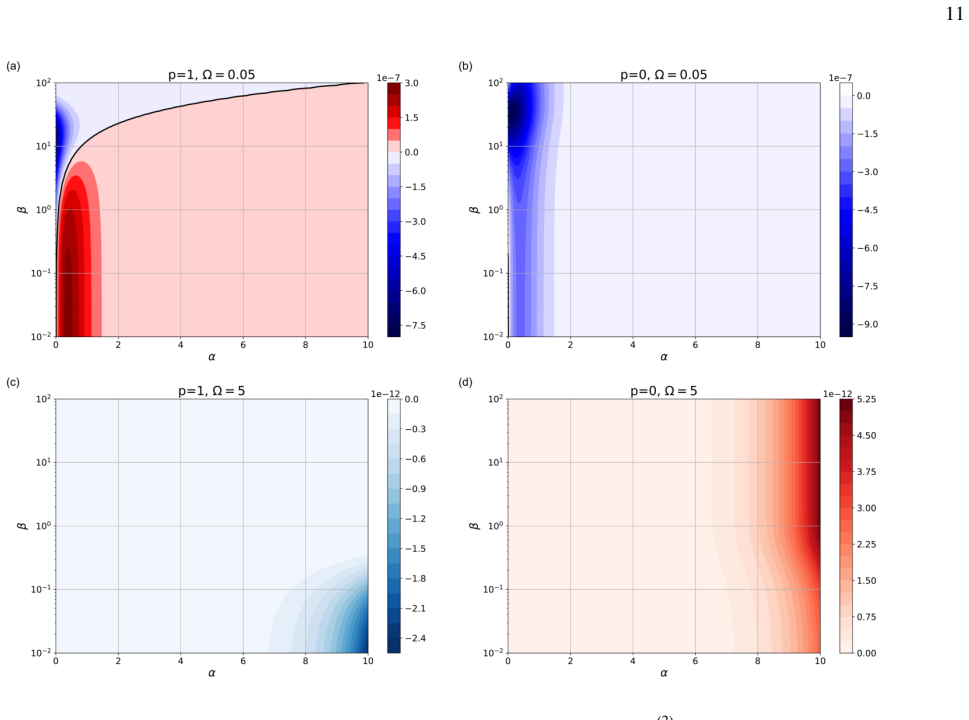
Work Extraction W(2) ext Though the density plots of W(2) ext can give a more complete picture, it is not easy to compare di fferent types of qubit coupling. Alternatively, here we present the 1D plots ofW(2) ext on only one parameter but with others fixed for all three qubit-coupling cases in a single figure. In this way, we can see how the patterns of W...
-
[13]
Lenard, Journal of Statistical Physics 19, 575 (1978)
A. Lenard, Journal of Statistical Physics 19, 575 (1978)
work page 1978
-
[14]
W. Pusz and S. L. Woronowicz, Communications in Mathemat- ical Physics 58, 273 (1978)
work page 1978
-
[15]
P. Skrzypczyk, R. Silva, and N. Brunner, Phys. Rev. E 91, 052133 (2015)
work page 2015
-
[16]
Jarzynski, Physical Review Letters 78, 2690 (1997)
C. Jarzynski, Physical Review Letters 78, 2690 (1997)
work page 1997
-
[17]
G. E. Crooks, Physical Review E 61, 2361 (2000)
work page 2000
-
[18]
G. E. Crooks, Physical Review E 60, 2721 (1999)
work page 1999
-
[19]
Jarzynski Relations for Quantum Systems and Some Applications
H. Tasaki, arXiv preprint cond-mat /0009244 (2000), 10.48550/arXiv.cond-mat/0009244
work page internal anchor Pith review Pith/arXiv arXiv doi:10.48550/arxiv.cond-mat/0009244 2000
-
[20]
J. Liphardt, S. Dumont, S. B. Smith, I. Tinoco, and C. Busta- mante, Science (New York, N.Y .)296, 1832—1835 (2002)
work page 2002
- [21]
-
[22]
T. B. Batalhão, A. M. Souza, L. Mazzola, R. Auccaise, R. S. Sarthour, I. S. Oliveira, J. Goold, G. De Chiara, M. Paternostro, and R. M. Serra, Phys. Rev. Lett. 113, 140601 (2014)
work page 2014
-
[23]
N. C. Harris, Y . Song, and C.-H. Kiang, Phys. Rev. Lett. 99, 068101 (2007)
work page 2007
-
[24]
Z. Fei, J. Zhang, R. Pan, T. Qiu, and H. T. Quan, Phys. Rev. A 99, 052508 (2019)
work page 2019
-
[25]
A. Solfanelli, A. Santini, and M. Campisi, PRX Quantum 2, 030353 (2021)
work page 2021
-
[26]
D. Hahn, M. Dupont, M. Schmitt, D. J. Luitz, and M. Bukov, Physical Review X 13, 041023 (2023)
work page 2023
-
[27]
L. Bassman Oftelie and M. Campisi, Quantum Sci. Technol.10, 025045 (2025), arXiv:2412.17491 [quant-ph]
-
[28]
Silva, Physical review letters 101, 120603 (2008)
A. Silva, Physical review letters 101, 120603 (2008)
work page 2008
-
[29]
F. N. Paraan and A. Silva, Physical Review E—Statistical, Non- linear, and Soft Matter Physics 80, 061130 (2009)
work page 2009
-
[30]
N. O. Abeling and S. Kehrein, Phys. Rev. B 93, 104302 (2016)
work page 2016
- [31]
- [32]
-
[33]
E. G. Arrais, D. A. Wisniacki, A. J. Roncaglia, and F. Toscano, Phys. Rev. E 100, 052136 (2019)
work page 2019
- [34]
- [35]
-
[36]
C. Aron, G. Biroli, and L. F. Cugliandolo, SciPost Phys. 4, 008 (2018), arXiv:1705.10800 [cond-mat.stat-mech]
work page internal anchor Pith review Pith/arXiv arXiv 2018
- [37]
- [38]
-
[39]
W. G. Unruh, Phys. Rev. D 14, 870 (1976)
work page 1976
-
[40]
Quantum gravity: The new synthesis ,
B. S. DeWitt, “Quantum gravity: The new synthesis ,” in Gen- eral Relativity: An Einstein Centenary Survey (1980) pp. 680– 745
work page 1980
-
[41]
Jarzynski Equality for Driven Quantum Field Theories
A. Bartolotta and S. De ffner, Phys. Rev. X 8, 011033 (2018), arXiv:1710.00829 [cond-mat.stat-mech]
work page internal anchor Pith review Pith/arXiv arXiv 2018
- [42]
- [43]
-
[44]
D. J. Evans, E. G. D. Cohen, and G. P. Morriss, Phys. Rev. Lett. 71, 2401 (1993)
work page 1993
-
[45]
D. J. Evans and D. J. Searles, Phys. Rev. E 50, 1645 (1994)
work page 1994
- [46]
-
[47]
G. E. Crooks, Phys. Rev. A 77, 034101 (2008)
work page 2008
-
[48]
A. M. Alhambra, L. Masanes, J. Oppenheim, and C. Perry, Phys. Rev. X 6, 041017 (2016)
work page 2016
- [49]
- [50]
-
[51]
Z. Huang, Phys. Rev. A 105, 062217 (2022), arXiv:2201.08691 [quant-ph]
-
[52]
Á. M. Alhambra, L. Masanes, J. Oppenheim, and C. Perry, Physical Review X 6, 041017 (2016), arXiv:1601.05799 [quant-ph]
work page internal anchor Pith review Pith/arXiv arXiv 2016
- [53]
- [54]
-
[55]
G. Bai, F. Buscemi, and V . Scarani, arXiv preprint arXiv:2412.12489 (2024)
work page internal anchor Pith review Pith/arXiv arXiv 2024
-
[56]
A. Biggs and J. Maldacena, arXiv preprint arXiv:2405.02227 (2024), 10.48550/arXiv.2405.02227
-
[57]
Wick Theorem for General Initial States
R. van Leeuwen and G. Stefanucci, Phys. Rev. B 85, 115119 (2012), arXiv:1102.4814 [cond-mat.stat-mech]
work page internal anchor Pith review Pith/arXiv arXiv 2012
-
[58]
Wick theorem for all orderings of canonical operators
L. Diósi, J. Phys. A 51, 365201 (2018), arXiv:1712.08811 [quant-ph]
work page internal anchor Pith review Pith/arXiv arXiv 2018
-
[59]
L. Ferialdi and L. Diósi, Phys. Rev. A 104, 052209 (2021), arXiv:2110.02920 [quant-ph]
-
[60]
L. Ferialdi, Phys. Rev. D 107, 105010 (2023), arXiv:2302.01264 [quant-ph]
-
[61]
T. S. Evans and D. A. Steer, Nucl. Phys. B 474, 481 (1996), arXiv:hep-ph/9601268
work page internal anchor Pith review Pith/arXiv arXiv 1996
-
[62]
On Normal ordering and Canonical transformations in Thermal Field Theory
M. Blasone, T. S. Evans, D. A. Steer, and G. Vitiello, J. Phys. A 32, 1185 (1999), arXiv:hep-ph/9706549
work page internal anchor Pith review Pith/arXiv arXiv 1999
-
[63]
T. S. Evans, T. W. B. Kibble, and D. A. Steer, J. Math. Phys. 39, 5726 (1998), arXiv:hep-ph/9801404
work page internal anchor Pith review Pith/arXiv arXiv 1998
-
[64]
L. S. Brown, Quantum Field Theory (Cambridge University Press, 1992)
work page 1992
-
[65]
Seifert, Reports on progress in physics 75, 126001 (2012)
U. Seifert, Reports on progress in physics 75, 126001 (2012)
work page 2012
-
[66]
Yunger Halpern, Physical Review A 95, 012120 (2017)
N. Yunger Halpern, Physical Review A 95, 012120 (2017)
work page 2017
-
[67]
J. Polchinski, String theory. V ol. 1: An introduction to the bosonic string , Cambridge Monographs on Mathematical Physics (Cambridge University Press, 2007)
work page 2007
-
[68]
A. Y . Kitaev, Physics-uspekhi44, 131 (2001)
work page 2001
-
[69]
Topological phases and quantum computation
A. Kitaev and C. Laumann, (2010), 10.48550/arXiv.0904.2771, 0904.2771
work page internal anchor Pith review Pith/arXiv arXiv doi:10.48550/arxiv.0904.2771 2010
discussion (0)
Sign in with ORCID, Apple, or X to comment. Anyone can read and Pith papers without signing in.