REVIEW 3 major objections 4 minor 2 cited by
DataS^3: Dataset Subset Selection for Specialization
T0 review · 3 major / 4 minor · reviewed 2026-08-16 · deepseek-v4-flash
Pith's one-line read Deployment-specific subsets of a general training pool can beat training on all the data, with gains up to 51.3 percent.
desk verdict Useful benchmark for deployment-specific data selection, but the AutoArborist ID/OOD contradiction undercuts the flagship number and must be fixed. read the letter →
The pith
A machine-rendered reading of the paper's core claim, the machinery that carries it, and where it could break.
The reading
What carries the argument
The load-bearing object is the DS3 selection objective (Equation 1): an algorithm receives the training pool $T$ and a query set $Q$ drawn from the deployment distribution, and must return the subset $S\subset T$ that minimizes the expected deployment loss $\mathbb{E}_{q\sim P_Q}\,L(\theta(S), q)$. The benchmark wraps this objective in a fixed four-step pipeline: split the deployment pool into query and evaluation sets, select a subset, finetune a fixed model (ResNet50, ViT, or YOLOv8n depending on task), and evaluate on the held-out deployment set. The knowledge-driven subsets act as oracle upper bounds for the existence claim, since they are built from metadata and class lists rather than from the query set itself.
What would settle it
Recompute the iWildCam Deployment 1 knowledge-driven subset without the step that removes classes absent from the deployment, keeping only the GPS-proximity filter, and retrain under the same protocol. If accuracy drops to the all-data baseline, the reported gains depend on oracle class-list pruning rather than on selection from the query set.
Extended reading notes
Core claim
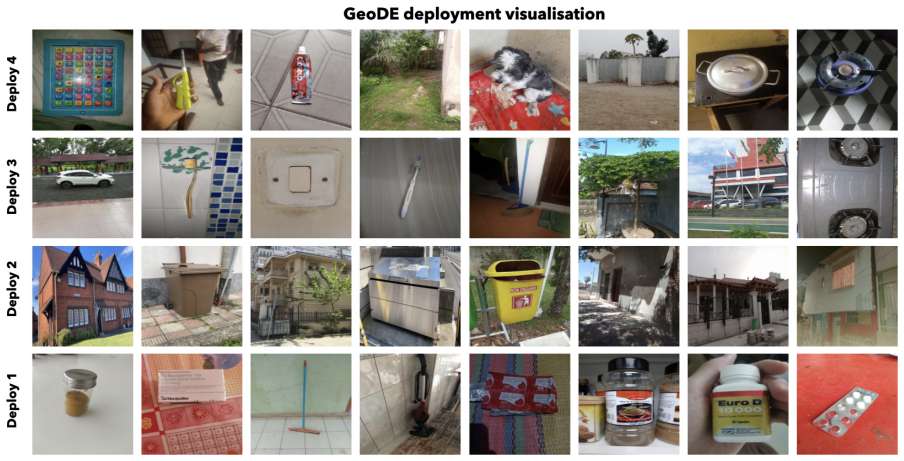
On the paper's own terms, the discovery is an existence result: for each of the twelve deployments in the benchmark, there is a curated subset of the general training pool whose fine-tuned model beats the model trained on the entire pool. These knowledge-driven subsets are constructed with information that benchmark users are not given, such as GPS proximity between training camera traps and the deployment, matching city, country, or region identity, and the full class list of the deployment evaluation set. The reported margins are up to 3.6% higher accuracy on GeoDE, 11.9% on iWildCam, and 51.3% on AutoArborist, a 0.03 lower mean squared error on NuScenes, and a 0.13 higher mAP50 on FishDetection. A second claim is negative: simple query-set alignment baselines, both image-alignment and nearest-neighbor, do not consistently reach these gains, so the benchmark is offered as an open testbed rather than a solved task.
Load-bearing premise
The load-bearing premise is that the knowledge-driven subsets are fair upper bounds: they use privileged information (deployment class lists and GPS locations) that users are not given, and the paper's own split descriptions conflict over which AutoArborist deployments count as in-distribution, so the gains may not be approachable by a method that only sees the unlabeled query set.
Editorial extensions
If this is right
- A model fine-tuned on a deployment-matched subset can beat a model trained on the full general pool, so data selection is a lever for deployment performance independent of architecture.
- Subset sizes that achieve these gains average 4–20% of the training pool, so specialization can also cut training compute and storage.
- Methods designed for generalization, such as coresets and distribution matching, are not directly transferable to specialization, which is why a dedicated benchmark is needed.
- Since labeled query sets are often unavailable in field deployments, progress on unlabeled-query subset selection is the main requirement for practical impact.
Reading between the lines
- Beyond the paper, separating the two ingredients of the oracle subsets—class-list pruning and geographic proximity—would show which one carries the gains; a method that predicts deployment classes from query images could emulate the first without labels.
- The same pipeline could be applied to the future-work domains named in the paper (histopathology, ICU mortality, crop mapping, galaxy classification), providing a quick test of whether subset-existence transfers across data modalities.
- The NuScenes result hints that in regression settings, removing irrelevant scenes may matter more than sample count; a direct test would train on random subsets matched for size and compare variance.
Signed reviews
Editorial analysis
A structured set of objections, weighed in public.
Referee Report
Summary. The paper formalizes dataset subset selection for specialization (DS3): given a general training pool and a small query set from a deployment-specific distribution, select a training subset that maximizes deployment performance. It introduces DataS3, a benchmark spanning five datasets (iWildCam, AutoArborist, GeoDE, NuScenes, FishDetection) with twelve deployments, evaluates a suite of coreset and data-filtering baselines, and reports proof-of-concept expert/knowledge-driven subsets that often outperform training on all available data. The central empirical claim is that deployment-specific curated subsets can substantially beat all-data training while using far less data.
Significance. If the protocol issues are resolved, DataS3 would be a timely and useful benchmark: it operationalizes a practical problem that existing subset-selection benchmarks do not target, and the existence result that curated subsets can outperform training on the full pool at a fraction of the data size is nontrivial and motivating for new methods. The paper also ships open-source splits and code, which strengthens its reproducibility. However, the current draft contains direct internal contradictions in the experimental protocol, and several headline numbers in the results section are not supported by the reported tables. The benchmark's value can only be assessed after these load-bearing issues are corrected.
major comments (3)
- [Section 4.3 and Appendix D.3] The paper gives two mutually exclusive descriptions of the AutoArborist deployment splits. Section 4.3 states that Surrey and Calgary are in-distribution (ID) deployments with some of their data in the training pool, while Los Angeles and Washington DC are out-of-distribution (OOD) with no city data in the pool; the knowledge-driven subsets are then built from Surrey/Calgary data for Deployments 1 and 2 and from nearby cities for Deployments 3 and 4. Appendix D.3 states the opposite, identifying Los Angeles and Washington DC as ID and Surrey and Calgary as OOD, and describes the expert subsets accordingly. These two protocols produce materially different subsets, and the largest headline result (AutoArborist Deployment 1, 0.86 vs 0.35) depends on which description is correct. Please unify the two sections and report exactly which training-pool cities were used for each knowledge-driven subset.
- [Section 6 and Table 1] The text in Section 6 is not supported by Table 1 in two places. First, the claimed 'up to 11.9%' improvement for iWildCam does not appear in the table: the largest knowledge-driven improvement over all-data is 0.75 vs 0.72 (Deployment 3), about 4.2% relative or 3 percentage points. Second, the sentence 'Even when the knowledge-driven subsets underperform all training data, as in NuScenes Deployment 2, there exist subsets from other baselines that outperform using all the data' contradicts Table 1, where all-data has MSE 0.021 and every listed subset has MSE at least 0.032. Please correct these claims or identify which table or metric they refer to.
- [Sections 4.1, 4.3, and 6] The knowledge-driven subsets are constructed with information that DS3 algorithms will not have, notably the deployment's class list (used to eliminate classes absent from the deployment) and geographic metadata (Section 4.1; Section 4.3; Appendix D). This is disclosed in Section 4, but Section 6's discussion of 'well-chosen subsets' and the abstract's existence framing do not consistently make clear that these are oracle upper bounds rather than selections achievable by an algorithm that only sees the query set. Because the class-list pruning directly encodes part of the evaluation distribution, the reported gains likely conflate two effects: removing irrelevant classes and matching location. Please state explicitly that the knowledge-driven results are oracle bounds computed with privileged information, and consider decomposing the AutoArborist and iWildCam gains into the contribution from class pruning versus location-based selection.
minor comments (4)
- [Appendix D.2] The 'Expert subsets' paragraph for GeoDE appears to be copied from the iWildCam section: it refers to 'the testing pool', 'relevant locations', and a 500km radius, which does not match Section 4.2's description of selecting African subcontinent data for Nigeria, Asian subcontinent data for Indonesia, and indoor/outdoor objects for the other deployments. Please replace this with the correct GeoDE protocol.
- [Table 6 and Figure 3] The AutoArborist deployment class counts are inconsistent: Section 4.3 and Figure 3 state Calgary has 30 classes, Los Angeles has 175, and Washington DC has 67, while Table 6 lists Calgary as 15, Los Angeles as 30, and Washington DC as 33, even though the listed genus lists agree with the former counts. Please align the header values with the actual class lists.
- [Section 6 and abstract] The paper mixes relative and absolute gains without definition: AutoArborist's '51.3%' is 0.86 - 0.35 = 0.51 in absolute accuracy (51 percentage points), which is not a relative improvement (about 145% relative); GeoDE's '3.6%' is likewise an absolute difference. Please state consistently whether reported gains are relative or absolute.
- [Related Work] The citation 'Anonymous (2023)' in the Related Work section is not appropriate for a journal version; please replace it with the actual reference or remove the anonymized citation.
Circularity Check
No significant circularity: the knowledge-driven subsets are explicitly oracle constructions evaluated on held-out data, and the benchmark's central claim is an existence result rather than a prediction derived from its inputs.
full rationale
The paper's central claim is an empirical existence claim: manually curated knowledge-driven subsets, evaluated on held-out deployment evaluation sets, outperform the full training pool. This is not a derivation or prediction that reduces to its inputs. Section 4 explicitly labels these subsets as a "proof-of-concept 'oracle' / knowledge-driven subset" and states that they were created using information benchmark users are not provided (metadata, GPS location, region), and Section 6 states that "finding this subset without extra knowledge is still an open problem." The evaluation is an independent measurement on separated evaluation data, not a fitted statistic: hyperparameters are swept and reported per subset, and the all-data and algorithmic baselines are trained with the same protocol. No load-bearing result is justified by a self-citation: the cited prior work provides datasets or background, not the paper's existence claim. The acknowledged use of deployment class lists and geospatial metadata to construct oracle subsets is a benchmark-design limitation concerning upper bounds and reproducibility, not circularity. The contradictory ID/OOD descriptions for AutoArborist between Section 4.3 and Appendix D.3 are an internal experimental inconsistency that should be corrected but do not constitute a circular argument. Therefore no circular step is identified.
Assumptions & free parameters
free parameters (6)
- iWildCam expert subset radius =
100 km for ID deployments, 500 km for OOD deployments
- AutoArborist expert subset city set =
Main text: Surrey/Calgary data for Surrey/Calgary; SF/SJ for LA; Charlottesville/Pittsburgh/NY for DC.
- Query set size =
500 images (iWildCam, GeoDE, NuScenes); 1500 (AutoArborist)
- Near-Nbors cluster count =
1000
- CLIP-score subset thresholds =
25%, 50%, 75%, 90% of dataset
- Image-Align overlap threshold =
{1, 10, 100} query examples
assumptions (4)
- domain assumption The stratified query set is representative of the deployment evaluation distribution.
- domain assumption Fine-tuning a fixed pretrained model on a selected subset is a valid way to measure deployment performance.
- domain assumption The external dataset splits (WILDS-iWildCam, AutoArborist, GeoDE, NuScenes, VIAME) are correct and leak-free.
- ad hoc to paper The oracle expert subsets may use the deployment class list and metadata not provided to benchmark users.
Cite this review
Pith. "Pith review of DataS^3: Dataset Subset Selection for Specialization." pith.science (2026). https://pith.science/paper/O7FOYONH
@misc{pith2026250416277,
  author       = {Pith},
  title        = {Pith review of: DataS^3: Dataset Subset Selection for Specialization},
  year         = {2026},
  howpublished = {\url{https://pith.science/paper/O7FOYONH}},
  note         = {Machine review of arXiv:2504.16277}
}
read the original abstract
In many real-world machine learning (ML) applications (e.g. detecting broken bones in x-ray images, detecting species in camera traps), in practice models need to perform well on specific deployments (e.g. a specific hospital, a specific national park) rather than the domain broadly. However, deployments often have imbalanced, unique data distributions. Discrepancy between the training distribution and the deployment distribution can lead to suboptimal performance, highlighting the need to select deployment-specialized subsets from the available training data. We formalize dataset subset selection for specialization (DS3): given a training set drawn from a general distribution and a (potentially unlabeled) query set drawn from the desired deployment-specific distribution, the goal is to select a subset of the training data that optimizes deployment performance. We introduce DataS^3; the first dataset and benchmark designed specifically for the DS3 problem. DataS^3 encompasses diverse real-world application domains, each with a set of distinct deployments to specialize in. We conduct a comprehensive study evaluating algorithms from various families--including coresets, data filtering, and data curation--on DataS^3, and find that general-distribution methods consistently fail on deployment-specific tasks. Additionally, we demonstrate the existence of manually curated (deployment-specific) expert subsets that outperform training on all available data with accuracy gains up to 51.3 percent. Our benchmark highlights the critical role of tailored dataset curation in enhancing performance and training efficiency on deployment-specific distributions, which we posit will only become more important as global, public datasets become available across domains and ML models are deployed in the real world.
Figures


Figures from the paper (9 more)




Forward citations
Cited by 2 Pith papers
-
Provable Pruning for Efficient 3D Gaussian Splatting via Coresets
3DGS admits resolution-dependent multiplicative coresets via sensitivity sampling (impossible unrestricted), and the resulting prune rule is SOTA under no or very short finetuning.
-
A Critical Look at Targeted Instruction Selection: Disentangling What Matters (and What Doesn't)
Only gradient-based (LESS) representations make subset-to-query distance a reliable predictor of instruction-tuning performance; greedy round-robin helps most at small budgets, and random selection is surprisingly com...
Reference graph
Works this paper leans on
-
[4]
and eliminating irrelevant classes that are not present in the testing set. For Deployments 2 and 4 (the OOD deployments), the expert subsets were created by only choosing data from locations that are within 500km of the locations in the deployments and eliminating irrelevant classes that are not present in the testing set. 19 Deployment # # classes # ima...
work page 2009
-
[5]
Zhang, Aahlad Manas Puli, and Rajesh Ranganath
Rhys Compton, Lily H. Zhang, Aahlad Manas Puli, and Rajesh Ranganath. When more is less: Incorporating additional datasets can hurt performance by introducing spurious correlations. ArXiv, abs/2308.04431,
-
[9]
Active Learning for BERT: An Empirical Study
Liat Ein-Dor, Alon Halfon, Ariel Gera, Eyal Shnarch, Lena Dankin, Leshem Choshen, Marina Danilevsky, Ranit Aharonov, Yoav Katz, and Noam Slonim. Active Learning for BERT: An Empirical Study. InProceedings of the 2020 Conference on Empirical Methods in Natural Language Processing (EMNLP), pages 7949–7962, Online,
work page 2020
-
[10]
SELECT: A Large-Scale Benchmark of Data Curation Strategies for Image Classification
Association for Computational Linguistics. Benjamin Feuer, Jiawei Xu, Niv Cohen, Patrick Yubeaton, Govind Mittal, and Chinmay Hegde. Select: A large-scale benchmark of data curation strategies for image classification. arXiv preprint arXiv:2410.05057,
-
[14]
Measuring robustness to natural distribution shifts in image classification
Rohan Taori, Achal Dave, Vaishaal Shankar, Nicholas Carlini, Benjamin Recht, and Ludwig Schmidt. Measuring robustness to natural distribution shifts in image classification. ArXiv, abs/2007.00644,
arXiv 2007
-
[15]
Drive anywhere: Generalizable end-to-end autonomous driving with multi-modal foundation models
Tsun-Hsuan Wang, Alaa Maalouf, Wei Xiao, Yutong Ban, Alexander Amini, Guy Rosman, Sertac Karaman, and Daniela Rus. Drive anywhere: Generalizable end-to-end autonomous driving with multi-modal foundation models. In 2024 IEEE International Conference on Robotics and Automation (ICRA), pages 6687–6694. IEEE,
work page 2024
-
[16]
Michelle Yuan, Hsuan-Tien Lin, and Jordan Boyd-Graber
European Language Resources Association. Michelle Yuan, Hsuan-Tien Lin, and Jordan Boyd-Graber. Cold-start active learning through self-supervised language modeling. In Proceedings of the 2020 Conference on Empirical Methods in Natural Language Processing (EMNLP), pages 7935–7948, Online,
work page 2020
-
[17]
These "efficiency-style" experiments were not performed for the full-finetuning ResNet50 models, due to computational constraints of training a great number of models. Figure 4: Plotting the sample efficiency of the baselines, for the baselines that thresholds of subset size were set (CLIP-score, Image-Align, Match-Dist), with Random as a comparison point...
work page 2015
Show all 20 references
-
[19]
in-distribution
and eliminating irrelevant classes that are not present in the testing set. For Deployments 2 and 4 (the OOD deployments), the expert subsets were created by only choosing data from locations that are within 500km of the locations in the deployments and eliminating irrelevant ...
2016
-
[20]
extraneous
25 Figure 10: AutoArborist deployment label distribution for the 50 most common classes (commonly determined by the training pool) in log-scale. As seen, there is a significant label shift from the training pool to the deployments, and from the deployments to each other. 26 De...
2020
-
[2004]
Zhang, Shaoqing Ren, and Jian Sun
Kaiming He, X. Zhang, Shaoqing Ren, and Jian Sun. Deep residual learning for image recognition. 2016 IEEE Conference on Computer Vision and Pattern Recognition (CVPR), pages 770–778,
2016
-
[2008]
An open-source platform for underwater image and video analytics
Matthew Dawkins, Linus Sherrill, Keith Fieldhouse, Anthony Hoogs, Benjamin Richards, David Zhang, Lakshman Prasad, Kresimir Williams, Nathan Lauffenburger, and Gaoang Wang. An open-source platform for underwater image and video analytics. In 2017 IEEE Winter Conference on Appl...
2017
-
[2009]
Alina Kuznetsova, Hassan Rom, Neil Gordon Alldrin, Jasper R. R. Uijlings, Ivan Krasin, Jordi Pont-Tuset, Shahab Kamali, Stefan Popov, Matteo Malloci, Alexander Kolesnikov, Tom Duerig, and Vittorio Ferrari. The open images dataset v4. International Journal of Computer Vision, 1...
1956
-
[2016]
New frameworks for offline and streaming coreset constructions
Vladimir Braverman, Dan Feldman, and Harry Lang. New frameworks for offline and streaming coreset constructions. arXiv preprint arXiv:1612.00889,
-
[2017]
Imagenet: A large-scale hierarchical image database
Jia Deng, Wei Dong, Richard Socher, Li-Jia Li, Kai Li, and Li Fei-Fei. Imagenet: A large-scale hierarchical image database. In 2009 IEEE Conference on Computer Vision and Pattern Recognition, pages 248–255, 2009a. Jia Deng, Wei Dong, Richard Socher, Li-Jia Li, Kai Li, and Li F...
2009
-
[2019]
The iwildcam 2021 competition dataset,
Sara Beery, Arushi Agarwal, Elijah Cole, and Vighnesh Birodkar. The iwildcam 2021 competition dataset,
2021
-
[2020]
11 Tom B. Brown, Benjamin Mann, Nick Ryder, Melanie Subbiah, Jared Kaplan, Prafulla Dhariwal, Arvind Neelakantan, Pranav Shyam, Girish Sastry, Amanda Askell, Sandhini Agarwal, Ariel Herbert-V oss, Gretchen Krueger, Tom Henighan, Rewon Child, Aditya Ramesh, Daniel M. Ziegler, J...
2005 arXiv
-
[2021]
Majewski, Shreyasee Mukherjee, Stanley Chan, John Morgan, Vivek Rathod, and Jonathan Huang
Sara Beery, Guanhang Wu, Trevor Edwards, Filip Pavetic, Bohdan S. Majewski, Shreyasee Mukherjee, Stanley Chan, John Morgan, Vivek Rathod, and Jonathan Huang. The auto arborist dataset: A large-scale benchmark for multiview urban forest monitoring under domain shift.2022 IEEE/C...
2022
-
[2022]
An image is worth 16x16 words: Transformers for image recognition at scale
Alexey Dosovitskiy, Lucas Beyer, Alexander Kolesnikov, Dirk Weissenborn, Xiaohua Zhai, Thomas Unterthiner, Mostafa Dehghani, Matthias Minderer, Georg Heigold, Sylvain Gelly, Jakob Uszkoreit, and Neil Houlsby. An image is worth 16x16 words: Transformers for image recognition at...
2010 arXiv
-
[2023]
Living planet report 2020: Bending the curve of biodiversity loss,
Francis Staub. Living planet report 2020: Bending the curve of biodiversity loss,
2020
Reviewed August 16, 2026 · model on record in the stance chip above.
Discussion (0). Continue with ORCID to comment.