Quantum Physics · arXiv:2505.06157 v1 · submitted 9 May 2025 · 32 references
Advancing Finite-Length Quantum Error Correction Using Generalized Bicycle Codes
The paper says
“Generalized bicycle (GB) codes have emerged as a promising class of quantum error-correcting codes with practical decoding capabilities. While numerous asymptotically good quantum codes and quantum low-density parity-check code constructions have been proposed, their finite block-length performance often remains unquantified.”
more of the abstract
In this work, we demonstrate that GB codes exhibit comparable or superior error correction performance in finite-length settings, particularly when designed with higher or unrestricted row weights. Leveraging their flexible construction, GB codes can be tailored to achieve high rates while maintaining efficient decoding. We evaluate GB codes against other leading quantum code families, such as quantum Tanner codes and single-parity-check product codes, highlighting their versatility in practical finite-length applications.
from the abstract
Pith says
Machine review · deepseek-v4-flash · 15 Aug 2026 · what was read was not recorded · not checked by a person
It can be wrong. Challenge this review or reply to it.
Holds up, with conditions. A useful, honest finite-length code paper: new GB code constructions and comparisons that support a modest claim, but the family-level superiority statement overreaches the evidence. This line is wrong
4 major objections · 5 minor
How often objections from reviews like this one are right: not yet measured
Not checked: figures, code, what the 32 references say.
The paper says, at Section IV (Simulation methodology, paragraph on GB code selection)
The review did not quote this passage.
Pith says: Objection 1 of 4 · major
The comparison is asymmetric: each GB code is selected as the best of 5–20 random attempts, while each comparator is a single fixed published instance (the [[392,32,12]]/[[392,48,12]] QT codes, the [[512,174,8]] SPC code, and the [[144,12,12]] BB code). Best-of-N selection inflates the apparent performance of the favored family because the reported curve is the maximum over many random draws, whereas the comparators receive no such selection.
more of objection 1
To support the abstract's claim that GB codes are 'comparable or superior' as a family, the authors should either report the distribution of GB code performance over the random attempts, provide a similar best-of-N selection for the comparator families (e.g., by sampling multiple QT or SPC codes with the same construction rules), or explicitly limit the claim to the specific listed codes rather than the family.
The paper says, at Section IV (decoder tuning; α in MBP4)
The review did not quote this passage.
Pith says: Objection 2 of 4 · major
The decoder parameter α is swept per code from 1.0 upward until 'performance saturates,' and different values are used for different codes (e.g., α=1.6 for GB#1 and QT codes, α=1.2 for GB#3, α=1.5 for BB and GB#5). It is not stated whether the QT, SPC, and BB comparators received the same optimization budget, or whether their α values were simply taken as given.
more of objection 2
Unequal tuning of a decoder hyperparameter can change the relative ordering of steep error-rate curves, so the authors should either document that all codes were tuned with the same procedure, or show that the reported conclusions are robust to a range of α for the comparators.
The paper says, at Section IV (statistical methodology, sentence on error-event counts)
The review did not quote this passage.
Pith says: Objection 3 of 4 · major
The paper reports at least 200 error events per point, dropping to 100 below 10^-4, but does not provide confidence intervals or error bars. For the claims of superiority by one to two orders of magnitude and the statement that 'no error floor is observed' at a logical error rate of 10^-7, the number of collected error events is modest; a Poisson error of 10% on each point can shift a steep curve noticeably.
more of objection 3
The authors should add error bars or at least state the standard deviation, and should clarify how many trials were performed for the lowest-rate points where only 100 events were collected.
The paper says, at Figures 1–3 and accompanying text (IV.A–IV.C)
The review did not quote this passage.
Pith says: Objection 4 of 4 · major
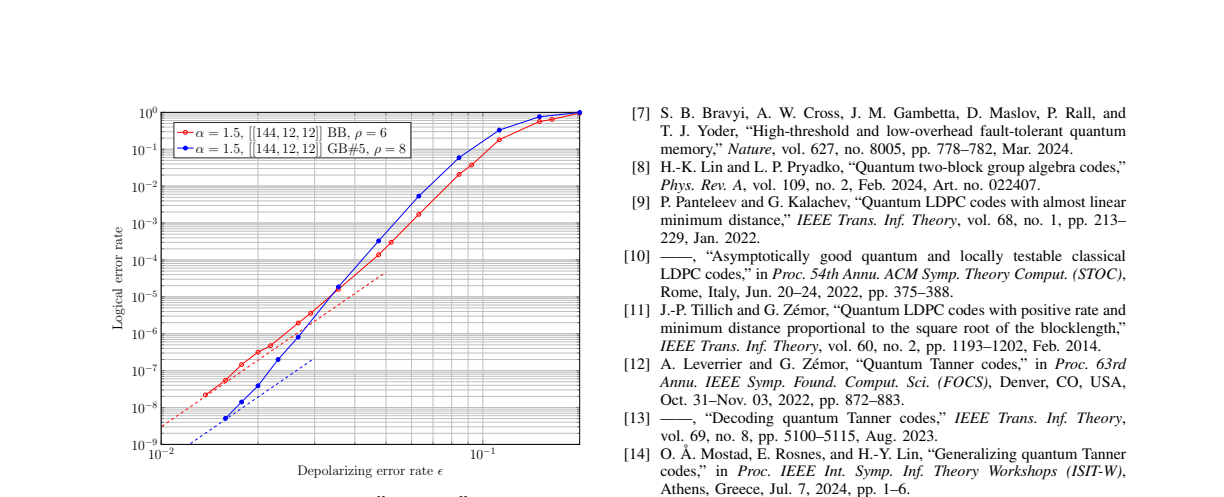
The comparisons are not at matched minimum distance or row weight: GB#1 has d=14 versus QT d=12; GB#3 has d=6 versus SPC d=8; GB#5 has d=12 but row weight 8 versus BB row weight 6. Since the central claim is that GB codes are 'comparable or superior' at finite lengths, the advantage in some plots may be attributable to the …
more of objection 4
… higher minimum distance of the GB code (GB#1) or to the relaxed row weight (GB#5) rather than to the code family itself. The authors should either compare codes with identical or closely matched (n,k,d, row weight) parameters, or explicitly disentangle the effect of distance and row weight from the family comparison, for instance by including multiple GB codes with the same distance as the comparator.
5 minor objections
The paper says, at Section IV (introductory paragraph)
Pith says: minor objection 1 of 5
The sentence 'For each code of minimum distance 2t+1 or 2t+2, we include a reference curve y = a x^{t+1}' appears to describe a dashed reference line in the figures, but no such reference curves are visible in Figures 1–3. Either add the curves or remove the sentence.
The paper says, at Section III.A (Construction MMM, step (iii))
Pith says: minor objection 2 of 5
The statement 'It is important to maintain uniform column weights during the row removal process' is not followed by any explanation of how uniform column weights are enforced or why it matters. A brief clarification or a reference to the code-generation script would help.
show 3 more
The paper says, at Section IV (paragraph on α tuning)
Pith says: minor objection 3 of 5
The description of the α sweep ('values from 1.0,1.1,..., until performance saturates') is underspecified: the increment (0.1) and the saturation criterion (e.g., no further drop in logical error rate over a range) should be stated.
The paper says, at Section III.B (Quantum Tanner Codes)
Pith says: minor objection 4 of 5
The notation 'C(A⊗C_B)^⊥' and 'C^⊥_A ⊗ C^⊥_B' is a bit terse; the authors could define the tensor product of parity-check matrices or point to the relevant section of [12] more explicitly.
The paper says, at Section III.D (Bivariate Bicycle Codes)
Pith says: minor objection 5 of 5
In the sentence 'Since U and W are circulants, with U^{ℓ1}=W^{ℓ2}=I_{ℓ1ℓ2}', the statement holds because U= S_{\ell1}⊗I_{\ell2} and W=I_{\ell1}⊗S_{\ell2}; the authors might want to write the tensor product explicitly to avoid confusion about the exponents acting on the full matrix.
What would settle it
Use the [[144,12]] benchmark from Section IV.C. Enumerate or randomly sample 100 BB codes from the bivariate-bicycle construction of [7] with length 144 and dimension 12 (varying l1, l2, and monomial exponents while keeping row weight 6), and 100 GB codes from Construction PK with row weight 8 and matched [[144,12]] parameters. Decode every code with the same MBP4+ADOSD4 decoder, using the same α-sweep budget and the same number of Monte Carlo trials per code (e.g., 10^6 at each ε). Compare the median and best logical error rates at ε=0.01 and ε=0.02. If a sampled BB code matches or beats GB#5, or if the best-of-100 GB advantage is within Monte Carlo error, the claimed family-level superiority does not hold.
from the skeptic's reading
How the review went
4 readings by deepseek-v4-flash · 15 Aug 2026
- Reader holds up, with conditions
- Skeptic agrees
- Editor wrote the verdict above
- Referee major revision: 4 major objections, 5 minor
Not run on this paper: the simulated authors' defence.
Pith did not check this review's objections against the paper.
The review in full
The review in brief, machine-written
Quick take: this is a useful, honest engineering paper that gives the community several new generalized bicycle codes and a careful simulation comparison against quantum Tanner, SPC product, and bivariate bicycle codes. The central claim—GB codes can be competitive or better at finite lengths when you let row weights grow—is plausible and supported by the plotted data, but the evidence is a family-level comparison with an asymmetry that the paper underplays.
What's new: Construction MMM, a simple way to get even-length GB codes with specified row weight, plus five explicit code examples with polynomials (GB#1–GB#5). The systematic comparison against QT, SPC, and BB codes at matched length and dimension is genuinely useful. The authors are careful about decoder choice (MBP4+ADOSD4), give reference curves based on distance, and are upfront in the conclusion that higher row weight complicates syndrome extraction. That candor earns credit.
Soft spots: First, the selection asymmetry. GB codes are chosen as best of 5–20 random attempts, while each competitor is a single fixed published example. The authors did try to improve the QT code with column permutations and report no luck, which helps, but it's not the same search budget. The claim 'GB codes exhibit comparable or superior performance' as a family statement is too strong; 'the constructed GB codes' would be defensible. Second, no error bars or confidence intervals. With 100–200 error events at low rates, the steep curves could shift more than one might think. On a minor note, the comparison in Fig. 2 pits a distance-6 code against a distance-8 code; the authors mention this, but the headline 'outperforms SPC' deserves that caveat visible in the text, not just in the code parameters.
The math and citation pattern look solid. The construction is clearly derived from existing bicycle concepts, and the novelty is appropriately modest. No sign of circularity; alpha tuning is a standard practice, though it's worth stating that comparators weren't given the same tuning budget.
Who it's for: people working on finite-length QLDPC codes and quantum memory architectures looking for concrete code options. It deserves serious peer review—with revision to soften the family-level claim, add error bars or at least error-event counts, and ideally release code/data. I'd recommend sending it out.
The strongest objection
The central claim that GB codes are 'comparable or superior' to QT, SPC, and BB codes at finite lengths is a family-level statement, but the supporting simulations compare a small selected sample of GB codes against one or two fixed instances of each competitor. In Section IV the authors state that each GB code is generated randomly from 5–20 attempts and the best performing code is selected, while the QT codes are built from a single group (Z/8Z) and Hamming code, the SPC comparison uses one published [[512,174,8]] product code, and the BB comparison uses one published [[144,12,12]] code. The paper notes for QT that column permutations were tried without improvement, but this does not cover other groups, expanders, or code parameters. Because logical error rate curves are steep and Monte Carlo estimates have finite variance, selecting the best of 20 random codes can materially inflate apparent performance relative to a single fixed comparator. The decoder parameter α is also tuned per code, with no statement of an equivalent tuning or search budget for the comparators. Thus, if better representatives of the QT, SPC, or BB families exist, or if the fixed comparators are unlucky examples, the headline ranking could change; the current evidence does not establish a family-level advantage.
The reader's weakest_assumption identified exactly the load-bearing threat to the central claim: the comparison is between best-of-N GB codes and fixed examples of other families. The paper is transparent about its selection procedure and about the restricted QT search, so this is not a hidden flaw; it is a limitation of the evidence for a family-level statement. I did not find an internal inconsistency: the CSS orthogonality condition follows from commutativity of the circulant matrices, and the reported code parameters are plausible. The main risk is that the headline overstates what the data show. A conditional verdict with a request for broader sampling of comparator families and matched search budgets is appropriate. The proposed concrete test would directly settle whether the observed advantage is a family property or an artifact of asymmetric selection.
The referee's report
If the comparisons are taken at face value, the paper offers concrete, finite-length evidence that GB codes are competitive with more recently proposed quantum LDPC families, and it demonstrates practical constructions with tunable rate and row weight. The use of a standard decoder (MBP4+ADOSD4) and explicit code definitions are strengths: the results are reproducible in principle and the performance curves are directly checkable. However, the headline claim is a family-level statement, and the evidence base is a small set of hand-picked GB instances compared against single fixed instances of other families. The lack of matched code parameters, the best-of-N selection, and the per-code tuning of the decoder parameter mean that the significance of the paper is conditional on these methodological gaps being addressed. As a finite-length case study of specific codes, the paper is useful; as a demonstration of family-level superiority, it is not yet conclusive.
Pith's reading of the paper (a machine's summary, not the authors')
This paper argues that generalized bicycle (GB) codes—quantum LDPC codes built from pairs of commuting circulant matrices—are not merely an asymptotic construction but a practical, competitive option at finite block lengths. It gives two explicit construction recipes, builds concrete codes of length 144, 392, and 512, and compares them under a common decoder against quantum Tanner codes, single-parity-check product codes, and bivariate bicycle codes. The central empirical claim is that, with comparable row weights, GB codes match or outperform these families, and that relaxing the row-weight constraint yields higher minimum distance and lower logical error rates, sometimes by more than an order of magnitude.
What carries the argument. The central object is the generalized bicycle construction $H_X = [M_1 \ M_2]$, $H_Z = [M_2^\top \ M_1^\top]$, where $M_1$ and $M_2$ are commuting circulant matrices so the CSS orthogonality condition $H_X H_Z^\top = 0$ holds automatically; row weight is the number of non-identity factors in each stabilizer measurement. Two recipes carry the argument: Construction MMM builds even-length GB codes with arbitrary row weight by generating random circulants and removing redundant rows, while Construction PK builds low-rate codes from polynomials $a(x)$, $b(x)$ and a chosen gcd $g(x)$ that fixes the dimension. These recipes let the authors tune row weight and minimum distance, which is what produces the performance comparisons against other families.
Core claim. Under the depolarizing code-capacity model, decoded with MBP4+ADOSD4, the paper's GB codes show logical error-rate curves that are comparable to or better than those of representative quantum Tanner, SPC product, and bivariate bicycle codes of the same length and dimension. Specific results: a [[392,32,14]] GB code with row weight 12 beats a [[392,32,12]] QT code, and a [[392,48,13]] GB code beats a [[392,48,12]] QT code, with no observed error floor down to a logical error rate of $10^{-7}$; GB codes of length 512 with row weights 8 and 9 both outperform a [[512,174,8]] SPC product code for depolarizing rates above roughly 0.002; and a [[144,12,12]] GB code with row weight 8 outperforms an equal-distance [[144,12,12]] BB code at physical error rates below 0.03. The paper concludes that GB codes combine flexible parameter selection, efficient decoding, and strong finite-length performance, while noting that higher-row-weight codes may need flagged syndrome extraction under circuit-level noise.
The premise it rests on. The performance ranking rests on a small set of representative comparator codes and a single decoding algorithm, so if better examples of those code families exist or the decoder is not neutral across families, the observed advantage of GB codes could shrink or disappear.
If the paper is right (Pith's inferences, not the authors')
GB codes become a viable candidate for practical finite-length quantum memories and computations, not just an asymptotic benchmark.
Relaxing the row-weight budget is a concrete design lever: higher row weight buys higher minimum distance and lower error floors at the cost of more demanding syndrome extraction.
The specific codes listed ([[392,32,14]], [[392,48,13]], [[512,174,6]], [[512,174,7]], and [[144,12,12]]) can serve as standard benchmarks for future finite-length quantum LDPC comparisons.
The absence of an observed error floor down to $10^{-7}$ for some GB codes suggests their low-error-rate behavior may be predictable enough for fault-tolerance planning.
Because the paper uses a general-purpose decoder, its performance rankings are not tied to a decoder specialized to bicycle structure, making the comparison more transferable.
If the same ranking holds under circuit-level noise with flagged syndrome extraction, GB codes would move from an interesting finite-length curiosity to a serious competitor for fault-tolerant memory, but that regime is not tested in the paper.
The reported GB codes are selected as the best of 5–20 random draws and the decoder parameter α is tuned per code; averaging over many draws rather than selecting the best would show whether the advantage is typical of the family or a publication-bias artifact.
The pattern that increasing row weight improves performance suggests a broader design principle for quantum LDPC codes: for a fixed decoder, trading measurement weight for minimum distance can lower logical error rates, which could be tested in other code families as well.
Check this review
Pith stored no record of this review's passes and took no fingerprint of it. Reviews made by code from 13 Nov 2026 on carry both.
How often reviews like this one are right
Reviews like this one: written by deepseek-v4-flash, where what was read was not recorded.
How often objections from reviews like this one are right: not yet measured
Reviews by people
This review was written by a machine. No person has reviewed this paper on Pith yet. A scientist listed on Pith can review it for a fee, and their review is published here whatever it concludes.
The paper
Abstract
Generalized bicycle (GB) codes have emerged as a promising class of quantum error-correcting codes with practical decoding capabilities. While numerous asymptotically good quantum codes and quantum low-density parity-check code constructions have been proposed, their finite block-length performance often remains unquantified. In this work, we demonstrate that GB codes exhibit comparable or superior error correction performance in finite-length settings, particularly when designed with higher or unrestricted row weights. Leveraging their flexible construction, GB codes can be tailored to achieve high rates while maintaining efficient decoding. We evaluate GB codes against other leading quantum code families, such as quantum Tanner codes and single-parity-check product codes, highlighting their versatility in practical finite-length applications.
The paper's own sentences, arranged, kept beside the review and separate from it. Each label is drawn from a closed vocabulary; the number beside it is the probability the classifier gave that label. No sentence in this record was written by a model.
abstract compiled · 2026-09-23
The authors' main claim, as the classifier picked it out 1.00
“In this work, we demonstrate that GB codes exhibit comparable or superior error correction performance in finite-length settings, particularly when designed with higher or unrestricted row weights.”
How the main claim is stated: asserted 1.00
What the abstract itself states, as probabilities: claims first 0.04 · states limitation 0.10 · human participants 0.02 · controlled comparison 0.66 · randomized assignment 0.01 · states quantitative result 0.06 · compares with prior results 0.96 · mentions code or data availability 0.03
The abstract, sentence by sentence
This table labels the abstract only (arXiv listing abstract v1). The number is the probability the classifier gave the label.
| Sentence | Role | The authors' own work | States the main conclusion | Strength |
|---|---|---|---|---|
| Generalized bicycle (GB) codes have emerged as a promising class of quantum error-correcting codes with practical decoding capabilities. | background 1.00 | 0.05 | 0.04 | asserted 0.81 |
| While numerous asymptotically good quantum codes and quantum low-density parity-check code constructions have been proposed, their finite block-length performance often remains unquantified. | gap 0.97 | 0.05 | 0.03 | asserted 0.92 |
| In this work, we demonstrate that GB codes exhibit comparable or superior error correction performance in finite-length settings, particularly when designed with higher or unrestricted row weights. | result 0.94 | 0.92 | 0.87 | asserted 1.00 |
| Leveraging their flexible construction, GB codes can be tailored to achieve high rates while maintaining efficient decoding. | interpretation 0.64 | 0.27 | 0.10 | hedged possibility 0.65 |
| We evaluate GB codes against other leading quantum code families, such as quantum Tanner codes and single-parity-check product codes, highlighting their versatility in practical finite-length applications. | contribution 0.60 | 0.91 | 0.13 | asserted 1.00 |
What kind of paper the classifier reports this is: simulation study 0.81 · evidence from simulation or computation 0.96
What was examined, and what was not
Sources read
- arXiv listing abstract v1
Not examined
- full text
- figures and tables
- references and citing sentences
- relations to other papers
Levels run
- P abstract
Not run
- S sections
- T body sentences
- C citations
- R cross-paper relations
How the labels were made
Compiled by classifier-1.13.0 via TypeSafe API, question bank abstract-p1-20260923, 2026-09-23: 1 request, 4,242 input tokens.
Every quoted sentence on this record is the authors'. Every label is from Pith's closed vocabulary, with the probability shown beside it. This record as JSON
Figures (3)

Showing 2 of the paper's 3 figures. Figures are the authors', reproduced from the paper.
References (32)
- [1] B. M. Terhal, “Quantum error correction for quantum memories,”Rev. Modern Phys., vol. 87, no. 2, pp. 307–346, Apr. 2015 on Pith
- [2] C.-Y . Lai and K.-Y . Kuo, “Harnessing coding theory for reliable network quantum communication,”IEEE Wireless Commun., vol. 31, no. 4, pp. 82–88, Aug. 2024 on Pith
- [3] A. Kitaev, “Fault-tolerant quantum computation by anyons,”Ann. Phys., vol. 303, no. 1, pp. 2–30, Jan. 2003 on Pith
- [4] E. Dennis, A. Kitaev, A. Landahl, and J. Preskill, “Topological quantum memory,”J. Math. Phys., vol. 43, no. 9, pp. 4452–4505, Aug. 2002 on Pith
- [5] A. G. Fowler, M. Mariantoni, J. M. Martinis, and A. N. Cleland, “Surface codes: Towards practical large-scale quantum computation,”Phys. Rev. A, vol. 86, no. 3, Sep. 2012, Art. no. 032324 on Pith
- [6] D. Gottesman, “Fault-tolerant quantum computation with constant over- head,”Quantum Inf. Comput., vol. 14, no. 15–16, pp. 1338–1372, Nov. 2014 on Pith
- [7] S. B. Bravyi, A. W. Cross, J. M. Gambetta, D. Maslov, P. Rall, and T. J. Yoder, “High-threshold and low-overhead fault-tolerant quantum memory,”Nature, vol. 627, no. 8005, pp. 778–782, Mar. 2024 on Pith
- [8] H.-K. Lin and L. P. Pryadko, “Quantum two-block group algebra codes,” Phys. Rev. A, vol. 109, no. 2, Feb. 2024, Art. no. 022407 on Pith
- [9] P. Panteleev and G. Kalachev, “Quantum LDPC codes with almost linear minimum distance,”IEEE Trans. Inf. Theory, vol. 68, no. 1, pp. 213– 229, Jan. 2022 on Pith
- [10] ——, “Asymptotically good quantum and locally testable classical LDPC codes,” inProc. 54th Annu. ACM Symp. Theory Comput. (STOC), Rome, Italy, Jun. 20–24, 2022, pp. 375–388 on Pith
- [11] J.-P. Tillich and G. Zémor, “Quantum LDPC codes with positive rate and minimum distance proportional to the square root of the blocklength,” IEEE Trans. Inf. Theory, vol. 60, no. 2, pp. 1193–1202, Feb. 2014 on Pith
- [12] A. Leverrier and G. Zémor, “Quantum Tanner codes,” inProc. 63rd Annu. IEEE Symp. F ound. Comput. Sci. (FOCS), Denver, CO, USA, Oct. 31–Nov. 03, 2022, pp. 872–883 on Pith
- [13] ——, “Decoding quantum Tanner codes,”IEEE Trans. Inf. Theory, vol. 69, no. 8, pp. 5100–5115, Aug. 2023 on Pith
- [14] O. Å. Mostad, E. Rosnes, and H.-Y . Lin, “Generalizing quantum Tanner codes,” inProc. IEEE Int. Symp. Inf. Theory Workshops (ISIT-W), Athens, Greece, Jul. 7, 2024, pp. 1–6 on Pith
- [15] D. J. C. MacKay, G. Mitchison, and P. L. McFadden, “Sparse-graph codes for quantum error correction,”IEEE Trans. Inf. Theory, vol. 50, no. 10, pp. 2315–2330, Oct. 2004 on Pith
- [16] A. A. Kovalev and L. P. Pryadko, “Quantum Kronecker sum-product low-density parity-check codes with finite rate,”Phys. Rev. A, vol. 88, no. 1, Jul. 2013, Art. no. 012311 on Pith
- [17] P. Panteleev and G. Kalachev, “Degenerate quantum LDPC codes with good finite length performance,”Quantum, vol. 5, Nov. 2021, Art. no. 585 on Pith
- [18] D. Ostrev, D. Orsucci, F. Lázaro, and B. Matuz, “Classical product code constructions for quantum Calderbank-Shor-Steane codes,”Quantum, vol. 8, Jul. 2024, Art. no. 1420 on Pith
- [19] K.-Y . Kuo and C.-Y . Lai, “Exploiting degeneracy in belief propagation decoding of quantum codes,”npj Quantum Inf., vol. 8, no. 1, Sep. 2022, Art. no. 111 on Pith
- [20] C.-F. Kung, K.-Y . Kuo, and C.-Y . Lai, “Efficient approximate degen- erate ordered statistics decoding for quantum codes via reliable subset reduction,” Dec. 2024, arXiv:2412.21118v2 [quant-ph] on PitharXiv
show 12 more
- [21] M. A. Nielsen and I. L. Chuang,Quantum Computation and Quantum Information, 10th ed. Cambridge, U.K.: Cambridge University Press, 2010 on Pith
- [22] A. R. Calderbank and P. W. Shor, “Good quantum error-correcting codes exist,”Phys. Rev. A, vol. 54, no. 2, pp. 1098–1105, Aug. 1996 on Pith
- [23] A. M. Steane, “Error correcting codes in quantum theory,”Phys. Rev. Lett., vol. 77, no. 5, pp. 793–797, Jul. 1996 on Pith
- [24] E. Rosnes and Ø. Ytrehus, “An efficient algorithm to find all small-size stopping sets of low-density parity-check matrices,”IEEE Trans. Inf. Theory, vol. 55, no. 9, pp. 4167–4178, Sep. 2009 on Pith
- [25] E. Rosnes, Ø. Ytrehus, M. A. Ambroze, and M. Tomlinson, “Addendum to “An efficient algorithm to find all small-size stopping sets of low- density parity-check matrices”,”IEEE Trans. Inf. Theory, vol. 58, no. 1, pp. 164–171, Jan. 2012 on Pith
- [26] I. Dinur, S. Evra, R. Livne, A. Lubotzky, and S. Mozes, “Locally testable codes with constant rate, distance, and locality,” inProc. 54th Annu. ACM Symp. Theory Comput. (STOC), Rome, Italy, Jun. 20–24, 2022, pp. 357–374 on Pith
- [27] M. Sipser and D. A. Spielman, “Expander codes,”IEEE Trans. Inf. Theory, vol. 42, no. 6, pp. 1710–1722, Nov. 1996 on Pith
- [28] O. Å. Mostad, E. Rosnes, and H.-Y . Lin, “Improved construction of generalized quantum Tanner codes,” Apr. 2025, subm on Pith
- [29] K.-Y . Kuo and C.-Y . Lai, “Refined belief propagation decoding of sparse-graph quantum codes,”IEEE J. Sel. Areas Inf. Theory, vol. 1, no. 2, pp. 487–498, Aug. 2020 on Pith
- [30] S. Miao, A. Schnerring, H. Li, and L. Schmalen, “Quaternary neural belief propagation decoding of quantum LDPC codes with overcomplete check matrices,”IEEE Access, vol. 13, pp. 25 637–25 649, 2025 on Pith
- [31] R. Chao and B. W. Reichardt, “Quantum error correction with only two extra qubits,”Phys. Rev. Lett., vol. 121, no. 5, Aug. 2018, Art. no. 050502 on Pith
- [32] P.-H. Liou and C.-Y . Lai, “Reducing quantum error correction overhead with versatile flag-sharing syndrome extraction circuits,” Jun. 2024, arXiv:2407.00607v1 [quant-ph] on PithPith's reviewarXiv
Cited by 2 Pith papers
Reviewed papers on Pith that cite this one. The full citation record
- QEDist: Practical Exact Distance Certification for Stabilizer Codes quant-ph · Nov 2026
- Bicycle Race: small two-block codes on the Pareto frontier quant-ph · Oct 2026
How the literature uses it
What this paper does with the arXiv papers it cites
What it cites · 2 sentences without a confident label
Uses the method or tool of 1 paper
-
The decoding performance of finite-length quantum LDPC codes is evaluated using the memory belief propagation (MBP) decoding algorithm [ref] combined with postprocessing via approximate degenerate ordered statistics decoding (ADOSD) [ref] .
2412.21118 · Introduction · 1.00
Challenges and discussion
Disagree with the review, or know something it missed? Leave a comment, or challenge this review formally: a challenge becomes a permanent entry in this paper's record, and its decision is published here.
Come back by email
A short list of the week's newly reviewed papers. Nothing is sent until you confirm from your inbox, and every email has a link that stops it. No account.
No comments yet.
Sign in to comment