REVIEW 4 major objections 7 minor 22 references
GRoQ-LoCO: Generalist and Robot-agnostic Quadruped Locomotion Control using Offline Datasets
T0 review · 4 major / 7 minor · reviewed 2026-08-15 · deepseek-v4-flash
Pith's one-line read A single offline-trained behavior-cloning policy controls multiple quadruped robots it never encountered during training, walking on flat ground and climbing stairs, with no robot-specific encoding and no test-time adaptation.
desk verdict A zero-shot multi-robot locomotion claim worth taking seriously, but the evidence is too thin and the recurrent training loop as written is broken—needs a proper rewrite and repeated-trial evaluation. read the letter →
The pith
A machine-rendered reading of the paper's core claim, the machinery that carries it, and where it could break.
The reading
What carries the argument
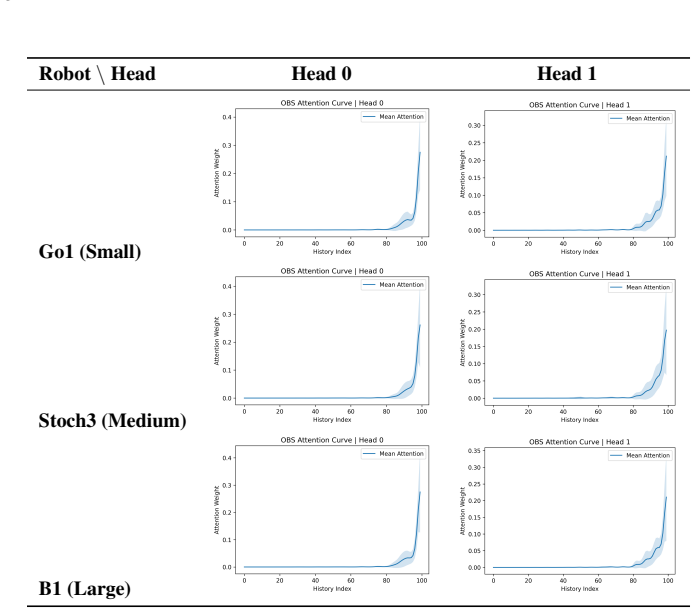
An attention-augmented recurrent policy trained by behavior cloning forms the mechanism. Each proprioceptive observation (joint angles and velocities, previous two actions, gravity vector, angular velocity, commanded velocity) passes through a linear encoder with LayerNorm; sinusoidal positional embeddings are added, and multi-head self-attention runs twice—once over a sliding window of recent observations and once over a sliding window of recent GRU hidden states—with a final MLP head producing joint actions. Two design choices carry the argument: the absence of any robot identifier, forcing the policy to infer embodiment purely from dynamics, and an adaptive per-joint loss (a robust Huber-like term with a learned per-dimension variance) that re-weights joints according to modeling difficulty. The attention analyses are used to claim that the heads learn terrain-conditioned, robot-independent features.
What would settle it
Remove stair-climbing demonstrations from the training set for all robots and evaluate the trained policy on stairs; if stair traversal still succeeds, behavior fusion is not the mechanism behind zero-shot transfer. The paper's Setting 4 (stair data from Go1 only) already shows B2 and Aliengo failing at 17 cm, so a fully stair-free dataset would confirm that diversity in training data is what carries the transfer.
Extended reading notes
Core claim
The central claim is that a single policy trained by behavior cloning on offline expert demonstrations of two behaviors—periodic flat-terrain gait and non-periodic stair traversal—collected across several quadruped robots, generalizes zero-shot to unseen robot morphologies and to terrains (higher stairs, slopes) absent from training. The policy reads only proprioceptive observations (joint positions, velocities, previous actions, gravity vector, angular velocity, commanded velocity) and outputs actions at low latency on an embedded computer. No robot identifier, no morphology descriptor, and no test-time optimization is used. The paper reports that training configurations with full diversity (Setting 5, both behaviors and three morphologies) give the strongest zero-shot transfer, that stair-only robots extrapolate to out-of-distribution step heights, and that hardware deployment on the Unitree Go1 and Stoch5 succeeds without fine-tuning.
Load-bearing premise
The expert demonstrations are generated by two simulation RL controllers whose reward functions, domain randomization, terrain variation, and dataset size are not specified; if these demonstrations are too narrow or too simulation-specific, the zero-shot transfer seen in the paper would not occur.
Editorial extensions
If this is right
- A single policy trained once in simulation can be deployed across a fleet of different quadruped models without retraining, fine-tuning, or robot identifier.
- Stair-climbing ability transfers to robots that only contributed flat-ground demonstrations, indicating that periodic-gait experience alone generalizes to non-periodic terrain.
- Policies trained with full diversity extrapolate beyond their training range: robots trained on 17 cm stairs later climb 25–29 cm steps.
- Novel terrains absent from the training set (slopes up to 40°, both smooth and rough) are handled zero-shot by several robots.
- The same policy runs in real time on an embedded computer and transfers to physical hardware without test-time optimization.
Reading between the lines
- If the result holds beyond the tested kinematic range, behavior-cloned generalist policies could let the community pool demonstration data across robot models the way manipulation datasets do today; the paper's own limitation section flags the need to test more diverse leg geometries.
- The learned per-joint variance in the adaptive loss doubles as a diagnostic of which joints are hardest to model per terrain, which could guide where to collect more demonstrations.
- A direct test of the behavior-fusion hypothesis would be a training set that excludes one behavior entirely; the paper's Setting 4 partially does this and shows degraded transfer, suggesting that fusion is not automatic but depends on the diversity mix.
- Combining this architecture with a lightweight exteroceptive input, as the authors list for future work, is a natural next step to move from reactive terrain handling to planned navigation.
Signed reviews
Editorial analysis
A structured set of objections, weighed in public.
Referee Report
Summary. The paper proposes GRoQ-LoCO, an attention-based behavior-cloning policy trained entirely offline on expert demonstrations of flat-ground and stair-climbing locomotion from multiple quadruped robots. The policy consumes only proprioceptive observations and command velocities, with no robot-specific identifiers. The authors claim zero-shot generalization to unseen robots (including hardware deployment on Unitree Go1 and Stoch5) and to out-of-distribution terrains such as higher stairs and slopes, across five training configurations with uneven distribution of skills across robots.
Significance. If the claims hold, the work would be a useful advance: it demonstrates that a single offline-trained policy can serve as a generalist controller across multiple quadruped morphologies and terrains without test-time adaptation or robot encoding, which goes beyond prior single-embodiment offline locomotion works. The framework is simple and the idea of behavior fusion from periodic and non-periodic gaits is appealing. However, the current evidence is not conclusive: the evaluation is largely binary, the dataset is underspecified, and a training-procedure detail appears internally inconsistent. The paper also includes a useful comparison with robot-encoding variants in the appendix, which supports the claim that explicit encodings hurt transfer.
major comments (4)
- [Section 2.4] The training procedure as written passes recurrent hidden states from a randomly sampled batch at epoch e to the next random batch at epoch e+1. Since each epoch samples a new batch of 400 trajectories and trajectories are padded to Nmax, the initial hidden state for a trajectory in epoch e+1 is the terminal hidden state of an unrelated trajectory from the previous epoch. This creates a training-time distribution of initial recurrent states that does not match the zero initial state used at deployment, and it is not the standard truncated BPTT described in the same section. The reported zero-shot results therefore cannot be attributed to the method as specified; please either correct the implementation description or retrain with proper episode-aligned hidden-state resetting and confirm the results.
- [Section 3.1 (Table 1) and Figure 7a] The central generalization claims rest on binary success/failure evaluations with no repeated trials, no success rates, and no statistical analysis. For example, Table 1 reports a single check/cross per robot per stair height, and Figure 7a similarly reports a single binary outcome per slope condition. Without variance estimates or repeated runs, it is impossible to distinguish genuine zero-shot transfer from chance or from favorable single runs. Please report aggregate statistics, such as mean success rates over multiple seeds and trials, with error bars or confidence intervals.
- [Section 2.1] The expert demonstrations are generated by two RL controllers that are never specified: no reward functions, domain randomization, terrain distributions, episode lengths, or data volumes per robot are given. Since the entire method is behavior cloning from these datasets, the generalization claim cannot be assessed or reproduced without this information. Please include expert training details, dataset statistics, and a description of the diversity across robots and terrains, or make the dataset publicly available with full documentation.
- [Section 3.2] The hardware deployment results on Go1 and Stoch5 are anecdotal ('demonstrated zero-shot transfer', 'robust walking') with no quantitative measurements such as success rates over repeated runs, gait frequency, joint torques, or failure cases. As this is the paper's most direct evidence for sim-to-real transfer, it needs to be quantified and compared against baselines or at least reported with clear metrics and experimental protocol.
minor comments (7)
- [Table 6 and Appendix D.1] Table 6 reports 'Embedding Dimension (emb dim) = 64' while Appendix D.1 states 'emb dim = 128', and Table 6 describes a 2-layer MLP head while Appendix D.1 says a 3-layer MLP; please reconcile these values so the architecture is reproducible.
- [Section 2.2] The text says 'The most recent k outputs are aggregated' but k is never defined; the window size W=100 appears only in Appendix D.2. Define k in the main text and ensure consistent use of k versus W.
- [Figure 2 caption] The caption refers to 'GROQLoco' while the model is consistently named GRoQ-LoCO elsewhere; please standardize the name.
- [Section 2.3] The adaptive loss uses 'exp(-log σ)' which equals 1/σ; please simplify the expression or explain the intended adaptive weighting, and specify the initialization of the learnable parameter σ.
- [Appendix B] The text refers to 'Stoch5(ZO)' in Figure 8 and Figure 9 captions, which appears to be a typo for 'ZS' (zero-shot).
- [Appendix D.3] The attention pattern figures appear as placeholders with no actual plots; please include the figures or remove the section, as the current presentation cannot be evaluated.
- [References] Reference [9] has an incomplete author field (a missing name before 'Gajewski'); please correct it.
Circularity Check
No circularity: the zero-shot holdout evaluations are externally defined and not reconstructed from the training loss or self-citations.
full rationale
GRoQ-LoCO's central claim is that a behavior-cloned policy trained on multi-robot, multi-terrain expert demonstrations transfers zero-shot to unseen robots and terrains. The training objective (Sec. 2.3) is a standard adaptive regression loss on expert actions, and the evaluation (Sec. 3.1, Tables 1-4) is an external holdout: ZS robots are excluded from training, and 21-29 cm stairs and 25-40 degree slopes are labeled OOD. No equation in the paper defines the target result in terms of the fitted loss or a self-cited uniqueness theorem. The only self-citation, [7] (BiRoiDiff), appears in a related-work list and is not load-bearing. The explicit limitation in Sec. 4 that the method targets comparable kinematic setups narrows, rather than circularly forces, the claim. Two non-circular weaknesses exist: Sec. 2.1 does not specify the expert RL controllers' rewards, randomization, terrain mix, or data volume, and Sec. 2.4 describes carrying hidden states across independently sampled batches, which could cause a train/deploy recurrent-state mismatch; these are reproducibility and correctness risks, not definitional circularity. Accordingly, no circular step is identified.
Assumptions & free parameters
free parameters (4)
- delta (adaptive loss scale) =
0.5
- attention window size W =
100
- embedding dimension (reported inconsistently) =
64 in Table 6, 128 in Appendix D.1
- warmup epochs Ew =
50
assumptions (4)
- domain assumption Simulation dynamics used to generate expert demonstrations are faithful enough to real robot dynamics for zero-shot sim-to-real transfer.
- domain assumption Expert RL controllers used for data collection produce demonstrations that are sufficiently optimal and diverse for behavior cloning to recover good locomotion.
- domain assumption Proprioceptive observations (joint positions, velocities, previous actions, gravity vector, angular velocity, command) contain enough information to disambiguate robot morphology and dynamics without any robot identifier.
- domain assumption Binary checkmark success on a single run of 8 stairs is a sufficient performance measure.
Cite this review
Pith. "Pith review of GRoQ-LoCO: Generalist and Robot-agnostic Quadruped Locomotion Control using Offline Datasets." pith.science (2026). https://pith.science/paper/SARFFAA3
@misc{pith2026250510973,
  author       = {Pith},
  title        = {Pith review of: GRoQ-LoCO: Generalist and Robot-agnostic Quadruped Locomotion Control using Offline Datasets},
  year         = {2026},
  howpublished = {\url{https://pith.science/paper/SARFFAA3}},
  note         = {Machine review of arXiv:2505.10973}
}
read the original abstract
Recent advancements in large-scale offline training have demonstrated the potential of generalist policy learning for complex robotic tasks. However, applying these principles to legged locomotion remains a challenge due to continuous dynamics and the need for real-time adaptation across diverse terrains and robot morphologies. In this work, we propose GRoQ-LoCO, a scalable, attention-based framework that learns a single generalist locomotion policy across multiple quadruped robots and terrains, relying solely on offline datasets. Our approach leverages expert demonstrations from two distinct locomotion behaviors - stair traversal (non-periodic gaits) and flat terrain traversal (periodic gaits) - collected across multiple quadruped robots, to train a generalist model that enables behavior fusion. Crucially, our framework operates solely on proprioceptive data from all robots without incorporating any robot-specific encodings. The policy is directly deployable on an Intel i7 nuc, producing low-latency control outputs without any test-time optimization. Our extensive experiments demonstrate zero-shot transfer across highly diverse quadruped robots and terrains, including hardware deployment on the Unitree Go1, a commercially available 12kg robot. Notably, we evaluate challenging cross-robot training setups where different locomotion skills are unevenly distributed across robots, yet observe successful transfer of both flat walking and stair traversal behaviors to all robots at test time. We also show preliminary walking on Stoch 5, a 70kg quadruped, on flat and outdoor terrains without requiring any fine tuning. These results demonstrate the potential of offline, data-driven learning to generalize locomotion across diverse quadruped morphologies and behaviors.
Figures


Figures from the paper (12 more)


Reference graph
Works this paper leans on
-
[1]
A. Brohan et al. Rt-1: Robotics transformer for real-world control at scale. arXiv preprint arXiv:2212.06817, 2022. URL https://arxiv.org/abs/2212.06817
arXiv 2022
-
[2]
A. Brohan et al. Rt-2: Vision-language-action models transfer web knowledge to robotic control. arXiv preprint arXiv:2307.15818 , 2023. URL https://arxiv.org/abs/2307. 15818
arXiv 2023
-
[3]
Open x-embodiment: Robotic learning datasets and rt-x models
Open X-Embodiment Collaboration. Open x-embodiment: Robotic learning datasets and rt-x models. In Proceedings of the 2024 IEEE International Conference on Robotics and Automa- tion (ICRA), pages 6892–6903. IEEE, 2024. doi:10.1109/ICRA57147.2024.10611477. URL https://arxiv.org/abs/2310.08864
arXiv 2024
-
[4]
K. Bousmalis, G. Vezzani, D. Rao, C. M. Devin, A. X. Lee, M. B. Villalonga, T. Davchev, Y . Zhou, A. Gupta, A. Raju, A. Laurens, C. Fantacci, V . Dalibard, M. Zambelli, M. F. Martins, R. Pevceviciute, M. Blokzijl, M. Denil, N. Batchelor, T. Lampe, E. Parisotto, K. ona, S. Reed, S. G. Colmenarejo, J. Scholz, A. Abdolmaleki, O. Groth, J.-B. Regli, O. Sushko...
work page 2024
-
[5]
A. Reske, J. Carius, Y . Ma, F. Farshidian, and M. Hutter. Imitation learning from mpc for quadrupedal multi-gait control. In Proceedings of the 2021 IEEE International Conference on Robotics and Automation (ICRA) , pages 5014–5020. IEEE, 2021. doi:10.1109/ICRA48506. 2021.9561214. URL https://arxiv.org/abs/2103.14331
-
[6]
X. Huang, Y . Chi, R. Wang, Z. Li, X. B. Peng, S. Shao, B. Nikolic, and K. Sreenath. Diffuse- loco: Real-time legged locomotion control with diffusion from offline datasets. In P. Agrawal, O. Kroemer, and W. Burgard, editors, Proceedings of The 8th Conference on Robot Learning, volume 270 of Proceedings of Machine Learning Research, pages 1567–1589. PMLR,...
work page 2025
-
[7]
G. Mothish, M. Tayal, and S. Kolathaya. Birodiff: Diffusion policies for bipedal robot loco- motion on unseen terrains. In Proceedings of the 10th Indian Control Conference (ICC), pages 9 385–390. IEEE, 2024. doi:10.1109/icc64753.2024.10883743. URL https://arxiv.org/ abs/2407.05424
-
[8]
R. O’Mahoney, A. L. Mitchell, W. Yu, I. Posner, and I. Havoutis. Offline adaptation of quadruped locomotion using diffusion models. arXiv preprint arXiv:2411.08832, 2024. URL https://arxiv.org/abs/2411.08832
arXiv 2024
Show all 22 references
-
[9]
Solving multi-goal robotic tasks with decision transformer
Gajewski et al. Solving multi-goal robotic tasks with decision transformer. In arXiv, 2024. URL https://arxiv.org/abs/2410.06347
2024 arXiv
-
[10]
Dong et al
W. Dong et al. Optimizing robotic manipulation with decision-rwkv: A recurrent se- quence modeling approach for lifelong learning. In Journal of Computing and Informa- tion Science in Engineering , 2025. URL https://asmedigitalcollection.asme.org/ computingengineering/article/...
2025
-
[11]
Hwangbo, J
J. Hwangbo, J. Lee, A. Dosovitskiy, D. Bellicoso, V . Tsounis, V . Koltun, and M. Hutter. Learning agile and dynamic motor skills for legged robots. Science Robotics, 4(26):eaau5872,
-
[12]
Kumar, Z
A. Kumar, Z. Fu, D. Pathak, and J. Malik. Rma: Rapid motor adaptation for legged robots. In Proceedings of Robotics: Science and Systems (RSS), 2021. doi:10.15607/RSS.2021.XVII
2021 doi
-
[13]
Xue et al
Y . Xue et al. Learning vision-guided quadrupedal locomotion end-to-end with a locomotion transformer. In Proceedings of the 2021 Conference on Robot Learning, 2021. URL https: //arxiv.org/abs/2107.03996
2021 arXiv
-
[14]
URL https://arxiv.org/abs/2107.04034
-
[15]
Wang et al
Y . Wang et al. Amp in the wild: Learning robust, agile, natural legged locomotion skills.arXiv preprint arXiv:2304.10888, 2023. URL https://arxiv.org/abs/2304.10888
2023 arXiv
-
[16]
Hoeller et al
D. Hoeller et al. Anymal parkour: Learning agile navigation for quadrupedal robots. In Proceedings of the 7th Conference on Robot Learning , 2023. URL https://arxiv.org/ abs/2306.14874
2023 arXiv
-
[17]
Kim, Y .-H
G. Kim, Y .-H. Lee, and H.-W. Park. A learning framework for diverse legged robot locomotion using barrier-based style rewards. arXiv preprint arXiv:2409.15780 , 2024. URL https: //arxiv.org/abs/2409.15780
2024 arXiv
-
[18]
J. Long, Z. Wang, Q. Li, L. Cao, J. Gao, and J. Pang. Hybrid internal model: Learning agile legged locomotion with simulated robot response. In Proceedings of the Twelfth International Conference on Learning Representations (ICLR) , 2024. URL https://openreview.net/ forum?id=9...
2024
-
[19]
Bohlinger, G
N. Bohlinger, G. Czechmanowski, M. Krupka, P. Kicki, K. Walas, J. Peters, and D. Tateo. One policy to run them all: an end-to-end learning approach to multi-embodiment locomotion. In Proceedings of the 8th Conference on Robot Learning (CoRL), 2024. URL https://arxiv. org/abs/2...
2024
-
[20]
G. Feng, H. Zhang, Z. Li, X. B. Peng, B. Basireddy, L. Yue, Z. Song, L. Yang, Y . Liu, K. Sreenath, and S. Levine. Genloco: Generalized locomotion controllers for quadrupedal robots. In L. P. Kaelbling, D. Kragic, and K. Fragkiadaki, editors, Proceedings of the 6th Conference ...
1903
-
[22]
Z. Luo, X. Li, R. Huang, Z. Shu, E. Xiao, and Y . Dong. Moral: Learning morphologically adaptive locomotion controller for quadrupedal robots on challenging terrains. IEEE Robotics and Automation Letters, 9(5):4019–4026, 2024. doi:10.1109/lra.2024.3375086. URL https: //ieeexpl...
2024
-
[2019]
URL https://www.science.org/doi/10.1126/ scirobotics.aau5872
doi:10.1126/scirobotics.aau5872. URL https://www.science.org/doi/10.1126/ scirobotics.aau5872
Reviewed August 15, 2026 · model on record in the stance chip above.
Discussion (0). Continue with ORCID to comment.