REVIEW 4 major objections 6 minor 1 cited by
Searching for extreme mass ratio inspirals in LISA: from identification to parameter estimation
T0 review · 4 major / 6 minor · reviewed 2026-08-07 · deepseek-v4-flash
Pith's one-line read A phase-blind time-frequency search statistic takes LISA EMRI signals from wide-prior detection to parameter estimation.
desk verdict A genuinely new EMRI search statistic and a working pipeline, but the validation is too narrow to support the 'wide priors' claim. read the letter →
The pith
A machine-rendered reading of the paper's core claim, the machinery that carries it, and where it could break.
The reading
What carries the argument
The load-bearing object is the statistic $S_\lambda$ of Eq. 8 with the time-frequency inner product $\langle x,y\rangle_{\mathrm{tf},\lambda}$ of Eq. 9. This is a generalized mean (a type of average controlled by $\lambda$) of per-window spectral matches between data and template, computed from short-time Fourier transforms; it deliberately discards phase differences between time-frequency pixels while preserving the track of the signal's frequency evolution. The exponent $\lambda$ controls the tradeoff: small $\lambda$ gives a wide primary peak but lets noise or secondary modes win, while large $\lambda$ suppresses those but narrows the peak. The paper sets $\lambda=3$ as the smallest exponent for which, on the single test injection, secondary modes stay below the injected match. The rest of the machinery is the staged optimizer: initial search on intrinsic parameters without the LISA response, iterative prior narrowing, a final maximization of the ordinary SNR $\rho$, and an MCMC chain for posteriors.
What would settle it
Run the full pipeline on a set of EMRI injections drawn from the same wide prior without retuning $\lambda$; if the fraction of runs that converge to the primary peak and recover the injection within credible intervals is far below the two showcased cases, the general search claim is falsified. A cheaper check is to draw 1000 random parameter sets around a second, different injection and test whether $\lambda=3$ still keeps all secondary modes below the injected match.
Extended reading notes
Core claim
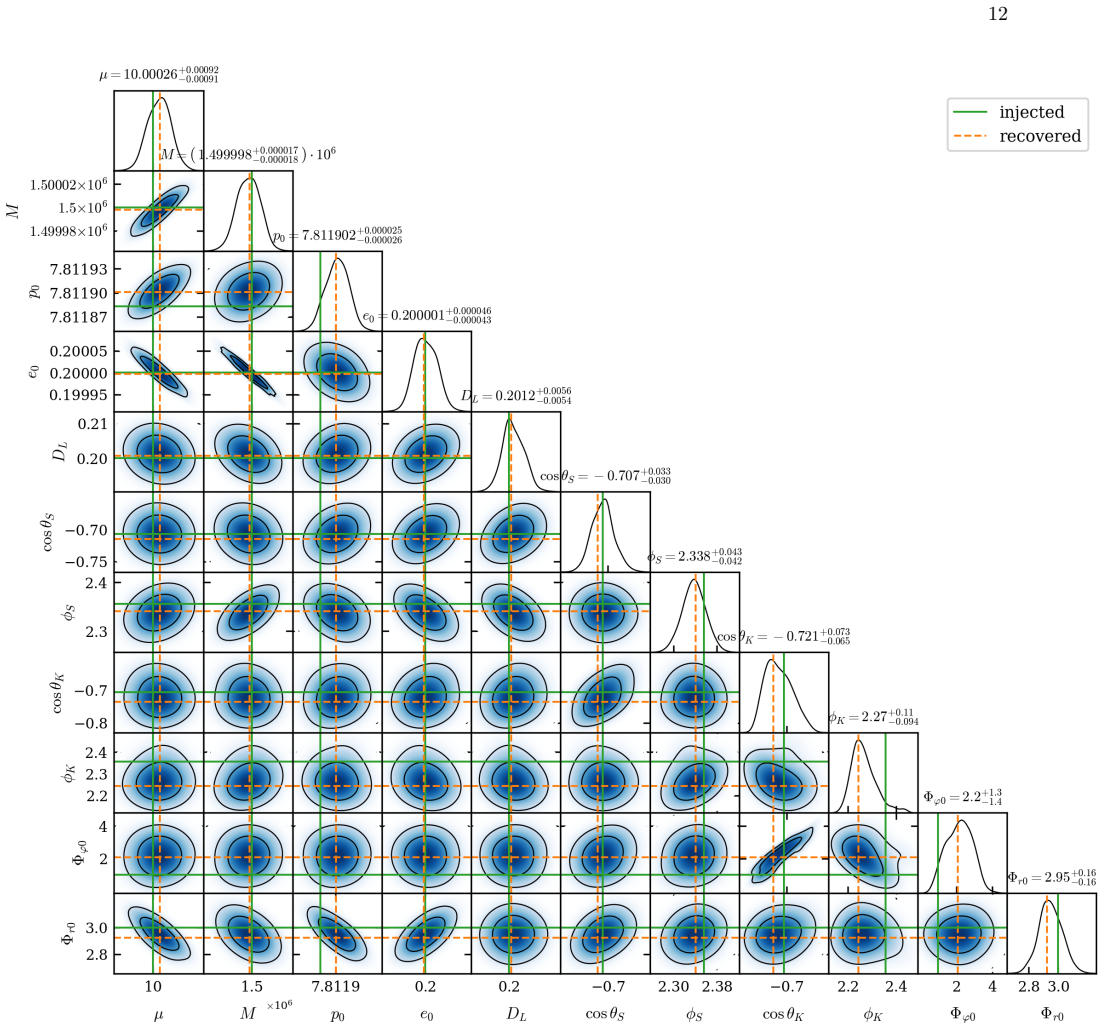
The central discovery is that maximizing a phase-blind, time-frequency power match is enough to pull an EMRI out of noisy LISA data. The statistic, defined as $S_\lambda=\langle d,s(\theta)\rangle_{\mathrm{tf},\lambda}/\sqrt{\langle s(\theta),s(\theta)\rangle_{\mathrm{tf},\lambda}}$, with the time-frequency inner product summing generalized-mean powers of per-window spectra, sacrifices phase coherence between short-time windows but keeps the coherence of the frequency evolution. This widens the primary mode in the mass, eccentricity, and semi-latus-rectum landscape relative to the standard matched-filter SNR, while a sufficiently large $\lambda$ suppresses spurious secondary modes. The paper's pipeline first optimizes $S_\lambda$ without the LISA response to locate the intrinsic parameters, then narrows the priors, refines with the full response, switches to maximizing the ordinary SNR $\rho$, and finally runs MCMC to obtain posteriors. In two demonstrations (optimal SNRs 56 and 82), the recovered maximum-likelihood signal matches the injection closely enough that the residual is an order of magnitude smaller than the signal, and the posteriors contain the injected parameters except for the initial phase.
Load-bearing premise
The method's key tuning choice—the exponent $\lambda=3$—is selected by looking at the known injected signal, so the demonstrations do not show that the same setting works for unknown signals; if $\lambda$ must be retuned per source, the claimed blind search capability collapses.
Editorial extensions
If this is right
- A single loud EMRI can be carried from a wide-prior search to MCMC posteriors in about 10 hours of optimization plus 8 hours of sampling on a mobile GPU, making large template banks unnecessary in this regime.
- The residual after subtracting the recovered signal is an order of magnitude smaller than the signal itself, so the output can be fed into a global fit that then searches for the remaining LISA sources.
- Because the statistic only needs a time-domain waveform, it can be re-run with more accurate waveform models, including spinning black holes, without changing the search architecture.
- The demonstrated SNR regime (optimal SNR 56 and 82) sets a floor: fainter EMRIs will need a modified statistic or a longer integration to be found by this pipeline.
Reading between the lines
- The choice of $\lambda=3$ is made by inspecting the injected signal, so the paper does not establish a principled way to set this exponent for an unknown source; an adaptive or marginalized $\lambda$ would be a natural extension to test.
- Since $S_\lambda$ ignores phase, the final coherent SNR step must carry the phase information, and the two demonstrations already show the initial phase $\Phi_{\varphi_0}$ falling outside the 68% region, suggesting phase parameters are the first to degrade at lower SNR.
- The two-week prior window on the time to plunge means the method already assumes a rough end time for the inspiral; a fully blind search would need to scan such windows, multiplying the cost.
- The paper leaves the behavior of $S_\lambda$ across the full EMRI parameter space unexplored, so the immediate stress test is an ensemble of injections with varied masses, eccentricities, sky locations, and SNRs using a fixed $\lambda$.
Editorial analysis
A structured set of objections, weighed in public.
Referee Report
Summary. The paper introduces a new search statistic for EMRI signals in LISA data, combining a time-frequency power-matched generalized mean (Eq. 8) with a staged optimization pipeline: first optimizing S without the LISA response on intrinsic parameters, then refining with S and finally maximizing the standard SNR, followed by MCMC parameter estimation. The method is demonstrated on two injected signals (optimal SNR 56 and 81) using the FastEMRIWaveforms package and the fast LISA response, with reported end-to-end runtimes of about a day on a laptop. The abstract claims that the strategy allows EMRI signals to be found 'from wide priors all the way to performing parameter estimation'.
Significance. If the central claim were fully supported, this would be a practical advance: it is one of the first demonstrations of an end-to-end chain from a coarse search to posterior sampling for a single EMRI, and it makes concrete use of public waveform and response tools. The paper is honest about its computational cost and provides reproducible ingredients (code, waveform models, and detailed pseudocode). However, the evidence presented is currently limited to two high-SNR injections, and the key hyperparameter λ is selected using the same injection used for validation. The 'wide priors' claim is also weakened by the narrow two-week tp prior. The method is therefore best viewed as a promising pipeline with an existence proof, not a validated search-from-wide-priors capability.
major comments (4)
- [Sec. II.C, Eq. (8), Fig. 3] The selection of λ = 3 is post-hoc: the paper states that λ is chosen as 'the smallest value for which secondary modes do not exceed the match statistic of the injected parameters,' using the same injection (Table I) that is later used for the demonstrations in Sec. III. This is circular: the success of the two recoveries does not establish that λ = 3 is appropriate for other EMRI parameters, other noise realizations, or other prior volumes. Please either (a) calibrate λ on a set of injections that are not used in the final demonstrations, including varied intrinsic parameters and noise draws, (b) perform a sensitivity study showing the dependence of the results on λ, or (c) explicitly reframe the claim as an existence proof for a fixed, injection-tuned choice. As it stands, the abstract's general claim of a new search strategy that works from wide priors is not supported.
- [Sec. II.E, Table II, Sec. III] The claim of searching 'from wide priors' is only partially demonstrated. The prior on the time to plunge tp is restricted to [0.42, 0.46] yr, a two-week window centered on the true injected value tp = 0.44 yr (Table II). The text in Sec. II.E states that 'the first iteration of the search restricts the prior on the time to plunge, tp, to a two-week window,' and Sec. III explains that either the pipeline is repeated with a moving window or a previous detection algorithm has already localized the signal in time. This means the search is not blind over the full mission duration. Please specify how the moving-window scan is implemented (step size, number of windows, total cost) and, ideally, demonstrate a search over a longer time interval without prior knowledge to substantiate the 'wide priors' claim.
- [Sec. III, Sec. II.C] There is no detection statistic with a calibrated threshold or false-alarm analysis. The text in Sec. III says that 'if the identified signal has an SNR above a certain threshold the signal is determined as a detection,' but no threshold is defined, no false-alarm probability is computed, and no noise-only trials are reported. The histograms in Fig. 3 show the distribution of the statistic for random prior samples, but they do not provide a detection threshold over many noise realizations. Without such an analysis, the pipeline cannot be used to claim that it can 'find' signals in unknown data rather than recover a known injection. Please add a noise-only study and define a detection criterion.
- [Sec. III, Conclusions] The two demonstrations use only high-SNR injections (ρoptimal = 56 and 81), and the paper's own Conclusions state that 'a current limitation of the method is its reliance on relatively high-SNR signals that stand out within a noisy power spectrum.' This is a load-bearing caveat for the central claim: if the method only works for very loud signals, then it is not a general EMRI search strategy. Please characterize the minimum SNR at which the pipeline can still recover a signal, or at least report the behavior of the statistic as a function of SNR, to place the two examples in context. Alternatively, temper the abstract's claim to 'high-SNR EMRI signals.'
minor comments (6)
- [Introduction] In the sentence 'Previous works have adopted ... with phenomenological waveform seachers [17],' the word 'seachers' should be 'searchers.'
- [Acknowledgements] The phrase 'previous work on ERMI signal simulation' should read 'EMRI signal simulation'.
- [Fig. 2] The caption of Fig. 2 does not specify which value of λ corresponds to each panel, making it difficult to verify the statements in the text that 'S λ=1 exhibits secondary modes' in the bottom-left panel and that 'S λ=4 results in a narrower primary mode compared to S λ=3.' Please label each panel with its λ value.
- [Algorithm 1] The pseudocode reads 'F unctionEMRI search(d)' with an apparent space inserted; this should be 'Function EMRI_search(d).' Also, the comment about the two-week window in Algorithm 1 is redundant with the main text and could be clarified.
- [Sec. III.A] The sentence 'Notably, the detected SNR of the recovered signal slightly surpasses that of the injected signal, which can be attributed to noise fluctuations. The condition ρ(θMLE) > ρ(θinjected) further validates the success of the optimization procedure' is somewhat overstated: for a noisy realization, the maximum matched-filter SNR is generally expected to exceed the injection SNR even for a correct template, so this condition does not by itself validate the optimization. It would be more informative to compare the recovered parameters to the injected values.
- [Appendix A] The sentence 'The full posterior Figure 11 with all parameters can be found in the appendix A' is grammatically awkward and should be rephrased, e.g., 'The full posterior, including all parameters, is shown in Figure 11 in Appendix A.'
Circularity Check
λ=3 is selected using the same injected signal used for the recovery demonstrations, making the headline results in-sample rather than independent predictions.
-
fitted input called prediction
[Sec. II.C (Matching spectrograms), Fig. 3 and following text; applied in Sec. III.A, Table III]
"To balance these effects, we set λ = 3 for the remainder of this study, as it is the smallest value for which secondary modes do not exceed the match statistic of the injected parameters."
The free exponent λ in the new search statistic S_λ is chosen by evaluating S_λ on 1000 random prior draws against the single injected EMRI used for all subsequent validation, selecting the smallest λ such that no random draw beats the match statistic of the injected parameters. The pipeline in Sec. III.A is then run on that same injection and reported as a successful extraction. The recovery therefore demonstrates that the optimizer can climb the landscape after the landscape's key hyperparameter was tuned to make the injected point stand out; it is not an out-of-sample test of the search statistic. The second example keeps the same λ=3, so it inherits the tuning choice, and the paper notes that an extensive investigation over the EMRI parameter space is left for future work.
full rationale
The central circularity is the selection of λ=3 in Sec. II.C using the same injected signal whose recovery is then presented as the main result (Sec. III.A, Table III). Because λ controls the width and prominence of the primary peak of S_λ, choosing it so that the injected parameters have the highest match among random prior samples builds the target recovery into the search statistic's tuning. This is a fitted-input-called-prediction pattern and justifies a score around 5. No other circular steps were found: the likelihood, SNR, time-frequency inner product, noise estimation, and MCMC sampling are defined independently and are not reduced to the paper's own conclusions; the waveform and response models are external tools. The paper's 'wide priors' claim is weakened by the two-week tp window (Sec. II.E, Table II) and the absence of a false-alarm or detection-threshold study, but that is a scope/overclaim issue rather than a circularity. The second injection (Table IV) provides some independent evidence, but it still uses the λ chosen for the first signal, so it does not remove the in-sample tuning concern.
Assumptions & free parameters
free parameters (4)
- λ (generalized mean exponent) =
3
- tp prior window =
[0.42, 0.46] yr
- STFT window and overlap =
50000/dt samples, 50% overlap, Hann window
- Noise smoothing parameters =
30-bin moving median, Savitzky-Golay filter
assumptions (4)
- domain assumption TDI channels A and E are independent with stationary Gaussian noise
- domain assumption The FastEMRIWaveforms (few) model accurately represents EMRI signals for injection and recovery
- domain assumption The PSD estimated from the data (including the signal) is a good proxy for the true noise PSD
- standard math Differential evolution converges to the global maximum of the search statistics
Cite this review
Pith. "Pith review of Searching for extreme mass ratio inspirals in LISA: from identification to parameter estimation." pith.science (2026). https://pith.science/paper/FOTJZGL6
@misc{pith2026250517814,
  author       = {Pith},
  title        = {Pith review of: Searching for extreme mass ratio inspirals in LISA: from identification to parameter estimation},
  year         = {2026},
  howpublished = {\url{https://pith.science/paper/FOTJZGL6}},
  note         = {Machine review of arXiv:2505.17814}
}
read the original abstract
The Laser Interferometer Space Antenna (LISA) is a planned space-based observatory designed to detect gravitational waves (GWs) within the millihertz frequency range. LISA is anticipated to observe the inspiral of compact objects into black holes at the centers of galaxies, so called extreme-mass-ratio inspirals (EMRIs). However, the extraction of these long-lived complex signals is challenging due to the large size and multimodality of the search space. In this study, we introduce a new search strategy that allows us to find EMRI signals in noisy data from wide priors all the way to performing parameter estimation. This work is an important step in understanding how to extract EMRIs from future LISA data.
Figures


Figures from the paper (9 more)


Forward citations
Cited by 1 Pith paper
-
Coherent End-to-End Search for Generic Extreme-Mass-Ratio Inspirals
A hierarchical search that uses the clustering of high-likelihood secondary maxima recovers generic EMRI signals in 14-dimensional parameter space from simulated LISA data.
Reference graph
Works this paper leans on
-
[21]
by reaching the primary peak and performing pa- rameter estimation, simulating a full search and param- eter estimation pipeline for a single EMRI in stationary arXiv:2505.17814v1 [gr-qc] 23 May 2025 2 Gaussian noise. We introduce a novel search statistic and employ it to achieve an accurate identification of EMRI signals, leading to the successful extrac...
arXiv 2025
- [1]
- [2]
-
[3]
Amaro-Seoane, Relativistic dynamics and extreme mass ratio inspirals, Living Rev
P. Amaro-Seoane, Relativistic dynamics and extreme mass ratio inspirals, Living Rev. Rel. 21, 4 (2018), arXiv:1205.5240 [astro-ph.CO]
arXiv 2018
-
[4]
C. P. L. Berry, S. A. Hughes, C. F. Sopuerta, A. J. K. Chua, A. Heffernan, K. Holley-Bockelmann, D. P. Mi- haylov, M. C. Miller, and A. Sesana, The unique poten- tial of extreme mass-ratio inspirals for gravitational-wave astronomy (2019), arXiv:1903.03686 [astro-ph.HE]
arXiv 2019
-
[5]
J. R. Gair, L. Barack, T. Creighton, C. Cutler, S. L. Larson, E. S. Phinney, and M. Vallisneri, Event rate estimates for LISA extreme mass ratio capture sources, Class. Quant. Grav. 21, S1595 (2004), arXiv:gr- qc/0405137
arXiv 2004
- [6]
-
[7]
L. Barack and C. Cutler, Using LISA EMRI sources to test off-Kerr deviations in the geometry of massive black holes, Phys. Rev. D 75, 042003 (2007), arXiv:gr- qc/0612029
arXiv 2007
Show all 46 references
-
[8]
C. F. Sopuerta and N. Yunes, Extreme and Intermediate- Mass Ratio Inspirals in Dynamical Chern-Simons Modified Gravity, Phys. Rev. D 80, 064006 (2009), arXiv:0904.4501 [gr-qc]
2009 arXiv
-
[9]
J. R. Gair, C. Tang, and M. Volonteri, LISA extreme- mass-ratio inspiral events as probes of the black hole mass function, Phys. Rev. D 81, 104014 (2010), arXiv:1004.1921 [astro-ph.GA]
2010 arXiv
-
[10]
Speri, A
L. Speri, A. Antonelli, L. Sberna, S. Babak, E. Ba- rausse, J. R. Gair, and M. L. Katz, Probing Accretion Physics with Gravitational Waves, Phys. Rev. X 13, 021035 (2023), arXiv:2207.10086 [gr-qc]
2023 arXiv
-
[11]
P. S. Cole, G. Bertone, A. Coogan, D. Gaggero, T. Kary- das, B. J. Kavanagh, T. F. M. Spieksma, and G. M. Tomaselli, Distinguishing environmental effects on binary black hole gravitational waveforms, Nature Astron. 7, 943 (2023), arXiv:2211.01362 [gr-qc]
2023
-
[12]
A. J. K. Chua and C. J. Cutler, Nonlocal parameter degeneracy in the intrinsic space of gravitational-wave signals from extreme-mass-ratio inspirals, Phys. Rev. D 106, 124046 (2022), arXiv:2109.14254 [gr-qc]
2022 arXiv
-
[13]
Babak, J
S. Babak, J. G. Baker, M. J. Benacquista, N. J. Cornish, S. L. Larson, I. Mandel, S. T. McWilliams, A. Petiteau, E. K. Porter, E. L. Robinson, et al., The mock lisa data challenges: from challenge 3 to challenge 4, Classical and Quantum Gravity 27, 084009 (2010)
2010
-
[14]
Babak, J
S. Babak, J. R. Gair, and E. K. Porter, An Algorithm for detection of extreme mass ratio inspirals in LISA data, Class. Quant. Grav. 26, 135004 (2009), arXiv:0902.4133 [gr-qc]
2009 arXiv
-
[15]
N. J. Cornish, Detection Strategies for Extreme Mass Ratio Inspirals, Class. Quant. Grav. 28, 094016 (2011), arXiv:0804.3323 [gr-qc]
2011 arXiv
-
[16]
A. J. K. Chua, One-stop function for gravitational-wave detection, identification, and inference, Phys. Rev. D 106, 104051 (2022), arXiv:2205.08702 [gr-qc]. 11 FIG. 11: The green solid lines indicate the injected parameters, while the orange dashed lines represent the recovere...
2022 arXiv
-
[17]
Y. Wang, Y. Shang, S. Babak, Y. Shang, and S. Babak, EMRI data analysis with a phenomenological waveform, Phys. Rev. D 86, 104050 (2012), arXiv:1207.4956 [gr-qc]
2012 arXiv
-
[18]
Badger, J
C. Badger, J. A. Font, M. Sakellariadou, and A. Torres- Forn´ e, High-speed reconstruction of long-duration grav- itational waves from extreme-mass-ratio inspirals using sparse dictionary learning, Phys. Rev. D 110, 064074 (2024), arXiv:2407.02908 [gr-qc]
2024 arXiv
-
[19]
Yun, W.-B
Q. Yun, W.-B. Han, Y.-Y. Guo, H. Wang, and M. Du, The detection, extraction and parameter esti- mation of extreme-mass-ratio inspirals with deep learn- ing, Sci. China Phys. Mech. Astron. 68, 210413 (2025), arXiv:2311.18640 [gr-qc]
2025 arXiv
-
[20]
Zhang, C
X.-T. Zhang, C. Messenger, N. Korsakova, M. L. Chan, Y.-M. Hu, and J.-d. Zhang, Detecting gravitational waves from extreme mass ratio inspirals using convolutional neural networks, Phys. Rev. D 105, 123027 (2022), arXiv:2202.07158 [astro-ph.HE]
2022 arXiv
-
[22]
Ye, H.-M
C.-Q. Ye, H.-M. Fan, A. Torres-Orjuela, J.-d. Zhang, and Y.-M. Hu, Identification of gravitational waves from extreme-mass-ratio inspirals, Phys. Rev. D 109, 124034 (2024), arXiv:2310.03520 [gr-qc]
2024 arXiv
-
[23]
T. A. Prince, M. Tinto, S. L. Larson, and J. W. Arm- strong, Lisa optimal sensitivity, Physical Review D 66, 122002 (2002)
2002
-
[24]
Vallisneri, Synthetic lisa: Simulating time delay inter- ferometry in a model lisa, Physical Review D 71, 022001 12 FIG
M. Vallisneri, Synthetic lisa: Simulating time delay inter- ferometry in a model lisa, Physical Review D 71, 022001 12 FIG. 12: Corner plot of the increased mass signal. The injected parameters are shown as green solid lines, while the recovered parameters, θMLE, are indicated...
2005
-
[25]
T. B. Littenberg, N. J. Cornish, K. Lackeos, and T. Rob- son, Global analysis of the gravitational wave signal from galactic binaries, Phys. Rev. D 101, 123021 (2020)
2020
-
[26]
A. J. K. Chua, M. L. Katz, N. Warburton, and S. A. Hughes, Rapid generation of fully relativis- tic extreme-mass-ratio-inspiral waveform templates for LISA data analysis, Phys. Rev. Lett. 126, 051102 (2021), arXiv:2008.06071 [gr-qc]
2021 arXiv
-
[27]
M. L. Katz, L. Speri, A. J. K. Chua, C. E. A. Chapman- Bird, N. Warburton, and S. A. Hughes, BlackHolePertur- bationToolkit/FastEMRIWaveforms: Frequency Domain Waveform Added! (2023)
2023
-
[28]
A. J. Chua, C. R. Galley, and M. Vallisneri, Reduced- order modeling with artificial neurons for gravitational- wave inference, Phys. Rev. Lett. 122, 211101 (2019), arXiv:1811.05491 [astro-ph.IM]. 13
2019 arXiv
-
[29]
Fujita and M
R. Fujita and M. Shibata, Extreme mass ratio inspirals on the equatorial plane in the adiabatic order, Phys. Rev. D 102, 064005 (2020), arXiv:2008.13554 [gr-qc]
2020 arXiv
-
[30]
L. C. Stein and N. Warburton, Location of the last sta- ble orbit in Kerr spacetime, Phys. Rev. D 101, 064007 (2020), arXiv:1912.07609 [gr-qc]
2020 arXiv
-
[31]
A. J. Chua and J. R. Gair, Improved analytic extreme- mass-ratio inspiral model for scoping out eLISA data analysis, Class. Quant. Grav. 32, 232002 (2015), arXiv:1510.06245 [gr-qc]
2015 arXiv
-
[32]
A. J. Chua, C. J. Moore, and J. R. Gair, Augmented kludge waveforms for detecting extreme-mass-ratio inspi- rals, Phys. Rev. D 96, 044005 (2017), arXiv:1705.04259 [gr-qc]
2017 arXiv
-
[33]
Barack and C
L. Barack and C. Cutler, LISA capture sources: Approx- imate waveforms, signal-to-noise ratios, and parameter estimation accuracy, Phys. Rev. D 69, 082005 (2004), arXiv:gr-qc/0310125
2004 arXiv
-
[34]
Speri, M
L. Speri, M. L. Katz, A. J. Chua, S. A. Hughes, N. War- burton, J. E. Thompson, C. E. Chapman-Bird, and J. R. Gair, Fast and fourier: extreme mass ratio inspiral wave- forms in the frequency domain, Frontiers in Applied Mathematics and Statistics 9, 1266739 (2024)
2024
-
[35]
A. J. Chua, M. L. Katz, N. Warburton, and S. A. Hughes, Data for fast emri waveforms, 10.5281/zenodo.3981654 (2020)
2020 doi
-
[36]
Ye, H.-M
C.-Q. Ye, H.-M. Fan, A. Torres-Orjuela, J.-d. Zhang, and Y.-M. Hu, Identification of gravitational waves from extreme-mass-ratio inspirals, Physical Review D 109, 124034 (2024)
2024
-
[37]
Katz, CChapmanbird, L
M. Katz, CChapmanbird, L. Speri, N. Karnesis, and N. Korsakova, mikekatz04/lisaanalysistools: First main release. (2024)
2024
-
[38]
de Carvalho, Mean, what do you mean? (2016)
M. de Carvalho, Mean, what do you mean? (2016)
2016
-
[39]
P. S. Bullen, The power means, in Handbook of Means and Their Inequalities(Springer Netherlands, Dordrecht,
-
[40]
S. H. Strub, L. Ferraioli, C. Schmelzbach, S. C. St¨ ahler, and D. Giardini, Global analysis of lisa data with galactic binaries and massive black hole binaries, Physical Review D 110, 024005 (2024)
2024
-
[41]
S. H. Strub, L. Ferraioli, C. Schmelzbach, S. C. St¨ ahler, and D. Giardini, Accelerating global parameter estima- tion of gravitational waves from galactic binaries using a genetic algorithm and gpus, Physical Review D 108, 103018 (2023)
2023
-
[42]
Karnesis, M
N. Karnesis, M. L. Katz, N. Korsakova, J. R. Gair, and N. Stergioulas, Eryn: a multipurpose sampler for bayesian inference, Monthly Notices of the Royal Astro- nomical Society 526, 4814 (2023)
2023
-
[43]
M. Katz, N. Karnesis, and N. Korsakova, mikekatz04/eryn: first full release (2023)
2023
-
[44]
Foreman-Mackey, D
D. Foreman-Mackey, D. W. Hogg, D. Lang, and J. Good- man, emcee: the mcmc hammer, Publications of the As- tronomical Society of the Pacific 125, 306 (2013)
2013
-
[45]
Virtanen, R
P. Virtanen, R. Gommers, T. E. Oliphant, M. Haber- land, T. Reddy, D. Cournapeau, E. Burovski, P. Peter- son, W. Weckesser, J. Bright, et al., SciPy 1.0: Fun- damental algorithms for scientific computing in Python, Nature Methods 17, 261 (2020)
2020
-
[46]
Storn and K
R. Storn and K. Price, Differential evolution–a simple and efficient heuristic for global optimization over con- tinuous spaces, Journal of global optimization 11, 341 (1997)
1997
Reviewed August 7, 2026 · model on record in the stance chip above.
Discussion (0). Continue with ORCID to comment.