REVIEW 4 major objections 5 minor 13 references
Do you see what I see? An Ambiguous Optical Illusion Dataset exposing limitations of Explainable AI
T0 review · 4 major / 5 minor · reviewed 2026-08-07 · deepseek-v4-flash
Pith's one-line read Adding gaze and eye annotations to illusion images raises classifier accuracy by more than 20 percent.
desk verdict The Ambivision dataset is a real new resource, but the paper's central claim that gaze/eye concepts improve learning is unsupported because the only successful experiments draw annotations into the pixels. read the letter →
The pith
A machine-rendered reading of the paper's core claim, the machinery that carries it, and where it could break.
The reading
What carries the argument
The central object is the Ambivision dataset with its concept annotations. Each image carries an eye position $e=[e_x,e_y]\in\mathbb{R}^2$ and a normalized head direction $d=[d_x,d_y]\in\mathbb{R}^2$, combined as gaze $g=e+\alpha d$ with a scaling constant $\alpha$; the right eye is annotated when two are visible. The mechanism that carries the argument is the training-time overlay: drawn gaze arrows or circled eyes are inserted directly into the image, and fine-tuned ResNet and VGG classifiers learn markedly better with these markings than with no marking or random markings. An attempt to concatenate gaze coordinates before the final softmax layer did not help, so the paper's evidence rests on the image-space annotations.
What would settle it
Present each Ambivision image to naive human viewers and ask them to name what they see and whether they can perceive both animals; if most images are resolved to a single dominant animal, the dataset does not instantiate perceptual ambiguity, and the reported gaze gains would be about the markers rather than about ambiguous perception.
Extended reading notes
Core claim
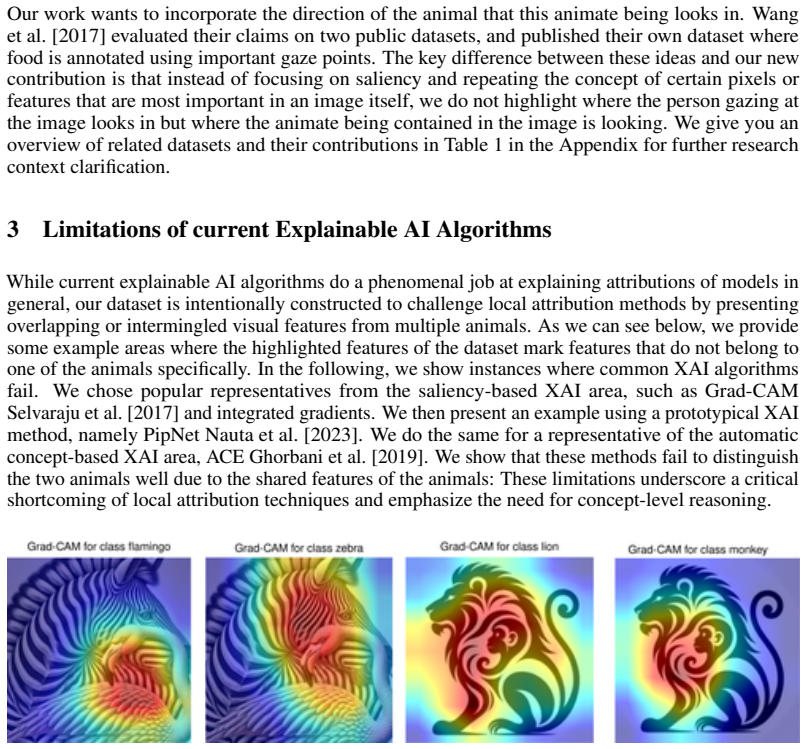
On its own terms, the paper's discovery is that two abstract visual concepts—where the animal's eye is located and which direction the head is looking—carry the information needed to resolve optical illusions between merged animal pairs, and that exposing a classifier to these cues through simple image overlays markedly improves its accuracy. The authors report that both gaze direction and eye annotation alone produce meaningful gains, raising accuracy by over 20% in a setting with up to 1000 classes, and that marking the eye outperformed all other tested conditions. They further show that standard saliency and prototype methods, including Grad-CAM, integrated gradients, PipNet, and ACE, fail to separate the two animals or extract the gaze concept, which they take as evidence that pixel-level explanations are inadequate for ambiguous data.
Load-bearing premise
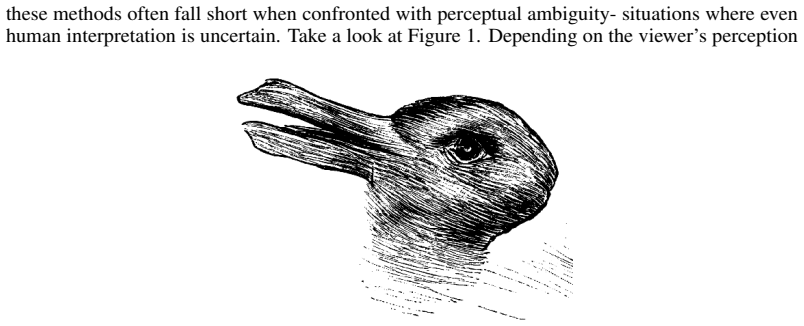
The load-bearing premise is that the ChatGPT-generated images are genuinely perceived by humans as ambiguous between the two animal classes, yet the paper never measures human perception of that ambiguity.
Editorial extensions
If this is right
- If the claim holds, ambiguous-image classification can be improved simply by adding small concept markers, without changing model architecture or training hyperparameters.
- Explanation methods that rely on pixel saliency will systematically underperform on data where the deciding feature is an abstract relation such as gaze, motivating concept-based XAI.
- Ambivision provides a reusable benchmark with fine-grained labels (eye coordinates, gaze vectors, bounding boxes) for evaluating both classification and explainability under ambiguity.
- The gaze and eye concepts appear to be generalizable across animal classes and architectures, rather than being tied to one species or one model.
- Because the dataset is machine-generated, it offers a testbed for how generative-model biases and prompt-design choices shape visual ambiguity.
Reading between the lines
- Beyond the paper: if gaze direction genuinely disambiguates these images for classifiers, then measuring human gaze fixations on the same images could test whether humans and models resolve the ambiguity by the same cue, directly linking the dataset to human-machine alignment.
- Beyond the paper: a testable extension is to replace the hand-drawn arrows with a separate gaze-estimation model; if the accuracy gain persists with predicted gaze, the concept transfers, and if it vanishes, part of the reported gain may be an artifact of visible markers.
- Beyond the paper: because the paper never validates human perception of ambiguity, the dataset's status as an optical-illusion benchmark rests on an unmeasured assumption; a human labeling study would determine whether the images evoke two interpretations or are simply hard single-class images.
Editorial analysis
A structured set of objections, weighed in public.
Referee Report
Summary. This paper introduces Ambivision, a dataset of images generated with ChatGPT that are intended to depict two intermingled animals in a perceptually ambiguous way, annotated with class labels, eye coordinates, gaze direction vectors, and bounding boxes. The authors argue that pixel-based XAI methods such as Grad-CAM, Integrated Gradients, PipNet, and ACE are inadequate for ambiguous images, and they propose gaze direction and eye position as generalizable visual concepts whose integration improves classification performance. To test this, they fine-tune ImageNet classifiers under four annotation conditions (no annotation, direction arrows, eye circles, and random marks) and report accuracy gains for the arrow and eye conditions. They also report that an alternative method of concatenating gaze coordinates into the model, formalized in Eq. (1), did not lead to a detectable accuracy increase. The paper closes with a discussion of bias mitigation, limitations, and future work.
Significance. The paper has clear strengths: it releases a new dataset and source code, addresses a real limitation of pixel-level explanations, and evaluates several architectures and XAI methods on the proposed images. If the central claim were established, the work would be a useful step toward concept-based XAI and human–machine alignment. However, the empirical evidence does not support the claim that gaze and eye cues are learned as generalizable concepts. The only accuracy improvements come from drawing arrows or circles directly into the image, which is input-space annotation rather than concept integration, and the coordinate-concatenation experiment that would test the claimed mechanism shows no gain. In addition, the dataset's premise that the images are perceptually ambiguous for humans is never validated with behavioral data. The dataset may still have value as a benchmark resource, but that contribution is not the paper's stated central claim.
major comments (4)
- [Section 5, Eq. (1) and Fig. 7] The paper's abstract and Section 1 state that integrating gaze direction and eye coordinates into the learning process improves model performance. The experiment that directly tests this integration, formalized in Eq. (1) as a concatenation of (e, d) before the softmax, 'did not lead to a detectable increase in accuracy.' The conditions that improved accuracy were those in which the gaze vector was drawn as an arrow and the eye was marked with a circle in the input image. This is input-space augmentation, not concept integration, because a CNN can exploit the added pixel marks directly. The reported evidence therefore contradicts the paper's headline claim.
- [Section 5, random-marking baseline] The 'random annotations' condition is not a valid control for a pixel-space shortcut. Since Ambivision was deliberately constructed so that eye coordinate and gaze direction are the class-distinguishing features, the arrow and eye circle exactly encode the target signal, whereas random marks are not class-correlated. Comparing signal injection against noise injection does not show that the model learns the abstract concept of gaze; it shows only that the model can read informative marks from pixels. A proper control would require class-conditioned but non-informative marks, or a demonstration that the benefit persists when the marks are removed at test time.
- [Section 6 and Section 7] The dataset's central premise is that the images are perceptually ambiguous for humans, yet no human behavioral validation is reported. The paper asserts that the images are 'designed to evoke perceptual ambiguity' and claims the dataset is 'difficult for humans,' but it never measures whether human viewers actually perceive two distinct interpretations, nor the rate at which they do so. This is load-bearing for the framing of Ambivision as an optical illusion dataset and for any claims about human–machine alignment, so the missing validation is a substantive gap rather than a presentation issue.
- [Section 5, Fig. 7] No transfer or generalization evaluation is reported: the annotation is present in both training and test images. To support the claim that gaze and eye are 'generalizable visual concepts,' the authors would need to show that models trained with the concept information transfer to unannotated images, or that the learned representation improves performance on held-out illusion types. Without such a condition, the observed accuracy gains can be entirely explained by the model using the added marks as a pixel-level shortcut during both training and inference.
minor comments (5)
- [Section 5] The text refers to 'Resnet52,' but the figure captions and the cited work use ResNet-50; please correct the inconsistency.
- [Section 5, Eq. (1)] Equation (1) includes the notation 'arg ming∈G' without defining the set G or the optimization problem formally; please specify the learning objective and the role of the gaze coordinates (e, d) in the loss.
- [Section 5] The phrase 'raising accuracy rates by over 20% in a setting allowing up to 1000 classes' is unclear; please state whether evaluation is closed-set on the two animal labels or on the full ImageNet label space, and report the exact evaluation protocol.
- [Figure 7 and Appendix Figures 12–14] The accuracy curves are presented as single runs without error bars or significance tests; adding multiple seeds and reporting standard deviations would make the reported improvements more credible.
- [Appendix, Table 1] Table 1 contains formatting and typographical issues, including the misspelling 'Cathegory' and unclear merged cells; a cleaner presentation would improve readability.
Circularity Check
The claimed gaze/eye-concept improvement reduces to drawing the label-discriminating features into the input pixels; the only non-pixel integration (Eq. 1) showed no gain.
-
self definitional
[Section 2, Figure 2 caption]
"All of these examples have two animals distinguishable by the eye coordinate and the gaze vector, meaning they might be looking in the same direction, but their right eye (if more than one is visible) is positioned somewhere differently."
The dataset is defined so that the eye coordinate plus gaze vector is the class-distinguishing signal. The headline experiment then draws exactly this signal into the image (arrows for gaze, circles for eyes) and reports improved accuracy. The improvement is therefore encoded in the input by construction: the added pixels carry the very information that separates the two animal classes. The paper's own Eq. (1) integration of the coordinates (e,d) as features, which would test the concept without pixel injection, 'did not lead to a detectable increase in accuracy', so the successful conditions do not provide independent evidence for gaze/eye as learned concepts.
-
fitted input called prediction
[Section 5, Eq. (1) paragraph and Figure 7]
"This particular setup, however, did not lead to a detectable increase in accuracy. We managed to increase the accuracy by including the gaze vector directly into the image information."
The paper's central claim is that 'integrating gaze direction and eye coordinates into the learning process improves model performance.' The only setups that improve are input-space augmentations: drawing the gaze arrow and encircling the eye in the pixel image. A CNN can exploit these pixels as a shortcut without learning any generalizable concept, and the random-marking baseline does not control for this because random marks carry no class-discriminative information while the arrow and circle exactly encode the annotation. The coordinate-concatenation method that would isolate the concept level gave no gain, so the reported 'improvement' is the injected input signal, not a demonstrated concept learned by the model.
full rationale
The central claim of the paper is that gaze direction and eye coordinates are generalizable visual concepts whose integration improves classifier performance. The paper's own evidence contradicts this at the concept level: Eq. (1), which concatenates the gaze coordinates (e,d) into the classifier, 'did not lead to a detectable increase in accuracy.' The accuracy gains in Figure 7 come only from adding arrows or eye circles to the pixel input. Because the dataset was explicitly constructed so that the two animal classes are 'distinguishable by the eye coordinate and the gaze vector', drawing those features into the image injects the class-discriminating label into the input space. The random-annotation baseline does not remove this confound, since random marks carry no class information. Thus the successful conditions reduce by construction to a pixel-space shortcut rather than to concept learning. This is the main circularity (score 6). The missing human-perception validation of ambiguity is a correctness/validity concern, not a circularity concern, and the one self-citation (Newen and Müller 2022) is not load-bearing. The dataset itself and the XAI limitation demonstrations are independent contributions, but the headline learning-improvement claim is unsupported by the non-circular evidence.
Assumptions & free parameters
free parameters (1)
- gaze scaling constant alpha =
not specified, chosen for visibility
assumptions (3)
- domain assumption Generated images are valid optical illusions that evoke ambiguity in human perception.
- domain assumption The two animals in each image are distinguishable by gaze/eye annotations, and those annotations belong to the correct animal.
- domain assumption Fine-tuning ImageNet classifiers on about 200 images yields meaningful accuracy differences.
Cite this review
Pith. "Pith review of Do you see what I see? An Ambiguous Optical Illusion Dataset exposing limitations of Explainable AI." pith.science (2026). https://pith.science/paper/2DDMO6PO
@misc{pith2026250521589,
  author       = {Pith},
  title        = {Pith review of: Do you see what I see? An Ambiguous Optical Illusion Dataset exposing limitations of Explainable AI},
  year         = {2026},
  howpublished = {\url{https://pith.science/paper/2DDMO6PO}},
  note         = {Machine review of arXiv:2505.21589}
}
read the original abstract
From uncertainty quantification to real-world object detection, we recognize the importance of machine learning algorithms, particularly in safety-critical domains such as autonomous driving or medical diagnostics. In machine learning, ambiguous data plays an important role in various machine learning domains. Optical illusions present a compelling area of study in this context, as they offer insight into the limitations of both human and machine perception. Despite this relevance, optical illusion datasets remain scarce. In this work, we introduce a novel dataset of optical illusions featuring intermingled animal pairs designed to evoke perceptual ambiguity. We identify generalizable visual concepts, particularly gaze direction and eye cues, as subtle yet impactful features that significantly influence model accuracy. By confronting models with perceptual ambiguity, our findings underscore the importance of concepts in visual learning and provide a foundation for studying bias and alignment between human and machine vision. To make this dataset useful for general purposes, we generate optical illusions systematically with different concepts discussed in our bias mitigation section. The dataset is accessible in Kaggle via https://kaggle.com/datasets/693bf7c6dd2cb45c8a863f9177350c8f9849a9508e9d50526e2ffcc5559a8333. Our source code can be found at https://github.com/KDD-OpenSource/Ambivision.git.
Figures

Figures from the paper (15 more)


Reference graph
Works this paper leans on
-
[1]
Getting a clue: A method for explaining uncertainty estimates.arXiv preprint arXiv:2006.06848,
Javier Antorán, Umang Bhatt, Tameem Adel, Adrian Weller, and José Miguel Hernández-Lobato. Getting a clue: A method for explaining uncertainty estimates.arXiv preprint arXiv:2006.06848,
arXiv 2006
-
[7]
Petr Kellnhofer, Adria Recasens, Simon Stent, Wojciech Matusik, and Antonio Torralba
URLhttps://arxiv.org/abs/1512.03385. Petr Kellnhofer, Adria Recasens, Simon Stent, Wojciech Matusik, and Antonio Torralba. Gaze360: Physically unconstrained gaze estimation in the wild. InProceedings of the IEEE/CVF international conference on computer vision, pages 6912–6921,
-
[8]
Kurt Koffka.Principles of Gestalt psychology
URL https: //arxiv.org/abs/1412.6980. Kurt Koffka.Principles of Gestalt psychology. routledge,
-
[10]
Explaining machine learning classifiers through diverse counterfactual explanations
Ramaravind K Mothilal, Amit Sharma, and Chenhao Tan. Explaining machine learning classifiers through diverse counterfactual explanations. InProceedings of the 2020 conference on fairness, accountability, and transparency, pages 607–617,
work page 2020
-
[11]
Sankha S Mukherjee and Neil Martin Robertson. Deep head pose: Gaze-direction estimation in multimodal video.IEEE Transactions on Multimedia, 17(11):2094–2107,
-
[13]
Eth-xgaze: A large scale dataset for gaze estimation under extreme head pose and gaze variation
Xucong Zhang, Seonwook Park, Thabo Beeler, Derek Bradley, Siyu Tang, and Otmar Hilliges. Eth-xgaze: A large scale dataset for gaze estimation under extreme head pose and gaze variation. InComputer Vision–ECCV 2020: 16th European Conference, Glasgow, UK, August 23–28, 2020, Proceedings, Part V 16, pages 365–381. Springer,
work page 2020
-
[2015]
Explaining classifiers with causal concept effect (cace)
Yash Goyal, Amir Feder, Uri Shalit, and Been Kim. Explaining classifiers with causal concept effect (cace). arXiv preprint arXiv:1907.07165,
arXiv 1907
-
[2017]
Concept-level debugging of part-prototype networks.arXiv preprint arXiv:2205.15769,
Andrea Bontempelli, Stefano Teso, Katya Tentori, Fausto Giunchiglia, and Andrea Passerini. Concept-level debugging of part-prototype networks.arXiv preprint arXiv:2205.15769,
Show all 13 references
-
[2018]
URL http://arxiv.org/abs/1806. 10574. D Choi. On empirical comparisons of optimizers for deep learning.arXiv preprint arXiv:1910.05446,
1910 arXiv
-
[2019]
A unified approach to interpreting model predictions, 2017a
Scott Lundberg and Su-In Lee. A unified approach to interpreting model predictions, 2017a. URL https: //arxiv.org/abs/1705.07874. Scott M Lundberg and Su-In Lee. A unified approach to interpreting model predictions.Advances in neural information processing systems, 30, 2017b. ...
-
[2020]
Facilitating object detection and recognition through eye gaze
Mihai Bâce, Philippe Schlattner, Vincent Becker, and Gábor Sörös. Facilitating object detection and recognition through eye gaze. In19th International Conference on Human-Computer Interaction with Mobile Devices and Services (MobileHCI 2017). ETH Zurich,
2017
-
[2021]
Explainable ai: A brief survey on history, research areas, approaches and challenges
Feiyu Xu, Hans Uszkoreit, Yangzhou Du, Wei Fan, Dongyan Zhao, and Jun Zhu. Explainable ai: A brief survey on history, research areas, approaches and challenges. InNatural Language Processing and Chinese Computing: 8th CCF International Conference, NLPCC 2019, Dunhuang, China, ...
2019
-
[2022]
This looks like that: deep learning for interpretable image recognition.CoRR, abs/1806.10574,
Chaofan Chen, Oscar Li, Alina Barnett, Jonathan Su, and Cynthia Rudin. This looks like that: deep learning for interpretable image recognition.CoRR, abs/1806.10574,
Reviewed August 7, 2026 · model on record in the stance chip above.
Discussion (0). Sign in to comment.