REVIEW 3 major objections 5 minor 63 references
Prospect of Constraining the EoS of Neutron Stars Using Post-Merger Signals
T0 review · 3 major / 5 minor · reviewed 2026-08-07 · deepseek-v4-flash
Pith's one-line read This paper claims that combining post-merger gravitational-wave signals from many binary neutron star mergers through a two-stage hierarchical inference can constrain neutron star radii to within about 1 km, and to about 0.55 km when…
desk verdict The multi-radius extension is clearly described, but the combination step reuses the same events four times, so the headline radius constraints are not statistically supported. read the letter →
The pith
A machine-rendered reading of the paper's core claim, the machinery that carries it, and where it could break.
The reading
What carries the argument
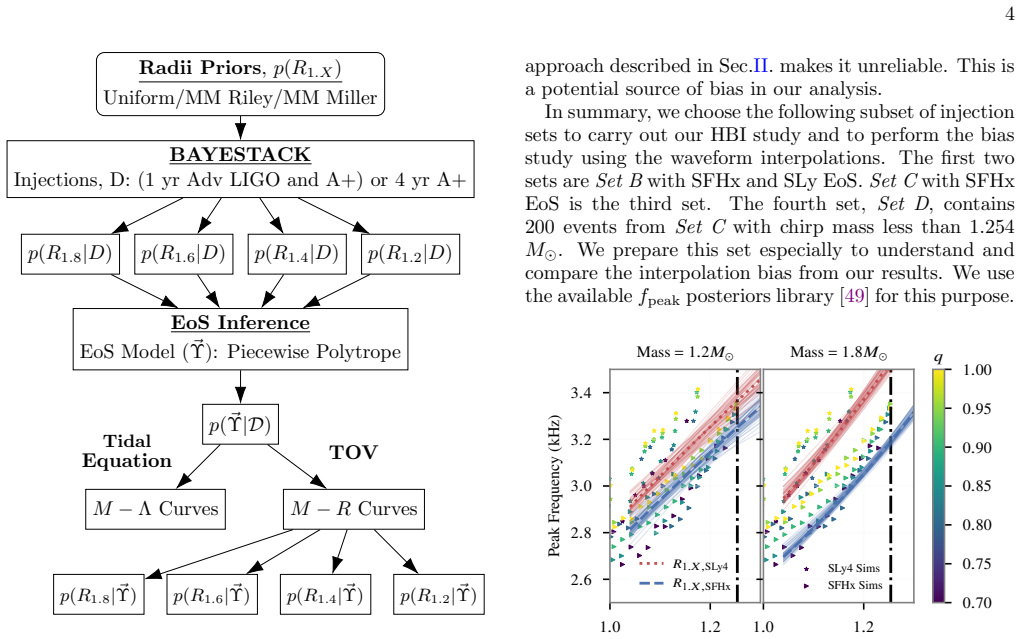
The load-bearing identity is the empirical relation $f_{\rm peak} = b_0 + b_1 M + b_2 M^2 + b_3 R_{1.X} M + b_4 R_{1.X} M^2 + b_5 R_{1.X}^2 M$, which links the post-merger peak frequency to chirp mass and a radius proxy. This relation feeds the first-stage BAYESTACK posterior $p(R_{1.X}|D)$ for each of four masses; the second stage multiplies these four posteriors, with a delta-function prior mapping $R_{1.X}$ to the radius computed from the piecewise polytrope parameters via the Tolman-Oppenheimer-Volkhoff equations. The product is the equation-of-state posterior that is then sliced to give joint radius constraints.
What would settle it
Inject many simulated catalogs with a known equation of state, run the two-stage inference on disjoint halves of the events for different radius slices, and check whether the true radius lies inside the 90% interval as often as claimed; a coverage deficit would show that the independence assumption is wrong.
Extended reading notes
Core claim
The central claim is that the two-stage hierarchical inference—first obtaining per-mass radius posteriors from ensembles of post-merger detections, then combining them through a piecewise polytropic equation of state—yields radius constraints of about 1 km at 90% credibility for a four-year A+ catalog of 357 events. Using priors informed by NICER and GW170817 tightens this to roughly 0.55 km. The paper also finds that the injected equation of state is recovered at the boundary of the 90% bound for the mass-tidal deformability curve, but shows a bias in the mass-radius curve that it attributes to waveform interpolation and to the limited validity of the empirical frequency-radius relation at high masses.
Load-bearing premise
The reported bounds assume that the radius posteriors from the four mass slices are statistically independent even though they are all computed from the same catalog of events, so any shared systematic error would make the combined intervals too narrow.
Editorial extensions
If this is right
- If the A+ era produces roughly 357 post-merger detections, radius bounds near 1 km become achievable without external priors.
- With NICER/GW170817-informed priors, the same catalog yields ~0.55 km radius bounds, sharp enough to distinguish many proposed equations of state.
- Because the four radius slices are tied to a single equation of state, the method also constrains the mass-radius and mass-tidal-deformability curves across the 1.2–1.8 solar mass range.
- The identified biases at high chirp mass imply that improving the empirical relation would remove the main systematic limitation.
Reading between the lines
- A fully joint inference that processes all events simultaneously in one hierarchical model, rather than combining four separately computed posteriors, would test the independence assumption and could either validate or widen the reported intervals.
- The per-radius 90% intervals reported assume the product of four posteriors is a valid joint posterior; if the same events dominate all four slices, the true uncertainty may be larger than stated.
- The empirical-relation bias at high mass suggests the actual constraining power of future catalogs may depend more on improving fpeak models than on detector sensitivity alone.
- If third-generation detectors deliver many more events, the same two-stage scheme could probe temperature-dependent effects such as phase transitions, as the paper hints.
Editorial analysis
A structured set of objections, weighed in public.
Referee Report
Summary. This paper extends Criswell et al.'s hierarchical Bayesian inference for post-merger neutron-star signals from a single radius proxy R1.6 to four proxies R1.2, R1.4, R1.6, and R1.8. The authors compute BAYESTACK (BaSt) posteriors for each proxy from simulated event sets (Sets B, C, D) under uniform and astrophysical (MM Miller/Riley) radius priors, then combine the four posteriors through a piecewise-polytrope EoS model to constrain M-R and M-Lambda curves. They report that the combined analysis constrains radii to within ~1 km with uniform priors and ~0.55 km with astrophysical priors for A+ noise, and they discuss biases from the empirical f_peak(M,R1.X) relation and waveform interpolation.
Significance. The paper addresses an important and timely question, and the two-stage idea is a natural extension of Criswell et al. It makes use of public data and code, considers two injected EoSs and several event sets, and is candid about interpolation and empirical-relation biases. If the combination step were valid, the projected ~1 km radius constraints would be a valuable forecast for A+. However, the central statistical step in Eqs. (8)-(9) is not a valid posterior combination; the product of four posteriors from the same event catalog double-counts data and priors. The quantitative conclusions and the main claim are therefore not supported by the analysis as presented.
major comments (3)
- [II.B, Eqs. (8)-(9)] The combination step is not a valid posterior. In Eq. (8) the four factors p(d_i|R1.X_i) are set equal to the BaSt posteriors p(R1.X_i|D) from Eq. (7), but every one of those posteriors is computed from the same full event catalog (e.g., Set C with 357 events). The four factors are therefore not independent likelihoods, and the product in Eq. (9) reuses the same events four times, inflating the effective information and producing artificially narrow 90% intervals. Moreover, Eq. (7) already includes the first-stage radius prior p(R1.X_i); substituting it for p(d_i|R1.X_i) without dividing by p(R1.X_i) double-counts that prior. The double counting is harmless only for a constant uniform prior, but not for the nonuniform MM Miller/Riley priors used in Sec. III.B. The ~0.55 km claim in the abstract is therefore not statistically justified by the derivation as written. A correct hierarchical likelihood should start from the per-event data and the EoS-parameter mapping, not multiply four posteriors from the same catalog.
- [II.A and III (injection construction)] The recovery tests do not independently validate the empirical relation. Eq. (5) is fitted to SPH simulated waveforms, and the injected signals in Sets B and C are generated by nearest-neighbor interpolation from the same SPH waveform library, as described in Sec. II.A and Sec. III. Thus the recovery is partly a consistency check that re-derives the fitted relation; it does not test the empirical relation against an independent waveform set. This circularity should be stated explicitly and, ideally, mitigated by testing with an independent simulation code or by quantifying the interpolation-induced bias beyond the qualitative discussion in Sec. IV.A.
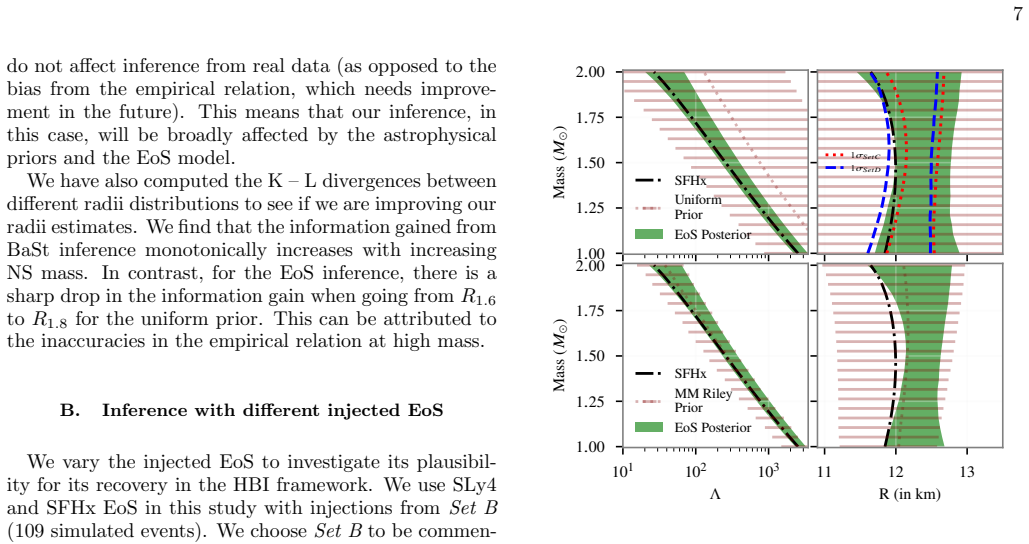
- [IV.C, Fig. 5] The claim that astrophysical priors yield ~0.55 km constraints is also in tension with Fig. 5: with MM Riley and MM Miller priors the injected M-R curve lies outside the 90% band. The text attributes this to interpolation bias and empirical-relation inaccuracy, but no procedure is given to correct or debias the quoted intervals. Until the method is shown to be calibrated, the narrower credible intervals under informative priors should not be presented as a robust prospect.
minor comments (5)
- [II.B, Eq. (8)] The notation in Eq. (8), rendered as '4Y_{i=1}', should be a product symbol, and the reuse of D for both the full event catalog in Eq. (7) and the four-element set in Eq. (8) is confusing and should be clarified.
- [III.B] There is a typo: 'GW1710817' should be 'GW170817'.
- [III.B and IV.A] The text refers to both 'MM Miller' and 'MM Riley' priors, but the figures shown use only MM Riley; please clarify which priors are used in each panel and state whether the MM Miller results are omitted or deferred.
- [Figures 2-5] Several figures contain garbled Unicode math symbols and unclear legends (e.g., Fig. 5 mixes 'red error bars', 'red dotted', and 'blue dashed' without a clean key); please regenerate the figures with standard math rendering and explicit panel labels.
- [Appendix B] Reference [52] is cited as '2024' but the arXiv version is 2023; please update the citation or the year.
Circularity Check
Eqs. (8)-(9) define the four EoS likelihoods as the BAYESTACK posteriors from the same event catalog, so multiplying them quadruple-counts the same data; the ~1 km and ~0.55 km bounds shrink by construction.
-
self definitional
[Sec. II.B, Eqs. (8)-(9); Fig. 1]
"p(Υ|D) ∝ (∏_{i=1}^4 ∫ p(d_i|R1.X_i) p(R1.X_i|Υ) dR1.X_i) p(Υ) ... The likelihoods p(d_i|R1.X_i ) are the posteriors, p(R1.X_i |D), obtained from Eq. (7)."
Eq. (7) already computes each p(R1.X|D) from the same simulated event catalog D (Set B or Set C). Eq. (8) then substitutes these four same-catalog posteriors for the four likelihoods p(d_i|R1.X_i) and multiplies them in Eq. (9). This is not an independent combination: the four radius slices are four summaries of the same events, so the product quadruple-counts the likelihood and artificially shrinks every reported 90% interval. The 'additional constraint due to common EoS' is therefore a mathematical consequence of multiplying four dependent posterior densities, not new information from independent data.
-
other
[Sec. II.A and Sec. III (Eq. (5), waveform library description)]
"Criswell et al. [1] created a library of GW for limited BNS systems using smooth particle hydrodynamics (SPH)... The injection waveforms for the simulated events described in Sets A,, B, C were then obtained by nearest-neighbor approximation (in the m1−m2 space) to the library of waveforms."
The empirical fpeak(M,R1.X) relation in Eq. (5) is fitted to SPH simulated BNS data, and the injected signals in Sets B and C are nearest-neighbor waveforms drawn from that same SPH library. A recovery study that injects and recovers from the same simulation library can validate the BayesWave/pipeline stages but cannot independently validate the empirical relation; it mostly confirms the fit against its own training data. The paper acknowledges the relation is inaccurate for high chirp mass and that the library is insufficient (157 Set-C events beyond the SFHx waveform coverage), so the headline radius constraints still inherit the fitted relation without an independent check against a different waveform family or simulation code.
full rationale
The central problem is Eqs. (8)-(9): p(d_i|R1.X_i) is explicitly defined as the posterior p(R1.X_i|D) from Eq. (7), and all four posteriors are computed from the same event set. Multiplying them yields the quoted tightened bounds by construction, not from four independent measurements. This is self-definitional rather than an external prediction; the prior is also double-counted because a posterior, not a likelihood, is inserted. The SPH injection-library loop is a secondary validation circularity: the empirical relation and the injected waveforms share the same simulation source, so the injection study cannot falsify the relation. However, the paper is transparent about several biases (empirical-relation inaccuracy and waveform interpolation error) and tests two EoS and different sets, so the analysis is not a pure tautology. The Tiwari et al. self-citation for the MM priors is not load-bearing circularity: those priors are external NICER/GW170817 constraints, and changing them would not rescue the product-likelihood issue.
Assumptions & free parameters
free parameters (2)
- Empirical relation coefficients b0...b5 (Eq. 5) =
Fitted in Vretinaris et al. 2020 to SPH simulations; b values not reproduced in this paper
- Piecewise-polytrope fit values for injected EoS (log P5, Gamma4, Gamma5, Gamma6) =
SLy4: 34.3817, 2.9823, 2.9993, 2.8454; SFHx: 34.4769, 4.2129, 3.0264, 2.4029 (Table I)
assumptions (5)
- domain assumption All neutron stars follow one cold equation of state, so R1.2...R1.8 are deterministic functions of the EoS parameters via the TOV equations.
- ad hoc to paper The four R1.X BAYESTACK posteriors, computed from the same event set D, can be multiplied as independent likelihoods in Eq. (9).
- domain assumption The empirical relation fpeak = b0 + b1 M + b2 M^2 + b3 R1.X M + b4 R1.X M^2 + b5 R1.X^2 M (Eq. 5) is accurate over the injection region.
- domain assumption Injected waveforms from the SPH library, mapped by nearest-neighbor in m1-m2 space, represent real post-merger signals.
- domain assumption The A+ noise curve and the BNS merger rate 320+490/-240 Gpc^-3 yr^-1 describe the observation scenario.
Cite this review
Pith. "Pith review of Prospect of Constraining the EoS of Neutron Stars Using Post-Merger Signals." pith.science (2026). https://pith.science/paper/EWWPFMW2
@misc{pith2026250521667,
  author       = {Pith},
  title        = {Pith review of: Prospect of Constraining the EoS of Neutron Stars Using Post-Merger Signals},
  year         = {2026},
  howpublished = {\url{https://pith.science/paper/EWWPFMW2}},
  note         = {Machine review of arXiv:2505.21667}
}
abstract
Post-merger gravitational-wave emission from a binary neutron star merger carries crucial information about the equation of state (EoS) of matter at high temperatures. Current gravitational wave detectors have limited sensitivities at post-merger frequencies in the range [1.5, 4] kHz. Therefore, valuable inferences can only be made after combining information from multiple (BNS) events. Criswell et al. [Phys. Rev. D 107, 043021 (2023)] carries out an injection study to infer the radius posterior for a $1.6 M_{\odot}$ NS by combining the information from injected BNS events via the hierarchical Bayesian inference (HBI) formulation. This formulation utilizes empirical relations that connect the peak frequency of the post-merger remnant with the chirp mass of the system, and the EoS proxy parameter $R_{1.6}$. In this work, we extend the HBI formulation to other EoS proxy parameters (i.e., the radius of (NS), $R_{1.X}$, with masses 1.2, 1.4, and 1.8 $M_{\odot}$) and combine the four $R_{1.X}$ posteriors through the piecewise polytropic EoS model to obtain measurable constraints on the EoS of the NS. We show that the NS radii can be constrained to within $\sim$1 km ( $\sim$0.55 km) assuming uniform (astrophysical) prior on $R_{1.X}$ for injections in the A+ noise. We also study systematic biases in the analysis coming from the limitations of empirical relations.
Figures


Figures from the paper (1 more)
Reference graph
Works this paper leans on
-
[1]
A. W. Criswell, J. Miller, N. Woldemariam, et al., Hierar- chical bayesian method for constraining the neutron star equation of state with an ensemble of binary neutron star postmerger remnants, Phys. Rev. D 107, 043021 (2023)
work page 2023
-
[2]
B. P. Abbott, R. Abbott, T. D. Abbott, et al. (LIGO Scientific Collaboration and Virgo Collabora- tion), GW170817: Observation of gravitational waves from a binary neutron star inspiral, Phys. Rev. Lett.119, 161101 (2017)
work page 2017
-
[3]
B. P. Abbott et al. (LIGO Scientific, Virgo), GW190425: Observation of a Compact Binary Coalescence with To- tal Mass ∼ 3.4M⊙, Astrophys. J. Lett. 892, L3 (2020), arXiv:2001.01761 [astro-ph.HE]
arXiv 2020
-
[4]
S. Huth, P. T. H. Pang, I. Tews, et al., Constraining neutron-star matter with microscopic and macroscopic collisions, Nature 606, 276–280 (2022)
work page 2022
-
[5]
T. Dietrich, M. W. Coughlin, P. T. Pang, et al., Mul- timessenger constraints on the neutron-star equation of state and the hubble constant, Science 370, 1450 (2020)
work page 2020
-
[6]
P. T. Pang, I. Tews, M. W. Coughlin, et al., Nuclear physics multimessenger astrophysics constraints on the neutron star equation of state: adding NICER’s PSR J0740+ 6620 measurement, Astrophys. J.922, 14 (2021)
work page 2021
-
[7]
P. T. Pang, T. Dietrich, M. W. Coughlin, et al., NMMA: A nuclear-physics and multi-messenger astro- physics framework to analyze binary neutron star merg- ers, arXiv preprint arXiv:2205.08513 (2022)
arXiv 2022
- [8]
Show all 63 references
-
[9]
Ghosh, B
S. Ghosh, B. K. Pradhan, D. Chatterjee, and J. Schaffner-Bielich, Multi-physics constraints at differ- ent densities to probe nuclear symmetry energy in hy- peronic neutron stars, Frontiers in Astronomy and Space Sciences 9, 59 (2022)
2022
-
[10]
Raaijmakers, S
G. Raaijmakers, S. Greif, T. Riley, et al., Constraining the dense matter equation of state with joint analysis of NICER and LIGO/Virgo measurements, Astrophys. J. Lett. 893, L21 (2020)
2020
-
[11]
Chatziioannou, Neutron-star tidal deformability and equation-of-state constraints, General Relativity and Gravitation 52, 109 (2020)
K. Chatziioannou, Neutron-star tidal deformability and equation-of-state constraints, General Relativity and Gravitation 52, 109 (2020)
2020
-
[12]
Biswas, Bayesian model selection of neutron star equa- tions of state using multi-messenger observations, Astro- phys
B. Biswas, Bayesian model selection of neutron star equa- tions of state using multi-messenger observations, Astro- phys. J. 926, 75 (2022)
2022
-
[13]
Landry, R
P. Landry, R. Essick, and K. Chatziioannou, Nonpara- metric constraints on neutron star matter with existing and upcoming gravitational wave and pulsar observa- tions, Phys. Rev. D. 101, 123007 (2020)
2020
-
[14]
Raaijmakers, S
G. Raaijmakers, S. Greif, K. Hebeler, et al., Constraints on the dense matter equation of state and neutron star properties from nicer’s mass–radius estimate of PSR J0740+ 6620 and multimessenger observations, 918, L29 (2021)
2021
-
[15]
Legred, K
I. Legred, K. Chatziioannou, R. Essick, et al., Impact of the PSR J0740+ 6620 radius constraint on the proper- ties of high-density matter, Phys. Rev. D. 104, 063003 (2021)
2021
-
[16]
Biswas, Impact of PREX-II and combined radio/NICER/XMM-Newton’s mass–radius mea- surement of PSR J0740+ 6620 on the dense-matter equation of state, Astrophys
B. Biswas, Impact of PREX-II and combined radio/NICER/XMM-Newton’s mass–radius mea- surement of PSR J0740+ 6620 on the dense-matter equation of state, Astrophys. J. 921, 63 (2021)
2021
-
[17]
M. C. Miller, F. K. Lamb, A. J. Dittmann, et al., Psr j0030+0451 mass and radius from nicer data and impli- cations for the properties of neutron star matter, The Astrophysical Journal Letters 887, L24 (2019)
2019
-
[18]
M. C. Miller, F. K. Lamb, A. J. Dittmann, et al., The radius of psr j0740+6620 from nicer and xmm-newton data, The Astrophysical Journal Letters918, L28 (2021)
2021
-
[19]
T. E. Riley, A. L. Watts, S. Bogdanov, et al., A nicer view of PSR J0030+0451: Millisecond pulsar parameter estimation, The Astrophysical Journal Letters 887, L21 (2019)
2019
-
[20]
T. E. Riley, A. L. Watts, P. S. Ray,et al., A NICER view of the massive pulsar PSR J0740+6620 informed by radio timing and XMM-Newton spectroscopy, The Astrophys- ical Journal Letters 918, L27 (2021)
2021
-
[21]
Russotto, S
P. Russotto, S. Gannon, S. Kupny, et al., Results of the asy-eos experiment at gsi: The symmetry energy at suprasaturation density, Physical Review C 94, 034608 (2016)
2016
-
[22]
Le Fevre, Y
A. Le Fevre, Y. Leifels, W. Reisdorf, et al., Constraining the nuclear matter equation of state around twice satu- ration density, Nuclear Physics A 945, 112 (2016)
2016
-
[23]
Hebeler, J
K. Hebeler, J. Lattimer, C. J. Pethick, and A. Schwenk, Equation of state and neutron star properties constrained by nuclear physics and observation, The Astrophysical Journal 773, 11 (2013)
2013
-
[24]
Drischler, R
C. Drischler, R. Furnstahl, J. Melendez, and D. Phillips, How well do we know the neutron-matter equation of state at the densities inside neutron stars? a bayesian approach with correlated uncertainties, Physical Review Letters 125, 202702 (2020)
2020
-
[25]
B. P. Abbott et al. (LIGO Scientific, Virgo), Properties of the binary neutron star merger GW170817, Phys. Rev. X 9, 011001 (2019), arXiv:1805.11579 [gr-qc]. 10
2019 arXiv
-
[26]
B. P. Abbott et al. (LIGO Scientific, Virgo, Fermi- GBM, INTEGRAL), Gravitational Waves and Gamma- rays from a Binary Neutron Star Merger: GW170817 and GRB 170817A, Astrophys. J. Lett. 848, L13 (2017), arXiv:1710.05834 [astro-ph.HE]
2017 arXiv
-
[27]
T. W. Baumgarte, S. L. Shapiro, and M. Shibata, On the maximum mass of differentially rotating neutron stars, The Astrophysical Journal 528, L29 (1999)
1999
-
[28]
Shibata and K
M. Shibata and K. b. o. Ury¯ u, Simulation of merging binary neutron stars in full general relativity: Γ = 2 case, Phys. Rev. D 61, 064001 (2000)
2000
-
[29]
Sarin and P
N. Sarin and P. D. Lasky, The evolution of binary neutron star post-merger remnants: a review, Gen. Rel. Grav. 53, 59 (2021), arXiv:2012.08172 [astro-ph.HE]
2021 arXiv
-
[30]
Stergioulas, A
N. Stergioulas, A. Bauswein, K. Zagkouris, and H.-T. Janka, Gravitational waves and non-axisymmetric os- cillation modes in mergers of compact object binaries, Monthly Notices of the Royal Astronomical Society 418, 427 (2011), https://academic.oup.com/mnras/article- pdf/418/1/...
2011
-
[31]
Bauswein, N
A. Bauswein, N. Stergioulas, and H.-T. Janka, Exploring properties of high-density matter through remnants of neutron-star mergers, The European Physical Journal A 52, 10.1140/epja/i2016-16056-7 (2016)
2016 doi
-
[32]
Shibata, Constraining nuclear equations of state us- ing gravitational waves from hypermassive neutron stars, Phys
M. Shibata, Constraining nuclear equations of state us- ing gravitational waves from hypermassive neutron stars, Phys. Rev. Lett. 94, 201101 (2005)
2005
-
[33]
J. Aasi, B. Abbott, R. Abbott, et al., Advanced LIGO, Classical and Quantum Gravity32, 10.1088/0264- 9381/32/7/074001 (2015)
2015 doi
-
[34]
Acernese, M
F. Acernese, M. Agathos, K. Agatsuma, et al., Ad- vanced Virgo: a second-generation interferometric grav- itational wave detector, Classical and Quantum Gravity 32, 024001 (2015), arXiv:1408.3978 [gr-qc]
2015 arXiv
-
[35]
Akutsu, M
T. Akutsu, M. Ando, K. Arai, et al., Overview of KAGRA: Detector design and construction history, Progress of Theoretical and Experimental Physics 2021, 05A101 (2020), https://academic.oup.com/ptep/article- pdf/2021/5/05A101/37974994/ptaa125.pdf
2020
-
[36]
F. H. Panther and P. D. Lasky, The effect of noise artefacts on gravitational-wave searches for neutron star post-merger remnants, Monthly No- tices of the Royal Astronomical Society 523, 2928 (2023), https://academic.oup.com/mnras/article- pdf/523/2/2928/53671921/stad1556.pdf
2023
-
[37]
K. W. Tsang, T. Dietrich, and C. Van Den Broeck, Mod- eling the postmerger gravitational wave signal and ex- tracting binary properties from future binary neutron star detections, Phys. Rev. D 100, 044047 (2019)
2019
-
[38]
Noise curves used for simulations in the update of the observing scenarios paper, Technical Report LIGO- T2000012 (2022)
2022
-
[39]
Vretinaris, N
S. Vretinaris, N. Stergioulas, and A. Bauswein, Empir- ical relations for gravitational-wave asteroseismology of binary neutron star mergers, Phys. Rev. D 101, 084039 (2020)
2020
-
[40]
https://github.com/criswellalexander/bayestack
-
[41]
Petrov, L
P. Petrov, L. P. Singer, M. W. Coughlin, et al., Data-driven expectations for electromagnetic counter- part searches based on ligo/virgo public alerts, The As- trophysical Journal 924, 54 (2022)
2022
-
[42]
B. P. Abbott et al. (KAGRA, LIGO Scientific, Virgo), Prospects for observing and localizing gravitational-wave transients with Advanced LIGO, Advanced Virgo and KAGRA, Living Rev. Rel. 19, 1 (2016), arXiv:1304.0670 [gr-qc]
2016 arXiv
-
[43]
Oechslin, H.-T
R. Oechslin, H.-T. Janka, and A. Marek, Relativistic neutron star merger simulations with non-zero tempera- ture equations of state: I. variation of binary parameters and equation of state, Astronomy & Astrophysics 467, 395–409 (2007)
2007
-
[44]
Oechslin, S
R. Oechslin, S. Rosswog, and F.-K. Thielemann, Confor- mally flat smoothed particle hydrodynamics application to neutron star mergers, Phys. Rev. D 65, 103005 (2002)
2002
-
[45]
Bauswein, R
A. Bauswein, R. Oechslin, and H.-T. Janka, Discrimi- nating strange star mergers from neutron star mergers by gravitational-wave measurements, Phys. Rev. D 81, 024012 (2010)
2010
-
[46]
A. W. Steiner, M. Hempel, and T. Fischer, Core-collapse supernova equations of state based on neutron star ob- servations, The Astrophysical Journal 774, 17 (2013)
2013
-
[47]
[50]) to model the crust
(Table II of Read et al. [50]) to model the crust. For the core, we parameterize the EoS curves using Γ 5, Γ 6, Γ7, and log P5 (i.e. ⃗Υ = [log P5, Γ5, Γ6, Γ7]). We com- pute the Ki in the expression above by demanding the continuity of the pressure at the transition density po...
-
[48]
Hempel and J
M. Hempel and J. Schaffner-Bielich, A statistical model for a complete supernova equation of state, Nuclear Physics A 837, 210 (2010)
2010
-
[49]
Douchin and P
F. Douchin and P. Haensel, A unified equation of state of dense matter and neutron star structure, Astronomy & Astrophysics 380, 151–167 (2001)
2001
-
[50]
J. S. Read, B. D. Lackey, B. J. Owen, and J. L. Fried- man, Constraints on a phenomenologically parametrized neutron-star equation of state, Physical Review D 79, 10.1103/physrevd.79.124032 (2009)
2009 doi
-
[51]
A. W. Criswell, J. Miller, N. Woldemarium, et al., Datasets for ”Needle in a Bayes Stack: a Hierarchi- cal Bayesian Method for Constraining the Neutron Star Equation of State with an Ensemble of Binary Neutron Star Post-merger Remnants”, 10.5281/zenodo.7007630 (2022)
2022 doi
-
[52]
Tiwari, D
P. Tiwari, D. Zhou, B. Biswas, et al., Framework for multi-messenger inference from neutron stars: Combin- ing nuclear theory priors (2024), arXiv:2306.04386 [astro- ph.HE]
2024 arXiv
-
[53]
Fonseca, H
E. Fonseca, H. T. Cromartie, T. T. Pennucci, et al., Refined mass and geometric measurements of the high- mass PSR J0740+6620, The Astrophysical Journal Let- ters 915, L12 (2021)
2021
-
[54]
Reitze, R
D. Reitze, R. X. Adhikari, S. Ballmer, et al., Cosmic Explorer: The U.S. Contribution to Gravitational-Wave Astronomy beyond LIGO, in Bulletin of the American Astronomical Society, Vol. 51 (2019) p. 35, arXiv:1907.04833 [astro-ph.IM]
2019 arXiv
-
[55]
Punturo, M
M. Punturo, M. Abernathy, F. Acernese, et al., The ein- stein telescope: a third-generation gravitational wave ob- servatory, Classical and Quantum Gravity 27, 194002 (2010)
2010
-
[56]
N. J. Cornish, T. B. Littenberg, B. B´ ecsy, et al., Bayeswave analysis pipeline in the era of gravitational wave observations, Phys. Rev. D 103, 044006 (2021)
2021
-
[57]
N. J. Cornish and T. B. Littenberg, Bayeswave: Bayesian inference for gravitational wave bursts and instrument glitches, Classical and Quantum Gravity 32, 135012 (2015)
2015
-
[58]
CompOSE Data Website (https://compose.obspm.fr)
-
[59]
As we deal with cold NS EoS, we se- lect the energy ( ϵi) – pressure ( Pi) data for SFHx at 0.1 MeV temperature
and SLy4 [60]. As we deal with cold NS EoS, we se- lect the energy ( ϵi) – pressure ( Pi) data for SFHx at 0.1 MeV temperature. We find the parameters using Leven- berg – Marquardt minimizing algorithm on the residual (defined in Lindblom [61]), ∆2(⃗θ) = NX i=1 1 N " log ( ϵfi...
-
[60]
Antonopoulou, Danai, Bozzo, Enrico, Ishizuka, Chikako, et al., CompOSE: a repository for neutron star equations of state and transport properties, Eur. Phys. J. A 58, 254 (2022)
2022
-
[61]
SFHx CompOSE Data (https://compose.obspm.fr/eos/36)
-
[62]
SLy4 CompOSE Data (https://compose.obspm.fr/eos/134). 11
-
[63]
Lindblom, Spectral representations of neutron-star equations of state, Physical Review D 82, 10.1103/phys- revd.82.103011 (2010)
L. Lindblom, Spectral representations of neutron-star equations of state, Physical Review D 82, 10.1103/phys- revd.82.103011 (2010)
2010 doi
Reviewed August 7, 2026 · model on record in the stance chip above.
Discussion (0). Sign in to comment.