REVIEW 2 major objections 6 minor 72 references
Disrupting Vision-Language Model-Driven Navigation Services via Adversarial Object Fusion
T0 review · 2 major / 6 minor · reviewed 2026-08-07 · deepseek-v4-flash
Pith's one-line read Adversarial Object Fusion (AdvOF) can craft a single 3D object that a VLM-powered navigation agent mistakes for an attacker-chosen label from multiple viewpoints, and this misperception propagates into navigation failure.
desk verdict Strong perception-level attack, but the navigation-failure claim rests on a table that violates the paper's own SPL<=SR inequality. read the letter →
The pith
A machine-rendered reading of the paper's core claim, the machinery that carries it, and where it could break.
The reading
What carries the argument
The central object is the 3D perturbation $\delta_{\text{adv}}$ on the victim object's point cloud, restricted by $\|\delta_{\text{adv}}\|_p \le \epsilon$, rendered through pinhole projection into each camera view. Three mechanisms carry the argument. Aligned Object Rendering locates the victim object: an open-set VLM query, an object detector, a segmentation model, back-projection of masks into 3D, and density-based clustering to choose an object. Adversarial Collaborative Optimization defines the losses: $\mathcal{L}_{3D}$ combines color similarity and Chamfer distance for physical closeness, while $\mathcal{L}_{2D}$ combines masked image-to-image alignment, image-to-text alignment with the target label, and a background-consistency subtraction term. Adversarial Object Fusion weights each view by detection score and pixel count, applies local gradient updates, and rejects updates that break consistency with previous views, so the final object is a stable fusion across views.
What would settle it
Fabricate a physical copy of an AdvOF-optimized object and place it in a real room, then run a VLM-powered navigation agent with a real camera; if the agent does not misclassify the object as the target label from multiple views, or if navigation success does not drop measurably, the central claim of a physical-world threat fails. A cheaper in-simulator check is to render the perturbed mesh directly rather than replacing RGB-D data, and see whether the same attack success is maintained.
Extended reading notes
Core claim
On its own terms, the paper claims that a 3D adversarial object can be generated by solving a joint optimization: a geometric loss keeps the object physically close to the victim object in color and Chamfer distance, while a masked VLM feature loss pushes the rendered object's visual embedding toward the text embedding of an attacker-chosen label. The object is optimized across views with importance weights and iteratively fused, so the misclassification holds from distant and close-up, seen and unseen viewpoints. The paper reports that this object-level confusion is what breaks navigation: with the adversarial object in the scene, the four tested VLN agents (Vlmaps, Cows, CF, ORION) show lower key-point accuracy, lower success rate, and longer paths, while the same object in a normal environment barely changes agent behavior.
Load-bearing premise
The load-bearing premise is that a point-cloud perturbation optimized in the simulator and injected into RGB-D frames corresponds to a physically fabricable object, such as one made by painting or 3D printing; the paper does not fabricate a physical object or test real cameras, lighting, or sensor noise.
Editorial extensions
If this is right
- If AdvOF works as reported, a single adversarial object can reduce the success rate of VLM-powered navigation agents by more than half (Vlmaps success rate drops from 0.297 to 0.122 in the targeted setting).
- The perception module is the vulnerable link: attack success rate reaches 0.92 on perception, so defending navigation requires hardening the semantic map, not just the planner.
- Because the attack transfers across image encoders, datasets, and model architectures, black-box agents are also exposed, not only agents with a known VLM.
- The attack's resistance to shear, scaling, Gaussian noise, and brightness changes means simple image preprocessing will not reliably remove the object.
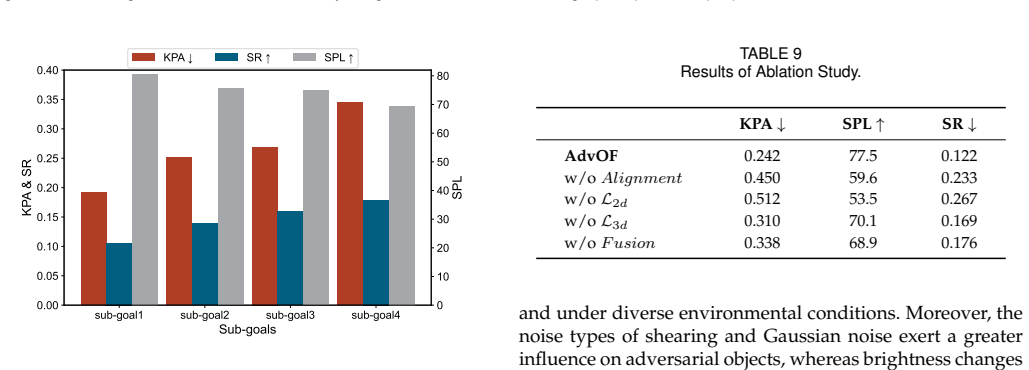
- Attacking an early goal object disrupts later goals more than attacking a final goal, meaning the attack can compound navigation errors through the instruction sequence.
Reading between the lines
- Editorial inference: the decisive untested step is physical realizability; if painting or 3D printing cannot reproduce the optimized perturbation, the threat remains a simulation-only phenomenon.
- Editorial inference: the same weighted multi-view optimization could be repurposed as a robustness probe for other embodied systems that build maps from VLM features, such as assistive robots with open-vocabulary grounding.
- Editorial inference: a natural defensive extension would be multi-view consistency checks, requiring the same object to produce the same label from different viewpoints, since the attack's power comes from making diverse views agree on a false label.
- Editorial inference: quantifying the perceptual distance between the perturbed and original object under human viewing would clarify whether the object is a subtle spoof or an obvious alteration.
Editorial analysis
A structured set of objections, weighed in public.
Referee Report
Summary. The paper proposes Adversarial Object Fusion (AdvOF), a framework for generating 3D adversarial objects that mislead VLM-based perception modules in vision-and-language navigation (VLN) agents. The method aligns victim objects in 2D and 3D, optimizes a point-cloud perturbation using image-image and image-text embedding similarities with physical regularization, and fuses multi-view updates with importance weights. Experiments on four VLN agents (Vlmaps, Cow, CF, ORION) report strong perception-level attack success (Table 4: Acc 0.02-0.05, Asr 0.91-0.94) and large SR drops in Table 3, plus transferability and ablation studies. The paper claims the attack degrades navigation performance while preserving normal-environment behavior.
Significance. If the reported results are correct, the paper is a valuable contribution to adversarial robustness of VLM-powered embodied agents. The perception-level results are clean and represent a clear improvement over 2D and 3D baselines, and the transferability experiments (Tables 5-7) and ablation (Table 9) provide useful evidence for the method's components. However, the central navigation-failure claim is currently supported only by Table 3, which contains internally inconsistent metric values (SPL > SR under the paper's own definitions). The simulation-only evaluation also leaves the physical-world threat model unvalidated. These issues do not invalidate the perception-level contribution, but they require substantial revision before the navigation-disruption claim can be accepted.
major comments (2)
- [Table 3 / Section 5.1] The reported SPL values are inconsistent with the paper's own definitions. Section 5.1 defines SR as the fraction of episodes where the agent stops within 1.0 m of the target and SPL as success weighted by the oracle shortest path length normalized by the actual path length. Under these definitions SPL <= SR for every episode and hence for every aggregate. Table 3 reports, for example, Vlmaps AdvOF(Targeted) with SR=0.122 and SPL=77.5, and similar violations in every row of the attacked block (Cow SR=0.067/SPL=19.9, CF SR=0.087/SPL=27.0, ORION SR=0.064/SPL=15.6) and in the Base rows. The magnitudes (tens of meters) suggest the column actually reports average path length (PL) or a similar quantity, not the standard SPL. Since Table 3 is the only evidence that perception errors propagate to navigation failure, the main claim is unsupported until the metric is recomputed under the stated definition or the column is relabeled and the definitions are aligned.
- [Section 5.1, Attack Implementations] The evaluation replaces RGB-D data associated with the victim object with perturbed data and regenerates the semantic map. No physical object is fabricated and no real-world camera, lighting, or sensor noise is tested. The abstract and Section 3.2 explicitly frame the attack as a threat to physical-world deployments and list painting and 3D printing as attacker capabilities, so the simulation-to-physical transfer is a load-bearing assumption. The authors should provide a physical validation (e.g., a printed object) or explicitly scope the claimed threat to simulated environments and discuss the transfer gap.
minor comments (6)
- [Section 5.1] In 'Simulation Datasets and Environments', the dataset is referred to as 'HP3D' but Table 1 lists 'HM3D'; the text should be corrected to HM3D.
- [Equation (19)] The formula for the view weight w_v is malformed ('wv = wP v in V w , where w = score v + N v/N'); please rewrite it with a clear normalization and define N.
- [Algorithm 1] The loop-variable notation is garbled (e.g., 'w v v', 'maskv v', and 'delta adv wv <- delta adv v'); please fix the typesetting so the update rule is readable.
- [Section 4.3 / Figure 4] The text says 'Fig. 6-(d) demonstrates that AdvOF can precisely manipulate the perception of the adversarial object', but Fig. 6(d) is the ST baseline; the AdvOF result is in Fig. 6(f).
- [Section 5.2] There is a typo in 'optimizes adversarial objects using trajectory historis'; it should be 'trajectory histories'.
- [Table 3 header] The arrow directions in the Table 3 header are inconsistent with the attack goal: the 'Attacked' block has SPL up and the 'Normal' block has SPL down, which would imply that higher SPL is worse under attack and lower SPL is better in normal operation. This should be aligned with the corrected metric definition.
Circularity Check
No significant circularity: the central claim is a white-box attack evaluated on its own objective, which is standard attack practice, and the transfer, ablation, and noise experiments provide external checks.
full rationale
AdvOF is a white-box adversarial attack, so the observation that its evaluation (Tables 3-4) measures VLM misclassification of objects that Eqs. 16-18 were explicitly optimized to misclassify is the standard object of attack evaluation, not a circular derivation: the paper claims to construct an attack, and the evaluation verifies that constructed artifact's effect. The framework is internally self-consistent with its inputs, but its inputs (victim object, target label, VLM parameters, rendering pipeline) are external, and no parameter is fitted to the reported outcomes; the hyperparameters (alpha=0.5, beta=0.01, epsilon=32/255, mu1=0.01, mu2=0.05) are fixed settings, and the ablation (Table 9) shows each designed component contributes to the result. Genuine external checks exist: held-out-view perception (Table 4), cross-encoder transfer (Table 5), cross-dataset transfer (Table 6), cross-model transfer (Table 7), and image-noise robustness (Table 8) all confirm behavior beyond the optimized views and models, so the attack result is not forced by construction. The only self-citations are [14] and [15] (co-author Jiacheng Wang) in a background enumeration of VLM and generative-AI works; they carry no load in the derivation, and no uniqueness theorem or ansatz is imported from prior work by the same authors. Two issues are worth flagging as correctness risks rather than circularity: (1) Table 3 reports SPL values (77.5, 19.9, 27.0, 15.6 for AdvOF Targeted rows) that exceed the corresponding SR values (0.122, 0.067, 0.087, 0.064), violating the paper's own metric definitions under which SPL is bounded above by SR for every episode, so the navigation-failure measurements are internally inconsistent; (2) Section 5.1 evaluates by replacing the victim object's RGB-D data with perturbed renders and regenerating the semantic map, so physical realizability through painting or 3D printing is assumed rather than demonstrated. Neither issue constitutes a reduction of the central claim to its own inputs by definition, so the circularity score is minimal.
Assumptions & free parameters
free parameters (7)
- epsilon (perturbation bound) =
32/255
- alpha (I2T weight) =
0.5
- beta (B2B weight) =
0.01
- mu1 (consistency threshold) =
0.01
- mu2 (fusion threshold) =
0.05
- max optimization iterations =
200
- grounding box and text thresholds =
0.40
assumptions (6)
- standard math Pinhole camera projection (Equation 5) maps 3D object perturbations to 2D perturbations exactly.
- domain assumption VLM embeddings (CLIP, LSeg, LLaVA) are differentiable surrogates for the agent's semantic map features.
- domain assumption Masked feature regularization leaves background semantics unchanged.
- domain assumption A 3D point-cloud perturbation plus rendering faithfully represents a physically realizable adversarial object.
- domain assumption Grounding DINO, SAM, and DBSCAN correctly isolate the victim object in 3D.
- ad hoc to paper View importance weights based on grounding score and pixel count improve optimization.
Cite this review
Pith. "Pith review of Disrupting Vision-Language Model-Driven Navigation Services via Adversarial Object Fusion." pith.science (2026). https://pith.science/paper/BBKLOGGG
@misc{pith2026250523266,
  author       = {Pith},
  title        = {Pith review of: Disrupting Vision-Language Model-Driven Navigation Services via Adversarial Object Fusion},
  year         = {2026},
  howpublished = {\url{https://pith.science/paper/BBKLOGGG}},
  note         = {Machine review of arXiv:2505.23266}
}
read the original abstract
We present Adversarial Object Fusion (AdvOF), a novel attack framework targeting vision-and-language navigation (VLN) agents in service-oriented environments by generating adversarial 3D objects. While foundational models like Large Language Models (LLMs) and Vision Language Models (VLMs) have enhanced service-oriented navigation systems through improved perception and decision-making, their integration introduces vulnerabilities in mission-critical service workflows. Existing adversarial attacks fail to address service computing contexts, where reliability and quality-of-service (QoS) are paramount. We utilize AdvOF to investigate and explore the impact of adversarial environments on the VLM-based perception module of VLN agents. In particular, AdvOF first precisely aggregates and aligns the victim object positions in both 2D and 3D space, defining and rendering adversarial objects. Then, we collaboratively optimize the adversarial object with regularization between the adversarial and victim object across physical properties and VLM perceptions. Through assigning importance weights to varying views, the optimization is processed stably and multi-viewedly by iterative fusions from local updates and justifications. Our extensive evaluations demonstrate AdvOF can effectively degrade agent performance under adversarial conditions while maintaining minimal interference with normal navigation tasks. This work advances the understanding of service security in VLM-powered navigation systems, providing computational foundations for robust service composition in physical-world deployments.
Figures


Figures from the paper (7 more)


Reference graph
Works this paper leans on
-
[1]
Efficient qos-aware service recommendation for multi-tenant service-based systems in cloud,
Y. Wang, Q. He, X. Zhang, D. Ye, and Y. Yang, “Efficient qos-aware service recommendation for multi-tenant service-based systems in cloud,”IEEE Transactions on Services Computing, vol. 13, no. 6, pp. 1045–1058, 2017
work page 2017
-
[2]
Edge computing for internet of everything: A survey,
X. Kong, Y. Wu, H. Wang, and F. Xia, “Edge computing for internet of everything: A survey,”IEEE Internet of Things Journal, vol. 9, no. 23, pp. 23 472–23 485, 2022
work page 2022
-
[3]
Groupchain: Towards a scalable public blockchain in fog computing of iot services com- puting,
K. Lei, M. Du, J. Huang, and T. Jin, “Groupchain: Towards a scalable public blockchain in fog computing of iot services com- puting,”IEEE Transactions on Services Computing, vol. 13, no. 2, pp. 252–262, 2020
work page 2020
-
[4]
P . Anderson, Q. Wu, D. Teney, J. Bruce, M. Johnson, N. S¨underhauf, I. Reid, S. Gould, and A. Van Den Hengel, “Vision-and-language navigation: Interpreting visually-grounded navigation instruc- tions in real environments,” inProceedings of the IEEE conference on computer vision and pattern recognition, 2018, pp. 3674–3683
work page 2018
-
[5]
Transferable representation learning in vision-and- language navigation,
H. Huang, V . Jain, H. Mehta, A. Ku, G. Magalhaes, J. Baldridge, and E. Ie, “Transferable representation learning in vision-and- language navigation,” inProceedings of the IEEE/CVF international conference on computer vision, 2019, pp. 7404–7413
work page 2019
-
[6]
X. Wang, W. Xiong, H. Wang, and W. Y. Wang, “Look before you leap: Bridging model-free and model-based reinforcement learning for planned-ahead vision-and-language navigation,” in Proceedings of the European Conference on Computer Vision (ECCV), 2018, pp. 37–53
work page 2018
-
[7]
X. Wang, Q. Huang, A. Celikyilmaz, J. Gao, D. Shen, Y.-F. Wang, W. Y. Wang, and L. Zhang, “Reinforced cross-modal matching and self-supervised imitation learning for vision-language navi- gation,” inProceedings of the IEEE/CVF conference on computer vision and pattern recognition, 2019, pp. 6629–6638
work page 2019
-
[8]
Lan- guage models are few-shot learners,
T. Brown, B. Mann, N. Ryder, M. Subbiah, J. D. Kaplan, P . Dhari- wal, A. Neelakantan, P . Shyam, G. Sastry, A. Askellet al., “Lan- guage models are few-shot learners,”Advances in neural informa- tion processing systems, vol. 33, pp. 1877–1901, 2020
1901
Show all 72 references
-
[9]
Gpt-4 technical report,
J. Achiam, S. Adler, S. Agarwal, L. Ahmad, I. Akkaya, F. L. Aleman, D. Almeida, J. Altenschmidt, S. Altman, S. Anadkatet al., “Gpt-4 technical report,”arXiv preprint arXiv:2303.08774, 2023
2023 arXiv
-
[10]
When search engine services meet large language models: visions and challenges,
H. Xiong, J. Bian, Y. Li, X. Li, M. Du, S. Wang, D. Yin, and S. Helal, “When search engine services meet large language models: visions and challenges,”IEEE Transactions on Services Computing, 2024
2024
-
[11]
Learning transfer- able visual models from natural language supervision,
A. Radford, J. W. Kim, C. Hallacy, A. Ramesh, G. Goh, S. Agarwal, G. Sastry, A. Askell, P . Mishkin, J. Clarket al., “Learning transfer- able visual models from natural language supervision,” inICML. PMLR, 2021, pp. 8748–8763
2021
-
[12]
Visual instruction tuning,
H. Liu, C. Li, Q. Wu, and Y. J. Lee, “Visual instruction tuning,” Advances in neural information processing systems, vol. 36, pp. 34 892– 34 916, 2023
2023
-
[13]
Jarvis: Joining adversarial training with vision transformers in next-activity prediction,
V . Pasquadibisceglie, A. Appice, G. Castellano, and D. Malerba, “Jarvis: Joining adversarial training with vision transformers in next-activity prediction,”IEEE Transactions on Services Computing, vol. 17, no. 4, pp. 1593–1606, 2023
2023
-
[14]
Generative ai based secure wireless sensing for isac networks,
J. Wang, H. Du, Y. Liu, G. Sun, D. Niyato, S. Mao, D. I. Kim, and X. Shen, “Generative ai based secure wireless sensing for isac networks,”arXiv preprint arXiv:2408.11398, 2024
2024 arXiv
-
[15]
Multi-objective aerial collaborative secure communication opti- mization via generative diffusion model-enabled deep reinforce- ment learning,
C. Zhang, G. Sun, J. Li, Q. Wu, J. Wang, D. Niyato, and Y. Liu, “Multi-objective aerial collaborative secure communication opti- mization via generative diffusion model-enabled deep reinforce- ment learning,”IEEE Transactions on Mobile Computing, 2024
2024
-
[16]
Visual language maps for robot navigation,
C. Huang, O. Mees, A. Zeng, and W. Burgard, “Visual language maps for robot navigation,” inICRA, 2023, pp. 10 608–10 615
2023
-
[17]
Cows on pasture: Baselines and benchmarks for language-driven zero-shot object navigation,
S. Y. Gadre, M. Wortsman, G. Ilharco, L. Schmidt, and S. Song, “Cows on pasture: Baselines and benchmarks for language-driven zero-shot object navigation,” inCVPR, 2023, pp. 23 171–23 181
2023
-
[18]
Think, act, and ask: Open- world interactive personalized robot navigation,
Y. Dai, R. Peng, S. Li, and J. Chai, “Think, act, and ask: Open- world interactive personalized robot navigation,” inICRA, 2024, pp. 3296–3303
2024
-
[19]
CLIP-fields: Weakly supervised semantic fields for robotic mem- ory,
N. M. M. Shafiullah, C. Paxton, L. Pinto, S. Chintala, and A. Szlam, “CLIP-fields: Weakly supervised semantic fields for robotic mem- ory,” inICRA Workshop, 2023
2023
-
[20]
A survey on robotics with foundation models: toward embodied ai,
Z. Xu, K. Wu, J. Wen, J. Li, N. Liu, Z. Che, and J. Tang, “A survey on robotics with foundation models: toward embodied ai,”arXiv preprint arXiv:2402.02385, 2024
2024 arXiv
-
[21]
Real-world robot applications of foundation models: A review,
K. Kawaharazuka, T. Matsushima, A. Gambardella, J. Guo, C. Pax- ton, and A. Zeng, “Real-world robot applications of foundation models: A review,”Advanced Robotics, pp. 1–23, 2024
2024
-
[22]
Velma: Verbalization embodiment of llm agents for vision and language navigation in street view,
R. Schumann, W. Zhu, W. Feng, T.-J. Fu, S. Riezler, and W. Y. Wang, “Velma: Verbalization embodiment of llm agents for vision and language navigation in street view,” inAAAI, vol. 38, no. 17, 2024, pp. 18 924–18 933
2024
-
[23]
Segment anything,
A. Kirillov, E. Mintun, N. Ravi, H. Mao, C. Rolland, L. Gustafson, T. Xiao, S. Whitehead, A. C. Berg, W.-Y. Loet al., “Segment anything,” inCVPR, 2023, pp. 4015–4026
2023
-
[24]
Defending adversarial attacks via semantic feature manipulation,
S. Wang, S. Nepal, C. Rudolph, M. Grobler, S. Chen, T. Chen, and Z. An, “Defending adversarial attacks via semantic feature manipulation,”IEEE Transactions on Services Computing, vol. 15, no. 6, pp. 3184–3197, 2021
2021
-
[25]
Exploring the robustness of decision-level through adversarial attacks on llm- based embodied models,
S. Liu, J. Chen, S. Ruan, H. Su, and Z. Yin, “Exploring the robustness of decision-level through adversarial attacks on llm- based embodied models,”arXiv preprint arXiv:2405.19802, 2024
2024 arXiv
-
[26]
Poex: Policy executable embodied ai jailbreak attacks,
X. Lu, Z. Huang, X. Li, W. Xuet al., “Poex: Policy executable embodied ai jailbreak attacks,”arXiv preprint arXiv:2412.16633, 2024
2024 arXiv
-
[27]
Exploring the adversarial vulnerabili- ties of vision-language-action models in robotics,
T. Wang, D. Liu, J. C. Liang, W. Yang, Q. Wang, C. Han, J. Luo, and R. Tang, “Exploring the adversarial vulnerabili- ties of vision-language-action models in robotics,”arXiv preprint arXiv:2411.13587, 2024
2024 arXiv
-
[28]
How secure are large language models (llms) for navigation in urban environ- ments?
C. Wen, J. Liang, S. Yuan, H. Huang, and Y. Fang, “How secure are large language models (llms) for navigation in urban environ- ments?”arXiv preprint arXiv:2402.09546, 2024
2024 arXiv
-
[29]
Universal and transferable adversarial attacks on aligned language models,
A. Zou, Z. Wang, N. Carlini, M. Nasr, J. Z. Kolter, and M. Fredrik- son, “Universal and transferable adversarial attacks on aligned language models,”arXiv preprint arXiv:2307.15043, 2023
2023 arXiv
-
[30]
Accelerating greedy coordinate gradient and general prompt optimization via probe sampling,
Y. Zhao, W. Zheng, T. Cai, X. Do Long, K. Kawaguchi, A. Goyal, and M. Q. Shieh, “Accelerating greedy coordinate gradient and general prompt optimization via probe sampling,”Advances in Neural Information Processing Systems, vol. 37, pp. 53 710–53 731, 2024
2024
-
[31]
Jailbreaker: Automated jailbreak across multiple large language model chatbots,
G. Deng, Y. Liu, Y. Li, K. Wang, Y. Zhang, Z. Li, H. Wang, T. Zhang, and Y. Liu, “Jailbreaker: Automated jailbreak across multiple large language model chatbots,” inNDSS, 2024
2024
-
[32]
Tree of attacks: Jailbreaking black- box llms automatically,
A. Mehrotra, M. Zampetakis, P . Kassianik, B. Nelson, H. Ander- son, Y. Singer, and A. Karbasi, “Tree of attacks: Jailbreaking black- box llms automatically,”Advances in Neural Information Processing Systems, vol. 37, pp. 61 065–61 105, 2024. 13
2024
-
[33]
Adv- clip: Downstream-agnostic adversarial examples in multimodal contrastive learning,
Z. Zhou, S. Hu, M. Li, H. Zhang, Y. Zhang, and H. Jin, “Adv- clip: Downstream-agnostic adversarial examples in multimodal contrastive learning,” inACMMM, 2023, pp. 6311–6320
2023
-
[34]
On evaluating adversarial robustness of large vision- language models,
Y. Zhao, T. Pang, C. Du, X. Yang, C. Li, N.-M. M. Cheung, and M. Lin, “On evaluating adversarial robustness of large vision- language models,”NeurIPS, vol. 36, 2023
2023
-
[35]
Spatiotemporal attacks for embodied agents,
A. Liu, T. Huang, X. Liu, Y. Xu, Y. Ma, X. Chen, S. J. Maybank, and D. Tao, “Spatiotemporal attacks for embodied agents,” inComputer Vision–ECCV 2020: 16th European Conference, Glasgow, UK, August 23–28, 2020, Proceedings, Part XVII 16. Springer, 2020, pp. 122–138
2020
-
[36]
Towards transferable targeted 3d adversarial attack in the physical world,
Y. Huang, Y. Dong, S. Ruan, X. Yang, H. Su, and X. Wei, “Towards transferable targeted 3d adversarial attack in the physical world,” inProceedings of the IEEE/CVF Conference on Computer Vision and Pattern Recognition, 2024, pp. 24 512–24 522
2024
-
[37]
Very deep convolutional networks for large-scale image recognition,
K. Simonyan and A. Zisserman, “Very deep convolutional networks for large-scale image recognition,”arXiv preprint arXiv:1409.1556, 2014
2014 arXiv
-
[38]
Mask r-cnn,
K. He, G. Gkioxari, P . Doll ´ar, and R. Girshick, “Mask r-cnn,” in Proceedings of the IEEE international conference on computer vision, 2017, pp. 2961–2969
2017
-
[39]
Deep residual learning for image recognition,
K. He, X. Zhang, S. Ren, and J. Sun, “Deep residual learning for image recognition,” inProceedings of the IEEE conference on computer vision and pattern recognition, 2016, pp. 770–778
2016
-
[40]
Chain-of-thought prompting elicits reasoning in large language models,
J. Wei, X. Wang, D. Schuurmans, M. Bosma, F. Xia, E. Chi, Q. V . Le, D. Zhouet al., “Chain-of-thought prompting elicits reasoning in large language models,”NeurIPS, vol. 35, pp. 24 824–24 837, 2022
2022
-
[41]
An embodied generalist agent in 3d world,
J. Huang, S. Yong, X. Ma, X. Linghu, P . Li, Y. Wang, Q. Li, S.-C. Zhu, B. Jia, and S. Huang, “An embodied generalist agent in 3d world,” inICLR 2024 Workshop: How Far Are We From AGI, 2024. [Online]. Available: https://openreview.net/forum?id=ltX3S0juSa
2024
-
[42]
Llm-planner: Few-shot grounded planning for embodied agents with large language models,
C. H. Song, J. Wu, C. Washington, B. M. Sadler, W.-L. Chao, and Y. Su, “Llm-planner: Few-shot grounded planning for embodied agents with large language models,” inCVPR, 2023, pp. 2998– 3009
2023
-
[43]
Towards learning a generalist model for embodied navigation,
D. Zheng, S. Huang, L. Zhao, Y. Zhong, and L. Wang, “Towards learning a generalist model for embodied navigation,” inCVPR, 2024, pp. 13 624–13 634
2024
-
[44]
Zson: Zero-shot object-goal navigation using multimodal goal embeddings,
A. Majumdar, G. Aggarwal, B. Devnani, J. Hoffman, and D. Batra, “Zson: Zero-shot object-goal navigation using multimodal goal embeddings,”NeurIPS, vol. 35, pp. 32 340–32 352, 2022
2022
-
[45]
A survey on large language model (llm) security and privacy: The good, the bad, and the ugly,
Y. Yao, J. Duan, K. Xu, Y. Cai, Z. Sun, and Y. Zhang, “A survey on large language model (llm) security and privacy: The good, the bad, and the ugly,”High-Confidence Computing, p. 100211, 2024
2024
-
[46]
Large language model alignment: A survey,
T. Shen, R. Jin, Y. Huang, C. Liu, W. Dong, Z. Guo, X. Wu, Y. Liu, and D. Xiong, “Large language model alignment: A survey,”arXiv preprint arXiv:2309.15025, 2023
2023 arXiv
-
[47]
Bert-attack: Adversarial attack against bert using bert,
L. Li, R. Ma, Q. Guo, X. Xue, and X. Qiu, “Bert-attack: Adversarial attack against bert using bert,” inEMNLP, 2020, pp. 6193–6202
2020
-
[48]
How robust is google’s bard to adversarial image attacks?
Y. Dong, H. Chen, J. Chen, Z. Fang, X. Yang, Y. Zhang, Y. Tian, H. Su, and J. Zhu, “How robust is google’s bard to adversarial image attacks?”arXiv preprint arXiv:2309.11751, 2023
2023 arXiv
-
[49]
Re- thinking model ensemble in transfer-based adversarial attacks,
H. Chen, Y. Zhang, Y. Dong, X. Yang, H. Su, and J. Zhu, “Re- thinking model ensemble in transfer-based adversarial attacks,” inICLR, 2024
2024
-
[50]
Physical adversarial attack meets computer vision: A decade survey,
H. Wei, H. Tang, X. Jia, Z. Wang, H. Yu, Z. Li, S. Satoh, L. Van Gool, and Z. Wang, “Physical adversarial attack meets computer vision: A decade survey,”IEEE TP AMI, 2024
2024
-
[51]
Robust adversarial objects against deep learning models,
T. Tsai, K. Yang, T.-Y. Ho, and Y. Jin, “Robust adversarial objects against deep learning models,” inAAAI, vol. 34, no. 01, 2020, pp. 954–962
2020
-
[52]
Pointcloud saliency maps,
T. Zheng, C. Chen, J. Yuan, B. Li, and K. Ren, “Pointcloud saliency maps,” inCVPR, 2019, pp. 1598–1606
2019
-
[53]
Advpc: Transfer- able adversarial perturbations on 3d point clouds,
A. Hamdi, S. Rojas, A. Thabet, and B. Ghanem, “Advpc: Transfer- able adversarial perturbations on 3d point clouds,” inECCV, 2020, pp. 241–257
2020
-
[54]
Lg-gan: Label guided adversarial network for flexible targeted attack of point cloud based deep networks,
H. Zhou, D. Chen, J. Liao, K. Chen, X. Dong, K. Liu, W. Zhang, G. Hua, and N. Yu, “Lg-gan: Label guided adversarial network for flexible targeted attack of point cloud based deep networks,” inCVPR, 2020, pp. 10 356–10 365
2020
-
[55]
Dta: Physical camouflage attacks using differentiable transformation network,
N. Suryanto, Y. Kim, H. Kang, H. T. Larasati, Y. Yun, T.-T.-H. Le, H. Yang, S.-Y. Oh, and H. Kim, “Dta: Physical camouflage attacks using differentiable transformation network,” inCVPR, 2022, pp. 15 305–15 314
2022
-
[56]
Active: Towards highly trans- ferable 3d physical camouflage for universal and robust vehicle evasion,
N. Suryanto, Y. Kim, H. T. Larasati, H. Kang, T.-T.-H. Le, Y. Hong, H. Yang, S.-Y. Oh, and H. Kim, “Active: Towards highly trans- ferable 3d physical camouflage for universal and robust vehicle evasion,” inCVPR, 2023, pp. 4305–4314
2023
-
[57]
Learning from simulated and unsupervised images through adversarial training,
A. Shrivastava, T. Pfister, O. Tuzel, J. Susskind, W. Wang, and R. Webb, “Learning from simulated and unsupervised images through adversarial training,” inCVPR, 2017, pp. 2107–2116
2017
-
[58]
Pointnet: Deep learning on point sets for 3d classification and segmentation,
C. R. Qi, H. Su, K. Mo, and L. J. Guibas, “Pointnet: Deep learning on point sets for 3d classification and segmentation,” inCVPR, 2017, pp. 652–660
2017
-
[59]
Pointnet++: Deep hierarchical feature learning on point sets in a metric space,
C. R. Qi, L. Yi, H. Su, and L. J. Guibas, “Pointnet++: Deep hierarchical feature learning on point sets in a metric space,” in NeurIPS, I. Guyon, U. V . Luxburg, S. Bengio, H. Wallach, R. Fergus, S. Vishwanathan, and R. Garnett, Eds., vol. 30. Curran Associates, Inc., 2017
2017
-
[60]
Faster r-cnn: Towards real-time object detection with region proposal networks,
S. Ren, K. He, R. Girshick, and J. Sun, “Faster r-cnn: Towards real-time object detection with region proposal networks,”IEEE TPMAI, vol. 39, no. 6, pp. 1137–1149, 2016
2016
-
[61]
You only look once: Unified, real-time object detec- tion,
J. Redmon, “You only look once: Unified, real-time object detec- tion,” inCVPR, 2016
2016
-
[62]
Beyond the nav-graph: Vision-and-language navigation in continuous en- vironments,
J. Krantz, E. Wijmans, A. Majumdar, D. Batra, and S. Lee, “Beyond the nav-graph: Vision-and-language navigation in continuous en- vironments,” inECCV, 2020, pp. 104–120
2020
-
[63]
A frontier-based approach for autonomous explo- ration,
B. Yamauchi, “A frontier-based approach for autonomous explo- ration,” inCIRA. IEEE, 1997, pp. 146–151
1997
-
[64]
Large language models can be easily distracted by irrelevant context,
F. Shi, X. Chen, K. Misra, N. Scales, D. Dohan, E. H. Chi, N. Sch¨arli, and D. Zhou, “Large language models can be easily distracted by irrelevant context,” inICML. PMLR, 2023, pp. 31 210–31 227
2023
-
[65]
Ad- versarial camouflage: Hiding physical-world attacks with natural styles,
R. Duan, X. Ma, Y. Wang, J. Bailey, A. K. Qin, and Y. Yang, “Ad- versarial camouflage: Hiding physical-world attacks with natural styles,” inProceedings of the IEEE/CVF conference on computer vision and pattern recognition, 2020, pp. 1000–1008
2020
-
[66]
An overview on 3d printing technology: Technological, materials, and applications,
N. Shahrubudin, T. C. Lee, and R. Ramlan, “An overview on 3d printing technology: Technological, materials, and applications,” Procedia manufacturing, vol. 35, pp. 1286–1296, 2019
2019
-
[67]
Grounding dino: Marrying dino with grounded pre-training for open-set object detection,
S. Liu, Z. Zeng, T. Ren, F. Li, H. Zhang, J. Yang, C. Li, J. Yang, H. Su, J. Zhuet al., “Grounding dino: Marrying dino with grounded pre-training for open-set object detection,”arXiv preprint arXiv:2303.05499, 2023
2023 arXiv
-
[68]
A density-based algorithm for discovering clusters in large spatial databases with noise,
M. Ester, H.-P . Kriegel, J. Sander, X. Xuet al., “A density-based algorithm for discovering clusters in large spatial databases with noise,” inKDD, vol. 96, no. 34, 1996, pp. 226–231
1996
-
[69]
Matterport3d: Learning from rgb-d data in indoor environments,
A. Chang, A. Dai, T. Funkhouser, M. Halber, M. Niebner, M. Savva, S. Song, A. Zeng, and Y. Zhang, “Matterport3d: Learning from rgb-d data in indoor environments,” in3DV, 2017, pp. 667–676
2017
-
[70]
Language-driven semantic segmentation,
B. Li, K. Q. Weinberger, S. Belongie, V . Koltun, and R. Ranftl, “Language-driven semantic segmentation,” inICLR, 2022
2022
-
[71]
Habitat-matterport 3d dataset (HM3d): 1000 large-scale 3d environments for embod- ied AI,
S. K. Ramakrishnan, A. Gokaslan, E. Wijmans, O. Maksymets, A. Clegg, J. M. Turner, E. Undersander, W. Galuba, A. Westbury, A. X. Chang, M. Savva, Y. Zhao, and D. Batra, “Habitat-matterport 3d dataset (HM3d): 1000 large-scale 3d environments for embod- ied AI,” inNeurIPS, 2021
2021
-
[72]
Habitat: A platform for embodied ai research,
M. Savva, A. Kadian, O. Maksymets, Y. Zhao, E. Wijmans, B. Jain, J. Straub, J. Liu, V . Koltun, J. Maliket al., “Habitat: A platform for embodied ai research,” inProceedings of the IEEE/CVF international conference on computer vision, 2019, pp. 9339–9347
2019
Reviewed August 7, 2026 · model on record in the stance chip above.
Discussion (0). Sign in to comment.