REVIEW 4 major objections 5 minor 52 references
Dynamic signature of the thermodynamic transition in a novel mean field system
T0 review · 4 major / 5 minor · reviewed 2026-08-07 · deepseek-v4-flash
Pith's one-line read In a mean-field variant of the Kob-Andersen liquid, the bonds between real particles and pseudo neighbours never fully break, and their surviving number—computable from static structure—directly sets the Kauzmann temperature via T_K = α_L…
desk verdict Useful extension of their pseudo-neighbour model, but the headline relation between TK and surviving bonds is a fit, not an independently tested prediction. read the letter →
The pith
A machine-rendered reading of the paper's core claim, the machinery that carries it, and where it could break.
The reading
What carries the argument
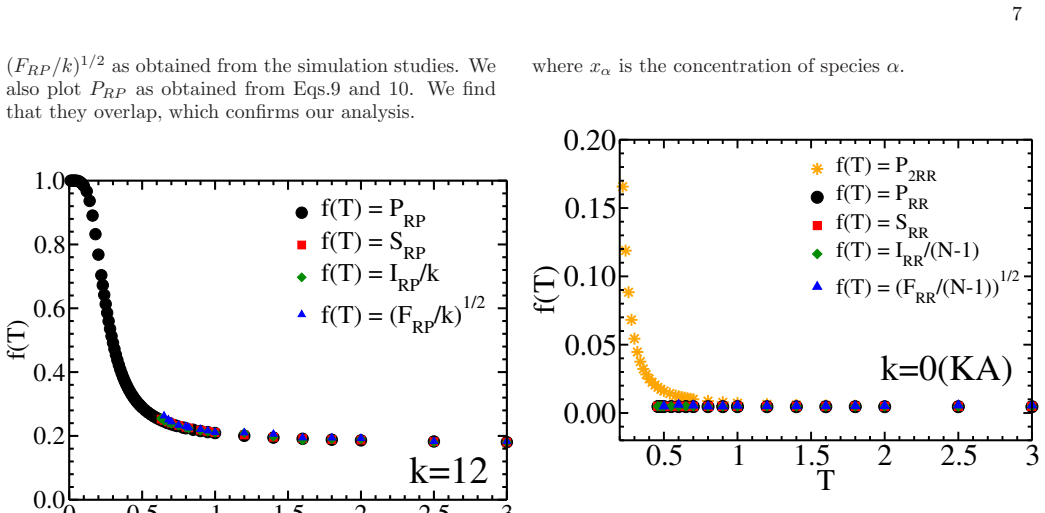
The load-bearing object is the real-pseudo bond breakage correlation function and its long-time plateau S_RP. A bond is defined as a pair (real particle, pseudo neighbour) whose separation minus the shift L stays within the interaction range 2.5σ; the plateau S_RP = BBRP(t→∞) is identified with the static probability P_RP from Eqs. 9-10, a spherical integral of the two-body Boltzmann weight exp(-βu(r-L)) over the accessible volume, generalised to the binary mixture via Eq. 10. The assumption that the long-time survival probability of an initially bonded pair equals the static probability converts a time-dependent correlation into a structural quantity, giving F_RP = k $P_RP^{2}$, and it is this expression that enters Eq. 13. The pseudo neighbours themselves are defined by a shifted, truncated Lennard-Jones potential u(r-L) with fixed L, added to a standard Kob-Andersen interaction without changing the radial distribution function.
What would settle it
At a state point where the simulation can still equilibrate (e.g., T = 0.7 for k = 12, L = 2.5), compute the long-time plateau of the real-pseudo bond breakage correlation from independent long runs and compare it with P_RP obtained from Eqs. 9-10 using the known potential; a difference beyond the estimated statistical error would falsify the identification S_RP = P_RP and the structural input of Eq. 13.
Extended reading notes
Core claim
The central claim is that surviving real-pseudo bonds are a robust dynamical signature of the thermodynamic transition in this mean-field system. The real-pseudo bond breakage correlation function saturates at a value S_RP = P_RP, where P_RP is the probability that a randomly assigned pseudo neighbour lies within the bonding range, given by Eqs. 9-10, while real-real bonds saturate at the same small, temperature-independent value as in the parent Kob-Andersen model. The paper shows that the initial number of real-pseudo bonds is I_RP = k P_RP and the number that survive to long times is F_RP = k $P_RP^{2}$, so the plateau is determined entirely by static structure. It then proposes T_K(k,L) = α_L F_RP(k,L,T_K) + T_K(k=0) with T_K(k=0)=0.28, verified against simulation-derived T_K for k = 4...28 and L = 2.5, 3.0. The paper concludes that the persistent pseudo bonds act like soft reversible bonds, giving the system properties analogous to randomly bonded ultrastable glasses while leaving self and collective dynamics coupled.
Load-bearing premise
The argument assumes that the chance a pseudo bond survives forever equals the static chance that a random pseudo neighbour sits inside the bonding range, so the measured plateau can be computed purely from the liquid structure; this equivalence is verified at the simulated temperatures but is not derived from the dynamics.
Editorial extensions
If this is right
- T_K for any such mean-field system can be estimated from the static probability P_RP alone, without simulating the deeply supercooled regime, by solving Eq. 13.
- The Adam-Gibbs breakdown is explained: local dynamical observables (overlap, velocity autocorrelation) relax through real-real bond breaking, while the thermodynamics is governed by the persistent pseudo bonds.
- The plateau value of the real-pseudo bond breakage correlation is a direct dynamical marker of the thermodynamic transition, since it grows strongly as T approaches T_K.
- The mean-field system shares key features with randomly bonded ultrastable glasses—translational invariance, coupled self and collective dynamics, and persistent soft bonds—suggesting an alternative route to ultrastability.
- The additive structure of Eq. 13 separates the real-neighbour contribution (0.28) from the pseudo-neighbour contribution, so the shift in T_K is linear in the number of surviving pseudo bonds.
Reading between the lines
- A natural extension is to vary the pseudo-neighbour interaction range or add an attractive tail; if Eq. 13 still holds with P_RP recomputed from the modified Boltzmann weight, the relation is generic rather than potential-specific.
- The near-horizontal locus of dF_RP/dT at T_K (Figs. 20-21) hints at a universal growth-rate criterion for the thermodynamic transition; checking whether the same rate marks T_K in other mean-field glass models would confirm or refute that criterion.
- Because the plateau equals a static probability, the method could transfer to colloidal or granular systems with long-range reversible bonds, where P_RP can be measured from structure factors without waiting for equilibrium dynamics.
- At fixed pseudo-neighbour density, the surviving-bond number grows with system size at low T (Fig. 16), so the dynamical signature may persist in the thermodynamic limit even as the plateau value itself shrinks; a larger-scale simulation could test this directly.
Editorial analysis
A structured set of objections, weighed in public.
Referee Report
Summary. The manuscript studies a binary Kob-Andersen system augmented with k randomly chosen pseudo-neighbours, producing a mean-field-like variant that preserves local structure. The authors compute configurational entropy by thermodynamic integration to obtain T_K for various k and L, and analyze bond-breakage correlations for real-real and real-pseudo bonds. They find that real-pseudo bond breakage saturates at a temperature-dependent plateau, that the plateau can be expressed in terms of a static probability P_RP (Eqs 6-12), and they propose Eq 13 relating T_K to the final number of surviving pseudo bonds F_RP = k P_RP^2. They claim this provides a robust dynamical signature of the thermodynamic transition, with a possible analogy to randomly bonded ultrastable glasses.
Significance. The model is original and the static probability calculation is clean; the verification in Fig. 9 is a genuine strength. The finite-size analysis at fixed pseudo-neighbour density is also careful and useful. If Eq. 13 were genuinely predictive, it would offer an interesting bridge between thermodynamics and bond dynamics. However, as presented, the central correlation is not independently tested, and the 'dynamic' nature of the observable is weakened by the identity S_RP = P_RP. The paper therefore has a defensible core but needs additional validation before the central claim can be accepted.
major comments (4)
- [Section III D, Eq. (13), Figs. 17-18] The validation of Eq. (13) is in-sample. The parameter α_L is defined as the inverse slope of a line drawn through the same (T_K, F_RP(T_K)) points that Fig. 18 compares, so the y=x agreement is constructed rather than tested. In addition, Eq. (13) is evaluated at T = T_K, using the simulated T_K on both sides; the equation is not solved as an implicit relation for T_K. To support the predictive claim, the authors should provide an out-of-sample test (e.g., held-out k, a new L, or a derivation of α_L) and should report error bars on both T_K and F_RP.
- [Section III B, Eqs. (9)-(13)] The factorization F_RP = I_RP * P_RP = k P_RP^2 asserts that the long-time conditional survival probability of an initially bonded pseudo pair equals the static equilibrium probability P_RP. This is a dynamical statement that is not derived; it is verified only at simulated state points (Fig. 9). Since Eq. (13) rests entirely on this product form, the assumption should be stated explicitly and supported by a derivation or by tests over a broader temperature range, including temperatures below the simulated range.
- [Table I and Figs. 17-18] No statistical uncertainties are reported for T_K(Sim), T_K(Eq. 13), or F_RP. Differences of up to about 0.015 in T_K (e.g., k=12, L=2.5) are presented as agreement, but without error bars one cannot judge whether the residuals are significant. T_K values obtained from thermodynamic-integration extrapolation carry inherent uncertainty, and this uncertainty should be propagated into the comparison.
- [Title, Abstract, and Eq. (9)-(10)] The paper calls the plateau a 'dynamic signature' of the thermodynamic transition, but Eqs. (9)-(10) and Fig. 9 show that S_RP = P_RP, a static equilibrium probability. The claim should be moderated or explicitly framed as a dynamic route to a static structural quantity; otherwise the terminology overstates the dynamical content of the observable.
minor comments (5)
- [Throughout] There are several typographical and formatting issues: the running header reads 'nove l' instead of 'novel'; 'V ACF' and 'M SD' appear with inconsistent spacing; and 'dashed dotted' vs 'dashed-dotted' is used inconsistently in figure captions.
- [Eq. (13)] The notation F_RP is used both for the final number of bonds and as a function of (k, L, T). Please clarify the arguments of F_RP and define I_RP and F_RP before they appear in Eq. (13).
- [Table I] The column header 'L=3' should be 'L=3.0' for consistency with the text and figures.
- [Section III B] The sentence introducing the conditional probability is abrupt; please define precisely the event whose probability is being computed and explain why it is equal to P_RP before using the product form.
- [Conclusion] The analogy to randomly bonded ultrastable glasses (Refs. 44,45) is interesting but speculative; consider labeling it explicitly as a conjecture rather than a direct implication of the present data.
Circularity Check
Eq. 13's agreement in Fig. 18 is an in-sample fit: αL is determined from the same (TK, FRP(TK)) points it is asked to reproduce.
-
fitted input called prediction
[Section III D, Eq. (13), Figs. 17 and 18]
"αL is the inverse slope of the dashed-dotted line, which connects the FRP values at TK for the systems with different k but same L values (Fig.17). ... To test the accuracy of the expression, in Fig.18, we plot TK calculated using Eq.13 against TK obtained from simulation for all the systems. We find that all the data almost fall on the straight line with no offset and slope 1 (y=x)."
αL is not an independent constant: it is the slope of the line through the same (TK_sim, FRP(TK_sim)) pairs that Fig. 18 compares. Inserting the simulation TK values into Eq. 13 with this fitted αL reproduces those TK values by construction, so the y=x agreement in Fig. 18 is an in-sample consistency check, not a validation of a predictive relation. All systems at a given L are used to estimate αL, leaving no held-out data; hence Eq. 13 cannot be tested by Fig. 18. The 'phenomenological relation' is therefore a fit to the data it claims to predict.
-
renaming known result
[Section III B, Eqs. (6)-(10) and definition of SRP]
"This quantity can be expressed as FRP = IRP ∗ PRP = k ∗ P_RP^2. Thus, the saturation value of the bond breakage time correlation function, SRP = FRP/IRP = PRP."
No derivation is given for equating the long-time conditional survival probability with the static equilibrium probability PRP. The saturation value of the time correlation function is thus identified with the structural probability from Eqs. (9)-(10); Fig. 9 verifies the equality over simulated temperatures. The 'dynamic signature' used in Eq. 13 is therefore a static structural quantity relabelled as dynamic, weakening the claim that surviving pseudo bonds are a dynamical fingerprint of TK.
full rationale
The static probability calculation (Eqs. 9-10) is derived from the potential and volume and is independently testable, and the bond-breakage simulation curves are new data. However, the paper's central validation of Eq. 13 is in-sample: αL is fit to the same (TK_sim, FRP(TK_sim)) pairs displayed in Fig. 18, so the y=x scatter is a consistency check rather than a prediction. Moreover, the saturation value SRP is equated to the static PRP, so the 'dynamical signature' is not an independent dynamic observable. No load-bearing self-citation or uniqueness theorem is involved, but the main quantitative claim reduces to a fit plus a static-probability ansatz, and the strongest assertion of a robust dynamical signature is correspondingly weakened.
Assumptions & free parameters
free parameters (2)
- α_L for L=2.5 =
Not stated explicitly; inverse slope of dashed-dotted line in Fig 17
- α_L for L=3.0 =
Not stated explicitly; inverse slope of dashed-dotted line in Fig 17
assumptions (4)
- domain assumption The pseudo neighbour pair distribution is approximated by the two-body Boltzmann weight exp(-βu(r-L)) (Eq 9).
- domain assumption The conditional probability that a bond survives to long times equals the static probability P_RP (FRP = k P_RP^2, Section III B).
- domain assumption The configurational entropy from thermodynamic integration and harmonic approximation yields a well-defined TK via extrapolation of TSc to zero (Appendix B).
- ad hoc to paper The additive form TK = αL FRP + TK(k=0) (Eq 13) with constant αL for each L.
Cite this review
Pith. "Pith review of Dynamic signature of the thermodynamic transition in a novel mean field system." pith.science (2026). https://pith.science/paper/UW3M6RGM
@misc{pith2026250523371,
  author       = {Pith},
  title        = {Pith review of: Dynamic signature of the thermodynamic transition in a novel mean field system},
  year         = {2026},
  howpublished = {\url{https://pith.science/paper/UW3M6RGM}},
  note         = {Machine review of arXiv:2505.23371}
}
read the original abstract
Understanding the connection between thermodynamics and dynamics in glass-forming liquids remains a central challenge in condensed matter physics. In this study, we investigate a novel model system that enables a continuous crossover from a standard three dimensional liquid to a fully connected mean field like system by introducing pseudo neighbours. These pseudo neighbours enhance the effective connectivity of the system without altering its local structure. While their presence slows down the dynamics, they influence thermodynamic properties even more significantly. In particular, the configurational entropy obtained via thermodynamic integration vanishes at a temperature much higher than the temperature where the dynamics begin to slow down, leading to a clear breakdown of the Adam Gibbs relation. To uncover a possible dynamical signature of this thermodynamic transition, we analyse bond breakage dynamics. Unlike real-real bonds, which decay similarly in both the parent Kob Andersen model and its mean field variant, real-pseudo bonds exhibit long lived, persistent behaviour with strong temperature dependence. These bonds do not fully decay over time, leading to a finite saturation value of the bond breakage correlation function. Remarkably, we show that the number of surviving pseudo bonds can be analytically estimated and correlates directly with the thermodynamic transition temperature T_K. We propose a phenomenological relation between T_K and the number of surviving pseudo-bonds, establishing a novel link between thermodynamic and dynamic observables. Our results suggest that these persistent pseudo bonds serve as a robust dynamical signature of the thermodynamic transition, and the system might have properties analogous to those of randomly bonded ultrastable glasses.
Figures


Figures from the paper (18 more)




Reference graph
Works this paper leans on
-
[1]
P. G. Debenedetti, Metastable Liquids. Concepts and Principles (Princeton Univ. Press, Princeton, 1996)
work page 1996
-
[2]
P. G. Debenedetti and F. H. Stillinger, Nature 410 , 259 (2001)
work page 2001
-
[3]
C. A. Angell, Science 267 , 1924 (1995)
work page 1995
- [4]
- [5]
- [6]
- [7]
- [8]
Show all 52 references
-
[9]
G\"otze, Complex Dynamics of Glass-Forming Liquids: A Mode-Coupling Theory (Oxford University Press, 2009)
W. G\"otze, Complex Dynamics of Glass-Forming Liquids: A Mode-Coupling Theory (Oxford University Press, 2009)
2009
-
[10]
Kob and H
W. Kob and H. C. Andersen, Phys. Rev. E 51 , 4626 (1995)
1995
-
[11]
S. P. Das, Rev. Mod. Phys. 76 , 785 (2004)
2004
-
[12]
S. M. Bhattacharyya, B. Bagchi, and P. G. Wolynes, Proc. Natl. Acad. Sci. U.S.A. 105 , 16077 (2008)
2008
-
[13]
M. K. Nandi and S. Maitra Bhattacharyya, J. Phys.: Condens. Matter 32 , 064001 (2019)
2019
-
[14]
Chong, Phys
S.-H. Chong, Phys. Rev. E 78 , 041501 (2008)
2008
-
[15]
T. R. Kirkpatrick, D. Thirumalai, and P. G. Wolynes, Phys. Rev. A 40 , 1045 (1989)
1989
-
[16]
Lubchenko and P
V. Lubchenko and P. G. Wolynes, Annu Rev Phys Chem 58 , 235 (2007)
2007
-
[17]
Cavagna, Phys
A. Cavagna, Phys. Rep. 476 , 51 (2009)
2009
-
[18]
Richert and C
R. Richert and C. A. Angell, J. Chem. Phys. 108 , 9016 (1998)
1998
-
[19]
Cammarota and G
C. Cammarota and G. Biroli, Proc. Natl. Acad. Sci. U.S.A. 109 , 8850 (2012)
2012
-
[20]
Ozawa, W
M. Ozawa, W. Kob, A. Ikeda, and K. Miyazaki, Proc. Natl. Acad. Sci. U.S.A. 112 , 6914 (2015)
2015
-
[21]
Chakrabarty, S
S. Chakrabarty, S. Karmakar, and C. Dasgupta, Sci. Rep. 5 , 12577 (2015)
2015
-
[22]
Brito, G
C. Brito, G. Parisi, and F. Zamponi, Soft Matter 9 , 8540 (2013)
2013
-
[23]
Ozawa, A
M. Ozawa, A. Ikeda, K. Miyazaki, and W. Kob, Phys. Rev. Lett. 121 , 205501 (2018)
2018
-
[24]
Patel and S
P. Patel and S. Maitra Bhattacharyya, J. Chem. Phys. 160 , 164501 (2024)
2024
-
[25]
Banerjee, S
A. Banerjee, S. Sengupta, S. Sastry, and S. M. Bhattacharyya, Phys. Rev. Lett. 113 , 225701 (2014)
2014
-
[26]
Banerjee, M
A. Banerjee, M. K. Nandi, S. Sastry, and S. M. Bhattacharyya, J. Chem. Phys. 145 , 034502 (2016)
2016
-
[27]
M. K. Nandi, A. Banerjee, S. Sengupta, S. Sastry, and S. M. Bhattacharyya, J. Chem. Phys. 143 , 174504 (2015)
2015
-
[28]
F. W. Starr, J. F. Douglas, and S. Sastry, J. Chem. Phys. 138 , 12A541 (2013)
2013
-
[29]
Sengupta, S
S. Sengupta, S. Karmakar, C. Dasgupta, and S. Sastry, Phys. Rev. Lett. 109 , 095705 (2012)
2012
-
[30]
A. D. S. Parmar, S. Sengupta, and S. Sastry, Phys. Rev. Lett. 119 , 056001 (2017)
2017
-
[31]
Sastry, Nature 409 , 164 (2001)
S. Sastry, Nature 409 , 164 (2001)
2001
-
[32]
U. K. Nandi et al. , J. Chem. Phys. 156 , 014503 (2022)
2022
-
[33]
Ozawa, W
M. Ozawa, W. Kob, A. Ikeda, and K. Miyazaki, Proc. Natl. Acad. Sci. U.S.A. 112 , E4821 (2015)
2015
-
[34]
Mari and J
R. Mari and J. Kurchan, J. Chem. Phys. 135 , 124504 (2011)
2011
-
[35]
U. K. Nandi, W. Kob, and S. Maitra Bhattacharyya, J. Chem. Phys. 154 , 094506 (2021)
2021
-
[36]
S.-T. Lin, M. Blanco, and I. Goddard, William A., J. Chem. Phys. 119 , 11792 (2003)
2003
-
[37]
S.-T. Lin, P. K. Maiti, and W. A. I. Goddard, J Phys Chem B 114 , 8191 (2010)
2010
-
[38]
Lai, C.-M
P.-K. Lai, C.-M. Hsieh, and S.-T. Lin, Phys. Chem. Chem. Phys 14 , 15206 (2012)
2012
-
[39]
Frenkel and B
D. Frenkel and B. Smit, Understanding Molecular Simulation: From Algorithms to Applications , Computational Science Series Vol. 1, Second ed. (Academic Press, San Diego, 2002)
2002
-
[40]
Anwar, P
E. Anwar, P. Patel, M. Sharma, and S. Maitra Bhattacharyya, J. Chem. Phys. 161 , 154501 (2024)
2024
-
[41]
J. P. Hansen and I. R. McDonald, The Theory of Simple Liquids, 2nd ed. ,Academic, London (1986)
1986
-
[42]
R. Das, C. Dasgupta, and S. Karmakar, Front. Phys 8 , 210 (2020)
2020
-
[43]
Yamamoto and A
R. Yamamoto and A. Onuki, J. Phys. Soc. Jpn 66 , 2545 (1997)
1997
-
[44]
Ozawa, Y
M. Ozawa, Y. Iwashita, W. Kob, and F. Zamponi, Nat. Commun 14 , 113 (2023)
2023
-
[45]
Ozawa, J.-L
M. Ozawa, J.-L. Barrat, W. Kob, and F. Zamponi, J. Stat. Mech 2024 , 013303 (2024)
2024
-
[46]
Kob, Course 5: Supercooled liquids, the glass transition, and computer simulations, in Slow Relaxations and nonequilibrium dynamics in condensed matter , edited by J.-L
W. Kob, Course 5: Supercooled liquids, the glass transition, and computer simulations, in Slow Relaxations and nonequilibrium dynamics in condensed matter , edited by J.-L. Barrat, M. Feigelman, J. Kurchan, and J. Dalibard, pp. 199--269, Berlin, Heidelberg, 2003, Springer Berl...
2003
-
[47]
Sciortino, W
F. Sciortino, W. Kob, and P. Tartaglia, J. Phys.: Condens. Matter 12 , 6525 (2000)
2000
-
[48]
Sastry, PhysChemComm 3 , 79 (2000)
S. Sastry, PhysChemComm 3 , 79 (2000)
2000
-
[49]
Singh, M
M. Singh, M. Agarwal, D. Dhabal, and C. Chakravarty, J. Chem. Phys. 137 , 024508 (2012)
2012
-
[50]
Sciortino, W
F. Sciortino, W. Kob, and P. Tartaglia, Phys. Rev. Lett. 83 , 3214 (1999)
1999
-
[51]
Sastry, Phys
S. Sastry, Phys. Rev. Lett. 85 , 590 (2000)
2000
-
[52]
Sengupta, F
S. Sengupta, F. Vasconcelos, F. Affouard, and S. Sastry, J. Chem. Phys. 135 , 194503 (2011)
2011
Reviewed August 7, 2026 · model on record in the stance chip above.
Discussion (0). Sign in to comment.