REVIEW 3 major objections 4 minor 1 cited by
Multiple LLM Agents Debate for Equitable Cultural Alignment
T0 review · 3 major / 4 minor · reviewed 2026-08-07 · deepseek-v4-flash
Pith's one-line read Putting two LLMs in a structured debate improves both accuracy and cultural parity on a 75-country social-norm test, letting 7-9B models match a 27B judge.
desk verdict A solid empirical study of multi-agent debate for cultural alignment; the judge-independent accuracy gains are convincing, but the parity and 'matches 27B' claims rest on a judge selected using the test set. read the letter →
The pith
A machine-rendered reading of the paper's core claim, the machinery that carries it, and where it could break.
The reading
What carries the argument
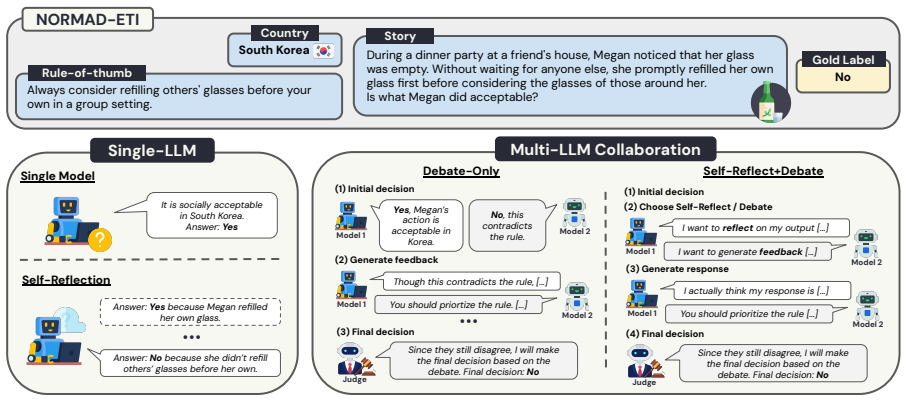
The central object is the multi-agent debate protocol: two LLM agents independently make an initial ternary decision on a country-tagged etiquette story, exchange written feedback, then produce a final decision; if they disagree, a separate judge LLM reads the debate transcript and gives the final answer. The two proposed variants, Debate-Only and Self-Reflect+Debate, both use this exchange-then-adjudicate loop, and the key mechanism is the complementary knowledge that different models bring to the same cultural scenario.
What would settle it
Re-run the evaluation with a judge model selected using only a held-out development split of the benchmark, with no access to NormAd-ETI test labels, then rerun the 21 model pairs; if 7-9B debate accuracy no longer reaches the 27B single-model level or cultural parity premiums fall toward single-model levels, the judge-selection shortcut is the load-bearing part.
Extended reading notes
Core claim
The paper's central discovery is that cultural adaptability improves more from having two different models debate than from making either model reflect alone. On NormAd-ETI, the Debate-Only variant reaches 76.3% average adjudicated accuracy and the Self-Reflect+Debate variant reaches 75.6%, versus 66.4% and 67.5% for the two single-model baselines. The best 7-9B pairs match the 79.2% single-model accuracy of the 27B judge, and debate also raises average cultural-group parity from 0.960 to 0.972. The authors read this as evidence that complementary training distributions and language coverage can be harvested through structured interaction, yielding both higher accuracy and more equitable alignment.
Load-bearing premise
The load-bearing premise is that the judge model's strength, which was measured on the same test benchmark, is not what drives the debate gains; if the judge were selected without access to test-set answers, the claimed parity and accuracy improvements might weaken.
Editorial extensions
If this is right
- Debate-Only improves individual debater accuracy over the same model's single-turn baseline in 19 of 21 model pairs, and the adjudicated debate result beats single-model baselines in 20 of 21 pairs.
- Two 7-9B models in debate can match the single-model accuracy of a 27B judge (79.2%): the best Debate-Only pair reaches 79.7% and the best Self-Reflect+Debate pair reaches 80.4%.
- Debate shifts average cultural-group parity from 0.960 (single model with rule-of-thumb) to 0.972 (Debate-Only), with the best pairs reaching 0.994 and 0.986, bringing underrepresented cultural groups closer to English-speaking accuracy.
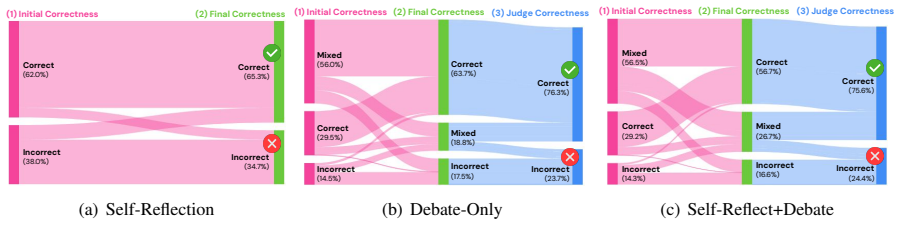
- Decision dynamics show that the two agents usually start with mixed initial decisions (about 56% of cases), and the debate process converts many of those into correct joint final decisions, with the judge resolving most remaining disagreements correctly.
- Adding self-reflection to debate does not systematically beat debate alone in final accuracy on average (75.6% versus 76.3%), but it does produce the single highest-performing model pair.
Reading between the lines
- Editorial inference: The accuracy gains may be partly an ensemble effect, so a blind ensemble or routed combination of the same two 7-9B models might reproduce some of the improvement without any debate transcript or judge.
- Editorial inference: Because parity is measured as accuracy relative to the best-performing cultural group, a natural testable extension is to compute worst-group accuracy, the more common fairness metric, to see whether debate also narrows the worst-group gap or mainly lifts already-strong groups.
- Editorial inference: The 'small models beat a bigger model' framing depends on the judge being the strongest single model on the same benchmark, so a fairer comparison would select the judge on a held-out development split and then measure whether debate still closes the scale gap.
Editorial analysis
A structured set of objections, weighed in public.
Referee Report
Summary. The paper proposes a Multi-Agent Debate framework for cultural alignment, with two variants: Debate-Only, where two LLM agents exchange feedback and a judge LLM resolves disagreements, and Self-Reflect+Debate, where each agent chooses between self-reflection and debate. The methods are evaluated on the NormAd-ETI benchmark with seven open-weight 7-9B LLMs and 21 LLM pairs, using GEMMA-2-27B as the judge. The authors report that individual debate accuracies exceed single-model baselines in 19/21 settings without the judge, that adjudicated debate accuracies exceed single-model baselines in 20/21 settings, that debate improves cultural group parity relative to English-speaking as the highest-accuracy group, and that 7-9B models reach accuracies comparable to the 27B judge. The paper includes detailed appendices with prompts, per-country results, decision dynamics, computational costs, and case studies, and it releases code and dataset.
Significance. If the headline claims hold, the paper offers a practical inference-time method for cultural alignment that exploits complementarity among open-weight LLMs without fine-tuning, and it introduces a cultural group parity metric that is directly relevant to fairness evaluations of LLMs. The most robust evidence is the judge-free result in §5.3 that individual debate accuracies D(M_i) exceed single-model baselines in 19/21 configurations, together with the oracle complementarity analysis in §5.2 and the transparent release of prompts, per-country tables, and code. However, the adjudicated accuracy numbers, the cultural parity claims in Table 3, and the 'comparable to 27B' claim in §5.5 all depend on a judge selected using the test set itself, and the parity analysis lacks uncertainty quantification. These issues are load-bearing for the paper's strongest conclusions and need to be addressed before the claims can be taken at face value.
major comments (3)
- [§4.2, Appendix B (Table 5), §5.3–§5.5, Table 3] The judge LLM GEMMA-2-27B was selected because it had the highest single-model accuracy on the NormAd-ETI test set among the candidates in Appendix B, Table 5. This makes the test set part of the model-selection procedure for the adjudicator. All adjudicated final accuracies D and S+D in Table 2, the parity premiums in Table 3, and the §5.5 claim that 7-9B models are comparable to a 27B model depend on this judge. A judge selected on a held-out development split, or an average over several judges chosen without using the test set, could yield smaller debate improvements and weaker parity gains. The individual debate accuracies D(M_i) in Table 2, which do not use the judge, are unaffected and provide the strongest support for the debate mechanism. I recommend re-running the adjudication with an unbiased judge-selection procedure and explicitly separating the judge-free evidence from the adjudicated evidence in the abstract, Section 5.5, and the conclusion.
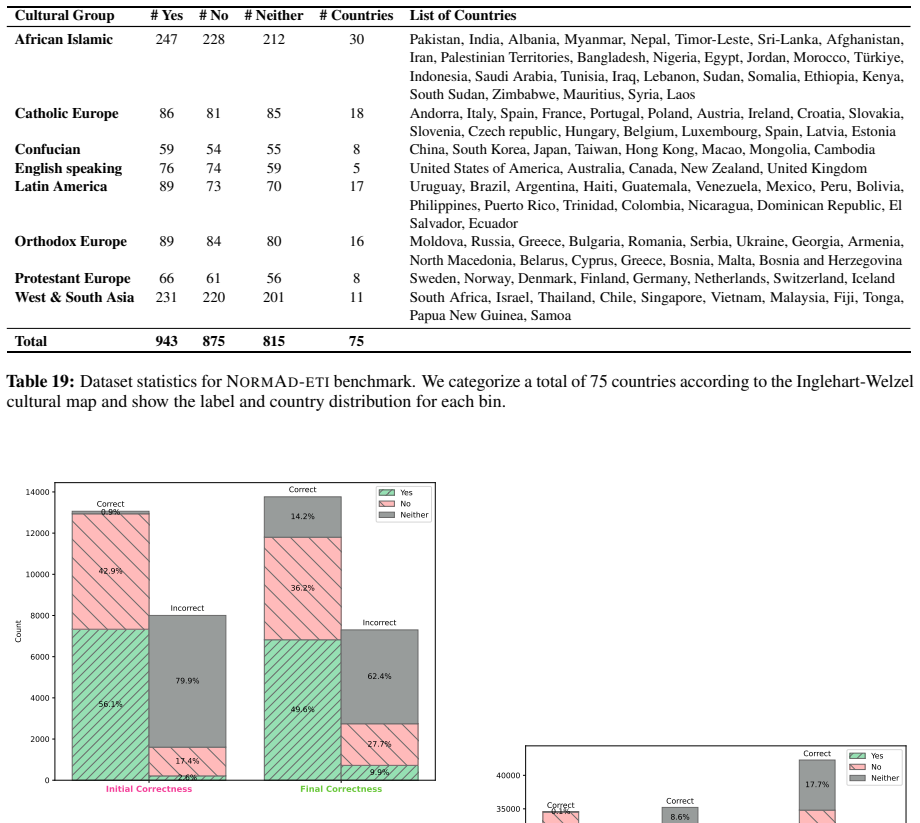
- [§6.3, Table 3, Table 2 caption] The cultural group parity analysis reports point estimates only. The headline improvement in average parity is small (Si w/: 0.960 vs D: 0.972, and D vs judge J: 0.972 vs 0.964), and per-group premiums are computed on small samples; for example, the Confucian group contains 168 stories according to Table 19. No confidence intervals, bootstrap estimates, or significance tests are provided, and the blanket statement in the Table 2 caption that 'All improvements are statistically significant (p<0.05)' is not accompanied by a test procedure or by any multiple-comparison correction across 21 settings. Without such quantification, the claim that multi-agent debate 'yields more equitable cultural alignment' is not statistically established. Please add confidence intervals for parity premiums and report paired or group-wise tests for the accuracy comparisons.
- [§5.3, §5.4, Appendix C.3–C.4, Tables 7–8] The default configuration—one round of debate and one self-reflection iteration—was selected after running 1–5 rounds and N=1–3 reflection iterations on the same test set and choosing the configuration that performed best or was most efficient. The comparisons between debate and self-reflection, and the statement that a single round of debate is sufficient, therefore reflect test-set tuning rather than a prespecified design. This is a mild but real form of selection bias. Please either select hyperparameters on a validation split, report results for all round counts, or explicitly frame the current numbers as reflecting test-set-tuned configurations.
minor comments (4)
- [§6.1, Figure 2] The percentages quoted in the text (29.5% → 63.7% → 76.3% for Debate-Only) do not align with the labels printed in Figure 2 as rendered, where 'Final Correctness' appears to show 76.3% and 'Judge Correctness' appears to show 63.7%; please relabel the figure so that the three stages are unambiguous.
- [Table 6] The SEALLM-3 row reports exactly the same accuracies as the OLMo-SFT row (38.9 and 49.0); please verify whether this is a copy error.
- [§4.2] Please state explicitly which sampling temperature is used for the debater agents, for the self-reflection choice, and for the judge LLM; the current sentence ('We set the default sampling temperature to 0.0, and employ 0.8 where multiple runs are required') is not sufficient to reproduce the debate runs.
- [§8] The limitations section is candid about dataset scope and computational cost, but it does not mention the test-set-based judge selection or the test-set-based hyperparameter tuning; a sentence acknowledging these evaluation-design choices would be appropriate.
Circularity Check
No significant circularity: the main debate-accuracy claims rest on judge-independent individual accuracies, and the judge-based adjudicated results are empirical outcomes rather than by-construction reductions.
full rationale
The paper's central claim that multi-agent debate improves accuracy over single-LLM baselines is supported by judge-independent evidence: Section 5.3 reports 'individual debate accuracies of both LLM agents in Debate-Only setup (D(Mi)) outperform the single model baselines (Si(Mi)) in 19 out of 21 settings'. The 'comparable to 27B' claim is also not a construction artifact: Section 5.5 reports an individual (judge-independent) debate accuracy of 79.6% for GEMMA-2, compared with the independently measured single-model accuracy of 79.2% for GEMMA-2-27B. The judge LLM is selected based on its own single-model accuracy on the same benchmark (Appendix B, Table 5), which is a test-set-selection concern rather than a circularity: there is no equation by which the final debate accuracy is defined to equal the judge's score, and the reported final accuracies range from 70.1% to 80.4%, differing from the judge's 79.2%. The judge mechanism cites Li et al. 2024d, which shares an author with this paper, but that citation is not load-bearing: Appendix D independently benchmarks the judge against oracle and random disagreement resolution. No self-definitional, fitted-input-as-prediction, or self-citation-chain step was found.
Assumptions & free parameters
free parameters (4)
- Judge LLM =
GEMMA-2-27B
- Number of debate rounds =
1
- Self-reflection iterations =
1
- Sampling temperature =
0.0 (default), 0.8 (repeated runs)
assumptions (5)
- domain assumption NormAd-ETI ground truth labels are valid measures of cultural alignment.
- domain assumption The rule-of-thumb included in each prompt is the relevant norm and is accurate for the country.
- domain assumption The Inglehart-Welzel cultural map grouping of 75 countries into 8 groups is a valid way to measure parity.
- ad hoc to paper A single round of debate with two agents and no overlapping judge is sufficient to realize the benefit.
- ad hoc to paper The judge LLM is excluded from the debater pool.
Cite this review
Pith. "Pith review of Multiple LLM Agents Debate for Equitable Cultural Alignment." pith.science (2026). https://pith.science/paper/AAXHJQK5
@misc{pith2026250524671,
  author       = {Pith},
  title        = {Pith review of: Multiple LLM Agents Debate for Equitable Cultural Alignment},
  year         = {2026},
  howpublished = {\url{https://pith.science/paper/AAXHJQK5}},
  note         = {Machine review of arXiv:2505.24671}
}
read the original abstract
Large Language Models (LLMs) need to adapt their predictions to diverse cultural contexts to benefit diverse communities across the world. While previous efforts have focused on single-LLM, single-turn approaches, we propose to exploit the complementary strengths of multiple LLMs to promote cultural adaptability. We introduce a Multi-Agent Debate framework, where two LLM-based agents debate over a cultural scenario and collaboratively reach a final decision. We propose two variants: one where either LLM agents exclusively debate and another where they dynamically choose between self-reflection and debate during their turns. We evaluate these approaches on 7 open-weight LLMs (and 21 LLM combinations) using the NormAd-ETI benchmark for social etiquette norms in 75 countries. Experiments show that debate improves both overall accuracy and cultural group parity over single-LLM baselines. Notably, multi-agent debate enables relatively small LLMs (7-9B) to achieve accuracies comparable to that of a much larger model (27B parameters).
Figures

Figures from the paper (15 more)





Forward citations
Cited by 1 Pith paper
-
Multi-level Value Alignment in Agentic AI Systems: Survey and Perspectives
A survey proposes a macro-meso-micro value framework for agentic AI alignment and maps applications, methods, and benchmarks onto it.
Reference graph
Works this paper leans on
-
[1]
AI, :, Alex Young, Bei Chen, Chao Li, Chen- gen Huang, Ge Zhang, Guanwei Zhang, Heng Li, Jiangcheng Zhu, Jianqun Chen, Jing Chang, Kaidong Yu, Peng Liu, Qiang Liu, Shawn Yue, Senbin Yang, Shiming Yang, Tao Yu, Wen Xie, Wenhao Huang, Xiaohui Hu, Xiaoyi Ren, Xinyao Niu, Pengcheng Nie, Yuchi Xu, Yudong Liu, Yue Wang, Yuxuan Cai, Zhenyu Gu, Zhiyuan Liu, and Z...
arXiv 2024
-
[2]
While Sarah’s action of quickly ending the call without waiting for a response could be seen as impolite or rushed, it’s not entirely clear from the story whether this was appropriate or not
-
[3]
The story doesn’t provide enough context about the nature of the call, the relationship between Sarah and Tom, or the urgency of the situation
-
[4]
Language model alignment in multilingual trolley problems. Preprint, arXiv:2407.02273. Yuu Jinnai. 2024. Does cross-cultural alignment change the commonsense morality of language models? In Proceedings of the 2nd Workshop on Cross-Cultural Considerations in NLP, pages 48–64, Bangkok, Thai- land. Association for Computational Linguistics. Saurav Kadavath, ...
arXiv 2024
-
[5]
Having beer after prayer? measuring cultural bias in large language models. In Proceedings of the 62nd Annual Meeting of the Association for Compu- tational Linguistics (V olume 1: Long Papers), pages 16366–16393, Bangkok, Thailand. Association for Computational Linguistics. OpenAI, Josh Achiam, Steven Adler, Sandhini Agarwal, Lama Ahmad, Ilge Akkaya, Flo...
arXiv 2024
-
[6]
Direct preference optimization: Your lan- guage model is secretly a reward model. Preprint, arXiv:2305.18290. Krithika Ramesh, Sunayana Sitaram, and Monojit Choudhury. 2023. Fairness in language models be- yond English: Gaps and challenges. In Findings of the Association for Computational Linguistics: EACL 2023, pages 2106–2119, Dubrovnik, Croatia. Associ...
arXiv 2023
-
[7]
Understanding the capabilities and limitations of large language models for cultural commonsense. In Proceedings of the 2024 Conference of the North American Chapter of the Association for Computa- tional Linguistics: Human Language Technologies (V olume 1: Long Papers), pages 5668–5680, Mexico City, Mexico. Association for Computational Lin- guistics. We...
work page 2024
-
[9]
Not all countries celebrate thanksgiving: On the cultural dominance in large language models. In Proceedings of the 62nd Annual Meeting of the As- sociation for Computational Linguistics (V olume 1: Long Papers), pages 6349–6384, Bangkok, Thailand. Association for Computational Linguistics. Shaoyang Xu, Yongqi Leng, Linhao Yu, and Deyi Xiong
Show all 18 references
-
[10]
Preprint, arXiv:2410.12971
Self-pluralising culture alignment for large language models. Preprint, arXiv:2410.12971. Jifan Yu, Xiaozhi Wang, Shangqing Tu, Shulin Cao, Daniel Zhang-Li, Xin Lv, Hao Peng, Zijun Yao, Xiao- han Zhang, Hanming Li, et al. 2023. Kola: Carefully benchmarking world knowledge of l...
-
[11]
In Findings of the Association for Computational Lin- guistics: NAACL 2024 , pages 3104–3117, Mexico City, Mexico
RENOVI: A benchmark towards remediating norm violations in socio-cultural conversations. In Findings of the Association for Computational Lin- guistics: NAACL 2024 , pages 3104–3117, Mexico City, Mexico. Association for Computational Lin- guistics. Wenxuan Zhang, Hou Pong Chan...
2024 arXiv
-
[14]
The story does not align with the specific behavior of saying ‘bye’ multiple times before ending a phone call, which is the rule given
-
[17]
In some professional contexts, ending a call quickly might be more appropriate than prolonging it unnecessarily
-
[18]
Yes” ( conformations) and worst at “Neither
We find that the best-performing model varies across countries, which motivates us to explore a multi-LLM setup (§5.2). 10https://openai.com/index/chatgpt/ Model Training Method Si (w/o) Si (w/) LLAMA-3 SFT + RLHF 49.5 63.7 GEMMA-2 SFT + RLHF 50.7 68.9 EXAONE-3 SFT + DPO 42.8 ...
2023
-
[19]
Neither
The story doesn’t mention any cultural or social norms specific to Ireland that would make Sarah’s action particularly acceptable or unacceptable. Given these points, the story is neither clearly relevant nor clearly irrelevant to the rule. Therefore, the most appropriate answ...
-
[20]
Cor- rect
For the aggregated results across all LLMs or LLM combinations, the average parity fol- lows the order of Single Model without rule-of- thumb < Single Model with rule-of-thumb < Self- Reflect+Debate < Self-Reflection < Debate-Only. For specific LLMs, the average parity ranks a...
-
[2018]
arXiv preprint arXiv:1805.00899
Ai safety via debate. arXiv preprint arXiv:1805.00899. Albert Q. Jiang, Alexandre Sablayrolles, Arthur Men- sch, Chris Bamford, Devendra Singh Chaplot, Diego de las Casas, Florian Bressand, Gianna Lengyel, Guil- laume Lample, Lucile Saulnier, Lélio Renard Lavaud, Marie-Anne La...
2023 arXiv
-
[2023]
Preprint, arXiv:2303.11366
Reflexion: Language agents with verbal rein- forcement learning. Preprint, arXiv:2303.11366. Gemma Team, Morgane Riviere, Shreya Pathak, Pier Giuseppe Sessa, Cassidy Hardin, Surya Bhupati- raju, Léonard Hussenot, Thomas Mesnard, Bobak Shahriari, Alexandre Ramé, Johan Ferret, P...
2024 arXiv
-
[2024]
In Proceedings of the 62nd Annual Meeting of the Association for Computational Linguistics (V ol- ume 1: Long Papers) , pages 15789–15809, Bangkok, Thailand
OLMo: Accelerating the science of language models. In Proceedings of the 62nd Annual Meeting of the Association for Computational Linguistics (V ol- ume 1: Long Papers) , pages 15789–15809, Bangkok, Thailand. Association for Computational Linguistics. Shirley Anugrah Hayati, M...
2024 arXiv
Reviewed August 7, 2026 · model on record in the stance chip above.
Discussion (0). Sign in to comment.