REVIEW 3 major objections 8 minor 3 cited by
Pitfalls in Evaluating Language Model Forecasters
T0 review · 3 major / 8 minor · reviewed 2026-08-07 · deepseek-v4-flash
Pith's one-line read Claims that LLMs match human forecasters are not yet established by current benchmarks.
desk verdict A sound, well-hedged methodological critique of LLM forecasting benchmarks that doesn't overclaim and deserves refereeing, even though it doesn't prove scores are inflated. read the letter →
The pith
A machine-rendered reading of the paper's core claim, the machinery that carries it, and where it could break.
The reading
What carries the argument
The paper's analysis is carried by a catalogue of specific leakage and gaming channels, each illustrated with concrete examples, plus two toy models that formalize the mechanisms. The leakage channels are: logical leakage from selecting resolved questions, retrieval leakage from incorrect date metadata and future-trained ranking, and cutoff leakage from unreliable training-cutoff claims. The gaming channels are piggybacking on human forecasts, betting on shared latent variables, distributional skew, and metric artifacts. The latent-variable toy model shows that a calibrated forecaster can never maximize its chance of winning a contest against forecasters who commit to one world; the label-noise toy model shows that clamping probability estimates improves logarithmic score.
What would settle it
A decisive test would be to run a top-performing LLM forecaster on the same benchmark questions with every leakage channel closed—using a verified past-corpus for retrieval, a release-date cutoff, and no access to human forecast aggregates or post-resolution data—then compare the resulting Brier and logarithmic scores against the originally reported scores. If the scores drop by less than a pre-registered margin, the leakage concerns would be shown not to explain the reported performance.
Extended reading notes
Core claim
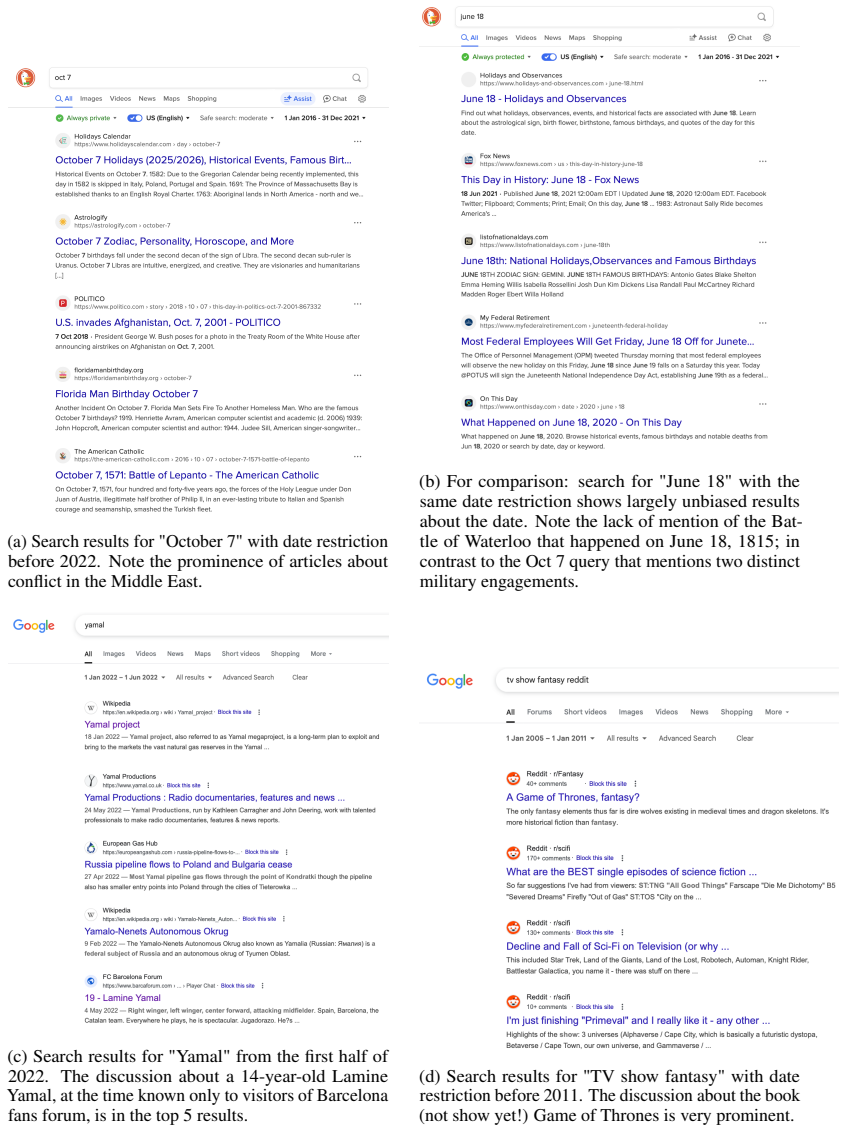
The central claim is that backtesting LLM forecasters is far more difficult than it appears, and that current benchmarks admit shortcuts that can inflate scores. Logical leakage arises because question selection implicitly encodes the future: a forecaster who knows it is being evaluated in 2025 can deduce that a question about an event that has not yet resolved by that date must resolve negatively. Unreliable date-restricted retrieval means search engines return future-dated or future-ranked content even when filters are applied. Model knowledge cutoffs are not guarantees and can be extended by system prompts and later preference data. Even with a clean evaluation, the paper argues that piggybacking on human forecasts makes 'matching humans' claims circular, betting on shared latent variables can win benchmarks without calibrated judgment, benchmark question distributions are heavily skewed, and common metrics such as accuracy, calibration, and Brier score can reward the wrong sort of behavior. The paper also shows that using backtests as a training objective introduces its own temporal leakage.
Load-bearing premise
The argument's load-bearing premise is that the leakage channels occur often enough in real benchmarks to materially inflate scores, rather than merely being possible in theory; the paper gives concrete instances but does not measure their aggregate impact on final performance claims.
Editorial extensions
If this is right
- Reported LLM forecasting scores on current benchmarks should not be read as evidence of human-level or superhuman predictive skill.
- Evaluation protocols should use release dates instead of knowledge cutoffs, restrict retrieval to a dated corpus, and measure the forecaster's edge over the human crowd rather than absolute agreement.
- Training on backtests will introduce temporal leakage unless the pipeline separates forecasting from memorization of earlier events.
- Live evaluation on prediction markets with profit and risk-adjusted return reporting is a more trustworthy end-to-end test than backtests.
- Current benchmark leaderboards may mis-rank models because different systems exploit shortcuts to different degrees.
Reading between the lines
- The same leakage channels likely affect other temporal prediction tasks, such as medical outcome prediction or economic event forecasting, whenever models are evaluated on past data with retrieval or fine-tuning.
- The latent-variable betting incentive suggests that leaderboards for forecasters may systematically select overconfident models, so a top-ranked system could be less calibrated than an unranked one.
- A testable extension would be to run a top forecaster with all leakage channels blocked and compare scores against published results; a small gap would indicate the leaks are not the main driver of performance claims.
- The piggybacking critique implies that 'matching human forecasters' claims should be compared against the best available baseline of incremental value over public crowd forecasts, not against absolute agreement with them.
Editorial analysis
A structured set of objections, weighed in public.
Referee Report
Summary. The paper argues that evaluating LLM forecasters through backtesting is fraught with pitfalls that can undermine performance claims. It identifies temporal leakage (logical leakage from resolved-question selection, unreliable date-restricted retrieval, and model cutoff uncertainty) and extrapolation issues (piggybacking on human forecasts, benchmark gaming via correlated bets, skewed data distributions, and imperfect metrics). It provides concrete examples, including percentages of trivially resolvable questions in prior benchmarks and a DeBERTa shortcut classifier, plus two analytically solved toy models showing that label noise can make clamping optimal for logarithmic score and that betting on a shared latent can maximize win probability. The authors carefully limit their conclusion: they do not claim that existing scores are inflated, but argue that the community should be cautious about current performance claims.
Significance. This is a timely and valuable critique that systematizes scattered concerns into a clear checklist for evaluating forecasting LLMs and gives concrete demonstrations that leakage channels are not merely hypothetical. Its main strength is the honest framing: the central claim is about warranted caution, not about proving inflation, so the absence of end-to-end score deltas is a limitation rather than a fatal flaw. The two toy models in Appendices D and E are clean, analytically worked out, and appear correct; the paper also explicitly states what would be needed to convert its concerns into quantified conclusions. The result, if accepted, is an agenda-setting paper that should influence how future forecasting benchmarks are designed and reported.
major comments (3)
- [Section 2.1 and Appendix C] The quantitative evidence for practical leakage is not reproducible as reported. The paper reports 'at least 3.8%' of Halawi et al. and 'at least 10%' of Tao et al. as trivially resolvable, but it does not define the criterion used to label a question as trivial, nor does it release the annotations. Likewise, Appendix C reports DeBERTa shortcut-classifier accuracies up to 80% without code, confidence intervals, or a full experimental protocol (e.g., number of questions, hyperparameters, number of seeds). Since these numbers are used to argue that leakage is a practical concern and not merely a theoretical one, the authors should either release the protocol and annotations and report error bars, or explicitly downgrade these numbers to illustrative estimates.
- [Section 2.1] The logical-leakage argument applies only if the forecaster knows that it is being backtested, knows the resolution date or evaluation window, and knows that questions were selected because they resolved. The paper states this condition internally, but the empirical paragraphs then treat the 3.8% and 10% figures as evidence of leakage without testing or even discussing whether the systems in Halawi et al. and Tao et al. actually receive the relevant information or would exploit it. The authors should add a sensitivity test (e.g., prompting with and without the backtest date) or explicitly state in the empirical subsection that these percentages measure a conditional possibility, not a demonstrated exploit.
- [Section 3.2 and Appendix E] The gaming argument shows that, in a contest with a shared latent variable, a forecaster who bets on one latent outcome can maximize the probability of winning. However, the paper does not connect this to any observed behavior of current LLM forecasters or to the actual scoring and selection protocols of the cited benchmarks. The authors acknowledge this ('It remains unclear if current LLM forecasters resort to such strategies'), but the section would be more proportionately framed if it explicitly stated that this is a theoretical possibility and that no current benchmark has been shown to be gameable in this way. A small Monte Carlo demonstration of win probabilities under the Appendix E model would also make the practical relevance easier to assess.
minor comments (8)
- [Abstract] Consider adding one sentence that explicitly disclaims any claim that existing Brier or logarithmic scores are inflated; the Discussion already contains this caveat, and placing it in the abstract would help prevent misreading of the paper's scope.
- [Section 1] The time-traveler analogy is slightly confusing: if someone from 2035 asks whether alien life will be found before 2040, the deduction 'yes' applies only if the question is known to be part of a backtest in which it has already resolved. Please clarify that the leakage comes from the resolved-question selection, not from the mere fact of being asked by a time traveler.
- [Appendix C] Please report the exact number of questions used for each benchmark, the DeBERTa variant, and whether results are averaged over multiple seeds or a single run. Without these details, the striking 55-80% accuracy figures are difficult to assess.
- [Section 2.1] The estimate that 'over 90%' of Dai et al. questions are overly specific is presented without a protocol and is described as inherently subjective; please move this to a clearly labeled informal estimate or provide an annotation methodology so that readers can distinguish it from the reproducible 3.8% and 10% numbers.
- [Figure 4] The caption contains a grammar error: 'Figure 4d and Figure 4c shows' should be 'show'. Also, please specify the exact date-restriction parameters used for each search so the examples can be reproduced.
- [Appendix D] The notation uses p both as the random true probability and as the integration variable; renaming the integration variable (e.g., u) in the integrals for E[ell] and E[ell_t] would improve readability.
- [References] The reference 'Review of Financial Sttidies' should be 'Review of Financial Studies'.
- [Section 3.1] The piggybacking claim would be strengthened by checking whether the cited benchmarks actually grant the LLM access to retrieval of prediction-market pages; as written, the claim is conditional on an assumption that may not hold for all compared systems.
Circularity Check
No circular derivation; only a minor non-load-bearing self-citation to the authors' own prior dataset.
full rationale
This paper is a critique of LLM forecasting evaluation practices. It does not fit parameters to data and then predict a closely related quantity, nor does it derive a conclusion from an assumption that already contains the conclusion. The central leakage arguments rest on externally documented evidence: search-engine screenshots, elicited GPT-4o responses, question-level counts from Halawi et al. and Tao et al., and two self-contained toy proofs in Appendices D and E. The only author-overlapping citation is Paleka et al. (2024), which is used to identify back-generated news datasets, to note an incomplete augmentation fix, and to cite a 1-5% label-noise rate. These uses are supporting details, not the load-bearing premise of the paper's main claim. The Appendix C DeBERTa shortcut classifier is a new analysis performed on an existing dataset, so it is not a fitted input renamed as a prediction. The paper explicitly disclaims quantitative impact on the prior performance claims ('We also do not have proof that the benchmark issues we uncover would lower the performance claims of LLM forecasters'), which weakens the conclusion but does not make the reasoning circular. No equation reduces to its own input, and no benchmark outcome is forced by a self-citation chain. The score of 2 reflects only the presence of a minor, non-load-bearing self-citation.
Assumptions & free parameters
assumptions (6)
- domain assumption A backtested forecaster that knows the evaluation date can deduce that all questions in the benchmark must have resolved by that date.
- domain assumption Search engines with date restrictions return results whose ranking is partly determined by post-date knowledge.
- domain assumption Stated knowledge cutoff dates are not reliable boundaries for a model's information.
- domain assumption Human forecasts from prediction markets are likely present in LLM training data or retrievable at evaluation time.
- domain assumption Optimizing a model on a chronological sequence of backtested events corrupts the test signal through parameter updates.
- ad hoc to paper For the label-noise toy model, true probabilities are uniformly distributed on [0,1] and label noise is symmetric with constant rate eta.
Cite this review
Pith. "Pith review of Pitfalls in Evaluating Language Model Forecasters." pith.science (2026). https://pith.science/paper/MYPJ2XRD
@misc{pith2026250600723,
  author       = {Pith},
  title        = {Pith review of: Pitfalls in Evaluating Language Model Forecasters},
  year         = {2026},
  howpublished = {\url{https://pith.science/paper/MYPJ2XRD}},
  note         = {Machine review of arXiv:2506.00723}
}
read the original abstract
Large language models (LLMs) have recently been applied to forecasting tasks, with some works claiming these systems match or exceed human performance. In this paper, we argue that, as a community, we should be careful about such conclusions as evaluating LLM forecasters presents unique challenges. We identify two broad categories of issues: (1) difficulty in trusting evaluation results due to many forms of temporal leakage, and (2) difficulty in extrapolating from evaluation performance to real-world forecasting. Through systematic analysis and concrete examples from prior work, we demonstrate how evaluation flaws can raise concerns about current and future performance claims. We argue that more rigorous evaluation methodologies are needed to confidently assess the forecasting abilities of LLMs.
Figures


Figures from the paper (5 more)


Forward citations
Cited by 3 Pith papers
-
Global Merger-Arbitrage Forecasting with Language Models
Expert-context research agents plus hindsight-guided finetuning cut class-balanced Brier score on merger outcomes to 0.151, beating calibrated market prices, XGBoost, and frontier LLMs.
-
Agentic Forecasting using Sequential Bayesian Updating of Linguistic Beliefs
BLF achieves state-of-the-art binary forecasting on ForecastBench by using linguistic belief states updated in tool-use loops, hierarchical multi-trial logit averaging, and hierarchical Platt scaling calibration.
-
Advancing Event Forecasting through Massive Training of Large Language Models: Challenges, Solutions, and Broader Impacts
A position paper advocating large-scale training of event forecasting LLMs, with proposals for label selection, counterfactual training data, auxiliary rewards, and multi-source datasets.
Reference graph
Works this paper leans on
-
[1]
Scott Alexander. Who predicted 2022?, 2023. URL https://www.astralcodexten.com/p/who-predicted-2022. Accessed on 12-May-2025
work page 2022
-
[2]
A backtesting protocol in the era of machine learning
Robert D Arnott, Campbell R Harvey, and Harry Markowitz. A backtesting protocol in the era of machine learning. Available at SSRN 3275654, 2018
work page 2018
-
[3]
The probability of backtest overfitting
David H Bailey, Jonathan Borwein, Marcos Lopez de Prado, and Qiji Jim Zhu. The probability of backtest overfitting. Journal of Computational Finance (Risk Journals), 2015
work page 2015
-
[4]
Contra papers claiming superhuman AI forecasting, 2024
Nikos Bosse, Peter M \"u hlbacher, Lawrence Phillips, and Dan Schwarz. Contra papers claiming superhuman AI forecasting, 2024. URL https://www.lesswrong.com/posts/uGkRcHqatmPkvpGLq/contra-papers-claiming-superhuman-ai-forecasting
work page 2024
-
[5]
Long-horizon predictability: a cautionary tale
Jacob Boudoukh, Ronen Israel, and Matthew Richardson. Long-horizon predictability: a cautionary tale. Financial Analysts Journal, 2019
work page 2019
-
[6]
AI forecasting bots incoming: comment section, 2024
Gwern Branwen. AI forecasting bots incoming: comment section, 2024. URL https://www.lesswrong.com/posts/4kuXNhPf9FBwok7tK/ai-forecasting-bots-incoming?commentId=MirX9bPg232BuzMBq. Accessed 12 May 2025
work page 2024
-
[7]
Ernest Breitschwerdt. Point-in-time vs. lagged fundamentals: This time i(t)'s different? Research report, S&P Capital IQ, Quantamental Research, 2015. URL https://www.spglobal.com/marketintelligence/en/documents/sp-capitaliq-quantamental-point-in-time-vs-lagged-fundamentals.pdf. Accessed: 2025-05-27
work page 2015
-
[8]
Are LLMs prescient? A continuous evaluation using daily news as the oracle
Hui Dai, Ryan Teehan, and Mengye Ren. Are LLMs prescient? A continuous evaluation using daily news as the oracle. In ICML, 2025. URL https://arxiv.org/abs/2411.08324
arXiv 2025
Show all 35 references
-
[9]
Polymarket settles a market incorrectly -- again, 2024
Chris Gerlacher. Polymarket settles a market incorrectly -- again, 2024. URL https://predictionnews.com/news/polymarket-settles-a-market-incorrectly-again. Accessed on 12-May-2025
2024
-
[10]
Survivorship bias and mutual fund performance
Elton M Gruber and C Blake. Survivorship bias and mutual fund performance. Review of Financial Sttidies, 9: 0 1097--1120, 1996
1996
-
[11]
Knowledge cutoff issues of GPT -4o regarding Phan et al
Danny Halawi. Knowledge cutoff issues of GPT -4o regarding Phan et al. (2024), 2024. URL https://x.com/dannyhalawi15/status/1833295067764953397
2024
-
[12]
Approaching human-level forecasting with language models, 2024
Danny Halawi, Fred Zhang, Chen Yueh-Han, and Jacob Steinhardt. Approaching human-level forecasting with language models, 2024
2024
-
[13]
Introducing the SalemCSPi forecasting tournament, 2022
Richard Hanania. Introducing the SalemCSPi forecasting tournament, 2022. URL https://www.cspicenter.com/p/introducing-the-salemcspi-forecasting. Accessed on 12-May-2025
2022
-
[14]
The emerging science of machine learning benchmarks
Moritz Hardt. The emerging science of machine learning benchmarks. Online at https://mlbenchmarks.org, 2025. Manuscript
2025
-
[15]
Reasoning and tools for human-level forecasting
Elvis Hsieh, Preston Fu, and Jonathan Chen. Reasoning and tools for human-level forecasting. arXiv preprint arXiv:2408.12036, 2024
2024 arXiv
-
[16]
asgeirtj/system\_prompts\_leaks/claude.txt, 2025
Asgeir Thor Johnson. asgeirtj/system\_prompts\_leaks/claude.txt, 2025. URL https://github.com/asgeirtj/system\_prompts\_leaks/blob/f7d92dec4a9a9f5e4d11e4384f8239fb7ca3be05/claude.txt. Accessed 12 May 2025
2025
-
[17]
Ezra Karger, Houtan Bastani, Chen Yueh-Han, Zachary Jacobs, Danny Halawi, Fred Zhang, and Philip E. Tetlock. ForecastBench : A dynamic benchmark of AI forecasting capabilities, 2024 a . URL https://arxiv.org/abs/2409.19839
2024 arXiv
-
[18]
Ezra Karger, Houtan Bastani, Chen Yueh-Han, Zachary Jacobs, Danny Halawi, Fred Zhang, and Philip E. Tetlock. forecastingresearch/forecastbench/, 2024 b . URL https://github.com/forecastingresearch/forecastbench/tree/8e236823e3683584330fc31bf41196a81ce28626/src/helpers
2024
-
[19]
Questionable practices in machine learning
Gavin Leech, Juan J Vazquez, Niclas Kupper, Misha Yagudin, and Laurence Aitchison. Questionable practices in machine learning. arXiv preprint arXiv:2407.12220, 2024
2024 arXiv
-
[20]
Acx2025 tournament, 2025
Metaculus. Acx2025 tournament, 2025. URL https://www.metaculus.com/tournament/ACX2025/. Accessed on 12-May-2025
2025
-
[21]
Consistency checks for language model forecasters
Daniel Paleka, Abhimanyu Pallavi Sudhir, Alejandro Alvarez, Vineeth Bhat, Adam Shen, Evan Wang, and Florian Tram \`e r. Consistency checks for language model forecasters. arXiv preprint arXiv:2412.18544, 2024
2024 arXiv
-
[22]
LLMs are superhuman forecasters, 2024
Long Phan, Adam Khoja, Mantas Mazeika, and Dan Hendrycks. LLMs are superhuman forecasters, 2024. URL https://drive.google.com/file/d/1Tc_xY1NM-US4mZ4OpzxrpTudyo1W4KsE. Center for AI Safety, UC Berkeley
2024
-
[23]
White House planning face-to-face meeting with Biden , Xi , 2023
Reuters. White House planning face-to-face meeting with Biden , Xi , 2023. URL https://www.reuters.com/world/white-house-planning-face-to-face-meeting-with-biden-xi-washington-post-2023-10-05/
2023
-
[24]
Against calibration, 2023
Eigil Fjeldgren Rischel. Against calibration, 2023. URL https://erischel.com/againstcalibration/. Accessed on 12-May-2025
2023
-
[25]
Elicitation of personal probabilities and expectations
Leonard J Savage. Elicitation of personal probabilities and expectations. Journal of the American Statistical Association, 66 0 (336): 0 783--801, 1971
1971
-
[26]
Wisdom of the silicon crowd: LLM ensemble prediction capabilities rival human crowd accuracy
Philipp Schoenegger, Indre Tuminauskaite, Peter S Park, Rafael Valdece Sousa Bastos, and Philip E Tetlock. Wisdom of the silicon crowd: LLM ensemble prediction capabilities rival human crowd accuracy. Science Advances, 10 0 (45): 0 eadp1528, 2024
2024
-
[27]
Alignment problems with current forecasting platforms
Nu \ n o Sempere and Alex Lawsen. Alignment problems with current forecasting platforms. arXiv preprint arXiv:2106.11248, 2021
2021 arXiv
-
[28]
Capital asset prices: A theory of market equilibrium under conditions of risk
William F Sharpe. Capital asset prices: A theory of market equilibrium under conditions of risk. The journal of finance, 19 0 (3): 0 425--442, 1964
1964
-
[29]
Risk-adjusted performance of mutual funds
Katerina Simons. Risk-adjusted performance of mutual funds. New England Economic Review, 9: 0 33--48, 1998
1998
-
[30]
PROPHET : An inferable future forecasting benchmark with causal intervened likelihood estimation
Zhengwei Tao, Zhi Jin, Bincheng Li, Xiaoying Bai, Haiyan Zhao, Chengfeng Dou, Xiancai Chen, Jia Li, Linyu Li, and Chongyang Tao. PROPHET : An inferable future forecasting benchmark with causal intervened likelihood estimation. arXiv preprint arXiv:2504.01509, 2025
2025
-
[31]
Leonard J. Tashman. Out‐of‐sample tests of forecasting accuracy: An analysis and review. International Journal of Forecasting, 16 0 (4): 0 437--450, 2000. doi:10.1016/S0169-2070(00)00065-0
-
[32]
Biden , Xi talks in san francisco, 2023
Japan Times. Biden , Xi talks in san francisco, 2023. URL https://www.japantimes.co.jp/news/2023/11/08/world/politics/biden-xi-talks-san-francisco/
2023
-
[33]
Haooowang/llm-knowledge-cutoff-dates, 2025
Hao Wang. Haooowang/llm-knowledge-cutoff-dates, 2025. URL https://github.com/HaoooWang/llm-knowledge-cutoff-dates/blob/f2ea76a47437c2787cc651838b5c7af4720d1c0a/README.md. Accessed 12 May 2025
2025
-
[34]
Continual learning for large language models: A survey, 2024
Tongtong Wu, Linhao Luo, Yuan-Fang Li, Shirui Pan, Thuy-Trang Vu, and Gholamreza Haffari. Continual learning for large language models: A survey, 2024. URL https://arxiv.org/abs/2402.01364
2024 arXiv
-
[35]
Forecasting future world events with neural networks
Andy Zou, Tristan Xiao, Ryan Jia, Joe Kwon, Mantas Mazeika, Richard Li, Dawn Song, Jacob Steinhardt, Owain Evans, and Dan Hendrycks. Forecasting future world events with neural networks. arXiv preprint arXiv:2206.15474, 2022
2022 arXiv
Reviewed August 7, 2026 · model on record in the stance chip above.
Discussion (0). Sign in to comment.