REVIEW 4 major objections 5 minor 1 cited by
ADEPT: Adaptive Diffusion Environment for Policy Transfer Sim-to-Real
T0 review · 4 major / 5 minor · reviewed 2026-08-07 · deepseek-v4-flash
Pith's one-line read ADEPT uses a policy-steered diffusion model to generate off-road training environments, and reports that the resulting policies transfer zero-shot to real terrain better than procedural and natural baselines.
desk verdict A plausible adaptive diffusion curriculum method with strong empirical gains, but the steering mechanism is unvalidated off-manifold interpolation. read the letter →
The pith
A machine-rendered reading of the paper's core claim, the machinery that carries it, and where it could break.
The reading
What carries the argument
The central object is the weighted latent interpolation in the DDPM forward process: given n training environments, each is corrupted to a noise latent $e^i_k$ at forward step $k$, and the optimized initial noise is the weighted average $e'_k = \sum_i w(e^i,\pi) e^i_k / \sum_m w(e^m,\pi)$, with weight $w(e,\pi) = \exp\{-(s(e,\pi)-\bar{s})^2/\sigma^2\}$ where $s$ is the navigation success rate and $\bar{s}$ is the desired difficulty. Reverse diffusion from $e'_k$ generates the new environment. The diversity control is the forward step $k = K(1-\Lambda_{\mathrm{var}})$, where $\Lambda_{\mathrm{var}}$ is dataset variance from PCA; larger $k$ (more noise) gives more diverse, novel geometries while smaller $k$ keeps environments similar to known ones. This carries the argument because it converts policy performance into a steering signal for the generative model without retraining or fine-tuning the diffusion model.
What would settle it
Generate a grid of interpolated latents between an easy and a hard terrain at fixed $k$, reconstruct environments, and measure the navigation success rate of a fixed policy in those reconstructed environments; if success rate does not decrease monotonically along the interpolation path, the weighting function in Eq. (2) does not steer difficulty as claimed.
Extended reading notes
Core claim
The central claim is that the DDPM latent space can serve as a controllable environment curriculum: averaging forward-process latents of training environments with weights from policy success, then running reverse diffusion from the averaged noise, synthesizes new off-road environments that challenge the policy at an appropriate level. The starting noise level k, chosen inversely proportional to dataset variance, controls how similar or diverse the generated environments are. Together with a two-layer map representation (terrain elevation plus surface canopy) and a stereo-vision depth-noise simulation, this curriculum allows a teacher policy to be trained in simulation and distilled to a student policy that navigates real uneven terrain with no additional real-world training.
Load-bearing premise
The method assumes that averaging forward-process latents with policy-derived weights and then reverse-diffusing produces environments that are both realistic and at the intended difficulty, i.e., that DDPM latent interpolation behaves monotonically for elevation and canopy maps.
Editorial extensions
If this is right
- Policies trained with ADEPT-generated environments generalize to unseen geometries better than policies trained on procedural or fixed natural datasets.
- Varying the forward-step $k$ by dataset variance yields a curriculum that both fine-tunes and explores, enabling long-horizon navigation without hand-tuned terrain parameters.
- The teacher-student distillation combined with ADEPT transfers zero-shot to real robots in kilometer-scale off-road trials.
- The multi-layer elevation-plus-canopy representation lets a diffusion model generate realistic wild environments at low computational cost.
Reading between the lines
- If the latent-interpolation monotonicity holds, the same weighted-latent steering could apply to other diffusion-generated training assets, such as indoor layouts or vegetation density, wherever a scalar success signal is available.
- The inverse-variance scheduler is a heuristic; a learned or adaptive choice of $k$ could yield finer control over the explore-exploit tradeoff in the curriculum.
- Success rate alone may be a weak signal in sparse-reward tasks; combining it with TD-error or regret could make the curriculum more robust, at the cost of extra computation.
Editorial analysis
A structured set of objections, weighed in public.
Referee Report
Summary. The paper proposes ADEPT, an automatic curriculum environment generator for zero-shot sim-to-real off-road robot navigation. ADEPT trains a DDPM on a two-layer map representation (terrain elevation and surface canopy), then at each curriculum iteration generates new environments by taking a weighted average of forward-diffused latents of existing environments, with weights derived from the current policy's success rate; the forward step is set from the dataset's PCA variance, and the reverse diffusion synthesizes new training environments. The privileged teacher policy is trained with PPO on these environments and distilled into a depth/height-scan student policy under physics and perception domain randomization. Experiments compare the resulting policy against procedural and natural environment curricula and against Falco, MPPI, TERP, and POVNav in Gazebo, and report three long-range real-world trials on a Clearpath Jackal.
Significance. If the central mechanism is validated, ADEPT would be a useful step toward diffusion-based environment generators that are both realistic and policy-adaptive for off-road navigation. The paper is well positioned within automatic curriculum learning, proposes a sensible stereo-vision perception simulation pipeline, and includes genuine hardware trials with a kilometer-scale scope. The evaluation is largely self-contained against held-out environments and external planners, so circularity is not a primary concern. However, the load-bearing latent-interpolation property in Eq. (2) and the diversity scheduler in Section IV-B are asserted rather than directly validated, and the main simulation table reports no uncertainty. The hardware trials are valuable but explicitly non-comparative. The contribution is significant if the requested validation is provided; the current evidence is suggestive but incomplete.
major comments (4)
- [Section IV-A, Eq. (2)] The proposed latent fusion is asserted to steer generation difficulty, but Eq. (2) does not produce a valid forward-process latent. For independent e_i^k ~ N(sqrt(alpha_k) e_i, (1-alpha_k) I), the fused latent e'_k = sum_i w_i e_i^k has covariance (1-alpha_k) sum_i w_i^2 I, which is strictly smaller than the nominal (1-alpha_k) I whenever the normalized weights are not one-hot; the reverse diffusion therefore starts off-manifold. The manuscript provides no direct validation that reverse-diffusing such off-manifold latents yields realistic environments with the intended difficulty, and the simulation comparisons in Section V-C cannot separate the steering mechanism from the general diversity of diffusion-generated maps. I request an explicit validation study: vary the weights (and k) and measure the success rate or difficulty of generated environments, or compare against random-latent and uniform-fusion baselines to show monotonic steering.
- [Section IV-A, Eq. (3)] The weighting function w(e, pi) = exp(-(s(e, pi) - sbar)^2 / sigma^2) reduces environment difficulty to the current policy's success rate. This is a policy-dependent scalar with no demonstrated monotone relation to the latent interpolation in Eq. (2): environments with equal success rates can be very different geometrically, and nothing in the DDPM process guarantees that the scalar ordering of weights translates into an ordering of generated environment difficulty. The paper also leaves sbar and sigma as free parameters without a sensitivity study. To make the central curriculum claim load-bearing, please provide evidence that the success-rate-based weighting correlates with the difficulty of the synthesized environments, for example a scatter plot of weight versus measured difficulty of e'_0 or ablations over sbar.
- [Section V-C, Table I] The main quantitative comparison against Falco, MPPI, TERP, POVNav, N-AEPT, and APG reports only single aggregate numbers for each metric, with no error bars, standard deviations, or significance tests. Since the paper's central claim that ADEPT outperforms these methods rests on this table, at least mean and variance over multiple training seeds, or the per-environment performance distribution, should be reported to establish that the margins are not due to a single run.
- [Section IV-B] The diversity-control mechanism is not validated. The paper claims that setting the forward step k = K(1 - Lambda_var) controls generation diversity, but no experiment measures the diversity of generated environments as a function of k or Lambda_var, and no ablation compares the proposed linear scheduler with fixed k or random k. Without such evidence, the 'Adjustable Generation Diversity' contribution is asserted rather than demonstrated.
minor comments (5)
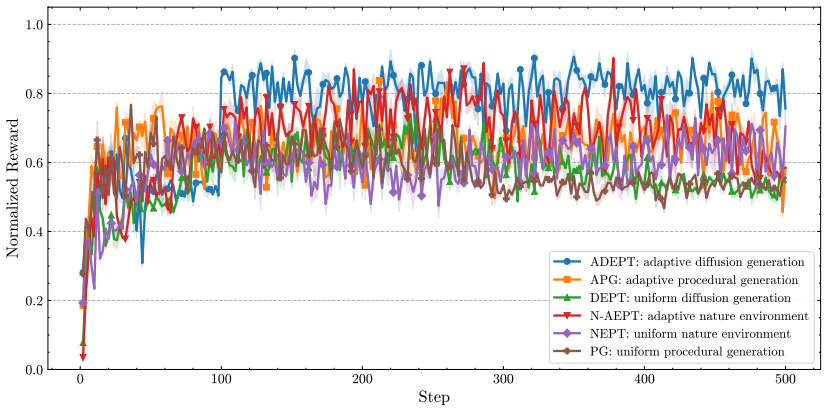
- [Section V-A] The ablation naming is inconsistent: the text mentions 'N-ADEPT' but Figure 4 uses 'N-AEPT', and 'DEPT: uniform diffusion generation' appears in the legend without being defined in the text; 'Monofont means the ablated parts' appears to be an editing artifact. Please unify names and define all curves in Figure 4.
- [Abstract and Section IV-A] The abstract and Section IV-A describe the method as 'optimizing the initial noise', but Eq. (2) is a closed-form weighted average, not an iterative optimization. Please adjust the terminology to avoid implying a more complex procedure, and clarify the relationship to citation [5].
- [Section IV-A, Eq. (3)] The quantities sbar and sigma are not defined in the text beyond 'desired difficulty level' and 'temperature'; please report the concrete values used in the experiments and provide a sensitivity analysis or justification for their choice.
- [Section V-D] The field trial is explicitly 'not designed for direct comparative analysis'; please state this limitation in the abstract or conclusion as well, so that the real-world evidence is not read as a comparative validation, and include the manual intervention in Trial C in the limitations discussion.
- [References] References [16]/[17] and [55]/[56] are duplicated, and Figure 1 contains an unexplained token 'Ourea'; please clean up these presentation issues.
Circularity Check
No significant circularity: the policy-weighted latent interpolation loop is validated on held-out environments and external planners; the main gaps are unvalidated steering assumptions, which are correctness risks rather than circularity.
full rationale
ADEPT's central derivation chain is self-contained. The curriculum loop in Algorithm 1 uses the current policy's success rate (Eq. 3) only to weight forward-process latents (Eq. 2) and to rank environments for selection; the paper's claims — higher success rate of the trained policy on held-out evaluation environments (E-30, 30,000 start-goal pairs) and against external planners (Falco, MPPI, TERP, POVNav) — are validated on data not used to fit any generator parameter. There is no fitted parameter renamed as a prediction: the generated environment's difficulty is never reported as a quantity defined by the weighting, so no output reduces to an input by construction. The ablation stack (PG, NEPT, DEPT, N-ADEPT, APG) is internally consistent: APG reuses the same score function Eq. (3), isolating the diffusion generator, while N-ADEPT isolates the curriculum, and NEPT isolates both, giving independent support for the diffusion and curriculum components. The field trial explicitly disclaims comparative analysis (Section V-D: 'this experiment is not designed for direct comparative analysis'), so no circular comparison is hidden there. Self-citations are present but not load-bearing: the paper frames itself as an extension of the authors' own [77], yet that prior work is not invoked to justify the load-bearing premise (that weighted latent interpolation steers difficulty); the DDPM machinery is cited to external work [25, 43], and initial-noise control to external work [5, 35, 22]. Co-authored references (Log-MPPI [48], POVNav [57]) appear only as comparison baselines, which is not circularity. The genuine limitation — that the paper asserts, without direct validation or monotonicity evidence, that Eq. (2)'s weighted average of forward-process latents reverse-diffuses into environments with difficulty near the target s-bar, and that success rate alone suffices as a difficulty proxy — is a soundness and empirical-validation gap, not circularity: no equation in the paper defines the generated environment's difficulty as the interpolated weighting itself, and the evaluation does not reuse the fitted scores. Per the review rules, unvalidated assumptions and missing monotonicity checks are correctness risk, not circularity. Score 1 reflects minor self-citation presence with no load-bearing self-referential step.
Assumptions & free parameters
free parameters (5)
- sbar (desired difficulty level) =
not reported
- sigma (temperature) =
not reported
- K (maximum forward step) =
not reported
- n (latent sample size) =
not reported
- PCA component count for Lambda_var =
not reported
assumptions (4)
- ad hoc to paper A weighted average of forward-process latents from real environments, when reverse-diffused, yields a realistic environment with controllable difficulty.
- domain assumption The policy success rate s(e, pi) is a valid proxy for how much an environment will improve the policy.
- domain assumption The pretrained DDPM, trained on natural off-road maps (E-3K), remains a valid prior over real environments after many rounds of generated environments are added.
- domain assumption PCA variance of the first few components captures environment diversity.
Cite this review
Pith. "Pith review of ADEPT: Adaptive Diffusion Environment for Policy Transfer Sim-to-Real." pith.science (2026). https://pith.science/paper/NYOAQATM
@misc{pith2026250601759,
  author       = {Pith},
  title        = {Pith review of: ADEPT: Adaptive Diffusion Environment for Policy Transfer Sim-to-Real},
  year         = {2026},
  howpublished = {\url{https://pith.science/paper/NYOAQATM}},
  note         = {Machine review of arXiv:2506.01759}
}
read the original abstract
Model-free reinforcement learning has emerged as a powerful method for developing robust robot control policies capable of navigating through complex and unstructured environments. The effectiveness of these methods hinges on two essential elements: (1) the use of massively parallel physics simulations to expedite policy training, and (2) an environment generator tasked with crafting sufficiently challenging yet attainable environments to facilitate continuous policy improvement. Existing methods of outdoor environment generation often rely on heuristics constrained by a set of parameters, limiting the diversity and realism. In this work, we introduce ADEPT, a novel \textbf{A}daptive \textbf{D}iffusion \textbf{E}nvironment for \textbf{P}olicy \textbf{T}ransfer in the zero-shot sim-to-real fashion that leverages Denoising Diffusion Probabilistic Models to dynamically expand existing training environments by adding more diverse and complex environments adaptive to the current policy. ADEPT guides the diffusion model's generation process through initial noise optimization, blending noise-corrupted environments from existing training environments weighted by the policy's performance in each corresponding environment. By manipulating the noise corruption level, ADEPT seamlessly transitions between generating similar environments for policy fine-tuning and novel ones to expand training diversity. To benchmark ADEPT in off-road navigation, we propose a fast and effective multi-layer map representation for wild environment generation. Our experiments show that the policy trained by ADEPT outperforms both procedural generated and natural environments, along with popular navigation methods.
Figures


Figures from the paper (2 more)

Forward citations
Cited by 1 Pith paper
-
Foundation Model Driven Robotics: A Comprehensive Review
A review of foundation-model-driven robotics that synthesizes recent work across perception, planning, control, HRI, simulation, and sim-to-real transfer, and highlights open challenges.
Reference graph
Works this paper leans on
-
[1]
Legged Locomotion in Challenging Terrains using Egocentric Vision
Ananye Agarwal, Ashish Kumar, Jitendra Malik, and Deepak Pathak. Legged Locomotion in Challenging Terrains using Egocentric Vision. InProc. Conf. Robot Learn., number 2, pages 403–415, 2023
work page 2023
-
[2]
Anurag Ajay, Yilun Du, Abhi Gupta, Joshua Tenenbaum, Tommi Jaakkola, and Pulkit Agrawal. Is conditional generative modeling all you need for decision-making? arXiv preprint arXiv:2211.15657, 2022
arXiv 2022
-
[3]
Solving rubik’s cube with a robot hand.arXiv preprint arXiv:1910.07113, 2019
Ilge Akkaya, Marcin Andrychowicz, Maciek Chociej, Mateusz Litwin, Bob McGrew, Arthur Petron, Alex Paino, Matthias Plappert, Glenn Powell, Raphael Ribas, et al. Solving rubik’s cube with a robot hand.arXiv preprint arXiv:1910.07113, 2019
arXiv 1910
-
[4]
Chunge Bai, Tao Xiao, Yajie Chen, Haoqian Wang, Fang Zhang, and Xiang Gao. Faster-LIO: Lightweight Tightly Coupled Lidar-Inertial Odometry Using Parallel Sparse Incremental V oxels.IEEE Robot. & Automat. Letters, 7 (2):4861–4868, 2022
work page 2022
-
[5]
Heli Ben-Hamu, Omri Puny, Itai Gat, Brian Karrer, Uriel Singer, and Yaron Lipman. D-Flow: Differentiating through Flows for Controlled Generation.arXiv preprint arXiv:2402.14017, 2024
arXiv 2024
-
[6]
Yoshua Bengio, J ´erˆome Louradour, Ronan Collobert, and Jason Weston. Curriculum learning. InInt. Conf. on Mach. Learn., pages 41–48, 2009
work page 2009
-
[7]
Training diffusion models with re- inforcement learning.arXiv preprint arXiv:2305.13301, 2023
Kevin Black, Michael Janner, Yilun Du, Ilya Kostrikov, and Sergey Levine. Training diffusion models with re- inforcement learning.arXiv preprint arXiv:2305.13301, 2023
arXiv 2023
-
[8]
Carlos Campos, Richard Elvira, Juan J. G ´omez Rodr´ıguez, Jos ´e M. M. Montiel, and Juan D. Tard ´os. ORB-SLAM3: An Accurate Open-Source Library for Visual, Visual–Inertial, and Multimap SLAM.IEEE Trans. on Robot., 37(6):1874–1890, 2021
work page 2021
Show all 80 references
-
[9]
Learning by Cheating
Dian Chen, Brady Zhou, Vladlen Koltun, and Philipp Kr¨ahenb¨uhl. Learning by Cheating. InProc. of the Conf. on Robot Learning, volume 100, pages 66–75. PMLR, 30 Oct–01 Nov 2020
2020
-
[10]
Schwing, Alexander Kirillov, and Rohit Girdhar
Bowen Cheng, Ishan Misra, Alexander G. Schwing, Alexander Kirillov, and Rohit Girdhar. Masked-attention Mask Transformer for Universal Image Segmentation. InIEEE/CVF Conf. on Computer Vision and Pattern Recognition (CVPR), pages 1280–1289, 2022
2022
-
[11]
Tree-centric mapping of forest carbon density from airborne laser scanning and hyperspectral data.Methods in ecology and evolution, 7(10):1236–1245, 2016
Michele Dalponte and David A Coomes. Tree-centric mapping of forest carbon density from airborne laser scanning and hyperspectral data.Methods in ecology and evolution, 7(10):1236–1245, 2016
2016
-
[12]
Emergent complexity and zero-shot transfer via unsupervised environment design.Advances in Neural Info
Michael Dennis, Natasha Jaques, Eugene Vinitsky, Alexandre Bayen, Stuart Russell, Andrew Critch, and Sergey Levine. Emergent complexity and zero-shot transfer via unsupervised environment design.Advances in Neural Info. Processing Syst., 33:13049–13061, 2020
2020
-
[13]
Learning Robotic Locomotion Af- fordances and Photorealistic Simulators from Human- Captured Data
Alejandro Escontrela, Justin Kerr, Kyle Stachowicz, and Pieter Abbeel. Learning Robotic Locomotion Af- fordances and Photorealistic Simulators from Human- Captured Data. In8th Annual Conference on Robot Learning, 2024
2024
-
[14]
Curriculum-guided Hindsight Expe- rience Replay
Meng Fang, Tianyi Zhou, Yali Du, Lei Han, and Zhengyou Zhang. Curriculum-guided Hindsight Expe- rience Replay. InAdvances in Neural Info. Processing Syst., volume 32. Curran Associates, Inc., 2019
2019
-
[15]
Probabilistic Terrain Mapping for Mobile Robots with Uncertain Localization.IEEE Robot
P ´eter Fankhauser, Michael Bloesch, and Marco Hutter. Probabilistic Terrain Mapping for Mobile Robots with Uncertain Localization.IEEE Robot. & Automat. Letters, 3(4):3019–3026, 2018
2018
-
[16]
Automatic Goal Generation for Reinforcement Learning Agents
Carlos Florensa, David Held, Xinyang Geng, and Pieter Abbeel. Automatic Goal Generation for Reinforcement Learning Agents. InProc. of Int. Conf. on Mach. Learn, volume 80, pages 1515–1528. PMLR, 10–15 Jul 2018
2018
-
[17]
Automatic Goal Generation for Reinforcement Learning Agents
Carlos Florensa, David Held, Xinyang Geng, and Pieter Abbeel. Automatic Goal Generation for Reinforcement Learning Agents. InInt. Conf. on Mach. Learn., vol- ume 80 ofProceedings of Machine Learning Research, pages 1515–1528. PMLR, 10–15 Jul 2018
2018
-
[18]
D. Fox, W. Burgard, and S. Thrun. The dynamic window approach to collision avoidance.IEEE Robot. & Automat. Magazine, 4(1):23–33, 1997
1997
-
[19]
Fast Traversability Estimation for Wild Visual Navigation
Jonas Frey, Matias Mattamala, Nived Chebrolu, Ce- sar Cadena, Maurice Fallon, and Marco Hutter. Fast Traversability Estimation for Wild Visual Navigation. In Proceedings of Robotics: Science and Systems, Daegu, Republic of Korea, July 2023
2023
-
[20]
3d-front: 3d furnished rooms with layouts and semantics
Huan Fu, Bowen Cai, Lin Gao, Ling-Xiao Zhang, Ji- aming Wang, Cao Li, Qixun Zeng, Chengyue Sun, Rongfei Jia, Binqiang Zhao, et al. 3d-front: 3d furnished rooms with layouts and semantics. InProceedings of the IEEE/CVF International Conference on Computer Vision, pages 10933–10...
2021
-
[21]
3d- future: 3d furniture shape with texture.International Journal of Computer Vision, 129:3313–3337, 2021
Huan Fu, Rongfei Jia, Lin Gao, Mingming Gong, Bin- qiang Zhao, Steve Maybank, and Dacheng Tao. 3d- future: 3d furniture shape with texture.International Journal of Computer Vision, 129:3313–3337, 2021
2021
-
[22]
Initno: Boosting text- to-image diffusion models via initial noise optimization
Xiefan Guo, Jinlin Liu, Miaomiao Cui, Jiankai Li, Hongyu Yang, and Di Huang. Initno: Boosting text- to-image diffusion models via initial noise optimization. InIEEE/CVF Conf. on Computer Vision and Pattern Recognition, pages 9380–9389, 2024
2024
-
[23]
Daniel Hernandez-Juarez, Alejandro Chac ´on, Antonio Espinosa, David V ´azquez, Juan Carlos Moure, and An- tonio M. L ´opez. Embedded Real-time Stereo Estimation via Semi-Global Matching on the GPU. InInternational Conference on Computational Science 2016, ICCS 2016, 6-8 June ...
2016
-
[24]
Classifier-free diffusion guidance.arXiv preprint arXiv:2207.12598, 2022
Jonathan Ho and Tim Salimans. Classifier-free diffusion guidance.arXiv preprint arXiv:2207.12598, 2022
2022 arXiv
-
[25]
Denoising Diffusion Probabilistic Models
Jonathan Ho, Ajay Jain, and Pieter Abbeel. Denoising Diffusion Probabilistic Models. InAdvances in Neural Info. Processing Syst., volume 33, pages 6840–6851. Curran Associates, Inc., 2020
2020
-
[26]
ANYmal parkour: Learning agile navigation for quadrupedal robots.Science Robotics, 9(88):eadi7566, 2024
David Hoeller, Nikita Rudin, Dhionis Sako, and Marco Hutter. ANYmal parkour: Learning agile navigation for quadrupedal robots.Science Robotics, 9(88):eadi7566, 2024
2024
-
[27]
Distributed Prioritized Experience Replay
Dan Horgan, John Quan, David Budden, Gabriel Barth- Maron, Matteo Hessel, Hado van Hasselt, and David Silver. Distributed Prioritized Experience Replay. InInt. Conf. on Learn. Representations, 2018
2018
-
[28]
A Sim-to- Real Pipeline for Deep Reinforcement Learning for Au- tonomous Robot Navigation in Cluttered Rough Terrain
Han Hu, Kaicheng Zhang, Aaron Hao Tan, Michael Ruan, Christopher Agia, and Goldie Nejat. A Sim-to- Real Pipeline for Deep Reinforcement Learning for Au- tonomous Robot Navigation in Cluttered Rough Terrain. IEEE Robot. & Automat. Letters, 6(4):6569–6576, 2021
2021
-
[29]
Adaptive & Multi-Resolution Procedural Infinite Terrain Gener- ation with Diffusion Models and Perlin Noise
Aryamaan Jain, Avinash Sharma, and Rajan. Adaptive & Multi-Resolution Procedural Infinite Terrain Gener- ation with Diffusion Models and Perlin Noise. In Proc. of the Thirteenth Indian Conference on Computer Vision, Graphics and Image Processing, 2023. ISBN 9781450398220
2023
-
[30]
DTC: Deep Tracking Control.Science Robotics, 9(86):eadh5401, 2024
Fabian Jenelten, Junzhe He, Farbod Farshidian, and Marco Hutter. DTC: Deep Tracking Control.Science Robotics, 9(86):eadh5401, 2024
2024
-
[31]
Putn: A plane- fitting based uneven terrain navigation framework
Zhuozhu Jian, Zihong Lu, Xiao Zhou, Bin Lan, Anxing Xiao, Xueqian Wang, and Bin Liang. Putn: A plane- fitting based uneven terrain navigation framework. In IEEE/RSJ Int. Conf. on Intel. Robots and Syst. (IROS), pages 7160–7166. IEEE, 2022
2022
-
[32]
Replay-guided adversarial environment design.Advances in Neural Info
Minqi Jiang, Michael Dennis, Jack Parker-Holder, Jakob Foerster, Edward Grefenstette, and Tim Rockt ¨aschel. Replay-guided adversarial environment design.Advances in Neural Info. Processing Syst., 34:1884–1897, 2021
2021
-
[33]
Prioritized level replay
Minqi Jiang, Edward Grefenstette, and Tim Rockt ¨aschel. Prioritized level replay. InInt. Conf. on Mach. Learn., pages 4940–4950. PMLR, 2021
2021
-
[34]
Deep Reinforcement Learning for Safe Local Planning of a Ground Vehicle in Unknown Rough Terrain.IEEE Robot
Shirel Josef and Amir Degani. Deep Reinforcement Learning for Safe Local Planning of a Ground Vehicle in Unknown Rough Terrain.IEEE Robot. & Automat. Letters, 5(4):6748–6755, 2020
2020
-
[35]
Optimizing diffusion noise can serve as universal motion priors
Korrawe Karunratanakul, Konpat Preechakul, Emre Ak- san, Thabo Beeler, Supasorn Suwajanakorn, and Siyu Tang. Optimizing diffusion noise can serve as universal motion priors. InIEEE/CVF Conf. on Computer Vision and Pattern Recognition, pages 1334–1345, 2024
2024
-
[36]
3D Gaussian Splatting for Real- Time Radiance Field Rendering.ACM Transactions on Graphics, 42(4), July 2023
Bernhard Kerbl, Georgios Kopanas, Thomas Leimk ¨uhler, and George Drettakis. 3D Gaussian Splatting for Real- Time Radiance Field Rendering.ACM Transactions on Graphics, 42(4), July 2023
2023
-
[37]
Rma: Rapid motor adaptation for legged robots
Ashish Kumar, Zipeng Fu, Deepak Pathak, and Jitendra Malik. Rma: Rapid motor adaptation for legged robots. 2021
2021
-
[38]
Landau, Benjamin Y
Michael J. Landau, Benjamin Y . Choo, and Peter A. Beling. Simulating Kinect Infrared and Depth Images. IEEE Transactions on Cybernetics, 46(12):3018–3031, 2016
2016
-
[39]
Learning-based Uncertainty-aware Navigation in 3D Off- Road Terrains
Hojin Lee, Junsung Kwon, and Cheolhyeon Kwon. Learning-based Uncertainty-aware Navigation in 3D Off- Road Terrains. InProc. Int. Conf. Robot. Automat., pages 10061–10068, 2023
2023
-
[40]
Learning quadrupedal locomotion over challenging terrain.Science Robotics, 5 (47):eabc5986, 2020
Joonho Lee, Jemin Hwangbo, Lorenz Wellhausen, Vladlen Koltun, and Marco Hutter. Learning quadrupedal locomotion over challenging terrain.Science Robotics, 5 (47):eabc5986, 2020
2020
-
[41]
Diver- sity Induced Environment Design via Self-Play, 2023
Dexun Li, Wenjun Li, and Pradeep Varakantham. Diver- sity Induced Environment Design via Self-Play, 2023
2023
-
[42]
Isaac Gym: High Performance GPU Based Physics Simulation For Robot Learning
Viktor Makoviychuk, Lukasz Wawrzyniak, Yunrong Guo, Michelle Lu, Kier Storey, Miles Macklin, David Hoeller, Nikita Rudin, Arthur Allshire, Ankur Handa, and Gavriel State. Isaac Gym: High Performance GPU Based Physics Simulation For Robot Learning. InThirty-fifth Conference on ...
2021
-
[43]
Sdedit: Guided image synthesis and editing with stochastic dif- ferential equations.Int
Chenlin Meng, Yutong He, Yang Song, Jiaming Song, Jiajun Wu, Jun-Yan Zhu, and Stefano Ermon. Sdedit: Guided image synthesis and editing with stochastic dif- ferential equations.Int. Conf. on Learn. Representation, 2022
2022
-
[44]
TerrainNet: Visual Modeling of Complex Terrain for High-speed, Off-road Navigation.Robotics: Science and Systems, 2023
Xiangyun Meng, Nathan Hatch, Alexander Lambert, Anqi Li, Nolan Wagener, Matthew Schmittle, JoonHo Lee, Wentao Yuan, Zoey Chen, Samuel Deng, et al. TerrainNet: Visual Modeling of Complex Terrain for High-speed, Off-road Navigation.Robotics: Science and Systems, 2023
2023
-
[45]
Learning robust perceptive locomotion for quadrupedal robots in the wild.Science Robotics, 7(1):eabk2822, 2022
Takahiro Miki, Joonho Lee, Jemin Hwangbo, Lorenz Wellhausen, Vladlen Koltun, and Marco Hutter. Learning robust perceptive locomotion for quadrupedal robots in the wild.Science Robotics, 7(1):eabk2822, 2022
2022
-
[46]
Learning to walk in confined spaces using 3D representation.arXiv preprint arXiv:2403.00187, 2024
Takahiro Miki, Joonho Lee, Lorenz Wellhausen, and Marco Hutter. Learning to walk in confined spaces using 3D representation.arXiv preprint arXiv:2403.00187, 2024
2024 arXiv
-
[47]
Nerf: Representing scenes as neural radiance fields for view synthesis.Communications of the ACM, 65(1):99– 106, 2021
Ben Mildenhall, Pratul P Srinivasan, Matthew Tancik, Jonathan T Barron, Ravi Ramamoorthi, and Ren Ng. Nerf: Representing scenes as neural radiance fields for view synthesis.Communications of the ACM, 65(1):99– 106, 2021
2021
-
[48]
Mohamed, Kai Yin, and Lantao Liu
Ihab S. Mohamed, Kai Yin, and Lantao Liu. Autonomous Navigation of AGVs in Unknown Cluttered Environ- ments: Log-MPPI Control Strategy.IEEE Robot. & Automat. Letters, 7(4):10240–10247, 2022
2022
-
[49]
Convex Approach to Data-Driven Off-Road Navigation via Linear Transfer Operators.IEEE Robot
Joseph Moyalan, Yongxin Chen, and Umesh Vaidya. Convex Approach to Data-Driven Off-Road Navigation via Linear Transfer Operators.IEEE Robot. & Automat. Letters, 8(6):3278–3285, 2023
2023
-
[50]
Taylor, and Peter Stone
Sanmit Narvekar, Bei Peng, Matteo Leonetti, Jivko Sinapov, Matthew E. Taylor, and Peter Stone. Curricu- lum Learning for Reinforcement Learning Domains: A Framework and Survey.J. Mach. Learn. Res., 21(1),
-
[51]
Imitation learning for agile autonomous driving
Yunpeng Pan, Ching-An Cheng, Kamil Saigol, Keuntaek Lee, Xinyan Yan, Evangelos A Theodorou, and Byron Boots. Imitation learning for agile autonomous driving. The International Journal of Robotics Research, 39(2-3): 286–302, 2020
2020
-
[52]
Evolving curricula with regret-based environment design
Jack Parker-Holder, Minqi Jiang, Michael Dennis, Mikayel Samvelyan, Jakob Foerster, Edward Grefen- stette, and Tim Rockt ¨aschel. Evolving curricula with regret-based environment design. InInt. Conf. on Mach. Learn., pages 17473–17498. PMLR, 2022
2022
-
[53]
Roadrunner m&m– learning multi-range multi-resolution traversability maps for autonomous off-road navigation.arXiv preprint arXiv:2409.10940, 2024
Manthan Patel, Jonas Frey, Deegan Atha, Patrick Spieler, Marco Hutter, and Shehryar Khattak. Roadrunner m&m– learning multi-range multi-resolution traversability maps for autonomous off-road navigation.arXiv preprint arXiv:2409.10940, 2024
2024 arXiv
-
[54]
DW A-RL: Dy- namically Feasible Deep Reinforcement Learning Policy for Robot Navigation among Mobile Obstacles
Utsav Patel, Nithish K Sanjeev Kumar, Adarsh Jagan Sathyamoorthy, and Dinesh Manocha. DW A-RL: Dy- namically Feasible Deep Reinforcement Learning Policy for Robot Navigation among Mobile Obstacles. InIEEE Int. Conf. on Robot. and Automat. (ICRA), pages 6057– 6063, 2021
2021
-
[56]
Automatic curriculum learning for deep rl: A short survey.arXiv preprint arXiv:2003.04664, 2020
R ´emy Portelas, C ´edric Colas, Lilian Weng, Katja Hof- mann, and Pierre-Yves Oudeyer. Automatic curriculum learning for deep rl: A short survey.arXiv preprint arXiv:2003.04664, 2020
2003 arXiv
-
[57]
Gregory, and Lantao Liu
Durgakant Pushp, Zheng Chen, Chaomin Luo, Jason M. Gregory, and Lantao Liu. POVNav: A Pareto-Optimal Mapless Visual Navigator, 2023
2023
-
[58]
A Reduction of Imitation Learning and Structured Pre- diction to No-Regret Online Learning
Stephane Ross, Geoffrey Gordon, and Drew Bagnell. A Reduction of Imitation Learning and Structured Pre- diction to No-Regret Online Learning. InProc. of Machine Learn. Research, volume 15, pages 627–635, Fort Lauderdale, FL, USA, 11–13 Apr 2011. PMLR
2011
-
[59]
Timed-Elastic-Bands for time-optimal point- to-point nonlinear model predictive control
Christoph R ¨osmann, Frank Hoffmann, and Torsten Bertram. Timed-Elastic-Bands for time-optimal point- to-point nonlinear model predictive control. InEuropean Control Conf., pages 3352–3357, 2015
2015
-
[60]
Proximal Policy Optimization Algorithms, 2017
John Schulman, Filip Wolski, Prafulla Dhariwal, Alec Radford, and Oleg Klimov. Proximal Policy Optimization Algorithms, 2017
2017
-
[61]
Enhancing Consistent Ground Maneuverability by Robot Adaptation to Complex Off-Road Terrains
Sriram Siva, Maggie Wigness, John Rogers, and Hao Zhang. Enhancing Consistent Ground Maneuverability by Robot Adaptation to Complex Off-Road Terrains. In Conf. on Robot Learn., 2021
2021
-
[62]
Lifelong Autonomous Improvement of Navigation Foun- dation Models in the Wild
Kyle Stachowicz, Lydia Ignatova, and Sergey Levine. Lifelong Autonomous Improvement of Navigation Foun- dation Models in the Wild. In8th Annual Conference on Robot Learning, 2024
2024
-
[63]
Learning Risk-Aware Costmaps via Inverse Reinforcement Learning for Off-Road Navigation
Samuel Triest, Mateo Guaman Castro, Parv Maheshwari, Matthew Sivaprakasam, Wenshan Wang, and Sebastian Scherer. Learning Risk-Aware Costmaps via Inverse Reinforcement Learning for Off-Road Navigation. InInt. Conf. on Robot. and Automat., pages 924–930, 2023
2023
-
[64]
Ve- lociraptor: Leveraging Visual Foundation Models for Label-Free, Risk-Aware Off-Road Navigation
Samuel Triest, Matthew Sivaprakasam, Shubhra Aich, David Fan, Wenshan Wang, and Sebastian Scherer. Ve- lociraptor: Leveraging Visual Foundation Models for Label-Free, Risk-Aware Off-Road Navigation. In8th Annual Conference on Robot Learning, 2024
2024
-
[65]
Understanding Reinforcement Learning- Based Fine-Tuning of Diffusion Models: A Tutorial and Review.arXiv preprint arXiv:2407.13734, 2024
Masatoshi Uehara, Yulai Zhao, Tommaso Biancalani, and Sergey Levine. Understanding Reinforcement Learning- Based Fine-Tuning of Diffusion Models: A Tutorial and Review.arXiv preprint arXiv:2407.13734, 2024
2024 arXiv
-
[66]
Amortizing intractable inference in diffusion models for vision, language, and control.arXiv preprint arXiv:2405.20971, 2024
Siddarth Venkatraman, Moksh Jain, Luca Scimeca, Minsu Kim, Marcin Sendera, Mohsin Hasan, Luke Rowe, Sarthak Mittal, Pablo Lemos, Emmanuel Bengio, et al. Amortizing intractable inference in diffusion models for vision, language, and control.arXiv preprint arXiv:2405.20971, 2024
2024 arXiv
-
[67]
Towards Efficient Trajectory Generation for Ground Robots be- yond 2D Environment
Jingping Wang, Long Xu, Haoran Fu, Zehui Meng, Chao Xu, Yanjun Cao, Ximin Lyu, and Fei Gao. Towards Efficient Trajectory Generation for Ground Robots be- yond 2D Environment. InProc. IEEE Int. Conf. Robot. Automat., pages 7858–7864, 2023
2023
-
[68]
Grounded Curriculum Learning.arXiv preprint arXiv:2409.19816, 2024
Linji Wang, Zifan Xu, Peter Stone, and Xuesu Xiao. Grounded Curriculum Learning.arXiv preprint arXiv:2409.19816, 2024
2024 arXiv
-
[69]
Paired open-ended trailblazer (poet): End- lessly generating increasingly complex and diverse learn- ing environments and their solutions.arXiv preprint arXiv:1901.01753, 2019
Rui Wang, Joel Lehman, Jeff Clune, and Kenneth O Stanley. Paired open-ended trailblazer (poet): End- lessly generating increasingly complex and diverse learn- ing environments and their solutions.arXiv preprint arXiv:1901.01753, 2019
1901 arXiv
-
[70]
Rui Wang, Joel Lehman, Aditya Rawal, Jiale Zhi, Yulun Li, Jeff Clune, and Kenneth O. Stanley. Enhanced POET: Open-Ended Reinforcement Learning through Unbounded Invention of Learning Challenges and their Solutions. InInt. Conf. on Mach. Learn., 2020
2020
-
[71]
TERP: Reliable Planning in Uneven Outdoor Environments using Deep Reinforce- ment Learning
Kasun Weerakoon, Adarsh Jagan Sathyamoorthy, Utsav Patel, and Dinesh Manocha. TERP: Reliable Planning in Uneven Outdoor Environments using Deep Reinforce- ment Learning. InProc. Int. Conf. Robot. Automat., pages 9447–9453, 2022
2022
-
[72]
Rehg, and Evangelos A
Grady Williams, Paul Drews, Brian Goldfain, James M. Rehg, and Evangelos A. Theodorou. Aggressive driving with model predictive path integral control. InProc. IEEE Int. Conf. Robot. Automat., pages 1433–1440, 2016
2016
-
[73]
Learning Inverse Kinodynamics for Accurate High-Speed Off- Road Navigation on Unstructured Terrain.IEEE Robot
Xuesu Xiao, Joydeep Biswas, and Peter Stone. Learning Inverse Kinodynamics for Accurate High-Speed Off- Road Navigation on Unstructured Terrain.IEEE Robot. & Automat. Letters, 6(3):6054–6060, 2021
2021
-
[74]
Junhong Xu, Kai Yin, Zheng Chen, Jason M Gre- gory, Ethan A Stump, and Lantao Liu. Kernel-based diffusion approximated Markov decision processes for autonomous navigation and control on unstructured ter- rains.The International Journal of Robotics Research, page 02783649231225...
2024
-
[75]
An Efficient Trajectory Planner for Car-Like Robots on Uneven Terrain
Long Xu, Kaixin Chai, Zhichao Han, Hong Liu, Chao Xu, Yanjun Cao, and Fei Gao. An Efficient Trajectory Planner for Car-Like Robots on Uneven Terrain. In IEEE/RSJ Int. Conf. on Intel. Robots and Syst. (IROS), pages 2853–2860. IEEE, 2023
2023
-
[76]
Learning Visual Parkour from Generated Images
Alan Yu, Ge Yang, Ran Choi, Yajvan Ravan, John Leonard, and Phillip Isola. Learning Visual Parkour from Generated Images. In8th Annual Conference on Robot Learning, 2024
2024
-
[77]
Adaptive Diffusion Terrain Generator for Autonomous Uneven Terrain Navigation
Youwei Yu, Junhong Xu, and Lantao Liu. Adaptive Diffusion Terrain Generator for Autonomous Uneven Terrain Navigation. In8th Annual Conference on Robot Learning, 2024
2024
-
[78]
Falco: Fast likelihood-based collision avoidance with extension to human-guided navigation.Journal of Field Robot., 37:1300 – 1313, 2020
Ji Zhang, Chen Hu, Rushat Gupta Chadha, and Sanjiv Singh. Falco: Fast likelihood-based collision avoidance with extension to human-guided navigation.Journal of Field Robot., 37:1300 – 1313, 2020
2020
-
[79]
Optimization-Based Collision Avoidance.IEEE Trans
Xiaojing Zhang, Alexander Liniger, and Francesco Bor- relli. Optimization-Based Collision Avoidance.IEEE Trans. on Control Sys. Tech., 29(3):972–983, 2021
2021
-
[80]
Guided conditional diffusion for controllable traffic simulation
Ziyuan Zhong, Davis Rempe, Danfei Xu, Yuxiao Chen, Sushant Veer, Tong Che, Baishakhi Ray, and Marco Pavone. Guided conditional diffusion for controllable traffic simulation. InIEEE Int. Conf. on Robot. and Automat. (ICRA), pages 3560–3566. IEEE, 2023
2023
-
[81]
Robot Parkour Learning
Ziwen Zhuang, Zipeng Fu, Jianren Wang, Christopher G Atkeson, S ¨oren Schwertfeger, Chelsea Finn, and Hang Zhao. Robot Parkour Learning. InConf. on Robot Learn., 2023
2023
Reviewed August 7, 2026 · model on record in the stance chip above.
Discussion (0). Sign in to comment.