Event Topology Classifiers at the Large Hadron Collider
Pith reviewed 2026-05-19 11:32 UTC · model grok-4.3
The pith
Event topology classifiers such as transverse sphericity isolate QGP-like signals in high-multiplicity proton-proton collisions with reduced biases.
A machine-rendered reading of the paper's core claim, the machinery that carries it, and where it could break.
Core claim
Event classifiers are fundamental observables for probing event topology in hadronic and nuclear collisions. Recent measurements show high-multiplicity proton-proton collisions exhibit features similar to quark-gluon plasma formation previously thought possible only in heavy nucleus-nucleus collisions. To pinpoint the origin of these features with reduced biases and place all collision systems on equal footing, the paper summarizes the motivation, scope, and practical use of transverse sphericity, transverse spherocity, relative transverse activity classifier, and charged-particle flattenicity, integrating results from all major LHC experiments.
What carries the argument
Event topology classifiers (transverse sphericity, transverse spherocity, relative transverse activity classifier, and charged-particle flattenicity) that sort events according to the spatial distribution of final-state particles to separate different underlying physics processes.
If this is right
- The classifiers allow direct comparison of proton-proton, proton-nucleus, and nucleus-nucleus data on the same footing.
- Infrared and collinear safety supports cleaner extraction of jet and heavy-flavor observables across LHC energies.
- Results can be used to prepare analysis strategies for Run 3, Run 4, and high-luminosity LHC data taking.
Where Pith is reading between the lines
- If the classifiers prove robust, they could be tested for consistency across different center-of-mass energies in future collider runs.
- Application of the same observables to lower-energy fixed-target data might reveal the energy threshold for the onset of the reported similarities.
- Cross-checks between the four listed classifiers on identical datasets would quantify how much independent information each contributes.
Load-bearing premise
The assumption that high-multiplicity proton-proton collisions produce features genuinely similar to quark-gluon plasma formation and that these classifiers can isolate the similarity without adding new biases.
What would settle it
A controlled Monte Carlo study in which the classifiers return the same distribution for events with and without collective flow when the underlying generator is known to lack plasma-like behavior.
Figures






















read the original abstract
Event classifiers are the most fundamental observables to probe the event topology of hadronic and nuclear collisions at relativistic energies. Over the last five decades, significant progress has been made to establish suitable event classifiers to probe different physics processes occurring in elementary $e^{+}e^{-}$ to heavy-ion collisions in a broad range of center of mass energies. One of the major motivations to revisit event classifiers at the Large Hadron Collider (LHC) originates from the recent measurements of high multiplicity proton-proton collisions, which have revealed that these small collision systems exhibit features similar to the formation of quark-gluon plasma (QGP), traditionally believed to be only achievable in heavy nucleus-nucleus collisions at ultra-relativistic energies. To pinpoint the origin of these QGP-like phenomena with substantially reduced autocorrelation and selection biases, and to bring all collision systems on equal footing, along with charged-particle multiplicity, lately several event topology classifiers such as transverse sphericity, transverse spherocity, relative transverse activity classifier, and charged-particle flattenicity have been used extensively in experiments as well as in the phenomenological front. In addition, the infrared and collinear safety of event-shape observables makes them ideal for precision studies of jets and heavy-flavors at the LHC. In this review article, we summarise the motivation, scope, and practical use of these event-shape observables. The discussion integrates results and insights from all major LHC experiments, setting the stage for precision investigations for Run 3, Run 4, and future high luminosity upgrades of the LHC.
Editorial analysis
A structured set of objections, weighed in public.
Referee Report
Summary. This review summarizes the motivation, scope, and LHC results for event topology classifiers (transverse sphericity, transverse spherocity, relative transverse activity classifier, and charged-particle flattenicity) in high-multiplicity proton-proton collisions. The central claim is that these observables help isolate QGP-like features with reduced autocorrelation and selection biases relative to multiplicity alone, drawing on existing experimental and phenomenological literature from all major LHC experiments while noting the infrared/collinear safety of the relevant observables.
Significance. If the citations are accurate and representative, the review provides a useful compilation of results and motivations for these classifiers, serving as a reference for precision studies in Run 3, Run 4, and high-luminosity LHC upgrades. It explicitly credits the infrared and collinear safety properties and the integration of multi-experiment data as strengths for jet and heavy-flavor analyses.
minor comments (2)
- Abstract, motivation paragraph: the phrasing 'substantially reduced autocorrelation and selection biases' is repeated from the reader's strongest claim but would benefit from a single concrete example (e.g., a cited LHC measurement) to illustrate the reduction relative to multiplicity-only selections.
- The manuscript correctly frames the infrared/collinear safety discussion as background rather than a new result; however, a brief table comparing safety properties across the four listed classifiers would improve clarity for readers new to the topic.
Simulated Author's Rebuttal
We thank the referee for the careful reading of our manuscript and the positive assessment of its scope and utility as a reference for LHC studies in Runs 3 and 4. The recommendation for minor revision is noted. No specific major comments were enumerated in the report, so we have no individual points requiring detailed rebuttal at this stage. We will perform a minor revision to ensure all citations remain accurate and representative, as flagged in the significance statement, and to incorporate any editorial suggestions.
Circularity Check
No significant circularity identified
full rationale
This is a review article summarizing motivation, scope, and existing LHC results for event topology classifiers such as transverse sphericity and spherocity. No new derivations, equations, or fitted parameters are introduced that could reduce to the paper's own inputs by construction. All central claims draw on external experimental and phenomenological literature from multiple independent sources, rendering the content self-contained against external benchmarks with no load-bearing self-citation chains or self-definitional steps.
Axiom & Free-Parameter Ledger
Lean theorems connected to this paper
-
IndisputableMonolith/Cost/FunctionalEquation.leanwashburn_uniqueness_aczel unclear?
unclearRelation between the paper passage and the cited Recognition theorem.
Event classifiers ... transverse sphericity, transverse spherocity, relative transverse activity classifier, and charged-particle flattenicity ... infrared and collinear safety
-
IndisputableMonolith/Foundation/AlexanderDuality.leanalexander_duality_circle_linking unclear?
unclearRelation between the paper passage and the cited Recognition theorem.
high multiplicity proton-proton collisions ... QGP-like phenomena
What do these tags mean?
- matches
- The paper's claim is directly supported by a theorem in the formal canon.
- supports
- The theorem supports part of the paper's argument, but the paper may add assumptions or extra steps.
- extends
- The paper goes beyond the formal theorem; the theorem is a base layer rather than the whole result.
- uses
- The paper appears to rely on the theorem as machinery.
- contradicts
- The paper's claim conflicts with a theorem or certificate in the canon.
- unclear
- Pith found a possible connection, but the passage is too broad, indirect, or ambiguous to say the theorem truly supports the claim.
Reference graph
Works this paper leans on
-
[1]
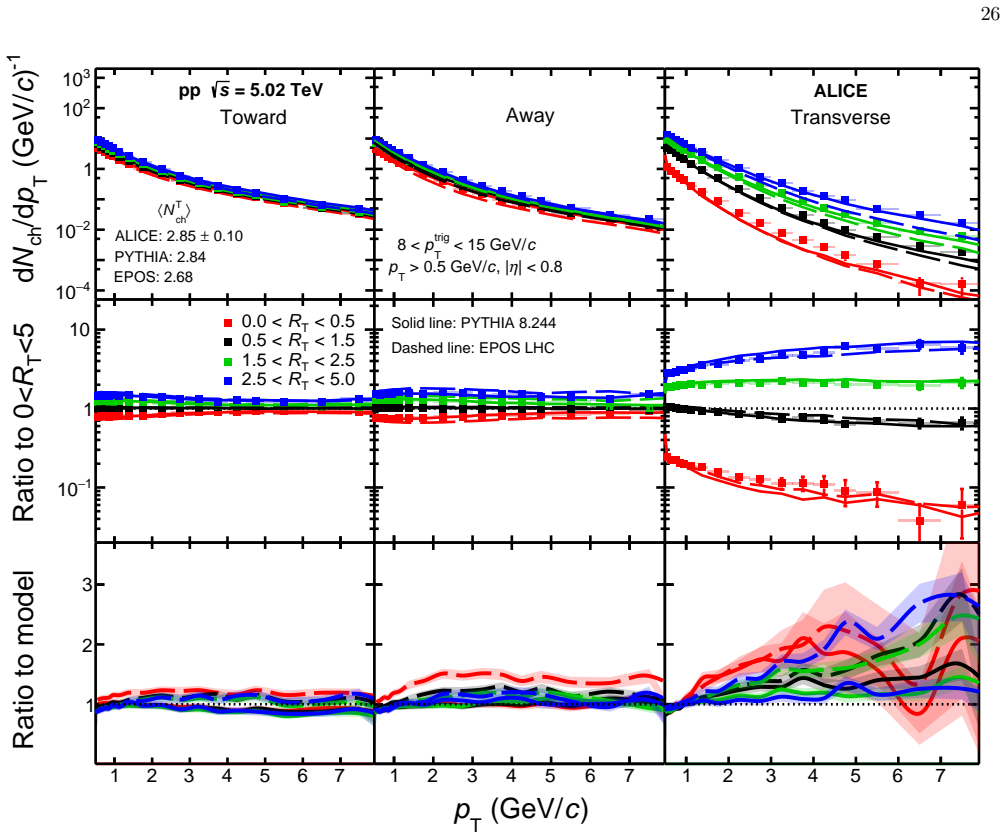
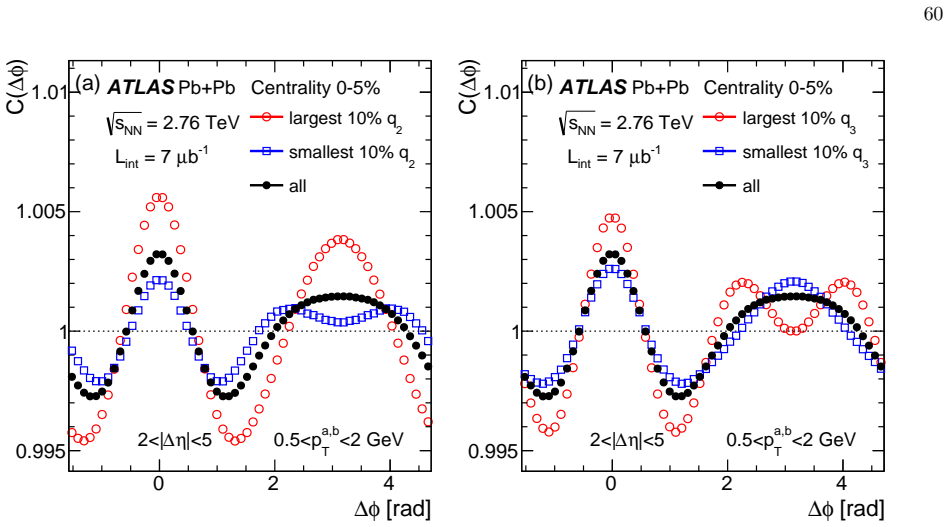
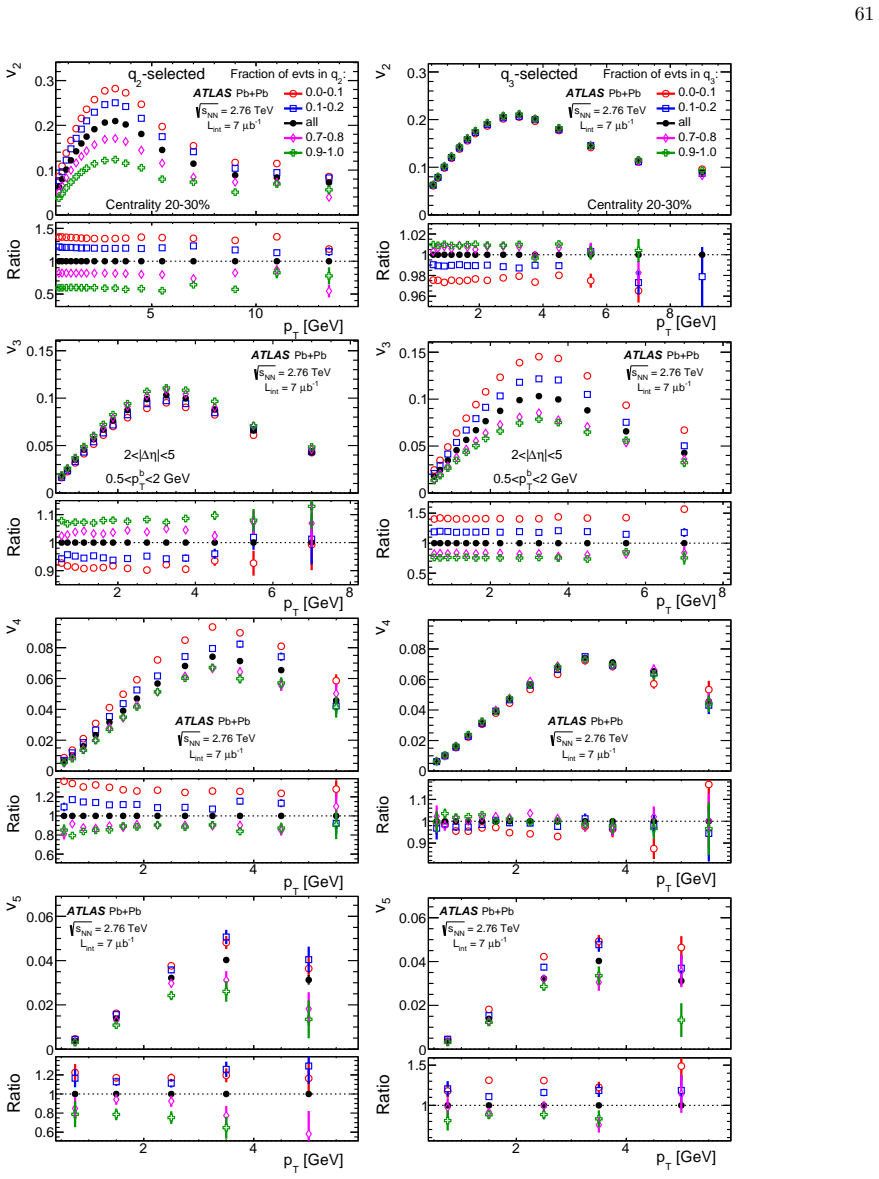
Two-particle correlations and anisotropic flow One of the key signatures for collectivity is the anisotropic flow, which can be obtained using two- particle azimuthal correlations. As already highlighted in Fig. 70, the initial state spatial anisotropy can be probed using event shape observables, which translates to final state momentum anisotropy. So, th...
-
[2]
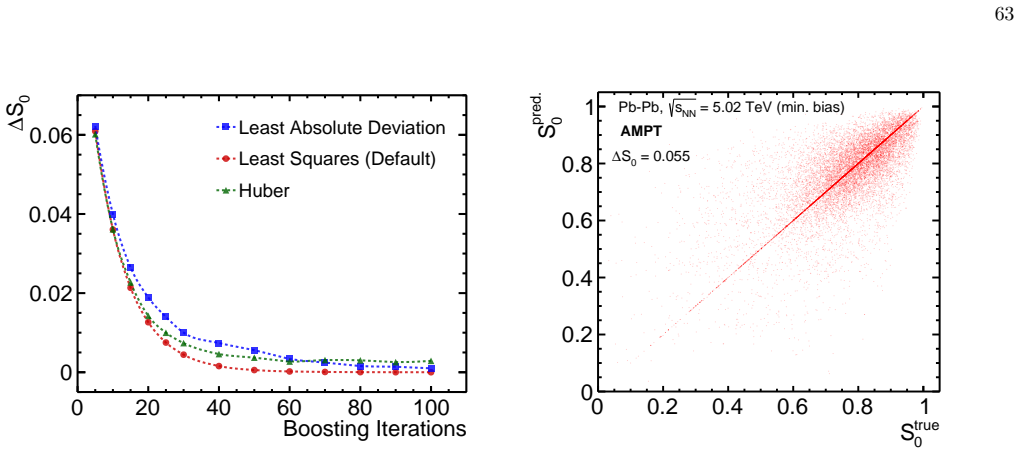
Eccentricity and elliptic flow fluctuations The strong correlation ofS0 with v2 shown in the previ- ous section can be exploited to constrain the probability distributions of v2, thereby reducing their event-by-event fluctuations. The left panel of Fig. 74 shows the relative eccentricity fluctuations, F (ϵ2) = σϵ2 /⟨ϵ2⟩, as a function of centrality for di...
-
[3]
Symmetry Plane Correlations After the discussion on anisotropic flow coefficients, their fluctuations, and the impact of event shape selec- tion on these coefficients, it is equally important to un- derstand the significance of symmetry plane angles, ψn. However, unlike vn, the estimation of ψn is not triv- ial in experiments due to uncertainty in the est...
-
[4]
Indian participation in the ALICE experiment at CERN
Kinetic freeze-out temperature and radial flow One of the crucial observables used in the high-energy collisions is the study of kinetic freeze-out temperature (Tkin) versus mean transverse radial flow velocity (⟨βT⟩), which gives much more information about the system formed in such collisions. Both these observables are anti-correlated and are proportio...
work page 2021
- [5]
-
[6]
Field, The underlying event in hadronic collisions, Ann
R. Field, The underlying event in hadronic collisions, Ann. Rev. Nucl. Part. Sci. 62, 453 (2012)
work page 2012
-
[7]
Soft QCD Physics at the LHC: highlights and opportunities,
P. Christiansen and P. Van Mechelen, “Soft QCD Physics at the LHC: highlights and opportunities,” [arXiv:2412.02672 [hep-ex]]
-
[8]
T. Sjostrand and M. van Zijl, A Multiple Interaction Model for the Event Structure in Hadron Collisions, Phys. Rev. D 36, 2019 (1987)
work page 2019
-
[9]
S. Chekanov et al. [ZEUS], Three- and four-jet final states in photoproduction at HERA, Nucl. Phys. B792, 1 (2008)
work page 2008
-
[10]
V. M. Abazov et al. [D0], Double parton interactions in γ+3 jet events in pp− bar collisions √s = 1 .96 TeV., Phys. Rev. D 81, 052012 (2010)
work page 2010
-
[11]
T. Sj¨ ostrandet. al. , An introduction to PYTHIA 8.2, Comput. Phys. Commun. 191, 159 (2015)
work page 2015
-
[12]
V. Khachatryan et al. [CMS], Evidence for collectivity in pp collisions at the LHC, Phys. Lett. B 765, 193 (2017)
work page 2017
-
[13]
A Decade of Collectivity in Small Systems,
J. F. Grosse-Oetringhaus and U. A. Wiedemann, “A Decade of Collectivity in Small Systems,” [arXiv:2407.07484 [hep-ex]]
-
[14]
S. Acharya et al. [ALICE], Investigations of Anisotropic Flow Using Multiparticle Azimuthal Correlations in pp, p-Pb, Xe-Xe, and Pb-Pb Collisions at the LHC, Phys. Rev. Lett. 123, 142301 (2019)
work page 2019
-
[15]
V. Khachatryan et al. [CMS], Observation of Long- Range Near-Side Angular Correlations in Proton- Proton Collisions at the LHC, JHEP 09, 091 (2010)
work page 2010
- [16]
-
[17]
V. Khachatryan et al. [CMS], Measurement of long- range near-side two-particle angular correlations in pp collisions at √s =13 TeV, Phys. Rev. Lett.116 , 172302 (2016)
work page 2016
-
[18]
M. Aaboud et al. [ATLAS], Measurements of long-range azimuthal anisotropies and associated Fourier coeffi- cients for pp collisions at √s = 5 .02 and 13 TeV and p+Pb collisions at √sNN = 5.02 TeV with the ATLAS detector, Phys. Rev. C 96, 024908 (2017)
work page 2017
- [19]
-
[20]
S. Acharya et al. [ALICE], First observation of ultra- long-range azimuthal correlations in low multiplicity pp and p-Pb collisions at the LHC, [arXiv:2504.02359]
-
[21]
J. Adam et al. [ALICE], Enhanced production of multi- strange hadrons in high-multiplicity proton-proton col- lisions, Nature Phys. 13, 535 (2017)
work page 2017
-
[22]
S. Acharya et al. [ALICE], Multiplicity dependence of light-flavor hadron production in pp collisions at √s = 7 TeV, Phys. Rev. C 99, 024906 (2019)
work page 2019
-
[23]
S. Acharya et al. [ALICE], Multiplicity dependence of (multi-)strange hadron production in proton-proton col- lisions at √s = 13 TeV, Eur. Phys. J. C 80, 167 (2020)
work page 2020
-
[24]
J. L. Nagle and W. A. Zajc, Small System Collectivity in Relativistic Hadronic and Nuclear Collisions, Ann. Rev. Nucl. Part. Sci. 68, 211 (2018)
work page 2018
-
[25]
S. Acharya et al. [ALICE], Search for jet quenching ef- fects in high-multiplicity pp collisions at √s = 13 TeV via di-jet acoplanarity, JHEP 05, 229 (2024)
work page 2024
-
[26]
C. Bierlich and J. R. Christiansen, Effects of color re- connection on hadron flavor observables, Phys. Rev. D 92, 094010 (2015)
work page 2015
-
[27]
C. Bierlich, G. Gustafson, L. L¨ onnblad and A. Tarasov, Effects of Overlapping Strings in pp collisions, JHEP 03, 148 (2015)
work page 2015
-
[28]
A shoving model for collectivity in hadronic collisions
C. Bierlich, G. Gustafson and L. L¨ onnblad, A shoving model for collectivity in hadronic collisions, [arXiv:1612.05132]
work page internal anchor Pith review Pith/arXiv arXiv
-
[29]
S. Acharya et al. [ALICE], Charged-particle production as a function of multiplicity and transverse spherocity in pp collisions at √s = 5.02 and 13 TeV, Eur. Phys. J. C 79, 857 (2019)
work page 2019
-
[30]
S. Acharya et al. [ALICE], Study of charged-particle production at high pT using event topology in pp, p–Pb and Pb–Pb collisions at √sNN = 5.02 TeV, Phys. Lett. B 843, 137649 (2023)
work page 2023
-
[31]
P. A. Movilla Fernandez et al. [JADE], A Study of event shapes and determinations of αs using data of e+e− annihilations at √s = 22 to 44-GeV, Eur. Phys. J. C 1, 461 (1998)
work page 1998
-
[32]
J. F. Donoghue, F. E. Low and S. Y. Pi, Tensor Analysis of Hadronic Jets in Quantum Chromodynamics, Phys. Rev. D 20, 2759 (1979)
work page 1979
-
[33]
M. Dasgupta and G. P. Salam, Event shapes in e+e− annihilation and deep inelastic scattering, J. Phys. G 30, R143 (2004)
work page 2004
- [34]
-
[35]
S. Bethke et al. [JADE], Determination of the Strong Coupling αs from hadronic Event Shapes with O( α3 s) and resummed QCD predictions using JADE Data, Eur. Phys. J. C 64, 351 (2009)
work page 2009
-
[36]
M. Z. Akrawy et al. [OPAL], A Study of Jet Production Rates and a Test of QCD on the Z0 Resonance, Phys. Lett. B 235, 389 (1990)
work page 1990
-
[37]
W. Bartel et al. [JADE], Observation of Four - Jet Struc- ture in e+e− Annihilation at √s = 33-GeV, Phys. Lett. B 115, 338 (1982)
work page 1982
- [38]
- [39]
-
[40]
V. Khachatryan et al. [CMS], First Measurement of Hadronic Event Shapes in pp Collisions at √s = 7 TeV, Phys. Lett. B 699, 48 (2011)
work page 2011
- [41]
-
[42]
C. Adler et al. [STAR], Elliptic flow from two and four particle correlations in Au+Au collisions at √sNN = 130-GeV, Phys. Rev. C 66, 034904 (2002)
work page 2002
-
[43]
C. Cesarotti and J. Thaler, A Robust Measure of Event Isotropy at Colliders, JHEP 08, 084 (2020)
work page 2020
- [44]
-
[45]
G. Bencedi, A. Ortiz and A. Paz, Disentangling the hard gluon bremsstrahlung effects from the relative trans- 65 verse activity classifier in pp collisions, Phys. Rev. D 104, 016017 (2021)
work page 2021
-
[46]
A. Ortiz and L. Valencia Palomo, Universality of the un- derlying event in pp collisions, Phys. Rev. D 96, 114019 (2017)
work page 2017
-
[47]
S. G. Weber, A. Dubla, A. Andronic and A. Morsch, Elucidating the multiplicity dependence of J/ψ produc- tion in proton–proton collisions with PYTHIA8, Eur. Phys. J. C 79, 36 (2019)
work page 2019
-
[48]
B. Abelev et al. [ALICE], Transverse sphericity of pri- mary charged particles in minimum bias proton-proton collisions at √s = 0.9, 2.76 and 7 TeV, Eur. Phys. J. C 72, 2124 (2012)
work page 2012
-
[49]
V. Chekhovsky et al. [CMS], Measurement of event shapes in minimum-bias events from proton-proton col- lisions at √s = 13 TeV, [arXiv:2505.17850]
- [50]
-
[51]
B. Abelev et al. [ALICE], Underlying Event measure- ments in pp collisions at √s = 0.9 and 7 TeV with the ALICE experiment at the LHC, JHEP 07, 116 (2012)
work page 2012
-
[52]
S. Acharya et al. [ALICE], Event-shape and multiplicity dependence of freeze-out radii in pp collisions at √s = 7 TeV, JHEP 09, 108 (2019)
work page 2019
-
[53]
S. Acharya et al. [ALICE], Underlying Event properties in pp collisions at √s = 13 TeV, JHEP 04, 192 (2020)
work page 2020
-
[54]
S. Acharya et al. [ALICE], Underlying-event properties in pp and p–Pb collisions at √sNN = 5.02 TeV, JHEP 06, 023 (2023)
work page 2023
-
[55]
S. Acharya et al. [ALICE], Production of pions, kaons, and protons as a function of the relative transverse ac- tivity classifier in pp collisions at √s = 13 TeV, JHEP 06, 027 (2023)
work page 2023
-
[56]
S. Acharya et al. [ALICE], Charged-particle production as a function of the relative transverse activity classifier in pp, p–Pb, and Pb–Pb collisions at the LHC, JHEP 01, 056 (2024)
work page 2024
-
[57]
S. Acharya et al. [ALICE], Light-flavor particle produc- tion in high-multiplicity pp collisions at √s= 13 TeV as a function of transverse spherocity, JHEP 05, 184 (2024)
work page 2024
-
[58]
S. Acharya et al. [ALICE], Modification of charged- particle jets in event-shape engineered Pb–Pb collisions at √sNN =5.02 TeV, Phys. Lett. B 851, 138584 (2024)
work page 2024
-
[59]
S. Acharya et al. [ALICE], Particle production as a func- tion of charged-particle flattenicity inpp collisions at √s = 13 TeV, Phys. Rev. D 111, 012010 (2025)
work page 2025
-
[60]
R. Rath, A. Khuntia, S. Tripathy and R. Sahoo, A Base- line Study of the Event-Shape and Multiplicity Depen- dence of Chemical Freeze-Out Parameters in Proton- Proton Collisions at √s = 13 TeV Using PYTHIA8, Physics 2, 679 (2020)
work page 2020
-
[61]
S. Tripathy, A. Bisht, R. Sahoo, A. Khuntia and M. P. Salvan, Event Shape and Multiplicity Depen- dence of Freeze-Out Scenario and System Thermody- namics in Proton+Proton Collisions at√s = 13 TeV Us- ing PYTHIA8, Adv. High Energy Phys. 2021, 8822524 (2021)
work page 2021
-
[62]
A. Khuntia, S. Tripathy, A. Bisht and R. Sahoo, Event shape engineering and multiplicity dependent study of identified particle production in proton + proton colli- sions at √s = 13 TeV using PYTHIA8, J. Phys. G 48, 035102 (2021)
work page 2021
-
[63]
A. M. K. R, S. Prasad, S. Tripathy, N. Mallick and R. Sahoo, Investigating radial-flow-like effects via pseu- dorapidity and transverse spherocity dependence of par- ticle production in pp collisions at the LHC, Eur. Phys. J. Plus 140, 110 (2025)
work page 2025
- [64]
-
[65]
S. Deb, R. Sahoo, D. Thakur, S. Tripathy and A. Khuntia, Investigating heavy-flavor vs light-flavor puzzle with event topology and multiplicity in proton + proton collisions at = 13 TeV using PYTHIA8, J. Phys. G 48, 095104 (2021)
work page 2021
- [66]
-
[67]
S. Deb, G. Sarwar, R. Sahoo and J. e. Alam, Study of QCD dynamics using small systems, Eur. Phys. J. A 57, 195 (2021)
work page 2021
-
[68]
S. Deb, S. Tripathy, G. Sarwar, R. Sahoo and J. e. Alam, Deciphering QCD dynamics in small collision systems using event shape and final state multiplicity at the Large Hadron Collider, Eur. Phys. J. A 56, 252 (2020)
work page 2020
-
[69]
N. Mallick, S. Tripathy, R. Sahoo and A. Ortiz, First implementation of transverse spherocity analysis for heavy-ion collisions at the Large Hadron Collider en- ergies, [arXiv:2001.06849]
-
[70]
S. Tripathy, S. Prasad and R. Sahoo, Event shape dependence of symmetry plane correlations using the Gaussian estimator in Pb-Pb collisions at the LHC us- ing AMPT, [arXiv:2504.09275]
- [71]
-
[72]
N. Mallick, R. Sahoo, S. Tripathy and A. Ortiz, Study of Transverse Spherocity and Azimuthal Anisotropy in Pb-Pb collisions at √sNN = 5.02 TeV using A Multi- Phase Transport Model, J. Phys. G 48, 045104 (2021)
work page 2021
-
[73]
N. Mallick, S. Tripathy and R. Sahoo, Event topology and constituent-quark scaling of elliptic flow in heavy- ion collisions at the Large Hadron Collider using a mul- tiphase transport model, Eur. Phys. J. C82, 524 (2022)
work page 2022
- [74]
- [75]
-
[76]
T. Akesson et al. [Axial Field Spectrometer], The Dom- inance of Jets at Large Transverse Energy in a Full Az- imuth Hadron Calorimeter at ISR Energies, Phys. Lett. B 128, 354 (1983)
work page 1983
-
[77]
C. Albajar et al. [UA1], Analysis of the Highest Trans- verse Energy Events Seen in the UA1 Detector at the Sp¯pS Collider, Z. Phys. C 36, 33 (1987). 66
work page 1987
-
[78]
R. Ansari et al. [UA2], Jet Measures and Hadronic Event Shapes at the CERN ¯pp Collider, Z. Phys. C 36 (1987), 175
work page 1987
-
[79]
T. Aaltonen et al. [CDF], Measurement of Event Shapes in Proton-Antiproton Collisions at Center-of-Mass En- ergy 1.96 TeV, Phys. Rev. D 83, 112007 (2011)
work page 2011
-
[80]
P. A. Movilla Fernandez, S. Bethke, O. Biebel and S. Kluth, Tests of power corrections for event shapes in e+e− annihilation, Eur. Phys. J. C 22, 1 (2001)
work page 2001
discussion (0)
Sign in with ORCID, Apple, or X to comment. Anyone can read and Pith papers without signing in.