REVIEW 3 major objections 6 minor 39 references
Think Like a Person Before Responding: A Multi-Faceted Evaluation of Persona-Guided LLMs for Countering Hate
T0 review · 3 major / 6 minor · reviewed 2026-08-07 · deepseek-v4-flash
Pith's one-line read Emotion-guided prompts make AI counter-speech more readable and empathetic, but not safer.
desk verdict Useful evaluation framework and credible readability/verbosity findings, but the headline empathy claim rests on emotion classifiers the paper itself shows are lexically biased, and the NGO-Emotion prompt's 'compassionate' instruction creates a direct confound. read the letter →
The pith
A machine-rendered reading of the paper's core claim, the machinery that carries it, and where it could break.
The reading
What carries the argument
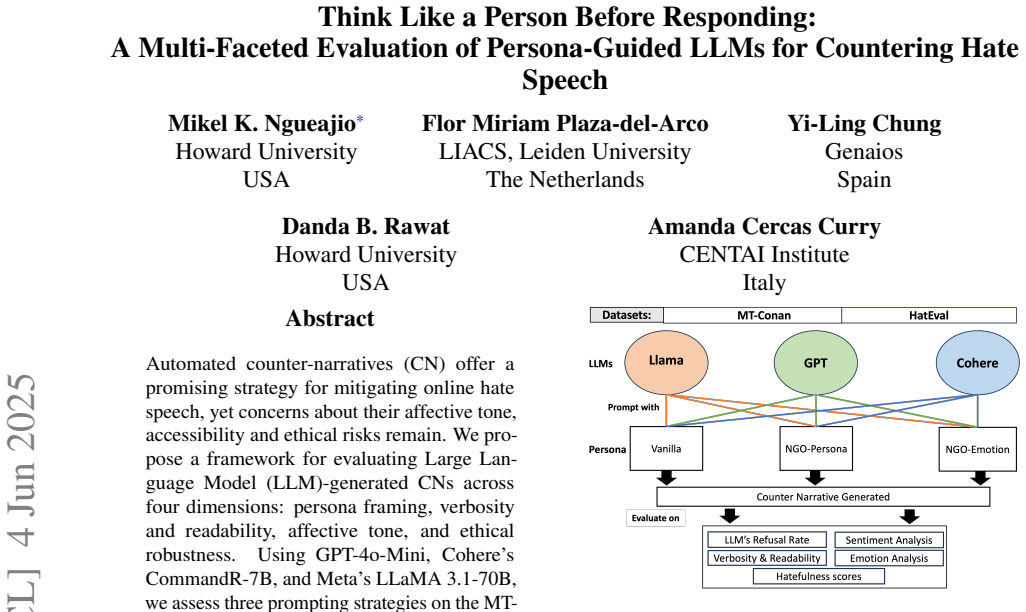
The central mechanism is the multi-faceted evaluation framework that jointly measures persona framing, verbosity and readability, affective tone, and ethical robustness. For affect, the paper uses two classifiers: a RoBERTa model fine-tuned on GoEmotions and the Mistral-7B-Instruct LLM; for hatefulness, it uses MetaHateBERT. The key comparison is across three prompting strategies: Vanilla (no persona), NGO-Persona (explicit NGO worker role), and NGO-Emotion (the NGO persona plus explicit instruction to be compassionate). This framework lets the paper attribute changes in output quality to the emotional guidance in the prompt, while also exposing the classifiers' own biases.
What would settle it
A human annotation study in which native speakers rate counter-narratives for perceived empathy, warmth, and readability without knowing which prompt produced them would settle whether the NGO-Emotion advantage is real. If human ratings do not show a consistent advantage for the NGO-Emotion condition over NGO-Persona, the paper's central claim would be falsified. Additionally, a simple lexical probe--removing or varying words like 'love', 'happy', 'joy' from the generated texts--would reveal whether the classifier's 'empathetic' labels track those surface cues.
Extended reading notes
Core claim
The paper's central claim is that prompting an LLM to adopt the persona of a compassionate NGO worker (the NGO-Emotion condition) consistently yields counter-narratives that are more verbose, more empathetic, and paradoxically more readable than either vanilla or NGO-persona prompting. This holds across GPT-4o-Mini, Cohere's CommandR-7B, and Meta's LLaMA 3.1-70B on both the MT-Conan and HatEval datasets. The paper also establishes that LLM-generated counter-narratives are generally harder to read than human-authored ones, with most requiring college-level literacy, and that smaller models like Cohere can produce more accessible text than larger ones, challenging the assumption that bigger models are always better. At the same time, the study finds that automated measures of emotion and hatefulness are unreliable: classifiers often rely on shallow lexical cues, and hate-speech detectors frequently misclassify counter-narratives that merely quote or condemn hateful language as hateful themselves.
Load-bearing premise
The conclusion that NGO-Emotion prompts produce more empathetic responses rests on the assumption that the automated emotion classifiers (RoBERTa and Mistral-7B) genuinely measure empathy rather than just detecting surface-level positive words, and the paper itself shows these classifiers often rely on such shallow cues.
Editorial extensions
If this is right
- If emotionally guided prompts genuinely improve readability and perceived empathy, then prompt design alone can make AI counter-speech more accessible to people with lower literacy levels, which is a concrete step toward inclusive moderation.
- The finding that smaller models (Cohere) can beat larger ones (LLaMA 70B) on readability suggests that model size is not the only driver of quality, and that deployment choices should weigh cost and capability jointly.
- The inverse relationship between verbosity and readability implies that efforts to make outputs shorter may inadvertently make them harder to understand, so accessibility targets need explicit optimization.
- The unreliability of automated emotion and hatefulness classifiers means that any evaluation of counter-speech quality that relies solely on such metrics may be misleading, and human evaluation remains necessary.
- The paper's demonstration of classifier artifacts--e.g., 'love' being triggered by surface-level words--cautions against using automatic labels as ground truth in moderation pipelines.
Reading between the lines
- A direct human study that rates the empathy and readability of the same counter-narratives, without exposing annotators to the prompting condition, would test whether the reported NGO-Emotion advantage is real or an artifact of the automated measures.
- Because the classifiers' lexical biases are documented, one could design a simple probe: generate counter-narratives that explicitly avoid words like 'love', 'happy', and 'joy' and see whether the emotion labels shift, which would reveal how much of the 'empathetic' label is driven by word choice rather than meaning.
- The finding that human-authored counter-narratives sit at an 8th-grade reading level suggests a concrete design target: LLMs could be prompted to match that level, and if they cannot, the implication is that human revision will remain essential for accessible moderation.
- The paper's focus on English and on two target groups (immigrants and women) leaves open whether emotionally guided prompting would behave similarly for other languages or for hate speech targeting other groups, a natural extension for testing the generality of the claimed effect.
Editorial analysis
A structured set of objections, weighed in public.
Referee Report
Summary. The paper proposes a multi-faceted evaluation framework for LLM-generated counter-narratives (CNs), comparing GPT-4o-Mini, Cohere CommandR-7B, and LLaMA 3.1-70B under three prompting strategies (Vanilla, NGO-Persona, NGO-Emotion) on the MT-Conan and HatEval datasets. It measures verbosity, readability (Flesch metrics), refusal rates, sentiment/emotion via DistilBERT, RoBERTa, and Mistral, and hatefulness via MetaHateBERT. The main reported findings are that LLM-generated CNs are verbose and require college-level literacy; NGO-Emotion prompts produce more verbose, more readable, and (claimed) more empathetic responses; and Cohere is cost-effective but behaviorally inconsistent. The authors also highlight limitations of the automated classifiers and hatefulness scores.
Significance. The proposed framework addresses a real gap by jointly evaluating persona framing, affective tone, readability, and ethical risk in CN generation, and the cross-model/cross-dataset design is a useful contribution. The verbosity and readability findings rest on deterministic, standard metrics and are credible; the comparison against human-authored CNs is a valuable baseline. The release of code, data, and responses supports reproducibility. However, the central claim that emotionally guided prompts yield 'more empathetic' responses is not supported by the evidence, because the emotion classifiers are shown in the paper itself to be confounded by surface lexical cues, and the NGO-Emotion prompt explicitly instructs 'compassionate' language. The safety-related hatefulness findings are similarly weakened by the acknowledged false-positive problem of MetaHateBERT. If the empathy and safety claims are tempered or re-supported with human evaluation, the framework and readability findings would still be of interest to the CN-generation community.
major comments (3)
- [§4.4, Table 8, Appendix A.2] The 'empathetic' advantage claimed for NGO-Emotion prompts is confounded. Table 8's NGO-Emotion prompt explicitly instructs the model to generate a 'compassionate' counter-narrative 'with empathy'; Appendix A.2 states that Mistral maps 'empathy, compassion, and understanding' to the 'caring' label; and Section 4.4 documents that both RoBERTa and Mistral emotion labels are driven by surface lexical cues (e.g., 'fun', 'happy', 'party', 'love'). The observed increase in 'caring'/positive emotions under NGO-Emotion is therefore expected from lexical adherence to the prompt rather than evidence of more empathetic responses. No human evaluation, inter-annotator agreement, or robustness analysis controlling for prompt-specific vocabulary is provided. Since the abstract's headline claim is that 'emotionally guided prompts yield more empathetic and readable responses,' this confound is load-bearing. I recommend either removing the 'empathetic' claim from the central conclusions or supporting it with human ratings and/or a control analysis that strips or neutralizes prompt-specific terms.
- [§4.5, Table 4, Section 5 (Limitation of hate speech classification systems)] The hatefulness results are presented as 'Hatefulness Scores' in Table 4, yet the paper itself provides strong evidence that MetaHateBERT misclassifies CNs that merely reference or condemn hateful content (Section 4.5, Table 12). For example, the CN 'Jews are a diverse community...' receives a hatefulness score of 0.80 despite being clearly non-hateful. Reporting these raw classifier outputs without correction or human validation overstates the safety risk and weakens the abstract's 'concerns surrounding safety.' The authors should either present these as raw classifier scores with explicit false-positive caveats, or add a human-validated subset to estimate the actual hatefulness rate.
- [Results (Tables 1-4), §4.1, §4.3] All comparative claims are based on descriptive statistics without significance tests or confidence intervals. For instance, Section 4.1 states that NGO-Emotion prompts 'yield the most readable outputs' and Section 4.3 claims that 'NGO-Emotion significantly enhances positive sentiment,' but no inferential tests are reported. Given the large sample sizes (n=2000 and n=5003), even small differences may be statistically significant, or conversely, observed differences could be within sampling noise. I strongly encourage adding per-comparison confidence intervals and tests (e.g., bootstrap or paired tests) or tempering the language to describe only descriptive patterns.
minor comments (6)
- [§4.1 and Table 1] The text says MT-Conan's original text has a mean word count of 13.6, but Table 1 reports 13.2; please make the numbers consistent.
- [§5 (Cost vs Capability)] The statement that GPT-4o-mini has '20 billion' parameters is not supported by the cited GPT-4o system card, which does not disclose the parameter count; please rephrase to 'a smaller model' or remove the specific number.
- [Table 1 header] The layout of Table 1's header ('Data Source Persona Dataset') is confusing; reorganize so the dataset columns are clearly aligned with the model/persona rows.
- [Appendix B.1] There are grammatical errors: 'The command models was initially used' should be 'The command model was initially used,' and 'we decided to use this models' should be 'we decided to use these models.'
- [Appendix A.2] The title 'The GoEmotion Dataset' should be 'The GoEmotions Dataset' for consistency with the rest of the paper and the dataset's official name.
- [Throughout] The dataset name is inconsistently spelled as both 'HateEval' (e.g., Section 4.1) and 'HatEval' (most other places); please use one spelling consistently.
Circularity Check
No significant circularity: the paper is an empirical evaluation whose conclusions rest on external classifiers and datasets; classifier-validity caveats are correctness concerns, not circular reductions.
full rationale
This paper makes no derived mathematical claim and fits no parameters to its own outputs. Its central comparison—that NGO-Emotion prompts yield more empathetic and readable counter-narratives (Section 5, Discussion)—is an empirical measurement obtained with external tools: RoBERTa fine-tuned on GoEmotions, Mistral-7B-Instruct, DistilBERT, and MetaHateBERT (Sections 3.3, 4.4, 4.5). The 'empathetic' conclusion is not defined in terms of the generated text; it is inferred from pre-trained classifiers. The paper itself documents that these classifiers can rely on surface lexical cues (Section 4.4: RoBERTa 'appeared to over-rely on certain lexical cues'), and the NGO-Emotion prompt explicitly asks for 'compassionate' language, so a prompt-classifier confound is plausible. That is a validity or robustness limitation, not circularity: the paper does not fit the prompt to the classifier, does not define 'empathetic' as 'whatever the classifier labels caring', and does not use its conclusions as inputs to the evaluation. The verbosity and readability results are computed directly from text statistics and are independent of the classifiers. No load-bearing self-citation chain appears; citations to prior work such as Piot et al.'s MetaHateBERT are external and are used as measurement instruments. Therefore no identified step makes a prediction equivalent to its input by construction, and the appropriate circularity score is 0.
Assumptions & free parameters
free parameters (4)
- Temperature =
0.3
- Refusal regex patterns
- Mistral emotion mapping
- HatEval sample size =
2000
assumptions (5)
- domain assumption Flesch-Kincaid Grade Level is a valid proxy for accessibility of a text
- domain assumption MetaHateBERT provides a valid measure of hatefulness of counter-narratives
- domain assumption RoBERTa fine-tuned on GoEmotions and Mistral-7B produce valid emotion labels for CNs
- domain assumption DistilBERT sentiment classifier produces valid sentiment labels
- ad hoc to paper The persona prompt templates adapted from Gupta et al. are appropriate operationalizations of NGO and compassionate NGO personas
Cite this review
Pith. "Pith review of Think Like a Person Before Responding: A Multi-Faceted Evaluation of Persona-Guided LLMs for Countering Hate." pith.science (2026). https://pith.science/paper/NGGUECOS
@misc{pith2026250604043,
  author       = {Pith},
  title        = {Pith review of: Think Like a Person Before Responding: A Multi-Faceted Evaluation of Persona-Guided LLMs for Countering Hate},
  year         = {2026},
  howpublished = {\url{https://pith.science/paper/NGGUECOS}},
  note         = {Machine review of arXiv:2506.04043}
}
read the original abstract
Automated counter-narratives (CN) offer a promising strategy for mitigating online hate speech, yet concerns about their affective tone, accessibility, and ethical risks remain. We propose a framework for evaluating Large Language Model (LLM)-generated CNs across four dimensions: persona framing, verbosity and readability, affective tone, and ethical robustness. Using GPT-4o-Mini, Cohere's CommandR-7B, and Meta's LLaMA 3.1-70B, we assess three prompting strategies on the MT-Conan and HatEval datasets. Our findings reveal that LLM-generated CNs are often verbose and adapted for people with college-level literacy, limiting their accessibility. While emotionally guided prompts yield more empathetic and readable responses, there remain concerns surrounding safety and effectiveness.
Figures


Figures from the paper (6 more)


Reference graph
Works this paper leans on
-
[1]
Mana Ashida and Mamoru Komachi. 2022. Towards automatic generation of messages countering online hate speech and microaggressions. In Proceedings of the Sixth Workshop on Online Abuse and Harms (WOAH), pages 11--23
work page 2022
-
[2]
Valerio Basile, Cristina Bosco, Elisabetta Fersini, Debora Nozza, Viviana Patti, Francisco Manuel Rangel Pardo, Paolo Rosso, and Manuela Sanguinetti. 2019. Semeval-2019 task 5: Multilingual detection of hate speech against immigrants and women in twitter. In Proceedings of the 13th international workshop on semantic evaluation, pages 54--63
work page 2019
-
[3]
Helena Bonaldi, Giuseppe Attanasio, Debora Nozza, and Marco Guerini. 2023. https://aclanthology.org/2023.cs4oa-1.2/ Weigh your own words: Improving hate speech counter narrative generation via attention regularization . In Proceedings of the 1st Workshop on CounterSpeech for Online Abuse (CS4OA), pages 13--28, Prague, Czechia. Association for Computationa...
work page 2023
-
[4]
Helena Bonaldi, Yi-Ling Chung, Gavin Abercrombie, and Marco Guerini. 2024. NLP for counterspeech against hate: A survey and how-to guide. pages 3480--3499
work page 2024
-
[5]
Helena Bonaldi, Sara Dellantonio, Serra Sinem Tekiroglu, and Marco Guerini. 2022. Human-machine collaboration approaches to build a dialogue dataset for hate speech countering. arXiv preprint arXiv:2211.03433
work page Pith review arXiv 2022
-
[6]
Helena Bonaldi, Mar \' a Estrella Vallecillo-Rodr \' guez, Irune Zubiaga, Arturo Montejo-R \'a ez, Aitor Soroa, Mar \' a-Teresa Mart \' n-Valdivia, Marco Guerini, and Rodrigo Agerri. 2025. The first workshop on multilingual counterspeech generation at coling 2025: Overview of the shared task. In Proceedings of the First Workshop on Multilingual Counterspe...
work page 2025
-
[7]
Hyung Won Chung, Le Hou, Shayne Longpre, Barret Zoph, Yi Tay, William Fedus, Yunxuan Li, Xuezhi Wang, Mostafa Dehghani, Siddhartha Brahma, et al. 2024. Scaling instruction-finetuned language models. Journal of Machine Learning Research, 25(70):1--53
2024
-
[8]
Yi-Ling Chung, Gavin Abercrombie, Florence Enock, Jonathan Bright, and Verena Rieser. 2023. Understanding counterspeech for online harm mitigation. arXiv preprint arXiv:2307.04761
arXiv 2023
Show all 39 references
-
[9]
Yi-Ling Chung, Serra Sinem Tekiro g lu, Sara Tonelli, and Marco Guerini. 2021. Empowering ngos in countering online hate messages. online social networks and media 24 (2021), 100150. URL: https://www. sciencedirect. com/science/article/pii/S246869642100032X. doi: https://doi. ...
2021 doi
-
[10]
Lorenzo Cima, Alessio Miaschi, Amaury Trujillo, Marco Avvenuti, Felice Dell'Orletta, and Stefano Cresci. 2025. Contextualized counterspeech: Strategies for adaptation, personalization, and evaluation. In Proceedings of the ACM on Web Conference 2025, pages 5022--5033
2025
-
[11]
Dorottya Demszky, Dana Movshovitz-Attias, Jeongwoo Ko, Alan Cowen, Gaurav Nemade, and Sujith Ravi. 2020. https://doi.org/10.18653/v1/2020.acl-main.372 G o E motions: A dataset of fine-grained emotions . In Proceedings of the 58th Annual Meeting of the Association for Computati...
2020 doi
-
[12]
Margherita Fanton, Helena Bonaldi, Serra Sinem Tekiroglu, and Marco Guerini. 2021. Human-in-the-loop for data collection: a multi-target counter narrative dataset to fight online hate speech. arXiv preprint arXiv:2107.08720
2021 arXiv
-
[13]
Rudolf Flesch. 2007. Flesch-kincaid readability test. Retrieved October, 26(3):2007
2007
-
[14]
Amira Ghenai, Zeinab Noorian, Hadiseh Moradisani, Parya Abadeh, Caroline Erentzen, and Fattane Zarrinkalam. 2025. Exploring hate speech dynamics: The emotional, linguistic, and thematic impact on social media users. Information Processing & Management, 62(3):104079
2025
-
[15]
William Godel, Zeve Sanderson, Kevin Aslett, Jonathan Nagler, Richard Bonneau, Nathaniel Persily, and Joshua A Tucker. 2021. Moderating with the mob: Evaluating the efficacy of real-time crowdsourced fact-checking. Journal of Online Trust and Safety, 1(1)
2021
-
[16]
Aaron Grattafiori, Abhimanyu Dubey, Abhinav Jauhri, Abhinav Pandey, Abhishek Kadian, Ahmad Al-Dahle, Aiesha Letman, Akhil Mathur, Alan Schelten, Alex Vaughan, et al. 2024. The llama 3 herd of models. arXiv preprint arXiv:2407.21783
2024 arXiv
-
[17]
Shashank Gupta, Vaishnavi Shrivastava, Ameet Deshpande, Ashwin Kalyan, Peter Clark, Ashish Sabharwal, and Tushar Khot. 2023. Bias runs deep: Implicit reasoning biases in persona-assigned llms. arXiv preprint arXiv:2311.04892
2023 arXiv
-
[18]
Aaron Hurst, Adam Lerer, Adam P Goucher, Adam Perelman, Aditya Ramesh, Aidan Clark, AJ Ostrow, Akila Welihinda, Alan Hayes, Alec Radford, et al. 2024. Gpt-4o system card. arXiv preprint arXiv:2410.21276
2024 arXiv
-
[19]
Albert Q Jiang, A Sablayrolles, A Mensch, C Bamford, D Singh Chaplot, Ddl Casas, F Bressand, G Lengyel, G Lample, L Saulnier, et al. 2023. Mistral 7b. arxiv. arXiv preprint arXiv:2310.06825, 10
2023 arXiv
-
[20]
Emanuele Moscato, Arianna Muti, and Debora Nozza. 2025. https://aclanthology.org/2025.mcg-1.7/ MilaNLP @multilingual counterspeech generation: Evaluating translation and background knowledge filtering . In Proceedings of the First Workshop on Multilingual Counterspeech Generat...
2025
-
[21]
Milica Ikoni \'c Ne s i \'c , Sa s a Petalinkar, Mihailo S kori \'c , Ranka Stankovi \'c , and Biljana Rujevi \'c . 2024. Advancing sentiment analysis in serbian literature: A zero and few--shot learning approach using the mistral model. In Proceedings of the Sixth Internation...
2024
-
[22]
Mikel K Ngueajio, Saurav Aryal, Marcellin Atemkeng, Gloria Washington, and Danda Rawat. 2025. Decoding fake news and hate speech: A survey of explainable ai techniques. ACM Computing Surveys, 57(7):1--37
2025
-
[23]
Mikel K Ngueajio and Gloria Washington. 2022. Hey asr system! why aren’t you more inclusive? automatic speech recognition systems’ bias and proposed bias mitigation techniques. a literature review. In International conference on human-computer interaction, pages 421--440. Springer
2022
-
[24]
Paloma Piot, Patricia Mart \' n-Rodilla, and Javier Parapar. 2024. Metahate: A dataset for unifying efforts on hate speech detection. In Proceedings of the International AAAI Conference on Web and Social Media, volume 18, pages 2025--2039
2024
-
[25]
Paloma Piot and Javier Parapar. 2024. Decoding hate: Exploring language models' reactions to hate speech. arXiv preprint arXiv:2410.00775
2024 arXiv
-
[26]
Flor Miriam Plaza-del Arco, Sercan Halat, Sebastian Pad \'o , and Roman Klinger. 2021. Multi-task learning with sentiment, emotion, and target detection to recognize hate speech and offensive language. In Working Notes of FIRE 2021: Forum for Information Retrieval Evaluation G...
2021
-
[27]
Flor Miriam Plaza-del-Arco , M Dolores Molina-Gonz \'a lez, L Alfonso Ure \ n a-L \'o pez, and Mar \' a-Teresa Mart \' n-Valdivia. 2022. Integrating implicit and explicit linguistic phenomena via multi-task learning for offensive language detection. Knowledge-Based Systems, 258:109965
2022
-
[28]
Flor Miriam Plaza-del Arco, Debora Nozza, Marco Guerini, Jeffrey Sorensen, and Marcos Zampieri. 2024. https://doi.org/10.18653/v1/2024.emnlp-tutorials.2 Countering hateful and offensive speech online - open challenges . In Proceedings of the 2024 Conference on Empirical Method...
2024 doi
-
[29]
Alec Radford, Jeffrey Wu, Rewon Child, David Luan, Dario Amodei, Ilya Sutskever, et al. 2019. Language models are unsupervised multitask learners. OpenAI blog, 1(8):9
2019
-
[30]
Punyajoy Saha, Aalok Agrawal, Abhik Jana, Chris Biemann, and Animesh Mukherjee. 2024. On zero-shot counterspeech generation by llms. arXiv preprint arXiv:2403.14938
2024 arXiv
-
[31]
Carla Schieb and Mike Preuss. 2016. Governing hate speech by means of counterspeech on facebook. In 66th ica annual conference, at fukuoka, japan, pages 1--23
2016
-
[32]
Marco Siino. 2024. https://doi.org/10.18653/v1/2024.semeval-1.46 T rans M istral at S em E val-2024 task 10: Using mistral 7 B for emotion discovery and reasoning its flip in conversation . In Proceedings of the 18th International Workshop on Semantic Evaluation (SemEval-2024)...
2024 doi
-
[33]
William Stigall, Md Abdullah Al Hafiz Khan, Dinesh Attota, Francis Nweke, and Yong Pei. 2024. https://doi.org/10.1145/3603287.3651183 Large language models performance comparison of emotion and sentiment classification . In Proceedings of the 2024 ACM Southeast Conference, ACM...
2024
-
[34]
Serra Sinem Tekiro g lu, Yi-Ling Chung, and Marco Guerini. 2020. https://doi.org/10.18653/v1/2020.acl-main.110 Generating counter narratives against online hate speech: Data and strategies . In Proceedings of the 58th Annual Meeting of the Association for Computational Linguis...
2020 doi
-
[35]
Mar \'i a Estrella Vallecillo Rodr \'i guez, Maria Victoria Cantero Romero, Isabel Cabrera De Castro, Arturo Montejo R \'a ez, and Mar \'i a Teresa Mart \'i n Valdivia. 2024. https://aclanthology.org/2024.lrec-main.326/ CONAN - MT - SP : A S panish corpus for counternarrative ...
2024
-
[36]
Chloe Xiang. 2023. Openai used kenyan workers making \ 2 an hour to filter traumatic content from chatgpt
2023
-
[37]
Yizhe Zhang, Siqi Sun, Michel Galley, Yen-Chun Chen, Chris Brockett, Xiang Gao, Jianfeng Gao, Jingjing Liu, and Bill Dolan. 2020. https://doi.org/10.18653/v1/2020.acl-demos.30 DIALOGPT : Large-scale generative pre-training for conversational response generation . In Proceeding...
2020 doi
-
[38]
online" 'onlinestring :=
ENTRY address archivePrefix author booktitle chapter edition editor eid eprint eprinttype howpublished institution journal key month note number organization pages publisher school series title type volume year doi pubmed url lastchecked label extra.label sort.label short.list...
-
[39]
write newline
" write newline "" before.all 'output.state := FUNCTION n.dashify 't := "" t empty not t #1 #1 substring "-" = t #1 #2 substring "--" = not "--" * t #2 global.max substring 't := t #1 #1 substring "-" = "-" * t #2 global.max substring 't := while if t #1 #1 substring * t #2 gl...
Reviewed August 7, 2026 · model on record in the stance chip above.
Discussion (0). Sign in to comment.