REVIEW 4 major objections 6 minor 29 references
Object Navigation with Structure-Semantic Reasoning-Based Multi-level Map and Multimodal Decision-Making LLM
T0 review · 4 major / 6 minor · reviewed 2026-08-07 · deepseek-v4-flash
Pith's one-line read The paper claims that an environmental attribute map built from observed scenes plus diffusion-predicted unobserved regions, combined with a multimodal LLM hierarchical reasoner, raises zero-shot object navigation SPL to 28.4% on HM3D and…
desk verdict The paper reports solid SPL gains but never connects its headline diffusion-based map prediction to the algorithm, so the central claim doesn't hold up. read the letter →
The pith
A machine-rendered reading of the paper's core claim, the machinery that carries it, and where it could break.
The reading
What carries the argument
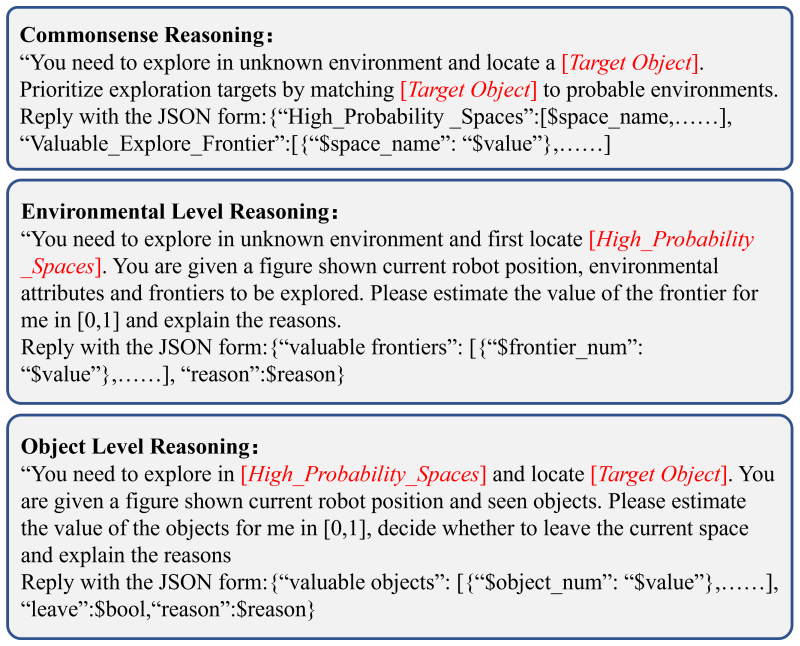
The carrying object is the Environmental Attributes Map (EAM): a 2D grid whose cells hold both an object-distribution vector and a Sentence-BERT attribute embedding, plus an exploration layer. It is assembled by zero-shot object detection, projection of RGB-D into point clouds, SBERT-based scene-attribute grounding (fine-tuned on HM3D triplets), and iterative 8-neighbor attribute propagation under room-layout constraints; the paper also describes completing unobserved cells with a LoRA-fine-tuned Stable Diffusion inpainting model. The second mechanism is the Multimodal Hierarchical Reasoning (MHR) module, a three-level MLLM pipeline that first selects which room-type region to approach, then which frontier edge to target, and finally where inside the room to search, with a TSP ordering over high-value frontiers to keep the loop real-time.
What would settle it
Disable the diffusion-inpainting module during an HM3D evaluation run while keeping everything else identical. If SPL does not drop materially from 28.4%, or if the agent never makes a single diffusion-inpainting call during episodes, then the claim that predicting unobserved environment attributes drives the navigation improvement is falsified.
Extended reading notes
Core claim
The central claim is that jointly representing an environment as observed object distributions and predicted spatial-attribute embeddings—an Environmental Attributes Map (EAM)—can resolve the long-range search problem better than raw frontier exploration or soft-commonsense rules alone. The EAM is built by projecting RGB-D into 3D point clouds, grounding detected objects with a fine-tuned Sentence-BERT encoder, propagating attribute embeddings across eight-connected free grid cells, and, per the method section, filling unobserved regions with a diffusion-based floor-plan inpainting model. A Multimodal Hierarchical Reasoning module (MHR) then consumes this map, using an MLLM to reason at the commonsense level (which room is likely to hold the target), the environment level (which frontier region to commit to), and the object level (where in the room to look), with a TSP solver ordering the chosen frontiers. The paper reports that this combination yields scene-understanding consistency of 64.5% on MP3D and SPL values of 28.4% and 26.3% on HM3D and MP3D, beating the ESC and frontier baselines on both success rate and SPL.
Load-bearing premise
The load-bearing premise is that the diffusion-based floor-plan inpainting is actually part of the live navigation loop and steers exploration decisions; if that module is not in the loop, the paper's reported gains rest entirely on the SBERT labeling and MLLM decision parts.
Editorial extensions
If this is right
- If the improvements hold, an agent can be dropped into an unseen HM3D/MP3D home and find a never-seen target category with a success rate around 41–43% and nearly twice the path efficiency of frontier exploration.
- The map's predictive layer implies that commonsense spatial priors can substitute for some direct perception: the agent should prioritize regions whose predicted attributes match the target before confirming by observation.
- The MLLM hierarchical decomposition suggests that long-range navigation can be planned as a sequence of room-level decisions rather than one continuous trajectory, which keeps the decision space small enough for real-time inference.
- On MP3D the scene-understanding accuracy of 64.5% indicates that most room attributes can be inferred from the object distribution of a single frame, which supports the use of lightweight semantic grounding instead of dense 3D semantic segmentation.
Reading between the lines
- If the diffusion inpainting is truly in the loop, the method is a concrete test of how much predictive imagination helps navigation; a clean experiment would ablate just the inpainting step and measure SPL, which the paper does not report.
- The same attribute-map idea should carry over to other long-horizon embodied tasks, such as active search for a specific room type (e.g., find the bathroom) or cleaning schedules, because the map encodes the room-level prior that such tasks need.
- Since the diffusion prior is trained on East Asian floor plans (RPLAN) while the navigation benchmarks are Matterport-style Western homes, the reported gains may be partly prior-style-specific; testing across floor-plan corpora would show how much of the benefit generalizes.
- A stronger validation would separate the map's contribution from the MLLM decision policy by replacing MHR with a fixed scoring rule on the same EAM; that isolates whether the gain is in representation or in reasoning.
Editorial analysis
A structured set of objections, weighed in public.
Referee Report
Summary. The paper proposes a zero-shot object navigation framework combining an Environmental Attributes Map (EAM), built with SBERT semantic reasoning and diffusion-based floor-plan inpainting, and an MLLM Hierarchical Reasoning module (MHR) for frontier exploration and long-range decision-making. The authors report scene-understanding accuracy of 64.5% SUC on MP3D and navigation SPLs of 28.4% and 26.3% on HM3D and MP3D, claiming absolute improvements of 21.4% and 46.0% over baselines.
Significance. If the system works as claimed, the results would be a strong step for zero-shot object navigation: combining commonsense spatial priors with diffusion-based map completion and MLLM reasoning could substantially improve long-range navigation efficiency. The paper includes component validation, ablations, and a comparison against two baselines, but the reported claims are undercut by the issues below; the actual contribution of each novel module is not demonstrated by the current evidence.
major comments (4)
- [Section 3.2 and Appendix A (Algorithm 1)] The diffusion-based floor-plan inpainting described in Section 3.2 is never invoked in the EAM generation algorithm. Algorithm 1 builds the map from point clouds, zero-shot detections, SBERT embeddings, and neighborhood propagation; for unobserved cells it sets g.e←Unknown (line 17) and the propagation loop (lines 22–28) only updates cells that are already non-Unknown. No diffusion/inpainting call appears anywhere in the algorithm, nor in Algorithm 2 (MHR). Moreover, Tables 3 and 4 do not compare a diffusion-enabled model against a diffusion-disabled one. Consequently, the abstract's central claim that EAM predicts unobserved environmental attributes with diffusion is unsupported by the algorithmic specification and experimental evidence; the reported navigation gains cannot be attributed to that module.
- [Abstract and Section 5 vs. Table 2] The claimed 'absolute improvements of 21.4% and 46.0%' in SPL are inconsistent with the numbers in Table 2. For HM3D, Ours (SPL 28.4) exceeds ESC (22.3) by 6.1 percentage points and Frontier (15.3) by 13.1 points. For MP3D, Ours (26.3) exceeds Frontier (17.7) by 8.6 points and ESC (14.2) by 12.1 points. None of these differences equals 21.4% or 46.0%, and the percentage wording in the text is also unclear. Additionally, Section 4.3 states ESC SPL on HM3D is 21.5%, whereas Table 2 reports 22.3%. These internal inconsistencies undermine the quantitative credibility of the headline results.
- [Section 4.2 and Appendix B.2] The SBERT model is fine-tuned on 'HM3D and MP3D datasets' (B.2), and Table 1 then reports SUC/EPP on HM3D and MP3D as the component validation. This is an in-distribution evaluation, not a zero-shot test of scene understanding. If the navigation episodes in Section 4.3 also use scenes from the same datasets after this fine-tuning, the 'zero-shot' claim for navigation is similarly weakened. The authors must specify which scenes are used for fine-tuning, which for validation/test, and provide a clear train/test split for both the SUC metric and the navigation benchmarks.
- [Section 4.3 and Appendix B] The experimental protocol is under-specified. The paper does not state the number of navigation episodes, the number of random seeds, or the evaluation protocol for the Frontier and ESC baselines, making it impossible to assess statistical significance or fair comparison. Furthermore, the decision module relies on the proprietary Doubao-vision-pro-32k model, but the cited reference [26] points to Seed1.5-VL, not Doubao; this mismatch plus the lack of any parameter count, temperature, or prompt details prevents replication and casts doubt on the reproducibility of the MLLM-based results.
minor comments (6)
- [Section 1] The word 'adjacity' on page 2 appears to be a typo for 'adjacency'.
- [Section 4.4] The heading 'Effect of HMR module' uses the acronym HMR, but the module is consistently called MHR elsewhere; this should be corrected.
- [Algorithm 2] The label 'Commensence Level Reasoning' should read 'Commonsense Level Reasoning'.
- [Eq. (1)] The cost function notation in Eq. (1) uses P_a and P_s without defining their meaning; please clarify whether these are path lengths or probabilities and how they are computed.
- [Appendix B.1] The RPLAN dataset is mentioned as the diffusion training data but no citation is provided; a reference is needed for reproducibility.
- [Figure 5] The caption for Figure 5 is incomplete; it labels three groups 'Base Tuned GT' but does not explain what each column or row represents.
Circularity Check
Navigation SPL gains are grounded in external baselines and are not circular, but the abstract's 64.5% scene-understanding number is an in-sample report from the fine-tuned SBERT, and the diffusion-based prediction of unobserved regions described in the abstract is never invoked by Algorithm 1.
-
fitted input called prediction
[Section 4.2, Table 1; Appendix B.2]
"We collected data on the HM3D and MP3D datasets to build a text dataset for fine-tuning SBERT. ... The final model demonstrates 51.1% scene classification accuracy on HM3D validation split. (Table 1: EAM(finetune) ... MP3D SUC 64.5)"
The EAM's scene-attribute predictions come from SBERT after fine-tuning on HM3D/MP3D triplet text data derived from the same object-region annotations. Table 1 then reports EAM(finetune) SUC/EPP on HM3D and MP3D as the module's component validation, and the abstract cites the MP3D 64.5% SUC as an achieved result. Without any statement of a disjoint held-out evaluation split, this number is a report of the fine-tuned classifier on its training distribution, i.e., a fitted input presented as a prediction. It is not a held-out prediction of unobserved environmental attributes, so the internal scene-understanding claim reduces to the fine-tuning fit.
-
other
[Section 3.2 vs Appendix A, Algorithm 1 line 17]
"EAM is constructed by reasoning observed environments with SBERT and predicting unobserved ones with Diffusion (abstract). Algorithm 1: 'else g.e←Unknown'."
The abstract's load-bearing claim that EAM predicts unobserved regions via diffusion is not realized in the algorithm. Algorithm 1 sets every out-of-range grid cell to g.e←Unknown, never calls the Section 3.2 diffusion inpainting module, and the neighborhood-propagation loop updates only cells already non-Unknown. Thus the claimed prediction of unobserved environment attributes is absent from the derivation chain. This is a missing-support/omitted-proof flag rather than a definitional circularity, but it is material because the paper attributes its navigation gains to the collaboration of 'SBERT semantic reasoning and spatial completion of the diffusion model' (Section 4.3).
full rationale
The headline navigation results are not circular: HM3D and MP3D SPL numbers are compared against external baselines Frontier and ESC, and the reported improvements do not reduce by construction to the paper's own definitions or fitted parameters. The internal scene-understanding claim, however, is self-referential: SBERT is fine-tuned on HM3D/MP3D text data and then evaluated with SUC/EPP on HM3D/MP3D, with no explicit held-out split, so the 64.5% 'scene mapping accuracy' is best read as an in-sample fit rather than an independent prediction. Separately, the diffusion-based inpainting described in Section 3.2 never appears in Algorithm 1 or Algorithm 2; unobserved cells are simply marked Unknown, so the abstract's 'predicting unobserved ones with Diffusion' is unsupported by the algorithmic specification. That is a correctness/novelty-support risk, not a circular reduction. Finally, the claimed 'absolute improvements of 21.4% and 46.0%' in the abstract are inconsistent with Table 2: from ESC to Ours, HM3D SPL rises 22.3 to 28.4 (6.1 points, 27% relative) and MP3D rises 14.2 to 26.3 (12.1 points, 85% relative); the stated percentages appear to be relative to the method's own final SPL, not to the baseline. These issues lower confidence in the internal component claims and the presentation of the gains, but the core navigation comparison against external methods remains non-circular.
Assumptions & free parameters
free parameters (4)
- EAM propagation coefficient alpha =
not reported
- SBERT triplet mining thresholds =
0.8 (positive) / 0.2 (negative)
- Diffusion LoRA rank =
32
- Frontier scoring and TSP parameters =
not reported
assumptions (4)
- domain assumption Object-room correlations and room-room adjacencies in HM3D/MP3D are stable enough to transfer to unseen test scenes.
- domain assumption A diffusion model fine-tuned on RPLAN floor plans can generate plausible room layouts for HM3D/MP3D scenes.
- domain assumption Doubao-vision-pro-32k gives reliable zero-shot spatial commonsense from painted top-view maps.
- domain assumption SBERT fine-tuning on HM3D/MP3D descriptions does not overlap with the evaluation split.
invented entities (1)
-
Environmental attribute vector e(i,j)
Cite this review
Pith. "Pith review of Object Navigation with Structure-Semantic Reasoning-Based Multi-level Map and Multimodal Decision-Making LLM." pith.science (2026). https://pith.science/paper/SMQTBYIU
@misc{pith2026250605896,
  author       = {Pith},
  title        = {Pith review of: Object Navigation with Structure-Semantic Reasoning-Based Multi-level Map and Multimodal Decision-Making LLM},
  year         = {2026},
  howpublished = {\url{https://pith.science/paper/SMQTBYIU}},
  note         = {Machine review of arXiv:2506.05896}
}
read the original abstract
The zero-shot object navigation (ZSON) in unknown open-ended environments coupled with semantically novel target often suffers from the significant decline in performance due to the neglect of high-dimensional implicit scene information and the long-range target searching task. To address this, we proposed an active object navigation framework with Environmental Attributes Map (EAM) and MLLM Hierarchical Reasoning module (MHR) to improve its success rate and efficiency. EAM is constructed by reasoning observed environments with SBERT and predicting unobserved ones with Diffusion, utilizing human space regularities that underlie object-room correlations and area adjacencies. MHR is inspired by EAM to perform frontier exploration decision-making, avoiding the circuitous trajectories in long-range scenarios to improve path efficiency. Experimental results demonstrate that the EAM module achieves 64.5\% scene mapping accuracy on MP3D dataset, while the navigation task attains SPLs of 28.4\% and 26.3\% on HM3D and MP3D benchmarks respectively - representing absolute improvements of 21.4\% and 46.0\% over baseline methods.
Figures


Figures from the paper (8 more)


Reference graph
Works this paper leans on
- [26]
-
[1]
Hierarchical spatial proximity reasoning for vision-and-language navigation, 2024
Ming Xu and Zilong Xie. Hierarchical spatial proximity reasoning for vision-and-language navigation, 2024
work page 2024
-
[2]
Flona: Floor plan guided embodied visual navigation, 2024
Jiaxin Li, Weiqi Huang, Zan Wang, Wei Liang, Huijun Di, and Feng Liu. Flona: Floor plan guided embodied visual navigation, 2024
work page 2024
-
[3]
Esc: Exploration with soft commonsense constraints for zero-shot object navigation, 2023
Kaiwen Zhou, Kaizhi Zheng, Connor Pryor, Yilin Shen, Hongxia Jin, Lise Getoor, and Xin Eric Wang. Esc: Exploration with soft commonsense constraints for zero-shot object navigation, 2023
work page 2023
-
[4]
Ramakrishnan, Aaron Gokaslan, Erik Wijmans, Oleksandr Maksymets, Alex Clegg, John Turner, Eric Undersander, Wojciech Galuba, Andrew Westbury, Angel X
Santhosh K. Ramakrishnan, Aaron Gokaslan, Erik Wijmans, Oleksandr Maksymets, Alex Clegg, John Turner, Eric Undersander, Wojciech Galuba, Andrew Westbury, Angel X. Chang, Manolis Savva, Yili Zhao, and Dhruv Batra. Habitat-matterport 3d dataset (hm3d): 1000 large-scale 3d environments for embodied ai, 2021
2021
-
[5]
Pla: Language-driven open-vocabulary 3d scene understanding, 2023
Runyu Ding, Jihan Yang, Chuhui Xue, Wenqing Zhang, Song Bai, and Xiaojuan Qi. Pla: Language-driven open-vocabulary 3d scene understanding, 2023
work page 2023
-
[6]
Blended latent diffusion.ACM Transactions on Graphics, 42(4):1–11, July 2023
Omri Avrahami, Ohad Fried, and Dani Lischinski. Blended latent diffusion.ACM Transactions on Graphics, 42(4):1–11, July 2023
work page 2023
-
[7]
Glide: Towards photorealistic image generation and editing with text-guided diffusion models, 2022
Alex Nichol, Prafulla Dhariwal, Aditya Ramesh, Pranav Shyam, Pamela Mishkin, Bob McGrew, Ilya Sutskever, and Mark Chen. Glide: Towards photorealistic image generation and editing with text-guided diffusion models, 2022
2022
Show all 29 references
-
[8]
Blended diffusion for text-driven editing of natural images
Omri Avrahami, Dani Lischinski, and Ohad Fried. Blended diffusion for text-driven editing of natural images. In2022 IEEE/CVF Conference on Computer Vision and Pattern Recognition (CVPR), page 18187–18197. IEEE, June 2022
2022
-
[9]
Housediffusion: Vector floorplan generation via a diffusion model with discrete and continuous denoising
Mohammad Amin Shabani, Sepidehsadat Hosseini, and Yasutaka Furukawa. Housediffusion: Vector floorplan generation via a diffusion model with discrete and continuous denoising. In 2023 IEEE/CVF Conference on Computer Vision and Pattern Recognition (CVPR), pages 5466–5475, 2023
2023
-
[10]
Msd: A benchmark dataset for floor plan generation of building complexes, 2024
Casper van Engelenburg, Fatemeh Mostafavi, Emanuel Kuhn, Yuntae Jeon, Michael Franzen, Matthias Standfest, Jan van Gemert, and Seyran Khademi. Msd: A benchmark dataset for floor plan generation of building complexes, 2024
2024
-
[11]
Repaint: Inpainting using denoising diffusion probabilistic models, 2022
Andreas Lugmayr, Martin Danelljan, Andres Romero, Fisher Yu, Radu Timofte, and Luc Van Gool. Repaint: Inpainting using denoising diffusion probabilistic models, 2022
2022
-
[12]
High-resolution image synthesis with latent diffusion models, 2022
Robin Rombach, Andreas Blattmann, Dominik Lorenz, Patrick Esser, and Björn Ommer. High-resolution image synthesis with latent diffusion models, 2022
2022
-
[13]
Alexander Ilin, Advisor Dr, Kourosh Naderi, Collaborative, and MagiCAD Group
Linh Hahkio, Prof. Alexander Ilin, Advisor Dr, Kourosh Naderi, Collaborative, and MagiCAD Group. Generation of realistic floorplans using diffusion-based models. 2023
2023
-
[14]
Visual language maps for robot navigation, 2023
Chenguang Huang, Oier Mees, Andy Zeng, and Wolfram Burgard. Visual language maps for robot navigation, 2023
2023
-
[15]
Vlfm: Vision-language frontier maps for zero-shot semantic navigation, 2023
Naoki Yokoyama, Sehoon Ha, Dhruv Batra, Jiuguang Wang, and Bernadette Bucher. Vlfm: Vision-language frontier maps for zero-shot semantic navigation, 2023
2023
-
[16]
V oronav: V oronoi-based zero-shot object navigation with large language model, 2024
Pengying Wu, Yao Mu, Bingxian Wu, Yi Hou, Ji Ma, Shanghang Zhang, and Chang Liu. V oronav: V oronoi-based zero-shot object navigation with large language model, 2024
2024
-
[17]
Mobile robot navigation using hand-drawn maps: A vision language model approach, 2025
Aaron Hao Tan, Angus Fung, Haitong Wang, and Goldie Nejat. Mobile robot navigation using hand-drawn maps: A vision language model approach, 2025
2025
-
[18]
Zhenhua Xu, Yujia Zhang, Enze Xie, Zhen Zhao, Yong Guo, Kwan-Yee. K. Wong, Zhenguo Li, and Hengshuang Zhao. Drivegpt4: Interpretable end-to-end autonomous driving via large language model, 2024. 10
2024
-
[19]
Navigation with large language models: Semantic guesswork as a heuristic for planning
Dhruv Shah, Michael Robert Equi, Bła ˙zej Osi´nski, Fei Xia, brian ichter, and Sergey Levine. Navigation with large language models: Semantic guesswork as a heuristic for planning. In7th Annual Conference on Robot Learning, 2023
2023
-
[20]
Tag map: A text-based map for spatial reasoning and navigation with large language models, 2024
Mike Zhang, Kaixian Qu, Vaishakh Patil, Cesar Cadena, and Marco Hutter. Tag map: A text-based map for spatial reasoning and navigation with large language models, 2024
2024
-
[21]
Topv-nav: Unlocking the top-view spatial reasoning potential of mllm for zero-shot object navigation, 2024
Linqing Zhong, Chen Gao, Zihan Ding, Yue Liao, and Si Liu. Topv-nav: Unlocking the top-view spatial reasoning potential of mllm for zero-shot object navigation, 2024
2024
-
[22]
Hu, Yelong Shen, Phillip Wallis, Zeyuan Allen-Zhu, Yuanzhi Li, Shean Wang, Lu Wang, and Weizhu Chen
Edward J. Hu, Yelong Shen, Phillip Wallis, Zeyuan Allen-Zhu, Yuanzhi Li, Shean Wang, Lu Wang, and Weizhu Chen. Lora: Low-rank adaptation of large language models, 2021
2021
-
[23]
Auto-encoding variational bayes, 2022
Diederik P Kingma and Max Welling. Auto-encoding variational bayes, 2022
2022
-
[24]
Learning transferable visual models from natural language supervision, 2021
Alec Radford, Jong Wook Kim, Chris Hallacy, Aditya Ramesh, Gabriel Goh, Sandhini Agar- wal, Girish Sastry, Amanda Askell, Pamela Mishkin, Jack Clark, Gretchen Krueger, and Ilya Sutskever. Learning transferable visual models from natural language supervision, 2021
2021
-
[25]
Sentence-bert: Sentence embeddings using siamese bert- networks, 2019
Nils Reimers and Iryna Gurevych. Sentence-bert: Sentence embeddings using siamese bert- networks, 2019
2019
-
[27]
Habitat: A Platform for Embodied AI Research
Manolis Savva, Abhishek Kadian, Oleksandr Maksymets, Yili Zhao, Erik Wijmans, Bhavana Jain, Julian Straub, Jia Liu, Vladlen Koltun, Jitendra Malik, Devi Parikh, and Dhruv Batra. Habitat: A Platform for Embodied AI Research. InProceedings of the IEEE/CVF International Conferenc...
2019
-
[28]
Habitat 2.0: Training home assistants to rearrange their habitat
Andrew Szot, Alex Clegg, Eric Undersander, Erik Wijmans, Yili Zhao, John Turner, Noah Maestre, Mustafa Mukadam, Devendra Chaplot, Oleksandr Maksymets, Aaron Gokaslan, Vladimir V ondrus, Sameer Dharur, Franziska Meier, Wojciech Galuba, Angel Chang, Zsolt Kira, Vladlen Koltun, J...
2021
-
[29]
Habitat 3.0: A co-habitat for humans, avatars and robots, 2023
Xavi Puig, Eric Undersander, Andrew Szot, Mikael Dallaire Cote, Ruslan Partsey, Jimmy Yang, Ruta Desai, Alexander William Clegg, Michal Hlavac, Tiffany Min, Theo Gervet, Vladimi´r V ondrusˇ, Vincent-Pierre Berges, John Turner, Oleksandr Maksymets, Zsolt Kira, Mrinal Kalakrishn...
2023
Reviewed August 7, 2026 · model on record in the stance chip above.
Discussion (0). Sign in to comment.