REVIEW 4 major objections 6 minor 54 references
UA-Pose: Uncertainty-Aware 6D Object Pose Estimation and Online Object Completion with Partial References
T0 review · 4 major / 6 minor · reviewed 2026-08-07 · deepseek-v4-flash
Pith's one-line read The paper claims that labeling unseen object regions as uncertain lets 6D pose estimation work from just two reference views or a single RGB image, and that this uncertainty signal can trigger online completion exactly when the object…
desk verdict Solid systems paper on uncertainty-gated online completion for partial-reference pose estimation, but the headline gains over FoundationPose are inflated by a weakened baseline and hand-picked references. read the letter →
The pith
A machine-rendered reading of the paper's core claim, the machinery that carries it, and where it could break.
The reading
What carries the argument
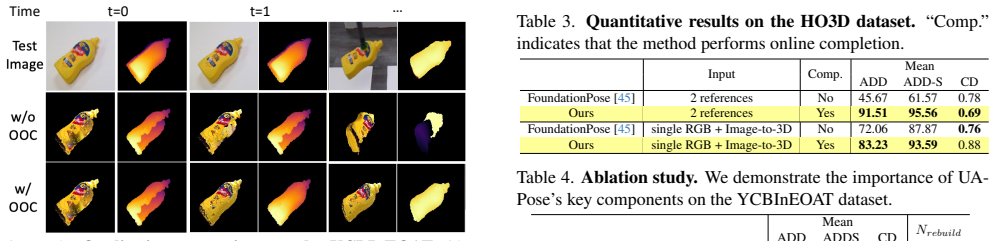
The load-bearing object is the hybrid representation M=(E,U): a closed mesh extracted from a neural signed distance field learned from whatever partial references exist, decorated with a per-vertex binary uncertainty map marking seen and unseen regions. Its work is to ground three decisions in one geometric signal: render the certain region, measure seen IoU against the test mask, and use the result to reject unreliable pose hypotheses, to filter which frames enter the memory pool, and to trigger uncertainty-aware sampling for online SDF retraining when the model's seen part stops explaining the observation.
What would settle it
Give the method two randomly chosen reference images per object (not manually selected to cover the first test frame) on all YCBInEOAT sequences and report MeanADD per sequence; if the gap to FoundationPose collapses or completion triggers on almost every frame, the manual selection is carrying the claimed improvement. A comparable test corrupts the off-the-shelf test masks by dilating or eroding them and checks whether the seen-IoU gate still tracks true pose accuracy.
Extended reading notes
Core claim
The paper's claim is that uncertainty is the missing ingredient for pose estimation from partial references. It represents the object as a hybrid mesh M=(E,U), where E is a closed surface extracted by marching cubes from a neural SDF trained on the reference images, and U labels every vertex seen in any reference as certain and every other vertex as uncertain. From this representation it computes seen IoU—the intersection over union of the rendered certain region with the test object mask—and uses that single number to filter pose hypotheses, admit frames into the memory pool, and decide when to retrain the SDF online. On YCBInEOAT with two posed RGBD references, MeanADD reaches 89.99 versus 68.52 for FoundationPose; on HO3D with a single unposed RGB image, it reaches 83.23 versus 72.06.
Load-bearing premise
The load-bearing premise is that the reference images are chosen so that the first test frame's viewpoint is already covered by the model's 'seen' region, and that the off-the-shelf segmentation masks are accurate; if references are random or masks are wrong, the seen-IoU signal that drives filtering and completion loses its meaning.
Editorial extensions
If this is right
- With two posed RGBD references, the pipeline no longer needs a full CAD model or 16 dense views; on YCBInEOAT MeanADD improves from 68.52 to 89.99.
- A single unposed RGB image suffices as a reference when paired with an image-to-3D generator; on HO3D ADD-AUC reaches 83.23 versus 72.06 for the baseline.
- Object completion runs only when the seen-IoU confidence drops below a threshold, keeping most frames at refinement speed under 0.02 seconds and cutting the number of rebuilds from 181 to 58 in the ablation.
- Frames whose seen IoU is low are kept out of the memory pool, preventing noisy SDF training from corrupted pose estimates.
- The uncertainty label also lets synthesized image-to-3D renderings supervise only the unseen parts of the object, avoiding conflicting supervision in regions already covered by real frames.
Reading between the lines
- The seen-IoU gate is a transferable mechanism: the same signal could be glued onto other render-and-compare trackers without retraining their refinement networks, since it only needs a rendered certain mask and a test mask.
- The paper's protocol chooses reference images that cover the first test frame and evaluates single-RGB YCB-Video on a four-object subset; a fair stress test would use random reference pairs and the full object set, since the reported gap may partly reflect favorable coverage rather than the method alone.
- The uncertainty map could double as an active-viewpoint planner: a robot could aim its next observation at the mesh region with the highest concentration of unseen vertices, turning completion into a deliberate exploration policy.
Editorial analysis
A structured set of objections, weighed in public.
Referee Report
Summary. UA-Pose proposes an uncertainty-aware 6D object pose estimation method for partial reference inputs. The method builds a hybrid object representation that combines a neural-SDF-derived mesh with a vertex-level uncertainty map labeling seen and unseen regions, uses a seen-IoU metric to filter pose hypotheses and gate an online object completion loop, and optionally leverages a single-image-to-3D model when only one unposed RGB image is available. The authors evaluate on YCB-Video, YCBInEOAT, and HO3D, reporting large gains over FoundationPose in the two-reference RGBD setting and in the single-RGB image-to-3D setting, with ablations showing that removing the completion loop, uncertainty-aware completion triggering, image filtering, or uncertainty-aware sampling degrades performance.
Significance. If validated, the paper makes a useful practical contribution: it extends a strong model-free pose estimator to settings where only two posed RGBD references or a single unposed RGB image are available, and it introduces a simple, interpretable uncertainty signal that demonstrably reduces the number of costly online reconstructions. The internal ablations are consistent with the claimed mechanism, and the uncertainty-aware sampling strategy is clearly described and cheap to compute. However, the evaluation protocol currently contains several load-bearing threats: manually selected references that cover the first test frame, a possibly degraded FoundationPose checkpoint, curated subsets and excluded sequences in key experiments, and a test-time-adaptation design whose gains are not compared against a non-uncertainty online-completion baseline. The significance of the headline claim therefore depends on whether these protocol issues are resolved.
major comments (4)
- [Supplementary B] The protocol for selecting the two RGBD references is load-bearing because Table 4 shows that the entire gain over FoundationPose is attributable to the online completion loop (68.52 to 89.99 MeanADD), and that loop is initialized from these references. The manual selection 'to ensure that the first frame of the test images is covered by the selected references' gives UA-Pose a near-oracle starting viewpoint; under random or adversarial partial references, the memory pool and completion trigger would behave differently. Please report results averaged over random reference pairs (or over all pairs in S) with standard deviations, and state explicitly whether the first-frame coverage condition is necessary for the claimed improvement.
- [Supplementary A] The note that the FoundationPose checkpoint used for the baseline 'was not trained on diffusion-augmented data, which may lead to performance degradation compared to the expected results reported in [45]' is a direct threat to the headline comparison. Since all central tables (Tables 1-3) compare against this checkpoint, the reported margins could be inflated. Please either use a checkpoint that reproduces the published FoundationPose numbers, quantify the degradation on the present benchmarks, or clearly label every baseline number as coming from a possibly degraded checkpoint; without this, the claimed 'significant performance improvements' are not fully supportable.
- [Supplementary E and Supplementary B] The evaluation restricts the YCB-Video single-RGB experiment to a curated 4-object subset and excludes the 'tomato soup can' sequence from Figure 9 due to pose-estimation failures. Such exclusions are acceptable only if they are disclosed prominently in the main paper and accompanied by results on the full set; as written, the main-text claim of 'significant performance improvements over existing methods' is not demonstrated for the full benchmark or for arbitrary partial references. Please report full-set numbers, or clearly state in the abstract and conclusion that the claim is limited to the curated subset and to sequences without known failure modes.
- [Table 4] The ablation shows that 'w/o object completion' exactly reproduces the FoundationPose 2-reference baseline (MeanADD 68.52), and the full method's gain comes from repeatedly retraining the SDF on test frames and re-evaluating on those same frames. This is test-time adaptation. To establish that the uncertainty-aware gating, filtering, and sampling are the cause of the gain, the comparison needs a strong non-uncertainty baseline that also performs online completion under the same protocol (for example, completion triggered by geodesic distance only, with no seen-IoU filter), and ideally a per-frame breakdown of accuracy before versus after each completion event. Without that, the central claim conflates 'online completion helps' with 'uncertainty-aware completion is what helps.'
minor comments (6)
- [Sections 3.3 and 3.4] The headings contain the typo 'Uncentainty-aware'; please correct them to 'Uncertainty-aware'.
- [Equation (8)] Equation (8) is typeset incorrectly: the fraction bar is missing and the denominator expression is ambiguous; please define the pixel-count operator P explicitly and rewrite the formula as a fraction.
- [Tables 1-3] Chamfer Distance values are reported without units; please state the unit (centimeters) consistently in the table captions or in a common note.
- [Table 3] In the single-RGB row, the CD of UA-Pose (0.88) is worse than FoundationPose (0.76) while ADD/ADD-S are better; the text explains texture issues, but the caption or text should state explicitly that CD and pose accuracy are not expected to move together in this comparison.
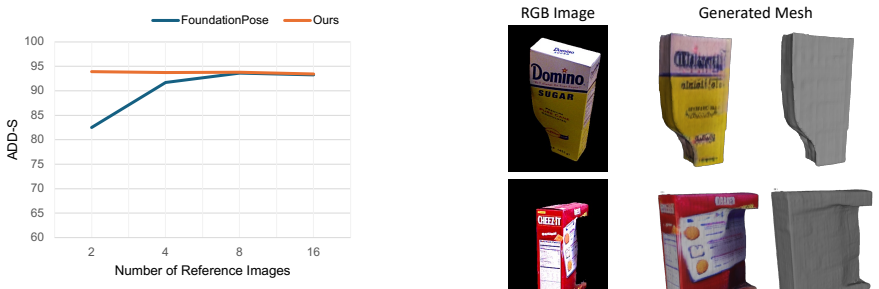
- [Figure 9] The y-axis of Figure 9 starts near 60 and the 'tomato soup can' exclusion is only discussed in the supplementary; please either show the full plot or mark the excluded sequence and its effect in the main text.
- [Supplementary A.2] Several thresholds (Tu, Ts, Tconf, Tcomplete, Tgeo, Tgen) are listed, but no sensitivity analysis is reported; a small study varying Tcomplete, which directly controls the completion trigger, would strengthen the claim that the results are not sensitive to threshold choices.
Circularity Check
No significant circularity: UA-Pose's reported gains come from a test-time completion loop evaluated against external baselines, and the paper's ablations isolate the contribution rather than hiding it.
full rationale
UA-Pose is an empirical system, not a derivation, and I found no step in which a predicted quantity is defined in terms of itself or in which a fitted parameter is renamed as a prediction. The uncertainty map (Sec. 3.2.2) is defined by projecting reference or memory-pool masks onto a mesh, and the seen-IoU metric (Eq. 9) is then used as a pose-confidence filter; this is a feedback control loop, but the pose hypotheses are produced by the external pretrained refinement and selection modules of FoundationPose [45], so the confidence metric does not by construction determine the reported ADD and ADD-S numbers. Table 4's 'w/o object completion' row exactly matches the FoundationPose 2-reference baseline, which is a sanity check showing that the ablation isolates the completion effect rather than obscuring it. The citations to [44, 45, 47] are external prior work with no author overlap with the submitted paper, so no load-bearing self-citation chain exists. The manual 2-reference selection (Supp. B) and the 4-object YCB-Video subset are evaluation-protocol choices that affect generalizability and external validity, but they do not make the method's outputs equivalent to its inputs. Consequently, the paper is self-contained with respect to circularity and scores 0.
Assumptions & free parameters
free parameters (8)
- Tu, Ts =
0.5, 0.5
- Tconf =
0.5
- Tcomplete =
0.7
- Tgeo =
10 degrees
- K (memory pool size) =
30
- Nv, Nin =
42, 12
- Scaling factor set S =
{0.8, ..., 1.2}, |S|=11
- Tgen =
45 degrees
assumptions (5)
- domain assumption Test frames are a sequential video of the same object with known camera intrinsics.
- domain assumption Per-frame 2D object masks from the off-the-shelf segmenter are accurate enough that seen IoU is meaningful.
- domain assumption FoundationPose's pretrained pose refinement and selection networks transfer to incomplete and generated 3D models.
- domain assumption Visual-hull style visibility from 2D masks correctly separates seen from unseen mesh vertices.
- standard math Marching cubes on the trained SDF yields a closed surface that supports rendering and visibility checks.
Cite this review
Pith. "Pith review of UA-Pose: Uncertainty-Aware 6D Object Pose Estimation and Online Object Completion with Partial References." pith.science (2026). https://pith.science/paper/LW7WBZ7H
@misc{pith2026250607996,
  author       = {Pith},
  title        = {Pith review of: UA-Pose: Uncertainty-Aware 6D Object Pose Estimation and Online Object Completion with Partial References},
  year         = {2026},
  howpublished = {\url{https://pith.science/paper/LW7WBZ7H}},
  note         = {Machine review of arXiv:2506.07996}
}
read the original abstract
6D object pose estimation has shown strong generalizability to novel objects. However, existing methods often require either a complete, well-reconstructed 3D model or numerous reference images that fully cover the object. Estimating 6D poses from partial references, which capture only fragments of an object's appearance and geometry, remains challenging. To address this, we propose UA-Pose, an uncertainty-aware approach for 6D object pose estimation and online object completion specifically designed for partial references. We assume access to either (1) a limited set of RGBD images with known poses or (2) a single 2D image. For the first case, we initialize a partial object 3D model based on the provided images and poses, while for the second, we use image-to-3D techniques to generate an initial object 3D model. Our method integrates uncertainty into the incomplete 3D model, distinguishing between seen and unseen regions. This uncertainty enables confidence assessment in pose estimation and guides an uncertainty-aware sampling strategy for online object completion, enhancing robustness in pose estimation accuracy and improving object completeness. We evaluate our method on the YCB-Video, YCBInEOAT, and HO3D datasets, including RGBD sequences of YCB objects manipulated by robots and human hands. Experimental results demonstrate significant performance improvements over existing methods, particularly when object observations are incomplete or partially captured. Project page: https://minfenli.github.io/UA-Pose/
Figures


Figures from the paper (7 more)




Reference graph
Works this paper leans on
-
[45]
Foundationpose: Unified 6d pose estimation and tracking of novel objects.CVPR, 2024
Bowen Wen, Wei Yang, Jan Kautz, and Stan Birchfield. Foundationpose: Unified 6d pose estimation and tracking of novel objects.CVPR, 2024. 1, 2, 3, 4, 5, 6, 7, 8, 11, 12, 13, 14, 15
work page 2024
-
[1]
Zs6d: Zero-shot 6d object pose estimation using vision transformers.ICRA,
Philipp Ausserlechner, David Haberger, Stefan Thalhammer, Jean-Baptiste Weibel, and Markus Vincze. Zs6d: Zero-shot 6d object pose estimation using vision transformers.ICRA,
-
[2]
Andrea Caraffa, Davide Boscaini, Amir Hamza, and Fabio Poiesi. Freeze: Training-free zero-shot 6d pose estimation with geometric and vision foundation models.ECCV, 2024. 1, 2
work page 2024
-
[3]
Learn- ing canonical shape space for category-level 6D object pose and size estimation
Dengsheng Chen, Jun Li, Zheng Wang, and Kai Xu. Learn- ing canonical shape space for category-level 6D object pose and size estimation. InCVPR, 2020. 2
work page 2020
-
[4]
Zeropose: Cad- prompted zero-shot object 6d pose estimation in cluttered scenes.TCSVT, 2024
Jianqiu Chen, Zikun Zhou, Mingshan Sun, Rui Zhao, Li- wei Wu, Tianpeng Bao, and Zhenyu He. Zeropose: Cad- prompted zero-shot object 6d pose estimation in cluttered scenes.TCSVT, 2024. 1
work page 2024
-
[5]
Implicit geometric regularization for learning shapes
Amos Gropp, Lior Yariv, Niv Haim, Matan Atzmon, and Yaron Lipman. Implicit geometric regularization for learning shapes. InICML, 2020. 4
work page 2020
-
[6]
Honnotate: A method for 3d annotation of hand and object poses
Shreyas Hampali, Mahdi Rad, Markus Oberweger, and Vin- cent Lepetit. Honnotate: A method for 3d annotation of hand and object poses. InCVPR, 2020. 7
work page 2020
-
[7]
OnePose++: Keypoint-free one- shot object pose estimation without CAD models.NeurIPS,
Xingyi He, Jiaming Sun, Yuang Wang, Di Huang, Hujun Bao, and Xiaowei Zhou. OnePose++: Keypoint-free one- shot object pose estimation without CAD models.NeurIPS,
Show all 54 references
-
[8]
PVN3D: A deep point-wise 3D keypoints voting network for 6DoF pose estimation
Yisheng He, Wei Sun, Haibin Huang, Jianran Liu, Haoqiang Fan, and Jian Sun. PVN3D: A deep point-wise 3D keypoints voting network for 6DoF pose estimation. InCVPR, 2020. 2
2020
-
[9]
FFB6D: A full flow bidirectional fusion network for 6D pose estimation
Yisheng He, Haibin Huang, Haoqiang Fan, Qifeng Chen, and Jian Sun. FFB6D: A full flow bidirectional fusion network for 6D pose estimation. InCVPR, 2021. 2
2021
-
[10]
Fs6d: Few-shot 6d pose estimation of novel objects
Yisheng He, Yao Wang, Haoqiang Fan, Jian Sun, and Qifeng Chen. Fs6d: Few-shot 6d pose estimation of novel objects. InCVPR, 2022. 1, 2, 7
2022
-
[11]
Matchu: Matching unseen objects for 6d pose estimation from rgb-d images
Junwen Huang, Hao Yu, Kuan-Ting Yu, Nassir Navab, Slo- bodan Ilic, and Benjamin Busam. Matchu: Matching unseen objects for 6d pose estimation from rgb-d images. InCVPR,
-
[12]
Accelerating 3d deep learning with pytorch3d
Justin Johnson, Nikhila Ravi, Jeremy Reizenstein, David Novotny, Shubham Tulsiani, Christoph Lassner, and Steve Branson. Accelerating 3d deep learning with pytorch3d. In SIGGRAPH. 2020. 11
2020
-
[13]
CosyPose: Consistent multi-view multi-object 6D pose estimation
Yann Labb ´e, Justin Carpentier, Mathieu Aubry, and Josef Sivic. CosyPose: Consistent multi-view multi-object 6D pose estimation. InECCV, 2020. 2
2020
-
[14]
MegaPose: 6D pose estimation of novel objects via render & compare
Yann Labb ´e, Lucas Manuelli, Arsalan Mousavian, Stephen Tyree, Stan Birchfield, Jonathan Tremblay, Justin Carpentier, Mathieu Aubry, Dieter Fox, and Josef Sivic. MegaPose: 6D pose estimation of novel objects via render & compare. In CoRL, 2022. 1, 2
2022
-
[15]
Modular primitives for high-performance differentiable rendering.TOG, 2020
Samuli Laine, Janne Hellsten, Tero Karras, Yeongho Seol, Jaakko Lehtinen, and Timo Aila. Modular primitives for high-performance differentiable rendering.TOG, 2020. 11
2020
-
[16]
The visual hull concept for silhouette-based image understanding.IEEE TPAMI, 1994
Aldo Laurentini. The visual hull concept for silhouette-based image understanding.IEEE TPAMI, 1994. 3
1994
-
[17]
TTA-COPE: Test-time adaptation for category-level object pose estimation
Taeyeop Lee, Jonathan Tremblay, Valts Blukis, Bowen Wen, Byeong-Uk Lee, Inkyu Shin, Stan Birchfield, In So Kweon, and Kuk-Jin Yoon. TTA-COPE: Test-time adaptation for category-level object pose estimation. InCVPR, 2023. 2
2023
-
[18]
Sam-6d: Segment anything model meets zero-shot 6d object pose es- timation
Jiehong Lin, Lihua Liu, Dekun Lu, and Kui Jia. Sam-6d: Segment anything model meets zero-shot 6d object pose es- timation. InCVPR, 2024. 1, 2
2024
-
[19]
Robotic continuous grasping system by shape transformer- guided multi-object category-level 6d pose estimation.IEEE Transactions on Industrial Informatics, 2023
Jian Liu, Wei Sun, Chongpei Liu, Xing Zhang, and Qiang Fu. Robotic continuous grasping system by shape transformer- guided multi-object category-level 6d pose estimation.IEEE Transactions on Industrial Informatics, 2023. 1
2023
-
[20]
Zero-1-to-3: Zero-shot one image to 3d object
Ruoshi Liu, Rundi Wu, Basile Van Hoorick, Pavel Tok- makov, Sergey Zakharov, and Carl V ondrick. Zero-1-to-3: Zero-shot one image to 3d object. InICCV, 2023. 3
2023
-
[21]
Gen6D: Generalizable model-free 6-DoF object pose estimation from RGB images
Yuan Liu, Yilin Wen, Sida Peng, Cheng Lin, Xiaoxiao Long, Taku Komura, and Wenping Wang. Gen6D: Generalizable model-free 6-DoF object pose estimation from RGB images. ECCV, 2022. 1, 2
2022
-
[22]
Syncdreamer: Learning to generate multiview-consistent images from a single-view image.ICLR, 2024
Yuan Liu, Cheng Lin, Zijiao Zeng, Xiaoxiao Long, Lingjie Liu, Taku Komura, and Wenping Wang. Syncdreamer: Learning to generate multiview-consistent images from a single-view image.ICLR, 2024. 3
2024
-
[23]
Wonder3d: Single image to 3d using cross-domain diffusion
Xiaoxiao Long, Yuan-Chen Guo, Cheng Lin, Yuan Liu, Zhiyang Dou, Lingjie Liu, Yuexin Ma, Song-Hai Zhang, Marc Habermann, Christian Theobalt, and Wenping Wang. Wonder3d: Single image to 3d using cross-domain diffusion. CVPR, 2024. 3, 13
2024
-
[24]
Pose estimation for augmented reality: A hands-on survey
Eric Marchand, Hideaki Uchiyama, and Fabien Spindler. Pose estimation for augmented reality: A hands-on survey. TVCG, 2015. 1
2015
-
[25]
Instant neural graphics primitives with a multires- olution hash encoding.TOG, 2022
Thomas M ¨uller, Alex Evans, Christoph Schied, and Alexan- der Keller. Instant neural graphics primitives with a multires- olution hash encoding.TOG, 2022. 11, 12
2022
-
[26]
Gigapose: Fast and robust novel object pose estimation via one correspondence.CVPR, 2024
Van Nguyen Nguyen, Thibault Groueix, Mathieu Salzmann, and Vincent Lepetit. Gigapose: Fast and robust novel object pose estimation via one correspondence.CVPR, 2024. 1, 3, 13
2024
-
[27]
Found- pose: Unseen object pose estimation with foundation fea- tures.ECCV, 2024
Evin Pınar ¨Ornek, Yann Labb ´e, Bugra Tekin, Lingni Ma, Cem Keskin, Christian Forster, and Tomas Hodan. Found- pose: Unseen object pose estimation with foundation fea- tures.ECCV, 2024. 1, 15
2024
-
[28]
Pix2Pose: Pixel-wise coordinate regression of objects for 6D pose esti- mation
Kiru Park, Timothy Patten, and Markus Vincze. Pix2Pose: Pixel-wise coordinate regression of objects for 6D pose esti- mation. InICCV, 2019. 2
2019
-
[29]
Magic123: One image to high-quality 3d object generation using both 2d and 3d diffusion priors.ICLR,
Guocheng Qian, Jinjie Mai, Abdullah Hamdi, Jian Ren, Aliaksandr Siarohin, Bing Li, Hsin-Ying Lee, Ivan Sko- rokhodov, Peter Wonka, Sergey Tulyakov, and Bernard Ghanem. Magic123: One image to high-quality 3d object generation using both 2d and 3d diffusion priors.ICLR,
-
[30]
Kornia: an open source differentiable computer vision library for pytorch
Edgar Riba, Dmytro Mishkin, Daniel Ponsa, Ethan Rublee, and Gary Bradski. Kornia: an open source differentiable computer vision library for pytorch. InWACV, 2020. 11
2020
-
[31]
Zero123++: a single image to consistent multi-view dif- fusion base model.arXiv preprint arXiv:2310.15110, 2023
Ruoxi Shi, Hansheng Chen, Zhuoyang Zhang, Minghua Liu, Chao Xu, Xinyue Wei, Linghao Chen, Chong Zeng, and Hao Su. Zero123++: a single image to consistent multi-view dif- fusion base model.arXiv preprint arXiv:2310.15110, 2023. 3
-
[32]
OSOP: A multi-stage one shot object pose estimation frame- work
Ivan Shugurov, Fu Li, Benjamin Busam, and Slobodan Ilic. OSOP: A multi-stage one shot object pose estimation frame- work. InCVPR, 2022. 1, 2
2022
-
[33]
Deep multi-state object pose estimation for augmented reality assembly
Yongzhi Su, Jason Rambach, Nareg Minaskan, Paul Lesur, Alain Pagani, and Didier Stricker. Deep multi-state object pose estimation for augmented reality assembly. InISMAR- Adjunct, 2019. 1
2019
-
[34]
Loftr: Detector-free local feature matching with transformers
Jiaming Sun, Zehong Shen, Yuang Wang, Hujun Bao, and Xiaowei Zhou. Loftr: Detector-free local feature matching with transformers. InCVPR, 2021. 7
2021
-
[35]
OnePose: One-shot object pose estimation without CAD models
Jiaming Sun, Zihao Wang, Siyu Zhang, Xingyi He, Hongcheng Zhao, Guofeng Zhang, and Xiaowei Zhou. OnePose: One-shot object pose estimation without CAD models. InCVPR, 2022. 1, 2
2022
-
[36]
Shape prior deformation for categorical 6D object pose and size estima- tion
Meng Tian, Marcelo H Ang, and Gim Hee Lee. Shape prior deformation for categorical 6D object pose and size estima- tion. InECCV, 2020. 2
2020
-
[37]
Sv3d: Novel multi-view syn- thesis and 3d generation from a single image using latent video diffusion
Vikram V oleti, Chun-Han Yao, Mark Boss, Adam Letts, David Pankratz, Dmitry Tochilkin, Christian Laforte, Robin Rombach, and Varun Jampani. Sv3d: Novel multi-view syn- thesis and 3d generation from a single image using latent video diffusion. InECCV, 2025. 3
2025
-
[38]
Normalized object coordinate space for category-level 6D object pose and size estimation
He Wang, Srinath Sridhar, Jingwei Huang, Julien Valentin, Shuran Song, and Leonidas J Guibas. Normalized object coordinate space for category-level 6D object pose and size estimation. InCVPR, 2019. 2
2019
-
[39]
NeuS: Learning neural im- plicit surfaces by volume rendering for multi-view recon- struction
Peng Wang, Lingjie Liu, Yuan Liu, Christian Theobalt, Taku Komura, and Wenping Wang. NeuS: Learning neural im- plicit surfaces by volume rendering for multi-view recon- struction. InNeurIPS, 2021. 4
2021
-
[40]
Bundletrack: 6d pose track- ing for novel objects without instance or category-level 3d models
Bowen Wen and Kostas Bekris. Bundletrack: 6d pose track- ing for novel objects without instance or category-level 3d models. InIROS, 2021. 3, 8
2021
-
[41]
se (3)-tracknet: Data-driven 6d pose tracking by cali- brating image residuals in synthetic domains
Bowen Wen, Chaitanya Mitash, Baozhang Ren, and Kostas E Bekris. se (3)-tracknet: Data-driven 6d pose tracking by cali- brating image residuals in synthetic domains. InIROS, 2020. 7, 14
2020
-
[42]
CatGrasp: Learning category-level task-relevant grasping in clutter from simulation
Bowen Wen, Wenzhao Lian, Kostas Bekris, and Stefan Schaal. CatGrasp: Learning category-level task-relevant grasping in clutter from simulation. InICRA, 2022. 1
2022
-
[43]
You only demonstrate once: Category-level manip- ulation from single visual demonstration.RSS, 2022
Bowen Wen, Wenzhao Lian, Kostas Bekris, and Stefan Schaal. You only demonstrate once: Category-level manip- ulation from single visual demonstration.RSS, 2022. 1
2022
-
[44]
Bundlesdf: Neural 6-dof tracking and 3d reconstruction of unknown objects
Bowen Wen, Jonathan Tremblay, Valts Blukis, Stephen Tyree, Thomas M ¨uller, Alex Evans, Dieter Fox, Jan Kautz, and Stan Birchfield. Bundlesdf: Neural 6-dof tracking and 3d reconstruction of unknown objects. InCVPR, 2023. 3, 4, 7, 8, 11
2023
-
[46]
Posecnn: A convolutional neural network for 6d object pose estimation in cluttered scenes.RSS, 2018
Yu Xiang, Tanner Schmidt, Venkatraman Narayanan, and Dieter Fox. Posecnn: A convolutional neural network for 6d object pose estimation in cluttered scenes.RSS, 2018. 7, 11, 12
2018
-
[47]
Instantmesh: Efficient 3d mesh generation from a single image with sparse-view large reconstruction models.arXiv preprint arXiv:2404.07191,
Jiale Xu, Weihao Cheng, Yiming Gao, Xintao Wang, Shenghua Gao, and Ying Shan. Instantmesh: Efficient 3d mesh generation from a single image with sparse-view large reconstruction models.arXiv preprint arXiv:2404.07191,
-
[48]
Track anything: Segment anything meets videos.arXiv preprint arXiv:2304.11968, 2023
Jinyu Yang, Mingqi Gao, Zhe Li, Shang Gao, Fangjing Wang, and Feng Zheng. Track anything: Segment anything meets videos.arXiv preprint arXiv:2304.11968, 2023. 5, 11
2023 arXiv
-
[49]
Multiview neu- ral surface reconstruction by disentangling geometry and ap- pearance.NeurIPS, 2020
Lior Yariv, Yoni Kasten, Dror Moran, Meirav Galun, Matan Atzmon, Basri Ronen, and Yaron Lipman. Multiview neu- ral surface reconstruction by disentangling geometry and ap- pearance.NeurIPS, 2020. 3, 4
2020
-
[50]
SSP-Pose: Symmetry-aware shape prior deformation for direct category-level object pose estimation
Ruida Zhang, Yan Di, Fabian Manhardt, Federico Tombari, and Xiangyang Ji. SSP-Pose: Symmetry-aware shape prior deformation for direct category-level object pose estimation. InIROS, 2022. 2
2022
-
[51]
HS-Pose: Hybrid scope feature extraction for category-level object pose estimation
Linfang Zheng, Chen Wang, Yinghan Sun, Esha Dasgupta, Hua Chen, Ale ˇs Leonardis, Wei Zhang, and Hyung Jin Chang. HS-Pose: Hybrid scope feature extraction for category-level object pose estimation. InCVPR, 2023. 2
2023
-
[52]
Nice-slam: Neural implicit scalable encoding for slam
Zihan Zhu, Songyou Peng, Viktor Larsson, Weiwei Xu, Hu- jun Bao, Zhaopeng Cui, Martin R Oswald, and Marc Polle- feys. Nice-slam: Neural implicit scalable encoding for slam. InCVPR, 2022. 8
2022
-
[53]
single RGB + Image-to-3D
Chungang Zhuang, Shaofei Li, and Han Ding. Instance segmentation based 6d pose estimation of industrial objects using point clouds for robotic bin-picking.Robotics and Computer-Integrated Manufacturing, 2023. 1 Supplementary Materials A. Implementation Details The object image...
2023
-
[2024]
3, 7, 11, 12, 13, 14
Reviewed August 7, 2026 · model on record in the stance chip above.
Discussion (0). Sign in to comment.