REVIEW 4 major objections 5 minor 19 references
BG-HOP: A Bimanual Generative Hand-Object Prior
T0 review · 4 major / 5 minor · reviewed 2026-08-07 · deepseek-v4-flash
Pith's one-line read BG-HOP is a generative prior that models the joint distribution of two hands and an object by extending the single-hand G-HOP representation with two interaction grids in a shared coordinate frame.
desk verdict An honest baseline that extends G-HOP to two hands, but the Procrustes inversion is untested and the 'first generative prior' framing overshoots. read the letter →
The pith
A machine-rendered reading of the paper's core claim, the machinery that carries it, and where it could break.
The reading
What carries the argument
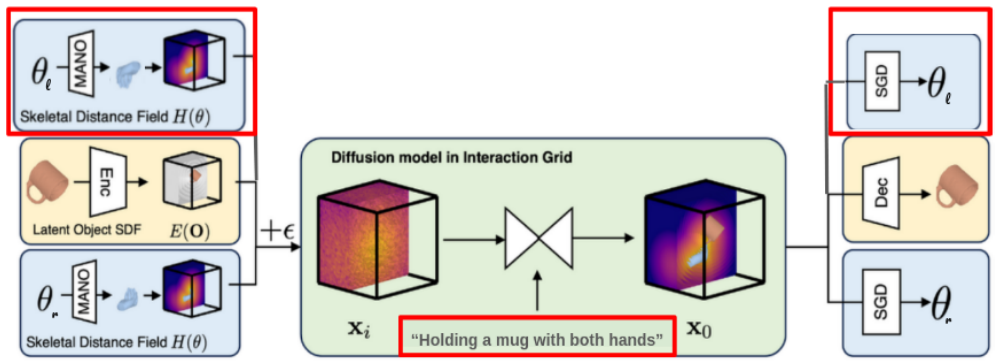
The load-bearing object is the three-tuple input—object SDF latent plus two hand interaction grids—computed in the normalized right-hand coordinate frame, so that a single diffusion model can learn the joint distribution $p(O, H_l, H_r \mid C)$. An interaction grid is an $n$-channel volumetric grid whose cells store distances to a hand's joints; in this design the right-hand grid encodes articulation, while the left-hand grid must encode both its articulation and its pose relative to the right hand. Because naively optimizing pose and articulation together is ill-posed, the paper introduces a Procrustes alignment step: extract, for each of 20 joints, the grid cell coordinate where the predicted distance is minimized, match those coordinates to a neutral hand pose, and solve for the rigid transform $R|t$; articulation is then optimized by gradient descent as in the single-hand case. This two-stage recovery is the mechanism that makes the left hand invertible from the shared-frame grid. For grasp synthesis the same prior is used as a score function in Score Distillation Sampling, optimizing four parameter sets jointly.
What would settle it
On held-out ARCTIC frames, decode left-hand grids with the proposed Procrustes-plus-articulation recovery and compare the recovered left-hand pose and articulation against ground truth; if the left-hand relative pose error is no better than a random-pose baseline while the right-hand is accurate, the grid does not encode the inter-hand relationship and the central claim fails. A simpler version: replace the left-hand grid in a generated sample with the grid of the same articulation but a different relative pose; if the model generates the same left-hand configuration, the representation has not captured pose.
Extended reading notes
Core claim
The central claim is that bimanual hand-object interaction can be modeled by a diffusion prior over a shared representation: the object is compressed into an SDF latent by a pre-trained VQ-VAE, and each hand is represented by an interaction grid of per-cell joint distances. Because bimanual data is scarce, the model is not trained from scratch but initialized from G-HOP and fine-tuned end-to-end on bimanual frames extracted from the ARCTIC dataset. At sampling time, the right hand is recovered by optimizing MANO parameters against its grid, while the left hand is recovered in two stages: a Procrustes alignment extracts the rigid transform from predicted grid-cell coordinates, then gradient descent recovers left-hand articulation. For grasp synthesis, the object and both hands are initialized and optimized through Score Distillation Sampling over four parameter sets: the two articulations, the object-to-right-hand transform, and the left-to-right-hand transform. The paper's evidence is qualitative and preliminary: samples show meaningful object geometry and right-hand grasps, but the left hand often intersects the object or floats, and novel object categories do not generalize.
Load-bearing premise
The load-bearing premise is that two interaction grids computed in the right-hand coordinate frame, stacked with the object's SDF latent, encode enough of each hand's articulation and of the left hand's pose relative to the right hand that a diffusion model can learn the bimanual distribution and a Procrustes step can recover the left hand's pose from the predicted grid.
Editorial extensions
If this is right
- Downstream bimanual grasp synthesis and interaction reconstruction get a generative baseline that models the joint distribution of hands and object, rather than task-specific solvers.
- The transfer-learning recipe—initialize from a single-hand prior, adapt the input/output layers, then fine-tune end-to-end—becomes a viable path for training bimanual models under data scarcity.
- The Procrustes decoupling of relative pose from articulation is a reusable mechanism for grid-based hand generation when a hand is represented in another hand's coordinate frame.
- The documented failure modes define the next targets: left-hand coordination and generalization to object categories outside the training distribution must be solved before the prior is broadly useful.
- SDS-based test-time optimization over both hands and object can synthesize grasps on object meshes, including objects unseen during bimanual fine-tuning.
Reading between the lines
- Editorial: a direct test of the representation would be to replace the left-hand grid with a grid computed in the left-hand's own frame plus an explicit relative transform; if that variant improves left-hand pose without other changes, the shared-frame encoding is the bottleneck.
- Editorial: because semi-frozen adaptation failed while full fine-tuning helped, the pretrained intermediate features need substantial rewiring; a parameter-efficient fine-tuning method that updates more than the new layers, such as low-rank adapters, may achieve similar gains with less data.
- Editorial: the novel-object failure suggests the object SDF latent is tied to object categories seen during pretraining; conditioning the prior on object geometry rather than text category alone could be a more general route.
- Editorial: a quantitative evaluation on held-out ARCTIC frames—measuring left-hand pose error against ground truth—would turn the qualitative left-hand failures into a measurable target and would be a natural next experiment.
Editorial analysis
A structured set of objections, weighed in public.
Referee Report
Summary. The paper proposes BG-HOP, a bimanual generative hand-object prior obtained by extending the single-hand G-HOP framework. The model is conditioned on an object category text prompt and represents an object as a VQ-VAE-compressed SDF latent together with two interaction grids computed in the right-hand coordinate frame; a diffusion model denoises this three-tuple representation. For sampling, the left-hand articulation and its pose relative to the right hand are recovered in two stages: first a Procrustes alignment on per-joint distance-field minima, then gradient-descent articulation optimization. The paper also presents a bimanual grasp-synthesis method based on Score Distillation Sampling over both hand articulations and the two relative transforms. The model is trained on a preprocessed subset of ARCTIC with three transfer-learning variants: from scratch, semi-frozen, and full fine-tuning. Experiments are qualitative only, showing that the right hand and object are often plausible but the left hand frequently intersects the object or floats, and that generalization to unseen object categories fails.
Significance. If the central claim is substantiated, BG-HOP would be a useful first generative baseline for bimanual hand-object interaction, and the transfer-learning recipe from single-hand priors is a plausible response to data scarcity. The paper honestly reports its main failure modes and makes code and models publicly available, which is commendable for reproducibility. However, the significance as stated in the title and introduction—'the first generative prior' that 'captures the joint distribution of hands and objects'—is currently supported only by qualitative figures and a few qualitative observations. The load-bearing Procrustes inversion is never validated in isolation, and the evaluation does not include any quantitative metric. The contribution is therefore best viewed as a promising preliminary study whose significance would be much stronger with a quantitative evaluation on a held-out split and with an explicit comparison to the cited bimanual synthesis baselines.
major comments (4)
- [§4.2 and §4.3, Fig. 3] The evaluation is entirely qualitative. There are no metrics, error bars, ablations, or held-out quantitative results. The abstract and introduction claim that BG-HOP 'captures the joint distribution of hands and objects,' but the only evidence is a small set of rendered samples. To support the central claim, the authors should report quantitative measures on a held-out ARCTIC test split—for example, contact coverage, penetration depth, per-joint pose error for both hands, relative pose error between hands, and a sample-quality metric such as FID or coverage over interaction grids. The grasp-synthesis results in Fig. 3 (Right) should similarly be evaluated with contact and penetration metrics across many initializations, not just shown for a few iterations.
- [§3.2, Procrustes alignment] The paper's critical technical assumption is that the left-hand interaction grid computed in the right-hand coordinate frame encodes both articulation and relative pose, and that the Procrustes inversion reliably recovers that pose. This assumption is acknowledged as a 'critical challenge,' but it is never tested. The authors should provide a direct validation on held-out ARCTIC frames: take ground-truth two-hand configurations, compute the left-hand interaction grids, run the Procrustes recovery, and report the resulting relative translation, rotation, and per-joint error. This would isolate whether the observed left-hand failures in Fig. 3 come from the inversion step or from the diffusion model. An ablation replacing Procrustes with end-to-end gradient optimization of both pose and articulation, or using a ground-truth left-hand transform during sampling, would directly identify the bottleneck.
- [§1 and §2, novelty and positioning] The claim that BG-HOP is 'the first generative prior designed for modeling bimanual hand-object interactions' needs precise positioning against the cited bimanual synthesis methods, especially DiffH2O and Text2HOI, which also generate bimanual interactions from object and text inputs. The distinction appears to be that a 'prior' is a single model supporting both generation and reconstruction, but the paper only demonstrates grasp synthesis. Please clarify the formal meaning of 'generative prior' in this context and either demonstrate a second downstream task (e.g., reconstruction from video, which G-HOP supports) or temper the novelty claim to 'first diffusion-based bimanual generative prior trained by transfer from a single-hand prior.'
- [§3.4 and §4.1, data and generalization] The data preprocessing is not fully specified: the contact threshold epsilon and the 'substantial percentage' of vertices in contact are not given numeric values, and the SDF sampling interval over the object's articulation range is not stated. Without these details and without a defined train/validation/test split over the 11 objects, the generalization claim in §4.2—that the model 'fails to generalize to text prompts describing objects outside the training distribution'—cannot be reproduced or verified quantitatively. Please specify the hyperparameters, the exact number of training and evaluation frames, and report generalization performance separately for seen and unseen object categories.
minor comments (5)
- [Abstract] There is a typo: 'presentBG-HOP' should be 'present BG-HOP.'
- [§3.4 and §4.3] The SDS optimization hyperparameters, including learning rates for the four parameter sets, number of optimization steps, and the score-distillation weighting schedule, are not reported; these are needed for reproducibility.
- [Fig. 3] The right panel's ordering 'Iter 0, Iter 500, Iter 1000' makes it look as if the object starts in the right hand and moves to the left; please clarify the initialization (mean articulation and random poses) directly in the caption and caption each column consistently.
- [Reference [12]] The MANO reference is cited as arXiv:2201.02610, but the canonical MANO paper is Romero, Tzionas, and Black, 'Embodied Hands: Modeling and Capturing Hands and Bodies Together,' ACM TOG 2017; please verify the citation.
- [§4.2] The statements that the from-scratch and semi-frozen variants 'fail to converge' would be more informative with training curves (loss vs. iteration) and a few sample outputs for each variant, even if the final qualitative figure is retained.
Circularity Check
No circularity: BG-HOP extends an external single-hand prior (G-HOP) with a new bimanual representation; no prediction reduces to a fitted input or self-citation.
full rationale
The derivation chain is not circular. The model's architecture (Section 3.2) concatenates an object SDF latent with two interaction grids computed in the right-hand coordinate frame; this is a new input representation, not a re-derivation of G-HOP's outputs. The Procrustes alignment used to recover left-hand pose from the predicted grid is a deterministic geometric inversion of the paper's own representation, and while its accuracy is not ablated, that is an empirical validation gap rather than a case of a fitted parameter being renamed a prediction. The only external dependence is G-HOP [17], which is prior work by different authors (Ye et al.) and is used as a pretrained initialization for fine-tuning; this is transfer learning from an independent source, not a self-citation chain. The 'first generative prior' claim is a novelty assertion relative to cited bimanual synthesizers (Text2HOI, DiffH2O, ArtiGrasp), not a circular definition. The paper's own stated limitations (Section 4.2: left-hand intersection or floating, failure to generalize to out-of-distribution objects) are acknowledged empirical weaknesses, not evidence that the reported results are equivalent to the inputs by construction.
Assumptions & free parameters
free parameters (3)
- contact threshold epsilon
- SDF sampling interval over articulation range
- SDS optimization hyperparameters
assumptions (5)
- domain assumption G-HOP's pretrained VQ-VAE SDF latent and interaction grid representation remain suitable for bimanual input.
- domain assumption Score Distillation Sampling approximates likelihood maximization of the learned diffusion prior.
- domain assumption MANO hand parameters can be recovered from predicted interaction grids by gradient descent.
- domain assumption The contact-filtered ARCTIC subset of roughly 20,000 triplets across 11 objects, combined with transfer learning, is sufficient to learn a bimanual prior.
- domain assumption Procrustes alignment on grid-cell minima inverts the left-hand pose from the predicted distance field.
Cite this review
Pith. "Pith review of BG-HOP: A Bimanual Generative Hand-Object Prior." pith.science (2026). https://pith.science/paper/N5ET4VO7
@misc{pith2026250609068,
  author       = {Pith},
  title        = {Pith review of: BG-HOP: A Bimanual Generative Hand-Object Prior},
  year         = {2026},
  howpublished = {\url{https://pith.science/paper/N5ET4VO7}},
  note         = {Machine review of arXiv:2506.09068}
}
read the original abstract
In this work, we present BG-HOP, a generative prior that seeks to model bimanual hand-object interactions in 3D. We address the challenge of limited bimanual interaction data by extending existing single-hand generative priors, demonstrating preliminary results in capturing the joint distribution of hands and objects. Our experiments showcase the model's capability to generate bimanual interactions and synthesize grasps for given objects. We make code and models publicly available.
Figures


Reference graph
Works this paper leans on
-
[1]
Text2hoi: Text-guided 3d motion generation for hand- object interaction
Junuk Cha, Jihyeon Kim, Jae Shin Yoon, and Seungryul Baek. Text2hoi: Text-guided 3d motion generation for hand- object interaction. InProceedings of the IEEE/CVF Con- ference on Computer Vision and Pattern Recognition, pages 1577–1585, 2024. 1
work page 2024
-
[2]
Dexycb: A benchmark for capturing hand grasping of objects
Yu-Wei Chao, Wei Yang, Yu Xiang, Pavlo Molchanov, Ankur Handa, Jonathan Tremblay, Yashraj S Narang, Karl Van Wyk, Umar Iqbal, Stan Birchfield, et al. Dexycb: A benchmark for capturing hand grasping of objects. InPro- ceedings of the IEEE/CVF conference on computer vision and pattern recognition, pages 9044–9053, 2021. 2
work page 2021
-
[3]
Diffh2o: Diffusion-based synthesis of hand-object interactions from textual descriptions
Sammy Christen, Shreyas Hampali, Fadime Sener, Edoardo Remelli, Tomas Hodan, Eric Sauser, Shugao Ma, and Bugra Tekin. Diffh2o: Diffusion-based synthesis of hand-object interactions from textual descriptions. InSIGGRAPH Asia 2024 Conference Papers, pages 1–11, 2024. 1
work page 2024
-
[4]
Ganhand: Predicting human grasp affordances in multi-object scenes
Enric Corona, Albert Pumarola, Guillem Alenya, Francesc Moreno-Noguer, and Gr ´egory Rogez. Ganhand: Predicting human grasp affordances in multi-object scenes. InProceed- ings of the IEEE/CVF conference on computer vision and pattern recognition, pages 5031–5041, 2020. 2
work page 2020
-
[5]
Arctic: A dataset for dexterous bimanual hand- object manipulation
Zicong Fan, Omid Taheri, Dimitrios Tzionas, Muhammed Kocabas, Manuel Kaufmann, Michael J Black, and Otmar Hilliges. Arctic: A dataset for dexterous bimanual hand- object manipulation. InProceedings of the IEEE/CVF Con- ference on Computer Vision and Pattern Recognition, pages 12943–12954, 2023. 2, 3
work page 2023
-
[6]
HOLD: Category-agnostic 3d reconstruction of in- teracting hands and objects from video
Zicong Fan, Maria Parelli, Maria Eleni Kadoglou, Muhammed Kocabas, Xu Chen, Michael J Black, and Otmar Hilliges. HOLD: Category-agnostic 3d reconstruction of in- teracting hands and objects from video. InProceedings of the IEEE/CVF Conference on Computer Vision and Pattern Recognition, pages 494–504, 2024. 2
work page 2024
-
[7]
Rao Fu, Dingxi Zhang, Alex Jiang, Wanjia Fu, Austin Funk, Daniel Ritchie, and Srinath Sridhar. Gigahands: A massive annotated dataset of bimanual hand activities.arXiv preprint arXiv:2412.04244, 2024. 2
arXiv 2024
-
[8]
Denoising dif- fusion probabilistic models.Advances in neural information processing systems, 33:6840–6851, 2020
Jonathan Ho, Ajay Jain, and Pieter Abbeel. Denoising dif- fusion probabilistic models.Advances in neural information processing systems, 33:6840–6851, 2020. 1
2020
Show all 19 references
-
[9]
Hoi4d: A 4d egocentric dataset for category-level human- object interaction
Yunze Liu, Yun Liu, Che Jiang, Kangbo Lyu, Weikang Wan, Hao Shen, Boqiang Liang, Zhoujie Fu, He Wang, and Li Yi. Hoi4d: A 4d egocentric dataset for category-level human- object interaction. InProceedings of the IEEE/CVF Con- ference on Computer Vision and Pattern Recognition, ...
2022
-
[10]
1st place solution to the 8th hands workshop challenge–arctic track: 3dgs-based bimanual category-agnostic interaction reconstruction.arXiv preprint arXiv:2409.19215, 2024
Jeongwan On, Kyeonghwan Gwak, Gunyoung Kang, Hyein Hwang, Soohyun Hwang, Junuk Cha, Jaewook Han, and Seungryul Baek. 1st place solution to the 8th hands workshop challenge–arctic track: 3dgs-based bimanual category-agnostic interaction reconstruction.arXiv preprint arXiv:2409....
2024 arXiv
-
[11]
Dreamfusion: Text-to-3d using 2d diffusion.arXiv preprint arXiv:2209.14988, 2022
Ben Poole, Ajay Jain, Jonathan T Barron, and Ben Milden- hall. Dreamfusion: Text-to-3d using 2d diffusion.arXiv preprint arXiv:2209.14988, 2022. 3
2022 arXiv
-
[12]
Em- bodied hands: Modeling and capturing hands and bodies to- gether.arXiv preprint arXiv:2201.02610, 2022
Javier Romero, Dimitrios Tzionas, and Michael J Black. Em- bodied hands: Modeling and capturing hands and bodies to- gether.arXiv preprint arXiv:2201.02610, 2022. 2
2022 arXiv
-
[13]
Bimanual grasp synthesis for dexterous robot hands.IEEE Robotics and Automation Letters, 2024
Yanming Shao and Chenxi Xiao. Bimanual grasp synthesis for dexterous robot hands.IEEE Robotics and Automation Letters, 2024. 1
2024
-
[14]
Neural discrete representation learning.Advances in neural information pro- cessing systems, 30, 2017
Aaron Van Den Oord, Oriol Vinyals, et al. Neural discrete representation learning.Advances in neural information pro- cessing systems, 30, 2017. 2
2017
-
[15]
Reconstructing hand-held objects in 3d.arXiv preprint arXiv:2404.06507, 2024
Jane Wu, Georgios Pavlakos, Georgia Gkioxari, and Jiten- dra Malik. Reconstructing hand-held objects in 3d.arXiv preprint arXiv:2404.06507, 2024. 2
2024
-
[16]
Oakink: A large-scale knowledge repos- itory for understanding hand-object interaction
Lixin Yang, Kailin Li, Xinyu Zhan, Fei Wu, Anran Xu, Liu Liu, and Cewu Lu. Oakink: A large-scale knowledge repos- itory for understanding hand-object interaction. InProceed- ings of the IEEE/CVF conference on computer vision and pattern recognition, pages 20953–20962, 2022. 2
2022
-
[17]
G-hop: generative hand-object prior for interac- tion reconstruction and grasp synthesis
Yufei Ye, Abhinav Gupta, Kris Kitani, and Shubham Tul- siani. G-hop: generative hand-object prior for interac- tion reconstruction and grasp synthesis. InProceedings of the IEEE/CVF Conference on Computer Vision and Pattern Recognition, pages 1911–1920, 2024. 1, 2
1911
-
[18]
Oakink2: A dataset of bimanual hands-object manipulation in complex task completion
Xinyu Zhan, Lixin Yang, Yifei Zhao, Kangrui Mao, Han- lin Xu, Zenan Lin, Kailin Li, and Cewu Lu. Oakink2: A dataset of bimanual hands-object manipulation in complex task completion. InProceedings of the IEEE/CVF Confer- ence on Computer Vision and Pattern Recognition, pages 44...
2024
-
[19]
Artigrasp: Physically plausible synthesis of bi-manual dexterous grasp- ing and articulation
Hui Zhang, Sammy Christen, Zicong Fan, Luocheng Zheng, Jemin Hwangbo, Jie Song, and Otmar Hilliges. Artigrasp: Physically plausible synthesis of bi-manual dexterous grasp- ing and articulation. In2024 International Conference on 3D Vision (3DV), pages 235–246. IEEE, 2024. 1 5
2024
Reviewed August 7, 2026 · model on record in the stance chip above.
Discussion (0). Sign in to comment.