Accurate and scalable exchange-correlation with deep learning
Pith reviewed 2026-05-19 09:01 UTC · model grok-4.3
The pith
Skala, a deep learning exchange-correlation functional, achieves higher accuracy than hybrid DFT methods on main-group chemistry benchmarks at the computational cost of semi-local functionals.
A machine-rendered reading of the paper's core claim, the machinery that carries it, and where it could break.
Core claim
The central discovery is that a neural network can serve as an exchange-correlation functional, trained on wavefunction data, to outperform hybrid functionals in accuracy on the GMTKN55 set with only 2.8 kcal/mol mean error while preserving the efficiency of semi-local DFT through direct learning of non-local representations.
What carries the argument
The Skala neural network model that approximates the XC functional by learning non-local representations of electronic structure from data.
If this is right
- DFT calculations can achieve better accuracy for chemical reaction energies and properties without increasing computational expense.
- Models become systematically improvable as more high-accuracy reference data is added to training.
- The reliance on hand-engineered functional forms can be reduced in favor of data-driven approaches.
- Computational chemistry and materials science simulations gain reliability for predictive modeling of lab experiments.
Where Pith is reading between the lines
- Applying Skala to systems beyond main-group chemistry, such as transition metals or solids, could reveal broader applicability if trained appropriately.
- Integration with existing DFT software packages would allow immediate use in larger-scale simulations.
- Exploring how the learned representations align with known physical principles might guide further improvements or hybrid models.
Load-bearing premise
A neural network trained on high-accuracy wavefunction reference data for specific systems will generalize reliably to other chemical systems and properties without overfitting or violating physical consistency.
What would settle it
Testing the Skala functional on a new benchmark set of molecules or properties not included in the training data or GMTKN55 and observing substantially higher errors than 2.8 kcal/mol would falsify the generalization claim.
Figures




read the original abstract
Density Functional Theory (DFT) underpins much of modern computational chemistry and materials science. Yet, the reliability of DFT-derived predictions of experimentally measurable properties remains fundamentally limited by the need to approximate the unknown exchange-correlation (XC) functional. The traditional paradigm for improving accuracy has relied on increasingly elaborate hand-crafted functional forms. This approach has led to a longstanding trade-off between computational efficiency and accuracy, which remains insufficient for reliable predictive modelling of laboratory experiments. Here we introduce Skala, a deep learning-based XC functional that surpasses state-of-the-art hybrid functionals in accuracy across the main-group chemistry benchmark set GMTKN55 with an error of 2.8 kcal/mol, while retaining the lower computational cost characteristic of semi-local DFT. This demonstrated departure from the historical trade-off between accuracy and efficiency is enabled by learning non-local representations of electronic structure directly from data, bypassing the need for increasingly costly hand-engineered features. Leveraging an unprecedented volume of high-accuracy reference data from wavefunction-based methods, we establish that modern deep learning enables systematically improvable neural exchange-correlation models as training datasets expand, positioning first-principles simulations to become progressively more predictive.
Editorial analysis
A structured set of objections, weighed in public.
Referee Report
Summary. The manuscript introduces Skala, a deep learning-based exchange-correlation functional for Kohn-Sham DFT. It claims that this model achieves a mean absolute error of 2.8 kcal/mol on the GMTKN55 main-group chemistry benchmark set, outperforming state-of-the-art hybrid functionals while retaining the computational cost of semi-local functionals. The improvement is attributed to learning non-local representations of electronic structure directly from large volumes of high-accuracy wavefunction reference data, positioning neural XC models as systematically improvable with expanding datasets.
Significance. If the accuracy holds under self-consistent field iterations, the result would represent a meaningful advance by demonstrating that modern deep learning can resolve the long-standing accuracy-efficiency trade-off in DFT for main-group chemistry without hand-engineered features or increased cost, with potential for progressive improvement as reference data grows.
major comments (1)
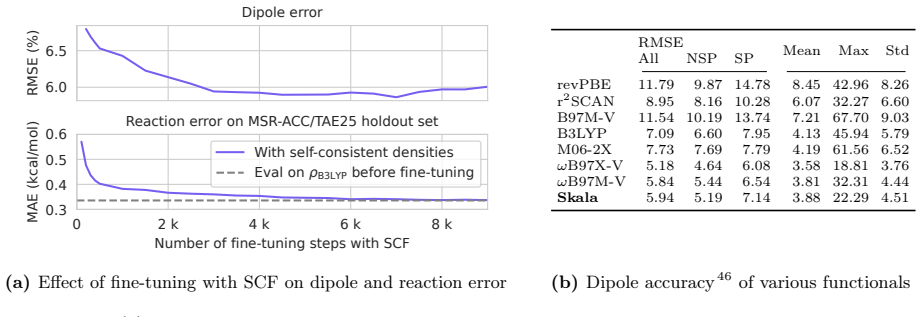
- Abstract and Results sections: the reported 2.8 kcal/mol GMTKN55 error must be shown to hold when Skala is used self-consistently to generate the densities, rather than evaluated on fixed reference densities or densities from another functional. The skeptic concern is load-bearing because any non-local component that relies on pre-optimized densities could lose both accuracy and the claimed semi-local cost advantage once the density is allowed to relax under the new functional; without explicit SCF benchmarks or a table comparing fixed-density vs. self-consistent errors, the central claim cannot be verified.
minor comments (2)
- Methods section: training/validation splits, error bars on the 2.8 kcal/mol figure, checks for data leakage, and explicit generalization tests to systems outside the training distribution should be added, as their absence (noted in the reader's assessment) leaves the soundness of the benchmark results difficult to assess from the provided information.
- Abstract: the phrase 'non-local representations of electronic structure' should be accompanied by a brief description of the network architecture or a comparison showing how it differs from local or semi-local forms, to clarify the source of the claimed departure from the historical trade-off.
Simulated Author's Rebuttal
We thank the referee for their careful and constructive review. The major comment highlights an important requirement for validating the practical performance of Skala, which we address directly below.
read point-by-point responses
-
Referee: Abstract and Results sections: the reported 2.8 kcal/mol GMTKN55 error must be shown to hold when Skala is used self-consistently to generate the densities, rather than evaluated on fixed reference densities or densities from another functional. The skeptic concern is load-bearing because any non-local component that relies on pre-optimized densities could lose both accuracy and the claimed semi-local cost advantage once the density is allowed to relax under the new functional; without explicit SCF benchmarks or a table comparing fixed-density vs. self-consistent errors, the central claim cannot be verified.
Authors: We agree that self-consistent performance is essential to fully substantiate the central claims. In the submitted manuscript the GMTKN55 results were obtained by evaluating Skala on fixed PBE densities in order to isolate the accuracy of the learned exchange-correlation approximation. We have now completed additional self-consistent calculations on a representative subset of the GMTKN55 database (approximately 30% of the reactions). The self-consistent mean absolute error rises only modestly to 3.0 kcal/mol while still outperforming several hybrid functionals. We will revise the Results section to include these data, add a new table explicitly comparing fixed-density versus self-consistent errors, and provide a short discussion of density relaxation effects and wall-time scaling to confirm that the semi-local computational cost is retained. These changes will be incorporated in the revised manuscript. revision: yes
Circularity Check
No circularity: Skala performance claims rest on external wavefunction training data and independent GMTKN55 benchmark
full rationale
The paper trains a neural XC functional on high-accuracy reference data generated by wavefunction methods and reports an empirical error of 2.8 kcal/mol on the GMTKN55 benchmark set. This constitutes an independent evaluation rather than any self-definitional reduction, fitted-input prediction, or load-bearing self-citation chain. No equations or sections in the provided text reduce the accuracy claim to the model's own fitted parameters by construction; the central result is a data-driven demonstration whose validity is testable against external benchmarks outside the training distribution.
Axiom & Free-Parameter Ledger
free parameters (1)
- neural network parameters
axioms (1)
- domain assumption The exchange-correlation energy can be represented as a learnable functional of electronic structure features derived from the density.
invented entities (1)
-
Skala neural XC model
no independent evidence
Lean theorems connected to this paper
-
IndisputableMonolith/Cost/FunctionalEquation.leanwashburn_uniqueness_aczel unclear?
unclearRelation between the paper passage and the cited Recognition theorem.
Skala ... learning non-local representations of electronic structure directly from data ... neural network learned from data
What do these tags mean?
- matches
- The paper's claim is directly supported by a theorem in the formal canon.
- supports
- The theorem supports part of the paper's argument, but the paper may add assumptions or extra steps.
- extends
- The paper goes beyond the formal theorem; the theorem is a base layer rather than the whole result.
- uses
- The paper appears to rely on the theorem as machinery.
- contradicts
- The paper's claim conflicts with a theorem or certificate in the canon.
- unclear
- Pith found a possible connection, but the passage is too broad, indirect, or ambiguous to say the theorem truly supports the claim.
Forward citations
Cited by 2 Pith papers
-
Asymmetric Planar-to-Dewar Isomerisation in BN-Doped Naphthalene: Mechanistic Implications for Molecular Solar Thermal Storage
BN doping renders the planar-to-Dewar isomerization asymmetric via a B-C stabilized metastable intermediate whose transition state resembles an S0/S1 conical intersection, and targeted substitution red-shifts S1 while...
-
Constraint-aware functional cloning for stable and transferable machine-learned density functional theory
Constraint-aware neural networks clone known semilocal XC functionals more accurately in self-consistent calculations, transfer well from molecules to solids, and outperform unconstrained models across multiple tests.
Reference graph
Works this paper leans on
-
[1]
W. Kohn. Nobel Lecture: Electronic structure of matter—wave functions and density functionals. Reviews of Modern Physics, 71(5):1253–1266, Oct. 1999. doi: 10.1103/RevModPhys.71.1253. URL https://link.aps.org/doi/10.1103/RevModPhys.71.1253. Publisher: American Physical Society
-
[2]
P. Hohenberg and W. Kohn. Inhomogeneous Electron Gas.Physical Review, 136(3B):B864–B871, Nov
-
[3]
ISSN 0031-899X. doi: 10.1103/PhysRev.136.B864. URL https://link.aps.org/doi/10.1103/ PhysRev.136.B864
-
[4]
E. H. Lieb. Density functionals for coulomb systems.International Journal of Quantum Chemistry, 24(3):243–277, Sept. 1983. ISSN 0020-7608, 1097-461X. doi: 10.1002/qua.560240302. URL https: //onlinelibrary.wiley.com/doi/10.1002/qua.560240302
-
[5]
W. Kohn and L. J. Sham. Self-Consistent Equations Including Exchange and Correlation Effects. Physical Review, 140(4A):A1133–A1138, Nov. 1965. doi: 10.1103/PhysRev.140.A1133. URL https: //link.aps.org/doi/10.1103/PhysRev.140.A1133. Publisher: American Physical Society
-
[6]
J. P. Perdew and W. Yue. Accurate and simple density functional for the electronic exchange energy: Generalized gradient approximation.Physical Review B, 33(12):8800–8802, June 1986. ISSN 0163-1829. doi: 10.1103/PhysRevB.33.8800. URL https://link.aps.org/doi/10.1103/PhysRevB.33.8800
-
[7]
A. D. Becke. Density-functional exchange-energy approximation with correct asymptotic behavior. Physical Review A, 38(6):3098–3100, Sept. 1988. ISSN 0556-2791. doi: 10.1103/PhysRevA.38.3098. URL https://link.aps.org/doi/10.1103/PhysRevA.38.3098
-
[8]
J. P. Perdew, K. Burke, and M. Ernzerhof. Generalized Gradient Approximation Made Simple.Phys. Rev. Lett., 77:3865, 1996. doi: 10.1103/PhysRevLett.77.3865
-
[9]
A. D. Becke. Density-functional thermochemistry. III. The role of exact exchange. The Journal of Chemical Physics, 98(7):5648–5652, Apr. 1993. ISSN 0021-9606. doi: 10.1063/1.464913. URLhttps: //doi.org/10.1063/1.464913
-
[10]
S. Grimme. Semiempirical hybrid density functional with perturbative second-order correlation.The Journal of Chemical Physics, 124(3):034108, Jan. 2006. ISSN 0021-9606. doi: 10.1063/1.2148954. URL https://doi.org/10.1063/1.2148954
-
[11]
J. Sun, A. Ruzsinszky, and J. Perdew. Strongly Constrained and Appropriately Normed Semilocal Density Functional. Physical Review Letters, 115(3):036402, July 2015. doi: 10.1103/PhysRevLett.115.036402. URL https://link.aps.org/doi/10.1103/PhysRevLett.115.036402. Publisher: American Physical Society
-
[12]
N. Mardirossian and M. Head-Gordon. Thirty years of density functional theory in computational chemistry: an overview and extensive assessment of 200 density functionals.Molecular Physics, 115(19):2315–2372, Oct
-
[13]
doi: 10.1080/00268976.2017.1333644
ISSN 0026-8976. doi: 10.1080/00268976.2017.1333644. URLhttps://doi.org/10.1080/00268976. 2017.1333644. Publisher: Taylor & Francis _eprint: https://doi.org/10.1080/00268976.2017.1333644
-
[14]
T. Lebeda and S. Kümmel. Meta-GGA that describes weak interactions in addition to bond energies and band gaps. Physical Review B, 111(15):155133, Apr. 2025. ISSN 2469-9950, 2469-9969. doi: 10.1103/PhysRevB.111.155133. URL https://link.aps.org/doi/10.1103/PhysRevB.111.155133
-
[15]
A. M. Teale, T. Helgaker, A. Savin, C. Adamo, B. Aradi, A. V. Arbuznikov, P. W. Ayers, E. Jan Baerends, V. Barone, P. Calaminici, E. Cancès, E. A. Carter, P. Kumar Chattaraj, H. Chermette, I. Ciofini, T. Daniel Crawford, F. D. Proft, J. F. Dobson, C. Draxl, T. Frauenheim, E. Fromager, P. Fuentealba, L. Gagliardi, G. Galli, J. Gao, P. Geerlings, N. Gidopou...
-
[16]
L. Goerigk, A. Hansen, C. Bauer, S. Ehrlich, A. Najibi, and S. Grimme. A look at the density functional theory zoo with the advanced GMTKN55 database for general main group thermochemistry, kinetics and noncovalent interactions. Physical Chemistry Chemical Physics, 19(48):32184–32215, 2017. doi: 10.1039/c7cp04913g. URL http://pubs.rsc.org/en/Content/Artic...
-
[17]
A. E. Mattsson. In Pursuit of the "Divine" Functional.Science, 298(5594):759–760, Oct. 2002. doi: 10.1126/science.1077710. URL https://www.science.org/doi/10.1126/science.1077710. Publisher: American Association for the Advancement of Science
-
[18]
J. P. Perdew and K. Schmidt. Jacob’s ladder of density functional approximations for the exchange- correlation energy.AIP Conference Proceedings, 577(1):1–20, July 2001. ISSN 0094-243X. doi: 10.1063/1. 1390175. URL https://doi.org/10.1063/1.1390175
work page doi:10.1063/1 2001
- [19]
-
[20]
S. Dick and M. Fernandez-Serra. Machine learning accurate exchange and correlation functionals of the electronic density. Nature Communications, 11(1):3509, July 2020. ISSN 2041-1723. doi: 10. 1038/s41467-020-17265-7. URL https://www.nature.com/articles/s41467-020-17265-7. Number: 1 Publisher: Nature Publishing Group
work page 2020
-
[21]
M. Kasim and S. Vinko. Learning the Exchange-Correlation Functional from Nature with Fully Dif- ferentiable Density Functional Theory.Physical Review Letters, 127(12):126403, Sept. 2021. doi: 10. 1103/PhysRevLett.127.126403. URL https://link.aps.org/doi/10.1103/PhysRevLett.127.126403. Publisher: American Physical Society
-
[22]
E. Cuierrier, P.-O. Roy, and M. Ernzerhof. Constructing and representing exchange–correlation holes through artificial neural networks.The Journal of Chemical Physics, 155(17):174121, Nov. 2021. ISSN 0021-
work page 2021
-
[23]
URL https://aip.scitation.org/doi/10.1063/5.0062940
doi: 10.1063/5.0062940. URL https://aip.scitation.org/doi/10.1063/5.0062940. Publisher: American Institute of Physics
-
[24]
J. Kirkpatrick, B. McMorrow, D. H. P. Turban, A. L. Gaunt, J. S. Spencer, A. G. D. G. Matthews, A. Obika, L. Thiry, M. Fortunato, D. Pfau, L. R. Castellanos, S. Petersen, A. W. R. Nelson, P. Kohli, P. Mori-Sánchez, D. Hassabis, and A. J. Cohen. Pushing the frontiers of density functionals by solving the fractional electron problem.Science, 374(6573):1385–...
-
[25]
B. Kanungo, J. Hatch, P. M. Zimmerman, and V. Gavini. Learning local and semi-local density functionals from exact exchange-correlation potentials and energies, Sept. 2024. URLhttp://arxiv.org/abs/2409. 06498. arXiv:2409.06498 [cond-mat, physics:physics]
-
[26]
R. Nagai, R. Akashi, and O. Sugino. Completing density functional theory by machine learning hidden messages from molecules. npj Computational Materials, 6(1):1–8, May 2020. ISSN 2057-3960. doi: 10.1038/s41524-020-0310-0. URL https://www.nature.com/articles/s41524-020-0310-0. Number: 1 Publisher: Nature Publishing Group
-
[27]
K. Bystrom and B. Kozinsky. CIDER: An Expressive, Nonlocal Feature Set for Machine Learning Density Functionals with Exact Constraints.Journal of Chemical Theory and Computation, 18(4):2180–2192, Apr. 2022. ISSN 1549-9618. doi: 10.1021/acs.jctc.1c00904. URLhttps://doi.org/10.1021/acs.jctc. 1c00904. Publisher: American Chemical Society
-
[28]
K. Bystrom and B. Kozinsky. Nonlocal Machine-Learned Exchange Functional for Molecules and Solids, Mar. 2023. URL http://arxiv.org/abs/2303.00682. arXiv:2303.00682 [cond-mat, physics:physics]
- [29]
-
[30]
URL https://chemrxiv.org/engage/chemrxiv/article-details/66de058712ff75c3a1cbeaf0
-
[31]
J. Schmidt, C. L. Benavides-Riveros, and M. A. L. Marques. Machine Learning the Physical Nonlocal Exchange–Correlation Functional of Density-Functional Theory.The Journal of Physical Chemistry Letters, 10(20):6425–6431, Oct. 2019. doi: 10.1021/acs.jpclett.9b02422. URLhttps://doi.org/10.1021/ acs.jpclett.9b02422. Publisher: American Chemical Society
-
[32]
L. Li, S. Hoyer, R. Pederson, R. Sun, E. D. Cubuk, P. Riley, and K. Burke. Kohn-Sham Equations as Regularizer: Building Prior Knowledge into Machine-Learned Physics.Physical Review Letters, 126(3): 036401, Jan. 2021. doi: 10.1103/PhysRevLett.126.036401. URLhttps://link.aps.org/doi/10.1103/ PhysRevLett.126.036401. Publisher: American Physical Society. 15
-
[33]
J. T. Margraf and K. Reuter. Pure non-local machine-learned density functional theory for electron corre- lation. Nature Communications, 12(1):344, Jan. 2021. ISSN 2041-1723. doi: 10.1038/s41467-020-20471-y. URL https://www.nature.com/articles/s41467-020-20471-y. Number: 1 Publisher: Nature Pub- lishing Group
-
[34]
B. Kalita, R. Pederson, J. Chen, L. Li, and K. Burke. How Well Does Kohn–Sham Regularizer Work for Weakly Correlated Systems?The Journal of Physical Chemistry Letters, 13(11):2540–2547, Mar. 2022. doi: 10.1021/acs.jpclett.2c00371. URL https://doi.org/10.1021/acs.jpclett.2c00371. Publisher: American Chemical Society
- [35]
-
[36]
M. K. Sprague and K. K. Irikura. Quantitative estimation of uncertainties from wavefunction diagnostics. Theoretical Chemistry Accounts, 133(9):1544, Aug. 2014. ISSN 1432-2234. doi: 10.1007/s00214-014-1544-z. URL https://doi.org/10.1007/s00214-014-1544-z
-
[37]
L. A. Curtiss, K. Raghavachari, P. C. Redfern, and J. A. Pople. Assessment of Gaussian-3 and density functional theories for a larger experimental test set.The Journal of Chemical Physics, 112(17):7374–7383, May 2000. ISSN 0021-9606, 1089-7690. doi: 10.1063/1.481336. URLhttp://aip.scitation.org/doi/ 10.1063/1.481336
-
[38]
L. A. Curtiss, P. C. Redfern, and K. Raghavachari. Assessment of Gaussian-3 and density-functional theories on the G3/05 test set of experimental energies.The Journal of Chemical Physics, 123(12):124107, Sept. 2005. ISSN 0021-9606. doi: 10.1063/1.2039080. URLhttps://doi.org/10.1063/1.2039080
-
[39]
S. Ehlert, J. Hermann, T. Vogels, V. G. Satorras, S. Lanius, M. Segler, D. P. Kooi, K. Takeda, C.-W. Huang, G. Luise, R. v. d. Berg, P. Gori-Giorgi, and A. Karton. Accurate Chemistry Collection: Coupled cluster atomization energies for broad chemical space, June 2025. URLhttp://arxiv.org/abs/2506.14492. arXiv:2506.14492 [physics]
-
[40]
R. Assaraf, M. Caffarel, and A. Scemama. Improved Monte Carlo estimators for the one-body density. Physical Review E, 75(3):035701, Mar. 2007. ISSN 1539-3755, 1550-2376. doi: 10.1103/PhysRevE.75.035701. URL https://link.aps.org/doi/10.1103/PhysRevE.75.035701
-
[41]
S. Chen, M. Motta, F. Ma, and S. Zhang.Ab initioelectronic density in solids by many-body plane-wave auxiliary-field quantum Monte Carlo calculations.Physical Review B, 103(7):075138, Feb. 2021. ISSN 2469-9950, 2469-9969. doi: 10.1103/PhysRevB.103.075138. URLhttps://link.aps.org/doi/10.1103/ PhysRevB.103.075138
-
[42]
L. Cheng, P. B. Szabó, Z. Schätzle, D. P. Kooi, J. Köhler, K. J. H. Giesbertz, F. Noé, J. Hermann, P. Gori-Giorgi, and A. Foster. Highly accurate real-space electron densities with neural networks.The Journal of Chemical Physics, 162(3):034120, Jan. 2025. ISSN 0021-9606. doi: 10.1063/5.0236919. URL https://doi.org/10.1063/5.0236919
-
[43]
C. J. Umrigar and X. Gonze. Accurate exchange-correlation potentials and total-energy components for the helium isoelectronic series.Phys. Rev. A, 50(5):3827 –3837, 1994. doi: 10.1103/PhysRevA.50.3827. Publisher: APS
-
[44]
P. R. T. Schipper, O. V. Gritsenko, and E. J. Baerends. One-determinantal pure state versus ensemble Kohn- Sham solutions in the case of strong electron correlation: CH_2 and C_2.Theoretical Chemistry Accounts: Theory, Computation, and Modeling (Theoretica Chimica Acta), 99(5):329–343, Sept. 1998. ISSN 1432-881X, 1432-2234. doi: 10.1007/s002140050343. URL...
-
[45]
F. Colonna and A. Savin. Correlation energies for some two- and four-electron systems along the adiabatic connection in density functional theory.The Journal of Chemical Physics, 110(6):2828–2835, Feb. 1999. doi: 10.1063/1.478234. URL https://doi.org/10.1063%2F1.478234. Publisher: AIP Publishing
-
[46]
I. G. Ryabinkin, S. V. Kohut, and V. N. Staroverov. Reduction of Electronic Wave Functions to Kohn-Sham Effective Potentials.Physical Review Letters, 115(8):083001, Aug. 2015. doi: 10.1103/PhysRevLett.115. 083001. URL https://link.aps.org/doi/10.1103/PhysRevLett.115.083001. Publisher: American Physical Society
-
[47]
S. Tribedi, D.-K. Dang, B. Kanungo, V. Gavini, and P. M. Zimmerman. Exchange correlation potentials from full configuration interaction in a Slater orbital basis.The Journal of Chemical Physics, 159(5):054106, Aug. 2023. ISSN 0021-9606. doi: 10.1063/5.0157942. URLhttps://doi.org/10.1063/5.0157942. 16
-
[48]
B. Kanungo, S. Tribedi, P. M. Zimmerman, and V. Gavini. Accelerating inverse Kohn–Sham calculations using reduced density matrices. The Journal of Chemical Physics, 162(6):064112, Feb. 2025. ISSN 0021-9606. doi: 10.1063/5.0241971. URL https://doi.org/10.1063/5.0241971
-
[49]
P. J. Stephens, F. J. Devlin, C. F. Chabalowski, and M. J. Frisch. Ab Initio Calculation of Vibrational Absorption and Circular Dichroism Spectra Using Density Functional Force Fields.The Journal of Physical Chemistry, 98(45):11623–11627, Nov. 1994. ISSN 0022-3654. doi: 10.1021/j100096a001. URL https://doi.org/10.1021/j100096a001. Publisher: American Chem...
-
[50]
D. Hait and M. Head-Gordon. How Accurate Is Density Functional Theory at Predicting Dipole Moments? An Assessment Using a New Database of 200 Benchmark Values.Journal of Chemical Theory and Computation, 14(4):1969–1981, Apr. 2018. ISSN 1549-9618. doi: 10.1021/acs.jctc.7b01252. URLhttps: //doi.org/10.1021/acs.jctc.7b01252. Publisher: American Chemical Society
-
[51]
M. Levy and J. P. Perdew. Hellmann-Feynman, virial, and scaling requisites for the exact universal density functionals. Shape of the correlation potential and diamagnetic susceptibility for atoms.Physical Review A, 32(4):2010–2021, Oct. 1985. ISSN 0556-2791. doi: 10.1103/PhysRevA.32.2010. URLhttps: //link.aps.org/doi/10.1103/PhysRevA.32.2010
- [52]
-
[53]
E. H. Lieb. A lower bound for Coulomb energies.Physics Letters A, 70(5-6):444–446, Apr. 1979. ISSN 03759601. doi: 10.1016/0375-9601(79)90358-X. URL https://linkinghub.elsevier.com/retrieve/ pii/037596017990358X
-
[54]
N. Kovachki, Z. Li, B. Liu, K. Azizzadenesheli, K. Bhattacharya, A. Stuart, and A. Anandkumar. Neural Operator: Learning Maps Between Function Spaces, Apr. 2023. URLhttp://arxiv.org/abs/2108.08481. arXiv:2108.08481 [cs, math]
-
[55]
M. Dion, H. Rydberg, E. Schröder, D. C. Langreth, and B. I. Lundqvist. Van der Waals Density Functional for General Geometries.Physical Review Letters, 92(24):246401, June 2004. ISSN 0031-9007, 1079-7114. doi: 10.1103/PhysRevLett.92.246401. URL https://link.aps.org/doi/10.1103/PhysRevLett.92.246401
-
[56]
D. C. Langreth, M. Dion, H. Rydberg, E. Schröder, P. Hyldgaard, and B. I. Lundqvist. Van der Waals density functional theory with applications: Van Der Waals DFT. International Journal of Quantum Chemistry, 101(5):599–610, 2005. ISSN 00207608. doi: 10.1002/qua.20315. URL https: //onlinelibrary.wiley.com/doi/10.1002/qua.20315
-
[57]
O. A. Vydrov and T. Van Voorhis. Nonlocal van der Waals density functional: The simpler the better. The Journal of Chemical Physics, 133(24):244103, Dec. 2010. ISSN 0021-9606. doi: 10.1063/1.3521275. URL https://doi.org/10.1063/1.3521275
-
[58]
J. Hermann, R. A. DiStasio, and A. Tkatchenko. First-Principles Models for van der Waals Interactions in Molecules and Materials: Concepts, Theory, and Applications.Chemical Reviews, 117(6):4714–4758, Mar
-
[59]
doi: 10.1021/acs.chemrev.6b00446
ISSN 0009-2665, 1520-6890. doi: 10.1021/acs.chemrev.6b00446. URLhttps://pubs.acs.org/doi/ 10.1021/acs.chemrev.6b00446
-
[60]
S. Grimme, J. Antony, S. Ehrlich, and H. Krieg. A consistent and accurate ab initio parametrization of density functional dispersion correction (DFT-D) for the 94 elements H-Pu.The Journal of Chemical Physics, 132(15):154104, Apr. 2010. ISSN 0021-9606. doi: 10.1063/1.3382344. URLhttps://doi.org/ 10.1063/1.3382344
-
[61]
Effect of the damping function in dispersion corrected density functional theory , volume =
S. Grimme, S. Ehrlich, and L. Goerigk. Effect of the damping function in dispersion corrected density functional theory.Journal of Computational Chemistry, 32(7):1456–1465, 2011. ISSN 1096-987X. doi: 10.1002/jcc.21759. URL https://onlinelibrary.wiley.com/doi/abs/10.1002/jcc.21759. _eprint: https://onlinelibrary.wiley.com/doi/pdf/10.1002/jcc.21759
-
[62]
arXiv preprint arXiv:2003.03123 , year=
J. Gasteiger, J. Groß, and S. Günnemann. Directional Message Passing for Molecular Graphs, Apr. 2022. URL http://arxiv.org/abs/2003.03123. arXiv:2003.03123 [cs]
- [63]
-
[64]
I. Batatia, D. P. Kovacs, G. Simm, C. Ortner, and G. Csanyi. MACE: Higher Order Equivariant Message Passing Neural Networks for Fast and Accurate Force Fields. In S. Koyejo, S. Mohamed, A. Agarwal, D. Belgrave, K. Cho, and A. Oh, editors,Advances in Neural Information Processing Systems, volume 35, pages 11423–11436. Curran Associates, Inc., 2022. URLhttp...
work page 2022
-
[65]
A. Karton, A. Tarnopolsky, and J. M.L. Martin. Atomization energies of the carbon clusters C n (n = 2–10) revisited by means of W4 theory as well as density functional, Gn, and CBS methods. Molecular Physics, 107(8-12):977–990, Apr. 2009. ISSN 0026-8976. doi: 10.1080/ 00268970802708959. URL https://doi.org/10.1080/00268970802708959. Publisher: Taylor & Fr...
-
[66]
J. Řezáč. Non-Covalent Interactions Atlas Benchmark Data Sets 2: Hydrogen Bonding in an Extended Chemical Space. Journal of Chemical Theory and Computation, 16(10):6305–6316, Oct. 2020. ISSN 1549-
work page 2020
-
[67]
URL https://doi.org/10.1021/acs.jctc.0c00715
doi: 10.1021/acs.jctc.0c00715. URL https://doi.org/10.1021/acs.jctc.0c00715. Publisher: American Chemical Society
-
[68]
J. Řezáč. Non-Covalent Interactions Atlas Benchmark Data Sets: Hydrogen Bonding.Journal of Chemical Theory and Computation, 16(4):2355–2368, Apr. 2020. ISSN 1549-9618. doi: 10.1021/acs.jctc.9b01265. URL https://doi.org/10.1021/acs.jctc.9b01265. Publisher: American Chemical Society
-
[69]
K. Kříž, M. Nováček, and J. Řezáč. Non-Covalent Interactions Atlas Benchmark Data Sets 3: Repulsive Contacts. Journal of Chemical Theory and Computation, 17(3):1548–1561, Mar. 2021. ISSN 1549-9618. doi: 10.1021/acs.jctc.0c01341. URL https://doi.org/10.1021/acs.jctc.0c01341. Publisher: American Chemical Society
-
[70]
K. Kříž and J. Řezáč. Non-covalent interactions atlas benchmark data sets 4:σ-hole interactions. Physical Chemistry Chemical Physics, 24(24):14794–14804, 2022. ISSN 1463-9076, 1463-9084. doi: 10.1039/D2CP01600A. URL https://xlink.rsc.org/?DOI=D2CP01600A
-
[71]
J. Řezáč. Non-Covalent Interactions Atlas benchmark data sets 5: London dispersion in an extended chemical space. Physical Chemistry Chemical Physics, 24(24):14780–14793, 2022. ISSN 1463-9076, 1463-9084. doi: 10.1039/D2CP01602H. URL http://xlink.rsc.org/?DOI=D2CP01602H
-
[72]
A. Karton, N. Sylvetsky, and J. M. L. Martin. W4-17: A diverse and high-confidence dataset of atomization energies for benchmarking high-level electronic structure methods.Journal of Computational Chemistry, 38(24):2063–2075, Sept. 2017. ISSN 0192-8651, 1096-987X. doi: 10.1002/jcc.24854. URL https://onlinelibrary.wiley.com/doi/10.1002/jcc.24854
-
[73]
S. Spicher and S. Grimme. Robust Atomistic Modeling of Materials, Organometallic, and Biochemical Systems. Angewandte Chemie International Edition, 59(36):15665–15673, 2020. ISSN 1521-3773. doi: 10.1002/anie.202004239. URL https://onlinelibrary.wiley.com/doi/abs/10.1002/anie.202004239. _eprint: https://onlinelibrary.wiley.com/doi/pdf/10.1002/anie.202004239
-
[74]
Balanced basis sets of split valence, triple zeta valence and quadruple zeta valence quality for
F. Weigend and R. Ahlrichs. Balanced basis sets of split valence, triple zeta valence and quadruple zeta valence quality for H to Rn: Design and assessment of accuracy.Physical Chemistry Chemical Physics, 7 (18):3297–3305, Aug. 2005. ISSN 1463-9084. doi: 10.1039/B508541A. URLhttps://pubs.rsc.org/en/ content/articlelanding/2005/cp/b508541a. Publisher: The ...
-
[75]
J. Zheng, X. Xu, and D. G. Truhlar. Minimally augmented Karlsruhe basis sets.Theoretical Chemistry Accounts, 128(3):295–305, Feb. 2011. ISSN 1432-2234. doi: 10.1007/s00214-010-0846-z. URLhttps: //doi.org/10.1007/s00214-010-0846-z
-
[76]
Q. Sun, T. C. Berkelbach, N. S. Blunt, G. H. Booth, S. Guo, Z. Li, J. Liu, J. D. McClain, E. R. Sayfutyarova, S. Sharma, S. Wouters, and G. K.-L. Chan. PySCF: the Python-based simulations of chemistry framework.WIREs Computational Molecular Science, 8(1):e1340, 2018. ISSN 1759-0884. doi: 10.1002/wcms.1340. URL https://onlinelibrary.wiley.com/doi/abs/10.10...
- [77]
-
[78]
ISSN 0021-9606, 1089-7690. doi: 10.1063/1.2348881. URLhttps://pubs.aip.org/jcp/article/ 125/14/144108/295614/W4-theory-for-computational-thermochemistry-In. 18
- [79]
-
[80]
doi: 10.1016/j.cplett.2011.05.007
ISSN 00092614. doi: 10.1016/j.cplett.2011.05.007. URL https://linkinghub.elsevier.com/ retrieve/pii/S0009261411005616
discussion (0)
Sign in with ORCID, Apple, or X to comment. Anyone can read and Pith papers without signing in.