REVIEW 4 major objections 5 minor 45 references
VideoGAN-based Trajectory Proposal for Automated Vehicles
T0 review · 4 major / 5 minor · reviewed 2026-08-06 · deepseek-v4-flash
Pith's one-line read An unconditional video GAN trained on low-resolution bird's-eye-view traffic videos can generate statistically realistic trajectories that respect inter-agent distances and traffic lights, at 20 ms inference.
desk verdict Decent pilot with a real finding -- a video GAN can learn red-light stopping in BEV scenes -- but the statistical-accuracy claim rests on an unvalidated tracking pipeline. read the letter →
The pith
A machine-rendered reading of the paper's core claim, the machinery that carries it, and where it could break.
The reading
What carries the argument
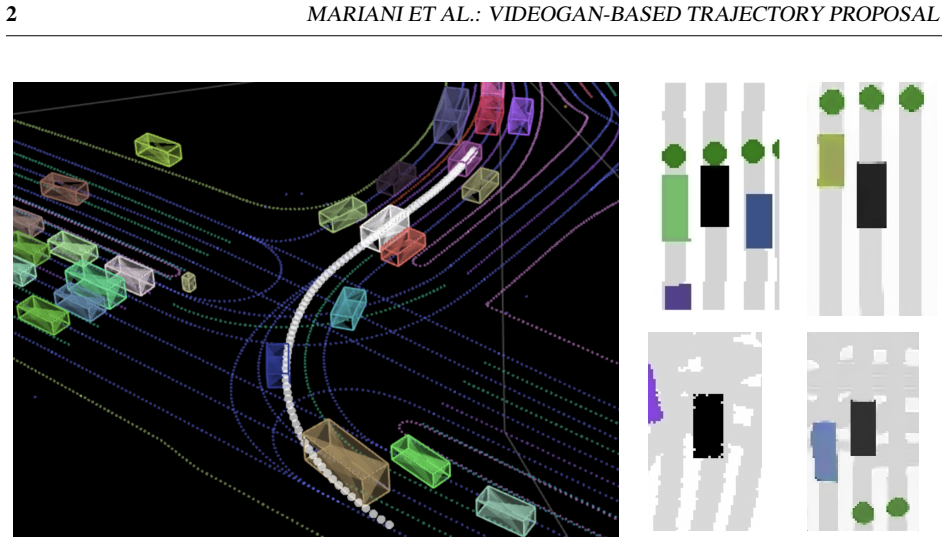
The load-bearing object is an unconditional video GAN operating on rasterized bird's-eye-view occupancy grids: each frame is an image of road centerlines, traffic lights, and colored rectangles for agents, and the model generates dynamically coherent videos of arbitrary length through spatiotemporal convolutions and latent vectors. The downstream trajectory extraction uses color-space masking for traffic lights and agents, morphological opening, contour analysis, and a cost matrix for frame-to-frame identity matching. The rasterization step is what turns abstract trajectory data into a visual format that naturally encodes spatial layout and agent interactions.
What would settle it
Compare trajectories extracted from generated videos against directly annotated ground-truth tracks of the same generated scenes; if speed and distance distributions differ substantially once tracking errors are corrected, the central claim of statistical accuracy would fail.
Extended reading notes
Core claim
The central claim is that a video GAN trained on low-resolution BEV occupancy grid videos learns the joint distribution of traffic scenes well enough that trajectories extracted from its generated videos are statistically realistic and spatially coherent. The paper reports that generated scenes match Waymo ground truth in the distribution of agent sizes, minimum distances, traffic density, relative speeds and accelerations, and in the interaction of the ego vehicle with red and green traffic lights. It further claims this is achieved with about 100 GPU hours of training and under 20 ms inference for a 15-second scene, which the authors position as an advantage over diffusion-based alternatives.
Load-bearing premise
The claim that extracted trajectories are statistically accurate rests on the assumption that the frame-to-frame object matching pipeline, applied to generated videos, produces tracks that faithfully represent what the video shows; the authors themselves note that agents morph, split, or merge near crossings.
Editorial extensions
If this is right
- Trajectory proposal can be done by sampling from a video generative model rather than by enumerating a fixed set of future paths per agent, letting agents enter and leave the scene naturally.
- Safety-relevant behaviors such as waiting at red lights and proceeding on green emerge from the occupancy-grid video training signal without explicit rule injection.
- The approach can propose whole scenes from scratch, not only predict the next positions of known agents, making it suitable as a simulation or data-augmentation engine.
- Inference under 20 ms for a 15-second scene makes scene-level proposal fast enough for real-time planning loops, with latency scaling linearly in sequence length.
Reading between the lines
- Because the model is unconditional, adding conditioning variables such as destination, map context, or traffic-light state would likely turn this into a controllable trajectory predictor, though the paper does not test this.
- The same trajectory-extraction evaluation could be applied to diffusion-based scene generators, offering a task-specific comparison beyond visual quality, which the paper motivates but does not perform.
- The reported distribution alignment may be sensitive to the tracking pipeline's handling of morphing and merging artifacts; a human-annotated trajectory benchmark on generated videos would clarify how much of the alignment is genuine.
- The rasterization design suggests that the approach could transfer to other sensor modalities, such as LiDAR or camera-based BEV, by swapping the rasterization front end, but this remains untested.
Editorial analysis
A structured set of objections, weighed in public.
Referee Report
Summary. The paper presents a pipeline that rasterizes Waymo Open Motion Dataset trajectories into low-resolution bird's-eye-view occupancy videos, trains a video GAN (LongVideoGAN) on these videos, and then extracts abstract trajectory data from the generated videos via single-frame object detection and frame-to-frame matching. The authors evaluate the realism of the extracted trajectories by comparing probability density distributions of agent sizes, inter-agent distances, traffic density, speeds, accelerations, and ego-vehicle behavior around traffic lights against distributions computed from real Waymo videos. They report training within 100 GPU hours and inference under 20 ms per 15 s scene.
Significance. If the central claim were fully supported, the paper would provide a novel, computationally light, spatially grounded generative approach to scene-level trajectory proposal, with the additional advantage of producing variable-length scenes and dynamic traffic-light interactions. The authors release code and models, and the modular pipeline is clearly presented. However, the significance is currently limited by the unvalidated trajectory extraction and the absence of statistical rigor in the distribution comparisons, which are the main evidence for the claims.
major comments (4)
- [Section 3 (Trajectory extraction) and Section 4 (Qualitative results)] The trajectory extraction pipeline relies on frame-to-frame object matching, and the authors acknowledge that non-ego agents "morph length-wise and seem to split or disappear" near crossings and that "two agents merge into a single elongated form" (Section 4, Qualitative results). Since all quantitative statistics in Figures 6-8 are computed from these extracted tracks, the acknowledged split/merge failures could inject spurious identity changes, speeds, and accelerations, and could alter density and distance statistics. Moreover, because the same unvalidated extraction is applied to both real and generated videos, systematic tracking errors could make the two distributions appear more similar than the underlying videos are. The paper does not validate the extraction by running it on real BEV rasters and comparing the resulting trajectories with the Waymo ground-truth tracks used to create them, nor does it quantify the frequency of the failure modes or their effect on the reported distributions. This validation is necessary to support the claim of "statistically accurate trajectories."
- [Section 4 (Experimental setting)] The training set is rebalanced so that turning scenes constitute about 40% of the data, whereas the 120 real Waymo videos used for comparison presumably reflect the natural ~10% turning frequency. Because all reported statistics (speeds, accelerations, density, distances) can depend on the frequency of turns, the distribution alignment may reflect this rebalancing rather than the model's ability to capture the natural distribution. The paper should either compare against a rebalanced real subset or analyze how the oversampling affects the metrics.
- [Section 4 (Quantitative results)] The PDF comparisons in Figures 6-8 are made visually, without error bars, confidence intervals, or statistical significance tests. For instance, the claim that generated vehicles are "on average 10% larger" and that the difference in red-light speed distributions is "almost negligible" is not supported by any statistical measure, and with only 80 generated and 120 real videos these differences may be within sampling noise. The paper should report bootstrap confidence intervals or two-sample tests (e.g., Kolmogorov-Smirnov) for each distribution comparison.
- [Abstract and Section 5] The claim that the model produces "statistically accurate trajectories that correctly capture spatial relationships" is stronger than what is evaluated. The quantitative results only compare marginal distributions of sizes, distances, density, speeds, and accelerations; no joint or conditional spatial statistics are reported (for example, relative positions as a function of traffic-light state or pairwise interaction patterns). To support the spatial-relationship claim, the paper should include additional analyses, such as joint position distributions or conditioned distance statistics.
minor comments (5)
- [Section 3 (Rasterization of trajectory data)] The phrase "three part" should be "three parts".
- [Section 5 (Conclusions)] The capitalization "videoGan" should be "videoGAN" for consistency.
- [Contributions and Section 4 (Experimental setting)] The contribution list claims "minimal inference times of 20 ms to generate a 200 s long video," but the experimental section reports 20 ms for a 15 s scene and 150 ms for a 2-minute scene; the 200 s figure should be corrected or justified.
- [Section 4 (Experimental setting)] The paper mentions monitoring the Frechet Video Distance (FVD) but does not report any FVD values; reporting the final FVD would help calibrate the visual fidelity of the generated videos.
- [Section 4 (Quantitative results)] The figures do not specify the bin width or kernel used for the PDF estimation; please provide this information.
Circularity Check
No significant circularity: the central claim is evaluated by comparing distributions of video-derived statistics, which is a standard generative-model check rather than a reduction to fitted inputs.
full rationale
The paper's derivation chain is a standard generative-model pipeline: real Waymo scenes are rasterized into BEV videos, a video GAN is trained to match that video distribution, and generated videos are post-processed by detection and matching to obtain trajectories. The abstract's claim of 'statistically accurate trajectories' is tested by comparing distributions of agent sizes, distances, speeds, and accelerations between real and generated videos (Figures 6-8). This is an evaluation of the training objective on a sample from the same distribution, not a fitted parameter renamed as a prediction; no quantity used in the loss is directly reused as the reported metric. The paper contains no load-bearing self-citation: the generative architecture [5] and dataset [37] are external, and no uniqueness theorem is invoked. The main caveats are correctness risks rather than circularity: the authors acknowledge that agents 'morph length-wise and seem to split or disappear' and that 'two agents merge into a single elongated form' (Section 4), and the same detection pipeline is applied to both real and generated videos, so tracker errors could bias the compared distributions. These issues weaken the evidence but do not make the derivation circular.
Assumptions & free parameters
free parameters (3)
- Turning-scene oversampling ratio =
about 40% of training scenes vs about 10% in Waymo
- BEV rasterization scale and window =
5 px/m, 20x10 m window, 54x96 px frames
- Detection and matching thresholds =
not specified in the paper
assumptions (5)
- domain assumption LongVideoGAN (Brooks et al.) produces temporally coherent videos without explicit physical constraints or scene conditioning.
- domain assumption The rasterized BEV occupancy grid at 5 px/m preserves sufficient traffic information to extract meaningful trajectories.
- domain assumption HSV-based detection and heuristic frame-to-frame matching yield correct agent identities and speeds in generated videos.
- domain assumption Aggregate distribution alignment of a handful of parameters is sufficient evidence of physical realism and safety.
- domain assumption The training set rebalancing to 40% turning scenes does not invalidate comparison with real Waymo videos.
Cite this review
Pith. "Pith review of VideoGAN-based Trajectory Proposal for Automated Vehicles." pith.science (2026). https://pith.science/paper/VKPL5FAQ
@misc{pith2026250616209,
  author       = {Pith},
  title        = {Pith review of: VideoGAN-based Trajectory Proposal for Automated Vehicles},
  year         = {2026},
  howpublished = {\url{https://pith.science/paper/VKPL5FAQ}},
  note         = {Machine review of arXiv:2506.16209}
}
read the original abstract
Being able to generate realistic trajectory options is at the core of increasing the degree of automation of road vehicles. While model-driven, rule-based, and classical learning-based methods are widely used to tackle these tasks at present, they can struggle to effectively capture the complex, multimodal distributions of future trajectories. In this paper we investigate whether a generative adversarial network (GAN) trained on videos of bird's-eye view (BEV) traffic scenarios can generate statistically accurate trajectories that correctly capture spatial relationships between the agents. To this end, we propose a pipeline that uses low-resolution BEV occupancy grid videos as training data for a video generative model. From the generated videos of traffic scenarios we extract abstract trajectory data using single-frame object detection and frame-to-frame object matching. We particularly choose a GAN architecture for the fast training and inference times with respect to diffusion models. We obtain our best results within 100 GPU hours of training, with inference times under 20\,ms. We demonstrate the physical realism of the proposed trajectories in terms of distribution alignment of spatial and dynamic parameters with respect to the ground truth videos from the Waymo Open Motion Dataset.
Figures


Figures from the paper (5 more)


Reference graph
Works this paper leans on
-
[1]
Implicit Occupancy Flow Fields for Perception and Prediction in Self-Driving
Ben Agro, Quinlan Sykora, Sergio Casas, and Raquel Urtasun. Implicit Occupancy Flow Fields for Perception and Prediction in Self-Driving. In Proceedings of the IEEE/CVF Conference on Computer Vision and Pattern Recognition, pages 1379–1388, 2023
work page 2023
-
[2]
Social LSTM: Human Trajectory Prediction in Crowded Spaces
Alexandre Alahi, Kratarth Goel, Vignesh Ramanathan, Alexandre Robicquet, Li Fei-Fei, and Silvio Savarese. Social LSTM: Human Trajectory Prediction in Crowded Spaces. In 2016 IEEE Conference on Computer Vision and Pattern Recognition (CVPR), pages 961– 971, June 2016. doi: 10.1109/CVPR.2016.110
-
[3]
S. H. Ashwin and Rashmi Naveen Raj. Deep reinforcement learning for autonomous vehicles: Lane keep and overtaking scenarios with collision avoidance. Int. j. inf. tecnol., 15(7):3541– 3553, October 2023. ISSN 2511-2112. doi: 10.1007/s41870-023-01412-6
-
[4]
Vibha Bharilya and Neetesh Kumar. Machine Learning for Autonomous Vehicle’s Trajectory Prediction: A comprehensive survey, Challenges, and Future Research Directions, July 2023
work page 2023
-
[5]
Generating Long Videos of Dynamic Scenes
Tim Brooks, Janne Hellsten, Miika Aittala, Ting-Chun Wang, Timo Aila, Jaakko Lehtinen, Ming-Yu Liu, Alexei A Efros, and Tero Karras. Generating Long Videos of Dynamic Scenes. In 36th Conference on Neural Information Processing Systems (NeurIPS 2022), 2022
work page 2022
-
[6]
MP3: A Unified Model To Map, Perceive, Predict and Plan
Sergio Casas, Abbas Sadat, and Raquel Urtasun. MP3: A Unified Model To Map, Perceive, Predict and Plan. In Proceedings of the IEEE/CVF Conference on Computer Vision and Pattern Recognition, pages 14403–14412, 2021
work page 2021
-
[7]
Trajectory generation: A survey on methods and techniques
Xin Chen, Chengrui Huang, Chenhao Wang, and Lisi Chen. Trajectory generation: A survey on methods and techniques. Geoinformatica, April 2025. ISSN 1573-7624. doi: 10.1007/ s10707-025-00545-z
work page 2025
-
[8]
LookOut: Diverse Multi-Future Prediction and Planning for Self-Driving
Alexander Cui, Sergio Casas, Abbas Sadat, Renjie Liao, and Raquel Urtasun. LookOut: Diverse Multi-Future Prediction and Planning for Self-Driving. In Proceedings of the IEEE/CVF International Conference on Computer Vision, pages 16107–16116, 2021
work page 2021
Show all 45 references
-
[9]
TPNet: Trajectory Pro- posal Network for Motion Prediction
Liangji Fang, Qinhong Jiang, Jianping Shi, and Bolei Zhou. TPNet: Trajectory Pro- posal Network for Motion Prediction. In Proceedings of the IEEE/CVF Conference on Computer Vision and Pattern Recognition, pages 6797–6806, 2020
2020
-
[10]
HOME: Heatmap Output for future Motion Estimation
Thomas Gilles, Stefano Sabatini, Dzmitry Tsishkou, Bogdan Stanciulescu, and Fabien Moutarde. HOME: Heatmap Output for future Motion Estimation. InIEEE Int. Intell. Transp. Syst. Conf., pages 500–507, 2021. doi: 10.1109/ITSC48978.2021.9564944
2021
-
[11]
A Survey of Deep Learning Techniques for Autonomous Driving
Sorin Grigorescu, Bogdan Trasnea, Tiberiu Cocias, and Gigel Macesanu. A Survey of Deep Learning Techniques for Autonomous Driving. Journal of Field Robotics, 37(3):362–386, April 2020. ISSN 1556-4959, 1556-4967. doi: 10.1002/rob.21918. 12 MARIANI ET AL.: VIDEOGAN-BASED TRAJECT...
2020 doi
-
[12]
Stochastic Trajectory Prediction via Motion Indeterminacy Diffusion
Tianpei Gu, Guangyi Chen, Junlong Li, Chunze Lin, Yongming Rao, Jie Zhou, and Jiwen Lu. Stochastic Trajectory Prediction via Motion Indeterminacy Diffusion. In Proceedings of the IEEE/CVF Conference on Computer Vision and Pattern Recognition, pages 17113–17122, 2022
2022
-
[13]
Social GAN: Socially Acceptable Trajectories With Generative Adversarial Networks
Agrim Gupta, Justin Johnson, Li Fei-Fei, Silvio Savarese, and Alexandre Alahi. Social GAN: Socially Acceptable Trajectories With Generative Adversarial Networks. In Proceedings of the IEEE Conference on Computer Vision and Pattern Recognition, pages 2255–2264, 2018
2018
-
[14]
The Integration of Prediction and Planning in Deep Learning Automated Driving Systems: A Review
Steffen Hagedorn, Marcel Hallgarten, Martin Stoll, and Alexandru Paul Condurache. The Integration of Prediction and Planning in Deep Learning Automated Driving Systems: A Review. IEEE Transactions on Intelligent Vehicles, pages 1–17, 2024. ISSN 2379-8904. doi: 10.1109/TIV .202...
2024
-
[15]
Vision-Based Driver Assistance Systems: Survey, Taxonomy and Advances
Jonathan Horgan, Ciarán Hughes, John McDonald, and Senthil Yogamani. Vision-Based Driver Assistance Systems: Survey, Taxonomy and Advances. In Proceedings of the 2015 IEEE 18th International Conference on Intelligent Transportation Systems, ITSC ’15, pages 2032–2039, USA, Sept...
2015 doi
-
[16]
FIERY: Future Instance Prediction in Bird’s-Eye View from Surround Monocular Cameras
Anthony Hu, Zak Murez, Nikhil Mohan, Sofia Dudas, Jeffrey Hawke, Vijay Badrinarayanan, Roberto Cipolla, and Alex Kendall. FIERY: Future Instance Prediction in Bird’s-Eye View from Surround Monocular Cameras. In 2021 IEEE/CVF International Conference on Computer Vision (ICCV), ...
2021
-
[17]
ST-P3: End-to-End Vision-Based Autonomous Driving via Spatial-Temporal Feature Learning
Shengchao Hu, Li Chen, Penghao Wu, Hongyang Li, Junchi Yan, and Dacheng Tao. ST-P3: End-to-End Vision-Based Autonomous Driving via Spatial-Temporal Feature Learning. In Shai Avidan, Gabriel Brostow, Moustapha Cissé, Giovanni Maria Farinella, and Tal Hass- ner, editors, Compute...
2022 doi
-
[18]
A Review of Deep Learning-Based Vehicle Motion Prediction for Autonomous Driving
Renbo Huang, Guirong Zhuo, Lu Xiong, Shouyi Lu, and Wei Tian. A Review of Deep Learning-Based Vehicle Motion Prediction for Autonomous Driving. Sustainability, 15(20): 14716, October 2023. ISSN 2071-1050. doi: 10.3390/su152014716
2023 doi
-
[19]
Multimodal Trajectory Prediction: A Survey, February 2023
Renhao Huang, Hao Xue, Maurice Pagnucco, Flora Salim, and Yang Song. Multimodal Trajectory Prediction: A Survey, February 2023
2023
-
[20]
HDGT: Hetero- geneous Driving Graph Transformer for Multi-Agent Trajectory Prediction via Scene Encod- ing
Xiaosong Jia, Penghao Wu, Li Chen, Yu Liu, Hongyang Li, and Junchi Yan. HDGT: Hetero- geneous Driving Graph Transformer for Multi-Agent Trajectory Prediction via Scene Encod- ing. IEEE Trans. Pattern Anal. Mach. Intell., 45(11):13860–13875, November 2023. ISSN 0162-8828, 2160-...
2023
-
[21]
MotionDiffuser: Controllable Multi-Agent Motion Prediction Us- ing Diffusion
Chiyu “Max” Jiang, Andre Cornman, Cheolho Park, Benjamin Sapp, Yin Zhou, and Dragomir Anguelov. MotionDiffuser: Controllable Multi-Agent Motion Prediction Us- ing Diffusion. In Proceedings of the IEEE/CVF Conference on Computer Vision and Pattern Recognition, pages 9644–9653, ...
2023
-
[22]
Kinematics-aware Trajectory Generation and Prediction with Latent Stochastic Differential Modeling
Ruochen Jiao, Yixuan Wang, Xiangguo Liu, Simon Sinong Zhan, Chao Huang, and Qi Zhu. Kinematics-aware Trajectory Generation and Prediction with Latent Stochastic Differential Modeling. In 2024 IEEE/RSJ International Conference on Intelligent Robots and Systems (IROS), pages 565...
2024
-
[23]
Towards learning-based planning: The nuPlan benchmark for real-world autonomous driving
Napat Karnchanachari, Dimitris Geromichalos, Kok Seang Tan, Nanxiang Li, Christopher Eriksen, Shakiba Yaghoubi, Noushin Mehdipour, Gianmarco Bernasconi, Whye Kit Fong, Yiluan Guo, and Holger Caesar. Towards learning-based planning: The nuPlan benchmark for real-world autonomou...
2024
-
[24]
Level-5 Autonomous Driving—Are We There Yet? A Review of Research Literature
Manzoor Ahmed Khan, Hesham El Sayed, Sumbal Malik, Talha Zia, Jalal Khan, Najla Alka- abi, and Henry Ignatious. Level-5 Autonomous Driving—Are We There Yet? A Review of Research Literature. ACM Comput. Surv., 55(2):1–38, February 2023. ISSN 0360-0300, 1557-7341. doi: 10.1145/3485767
2023 doi
-
[25]
A Review of Tracking and Trajectory Prediction Methods for Autonomous Driving
Florin Leon and Marius Gavrilescu. A Review of Tracking and Trajectory Prediction Methods for Autonomous Driving. Mathematics, 9(6):660, January 2021. ISSN 2227-7390. doi: 10.3390/math9060660
2021 doi
-
[26]
Gener- ative Models in Decision Making: A Survey, March 2025
Yinchuan Li, Xinyu Shao, Jianping Zhang, Haozhi Wang, Leo Maxime Brunswic, Kaiwen Zhou, Jiqian Dong, Kaiyang Guo, Xiu Li, Zhitang Chen, Jun Wang, and Jianye Hao. Gener- ative Models in Decision Making: A Survey, March 2025
2025
-
[27]
Occupancy Flow Fields for Motion Forecasting in Autonomous Driving
Reza Mahjourian, Jinkyu Kim, Yuning Chai, Mingxing Tan, Ben Sapp, and Dragomir Anguelov. Occupancy Flow Fields for Motion Forecasting in Autonomous Driving. IEEE Robot. Autom. Lett., 7(2):5639–5646, April 2022. ISSN 2377-3766, 2377-3774. doi: 10.1109/LRA.2022.3151613
2022
-
[28]
Weiss, Benjamin Sapp, Zhifeng Chen, and Jonathon Shlens
Jiquan Ngiam, Vijay Vasudevan, Benjamin Caine, Zhengdong Zhang, Hao-Tien Lewis Chi- ang, Jeffrey Ling, Rebecca Roelofs, Alex Bewley, Chenxi Liu, Ashish Venugopal, David J. Weiss, Benjamin Sapp, Zhifeng Chen, and Jonathon Shlens. Scene Transformer: A unified architecture for pr...
2021
-
[29]
Leveraging Future Relationship Reasoning for Vehicle Trajectory Prediction
Daehee Park, Hobin Ryu, Yunseo Yang, Jegyeong Cho, Jiwon Kim, and Kuk Jin Yoon. Leveraging Future Relationship Reasoning for Vehicle Trajectory Prediction. InInternational Conference on Learning Representations, 2023
2023
-
[30]
Deep Model-Based Reinforcement Learning for High-Dimensional Problems, a Survey, December 2020
Aske Plaat, Walter Kosters, and Mike Preuss. Deep Model-Based Reinforcement Learning for High-Dimensional Problems, a Survey, December 2020
2020
-
[31]
Deep Imitative Mod- els for Flexible Inference, Planning, and Control
Nicholas Rhinehart, Rowan McAllister, and Sergey Levine. Deep Imitative Mod- els for Flexible Inference, Planning, and Control. In International Conference on Learning Representations, September 2019. 14 MARIANI ET AL.: VIDEOGAN-BASED TRAJECTORY PROPOSAL
2019
-
[32]
Scene Compliant Trajectory Forecast With Agent-Centric Spatio-Temporal Grids.IEEE Robotics and Automation Letters, 5(2):2816–2823, April 2020
Daniela Ridel, Nachiket Deo, Denis Wolf, and Mohan Trivedi. Scene Compliant Trajectory Forecast With Agent-Centric Spatio-Temporal Grids.IEEE Robotics and Automation Letters, 5(2):2816–2823, April 2020. ISSN 2377-3766. doi: 10.1109/LRA.2020.2974393
2020
-
[33]
An introduction to deep generative modeling
Lars Ruthotto and Eldad Haber. An introduction to deep generative modeling. GAMM-Mitteilungen, 44(2):e202100008, 2021. ISSN 1522-2608. doi: 10.1002/gamm. 202100008
2021 doi
-
[34]
Trajectron++: Dynamically-Feasible Trajectory Forecasting with Heterogeneous Data
Tim Salzmann, Boris Ivanovic, Punarjay Chakravarty, and Marco Pavone. Trajectron++: Dynamically-Feasible Trajectory Forecasting with Heterogeneous Data. In Andrea Vedaldi, Horst Bischof, Thomas Brox, and Jan-Michael Frahm, editors, Computer Vision – ECCV 2020, pages 683–700, C...
2020 doi
-
[35]
Generative Adversarial Networks (GANs): Challenges, Solutions, and Future Directions
Divya Saxena and Jiannong Cao. Generative Adversarial Networks (GANs): Challenges, Solutions, and Future Directions. ACM Comput. Surv., 54(3):63:1–63:42, May 2021. ISSN 0360-0300. doi: 10.1145/3446374
2021 doi
-
[36]
Motion Transformer with Global Intention Localization and Local Movement Refinement
Shaoshuai Shi, Li Jiang, Dengxin Dai, and Bernt Schiele. Motion Transformer with Global Intention Localization and Local Movement Refinement. Advances in Neural Information Processing Systems, 35:6531–6543, December 2022
2022
-
[38]
Pengxiang Wu, Siheng Chen, and Dimitris N. Metaxas. MotionNet: Joint Perception and Motion Prediction for Autonomous Driving Based on Bird’s Eye View Maps. In 2020 IEEE/CVF Conference on Computer Vision and Pattern Recognition (CVPR), pages 11382–11392, Seattle, W A, USA, June...
2020
-
[39]
A Survey on Video Diffusion Models
Zhen Xing, Qijun Feng, Haoran Chen, Qi Dai, Han Hu, Hang Xu, Zuxuan Wu, and Yu-Gang Jiang. A Survey on Video Diffusion Models. ACM Comput. Surv., 57(2):1–42, February
-
[40]
Fine-Grained Behavior and Lane Constraints Guided Trajectory Prediction Method, April 2025
Wenyi Xiong, Jian Chen, and Ziheng Qi. Fine-Grained Behavior and Lane Constraints Guided Trajectory Prediction Method, April 2025
2025
-
[41]
Researches on Adaptive Cruise Control system: A state of the art review
Liangyao Yu and Ruyue Wang. Researches on Adaptive Cruise Control system: A state of the art review. Proceedings of the Institution of Mechanical Engineers, Part D: MARIANI ET AL.: VIDEOGAN-BASED TRAJECTORY PROPOSAL 15 Journal of Automobile Engineering, 236:095440702110192, Ma...
2021
-
[42]
Kebria, Abbas Khosravi, and Saeid Nahavandi
Maryam Zare, Parham M. Kebria, Abbas Khosravi, and Saeid Nahavandi. A Survey of Imi- tation Learning: Algorithms, Recent Developments, and Challenges. IEEE Transactions on Cybernetics, 54(12):7173–7186, 2023
2023
-
[43]
A Novel Di- rect Trajectory Planning Approach Based on Generative Adversarial Networks and Rapidly- Exploring Random Tree
Cong Zhao, Yifan Zhu, Yuchuan Du, Feixiong Liao, and Ching-Yao Chan. A Novel Di- rect Trajectory Planning Approach Based on Generative Adversarial Networks and Rapidly- Exploring Random Tree. IEEE Trans. Intell. Transport. Syst., 23(10):17910–17921, October
-
[44]
HiVT: Hierar- chical Vector Transformer for Multi-Agent Motion Prediction
Zikang Zhou, Luyao Ye, Jianping Wang, Kui Wu, and Kejie Lu. HiVT: Hierar- chical Vector Transformer for Multi-Agent Motion Prediction. In Proceedings of the IEEE/CVF Conference on Computer Vision and Pattern Recognition, pages 8823–8833, 2022
2022
-
[2022]
doi: 10.1109/TITS.2022.3164391
ISSN 1524-9050, 1558-0016. doi: 10.1109/TITS.2022.3164391
2022
- [2025]
Reviewed August 6, 2026 · model on record in the stance chip above.
Discussion (0). Sign in to comment.