REVIEW 1 major objections 5 minor 15 references
Optimal Online Bookmaking for Any Number of Outcomes
T0 review · 1 major / 5 minor · reviewed 2026-08-06 · deepseek-v4-flash
Pith's one-line read The paper derives the exact worst-case loss of an online bookmaker facing an adversarial gambler, for any number of event outcomes and any betting horizon, and shows it equals the largest root of a degree-K polynomial built from rising…
desk verdict Genuinely new minimax characterization for all K, but the proof of Theorem B has a real normalization slip that needs fixing before the Hermite connection is established. read the letter →
The pith
A machine-rendered reading of the paper's core claim, the machinery that carries it, and where it could break.
The reading
What carries the argument
The Bellman-Pareto frontier $\mathcal{P}_{H,K}$, the set of all residual loss vectors that a bookmaker can force against a decisive gambler over $H$ rounds. It carries the argument by reducing the dynamic program $$V_H(s)=\inf_r\max_q V_{H-1}(s+q\oslash r)$$ to a static polynomial identity: the residual vector $v=L^\star_{H,K}(s)\mathbf{1}_K - s$ satisfies $D_{H,K}(v)=0$ with $$D_{H,K}(v)=\sum_{m=0}^K (-H)^{K-m}\sigma_m(v),$$ and the optimal odds are $r(k)=D_{H-1,K-1}(v^{\setminus k})/D_{H-1,K}(v)$. The recurrence $D_{H,K}(v)=v(k)D_{H,K-1}(v^{\setminus k}) - H\,D_{H-1,K-1}(v^{\setminus k})$ is the engine that expresses everything through elementary symmetric polynomials.
What would settle it
Fix $T=3$, $K=2$ and compute $V_3(0)$ by exact backward induction over a fine discretization of the simplex of bookmaker actions. The theorem implies the value equals $3+\sqrt{3}\approx 4.732$, the largest root of $x^2-6x+6$. A brute-force computation that yields a strictly larger quantity for some gambler strategy, or a simulation of Algorithm 1 against a decisive gambler whose final loss exceeds $3+\sqrt{3}$, would refute the central claim.
Extended reading notes
Core claim
The central discovery is that the minimax value of the online bookmaking game has a closed form: $L^\star_{T,K}$ is the largest root of $$P_{T,K}(x)=\sum_{m=0}^K \binom{K}{m}(-T)^{K-m}x^m,$$ where $(-T)^{K-m}$ is the rising factorial. Equivalently, the asymptotic regret factor $\beta_K = \lim_T (L^\star_{T,K}-T)/\sqrt{T}$ is the largest root of the $K$-th probabilist's Hermite polynomial. The proof proceeds through a Bellman-Pareto frontier: the set of residual payout vectors achievable against a decisive gambler is exactly $$\mathcal{P}_{H,K}=\{L^\star_{H,K}(s)\mathbf{1}_K - s : s\in\mathbb{R}^K,\ \min_k s(k)=0\},$$ and this frontier is characterized by a polynomial $D_{H,K}$. The frontier yields a Nash equilibrium — the worst-case gambler can be taken to bet one-hot each round, and the optimal bookmaker balances losses so that every decisive betting sequence ends at the same total — together with an algorithm whose per-round complexity is $O(K^2)$ and whose odds are given by a ratio of two evaluations of $D$.
Load-bearing premise
The proof rests on the claim (Theorem 9) that the worst-case gambler can always be taken to bet on a single outcome each round and that the optimal bookmaker response is unique and equalizes the loss across all such decisive bets; this is established through convexity of the value function and existence of a compact set of safe odds. If either property fails for some $K$ or $H$, the polynomial-root formula would not give the true worst-case loss.
Editorial extensions
If this is right
- For any fixed $K$ and $T$, the optimal bookmaking loss can be computed by finding the largest root of a degree-$K$ polynomial, so the computational cost does not scale with the horizon $T$.
- The regret $R_{T,K}=L^\star_{T,K}-T$ scales as $\sqrt{T}$ for every $K$, with scaling factor given by the largest root of the $K$-th Hermite polynomial; hence bookmakers can be as fair as desired while remaining profitable as $T$ grows.
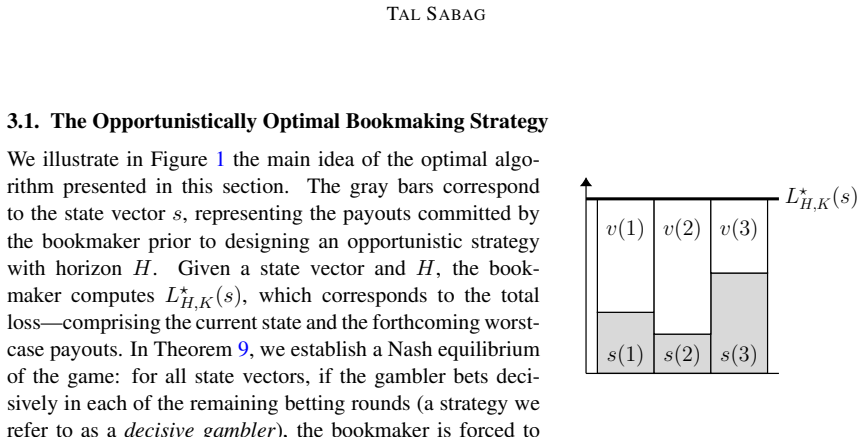
- Algorithm 1 achieves the optimal loss against an optimal (decisive) gambler, and whenever the gambler deviates from optimality the algorithm lowers the 'water level' to the optimal opportunistic loss.
- The characterization subsumes the previously known binary case $K=2$, where the loss is $T+\sqrt{T}$, and extends it to arbitrary $K$.
- The Bellman-Pareto frontier provides an explicit, efficiently computable description of all achievable residual payout vectors, which the paper argues may serve as a general tool for vector-valued repeated games.
Reading between the lines
- Editorial extension: the polynomial-root formula suggests that the value function is an algebraic function of the state for finite horizons; introducing noise or asymmetric outcomes might yield a perturbed polynomial whose roots still determine the value — a testable conjecture.
- Editorial extension: the water-filling optimal strategy implies that the bookmaker's worst-case loss is insensitive to how the gambler mixes across outcomes, so the same policy could serve as a risk-parity rule in continuous prediction markets.
- Editorial extension: for large $K$, the largest Hermite root behaves like $\sqrt{2K}$ with Airy-type corrections, so one could test whether finite-$T$ regret approaches $\sqrt{T}\beta_K$ from above or below as a function of $K$, a question not settled by the asymptotic theorem.
Signed reviews
Editorial analysis
A structured set of objections, weighed in public.
Referee Report
Summary. The paper studies a repeated zero-sum game between a bookmaker and a gambler with K possible outcomes and T betting rounds. The bookmaker chooses odds, the gambler chooses bets, and the bookmaker's worst-case loss is the maximal committed payout across outcomes. The main result, Theorem A, states that the optimal loss is the largest root of the explicit polynomial P_{T,K}(x)=∑_{m=0}^K C(K,m)(-T)^{K-m}x^m, where the superscript denotes the rising factorial. Theorem B claims that the regret R_{T,K}=L*_{T,K}-T grows like β_K√T, with β_K equal to the largest root of the K-th probabilist's Hermite polynomial He_K. The paper also introduces the Bellman-Pareto frontier, proves Theorem C characterizing the optimal opportunistic bookmaking loss and an O(TK^2) algorithm achieving it, and shows that bookmakers can make the overround arbitrarily close to 1 for large T. The proofs are carried out through a dynamic-programming value function, a Nash-equilibrium theorem for decisive gamblers, and a polynomial characterization of achievable residual loss vectors.
Significance. If the results hold, this is a substantial contribution: it gives an exact, closed-form characterization of the optimal loss for all K and T, extends the binary result of Bhatt et al. (2025) to arbitrary numbers of outcomes, provides a tractable algorithm with per-round complexity O(K^2), and establishes a surprising connection between bookmaking regret and Hermite polynomials. The paper is largely self-contained and parameter-free: no constants are fitted to data, and the central polynomial characterization is derived from first principles. I verified the K=2 and K=3 special cases and the structure of the Appendix D.1 coefficient extraction; the main proof architecture is coherent. However, the proof of Theorem B as printed contains a load-bearing normalization error: it claims a pointwise limit of polynomials that actually diverge by a factor of T^{K/2}. The claim is very likely true after an easy rescaling, but the written argument does not establish it. For this reason the appropriate verdict is major revision rather than acceptance in the current form.
major comments (1)
- [Appendix D.1, Eq. (D.6) and proof of Theorem B] The proof of Theorem B does not establish the stated pointwise limit. Equation (D.6) gives eP_{T,K}(x) = T^{K/2} ∑_{m=0}^K C(K,m) ec_{T,m} x^{K-m} with ec_{T,m} having powers of T at most 0 by Lemma 40. Consequently, for a fixed x with He_K(x) ≠ 0, eP_{T,K}(x) diverges in magnitude like T^{K/2}He_K(x); it does not converge to He_K(x). What is true is that the roots of eP_{T,K} are the same as the roots of Q_{T,K}(x) := T^{-K/2}eP_{T,K}(x). The proof should define Q_{T,K}, prove its coefficients converge to those of He_K (using the coefficient identities already present, including the m=2n terms and the Gould et al. identity), and then use the standard fact that roots of a monic polynomial depend continuously on its coefficients, or Hurwitz's theorem, to conclude β_K is the largest root of He_K. As printed, the limit step in Theorem B's proof is incorrect, and the Hermite relation asserted in the abstract is not justified by the written argument.
minor comments (5)
- [Section 4.2, proof of Theorem 12] In the forward direction, after setting s^ = -u and x = V_H(s^), the proof rules out x < 0 using Lemma 14.3 but does not explicitly rule out x > 0. This case should be excluded: if x > 0, then the vector x·1 - s^ = u + x·1 strictly dominates u, so by Lemma 14.3 it cannot be H-achievable, contradicting Theorem 9. An added sentence would make the argument complete.
- [Appendix D.6, Eq. (D.6)] The notation ec_{T,m} is used for a quantity that depends on T, but the subscript notation suggests a constant independent of T. Renaming this coefficient (for example c_{m,T}) would improve readability, especially since Theorem B takes limits in T.
- [Appendix E.4.1, final display of the derivation of (D.4)] The last displayed equation uses the symbol m in binom(m,d) even though the summation has been reindexed to n; this appears to be a typo for binom(n,d). Please correct it.
- [Equation (13)] The notation i_1 for the smallest positive root of the Airy function is easy to confuse with the imaginary unit; a name such as a_1 would be clearer.
- [Section 1, first paragraph] The sentence about UK football betting reads 'the overround typically 1 remains below 1.1'; the stray numeral '1' should be removed.
Circularity Check
No circular derivation: the polynomial and Hermite results are derived from first-principles dynamic programming; the only self-citation is not load-bearing.
full rationale
The central result, Theorem A, is obtained by specializing Theorem C to the zero state, and Theorem C follows from the Bellman-Pareto characterization in Theorem 12, which is proved through the inductive constraints in Lemma 14. The proof chain does not fit a parameter, rename an empirical pattern, or define a quantity in terms of the target result. The cited binary result of Bhatt et al. (2025) is used at the start of Section 2.2 to motivate restricting to decisive gamblers, and that citation shares an author with this paper; however, the decisive-gambler property for general states is re-proved independently in Theorem 9 via convexity of the value function (Lemma 31), the compact-continuous correspondence (Lemma 27), and the uniqueness argument (Lemma 30). Thus the self-citation is not load-bearing, and a normalization issue in the proof of Theorem B (the limit of eP_{T,K} as written diverges by T^{K/2} unless normalized) is a correctness concern, not a circularity: the claimed Hermite-root limit is an independent mathematical assertion rather than an input assumed in the derivation.
Assumptions & free parameters
assumptions (6)
- standard math Properties of elementary symmetric polynomials: generating function, recurrence, summation identities (Lemmas 24-26).
- standard math Berge's maximum theorem (Lemma 18).
- standard math Combinatorial identities for Stirling numbers and alternating binomial sums (Lemmas 41, 42, and Gould et al. 2015).
- standard math Roots of Hermite polynomials are real and their largest root has known bounds (Krasikov 2004).
- domain assumption The game is zero-sum with perfect recall, and deterministic strategies suffice for the bookmaker; the gambler's mixed strategies are captured by convex combinations over decisive bets.
- domain assumption The overround Gamma is fixed and time-independent, and odds are continuous variables r_t in the simplex.
Cite this review
Pith. "Pith review of Optimal Online Bookmaking for Any Number of Outcomes." pith.science (2026). https://pith.science/paper/AD3RD6X3
@misc{pith2026250616253,
  author       = {Pith},
  title        = {Pith review of: Optimal Online Bookmaking for Any Number of Outcomes},
  year         = {2026},
  howpublished = {\url{https://pith.science/paper/AD3RD6X3}},
  note         = {Machine review of arXiv:2506.16253}
}
read the original abstract
We study the Online Bookmaking problem, where a bookmaker dynamically updates betting odds on the possible outcomes of an event. In each betting round, the bookmaker can adjust the odds based on the cumulative betting behavior of gamblers, aiming to maximize profit while mitigating potential loss. We show that for any event and any number of betting rounds, in a worst-case setting over all possible gamblers and outcome realizations, the bookmaker's optimal loss is the largest root of a simple polynomial. Our solution shows that bookmakers can be as fair as desired while avoiding financial risk, and the explicit characterization reveals an intriguing relation between the bookmaker's regret and Hermite polynomials. We develop an efficient algorithm that computes the optimal bookmaking strategy: when facing an optimal gambler, the algorithm achieves the optimal loss, and in rounds where the gambler is suboptimal, it reduces the achieved loss to the optimal opportunistic loss, a notion that is related to subgame perfect Nash equilibrium. The key technical contribution to achieve these results is an explicit characterization of the Bellman-Pareto frontier, which unifies the dynamic programming updates for Bellman's value function with the multi-criteria optimization framework of the Pareto frontier in the context of vector repeated games.
Figures
Reference graph
Works this paper leans on
-
[1]
T m+1 = T · (T − 1)m
-
[2]
T m + m · T m−1 = (T + 1)m
-
[3]
T m = (−1)m(−T )m Definition 21 (The Stirling Numbers of the First Kind) The Stirling numbers of the first kind n k count the number of permutations of n elements consisting of exactly k disjoint cycles, where 1 ≤ k ≤ n. They satisfy the recurrence relation: n + 1 k = n n k + n k − 1 , for n ≥ 1, k≥ 1, with base cases: 0 0 = 1, n 0 = 0 for n >0, 0 k = 0 f...
work page 1994
-
[5]
(Weak) For every H ∈ N, ˆs ⪰ s =⇒ VH (ˆs) ≥ VH (s)
-
[6]
The proof of Lemma 29 is presented in Appendix B.2
(Strict) For every H ∈ N+, ˆs ≻ s =⇒ VH (ˆs) > VH (s). The proof of Lemma 29 is presented in Appendix B.2. Lemma 30 Let H ≥ 1 and suppose that the value functionVH−1 is convex. Then, for every states, the optimal bookmaker’s action r⋆ is unique and satisfies VH (s) = VH−1 (s + q ⊘ r⋆) ∀q ∈ EK. (20) The proof of Lemma 30, given in Appendix B.3, proceeds by...
-
[7]
DH,K is an infinitely differentiable function
-
[8]
, im} the expression ∂mvI stands for ∂v(i1)
For every m ∈ [K] and I ∈ [K] m ∂mDH,K ∂mvI (v) = DH,K−m v\I , where for I = {i1, . . . , im} the expression ∂mvI stands for ∂v(i1) . . . ∂v(im)
-
[9]
For every k ∈ [K] and m >1, ∂mDH,K ∂v(k)m (v) = 0. The proof of Lemma 36 is provided in Appendix E.3 and builds on the recurrence relation estab- lished in Lemma 13: DH,K (v) = v(k) · DH,K−1(v\k) − H · DH−1,K−1(v\k), for all H, K∈ N+. For the analysis, we use an equivalent form of the polynomial DH,K, given by DH,K (v) = KX m=0 (−1)mH m σK−m (v) (C.1) for...
work page 1978
Show all 15 references
-
[10]
State and Residual loss Vectors Update (Lines 4 and 8): element-wise vector operation, runs in O(K) time
-
[11]
These coefficients can be precomputed before the algorithm begins
Opportunistic Loss update (Line 6): (a) Computing the polynomial FH,K (15): This process consists of the following steps: • Computing the binomial coefficients K − n m − n for all 0 ≤ m, n≤ K. These coefficients can be precomputed before the algorithm begins. Using Pascal’s tr...
-
[12]
,DH−1,K−1(v\K) in O(K2)
Optimal Odds Update (Line 10): Using PESP, we compute all the necessary ESPs for the polynomials DH−1,K−1(v\1), . . . ,DH−1,K−1(v\K) in O(K2). The falling factorials required for these computations are obtained in O(K). Each polynomial, for k ∈ [K], involves K + 1iterations, e...
2025
-
[13]
Hence DH,K is itself a multivariate polynomial, and therefore C∞ on RK
By (16), DH,K (v) is a finite sum of elementary symmetric polynomials (each of which is a polynomial in v). Hence DH,K is itself a multivariate polynomial, and therefore C∞ on RK
-
[14]
• Base case (m = 1): Let k ∈ [K] be some index
We prove by induction on m. • Base case (m = 1): Let k ∈ [K] be some index. By Lemma 13, ∂ ∂v(k) DH,K (v) = ∂ ∂v(k) v(k) · DH,K−1 v\k − H · DH−1,K−1 v\k = DH,K−1 v\k • Inductive step (m → m + 1): Let m ∈ [K − 1]. Fix any subset of indices I = {i1, . . . , im} ⊂[K] of size m, a...
-
[15]
By Lemma 36.2 it holds that ∂m ∂v(k)m DH,K (v) = ∂m−1 ∂v(k)m−1 DH,K−1 v\k = 0
Let k ∈ [K] and m >1. By Lemma 36.2 it holds that ∂m ∂v(k)m DH,K (v) = ∂m−1 ∂v(k)m−1 DH,K−1 v\k = 0. Proof [Proof of Lemma 38] LetrH be any sequence of actions chosen by the bookmakerΨH. Then, if the gambler bets on a single outcomek ∈ [K] in each of the remaining H rounds, th...
-
[2025]
David Blackwell
arXiv:2501.06923. David Blackwell. An analog of the minimax theorem for vector payoffs. Pacific Journal of Mathe- matics, 6(1):1–8, 1956. Stephen Boyd and Lieven Vandenberghe.Convex Optimization. Cambridge University Press, 2004. N. Cesa-Bianchi and G. Lugosi. Prediction, Lear...
1990 arXiv
Reviewed August 6, 2026 · model on record in the stance chip above.
Discussion (0). Continue with ORCID to comment.