REVIEW 3 major objections 5 minor 2 cited by
Comparison between Causal and Acausal Diffusion: a Schwinger-Keldysh Effective Field Theory Perspective
T0 review · 3 major / 5 minor · reviewed 2026-08-06 · deepseek-v4-flash
Pith's one-line read By computing the one-loop correction to the real-time density correlation function in the Schwinger-Keldysh effective field theory of causal diffusion, this paper shows that in the underdamped (quasi-diffusive) limit the nonlinear…
desk verdict Genuinely new underdamped real-time scaling prediction for causal diffusion, but the derivation is compressed and the perturbative-control condition is fine-tuned; worth a serious referee on both points. read the letter →
The pith
A machine-rendered reading of the paper's core claim, the machinery that carries it, and where it could break.
The reading
What carries the argument
The engine of the argument is the one-loop expression for the density correlation function in momentum space, Eq. (4.8), together with its analytic structure. In the causal theory the two linear-response modes $\omega_1$ and $\omega_2$ combine into four channels, and the on-shell (pinch) singularities of internal lines inside the loop produce four branch points $\tilde\omega_{ij}$; as $\tau D k^2$ grows, the branch cuts collide, re-split, and in the underdamped limit shrink into double poles, turning the Fourier integral into a pure residue computation. The underlying effective field theory is the standard Schwinger-Keldysh action with a noise field $n_a$, specialised by taking $\tau$ and $\sigma$ constant so that the density-dependent diffusivity $D(n)$ carries all nonlinearities, with coupling $\lambda_D = dD/dn$; the nonlinear-order KMS condition fixes this specialisation.
What would settle it
Measure the real-time density correlation function at fixed large wave number in a quasi-diffusive cold-atom system at times of order the relaxation time: if the data do not track the damped oscillation combined with the universal correction $G_c$ prescribed by Eq. (5.2), apart from the single amplitude factor set by $\lambda_D$, the single-slow-mode causal theory is falsified. A cheaper check is the high-frequency sum rule: a measured $\omega^2\chi(\omega,k)$ that diverges as $\omega\to\infty$ rules out causal diffusion for that system.
Extended reading notes
Core claim
The central claim, stated on the authors' own terms, is that causal diffusion with a single slow non-hydrodynamic mode remains analytically solvable at one-loop order in both of its physical limits. In the overdamped limit, $\tau D k^2 \sim \tau\omega \ll 1$, the one-loop correction to the real-time density correlation function reproduces the acausal result, Eq. (4.13), with the universal scaling function $F_c(\tilde t_1)$ depending only on $\tilde t_1 = t D k^2$. In the underdamped limit, $\tau D k^2 \gg 1$, the four branch cuts of the loop-corrected correlator contract into second-order poles, and the inverse Fourier integral is evaluated by residues to give Eq. (4.15): $\delta G_{nn}^B(t,k) = \frac{T^2\chi^2 \lambda_D^2}{4 D^2}\,\frac{\tau D k^2}{\sqrt{\tau D}}\,G_c(\tilde t_2)$, with $\tilde t_2 = t/\tau$ and $f_0 = \sqrt{\tau D k^2}$. The same calculation exposes a causality signature: the high-frequency sum rule, $\lim_{\omega\to\infty}\omega^2\chi(\omega,k) = -\chi D k^2/\tau$, holds only in the causal theory, while for acausal diffusion both sides diverge. The paper offers these results as groundwork for precision tests of the Schwinger-Keldysh effective field theory in quasi-diffusive systems such as cold atoms on optical lattices.
Load-bearing premise
The underdamped prediction is under perturbative control only if the susceptibility is large enough to keep a combination that grows with the product of relaxation time, diffusivity, and squared wave number small, a condition the paper acknowledges as fine-tuning without tying it to any particular real system.
Editorial extensions
If this is right
- In the overdamped regime, causal and acausal diffusion make identical one-loop predictions, so the precision-test protocol developed for acausal diffusive systems applies unchanged to the causal theory at late times.
- In the underdamped regime, the closed-form function $G_c$ provides analytically controlled predictions at times of order the relaxation time $\tau$, a window the acausal theory cannot describe.
- The high-frequency sum rule distinguishes the two theories without any loop calculation: a measured response with finite $\omega^2\chi(\omega,k)$ signals a relaxation time, while a divergent one signals pure Fick diffusion.
- Once $D(n)$ is measured in linear response, $\lambda_D$ is fixed and the nonlinear correction is parameter-free, so deviations from Eqs. (4.13) and (4.15) indicate physics beyond the single-slow-mode description.
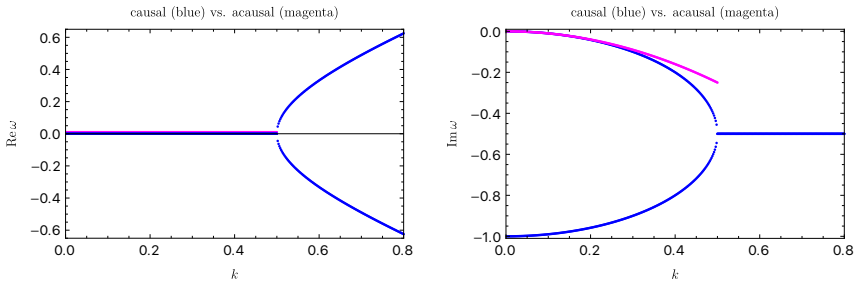
- Loop corrections split each linear-response pole into two, and in the causal theory the resulting four modes repel rather than merge at the momentum where the linear modes collide.
Reading between the lines
- Editorial extension: the double-pole residue machinery that produces $G_c$ should be iterable to two loops in the quasi-diffusive regime, potentially predicting long-time tails of a type the paper does not address.
- Editorial extension: in a system without a large susceptibility, the one-loop term of Eq. (4.15) is subleading and the dominant nonlinearity should come from density-dependent $\sigma$ or $\tau$, the couplings this effective field theory deliberately holds constant; that crossover is a natural next target.
- Editorial extension: the high-frequency sum-rule test can be applied to already existing response data to classify a measured diffusive system as causal or acausal before any one-loop analysis is attempted.
Editorial analysis
A structured set of objections, weighed in public.
Referee Report
Summary. The paper compares acausal Fick diffusion (Theory A) with causal Maxwell-Cattaneo diffusion (Theory B) within the Schwinger-Keldysh effective field theory framework. Using the momentum-space one-loop results of Refs. [15] and [16], it computes real-time density correlation functions in two asymptotic regimes: the overdamped limit, where it reproduces the known acausal result and its universal scaling function Fc, and the underdamped limit, where it claims a new universal scaling function Gc for the one-loop correction. The paper also analyzes the spectrum, dynamic susceptibility and sum rules, and presents numerical Fourier inversions supporting the scaling functions. The central new claim is Eq. (4.15): in the underdamped limit, δGnnB(t,k) = (T²χ²λ_D²)/(4D²) (τDk²)/√(τD) Gc(t/τ), with Gc given by Eq. (4.16).
Significance. If Eq. (4.15) is correct and the perturbative expansion is controlled, the paper provides an analytically tractable, universal prediction for nonlinear density fluctuations in quasi-diffusive systems, extending the SK-EFT program beyond the overdamped regime. The overdamped limit correctly recovers the known result of Ref. [31], and the numerical Fourier integrals in Fig. 12 provide nontrivial evidence for the scaling functions. The causality-based sum-rule check in Sec. 4.2 is a clean diagnostic distinguishing the two theories. However, the underdamped result is derived from a sketched contour argument whose uniformity is not established, and the physical applicability rests on a large-susceptibility assumption that is not quantified for the systems proposed for precision tests. These issues affect the central claim rather than peripheral presentation.
major comments (3)
- [Appendix E.2 and Eq. (4.15)] The underdamped result (4.15) is the central new analytical claim, but its derivation is only sketched. The text states that for τDk²≫1 the roots of the two square-root factors 'converge' and that the branch cuts reduce to two second-order poles, then writes Eq. (E.3) and asserts that the residue theorem gives Eq. (4.15) 'to leading order'. The actual residue computation is not shown, and no uniformity estimate is given for the double limit in which τDk² is sent to infinity while f0 = sqrt(τDk²) is kept as a finite parameter in Gc. This matters because the two sets of branch points differ by sqrt(τDk²)−sqrt(τDk²−1)=O(1/f0), and the oscillatory factors in (4.16) can amplify this difference over times of order t/τ; the plotted case f0=sqrt8 is not in a regime where this correction is manifestly negligible. Please provide the explicit contour deformation, the residue sum, and an estimate of the subleading corrections, or state precisely the asymptotic sense in which (4.15) holds.
- [Sec. 5, Eq. (5.2), and Appendix C] The proposed precision test in the underdamped regime rests on the condition stated in Sec. 5 that (χ0/χ) τDk² remain small, with χ0 ∼ T/(µ²√(τD)). No estimate of χ0/χ is given for any of the physical systems mentioned (cold atoms, QCD near the critical point, MHD). Without such an estimate, Eq. (5.2) is not established as the leading nonlinear correction in those systems, and the claim that Gc is the universal nonlinear prediction of the quasi-diffusive EFT is conditional on a fine-tuning assumption. The authors should either exhibit systems or parameter regimes where the condition holds, or reformulate the claim as a prediction for the one-loop contribution rather than for the full nonlinear correction.
- [Sec. 4.4.1, Eq. (4.16)] Even accepting the replacement of branch cuts by poles, the polynomial prefactors in Gc (the terms (1−t̃2/2), (1+t̃2/8), (1−t̃2/4), and (7+t̃2)/8) are asserted without showing how they arise from the residue sum at the four second-order poles. Because these prefactors control the early-time and intermediate-time behavior of δGnnB, the derivation should display at least one intermediate step of the residue evaluation so that the reader can verify that no factor is lost in the square-root replacement.
minor comments (5)
- [Eq. (3.10) and surrounding text] The sentence 'the second is fixed by requiring that the demanding that the cross-correlator...' contains a duplicated phrase; please rephrase.
- [Sec. 3.2] The notation for the current-density correlator alternates between G(0)_Jin and G(0)_Jj n; please use one convention consistently.
- [Sec. 4.4.1] Eq. (4.13) uses |k| while Eq. (4.15) uses k² and f0 = sqrt(τDk²); in d=1 the sign convention for k should be stated explicitly.
- [References] Reference [34] is missing its title and journal information, and the bibliographic entry for Ref. [46] is incomplete; please check the final reference list.
- [Table 1, row 9] The displayed expression for δD in Theory B has an unbalanced bracket in the typeset version; please verify the mathematical expression and its parentheses.
Circularity Check
No significant circularity: the underdamped one-loop result is a new Fourier inversion of a prior independent SK-EFT correlator, not a renamed input.
full rationale
The central new claim is Eq. (4.15), the real-time one-loop correction in the underdamped limit. It is obtained in Appendix E.2 by Fourier-inverting the momentum-space one-loop correlator Eq. (4.8), imported from Ref. [16]. That is a legitimate input-output relation, not a tautology: Ref. [16] is a separately published, parameter-free SK-EFT calculation under stated assumptions (tau and sigma constant), and it does not already contain the real-time scaling functions Fc or Gc. The Fourier inversion, branch-cut-to-pole replacement, residue evaluation, and numerical cross-check in Fig. 12 are new. The presence of overlapping authors in Ref. [16] is self-citation, but the cited result is independent support within the stated assumptions. Section 5's admission that perturbative control needs large susceptibility is an explicit limitation and correctness risk, not circularity: Eq. (4.15) remains a genuine one-loop prediction even if two-loop corrections dominate. No fitted parameter is renamed as a prediction, and the universal scaling functions are not smuggled in by definition.
Assumptions & free parameters
assumptions (3)
- domain assumption The system has a well-separated hierarchy of modes with the slowest non-hydrodynamic mode decaying on a timescale comparable to the diffusion mode (quasi-hydrodynamic assumption, Sec. 1).
- domain assumption The SK-EFT preserves KMS symmetry and takes t and sigma constant (or t'(n)/t = sigma'(n)/sigma), so that the only nonlinearity is D(n) (Sec. 3 and Appendix C).
- ad hoc to paper The susceptibility chi is sufficiently large to suppress the ratio (chi0/chi) tDk^2 in the underdamped regime, ensuring the perturbative expansion is controlled (Sec. 5).
Cite this review
Pith. "Pith review of Comparison between Causal and Acausal Diffusion: a Schwinger-Keldysh Effective Field Theory Perspective." pith.science (2026). https://pith.science/paper/CSG4KEVT
@misc{pith2026250620500,
  author       = {Pith},
  title        = {Pith review of: Comparison between Causal and Acausal Diffusion: a Schwinger-Keldysh Effective Field Theory Perspective},
  year         = {2026},
  howpublished = {\url{https://pith.science/paper/CSG4KEVT}},
  note         = {Machine review of arXiv:2506.20500}
}
read the original abstract
In Fick's time-honored theory of diffusion, the system responds instantaneously to external perturbations, resulting in acausal behavior. Maxwell-Cattaneo theory addresses this issue by introducing a relaxation time, rendering the diffusion process causal. We focus on systems where this relaxation time is comparable to the diffusion time and significantly larger than the relaxation times of all other non-conserved operators. In such systems, late-time diffusion is influenced by this relaxation process, leading to a theory of quasi-diffusion. Using the Schwinger-Keldysh Effective Field Theory (SK-EFT) framework, we compare the theories of diffusion and quasi-diffusion by analyzing the real-time dynamics of correlation functions both in linear response and at one-loop order. In particular, we show that the one-loop corrections in the causal (quasi-diffusion) theory, in both the underdamped and the overdamped cases, are governed by two universal functions. In the overdamped case, the behavior mirrors that of the acausal (diffusion) theory, which has recently been applied for precision tests of SK-EFT in diffusive systems. We suggest that our results in the underdamped limit can also be used for precision tests in quasi-diffusive systems.
Figures


Figures from the paper (9 more)


Forward citations
Cited by 2 Pith papers
-
Cumulant dynamics in finite-memory diffusion
Finite current relaxation introduces memory effects that suppress, shift, and reshape non-monotonic cumulant behavior relative to instantaneous equilibrium and Fickian diffusion, most visibly in higher-order cumulants.
-
Gaussian fluctuating Generally covariant diffusion
The authors extend a generally covariant formalism to include diffusion of conserved charges and comment on the seeming difference between the chemical potential term and the diffusion term.
Reference graph
Works this paper leans on
-
[16]
Theory of Nonlinear Diffusion with a Physical Gapped Mode,
N. Abbasi, M. Kaminski and O. Tavakol, “Theory of Nonlinear Diffusion with a Physical Gapped Mode,” Phys. Rev. Lett. 132 (2024) no.13, 131602 [arXiv:2212.11499 [hep-th]]
arXiv 2024
-
[15]
Theory of diffusive fluctuations,
X. Chen-Lin, L. V. Delacr´ etaz and S. A. Hartnoll, “Theory of diffusive fluctuations,” Phys. Rev. Lett. 122 (2019) no.9, 091602 [arXiv:1811.12540 [hep-th]]
arXiv 2019
-
[31]
Corrections to Diffusion in Interacting Quantum Systems,
A. A. Michailidis, D. A. Abanin and L. V. Delacr´ etaz, “Corrections to Diffusion in Interacting Quantum Systems,” Phys. Rev. X 14 (2024) no.3, 031020 [arXiv:2310.10564 [cond-mat.stat-mech]]
arXiv 2024
- [1]
-
[2]
Sur une forme de l’´ equation de la chaleur ´ eliminant le paradoxe d’une propagation instantan´ ee,
C. R. Cattaneo, “Sur une forme de l’´ equation de la chaleur ´ eliminant le paradoxe d’une propagation instantan´ ee,” Comptes Rendus247 (1958) no.4, 431
work page 1958
-
[3]
Relativistic dissipative hydrodynamics: A Minimal causal theory,
T. Koide, G. S. Denicol, P. Mota and T. Kodama, “Relativistic dissipative hydrodynamics: A Minimal causal theory,” Phys. Rev. C 75 (2007), 034909 [arXiv:hep-ph/0609117 [hep-ph]]
arXiv 2007
-
[4]
First-Order General-Relativistic Viscous Fluid Dynamics,
F. S. Bemfica, M. M. Disconzi and J. Noronha, “First-Order General-Relativistic Viscous Fluid Dynamics,” Phys. Rev. X 12 (2022) no.2, 021044 [arXiv:2009.11388 [gr-qc]]
arXiv 2022
-
[5]
Schwinger-Keldysh effective field theory for stable and causal relativistic hydrodynamics,
A. Jain and P. Kovtun, “Schwinger-Keldysh effective field theory for stable and causal relativistic hydrodynamics,” JHEP 01 (2024), 162 [arXiv:2309.00511 [hep-th]]
arXiv 2024
Show all 75 references
-
[6]
Does stability of relativistic dissipative fluid dynamics imply causality?,
S. Pu, T. Koide and D. H. Rischke, “Does stability of relativistic dissipative fluid dynamics imply causality?,” Phys. Rev. D 81 (2010), 114039 [arXiv:0907.3906 [hep-ph]]
2010 arXiv
-
[7]
First-order relativistic hydrodynamics with an information current,
L. Gavassino, N. Abboud, E. Speranza and J. Noronha, “First-order relativistic hydrodynamics with an information current,” Phys. Rev. D 109 (2024) no.8, 085013 [arXiv:2401.13852 [nucl-th]]
2024 arXiv
-
[8]
Holography and hydrodynamics with weakly broken symmetries,
S. Grozdanov, A. Lucas and N. Poovuttikul, “Holography and hydrodynamics with weakly broken symmetries,” Phys. Rev. D 99 (2019) no.8, 086012 [arXiv:1810.10016 [hep-th]]. 12The contour is counter-clockwise in the complex z-plane. 32
2019 arXiv
-
[9]
Hydrodynamics with parametric slowing down and fluctuations near the critical point,
M. Stephanov and Y. Yin, “Hydrodynamics with parametric slowing down and fluctuations near the critical point,” Phys. Rev. D 98 (2018) no.3, 036006 [arXiv:1712.10305 [nucl-th]]
2018 arXiv
-
[10]
Relaxed hydrodynamic theory of electrically driven non-equilibrium steady states,
D. K. Brattan, M. Matsumoto, M. Baggioli and A. Amoretti, “Relaxed hydrodynamic theory of electrically driven non-equilibrium steady states,” Phys. Rev. Res. 6, 043097 [arXiv:2404.05568 [cond-mat.stat-mech]]
-
[11]
Origin of the Relaxation Time in Dissipative Fluid Dynamics,
G. S. Denicol, J. Noronha, H. Niemi and D. H. Rischke, “Origin of the Relaxation Time in Dissipative Fluid Dynamics,” Phys. Rev. D 83 (2011), 074019 [arXiv:1102.4780 [hep-th]]
2011 arXiv
-
[12]
G. S. Denicol, H. Niemi, E. Molnar and D. H. Rischke, Phys. Rev. D 85, 114047 (2012) [erratum: Phys. Rev. D 91, no.3, 039902 (2015)] [arXiv:1202.4551 [nucl-th]]
2012 arXiv
-
[13]
Science 363, 379 (2019),
P. T. Brown, D. Mitchell, M. Guardado-Sanchez, R. Kondov, E. N. Demler, W. S. Bakr, “Science 363, 379 (2019),” arXiv:1802.09456 [cond-mat.quant-gas]
2019 arXiv
-
[14]
Baryon transport and the QCD critical point,
L. Du, X. An and U. Heinz, “Baryon transport and the QCD critical point,” Phys. Rev. C 104 (2021) no.6, 064904 [arXiv:2107.02302 [hep-ph]]
2021 arXiv
-
[17]
Hydrodynamic gradient expansion in linear response theory,
M. P. Heller, A. Serantes, M. Spali´ nski, V. Svensson and B. Withers, “Hydrodynamic gradient expansion in linear response theory,” Phys. Rev. D 104 (2021) no.6, 066002 [arXiv:2007.05524 [hep-th]]
2021 arXiv
-
[18]
Charge diffusion in relativistic resistive second-order dissipative magnetohydrodynamics,
A. Dash, M. Shokri, L. Rezzolla and D. H. Rischke, “Charge diffusion in relativistic resistive second-order dissipative magnetohydrodynamics,” Phys. Rev. D 107, no.5, 056003 (2023) [arXiv:2211.09459 [nucl-th]]
2023 arXiv
-
[19]
Resistive relativistic magnetohydrodynamics without Amperes Law,
R. Lier, A. Jain, J. Armas and O. Porth, “Resistive relativistic magnetohydrodynamics without Amperes Law,” [arXiv:2501.04638 [astro-ph.HE]]
-
[20]
Relativistic Fluid Dynamics In and Out of Equilibrium,
P. Romatschke and U. Romatschke, “Relativistic Fluid Dynamics In and Out of Equilibrium,” Cambridge University Press, 2019, ISBN 978-1-108-48368-1, 978-1-108-75002-8 [arXiv:1712.05815 [nucl-th]]. 33
2019 arXiv
-
[21]
New Developments in Relativistic Viscous Hydrodynamics,
P. Romatschke, “New Developments in Relativistic Viscous Hydrodynamics,” Int. J. Mod. Phys. E 19 (2010), 1-53 [arXiv:0902.3663 [hep-ph]]
2010 arXiv
-
[22]
Lectures on non-equilibrium effective field theories and fluctuating hydrodynamics,
H. Liu and P. Glorioso, “Lectures on non-equilibrium effective field theories and fluctuating hydrodynamics,” PoS TASI2017, 008 (2018) [arXiv:1805.09331 [hep-th]]
2018 arXiv
-
[23]
Effective field theory of dissipative fluids (II): classical limit, dynamical KMS symmetry and entropy current,
P. Glorioso, M. Crossley and H. Liu, “Effective field theory of dissipative fluids (II): classical limit, dynamical KMS symmetry and entropy current,” JHEP 09 (2017), 096 [arXiv:1701.07817 [hep-th]]
2017 arXiv
-
[24]
An entropy current in superspace,
K. Jensen, R. Marjieh, N. Pinzani-Fokeeva and A. Yarom, “An entropy current in superspace,” JHEP 01 (2019), 061 [arXiv:1803.07070 [hep-th]]
2019 arXiv
-
[25]
A panoply of Schwinger-Keldysh transport,
K. Jensen, R. Marjieh, N. Pinzani-Fokeeva and A. Yarom, “A panoply of Schwinger-Keldysh transport,” SciPost Phys. 5 (2018) no.5, 053 [arXiv:1804.04654 [hep-th]]
2018 arXiv
-
[26]
Effective Action for Relativistic Hydrodynamics: Fluctuations, Dissipation, and Entropy Inflow,
F. M. Haehl, R. Loganayagam and M. Rangamani, “Effective Action for Relativistic Hydrodynamics: Fluctuations, Dissipation, and Entropy Inflow,” JHEP 10 (2018), 194 [arXiv:1803.11155 [hep-th]]
2018 arXiv
-
[27]
Viscosity and dissipative hydrodynamics from effective field theory,
S. Grozdanov and J. Polonyi, “Viscosity and dissipative hydrodynamics from effective field theory,” Phys. Rev. D 91 (2015) no.10, 105031 [arXiv:1305.3670 [hep-th]]
2015 arXiv
-
[28]
Effective Action for Relativistic Hydrodynamics from the Crooks Fluctuation Theorem,
N. Mullins, M. Hippert and J. Noronha, “Effective Action for Relativistic Hydrodynamics from the Crooks Fluctuation Theorem,” Phys. Rev. Lett. 134 (2025) no.23, 232302 [arXiv:2501.04637 [nucl-th]]
2025 arXiv
-
[29]
Recent developments in relativistic hydrodynamic fluctuations,
G. Basar, “Recent developments in relativistic hydrodynamic fluctuations,” [arXiv:2410.02866 [hep-th]]
-
[30]
Statistical Physics Part 1,
L. D. Landau and E. M. Lifshitz, “Statistical Physics Part 1,” Course of Theoretical Physics, Vol 5 (Elsevier Science, 2013)
2013
-
[32]
Breakdown of Diffusion on Chiral Edges,
L. V. Delacretaz and P. Glorioso, “Breakdown of Diffusion on Chiral Edges,” Phys. Rev. Lett. 124 (2020) no.23, 236802 [arXiv:2002.08365 [cond-mat.str-el]]. 34
2020 arXiv
-
[33]
Relativistic hydrodynamic fluctuations from an effective action: Causality, stability, and the information current,
N. Mullins, M. Hippert, L. Gavassino and J. Noronha, “Relativistic hydrodynamic fluctuations from an effective action: Causality, stability, and the information current,” Phys. Rev. D 108 (2023) no.11, 116019 [arXiv:2309.00512 [hep-th]]
2023 arXiv
- [34]
-
[35]
Ginzburg-Landau effective action for a fluctuating holographic superconductor,
Y. Bu, M. Fujita and S. Lin, “Ginzburg-Landau effective action for a fluctuating holographic superconductor,” JHEP 09 (2021), 168 [arXiv:2106.00556 [hep-th]]
2021 arXiv
-
[36]
Holographic Schwinger-Keldysh effective field theories including a non-hydrodynamic mode,
Y. Liu, Y. W. Sun and X. M. Wu, “Holographic Schwinger-Keldysh effective field theories including a non-hydrodynamic mode,” [arXiv:2411.16306 [hep-th]]
-
[37]
Simple holograpic dual of the Maxwell-Cattaneo model,
Y. Ahn, M. Baggioli, Y. Bu, M. Matsumoto and X. Sun, “Simple holograpic dual of the Maxwell-Cattaneo model,” [arXiv:2506.00926 [hep-th]]
-
[38]
Causal Baryon Diffusion and Colored Noise,
J. I. Kapusta and C. Young, “Causal Baryon Diffusion and Colored Noise,” Phys. Rev. C 90 (2014) no.4, 044902 [arXiv:1404.4894 [nucl-th]]
2014 arXiv
-
[39]
On analytic properties of vertex parts in quantum field theory,
L. D. Landau, “On analytic properties of vertex parts in quantum field theory,” Nuclear Physics 13 (1959), 181-192
1959
-
[40]
The Analytic S-Matrix,
R. J. Eden, P. V. Landshoff, D. I. Olive, and J. C. Polkinghorne, “The Analytic S-Matrix,” Cambridge University Press, 1966
1966
-
[41]
Sequential Discontinuities of Feynman Integrals and the Monodromy Group,
J. L. Bourjaily, H. Hannesdottir, A. J. McLeod, M. D. Schwartz and C. Vergu, “Sequential Discontinuities of Feynman Integrals and the Monodromy Group,” JHEP 01 (2021), 205 [arXiv:2007.13747 [hep-th]]
2021 arXiv
-
[42]
How to Determine the Branch Points of Correlation Functions in Euclidean Space II: Three-Point Functions,
M. Q. Huber, W. J. Kern and R. Alkofer, “How to Determine the Branch Points of Correlation Functions in Euclidean Space II: Three-Point Functions,” Symmetry 15 (2023) no.2, 414 [arXiv:2302.01350 [hep-ph]]
2023 arXiv
-
[43]
Correlation functions in stable first-order relativistic hydrodynamics,
N. Abbasi, A. Davody and S. Tahery, “Correlation functions in stable first-order relativistic hydrodynamics,” Phys. Rev. D 109 (2024) no.3, 036006 [arXiv:2212.14619 [hep-th]]
2024 arXiv
-
[44]
Joule heating in bad and slow metals,
P. Glorioso and S. A. Hartnoll, “Joule heating in bad and slow metals,” SciPost Phys. 13 (2022) no.4, 095 [arXiv:2202.00689 [cond-mat.str-el]]
2022 arXiv
-
[45]
Hydrodynamics of a relativistic charged fluid in the presence of a periodically modulated chemical potential,
N. Chagnet and K. Schalm, “Hydrodynamics of a relativistic charged fluid in the presence of a periodically modulated chemical potential,” SciPost Phys. 16 (2024) no.1, 028 [arXiv:2303.17685 [cond-mat.str-el]]. 35
2024 arXiv
-
[46]
Quantum Monte Carlo study of the two-dimensional fermion Hubbard Model,
C. N. Varney, C.-R. Lee, Z. J. Bai, S. Chiesa, M. Jarrell and R. T. Scalettar, “Quantum Monte Carlo study of the two-dimensional fermion Hubbard Model,” Phys. Rev. B 80 (2009), 075116 [arXiv:0906.4311 [cond-mat.str-el]]
2009 arXiv
-
[47]
Viscosity, Black Holes, and Quantum Field Theory,
D. T. Son and A. O. Starinets, “Viscosity, Black Holes, and Quantum Field Theory,” Ann. Rev. Nucl. Part. Sci. 57 (2007), 95-118 [arXiv:0704.0240 [hep-th]]
2007 arXiv
-
[48]
Formation, dissociation, and regeneration of charmonia within microscopic Langevin simulations,
N. Oei, N. Krenz, H. van Hees, C. Greiner and J. M. Torres-Rincon, “Formation, dissociation, and regeneration of charmonia within microscopic Langevin simulations,” Phys. Rev. D 111 (2025) no.7, 074012 [arXiv:2410.19619 [hep-ph]]
2025 arXiv
-
[49]
Thermal Noise and Stochastic Strings in AdS/CFT,
D. T. Son and D. Teaney, “Thermal Noise and Stochastic Strings in AdS/CFT,” JHEP 07 (2009), 021 [arXiv:0901.2338 [hep-th]]
2009 arXiv
-
[50]
Transverse Momentum Broadening of a Fast Quark in a N=4 Yang Mills Plasma,
J. Casalderrey-Solana and D. Teaney, “Transverse Momentum Broadening of a Fast Quark in a N=4 Yang Mills Plasma,” JHEP 04 (2007), 039 [arXiv:hep-th/0701123 [hep-th]]
2007 arXiv
-
[51]
Heavy quark diffusion in strongly coupled N=4 Yang-Mills,
J. Casalderrey-Solana and D. Teaney, “Heavy quark diffusion in strongly coupled N=4 Yang-Mills,” Phys. Rev. D 74 (2006), 085012 [arXiv:hep-ph/0605199 [hep-ph]]
2006 arXiv
-
[52]
Dynamics of Heavy Quarks in Strongly Coupled N = 4 SYM Plasma,
K. Rajagopal, B. Scheihing-Hitschfeld and U. A. Wiedemann, “Dynamics of Heavy Quarks in Strongly Coupled N = 4 SYM Plasma,” [arXiv:2501.06289 [hep-ph]]
-
[53]
A Universal Equilibration Condition for Heavy Quarks,
K. Rajagopal, B. Scheihing-Hitschfeld and U. A. Wiedemann, “A Universal Equilibration Condition for Heavy Quarks,” [arXiv:2504.21139 [hep-ph]]
-
[54]
Non-Gaussianity from Schwinger-Keldysh effective field theory,
S. Lin, Y. Bu and C. Lei, “Non-Gaussianity from Schwinger-Keldysh effective field theory,” Phys. Rev. D 109 (2024) no.3, 036018 [arXiv:2301.06703 [hep-th]]
2024 arXiv
-
[55]
Theory of dynamic critical phenomena,
P. C. Hohenberg and B. I. Halperin, “Theory of dynamic critical phenomena,” Rev. Mod. Phys. 49 (1977), 435-479
1977
-
[56]
Critical dynamics in a real-time formulation of the functional renormalization group,
J. V. Roth and L. von Smekal, “Critical dynamics in a real-time formulation of the functional renormalization group,” JHEP 10 (2023), 065 [arXiv:2303.11817 [hep-ph]]
2023 arXiv
-
[57]
Universal scaling of conserved charge in stochastic diffusion dynamics,
S. Wu and H. Song, “Universal scaling of conserved charge in stochastic diffusion dynamics,” Chin. Phys. C 43 (2019) no.8, 084103 [arXiv:1903.06075 [nucl-th]]
2019 arXiv
-
[58]
Dynamical evolution of critical fluctuations with second-order baryon diffusion coupled to chiral condensate,
A. Sakai, K. Murase, H. Fujii and T. Hirano, “Dynamical evolution of critical fluctuations with second-order baryon diffusion coupled to chiral condensate,” [arXiv:2502.17791 [nucl-th]]. 36
-
[59]
Three-point functions from a Schwinger-Keldysh effective action, resummed in derivatives,
N. Abbasi and D. H. Rischke, “Three-point functions from a Schwinger-Keldysh effective action, resummed in derivatives,” [arXiv:2410.07929 [hep-th]]
-
[60]
Nonlinear response in diffusive systems,
L. V. Delacretaz and R. Mishra, “Nonlinear response in diffusive systems,” SciPost Phys. 16 (2024) no.2, 047 [arXiv:2304.03236 [cond-mat.str-el]]
2024 arXiv
-
[61]
An Open Effective Field Theory for light in a medium,
S. A. Salcedo, T. Colas and E. Pajer, “An Open Effective Field Theory for light in a medium,” [arXiv:2412.12299 [hep-th]]
-
[62]
Damping of Pseudo-Goldstone Fields,
L. V. Delacr´ etaz, B. Gout´ eraux and V. Ziogas, “Damping of Pseudo-Goldstone Fields,” Phys. Rev. Lett. 128 (2022) no.14, 141601 [arXiv:2111.13459 [hep-th]]
2022 arXiv
-
[63]
Schwinger-Keldysh effective action for hydrodynamics with approximate symmetries,
M. Hongo, N. Sogabe, M. A. Stephanov and H. U. Yee, “Schwinger-Keldysh effective action for hydrodynamics with approximate symmetries,” [arXiv:2411.08016 [hep-th]]
-
[64]
Effective field theories of dissipative fluids with one-form symmetries,
S. Vardhan, S. Grozdanov, S. Leutheusser and H. Liu, “Effective field theories of dissipative fluids with one-form symmetries,” [arXiv:2408.12868 [hep-th]]
-
[65]
Fluctuation-dissipation relation in cosmic microwave background,
A. Ota, “Fluctuation-dissipation relation in cosmic microwave background,” JCAP 05 (2024), 062 [arXiv:2402.07623 [hep-th]]
2024 arXiv
-
[66]
Off-equilibrium non-Gaussian fluctuations near the QCD critical point: an effective field theory perspective,
N. Sogabe and Y. Yin, “Off-equilibrium non-Gaussian fluctuations near the QCD critical point: an effective field theory perspective,” JHEP 03 (2022), 124 [arXiv:2111.14667 [nucl-th]]
2022 arXiv
-
[67]
Effective field theory for hydrodynamics without boosts,
J. Armas and A. Jain, “Effective field theory for hydrodynamics without boosts,” SciPost Phys. 11 (2021) no.3, 054 [arXiv:2010.15782 [hep-th]]
2021 arXiv
-
[68]
Lectures on hydrodynamic fluctuations in relativistic theories,
P. Kovtun, “Lectures on hydrodynamic fluctuations in relativistic theories,” J. Phys. A 45 (2012), 473001 [arXiv:1205.5040 [hep-th]]
2012 arXiv
-
[69]
The stickiness of sound: An absolute lower limit on viscosity and the breakdown of second order relativistic hydrodynamics,
P. Kovtun, G. D. Moore and P. Romatschke, “The stickiness of sound: An absolute lower limit on viscosity and the breakdown of second order relativistic hydrodynamics,” Phys. Rev. D 84 (2011), 025006 [arXiv:1104.1586 [hep-ph]]
2011 arXiv
-
[70]
Heavy Operators and Hydrodynamic Tails,
L. V. Delacretaz, “Heavy Operators and Hydrodynamic Tails,” SciPost Phys. 9 (2020) no.3, 034 [arXiv:2006.01139 [hep-th]]
2020 arXiv
-
[71]
Analytic structure of diffusive correlation functions,
S. Grozdanov, T. Lemut, J. Pelaiˇ c and A. Soloviev, “Analytic structure of diffusive correlation functions,” Phys. Rev. D 110 (2024) no.5, 056053 [arXiv:2407.13550 [hep-th]]. 37
2024 arXiv
-
[72]
Late Time Correlations in Hydrodynamics: Beyond Constitutive Relations,
A. Jain and P. Kovtun, “Late Time Correlations in Hydrodynamics: Beyond Constitutive Relations,” Phys. Rev. Lett. 128 (2022) no.7, 7 [arXiv:2009.01356 [hep-th]]
2022 arXiv
-
[73]
Long-time tails in the SYK chain from the effective field theory with a large number of derivatives,
N. Abbasi, “Long-time tails in the SYK chain from the effective field theory with a large number of derivatives,” JHEP 04 (2022), 181 [arXiv:2112.12751 [hep-th]]
2022 arXiv
-
[74]
A Bound on Thermalization from Diffusive Fluctuations,
L. V. Delacretaz, “A Bound on Thermalization from Diffusive Fluctuations,” [arXiv:2310.16948 [cond-mat.str-el]]
-
[75]
Long Time Tails in Stationary Random Media II: Applications,
J. Machta, M. H. Ernst, H. van Beijeren, and J. R. Dorfman, “Long Time Tails in Stationary Random Media II: Applications,” Journal of Statistical Physics, 35 Nos. 3/4 (1984), 413-441. 38
1984
Reviewed August 6, 2026 · model on record in the stance chip above.
Discussion (0). Sign in to comment.