Cumulant dynamics in finite-memory diffusion
Pith reviewed 2026-06-28 13:30 UTC · model grok-4.3
The pith
Finite current memory suppresses and reshapes non-monotonic cumulant behavior in diffusion models of the quark-gluon plasma.
A machine-rendered reading of the paper's core claim, the machinery that carries it, and where it could break.
Core claim
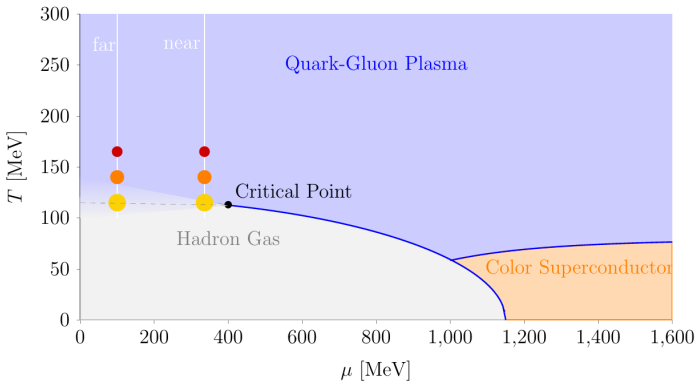
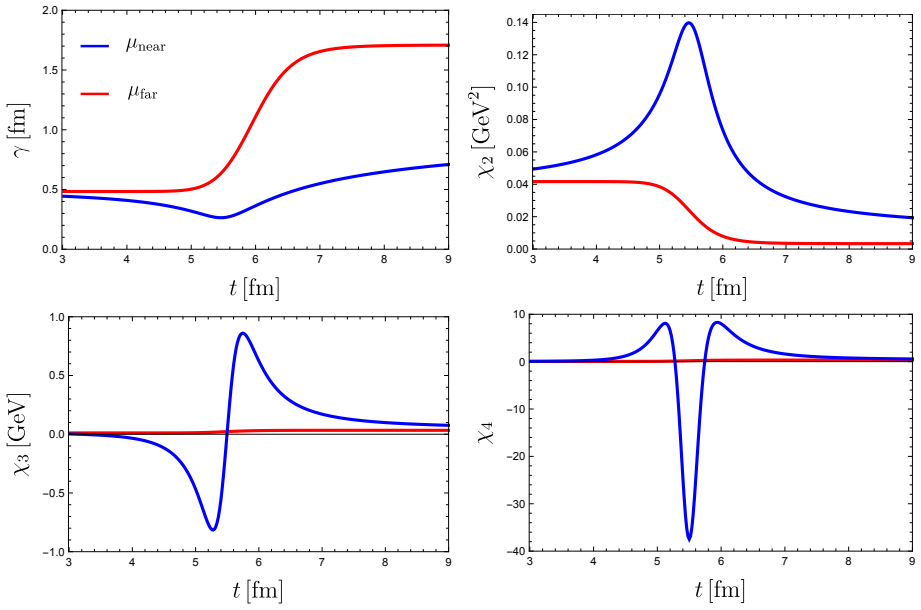
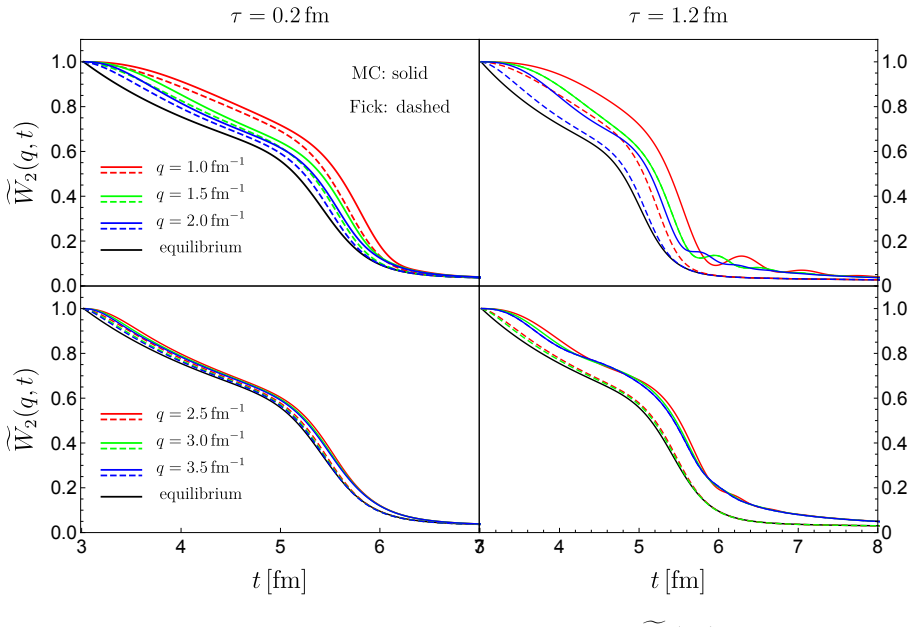
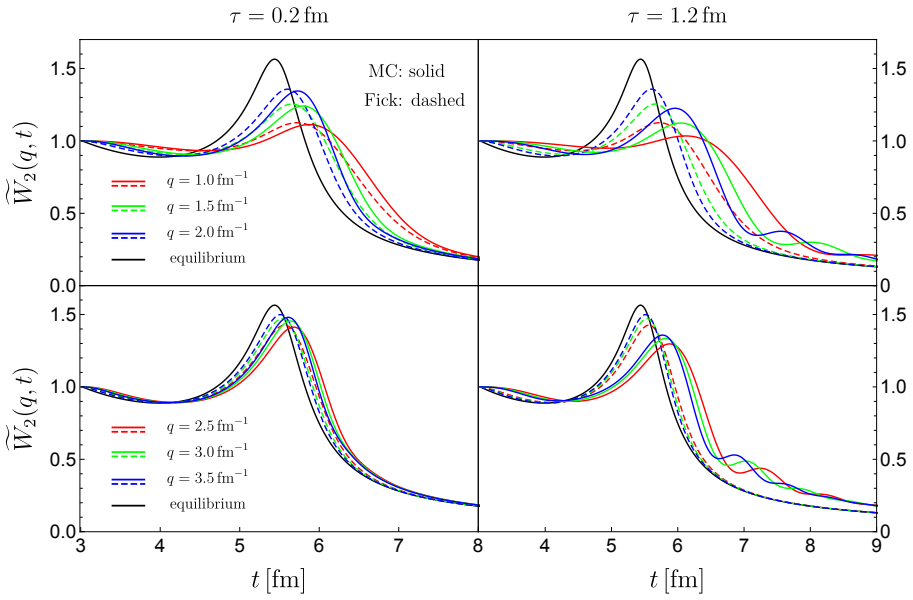
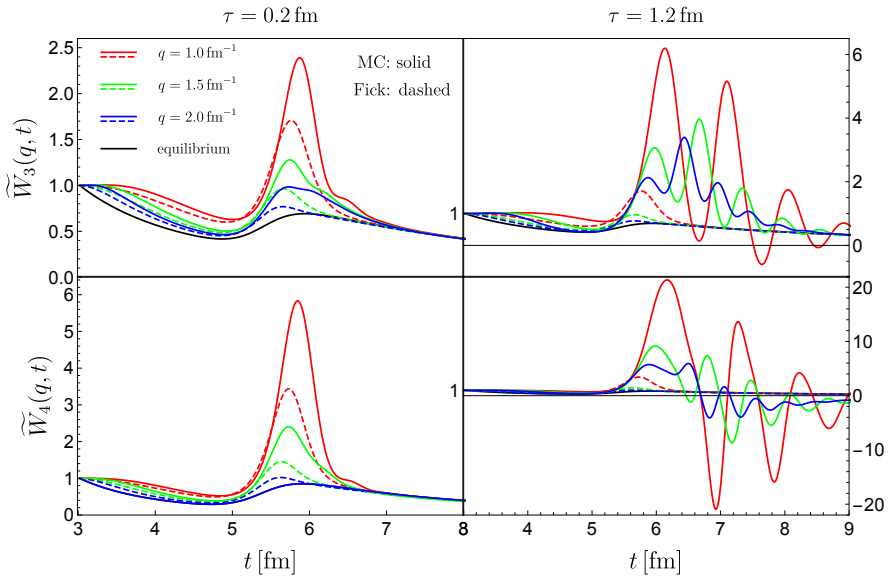
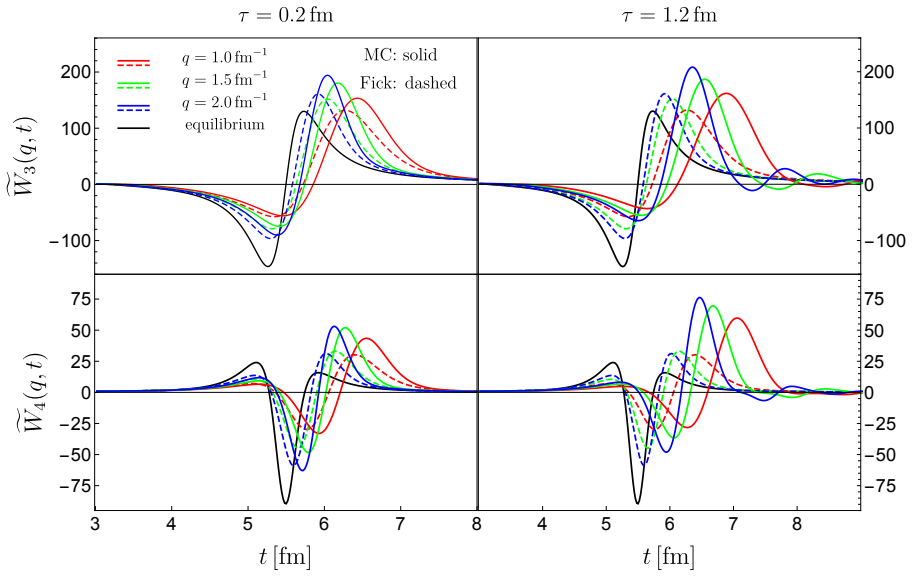
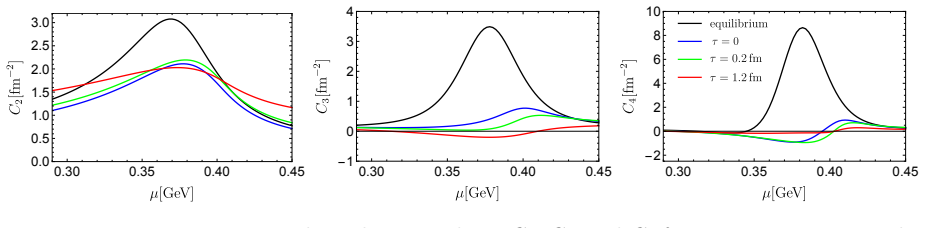
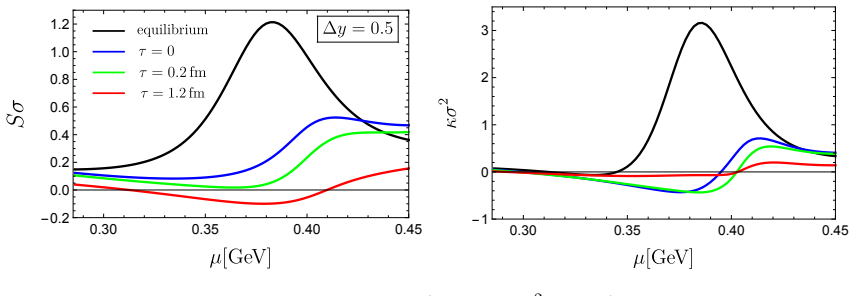
The central claim is that extending the diffusive evolution to include finite current relaxation time, via closed equations for multi-point Wigner functions, produces an additional memory effect that can suppress, shift, and reshape the non-monotonic behavior of acceptance-dependent cumulants relative to both instantaneous equilibrium and Fickian diffusion, with the most visible effects in higher-order cumulants and ratios along representative QCD phase diagram trajectories.
What carries the argument
Maxwell-Cattaneo diffusion, where the current relaxes on a finite time scale retaining memory, enabling derivation of closed evolution equations for multi-point Wigner functions.
If this is right
- Cumulants lag behind their instantaneous equilibrium values due to ordinary diffusion.
- Finite current relaxation adds a distinct memory-induced deviation on top of that lag.
- Non-monotonic features in the cumulants become suppressed, shifted, or reshaped.
- Higher-order cumulants and their ratios exhibit the largest sensitivity to the memory.
- The resulting freezeout values depend on the specific trajectory taken through the phase diagram.
Where Pith is reading between the lines
- Similar finite-memory corrections could matter in other transport settings where relaxation timescales overlap with system lifetimes.
- Heavy-ion collision analyses searching for the critical point may need to include this baseline to avoid misinterpreting fluctuation data.
- Varying the relaxation time parameter in simulations could identify regimes where memory effects dominate observable cumulant ratios.
Load-bearing premise
The current-relaxation time must be comparable to the relaxation time of the relevant fluctuation modes for the delayed-response effects to be non-negligible.
What would settle it
A direct comparison showing that measured cumulant ratios in heavy-ion collisions match Fickian diffusion predictions exactly, without additional suppression or shifting attributable to finite memory, would falsify the necessity of the Maxwell-Cattaneo extension.
Figures
read the original abstract
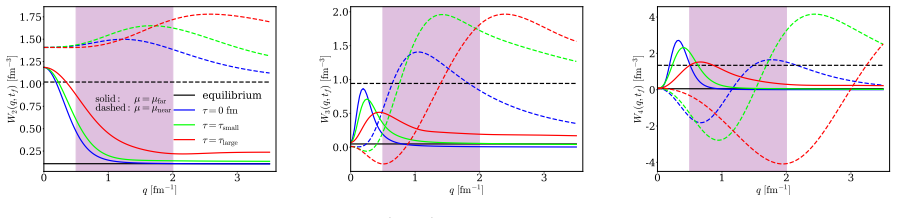
Fluctuations of conserved charges are among the main proposed signatures of the quantum chromodynamics (QCD) critical point, but their interpretation requires a dynamical description of how fluctuation correlators evolve during the finite lifetime of the quark--gluon plasma (QGP) fireball. The standard baseline for this evolution is Fickian diffusion, in which the diffusive current follows the local density gradient instantaneously. This instantaneous-current limit can miss delayed-response effects when the current-relaxation time becomes comparable to the relaxation time of the relevant fluctuation modes. In this work we extend this baseline to Maxwell--Cattaneo diffusion, where the current relaxes on a finite time scale and therefore retains memory. We derive closed evolution equations for multi-point Wigner functions and convert the freezeout correlators into acceptance-dependent cumulants along representative trajectories in the QCD phase diagram. While Fickian diffusion already causes the correlators to lag behind their instantaneous equilibrium values, finite current relaxation introduces an additional memory effect beyond this diffusive lag. As a result, current memory can suppress, shift, and reshape the non-monotonic behavior of the cumulants relative to both instantaneous equilibrium and Fickian diffusion, with the most visible effects appearing in higher-order cumulants and their ratios.
Editorial analysis
A structured set of objections, weighed in public.
Referee Report
Summary. The paper extends the standard Fickian diffusion model for conserved-charge fluctuations in the QGP to Maxwell-Cattaneo diffusion with finite current-relaxation time. It derives closed evolution equations for multi-point Wigner functions, converts the resulting freezeout correlators into acceptance-dependent cumulants along representative QCD trajectories, and reports that finite memory suppresses, shifts, and reshapes the non-monotonic cumulant behavior relative to both instantaneous equilibrium and Fickian diffusion, with the strongest impact on higher-order cumulants and ratios.
Significance. If the central results hold, the work supplies a technically useful extension of dynamical fluctuation modeling for QCD critical-point searches. The derivation of closed multi-point Wigner-function equations constitutes a clear methodological advance over the instantaneous-current baseline.
major comments (2)
- [Abstract] Abstract: the claim that finite current memory produces observable reshaping beyond Fickian lag is conditioned on the current-relaxation time becoming comparable to the relaxation times of the relevant fluctuation modes. The manuscript does not verify that this timescale condition is satisfied for the representative trajectories or parameter choices used in the cumulant computations; without such verification the reported additional memory effects remain conditional.
- [Numerical results / freezeout conversion] Conversion procedure (freezeout to acceptance-dependent cumulants): the load-bearing step that maps the evolved multi-point Wigner functions to the final cumulants inherits the unverified timescale assumption; if the chosen relaxation time remains much smaller than the diffusive timescales set by system size or wave-number, the reshaping effect does not materialize and the comparison to Fickian diffusion collapses to the already-known lag.
Simulated Author's Rebuttal
We thank the referee for the careful reading and constructive comments on our work. We address the two major comments point by point below, clarifying the parameter choices and proposing explicit additions to strengthen the presentation.
read point-by-point responses
-
Referee: [Abstract] Abstract: the claim that finite current memory produces observable reshaping beyond Fickian lag is conditioned on the current-relaxation time becoming comparable to the relaxation times of the relevant fluctuation modes. The manuscript does not verify that this timescale condition is satisfied for the representative trajectories or parameter choices used in the cumulant computations; without such verification the reported additional memory effects remain conditional.
Authors: We agree that observable reshaping beyond the Fickian lag requires the current-relaxation time to be comparable to the relaxation times of the relevant fluctuation modes. The representative trajectories and parameter sets in the manuscript were selected precisely so that this condition holds, which is why the computations exhibit suppression, shifts, and reshaping of the cumulants that are absent in the pure Fickian case. To remove any ambiguity we will add an explicit verification subsection (or appendix) that compares the current-relaxation time against the diffusive relaxation times set by system size and wave-number for each trajectory shown. revision: yes
-
Referee: [Numerical results / freezeout conversion] Conversion procedure (freezeout to acceptance-dependent cumulants): the load-bearing step that maps the evolved multi-point Wigner functions to the final cumulants inherits the unverified timescale assumption; if the chosen relaxation time remains much smaller than the diffusive timescales set by system size or wave-number, the reshaping effect does not materialize and the comparison to Fickian diffusion collapses to the already-known lag.
Authors: The conversion is performed on Wigner functions that have already evolved under the finite-memory dynamics. Because the reported cumulants display additional memory-induced features (suppression, shift, and reshaping) that are quantitatively distinct from the Fickian results, the timescale condition is satisfied for the displayed cases. Nevertheless, we accept that an explicit check would make the argument self-contained; we will therefore insert a short paragraph and accompanying table in the freezeout-conversion section that tabulates the relevant timescales for each trajectory and acceptance window. revision: yes
Circularity Check
No significant circularity; derivation uses independent input scales
full rationale
The paper treats the current-relaxation time as an independent external scale that must be comparable to fluctuation-mode times for the reported memory effects to appear. Closed equations for multi-point Wigner functions are derived from the Maxwell-Cattaneo constitutive relation and then converted to acceptance-dependent cumulants along trajectories; neither step reduces a claimed prediction to a quantity defined in terms of a fitted parameter or to a self-citation chain. The abstract and derivation explicitly flag the timescale condition as an input assumption rather than an output, and no self-definitional, fitted-input-called-prediction, or ansatz-smuggled patterns are exhibited. The central claim therefore remains self-contained against external benchmarks.
Axiom & Free-Parameter Ledger
free parameters (1)
- current relaxation time
axioms (2)
- standard math Charge conservation
- domain assumption Validity of Maxwell-Cattaneo constitutive relation for QGP
Reference graph
Works this paper leans on
-
[1]
Landau and E
L. Landau and E. Lifshitz,Fluid Mechanics, vol. 6 ofCourse of Theoretical Physics, Elsevier Science (2013)
2013
-
[2]
W. Florkowski, M.P. Heller and M. Spalinski,New theories of relativistic hydrodynamics in the LHC era,Rept. Prog. Phys.81(2018) 046001 [1707.02282]
Pith/arXiv arXiv 2018
-
[3]
Fourier,Th´ eorie analytique de la chaleur, Firmin Didot, p` ere et fils (1822)
J.-B.J. Fourier,Th´ eorie analytique de la chaleur, Firmin Didot, p` ere et fils (1822)
-
[4]
Fick,On liquid diffusion,The London, Edinburgh, and Dublin Philosophical Magazine and Journal of Science10(1855) 30
A. Fick,On liquid diffusion,The London, Edinburgh, and Dublin Philosophical Magazine and Journal of Science10(1855) 30
-
[5]
Cattaneo,Sur une forme de l’´ equation de la chaleur ´ eliminant le paradoxe d’une propagation instantan´ ee,Comptes Rendus de l’Acad´ emie des Sciences247(1958) 431
C. Cattaneo,Sur une forme de l’´ equation de la chaleur ´ eliminant le paradoxe d’une propagation instantan´ ee,Comptes Rendus de l’Acad´ emie des Sciences247(1958) 431
1958
-
[6]
Vernotte,Les paradoxes de la th´ eorie continue de l’´ equation de la chaleur,Comptes Rendus de l’Acad´ emie des Sciences246(1958) 3154
P. Vernotte,Les paradoxes de la th´ eorie continue de l’´ equation de la chaleur,Comptes Rendus de l’Acad´ emie des Sciences246(1958) 3154
1958
-
[7]
Israel and J.M
W. Israel and J.M. Stewart,Transient relativistic thermodynamics and kinetic theory,Annals Phys.118(1979) 341
1979
- [8]
- [9]
- [10]
-
[11]
Brants,Causal UV completions of relativistic hydrodynamics,2605.21377
R. Brants,Causal UV completions of relativistic hydrodynamics,2605.21377. 44
-
[12]
G.S. Denicol and J. Noronha,Stochastic fluctuations and the relaxation time in transient relativistic fluids,Phys. Lett. B868(2025) 139773 [2406.15569]
arXiv 2025
-
[13]
X. An, R. Brants, M.P. Heller and Y. Yin,Building far-from-equilibrium effective field theories using shift symmetries,arXiv:2511.11555 [hep-th]
-
[14]
Heaviside,On the extra current,Philosophical Magazine Series 52(1876) 135
O. Heaviside,On the extra current,Philosophical Magazine Series 52(1876) 135
-
[15]
Brown, D
P.T. Brown, D. Mitra, E. Guardado-Sanchez, R. Nourafkan, A. Reymbaut, C.-D. H´ ebert et al.,Bad metallic transport in a cold atom fermi-hubbard system,Science363(2019) 379
2019
-
[16]
Chester,Second sound in solids,Phys
M. Chester,Second sound in solids,Phys. Rev.131(1963) 2013
1963
-
[17]
M. Stephanov and Y. Yin,Hydrodynamics with parametric slowing down and fluctuations near the critical point,Phys. Rev. D98(2018) 036006 [1712.10305]
Pith/arXiv arXiv 2018
-
[18]
X. An, G. Ba¸ sar, M. Stephanov and H.-U. Yee,Fluctuation dynamics in a relativistic fluid with a critical point,Phys. Rev. C102(2020) 034901 [1912.13456]
arXiv 2020
-
[19]
P. Kovtun and L.G. Yaffe,Hydrodynamic fluctuations, long time tails, and supersymmetry, Phys. Rev. D68(2003) 025007 [hep-th/0303010]
Pith/arXiv arXiv 2003
-
[20]
J.V. Roth and L. von Smekal,Critical dynamics in a real-time formulation of the functional renormalization group,JHEP10(2023) 065 [2303.11817]
arXiv 2023
-
[21]
Stephanov,Non-Gaussian fluctuations near the QCD critical point,Phys
M.A. Stephanov,Non-Gaussian fluctuations near the QCD critical point,Phys. Rev. Lett. 102(2009) 032301 [0809.3450]
Pith/arXiv arXiv 2009
-
[22]
M. Asakawa, S. Ejiri and M. Kitazawa,Third moments of conserved charges as probes of QCD phase structure,Phys. Rev. Lett.103(2009) 262301 [0904.2089]
Pith/arXiv arXiv 2009
-
[23]
X. An, F. Giglio and G. Landolfi,Phase transitions and finite-size effects in integrable virial statistical models,Phys. Rev. E113(2026) L042103 [2503.15719]
Pith/arXiv arXiv 2026
-
[24]
X. Luo and N. Xu,Search for the QCD Critical Point with Fluctuations of Conserved Quantities in Relativistic Heavy-Ion Collisions at RHIC : An Overview,Nucl. Sci. Tech.28 (2017) 112 [1701.02105]
Pith/arXiv arXiv 2017
-
[25]
Koch,Hadronic Fluctuations and Correlations, inRelativistic Heavy Ion Physics, R
V. Koch,Hadronic Fluctuations and Correlations, inRelativistic Heavy Ion Physics, R. Stock, ed., pp. 626–652, Springer-Verlag Berlin Heidelberg (2010), DOI [0810.2520]
Pith/arXiv arXiv 2010
-
[26]
M. Asakawa and M. Kitazawa,Fluctuations of conserved charges in relativistic heavy ion collisions: An introduction,Prog. Part. Nucl. Phys.90(2016) 299 [1512.05038]
Pith/arXiv arXiv 2016
-
[27]
H.-T. Ding, F. Karsch and S. Mukherjee,Thermodynamics of strong-interaction matter from Lattice QCD,Int. J. Mod. Phys. E24(2015) 1530007 [1504.05274]. 45
Pith/arXiv arXiv 2015
-
[28]
L. Jiang, S. Wu and H. Song,Dynamical fluctuations in critical regime and across the 1st order phase transition,Nucl. Phys. A967(2017) 441 [1704.04765]
Pith/arXiv arXiv 2017
-
[29]
R. Stock, F. Becattini, M. Bleicher and J. Steinheimer,The QCD Phase Diagram from Statistical Model Analysis,Nucl. Phys. A982(2019) 827 [1811.07766]
Pith/arXiv arXiv 2019
- [30]
-
[31]
Bluhm et al.,Dynamics of critical fluctuations: Theory – phenomenology – heavy-ion collisions,Nucl
M. Bluhm et al.,Dynamics of critical fluctuations: Theory – phenomenology – heavy-ion collisions,Nucl. Phys. A1003(2020) 122016 [2001.08831]
arXiv 2020
-
[32]
S. Wu, C. Shen and H. Song,Dynamically Exploring the QCD Matter at Finite Temperatures and Densities: A Short Review,Chin. Phys. Lett.38(2021) 081201 [2104.13250]
arXiv 2021
- [33]
-
[34]
Fu,QCD at finite temperature and density within the fRG approach: an overview, Commun
W.-j. Fu,QCD at finite temperature and density within the fRG approach: an overview, Commun. Theor. Phys.74(2022) 097304 [2205.00468]
arXiv 2022
-
[35]
J. Li, L. Du and S. Shi,Rapidity scan approach for net-baryon cumulants with a statistical thermal model,Phys. Rev. C109(2024) 034906 [2311.11374]
arXiv 2024
- [36]
-
[37]
B. Ling, T. Springer and M. Stephanov,Hydrodynamics of charge fluctuations and balance functions,Phys. Rev. C89(2014) 064901 [1310.6036]
Pith/arXiv arXiv 2014
-
[38]
M. Nahrgang, M. Bluhm, T. Schaefer and S.A. Bass,Diffusive dynamics of critical fluctuations near the QCD critical point,Phys. Rev. D99(2019) 116015 [1804.05728]
Pith/arXiv arXiv 2019
- [39]
-
[40]
A. De, C. Plumberg and J.I. Kapusta,Calculating Fluctuations and Self-Correlations Numerically for Causal Charge Diffusion in Relativistic Heavy-Ion Collisions,Phys. Rev. C 102(2020) 024905 [2003.04878]
arXiv 2020
-
[41]
M. Nahrgang and M. Bluhm,Modeling the diffusive dynamics of critical fluctuations near the QCD critical point,Phys. Rev. D102(2020) 094017 [2007.10371]. 46
arXiv 2020
-
[42]
J. Chao and T. Schaefer,N-particle irreducible actions for stochastic fluids,JHEP06(2023) 057 [2302.00720]
arXiv 2023
-
[43]
C. Chattopadhyay, J. Ott, T. Schaefer and V. Skokov,Dynamic scaling of order parameter fluctuations in model B,Phys. Rev. D108(2023) 074004 [2304.07279]
arXiv 2023
-
[44]
X. An, G. Ba¸ sar, M. Stephanov and H.-U. Yee,Evolution of Non-Gaussian Hydrodynamic Fluctuations,Phys. Rev. Lett.127(2021) 072301 [2009.10742]
arXiv 2021
-
[45]
S. Mukherjee, R. Venugopalan and Y. Yin,Real time evolution of non-Gaussian cumulants in the QCD critical regime,Phys. Rev. C92(2015) 034912 [1506.00645]
Pith/arXiv arXiv 2015
-
[46]
L. Du, X. An and U. Heinz,Baryon transport and the QCD critical point,Phys. Rev. C104 (2021) 064904 [2107.02302]
arXiv 2021
-
[47]
E.V. Shuryak and M.A. Stephanov,When can long range charge fluctuations serve as a QGP signal?,Phys. Rev. C63(2001) 064903 [hep-ph/0010100]
Pith/arXiv arXiv 2001
-
[48]
M. Kitazawa and M. Asakawa,Relation between baryon number fluctuations and experimentally observed proton number fluctuations in relativistic heavy ion collisions,Phys. Rev. C86(2012) 024904 [1205.3292]
Pith/arXiv arXiv 2012
-
[49]
M. Pradeep, K. Rajagopal, M. Stephanov and Y. Yin,Freezing out fluctuations in Hydro+ near the QCD critical point,Phys. Rev. D106(2022) 036017 [2204.00639]
arXiv 2022
-
[50]
M.S. Pradeep and M. Stephanov,Maximum Entropy Freeze-Out of Hydrodynamic Fluctuations,Phys. Rev. Lett.130(2023) 162301 [2211.09142]
arXiv 2023
-
[51]
An,Non-Gaussian Fluctuation Dynamics,Acta Phys
X. An,Non-Gaussian Fluctuation Dynamics,Acta Phys. Polon. Supp.16(2023) 1 [2209.15005]
arXiv 2023
-
[52]
Christov,On frame indifferent formulation of the maxwell–cattaneo model of finite-speed heat conduction,Mechanics Research Communications36(2009) 481
C. Christov,On frame indifferent formulation of the maxwell–cattaneo model of finite-speed heat conduction,Mechanics Research Communications36(2009) 481
2009
-
[53]
H. Liu and P. Glorioso,Lectures on non-equilibrium effective field theories and fluctuating hydrodynamics,PoSTASI2017(2018) 008 [1805.09331]
Pith/arXiv arXiv 2018
-
[54]
X. An, G. Basar, M. Stephanov and H.-U. Yee,Non-Gaussian fluctuation dynamics in relativistic fluids,Phys. Rev. C108(2023) 034910 [2212.14029]
arXiv 2023
-
[55]
Y. Akamatsu, A. Mazeliauskas and D. Teaney,A kinetic regime of hydrodynamic fluctuations and long time tails for a Bjorken expansion,Phys. Rev. C95(2017) 014909 [1606.07742]
Pith/arXiv arXiv 2017
-
[56]
X. An, G. Basar, M. Stephanov and H.-U. Yee,Relativistic Hydrodynamic Fluctuations, Phys. Rev. C100(2019) 024910 [1902.09517]
arXiv 2019
-
[57]
M.P. Heller and M. Spalinski,Hydrodynamics Beyond the Gradient Expansion: Resurgence and Resummation,Phys. Rev. Lett.115(2015) 072501 [1503.07514]. 47
Pith/arXiv arXiv 2015
-
[58]
Hohenberg and B.I
P.C. Hohenberg and B.I. Halperin,Theory of Dynamic Critical Phenomena,Rev. Mod. Phys. 49(1977) 435
1977
-
[59]
M. Sakaida, M. Asakawa, H. Fujii and M. Kitazawa,Dynamical evolution of critical fluctuations and its observation in heavy ion collisions,Phys. Rev. C95(2017) 064905 [1703.08008]
Pith/arXiv arXiv 2017
- [60]
-
[61]
M. Cheng et al.,Baryon Number, Strangeness and Electric Charge Fluctuations in QCD at High Temperature,Phys. Rev. D79(2009) 074505 [0811.1006]
Pith/arXiv arXiv 2009
-
[62]
Bazavov et al.,The QCD Equation of State toO(µ 6 B)from Lattice QCD,Phys
A. Bazavov et al.,The QCD Equation of State toO(µ 6 B)from Lattice QCD,Phys. Rev. D95 (2017) 054504 [1701.04325]
Pith/arXiv arXiv 2017
-
[63]
A. Mukherjee, J. Steinheimer and S. Schramm,Higher-order baryon number susceptibilities: interplay between the chiral and the nuclear liquid-gas transitions,Phys. Rev. C96(2017) 025205 [1611.10144]
Pith/arXiv arXiv 2017
-
[64]
P. Parotto, M. Bluhm, D. Mroczek, M. Nahrgang, J. Noronha-Hostler, K. Rajagopal et al., QCD equation of state matched to lattice data and exhibiting a critical point singularity, Phys. Rev. C101(2020) 034901 [1805.05249]
arXiv 2020
-
[65]
Schofield,Parametric Representation of the Equation of State Near A Critical Point, Phys
P. Schofield,Parametric Representation of the Equation of State Near A Critical Point, Phys. Rev. Lett.22(1969) 606
1969
-
[66]
Josephson,Equation of state near the critical point,Journal of Physics C: Solid State Physics2(1969) 1113
B.D. Josephson,Equation of state near the critical point,Journal of Physics C: Solid State Physics2(1969) 1113
1969
-
[67]
Y. Zhang, Z. Wang, X. Luo and N. Xu,Search for the QCD Critical Point in High Energy Nuclear Collisions: A Status Report,Eur. Phys. J. Spec. Top.(2026) [arXiv:2602.08356 [nucl-ex]]
Pith/arXiv arXiv 2026
-
[68]
S. Wu, Z. Wu and H. Song,Universal scaling of theσfield and net-protons from Langevin dynamics of model A,Phys. Rev. C99(2019) 064902 [1811.09466]
Pith/arXiv arXiv 2019
-
[69]
S. Wu,Dynamics of the conserved net-baryon density near the QCD critical point within an inhomogeneous quark-gluon plasma profile,Phys. Rev. C111(2025) 014915 [2406.12325]
arXiv 2025
-
[70]
X. An, G. Basar, M. Stephanov and H.-U. Yee,Relativistic fluctuations in stochastic fluid dynamics,EPJ Web Conf.296(2024) 13011 [2402.18727]
arXiv 2024
-
[71]
X. An, G. Basar and M. Stephanov,Non-Gaussian fluctuations in relativistic hydrodynamics: Confluent equations for three-point correlations, 4, 2026. 48
2026
-
[72]
G. Basar and S. Song,Non-Gaussian hydrodynamic fluctuations in an expanding relativistic fluid,2604.27730
- [73]
-
[74]
N. Oei, N. Krenz, H. van Hees, C. Greiner and J.M. Torres-Rincon,Formation, dissociation, and regeneration of charmonia within microscopic Langevin simulations,Phys. Rev. D111 (2025) 074012 [2410.19619]
arXiv 2025
-
[75]
K. Rajagopal, B. Scheihing-Hitschfeld and U.A. Wiedemann,Universal Equilibration Condition for Heavy Quarks,Phys. Rev. Lett.135(2025) 242301 [2504.21139]
arXiv 2025
- [76]
-
[77]
S. Schlichting, D. Smith and L. von Smekal,Spectral functions and critical dynamics of the O(4) model from classical-statistical lattice simulations,Nucl. Phys. B950(2020) 114868 [1908.00912]
arXiv 2020
- [78]
- [79]
- [80]
discussion (0)
Sign in with ORCID, Apple, or X to comment. Anyone can read and Pith papers without signing in.