REVIEW 3 major objections 5 minor 54 references
Correlated reaction coordinate motion produces non-additive rate enhancement for electron and energy transfer in multi-acceptor structures
T0 review · 3 major / 5 minor · reviewed 2026-08-06 · deepseek-v4-flash
Pith's one-line read Multi-acceptor electron and energy transfer can beat the additive factor-of-two limit when acceptor–acceptor coupling is strong, temperature is low, and acceptor vibrations move anti-correlated.
desk verdict A genuinely new mechanism—acceptor–acceptor reorganization energy from correlated reaction-coordinate motion—is buried under an oversold comparison to experiment that rests on hand-picked correlation parameters. read the letter →
The pith
A machine-rendered reading of the paper's core claim, the machinery that carries it, and where it could break.
The reading
What carries the argument
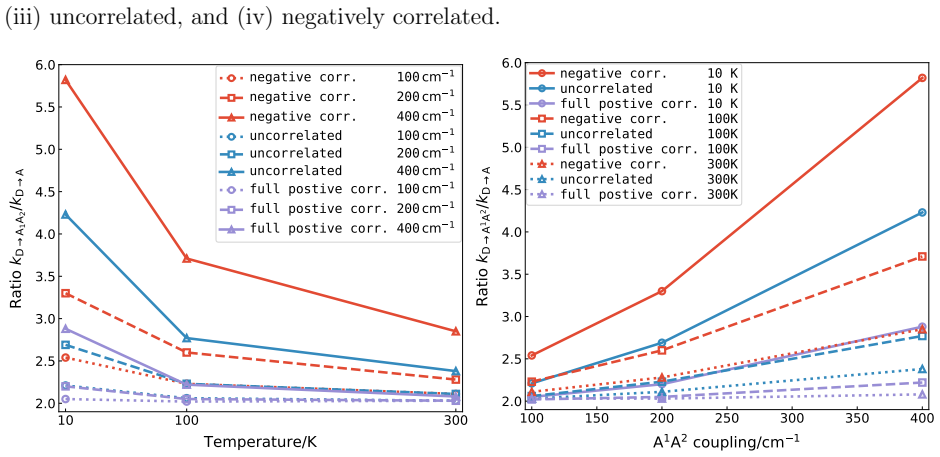
The machinery is a three-electronic-state vibronic Hamiltonian ($|D\rangle$, $|A_1\rangle$, $|A_2\rangle$) in which two sets of harmonic modes are shared between the two acceptor states with weights $\alpha$ and $\beta$ obeying $\alpha^2+\beta^2=1$, so the angle between the two reaction coordinates is tunable from fully correlated ($\alpha=\beta$) through uncorrelated ($\alpha=1$, $\beta=0$) to anti-correlated ($\beta<0$). The derived quantity that carries the argument is the acceptor–acceptor reorganization energy $\lambda^{\mathrm{reorg}}_{A_1,A_2} = \sum_n [(\alpha s_n-\beta s_n)^2 + (\beta s_n-\alpha s_n)^2]/\omega_n$, which is zero for fully correlated motion, $2\lambda$ for uncorrelated motion, and $3\lambda$ in the anti-correlated case used for the strong-enhancement predictions. Rates are computed by a partial summation of vibronic propagation pathways, a diagrammatic expansion of the donor survival amplitude kept to second order in the donor–acceptor coupling but summed to arbitrary order in the acceptor–acceptor coupling, with Monte Carlo evaluation of the thermal averages; the method is validated against the exact two-state Fermi golden rule in the fully correlated limit.
What would settle it
Compute the acceptor–acceptor reorganization energy (equivalently the correlation parameters $\alpha$ and $\beta$) for the experimental anthracene–1,4-benzoquinone molecule from its vibrational normal modes and solvent response. If it comes out at $2\lambda$ or less rather than the assumed $3\lambda$, the predicted $k_{D\to A_1A_2}/k_{D\to A}$ at $V_{A_1A_2}=400\,\mathrm{cm}^{-1}$ and $T=10\,\mathrm{K}$ falls toward 4 or below, weakening the claimed explanation. A complementary experiment would measure the two-acceptor/single-acceptor rate ratio as a function of temperature down to 10 K: the model predicts a steep rise below about 100 K because the non-additive pathways carry $\coth(\omega/k_BT)$ factors, whereas a purely coupling-based explanation would be nearly flat.
Extended reading notes
Core claim
The paper's central claim is that the non-additive rate enhancement in donor–two-acceptor systems arises from acceptor–acceptor interactions acting through three channels: a free-energy shift created by the acceptor–acceptor electronic coupling $V_{A_1A_2}$; coherently summed donor–acceptor coupling pathways of third and higher order (e.g., D→A1→A2→D and its repetitions); and, most importantly, the reorganization energy for A1→A2 transfer, which is set by the correlation between the two donor-to-acceptor reaction coordinates. When the two coordinates move out of phase with weights $\alpha\approx 0.97$ and $\beta\approx -0.26$, that reorganization energy is $3\lambda$, and the higher-order vibronic pathways — whose contributions carry factors like $\coth(\omega/k_BT)$ — survive at low temperature and amplify the rate well beyond the additive factor of two. The model obtains $k_{D\to A_1A_2}/k_{D\to A}=5.82$ for $V_{A_1A_2}=400\,\mathrm{cm}^{-1}$ at $10\,\mathrm{K}$, which the authors take to explain the measured 4-fold enhancement in the anthracene–dibenzoquinone system, and it predicts that systems with nearly parallel charge-transfer dipoles, for which the acceptor–acceptor reorganization energy is small, should show only the additive enhancement.
Load-bearing premise
The load-bearing premise is that, in the actual experimental molecule, the two acceptors' reaction-coordinate motions are strongly anti-correlated, giving an acceptor–acceptor reorganization energy near $3\lambda$ (three times the donor–acceptor reorganization energy); the paper supports this assignment with only a qualitative dipole-moment argument and never computes that quantity for the molecule.
Editorial extensions
If this is right
- The model attributes the measured 4- to 5-fold enhancement of the anthracene–dibenzoquinone system mainly to acceptor–acceptor reorganization energy created by anti-correlated reaction-coordinate motion, amplified at low temperature; the earlier $\sqrt{2}\times\sqrt{2}=4$-fold coupling argument is recovered as the fully correlated limit.
- When the two charge-transfer dipole moments are nearly parallel, as in the zinc porphyrin–NDI two-acceptor structures, the acceptor–acceptor reorganization energy is small and the predicted enhancement collapses to the additive factor of about two, matching the reported two-fold acceleration.
- At high temperature the vibrational bath is classical and a factor $\coth(\omega/k_BT)$ suppresses every non-additive pathway, so the two-acceptor rate cannot exceed twice the one-acceptor rate; strong enhancement requires low temperature or, equivalently, high-frequency vibrations.
- A donor with three anti-correlated acceptors sustains a 4-fold enhancement at 10 K even with acceptor–acceptor coupling as small as $80\,\mathrm{cm}^{-1}$, indicating that each added acceptor adds constructively interfering pathways.
- The analysis yields a concrete design strategy: maximize the A1-to-A2 reorganization energy by arranging acceptors so their charge-separation dipole changes differ strongly, keep acceptor–acceptor electronic coupling strong, and operate at low temperature.
Reading between the lines
- The quantitative match with experiment rests on an assumed parameter: the paper sets the anti-correlated weights ($\alpha\approx0.97$, $\beta\approx-0.26$) and hence $\lambda_{A_1A_2}=3\lambda$ from a qualitative dipole-moment argument. Computing $\alpha$ and $\beta$ for the actual molecule from its normal modes would either confirm the assignment or show that the real system sits in a milder regi
- A tunable design knob follows: the enhancement should vary continuously with the angle between the two charge-transfer dipole moments, from roughly the additive factor near 0 degrees (parallel) up to 5- to 6-fold near 120 degrees (anti-correlated); a homologous series of linkers that rotates the two acceptors relative to each other would map out this curve and test the mechanism directly.
- The pathway-interference mechanism should carry over to energy transfer in multi-chromophore light-harvesting assemblies, where correlated pigment vibrations are common; the analysis implies that engineering anti-correlated motion among acceptor chromophores could push energy-transfer rates beyond the sum of pairwise channels at cryogenic temperatures.
Editorial analysis
A structured set of objections, weighed in public.
Referee Report
Summary. The paper develops a partial-summation vibronic pathway theory for electron/energy transfer (ET/EnT) in one-donor, multi-acceptor systems. The model includes donor-acceptor and acceptor-acceptor electronic couplings, two (or three) correlated reaction-coordinate mode sets, and a Lorentzian spectral density. The authors analyze four correlation regimes and show that, for anti-correlated acceptor vibrations with a large acceptor-acceptor reorganization energy, the two-acceptor/single-acceptor rate ratio can reach 5.82 at 10 K for V_A1A2 = 400 cm^-1, which they compare with the 4- to 5-fold enhancement measured in Ref. 5. The fully correlated limit is benchmarked against an exact two-state Fermi golden rule calculation and agrees.
Significance. If the central mechanism is correct, the paper offers a concrete physical explanation for non-additive rate enhancement in multi-acceptor systems: acceptor-acceptor reorganization energy, generated by anti-correlated reaction-coordinate motion, amplifies higher-order vibronic pathway contributions at low temperature. The framework also yields qualitative design rules (large V_AA, low temperature, large lambda_AA) and extends naturally to three acceptors. The authors provide a reproducible code repository and transparent parameter tables (Tables S1–S3), and the fully correlated case is validated against an exact golden-rule benchmark, which lends credibility to the pathway-summation method in that limit. However, the quantitative comparison with the Phelan experiment rests on assumed, not computed, correlation parameters for the actual molecular structure, so the significance of the experimental claim is currently conditional.
major comments (3)
- [Sec. 2.2, Eq. (5), Table S3] The central experimental comparison is grounded in an assumed parameter point rather than a calculation for the molecule of Ref. 5. The anti-correlated simulation uses alpha = sqrt(2+sqrt(3))/2 ≈ 0.97 and beta = -sqrt(2-sqrt(3))/2 ≈ -0.26, chosen specifically so that Eq. (5) gives lambda_AA = 3 lambda = 15,736 cm^-1. Table S3 shows that the headline ratio k_D->A1A2/k_D->A = 5.79 at V_AA = 400 cm^-1 and T = 10 K drops to 4.23 for uncorrelated coordinates, 2.93 for partially correlated coordinates, and 2.88 for fully correlated coordinates. Sec. 3.1 supports the assignment to the anti-correlated regime only with the qualitative statement that the A1->A2 dipole-moment change 'can be substantial.' No calculation of alpha, beta, or lambda_AA for the Phelan molecule is provided. As written, the claim of 'good agreement' with the measured 4- to 5-fold enhancement is therefore an illustration at an assumed parameter point, not a test of the model for the actual molecule. The manuscript should either compute these correlation parameters (e.g., from the DFT charge/displacement data already used in Sec. 2.4) or explicitly reframe the experimental comparison as a conditional prediction that requires verification.
- [Sec. 2.4 vs. Sec. 3.1, Fig. 4] The electronic parameters used in the main simulations do not match the values computed for the molecule of Ref. 5. Sec. 2.4 reports DFT-based diabatic couplings V_DA1 = -144.8 cm^-1, V_DA2 = -68.0 cm^-1, and V_AA = 575.8 cm^-1, but the simulations in Fig. 4 and Tables S1–S3 use symmetric V_DA1 = V_DA2 = 109.7 cm^-1 and V_AA up to only 400 cm^-1. The paper does not explain why 109.7 cm^-1 is used instead of the computed values, nor why the computed V_AA = 575.8 cm^-1 is not used in the comparison. This parameter mismatch further weakens the direct quantitative link to the experiment; the predicted ratio of 5.82 is not the ratio for the DFT-characterized molecule.
- [Sec. 2.3 and SI Sec. S6] For the general (anti-correlated) case, the rate is computed with a finite-order resummation of acceptor-acceptor pathway terms, as detailed in SI Table S5, and the main text states that pathways with more than two donor-state visits are neglected. The manuscript does not state the truncation order used in the numerical simulations or provide a convergence check. This is load-bearing because the 5.82-fold enhancement is attributed precisely to higher-order AA pathways, and at V_AA = 400 cm^-1 with T = 10 K the AA coupling is not perturbatively small relative to the relevant vibronic energy scales. A convergence test (e.g., increasing the AA pathway order until the rate ratio stabilizes) is needed to demonstrate that the predicted non-additive enhancement is not an artifact of the truncation.
minor comments (5)
- [Eqs. (7)–(9)] The equations contain stray '⇐' symbols after the integrals, which appear to be LaTeX artifacts; these should be removed.
- [Sec. 3.1] The text says anti-correlated reaction coordinates form 'an angle θ > π'; this should read θ > π/2 (i.e., greater than 90°), consistent with Fig. 2(d).
- [Ref. 17] Reference 17 is incomplete: 'J. Am. Chem. Soc. 2024, (17)' lacks the article number or page range.
- [Fig. 4 caption] The caption refers to 'First:' and 'Second:' but the figure does not label its two panels; adding (a) and (b) labels would improve clarity.
- [Supporting Information] The SI contains several OCR-style artifacts (e.g., 'Vibrnoic Hamiltonian', garbled equation cross-references) that should be cleaned up before publication.
Circularity Check
No significant circularity: the rate enhancement is a numerical output of the stated Hamiltonian, though the experimental explanation rests on an uncomputed correlation parameter.
full rationale
After walking the derivation chain, I find no circular step. The rate ratio k_D→A1A2/k_D→A is a numerical output of the partial-summation rate theory applied to the Hamiltonian in Eqs. (1)–(4). The anti-correlated parameters α≈0.97, β≈−0.26 set the input reorganization energy λ_AA=3λ through Eq. (5); they do not encode the output ratio. Different correlation cases (Tables S1–S3) give different ratios, so the 5.82 value is not an identity with the chosen λ_AA. The paper does not fit the experimental 4-fold enhancement; it computes ratios at several V_AA values and temperatures, and one point (V_AA=400 cm⁻¹, T=10 K, anti-correlated) is close to the Ref. 5 value. The fully correlated limit is checked against an exact two-state Fermi golden rule, providing independent validation of the machinery. The weakness — that α, β, and λ_AA for the experimental molecule are not computed, only justified qualitatively via dipole-moment arguments — is an unverified-input / correctness risk, not circularity. The pathway-theory citations to the authors' own methodological work are not used to forbid alternatives or to import the central physical conclusion. The derivation is therefore self-contained as a model study, with the experimental attribution depending on an assumption rather than on a circular reduction.
Assumptions & free parameters
free parameters (4)
- alpha, beta (reaction-coordinate correlation parameters) =
anti-correlated: alpha = 0.97, beta = -0.26; partially correlated: alpha = 0.866, beta = 0.5
- V_DA (donor-acceptor electronic coupling) =
109.7 cm^-1
- V_A1A2 (acceptor-acceptor electronic coupling) =
100, 200, 400 cm^-1 (scan)
- Spectral density parameters lambda, eta, Omega =
lambda = 5245.4 cm^-1, eta = 263.4 cm^-1, Omega = 76.8 cm^-1
assumptions (6)
- domain assumption Condon approximation: electronic couplings V are independent of nuclear coordinates.
- domain assumption Non-adiabatic weak-coupling limit: perturbative expansion in DA coupling to second order.
- ad hoc to paper No vibrational pathway dephasing: all vibronic pathways are summed coherently.
- domain assumption Initial thermal equilibrium on the donor potential surface.
- ad hoc to paper Neglect of pathways with more than two donor-state visits.
- ad hoc to paper Truncation of the AA coupling pathway series at finite order for the general (anti-correlated) case.
Cite this review
Pith. "Pith review of Correlated reaction coordinate motion produces non-additive rate enhancement for electron and energy transfer in multi-acceptor structures." pith.science (2026). https://pith.science/paper/CDDJME2I
@misc{pith2026250621504,
  author       = {Pith},
  title        = {Pith review of: Correlated reaction coordinate motion produces non-additive rate enhancement for electron and energy transfer in multi-acceptor structures},
  year         = {2026},
  howpublished = {\url{https://pith.science/paper/CDDJME2I}},
  note         = {Machine review of arXiv:2506.21504}
}
read the original abstract
Molecular structures with multiple donor, bridge, or acceptor units can display quantum interference effects that influence electron and energy transfer (ET and EnT) rates. Recent experiments found a 4- to 5-fold increase in ET rates for donor-acceptor structures with two acceptors compared to one. This result is surprising: simple classical or quantum analysis suggests a factor of two rate enhancement. We analyze the coupling interactions in multiple acceptor systems and find that rate enhancements beyond additive effects arise from acceptor-acceptor interactions that: 1) shift the reaction free energy, 2) change the donor-acceptor couplings, and 3) alter the reaction-coordinate motion. Consideration of these effects explains the observed rates in multi-acceptor systems and suggests strategies to tailor energy and electron transfer kinetics.
Figures


Figures from the paper (3 more)


Reference graph
Works this paper leans on
-
[1]
How quantum coherence assists photosynthetic light-harvesting
Str\"umpfer, J.; Sener, M.; Schulten, K. How quantum coherence assists photosynthetic light-harvesting. J. Phys. Chem. Lett. 2012, 3, 536--542
work page 2012
-
[2]
Jakowetz, A. C.; B\"ohm, M. L.; Zhang, J.; Sadhanala, A.; Huettner, S.; Bakulin, A. A.; Rao, A.; Friend, R. H. What controls the rate of ultrafast charge transfer and charge separation efficiency in organic photovoltaic blends. J. Am. Chem. Soc. 2016, 138, 11672--11679
work page 2016
-
[3]
Bakulin, A. A.; Rao, A.; Pavelyev, V. G.; van Loosdrecht, P. H. M.; Pshenichnikov, M. S.; Niedzialek, D.; Cornil, J.; Beljonne, D.; Friend, R. H. The role of driving energy and delocalized states for charge separation in organic semiconductors. Science 2012, 335, 1340--1344
work page 2012
-
[4]
Lin, J.; Balamurugan, D.; Zhang, P.; Skourtis, S. S.; Beratan, D. N. Two-electron transfer pathways. J. Phys. Chem. B 2015, 119, 7589--7597
work page 2015
-
[5]
T.; Zhang, J.; Huang, G.-J.; Wu, Y.-L.; Zarea, M.; Young, R
Phelan, B. T.; Zhang, J.; Huang, G.-J.; Wu, Y.-L.; Zarea, M.; Young, R. M.; Wasielewski, M. R. Quantum coherence enhances electron transfer rates to two equivalent electron acceptors. J. Am. Chem. Soc. 2019, 141, 12236--12239
work page 2019
-
[6]
Terai, K.; Yuly, J. L.; Zhang, P.; Beratan, D. N. Correlated particle transport enables biological free energy transduction. Biophys. J. 2023, 122, 1762--1771
work page 2023
-
[7]
Feskov, S. V.; Ivanov, A. I. Efficiency of intramolecular electron transfer from the second excited state of the donor in molecular triads D--A 1--A 2. Russ. J. Phys. Chem. A 2016, 90, 144--151
work page 2016
-
[8]
Yuly, J. L.; Zhang, P.; Lubner, C. E.; Peters, J. W.; Beratan, D. N. Universal free-energy landscape produces efficient and reversible electron bifurcation. Proc. Natl. Acad. Sci. U.S.A. 2020, 117, 21045--21051
work page 2020
Show all 54 references
-
[9]
Cina, J. A. Dynamics of an excitation-transfer trimer: Interference, coherence, Berry’s phase development, and vibrational control of non-adiabaticity. J. Chem. Phys. 2023, 158
2023
-
[10]
L.; Gouterman, M
Fulton, R. L.; Gouterman, M. Vibronic coupling. I. Mathematical treatment for two electronic states. J. Chem. Phys. 1961, 35, 1059--1071
1961
-
[11]
Isolating non-adiabatically enhanced ground state quantum beats through two-dimensional electronic spectroscopy
Sahu, A.; Tiwari, V. Isolating non-adiabatically enhanced ground state quantum beats through two-dimensional electronic spectroscopy. J. Chem. Phys. 2025, 162
2025
-
[12]
E.; Mauck, C
Hartnett, P. E.; Mauck, C. M.; Harris, M. A.; Young, R. M.; Wu, Y.-L.; Marks, T. J.; Wasielewski, M. R. Influence of anion delocalization on electron transfer in a covalent porphyrin donor--perylenediimide dimer acceptor system. J. Am. Chem. Soc. 2017, 139, 749--756
2017
-
[13]
T.; Schultz, J
Phelan, B. T.; Schultz, J. D.; Zhang, J.; Huang, G.-J.; Young, R. M.; Wasielewski, M. R. Quantum coherence in ultrafast photo-driven charge separation. Faraday Discuss. 2019, 216, 319--338
2019
-
[14]
Photoinduced Cascading Charge Transfer in Perylene Bisimide-Based Triads
Loong, H.; Zhou, J.; Jiang, N.; Feng, Y.; Xie, G.; Liu, L.; Xie, Z. Photoinduced Cascading Charge Transfer in Perylene Bisimide-Based Triads. J. Phys. Chem. B 2022, 126, 2441--2448
2022
-
[15]
M.; Krzyaniak, M
Bancroft, L.; Zhang, J.; Harvey, S. M.; Krzyaniak, M. D.; Zhang, P.; Schaller, R. D.; Beratan, D. N.; Young, R. M.; Wasielewski, M. R. Charge transfer and spin dynamics in a zinc porphyrin donor covalently linked to one or two naphthalenediimide Acceptors. J. Phys. Chem. A 202...
2021
-
[16]
Fisher, J. M. Fundamental Electron Transfer Dynamics in Donor-Acceptor Compounds: One-, Two-, and Four-Pathway Systems. Ph.D.\ thesis, Northwestern University, 2023
2023
-
[17]
M.; Williams, M
Fisher, J. M.; Williams, M. L.; Palmer, J. R.; Powers-Riggs, N. E.; Young, R. M.; Wasielewski, M. R. Long-Lived Charge Separation in Single Crystals of an Electron Donor Covalently Linked to Four Acceptor Molecules. J. Am. Chem. Soc. 2024,
2024
-
[18]
D.; Silbey, R
Jang, S.; Newton, M. D.; Silbey, R. J. Multichromophoric F \"o rster resonance energy transfer. Phys. Rev. Lett. 2004, 92, 218301
2004
-
[19]
D.; Silbey, R
Jang, S.; Newton, M. D.; Silbey, R. J. Multichromophoric F \"o rster resonance energy transfer from B800 to B850 in the light harvesting complex 2: evidence for subtle energetic optimization by purple bacteria. J. Phys. Chem. B 2007, 111, 6807--6814
2007
-
[20]
Theory of multichromophoric coherent resonance energy transfer: A polaronic quantum master equation approach
Jang, S. Theory of multichromophoric coherent resonance energy transfer: A polaronic quantum master equation approach. J. Chem. Phys. 2011, 135
2011
-
[21]
D.; Jordanides, X
Scholes, G. D.; Jordanides, X. J.; Fleming, G. R. Adapting the F \"o rster theory of energy transfer for modeling dynamics in aggregated molecular assemblies. J. Phys. Chem. B 2001, 105, 1640--1651
2001
-
[22]
Scholes, G. D. Long-range resonance energy transfer in molecular systems. Annu. Rev. Phys. Chem. 2003, 54, 57--87
2003
-
[23]
D.; Fleming, G
Scholes, G. D.; Fleming, G. R. On the mechanism of light harvesting in photosynthetic purple bacteria: B800 to B850 energy transfer. J. Phys. Chem. B 2000, 104, 1854--1868
2000
-
[24]
B.; Kassal, I
Taylor, N. B.; Kassal, I. Generalised Marcus theory for multi-molecular delocalised charge transfer. Chem. Sci. 2018, 9, 2942--2951
2018
-
[25]
R.; Ratner, M
Zarea, M.; Powell, D.; Renaud, N.; Wasielewski, M. R.; Ratner, M. A. Decoherence and quantum interference in a four-site model system: Mechanisms and turnovers. J. Phys. Chem. B 2013, 117, 1010--1020
2013
-
[26]
L.; Zhang, P.; Ru, X.; Terai, K.; Singh, N.; Beratan, D
Yuly, J. L.; Zhang, P.; Ru, X.; Terai, K.; Singh, N.; Beratan, D. N. Efficient and reversible electron bifurcation with either normal or inverted potentials at the bifurcating cofactor. Chem 2021, 7, 1870--1886
2021
-
[27]
D.; Wasielewski, M
Powell, D. D.; Wasielewski, M. R.; Ratner, M. A. Redfield Treatment of Multipathway Electron Transfer in Artificial Photosynthetic Systems. J. Phys. Chem. B 2017, 121, 7190--7203
2017
-
[28]
P.; Phelan, B
Lin, C.; O’Connor, J. P.; Phelan, B. T.; Young, R. M.; Wasielewski, M. R. Ultrafast Charge Transfer Dynamics in a Slip-Stacked Donor--Acceptor--Acceptor System. J. Phys. Chem. A 2023,
2023
-
[29]
Mattuck, R. D. A guide to Feynman diagrams in the many-body problem, 2nd ed.; Dover Publications, 1992
1992
-
[30]
N.; Beratan, D
Onuchic, J. N.; Beratan, D. N.; Hopfield, J. J. Some aspects of electron-transfer reaction dynamics. J. Phys. Chem. 1986, 90, 3707--3721
1986
-
[31]
N.; de Andrade, P
Onuchic, J. N.; de Andrade, P. C. P.; Beratan, D. N. Electron tunneling pathways in proteins: a method to compute tunneling matrix elements in very large systems. J. Chem. Phys. 1991, 95, 1131--1138
1991
-
[32]
D.; Evans, D
Coalson, R. D.; Evans, D. G.; Nitzan, A. A nonequilibrium golden rule formula for electronic state populations in nonadiabatically coupled systems. J. Chem. Phys. 1994, 101, 436--448
1994
-
[33]
G.; Nitzan, A.; Ratner, M
Evans, D. G.; Nitzan, A.; Ratner, M. A. Photoinduced electron transfer in mixed-valence compounds: Beyond the golden rule regime. J. Chem. Phys. 1998, 108, 6387--6393
1998
-
[34]
Newton, M. D. Quantum chemical probes of electron-transfer kinetics: the nature of donor-acceptor interactions. Chem. Rev. 1991, 91, 767--792
1991
-
[35]
S.; Waldeck, D
Skourtis, S. S.; Waldeck, D. H.; Beratan, D. N. Inelastic electron tunneling erases coupling-pathway interferences. J. Phys. Chem. B 2004, 108, 15511--15518
2004
-
[36]
S.; Beratan, D
Skourtis, S. S.; Beratan, D. N. Theories of structure-function relationships for bridge-mediated electron transfer reactions. Adv. Chem. Phys. 1999, 106, 377--452
1999
-
[37]
K.; Jonas, D
Tiwari, V.; Peters, W. K.; Jonas, D. M. Electronic energy transfer through non-adiabatic vibrational-electronic resonance. I. Theory for a dimer. J. Chem. Phys. 2017, 147
2017
-
[38]
Solvent effects on the electron transfer reactions in supramolecular systems
Najbar, J.; Tachiya, M. Solvent effects on the electron transfer reactions in supramolecular systems. J. Photochem. Photobiol., A 1996, 95, 51--59
1996
-
[39]
Calculation of electron transfer rates using mixed quantum classical approaches: Nonadiabatic limit and beyond
Xie, W.; Bai, S.; Zhu, L.; Shi, Q. Calculation of electron transfer rates using mixed quantum classical approaches: Nonadiabatic limit and beyond. J. Phys. Chem. A 2013, 117, 6196--6204
2013
-
[40]
F.; Mendive-Tapia, D.; Bearpark, M
Izmaylov, A. F.; Mendive-Tapia, D.; Bearpark, M. J.; Robb, M. A.; Tully, J. C.; Frisch, M. J. Nonequilibrium Fermi golden rule for electronic transitions through conical intersections. J. Chem. Phys. 2011, 135, 234106
2011
-
[41]
Nonequilibrium Fermi’s golden rule charge transfer rates via the linearized semiclassical method
Sun, X.; Geva, E. Nonequilibrium Fermi’s golden rule charge transfer rates via the linearized semiclassical method. J. Chem. Theory Comput. 2016, 12, 2926--2941
2016
-
[42]
S.; Rubtsov, I
Xiao, D.; Skourtis, S. S.; Rubtsov, I. V.; Beratan, D. N. Turning charge transfer on and off in a molecular interferometer with vibronic pathways. Nano Lett. 2009, 9, 1818--1823
2009
-
[43]
Lepage, G. P. Adaptive multidimensional integration: VEGAS enhanced. J. Comput. Phys. 2021, 439, 110386
2021
-
[44]
E.; Yeganeh, S.; Cave, R
Subotnik, J. E.; Yeganeh, S.; Cave, R. J.; Ratner, M. A. Constructing diabatic states from adiabatic states: Extending generalized Mulliken--Hush to multiple charge centers with Boys localization. J. Chem. Phys. 2008, 129
2008
-
[45]
partial-summation
Nuomin, H. partial-summation. https://github.com/Beratan-Lab-Duke/partial-summation, 2024
2024
-
[46]
L.; Palmer, J
Williams, M. L.; Palmer, J. R.; Young, R. M.; Wasielewski, M. R. Charge Transfer Dynamics in Supramolecular Tessellations Composed of Aromatic Donors and Chiral Tris (naphthalenediimide) Triangular Acceptors. J. Am. Chem. Soc. 2024, 146, 34130--34140
2024
-
[47]
J.; Verhoeven, J
Brouwer, A.; Eijckelhoff, C.; Willemse, R. J.; Verhoeven, J. W.; Schuddeboom, W.; Warman, J. M. Two-step sequential light-induced electron transfer in a simple trichromophoric donor-donor-acceptor system. J. Am. Chem. Soc. 1993, 115, 2988--2989
1993
-
[48]
H.; Kim, Y
Yonemoto, E. H.; Kim, Y. I.; Schmehl, R. H.; Wallin, J. O.; Shoulders, B. A.; Richardson, B. R.; Haw, J. F.; Mallouk, T. E. Photoinduced electron transfer reactions in zeolite-based donor-acceptor and donor-donor-acceptor diads and triads. J. Am. Chem. Soc. 1994, 116, 10557--10563
1994
-
[49]
J.; Verhoeven, J
Willemse, R. J.; Verhoeven, J. W.; Brouwer, A. M. Reversible charge migration in the excited state of an electron Donor-Donor-Acceptor system detected via delayed charge transfer fluorescence. J. Phys. Chem. 1995, 99, 5753--5756
1995
-
[50]
E.; Pandey, L.; Barlow, S.; Tiwari, S
Polander, L. E.; Pandey, L.; Barlow, S.; Tiwari, S. P.; Risko, C.; Kippelen, B.; Bredas, J.-L.; Marder, S. R. Benzothiadiazole-dithienopyrrole donor--acceptor--donor and acceptor--donor--acceptor triads: synthesis and optical, electrochemical, and charge-transport properties. ...
2011
-
[51]
S.; Gierschner, J.; Yoon, S.-J.; Park, S
Kwon, M. S.; Gierschner, J.; Yoon, S.-J.; Park, S. Y. Unique piezochromic fluorescence behavior of dicyanodistyrylbenzene based donor--acceptor--donor triad: mechanically controlled photo-induced electron transfer (eT) in molecular assemblies. Adv. Mater. 2012, 24, 5487--5492
2012
-
[52]
Lin, J.-A.; Li, S.-W.; Liu, Z.-Y.; Chen, D.-G.; Huang, C.-Y.; Wei, Y.-C.; Chen, Y.-Y.; Tsai, Z.-H.; Lo, C.-Y.; Hung, W.-Y.; others Bending-type electron donor--donor--acceptor triad: dual excited-state charge-transfer coupled structural relaxation. Chem. Mater. 2019, 31, 5981--5992
2019
-
[53]
U.; Miao, J.; Meng, H
Zhao, J.; Yao, C.; Ali, M. U.; Miao, J.; Meng, H. Recent advances in high-performance organic solar cells enabled by acceptor--donor--acceptor--donor--acceptor (A--DA'D--A) type acceptors. Mater. Chem. Front. 2020, 4, 3487--3504
2020
-
[54]
Charge-Separated States Determined Photoinduced Electron Transfer Efficiency in a DDA System in an External Electric Field
Wang, X.; Wang, H.; Zhang, M.; Pullerits, T.; Song, P. Charge-Separated States Determined Photoinduced Electron Transfer Efficiency in a DDA System in an External Electric Field. J. Phys. Chem. C 2023, 127, 2805--2817 mcitethebibliography main_renamed.tex0000664000000000000000...
2023
Reviewed August 6, 2026 · model on record in the stance chip above.
Discussion (0). Continue with ORCID to comment.