REVIEW 1 major objections 4 minor 70 references
Implementation and representation of qudit multi-controlled unitaries and hypergraph states by N-body angular momentum couplings
T0 review · 1 major / 4 minor · reviewed 2026-08-06 · deepseek-v4-flash
Pith's one-line read In odd-dimensional qudit systems, the multi-controlled gate $C^{(n)}Z^k$ is exactly the unitary $\exp[(2k\pi i/d)J_z^{\otimes n}]$, so building the $n$-body spin coupling builds the gate.
desk verdict A correct and useful representation theorem mapping qudit multi-controlled gates to N-body angular momentum couplings, with a genuinely new state class; the optical implementation is plausible but leans on strong cross-Kerr, and a few minor slips need cleaning up. read the letter →
The pith
A machine-rendered reading of the paper's core claim, the machinery that carries it, and where it could break.
The reading
What carries the argument
The load-bearing object is the identity $C^{(n)}Z^k=\exp[(2k\pi i/d)J_z^{\otimes n}]$ for odd-dimensional qudits: it turns a circuit primitive into a Hamiltonian generator. Around it the paper assembles three supporting mechanisms: the reordered angular-momentum encoding that makes $R_z(2\pi/d)$ equal the local phase gate $Z$; the multi-mode Jordan-Schwinger map, which translates each $J_z^{\nu}J_z^{\mu}$ product into a linear combination of four bosonic number-number (cross-Kerr) interactions; and the decomposition lemma for qutrit hard-controlled gates, which reduces three-body couplings to sequences of two-body ones. The Pegg-Barnett phase operator $\Theta_z=FJ_zF^\dagger$ plays the same generator role for the $X$ side of the Pauli group.
What would settle it
Perform full process tomography on the proposed optical circuit for a single three-qutrit $CCZ$ gate in the nine-mode encoding; the output must be diagonal in the computational basis with phases $\omega^{abc}$ for $\omega=e^{2\pi i/3}$, so any non-diagonal residue or wrong phase shows that the Jordan-Schwinger/cross-Kerr representation is not exact.
Extended reading notes
Core claim
On the paper's own terms, the central discovery is a representation theorem: for odd $d=2j+1$, reorder the angular momentum basis so that the computational states are $|0_L\rangle=|m=0\rangle$, $|1_L\rangle=|m=1\rangle$, ..., $|j_L\rangle=|m=j\rangle$, $|(j+1)_L\rangle=|m=-j\rangle$, ..., $|(2j)_L\rangle=|m=-1\rangle$; then $R_z(2\pi/d)=Z$ and, by exponentiation, $C^{(n)}Z^k=\exp[(2k\pi i/d)J_z^{\otimes n}]$ for every $k\in\mathbb{Z}_d$. The same logic extends to other Pauli gates through the Pegg-Barnett phase operator $\Theta_z=F J_z F^\dagger$, which gives $X^k=\exp[(2k\pi i/d)\Theta_z]$, and expresses qutrit Clifford gates as rotations or quadratic polynomials in the $J_l$. For qudit hypergraph states the representation becomes $|H\rangle=\exp[(2\pi i/d)\sum_e g_e J_z^{(e)}]|+\rangle_V$, with $J_z^{(e)}=\bigotimes_{\nu\in e}J_z^\nu$, i.e. a hypergraph Hamiltonian exponentiated on the phase-eigenstate seed. The qutrit case is then decomposed into two-body hard-controlled gates, and the optical implementation realizes the needed couplings through the multi-mode Jordan-Schwinger map with cross-Kerr interactions. A new definition, the angular momentum hypergraph state $|J_H\rangle=\exp[-i\sum_e \phi_e J_z^{(e)}]|x_+\rangle_V$, is proposed so that the whole construction is expressed solely in angular momentum terms.
Load-bearing premise
The practical payoff rests on strong, low-loss two-mode cross-Kerr interactions between single-photon modes and on the multi-mode Jordan-Schwinger map being an exact optical analog of the angular momentum algebra; without those, the optical implementation is only a formal construction.
Editorial extensions
If this is right
- Any experiment that can tune an $n$-body interaction $J_z^{\otimes n}$ of the right strength directly produces a multi-controlled $Z$ gate, so platforms engineered for three- or five-body spin couplings become candidate qudit processors.
- Qudit hypergraph states in odd dimensions can be prepared by exponentiating a hypergraph Hamiltonian $\sum_e g_e J_z^{(e)}$ on $|+\rangle_V$, making hypergraph-state generation a Hamiltonian-simulation task.
- For qutrits, the gates $|1\rangle-CZ$, $|2\rangle-CZ^2$, and hence $CCZ$, decompose into five hard-controlled two-body gates, so existing two-body interaction platforms can reach three-qutrit controlled unitaries.
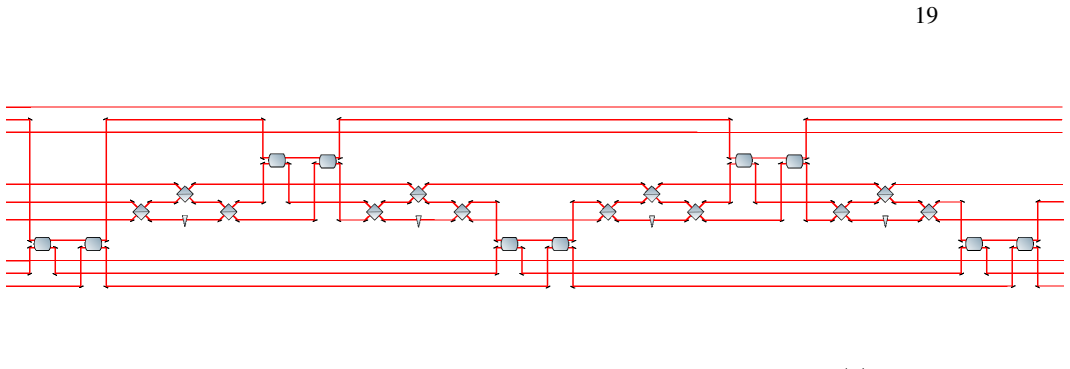
- The proposed optical scheme realizes $CCZ$ and uniform three-qutrit hypergraph states with single-photon sources, beam splitters, phase shifters, and cross-Kerr interactions, all resources currently available in quantum-optics laboratories.
- Angular momentum hypergraph states are SLOCC-equivalent to qudit hypergraph states via local diagonal operations, giving a new bridge between hypergraph entanglement classes and angular momentum physics.
Reading between the lines
- Read in reverse, the identity suggests that known atomic or condensed-matter systems already containing $N$-body $J_z$ couplings may secretly enact qudit Clifford circuits when coupling phases are tuned to $2k\pi/d$, giving a concrete search criterion for native qudit gates.
- If lossless cross-Kerr nonlinearities remain the scarce resource, the two-body decompositions suggest a resource trade: simulate each $J_z^{\otimes n}$ term by sequences of controlled gates and local rotations, trading lower nonlinearity for larger circuit depth.
- The angular momentum hypergraph states have an unexplored landscape of entanglement, contextuality, and magic-state properties; because they are built from $J_x$ eigenstates and $J_z$ couplings, they may be natural in platforms where the Pegg-Barnett phase-eigenstate seed $|+\rangle$ is not.
Editorial analysis
A structured set of objections, weighed in public.
Referee Report
Summary. The paper constructs a representation of qudit multi-controlled unitaries and qudit hypergraph states in terms of N-body angular momentum couplings. For odd-dimensional systems it establishes the identity C^{(n)}Z^k = exp[(2kπi/d) J_z^{⊗n}] under a specific basis encoding, and uses this to express hypergraph states as exponentials of sums of angular-momentum interactions. The qutrit (j=1) case is worked out in detail, including decompositions of three-qutrit controlled gates into two-body and local gates. A quantum-optical implementation is proposed using a multi-rail encoding, a three-mode Jordan-Schwinger map, single-photon sources, cross-Kerr nonlinearities, and linear optics. The paper also defines a new class of 'angular momentum hypergraph states' and proves SLOCC equivalence between these and ordinary qudit hypergraph states.
Significance. If the constructions are correct, the paper provides a clean mathematical bridge between quantum-information primitives (multi-controlled phase gates, hypergraph states) and angular-momentum Hamiltonians, which is useful for identifying candidate physical platforms and for reasoning about N-body interactions. The central identity is parameter-free and directly checkable, and the paper includes explicit qutrit circuit decompositions and a concrete optical resource analysis. The new angular-momentum hypergraph states are a natural extension that may find use in spin-based and condensed-matter settings. The main practical limitation—the need for strong, low-loss cross-Kerr interactions—is explicitly acknowledged and does not affect the validity of the representation theorem. However, the optical implementation section contains a technical error in the definition of the angular momentum operators that must be corrected before the implementation claims can be accepted.
major comments (1)
- [Section IV.A (unnumbered display after Eq. (25))] The three-mode operators as written do not satisfy the su(2) commutation relations. With J_x = 1/√2 [a_0^†(a_1+a_2) + a_0(a_1^†+a_2^†)], J_y = i/√2 [a_0^†(a_1+a_2) - a_0(a_1^†+a_2^†)], and J_z = a_1^† a_1 - a_2^† a_2, a direct calculation gives [J_x, J_y] ≠ i J_z. The standard spin-1 Schwinger representation requires J_y = i/√2 [a_0^†(a_1 - a_2) - a_0(a_1^† - a_2^†)] (up to a relabelling of modes). Since the paper describes this map as a 'quantum optical analog of the angular momentum representation' and uses it in subsequent identifications such as X_{12} = -exp[iπ J_x] and the dipole-quadrupole/quadrupole-quadrupole couplings, the definitions must be corrected and the affected implementations re-verified. This is a load-bearing issue for the optical implementation claims in Section IV, although the core representation theorem of Section III is not affected.
minor comments (4)
- [Appendix, Eq. (40)] The expansion of (Σ_{k=1}^{2j} σ_z^{ν,k})^{⊗n} contains (2j)^n terms, not 2n terms as stated in the sentence following Eq. (40). The j=1 example in Eqs. (41)-(42) correctly has 2^3 = 8 terms, so the main text should be corrected to '(2j)^n multi-qubit interactions'.
- [Section III.B, Eq. (21)] For even dimensions, the encoding that makes (J_z + I/2)^{⊗n} reproduce the standard C^{(n)}Z^k should be stated explicitly. In particular, the qubit case requires identifying |0_L⟩ with m=-1/2 and |1_L⟩ with m=+1/2; without this convention, Eq. (21) appears to apply the phase to |0...0⟩ rather than |1...1⟩.
- [Throughout] There are several typographical and formatting issues: 'readilly' should be 'readily', 'anihilitation' should be 'annihilation', 'potencies' should be 'powers', and the matrix display for [R_z(ϕ)]_j in Section III.A appears to omit the diagonal entries in the rendered text. These do not affect the technical content but should be cleaned up.
- [Section IV.B] The hard-controlled gate decompositions are presented without a detailed derivation or a figure for the |2⟩-controlled cases. Since the correctness of the optical implementation depends on the exact phase assignments, a short verification table (or a statement that all 3^3 basis states were checked) would improve the presentation.
Circularity Check
No significant circularity: the multi-controlled-phase representation is an exact identity with no fitted parameters, and self-citations are background only.
full rationale
The paper's load-bearing claim, C^(n)Z^k = exp[(2kπi/d)J_z^{⊗n}] for odd d (Section III.B), is a direct mathematical consequence of the independently defined qudit gates and the standard angular momentum operators, under the explicit encoding |qL⟩=|m=q mod d⟩. There are no fitted parameters, no data subset, and no hidden equivalence: the local identity Z=R_z(2π/d) is a matrix correspondence, and the n-partite identity follows by spectral decomposition. The decompositions into two-body gates are imported from an external source [54], not from the author's own work, and the optical implementation is a direct translation via the two-mode cross-Kerr interaction. The paper does cite the author's earlier work [12] for qudit hypergraph states, but that citation is background (the states are also defined in [13]) and does not support the central derivation. The new angular momentum hypergraph states are explicitly defined (Definition 1), and their SLOCC relation to ordinary hypergraph states is proved constructively in Observation 1, not assumed. The only mathematical slip found is the Appendix expansion around Eq. (40), where the cross terms of (Σ_k σ_z^k)^(⊗n) are omitted; that appendix is not used in the main construction and is a correctness issue, not a circularity. Remaining uncertainties, such as the need for strong low-loss cross-Kerr interactions, are practical feasibility concerns rather than logical circularity.
Assumptions & free parameters
assumptions (4)
- standard math Angular momentum operators satisfy su(2) commutation relations and have the standard representation with integer j for odd-dimensional systems.
- domain assumption The computational basis of a d-level system can be mapped to the angular momentum basis for odd d via the reordering given in Section III.A.
- domain assumption The multi-mode Jordan-Schwinger map from [21] yields the angular momentum operators in a multi-rail optical setting.
- domain assumption Cross-Kerr interactions H_ck = χ a† a b† b are available with sufficient strength and low loss.
invented entities (1)
-
Angular momentum hypergraph states (|JH>)
Cite this review
Pith. "Pith review of Implementation and representation of qudit multi-controlled unitaries and hypergraph states by N-body angular momentum couplings." pith.science (2026). https://pith.science/paper/TUJO6PLU
@misc{pith2026250621831,
  author       = {Pith},
  title        = {Pith review of: Implementation and representation of qudit multi-controlled unitaries and hypergraph states by N-body angular momentum couplings},
  year         = {2026},
  howpublished = {\url{https://pith.science/paper/TUJO6PLU}},
  note         = {Machine review of arXiv:2506.21831}
}
read the original abstract
We construct a representation of qudit multi-controlled unitary operators in terms of N-body angular momentum interactions. The representation is particularly convenient for odd-dimensional systems, with interesting connections to the Pegg-Barnett phase formalism. We illustrate the main points in the special case of qutrits, where simplifications and connections to dipole-quadrupole and quadrupole-quadrupole interactions can be established. We describe the representation of the closely related set of qudit hypergraph states, identifying possible realizations and their main obstacles. Qutrit tripartite controlled unitaries are decomposed in terms of more familiar two-body angular momentum couplings, enabling their implementation in a variety of physical systems. We give then a concrete example of implementation of qutrit unitaries and hypergraph states in optical systems that employs single-photon sources, two-mode cross-Kerr interactions and linear optical operations. Moreover, we define a new set of states, called angular momentum hypergraph states, which are more directly related to the angular momentum representation.
Figures


Figures from the paper (2 more)

Reference graph
Works this paper leans on
-
[1]
Local Pauli and Clifford groups Let H be a d−dimensional system with orthonormal basis {|q⟩}d−1 q=0 and define the unitaries Z = d−1X q=0 ωq|q⟩⟨q|, X = d−1X q=0 |q + 1⟩⟨q|, (5) where ω = ei2π/d is the d−th root of unity and arithmetic operations are modulo d. These gates are related through the discrete Fourier transform (DFT) F = d−1/2 Pd−1 q,q′=0 ωqq′ |...
-
[2]
Multi-controlled unitaries Given a bipartite system Ha ⊗ Hb, with orthonormal basis {|a, b⟩}d−1 a,b=0, a controlled unitary CU operation is the bipartite unitary defined as CU = d−1X a=0 |a⟩⟨a| ⊗U a. (9) where U is an unitary acting onHb. The number of times thatU is applied on the second subsystem is then conditioned on the control qudit|a⟩. We can exten...
-
[3]
The j = 1case In the j = 1 case we have further interesting simplifications. Noticing that J 3 l = Jl and J 4 l = J 2 l , l = x, y, z, we see that Rl(ϕ) = exp(iϕJl) = I + i sin ϕJl + (cos ϕ − 1)J 2 l Moreover, an arbitrary Hamiltonian in thej = 1 case is a polynomial of at most order2 in the Jk’s; the linear terms are associated to dipole potentials, whil...
-
[4]
is the so-called magic angle [46]. We obtain then that X = F ZF† = exp[(2πi/3)Θz] and the remaining local Clifford gates read S(1, 1, 0) = exp −(2πi/3)J 2 z ; S(1, 2, 0) = exp −(4πi/3)J 2 z ; (17) S(1, 0, 1) = exp (2πi/3)Θ2 z ; S(1, 0, 2) = exp (4πi/3)Θ2 z . (18) The qutrit T gate has a simple expression T = e(2πi/9)Jz, while in dimension d = 5 (j = 2) we...
-
[5]
I. Duck, E.C.G. Sudarshan, Pauli and the spin-statistics theorem, World Scientific (1998), ISBN 978- 9810231149
work page 1998
-
[6]
Huang, Statistical Mechanics, Wiley (1991), ISBN 978-0471815181
K. Huang, Statistical Mechanics, Wiley (1991), ISBN 978-0471815181
work page 1991
-
[7]
Hamermseh, Group theory an its application to physical problems , Dover (1989) ISBN 978- 0486661810
M. Hamermseh, Group theory an its application to physical problems , Dover (1989) ISBN 978- 0486661810
work page 1989
-
[8]
A. Mair, A. Vaziri, G. Weihs, A. Zeilinger, Entanglement of Orbital Angular Momentum States of Photons, Nature 412, 3123 (2001),
work page 2001
Show all 70 references
-
[9]
X.-G. Wen, F. Wilczek, A. Zee,Chiral spin states and superconductivity, Physical Review B 39, 11413 (1989),
1989
-
[10]
Menke, et al, Demonstration of tunable three-body interactions between superconducting qubits , 24 Phys
T. Menke, et al, Demonstration of tunable three-body interactions between superconducting qubits , 24 Phys. Rev. Lett. 129, 220501 (2022),
2022
-
[11]
Campbell, Enhanced fault-tolerant quantum computing in d-level systems , Phys
E.T. Campbell, Enhanced fault-tolerant quantum computing in d-level systems , Phys. Rev. Lett. 113, 230501 (2014),
2014
-
[12]
N de Silva, Efficient quantum gate teleportation in higher dimensions Proceedings of the Royal Soci- ety A 477 (2251), 20200865 (2021)
2021
-
[13]
Pachos, M.B
J.K. Pachos, M.B. Plenio, Three-spin interactions in optical lattices and criticality in cluster Hamil- tonians, Phys. Rev. Lett. 93, 056402 (2004)
2004
-
[14]
Andrade et al, Engineering an Effective Three-spin Hamiltonian in Trapped-ion Systems for Appli- cations in Quantum Simulation, Quantum Sci
B. Andrade et al, Engineering an Effective Three-spin Hamiltonian in Trapped-ion Systems for Appli- cations in Quantum Simulation, Quantum Sci. Technol. 7 034001 (2022),
2022
-
[15]
R. Qu, J. Wang, Z. Li, and Y . Bao, Phys. Rev. A 87, 022311 (2013)
2013
-
[16]
Zhan et al, Synthesizing five-body interaction in a superconducting quantum circuit , Phys
K. Zhan et al, Synthesizing five-body interaction in a superconducting quantum circuit , Phys. Rev. Lett. 128, 190502 (2022),
2022
-
[17]
Steinhoff, C
F.E.S. Steinhoff, C. Ritz, N.I. Miklin, O. G ¨uhne, Qudit hypergraph states , Physical Review A 95, 052340 (2017),
2017
-
[18]
Xiong et al, Qudit hypergraph states and their properties, Phys
F.L. Xiong et al, Qudit hypergraph states and their properties, Phys. Rev. A 97, 012323 (2018),
2018
-
[19]
Kruszynska and B
C. Kruszynska and B. Kraus. Phys. Rev. A 79, 052304 (2009)
2009
-
[20]
Sakurai and J.J
J.J. Sakurai and J.J. Napolitano, Modern Quantum Mechanics , Pearson (2010), ISBN 978- 0805382914
2010
-
[21]
Mathematical aspects of quantum entan- glement
gives Jx = 1√ 2 [a† 0(a1 + a2) + a0(a† 1 + a† 2)], J y = i√ 2 [a† 0(a1 + a2) − a0(a† 1 + a† 2)], J z = a† 1a1 − a† 2a2 as can be readilly verified from their commutation relations. The operator Jz is simply the popu- lation difference between modes 1 and 2, while the operators...
-
[22]
Rossi, M
M. Rossi, M. Huber, D. Bruss, and C. Macchiavello, New J. Phys. 15, 113022 (2013)
2013
-
[23]
Huang et al, Demonstration of hypergraph-state quantum information processing , Nat
J. Huang et al, Demonstration of hypergraph-state quantum information processing , Nat. Commun. 15, 2601 (2024),
2024
-
[24]
Yoshida, Topological phases with generalized global symmetries, Phys
B. Yoshida, Topological phases with generalized global symmetries, Phys. Rev. B 93, 155131 (2016),
2016
-
[25]
Miller, A
J. Miller, A. Miyake, Latent Computational Complexity of Symmetry-Protected Topological Order with Fractional Symmetry Phys. Rev. Lett. 120, 170503 (2018),
2018
-
[26]
Dubus, T
B. Dubus, T. Haas, N.J. Cerf, From bosons and fermions to spins: A multi-mode extension of the Jordan-Schwinger map, arXiv:2411.04918
-
[27]
J. Schwinger, On Angular Momentum , Unpublished Report, Harvard University, Nuclear Develop- ment Associates, Inc., United States Department of Energy (through predecessor agency the Atomic Energy Commission), Report Number NYO-3071 (1952)
1952
-
[28]
Puri Mathematical Methods of Quantum Optics , Springer Science and Business Media (2001), ISBN 3540678026, 9783540678021
R.R. Puri Mathematical Methods of Quantum Optics , Springer Science and Business Media (2001), ISBN 3540678026, 9783540678021
2001
-
[29]
Demkowicz-Dobrzanski, M
R. Demkowicz-Dobrzanski, M. Jarzyna, J. Kolodynski, Quantum limits in optical interferometry , Progress in Optics 60, 345 (2015),
2015
-
[30]
Yurke, S
B. Yurke, S. L. McCall, J.R. Klauder, SU (2) and SU (1, 1) interferometers, Phys. Rev. A 33, 4033 (1986),
1986
-
[31]
S. Du, S. Liu, F.E.S. Steinhoff, G Vitagliano, Characterizing resources for multiparameter estimation of SU(2) and SU(1,1) unitaries, arXiv:2412.19119
-
[32]
V ourdas, Quantum systems with finite Hilbert space, Rep
A. V ourdas, Quantum systems with finite Hilbert space, Rep. Prog. Phys. 67 267 (2004)
2004
-
[33]
Howard, J
M. Howard, J. Vala, Qudit versions of the qubit π/8 gate, Phys. Rev. A 86, 022316 (2012). 25
2012
-
[34]
Gottesman, The Heisenberg Representation of Quantum Computers, arXiv:quant-ph/9807006
D. Gottesman, The Heisenberg Representation of Quantum Computers, arXiv:quant-ph/9807006
-
[35]
Bravyi, A
S. Bravyi, A. Kitaev, Universal Quantum Computation with ideal Clifford gates and noisy ancillas , Phys. Rev. A 71, 022316 (2005)
2005
-
[36]
Howard, J.J
M. Howard, J.J. Wallman, V . Veitch, J. Emerson,Contextuality supplies the magic for quantum com- putation, Nature 510, 351 (2014)
2014
-
[37]
S.X. Cui, Z. Wang, Universal Quantum Computation with Metaplectic Anyons , J. Math. Phys. 56, 032202 (2015),
2015
-
[38]
G ¨uhne et al, Entanglement and nonclassical properties of hypergraph states , J
O. G ¨uhne et al, Entanglement and nonclassical properties of hypergraph states , J. Phys. A 47 (33), 335303 (2014)
2014
-
[39]
Lyons et al , Local Pauli stabilizers of symmetric hypergraph states , J
D.W. Lyons et al , Local Pauli stabilizers of symmetric hypergraph states , J. Phys. A 50, 245303 (2017)
2017
-
[40]
Malpetti, A
D. Malpetti, A. Bellisario, C. Macchiavello, Multipartite entanglement in qudit hypergraph states, J. Phys. A 55, 415301 (2022)
2022
-
[41]
Gachechiladze, C
M. Gachechiladze, C. Budroni, O. G ¨uhne, Extreme violation of local realism in quantum hypergraph states, Phys. Rev. Lett. 116, 070401 (2016)
2016
-
[42]
H. Zhu, M. Hayashi, Efficient Verification of Hypergraph States , Phys. Rev. Applied 12, 054047 (2019)
2019
-
[43]
J. Chen, Y . Yan, Y . Zhou,Magic of quantum hypergraph states, Quantum 8, 1351 (2024)
2024
-
[44]
Appel et al, Finite-Function-Encoding Quantum States, Quantum 6, 708 (2022); doi:10.22331/q- 2022-05-09-708
P. Appel et al, Finite-Function-Encoding Quantum States, Quantum 6, 708 (2022); doi:10.22331/q- 2022-05-09-708
2022 doi
-
[45]
Jia, Generalized cluster states from Hopf algebras: non-invertible symmetry and Hopf tensor net- work representation, J
Z. Jia, Generalized cluster states from Hopf algebras: non-invertible symmetry and Hopf tensor net- work representation, J. High Energ. Phys. 2024, 147 (2024),
2024
-
[46]
Zucchini, Calibrated hypergraph states, arXiv:2501.18967 and arXiv:2501.18968
R. Zucchini, Calibrated hypergraph states, arXiv:2501.18967 and arXiv:2501.18968
-
[47]
Barnett and D.T
S.M. Barnett and D.T. Pegg, Phase in Quantum Optics, J. Phys. A 19, 3849 (1986)
1986
-
[48]
Pegg and S.M
D.T. Pegg and S.M. Barnett, Unitary Phase Operator in Quantum-Mechanics, Europhys. Lett. 6, 1665 (1988)
1988
-
[49]
Lynch, The quantum phase problem: a critical review., Phys
R. Lynch, The quantum phase problem: a critical review., Phys. Rep. 256, 367 (1995)
1995
-
[50]
V ourdas, The angle-angular momentum quantum phase space , J
A. V ourdas, The angle-angular momentum quantum phase space , J. Phys. A: Math. Gen. 29, 4275 (1996)
1996
-
[51]
Horgan and J.G
C.O. Horgan and J.G. Murphy, On an Angle with Magical Properties, Notices Amer. Math. Soc. 69, 22 (2022). 26
2022
-
[52]
Erkiz, Ising model with dipole-quadrupole interaction on a Cayley tree: reentrant phase transitions, Physics Letters A 332, 121 (2004)
C. Erkiz, Ising model with dipole-quadrupole interaction on a Cayley tree: reentrant phase transitions, Physics Letters A 332, 121 (2004)
2004
-
[53]
Y . Di, Y . Wang, H. Wei,Dipole-quadrupole decomposition of two coupled spin 1 systems , J. Phys. A 43, 065303 (2010)
2010
-
[54]
de Farias, V .S
C.S. de Farias, V .S. de Carvalho, E. Miranda, R.G. Pereira, Quadrupolar spin liquid, octupolar Kondo coupling, and odd-frequency superconductivity in an exactly solvable model , Phys. Rev. B 102, 075110 (2020)
2020
-
[55]
Debergh, F
N. Debergh, F. Stancu, On the exact solutions of the Lipkin-Meshkov-Glick model, J. Phys. A 34, 3265 (2001)
2001
-
[56]
G. Co’, S. de Leo Analytical and numerical analysis of the complete Lipkin-Meshkov-Glick Hamilto- nian, Int. J. Mod. Phys. E 27, 1850039 (2018)
2018
-
[57]
Lupu-Gladstein, A
N. Lupu-Gladstein, A. Hertz, K. Heshami, A.Z. Goldberg Entanglement, loss, and quantumness: When balanced beam splitters are best, arXiv:2411.03423
-
[58]
Hertz, Lupu-Gladstein, K
A. Hertz, Lupu-Gladstein, K. Heshami, A.Z. Goldberg, Equalities and inequalities from entanglement, loss, and beam splitters, arXiv:2501.02047
-
[59]
L. Yeh, J. van de Wetering, Constructing all qutrit controlled Clifford+T gates in Clifford+T , 14th International Conference on Reversible Computation 13354, 28-50 (2022)
2022
-
[60]
M. Reck, A. Zeilinger, H.J. Bernstein, P. Bertani, Experimental realization of any discrete unitary operator, Phys. Rev. Lett. 73, 58 (1994)
1994
-
[61]
Steinhoff, Multipartite states under elementary local operations , Phys
F.E.S. Steinhoff, Multipartite states under elementary local operations , Phys. Rev. A 100, 022317 (2019)
2019
-
[62]
D.J. Brod, J. Combes, Passive CPHASE Gate via Cross-Kerr Nonlinearities , Phys. Rev. Lett. 117, 080502 (2016)
2016
-
[63]
Steel, M.J
M.J. Steel, M.J. Collett, Quantum state of two trapped Bose-Einstein condensates with a Josephson coupling, Phys. Rev. A 57, 2920 (1998)
1998
-
[64]
Luiz, E.I
F.S. Luiz, E.I. Duzzioni, L. Sanz, Implementation of quantum logic gates using coupled Bose-Einstein condensates, Braz. J. Phys. 45, 550 (2015)
2015
-
[65]
Guo, Multi-mode cross-Kerr interaction and three-qubit all-optical logic gates in a triple electro- magnetically induced transparency system, Eur
Y . Guo, Multi-mode cross-Kerr interaction and three-qubit all-optical logic gates in a triple electro- magnetically induced transparency system, Eur. Phys. J. D 67, 155 (2013)
2013
-
[66]
Tiwari, D
A. Tiwari, D. Burgarth, L. Fan, S. Guha, C. Arenz, Loss tolerant cross-Kerr enhancement via modu- lated squeezing, arXiv:2412.02909. 27
-
[67]
Demirel, Linear multi-particle, multi-port interferometers and their matrix representations , arXiv:1912.03707
B. Demirel, Linear multi-particle, multi-port interferometers and their matrix representations , arXiv:1912.03707
1912 arXiv
-
[68]
Cilluffo, Commentary on the decomposition of universal multiport interferometers: how it works in practice, arXiv:2412.11955
D. Cilluffo, Commentary on the decomposition of universal multiport interferometers: how it works in practice, arXiv:2412.11955
-
[69]
Yamazaki, Y
T. Yamazaki, Y . Takeuchi,Measurement-based quantum computation on weighted graph states with arbitrarily small weight, arxiv:2512.01327
-
[70]
Deliyannis, I
P. Deliyannis, I. Marvian, Permutationally-Invariant N-body gates via Tavis-Cummings Hamiltonian, arXiv:2506.03453
Reviewed August 6, 2026 · model on record in the stance chip above.
Discussion (0). Sign in to comment.