Actively induced supercoiling can slow down plasmid solutions by trapping the threading entanglements
Pith reviewed 2026-05-19 07:31 UTC · model grok-4.3
The pith
Active supercoiling traps threaded plasmid rings into slow-relaxing clusters.
A machine-rendered reading of the paper's core claim, the machinery that carries it, and where it could break.
Core claim
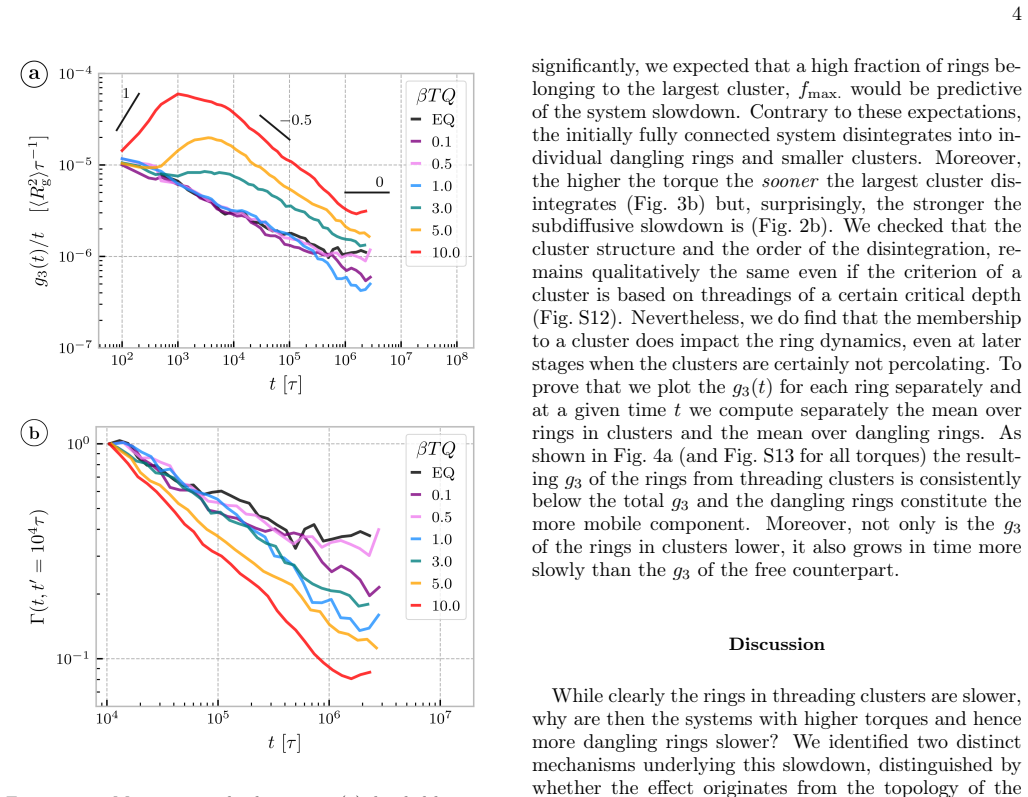
The activity of the agent not only alters the conformational topology from open to branched, but also locks-in threaded rings into supramolecular clusters, which relax very slowly.
What carries the argument
The supercoiling agent, which rapidly induces helical supercoiling and thereby traps threading entanglements into long-lived clusters.
If this is right
- Plasmid solutions under active supercoiling exhibit slower overall relaxation than equilibrium counterparts.
- Branched supercoiled conformations reduce the ability of rings to slide past threading entanglements.
- Non-equilibrium activity provides a route to tune the dynamic behavior of ring-polymer systems.
- The approach suggests a general method for creating driven materials whose glassy behavior arises from induced topology.
Where Pith is reading between the lines
- Similar locking of entanglements might occur in cellular DNA environments where gyrase-like enzymes are active.
- Varying the rate or specificity of the supercoiling agent could be used to test how sensitive cluster stability is to induction speed.
- The mechanism may connect to other active-matter systems in which topology and threading control macroscopic flow or viscosity.
Load-bearing premise
The simulation model of the supercoiling agent accurately captures rapid and specific induction of supercoiling without introducing artifacts that artificially stabilize the clusters.
What would settle it
An experiment or simulation in which actively supercoiled plasmids are observed to relax at the same rate or faster than torsionally relaxed ones would contradict the central claim.
Figures



read the original abstract
Harnessing the topology of ring polymers as a design motif in functional nanomaterials is becoming a promising direction in the field of soft matter. For example, the ring topology of DNA plasmids prevents the relaxation of excess twist introduced to the polymer, instead resulting in helical supercoiled structures. In equilibrium semi-dilute solutions, tightly supercoiled rings relax faster than their torsionally relaxed counterparts, since the looser conformations of the latter allow for rings to thread through each other and entrain through entanglements. Here we use molecular simulations to explore a non-equilibrium scenario, in which a supercoiling agent, akin to gyrase enzymes, rapidly induces supercoiling in the suspensions of relaxed plasmids. The activity of the agent not only alters the conformational topology from open to branched, but also locks-in threaded rings into supramolecular clusters, which relax very slowly. Ultimately, our work shows how the polymer topology under non-equilibrium conditions can be leveraged to tune dynamic behavior of macromolecular systems, suggesting a method to create a class of driven materials glassified by activity.
Editorial analysis
A structured set of objections, weighed in public.
Referee Report
Summary. The manuscript uses molecular simulations of semi-dilute plasmid solutions to explore a non-equilibrium scenario in which a supercoiling agent (modeled after gyrase) rapidly induces supercoiling in initially relaxed rings. The central claim is that this activity converts open conformations to branched ones while simultaneously locking threaded rings into supramolecular clusters whose relaxation is markedly slowed by trapped threading entanglements, in contrast to the faster relaxation of supercoiled rings seen in equilibrium. The work positions this as a route to activity-tuned glassy dynamics in topologically complex macromolecular systems.
Significance. If the simulation results are robust, the paper identifies a concrete mechanism by which non-equilibrium topological driving can stabilize entanglements that would otherwise relax, thereby providing a design principle for activity-controlled soft materials. It usefully extends equilibrium ring-polymer entanglement concepts into the driven regime and offers a plausible route toward glassification via topology rather than crowding or cross-linking.
major comments (2)
- [Simulation protocol] Simulation protocol section: No control simulation is reported in which the agent applies comparable local constraints or torques without net supercoiling induction (or in which the agent is removed after initial induction). Such a control is required to establish that the observed slow cluster relaxation arises from the induced branched topology and trapped threads rather than from the driving protocol itself altering unthreading moves or contact statistics.
- [Results] Results on relaxation times: The reported slowing is tied to the free parameter governing supercoiling induction rate, yet no systematic variation of this rate or comparison against equilibrium limits (e.g., known relaxation spectra of torsionally relaxed vs. supercoiled rings) is shown to confirm that the non-equilibrium dynamics are free of artifacts.
minor comments (2)
- [Introduction] The abstract and introduction would benefit from a brief citation to prior simulation or experimental work on gyrase-like supercoiling agents in polymer models to clarify how the present implementation differs from existing approaches.
- [Figures] Figure captions describing cluster identification should explicitly state the criteria used to define a 'supramolecular cluster' (e.g., threading number threshold or contact persistence time) so that the slow-relaxation claim can be reproduced.
Simulated Author's Rebuttal
We thank the referee for their detailed and constructive comments on our manuscript. We have carefully considered each point and provide our responses below. We believe these revisions will strengthen the presentation of our results on activity-induced topological effects in plasmid solutions.
read point-by-point responses
-
Referee: Simulation protocol section: No control simulation is reported in which the agent applies comparable local constraints or torques without net supercoiling induction (or in which the agent is removed after initial induction). Such a control is required to establish that the observed slow cluster relaxation arises from the induced branched topology and trapped threads rather than from the driving protocol itself altering unthreading moves or contact statistics.
Authors: We agree that additional control simulations would help to more rigorously isolate the role of the induced supercoiling. In the revised version of the manuscript, we have included new control simulations in which the agent applies local torques without resulting in a net increase in supercoiling (by balancing positive and negative twists or allowing periodic relaxation). These controls demonstrate that the slow relaxation of clusters is indeed tied to the branched conformations and trapped threading entanglements rather than the driving mechanism itself. We have also added a simulation where the agent is deactivated after initial supercoiling induction, showing that the slow dynamics persist due to the locked-in topology. revision: yes
-
Referee: Results on relaxation times: The reported slowing is tied to the free parameter governing supercoiling induction rate, yet no systematic variation of this rate or comparison against equilibrium limits (e.g., known relaxation spectra of torsionally relaxed vs. supercoiled rings) is shown to confirm that the non-equilibrium dynamics are free of artifacts.
Authors: The referee correctly notes that the induction rate is a key parameter. While the manuscript does include comparisons to equilibrium cases of relaxed and supercoiled rings, showing faster relaxation in the latter, we acknowledge the benefit of a more systematic exploration. In the revision, we now present results for a range of supercoiling induction rates and explicitly compare the relaxation spectra to established equilibrium data for ring polymers. This analysis confirms that the non-equilibrium slowing arises from the activity-induced trapping of entanglements and is not an artifact of the simulation protocol. revision: yes
Circularity Check
No significant circularity detected in the derivation chain
full rationale
The paper reports results from direct molecular dynamics simulations of non-equilibrium plasmid suspensions under active supercoiling. The observed slowing of relaxation emerges from the explicit time evolution of threaded entanglements and cluster formation in the simulated trajectories, without any fitted parameters being repurposed as predictions or any self-referential definitions of relaxation times. No load-bearing steps reduce by construction to inputs, and the central claim is grounded in the simulation protocol rather than self-citation chains or ansatzes.
Axiom & Free-Parameter Ledger
free parameters (1)
- supercoiling induction rate
axioms (1)
- domain assumption The coarse-grained model of the supercoiling agent faithfully reproduces enzymatic action without side effects on threading or cluster stability.
Lean theorems connected to this paper
-
IndisputableMonolith/Foundation/AlexanderDuality.leanalexander_duality_circle_linking unclear?
unclearRelation between the paper passage and the cited Recognition theorem.
The activity of the agent not only alters the conformational topology from open to branched, but also locks-in threaded rings into supramolecular clusters, which relax very slowly.
-
IndisputableMonolith/Cost/FunctionalEquation.leanwashburn_uniqueness_aczel unclear?
unclearRelation between the paper passage and the cited Recognition theorem.
We represent the ring polymers using bead-spring models with bending and torsional stiffnesses... apply oppositely oriented torques... supercoiling density σ = 1/p
What do these tags mean?
- matches
- The paper's claim is directly supported by a theorem in the formal canon.
- supports
- The theorem supports part of the paper's argument, but the paper may add assumptions or extra steps.
- extends
- The paper goes beyond the formal theorem; the theorem is a base layer rather than the whole result.
- uses
- The paper appears to rely on the theorem as machinery.
- contradicts
- The paper's claim conflicts with a theorem or certificate in the canon.
- unclear
- Pith found a possible connection, but the passage is too broad, indirect, or ambiguous to say the theorem truly supports the claim.
Reference graph
Works this paper leans on
-
[1]
L. Tubiana, G. P. Alexander, A. Barbensi, D. Buck, J. H. Cartwright, M. Chwastyk, M. Cieplak, I. Coluzza, S. Čopar, D. J. Craik, M. Di Stefano, R. Everaers, P. F. Faísca, F. Ferrari, A. Giacometti, D. Goundaroulis, E. Haglund, Y.-M. Hou, N. Ilieva, S. E. Jackson, A. Japaridze, N. Kaplan, A. R. Klotz, H. Li, C. N. Likos, E. Locatelli, T. López-León, T. Mac...
work page 2024
-
[2]
Z.Qu, S.Z.D.Cheng,andW.-B.Zhang,Macromolecular topology engineering, Trends in Chemistry 3, 402–415 (2021)
work page 2021
-
[3]
L. F. Hart, J. E. Hertzog, P. M. Rauscher, B. W. Rawe, M. M. Tranquilli, and S. J. Rowan, Material properties and applications of mechanically interlocked polymers, Nat. Rev. Mater.6, 508 (2021)
work page 2021
-
[4]
S. Shankar, A. Souslov, M. J. Bowick, M. C. Marchetti, andV.Vitelli,Topologicalactivematter,NatureReviews Physics 4, 380–398 (2022)
work page 2022
-
[5]
D.Michieletto, P.Neill, S.Weir, D.Evans, N.Crist, V.A. Martinez, and R. M. Robertson-Anderson, Topological digestion drives time-varying rheology of entangled DNA fluids, Nat. Commun. 13, 10.1038/s41467-022-31828-w (2022)
-
[6]
D. Kong, S. Banik, M. J. San Francisco, M. Lee, R. M. Robertson Anderson, C. M. Schroeder, and G. B. McKenna, Rheology of entangled solutions of ring–linear DNA blends, Macromolecules55, 1205 (2022)
work page 2022
-
[7]
K. R. Peddireddy, M. Lee, Y. Zhou, S. Adalbert, S. An- derson, C.M.Schroeder,andR.M.Robertson-Anderson, Unexpected entanglement dynamics in semidilute blends of supercoiled and ring DNA, Soft Matter16, 152 (2020)
work page 2020
-
[8]
A. Rosa, J. Smrek, M. S. Turner, and D. Michieletto, Threading-Induced Dynamical Transition in Tadpole- Shaped Polymers, ACS Macro Lett.9, 743 (2020)
work page 2020
-
[9]
M. Kapnistos, M. Lang, D. Vlassopoulos, W. Pyckhout- Hintzen, D. Richter, D. Cho, T. Chang, and M. Rubin- stein, Unexpected power-law stress relaxation of entan- gled ring polymers, Nat. Mater.7, 997 (2008)
work page 2008
- [10]
-
[11]
G. Liu, P. M. Rauscher, B. W. Rawe, M. M. Tranquilli, and S. J. Rowan, Polycatenanes: synthesis, characteriza- tion, and physical understanding, Chem. Soc. Rev.51, 4928 (2022)
work page 2022
-
[12]
K. Ito, Novel entropic elasticity of polymeric materials: why is slide-ring gel so soft?, Polymer Journal44, 38–41 (2011)
work page 2011
-
[13]
J.-X. Li, S. Wu, L.-L. Hao, Q.-L. Lei, and Y.-Q. Ma, Activity-driven polymer knotting for macromolecular topology engineering, Science Advances10, 10.1126/sci- adv.adr0716 (2024)
- [14]
-
[15]
A. Deblais, S. Woutersen, and D. Bonn, Rheology of en- tangled active polymer-like t. tubifex worms, Phys. Rev. Lett. 124, 188002 (2020)
work page 2020
-
[16]
V. P. Patil, H. Tuazon, E. Kaufman, T. Chakrabortty, D. Qin, J. Dunkel, and M. S. Bhamla, Ultrafast re- versible self-assembly of living tangled matter, Science 380, 392–398 (2023)
work page 2023
-
[17]
Y. Ozkan-Aydin, D. I. Goldman, and M. S. Bhamla, Col- lective dynamics in entangled worm and robot blobs, Proceedings of the National Academy of Sciences118, 10.1073/pnas.2010542118 (2021)
-
[18]
V. P. Patil, J. D. Sandt, M. Kolle, and J. Dunkel, Topo- logical mechanics of knots and tangles, Science 367, 71–75 (2020)
work page 2020
-
[19]
K. Becker, C. Teeple, N. Charles, Y. Jung, D. Baum, J. C. Weaver, L. Mahadevan, and R. Wood, Active entanglement enables stochastic, topological grasping, Proceedings of the National Academy of Sciences119, 10.1073/pnas.2209819119 (2022)
- [20]
- [21]
-
[22]
D. Breoni, C. Kurzthaler, B. Liebchen, H. Löwen, and S. Mandal, Giant activity-induced elasticity in entan- gled polymer solutions, Nature Communications 16, 10.1038/s41467-025-60210-9 (2025)
-
[23]
M. Kruteva, J. Allgaier, and D. Richter, Topology mat- ters: Conformation and microscopic dynamics of ring polymers, Macromolecules56, 7203 (2023)
work page 2023
-
[24]
J. Wang and T. Ge, Crazing reveals an entanglement net- work in glassy ring polymers, Macromolecules54, 7500 (2021)
work page 2021
-
[25]
J. Smrek and A. Y. Grosberg, Understanding the dy- namics of rings in the melt in terms of the annealed tree model, J. Phys. Condens. Matter27, 064117 (2015)
work page 2015
-
[26]
T. Ge, S. Panyukov, and M. Rubinstein, Self- similar conformations and dynamics in entangled melts and solutions of nonconcatenated ring poly- 8 mers, Macromolecules49, 708 (2016), pMID: 27057066, https://doi.org/10.1021/acs.macromol.5b02319
-
[27]
E. Ghobadpour, M. Kolb, M. R. Ejtehadi, and R. Ev- eraers, Monte carlo simulation of a lattice model for the dynamics of randomly branching double-folded ring poly- mers, Phys. Rev. E 104, 10.1103/physreve.104.014501 (2021)
-
[28]
E. Ghobadpour, M. Kolb, I. Junier, and R. Everaers, The emergent dynamics of double-folded randomly branching ring polymers (2025), arXiv:2503.01446 [cond-mat.soft]
-
[29]
A. Rosa and R. Everaers, Ring polymers in the melt state: The physics of crumpling, Phys. Rev. Lett.112, 118302 (2014)
work page 2014
-
[30]
J. Smrek and A. Y. Grosberg, Minimal Surfaces on Un- concatenated Polymer Rings in Melt, ACS Macro Lett. 5, 750 (2016)
work page 2016
-
[31]
M. A. Ubertini, J. Smrek, and A. Rosa, Entanglement length scale separates threading from branching of un- knotted and non-concatenated ring polymers in melts, Macromolecules 55, 10723 (2022)
work page 2022
-
[32]
A. Y. Grosberg, Annealed lattice animal model and flory theory for the melt of non-concatenated rings: towards the physics of crumpling, Soft Matter10, 560 (2014)
work page 2014
-
[33]
J. D. Halverson, W. B. Lee, G. S. Grest, A. Y. Grosberg, and K. Kremer, Molecular dynamics simulation study of nonconcatenated ring polymers in a melt. II. Dynamics, J. Chem. Phys.134, 204905 (2011)
work page 2011
-
[34]
E. Lee, S. Kim, and Y. Jung, Slowing down of ring poly- mer diffusion caused by inter-ring threading, Macromol. Rapid Commun.36, 1115 (2015)
work page 2015
-
[35]
D. G. Tsalikis, V. G. Mavrantzas, and D. Vlassopoulos, Analysis of slow modes in ring polymers: Threading of rings controls long-time relaxation, ACS Macro Lett.5, 755 (2016)
work page 2016
- [36]
-
[37]
D. Michieletto, N. Nahali, and A. Rosa, Glassiness and heterogeneous dynamics in dense solutions of ring poly- mers, Phys. Rev. Lett.119, 197801 (2017)
work page 2017
-
[38]
S. Goto, K. Kim, and N. Matubayasi, Unraveling the glass-like dynamic heterogeneity in ring polymer melts: From semiflexible to stiff chain, ACS Polymers Au3, 437 (2023), https://doi.org/10.1021/acspolymersau.3c00013
-
[39]
M. Q. Tu, O. Davydovich, B. Mei, P. K. Singh, G. S. Grest, K. S. Schweizer, T. C. O’Connor, and C. M. Schroeder, Unexpected slow relaxation dynamics in pure ring polymers arise from intermolecular interactions, ACS Polym. Au3, 307 (2023)
work page 2023
-
[40]
P. K. Roy, P. Chaudhuri, and S. Vemparala, Bidisperse ring polymers: Topological glass to stacking, Phys. Rev. Mater. 8, 045601 (2024)
work page 2024
- [41]
-
[42]
T. C. O’Connor, T. Ge, M. Rubinstein, and G. S. Grest, Topological linking drives anomalous thickening of ring polymersinweakextensionalflows,Phys.Rev.Lett. 124, 027801 (2020)
work page 2020
- [43]
-
[44]
C. Micheletti, I. Chubak, E. Orlandini, and J. Sm- rek, Topology-based detection and tracking of deadlocks reveal aging of active ring melts, ACS Macro Letters 13, 124 (2024), pMID: 38198592, https://doi.org/10.1021/acsmacrolett.3c00567
-
[45]
A. Fathizadeh, H. Schiessel, and M. R. Ejtehadi, Molec- ular dynamics simulation of supercoiled DNA rings, Macromolecules 48, 164 (2015)
work page 2015
-
[46]
B.A.KrajinaandA.J.Spakowitz,Large-scaleconforma- tional transitions in supercoiled DNA revealed by coarse- grained simulation, Biophys. J.111, 1339–1349 (2016)
work page 2016
-
[47]
M. Segers, E. Skoruppa, H. Schiessel, and E. Carlon, Statistical mechanics of multiplectoneme phases in dna, Physical Review E 111, 10.1103/physreve.111.044408 (2025)
- [48]
-
[49]
M. Gellert, K. Mizuuchi, M. H. O’Dea, and H. A. Nash, Dna gyrase: an enzyme that introduces superhelical turns into dna., Proceedings of the National Academy of Sciences73, 3872–3876 (1976)
work page 1976
-
[50]
R. Menzel and M. Gellert, The biochemistry and biol- ogyofdnagyrase,in DNA Topoisomerases: Biochemistry and Molecular Biology(Elsevier, 1994) p. 39–69
work page 1994
-
[51]
Y. A. G. Fosado, D. Michieletto, C. A. Brackley, and D. Marenduzzo, Nonequilibrium dynamics and action at a distance in transcriptionally driven DNA supercoil- ing,Proc.Natl.Acad.Sci. 118,10.1073/pnas.1905215118 (2021)
- [52]
-
[53]
P. Wu, L. Song, J. B. Clendenning, B. S. Fujimoto, A. S. Benight, and J. M. Schurr, Interaction of chloroquine with linear and supercoiled dnas. effect on the torsional dynamics, rigidity, andtwistenergyparameter,Biochem- istry 27, 8128–8144 (1988)
work page 1988
-
[54]
P. J. Kolbeck, M. Tišma, B. T. Analikwu, W. Vanderlin- den, C. Dekker, and J. Lipfert, Supercoiling-dependent dna binding: quantitative modeling and applications to bulk and single-molecule experiments, Nucleic Acids Re- search 52, 59–72 (2023)
work page 2023
- [55]
-
[56]
A. Bates and A. Maxwell,DNA Topology, Oxford bio- science (Oxford University Press, 2005)
work page 2005
-
[57]
J. Gore, Z. Bryant, M. D. Stone, M. Nöllmann, N. R. Cozzarelli, and C. Bustamante, Mechanochemical analy- sis of dna gyrase using rotor bead tracking, Nature439, 100–104 (2006)
work page 2006
-
[58]
A. Basu, M. Hobson, P. Lebel, L. E. Fernandes, E. M. Tretter, J. M. Berger, and Z. Bryant, Dynamic coupling between conformations and nucleotide states in dna gy- rase, Nature Chemical Biology14, 565–574 (2018)
work page 2018
-
[59]
C. J. Galvin, M. Hobson, J. X. Meng, A. Ierokomos, I. E. Ivanov, J. M. Berger, and Z. Bryant, Single-molecule dy- namics of dna gyrase in evolutionarily distant bacteria mycobacterium tuberculosis and escherichia coli, Journal of Biological Chemistry299, 103003 (2023)
work page 2023
-
[60]
R. M. Robertson, S. Laib, and D. E. Smith, Diffusion of isolated dna molecules: Dependence on length and topol- 9 ogy, Proceedings of the National Academy of Sciences 103, 7310–7314 (2006)
work page 2006
-
[61]
M. Hammermann, C. Steinmaier, H. Merlitz, U. Kapp, W. Waldeck, G. Chirico, and J. Langowski, Salt effects on the structure and internal dynamics of superhelical dnas studied by light scattering and brownian dynamics, Biophysical Journal73, 2674–2687 (1997)
work page 1997
-
[62]
M. K. Liu and J. C. Giddings, Separation and measure- ment of diffusion coefficients of linear and circular dnas by flow field-flow fractionation, Macromolecules26, 3576 (1993), https://doi.org/10.1021/ma00066a016
- [63]
-
[64]
F. Conforto, Y. Gutierrez Fosado, and D. Michieletto, Fluidification of entangled polymers by loop extrusion, Phys. Rev. Res.6, 033160 (2024)
work page 2024
- [65]
-
[66]
C. A. Brackley, A. N. Morozov, and D. Marenduzzo, Models for twistable elastic polymers in brownian dy- namics, and their implementation for lammps, J. Chem. Phys. 140, 135103 (2014)
work page 2014
- [67]
- [68]
-
[69]
F. Benedetti, D. Racko, J. Dorier, Y. Burnier, and A. Stasiak, Transcription-induced supercoiling explains formation of self-interacting chromatin domains in s. pombe, Nucleic Acids Research45, 9850 (2017)
work page 2017
- [70]
- [71]
-
[72]
D. Michieletto and M. S. Turner, A topologically driven glass in ring polymers, Proc. Natl. Acad. Sci. U.S.A.113, 5195 (2016)
work page 2016
- [73]
-
[74]
J. D. Halverson, W. B. Lee, G. S. Grest, A. Y. Grosberg, and K. Kremer, Molecular dynamics simulation study of nonconcatenated ring polymers in a melt. I. Statics, J. Chem. Phys.134, 204904 (2011)
work page 2011
-
[75]
A. V. Vologodskii, S. D. Levene, K. V. Klenin, M. Frank- Kamenetskii, and N. R. Cozzarelli, Conformational and thermodynamic properties of supercoiled dna, Journal of Molecular Biology227, 1224 (1992)
work page 1992
-
[76]
M. T. J. van Loenhout, M. V. de Grunt, and C. Dekker, Dynamics of dna supercoils, Science 338, 94 (2012), https://www.science.org/doi/pdf/10.1126/science.1225810
-
[77]
N.-E. Giesinger, The existence and formation dynam- ics of supramolecular chains in equilibrated and sheared ring polymer melts, Master’s thesis, University of Vienna (2025)
work page 2025
-
[78]
G. S. Grest and K. Kremer, Molecular dynamics simula- tion for polymers in the presence of a heat bath, Phys. Rev. A33, 3628 (1986)
work page 1986
-
[79]
K. Kremer and G. S. Grest, Dynamics of entangled lin- ear polymer melts: A molecular-dynamics simulation, J. Chem. Phys.92, 5057 (1990)
work page 1990
-
[80]
N. Clauvelin, W. K. Olson, and I. Tobias, Characteriza- tion of the geometry and topology of DNA pictured as a discrete collection of atoms, J. Chem. Theory Comput. 8, 1092 (2012), pMID: 24791158
work page 2012
discussion (0)
Sign in with ORCID, Apple, or X to comment. Anyone can read and Pith papers without signing in.