REVIEW 4 major objections 4 minor 1 cited by
What Makes Local Updates Effective: The Role of Data Heterogeneity and Smoothness
T0 review · 4 major / 4 minor · reviewed 2026-08-06 · deepseek-v4-flash
Pith's one-line read This thesis proves that small second-order heterogeneity—the extent to which clients' objectives disagree in curvature—is both necessary and sufficient for local update algorithms to outperform centralized or mini-batch methods.
desk verdict A solid synthesis of prior work on second-order heterogeneity, but the 'necessary and sufficient' claim outstrips the theorems: sufficiency needs globally small tau, and the manuscript is unfinished. read the letter →
The pith
A machine-rendered reading of the paper's core claim, the machinery that carries it, and where it could break.
The reading
What carries the argument
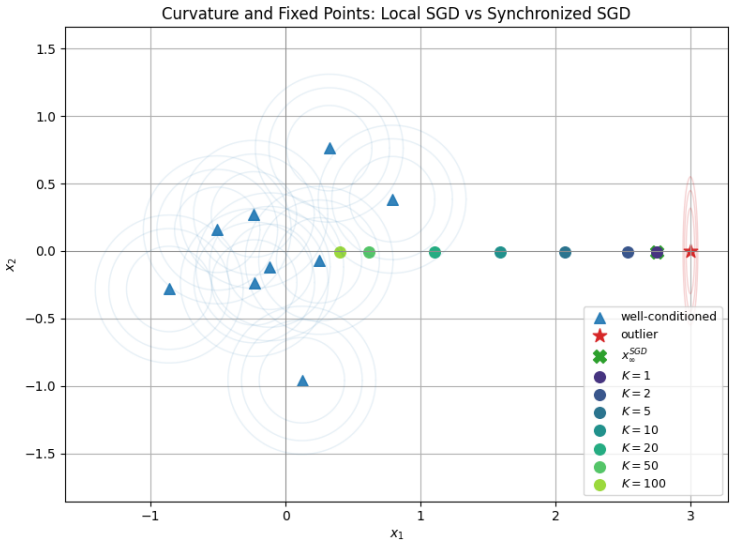
The central object is second-order heterogeneity $\tau$ (Assumption 11), a global uniform bound on Hessian disagreement between any two clients. It carries the argument because it enters into sharper consensus-error recursions—quantities measuring how far local models drift apart between communication rounds—which are coupled to iterate sub-optimality and tracked in second and fourth moments. A second central identity is the fixed-point analysis for quadratics: Local SGD converges to $x_\infty = (1/M)\sum_m C^{-1}C_m x^\star_m$ with $C_m = I - (I - \eta A_m)^K$, and its discrepancy from the true optimum $x^\star$ is bounded by $\zeta_\star \tau/\mu$, which goes to zero only when $\tau$ or $\zeta_\star$ does.
What would settle it
Construct a smooth, strongly convex two-client problem whose Hessian disagreement is at most $\tau$ inside a small ball around the shared optimum but large (order $H$) outside it, run Local SGD from a distant initialization, and measure communication rounds to reach accuracy $\epsilon$. If the observed complexity fails to match the $\tau$-dependent upper bound predicted by the theory (for example, it behaves like the mini-batch rate), then the global-uniform $\tau$ assumption is doing the work and the stated necessity/sufficiency claim does not survive under local-only heterogeneity.
Extended reading notes
Core claim
The paper's central claim is that local update algorithms outperform centralized or mini-batch methods exactly when the Hessians of clients' objectives are close: $\sup_{m,n,x}\|\nabla^2 F_m(x) - \nabla^2 F_n(x)\| \le \tau$ with small $\tau$. It proves this by establishing tight lower bounds showing that under only first-order heterogeneity (small gradient disagreement or shared optimizers) no local algorithm beats accelerated mini-batch SGD, whose rate is independent of heterogeneity, and by constructing matching upper bounds showing that when $\tau$ is small, Local SGD's communication complexity improves, for example $R(\epsilon) = \tilde{O}(H\tau/\mu^2 + \tau H \phi_\star/(\mu^2\sqrt{\epsilon}) + H^2 \zeta_\star/(\mu^2\sqrt{\epsilon}))$ in the strongly convex regime. In the non-convex setting, the new algorithm CE-LSGD is shown to be minimax optimal under exact oracles and nearly optimal with stochastic oracles, with rates that improve as $\tau$ decreases.
Load-bearing premise
The load-bearing premise is Assumption 11: the Hessians of every pair of clients must differ by at most $\tau$ uniformly over the entire space, so that 'low heterogeneity' holds globally, not just near the optima where local updates actually operate.
Editorial extensions
If this is right
- Communication complexity of Local SGD provably improves as $\tau$ decreases, interpolating to homogeneous problems where a constant number of communication rounds suffices for quadratic objectives.
- Under first-order heterogeneity alone, accelerated mini-batch SGD is min-max optimal, so no local-update benefit exists without second-order structure.
- In the non-convex setting, CE-LSGD achieves minimax optimal rates under exact oracles and nearly optimal rates with stochastic oracles, with improvements governed by $\tau$.
- In online optimization, collaboration gives no worst-case benefit with full gradient feedback, but provably helps under bandit feedback in high-dimensional or low-heterogeneity regimes.
- Third-order smoothness extends the known homogeneous benefits to heterogeneous regimes, yielding tighter finite-time bounds under small $Q$ and $\tau$.
Reading between the lines
- A practical diagnostic suggests itself: estimate $\tau$ (curvature disagreement across clients) to decide whether increasing local steps $K$ or reducing communication will help in a given federated deployment.
- The fixed-point analysis implies an implicit spectral filtering: local updates down-weight high-curvature directions, potentially connecting Local SGD to regularization and generalization—an interpretation the author draws, and one that invites testing on overparameterized models.
- The global-uniform nature of $\tau$ may be relaxable; if the theory can be rebuilt with local bounds near the optima, its applicability to real data, where Hessian disagreement is often large far from the optimum, would expand.
Editorial analysis
A structured set of objections, weighed in public.
Referee Report
Summary. The paper is a Ph.D. thesis that develops a unified theoretical account of local update algorithms, principally Local SGD, under heterogeneity measures that separate first- and second-order effects. The central claim is that small second-order heterogeneity, measured by the parameter τ, is both necessary and sufficient for local updates to outperform centralized or mini-batch methods in convex and non-convex settings. The thesis contributes lower bounds (Theorems 1–3, 13, 15), consensus-error-based upper bounds (Theorems 5–12), a communication-efficient algorithm CE-LSGD (Theorem 14), and extensions to online and bandit convex optimization (Theorems 17–21). The technical core is a fine-grained consensus-error framework that couples iterate error with local drift and introduces fourth-moment bounds under third-order smoothness. All results are drawn from four of the author's own prior papers, as disclosed in Section 1.3.
Significance. If the main claims hold, the thesis provides a coherent, falsifiable theory of when local updates are provably advantageous, with communication-complexity predictions that scale with τ and are empirically supported on synthetic linear regression and CIFAR-10 experiments. The strength of the work is that the upper and lower bounds are derived from explicit assumptions rather than fitted to data, and the lower-bound constructions carefully decouple τ from the smoothness constant H. The consensus-error recursions with fourth-moment control are technically substantive. However, the central 'necessary and sufficient' claim is currently established only for globally small τ, and several upper bounds are admitted to be loose or unmatched by lower bounds, so the significance is conditional on closing or qualifying these gaps.
major comments (4)
- [Section 2.5.1, Assumption 11; Chapter 5, Lemmas 6–7] The sufficiency half of the central claim is established only for globally small τ. Lemma 6's consensus-error recursion bounds local drift using the global uniform bound sup_{m,n,x} ||∇²F_m(x) − ∇²F_n(x)|| ≤ τ, and the proofs of Theorems 5–12 inherit this global requirement. The lower-bound constructions in Theorems 1–3 and 15, however, are quadratics or near-quadratics on which global and local τ coincide. Consequently, the abstract and Section 1.1's statement that small second-order heterogeneity is 'necessary and sufficient' is not proven for the practically relevant interpretation of small τ only in the region visited by the iterates; a construction with small τ near the optima but large away from them would expose the gap, since the current proofs do not control drift during early rounds or under large step sizes.
- [Section 5.2–5.3, Theorem 9] The sufficiency of small τ for general convex objectives is not established. Theorem 9, the most general result, retains terms depending on ζ☆ and φ☆ that do not vanish as τ → 0, and the text explicitly admits that it does not recover the quadratic convergence rate when Q = 0 and that the bound may contain extraneous terms. This means the strong form of the central claim holds only for quadratics (Q = 0), for third-order-smooth cases under additional restrictions, or under the restrictive Assumption 12. The abstract's unqualified statement should be revised to reflect that small τ alone is not shown to suffice in general smooth convex settings.
- [Section 6.2.2, Theorems 14–15] The stochastic non-convex upper bound for CE-LSGD contains a ΔH/√(KR) term, while the lower bound in Theorem 15 has ΔH/(KR); the resulting gap is acknowledged in Section 6.2.2 but left open. Because Table 6.1 presents these rates side by side and the chapter claims 'nearly minimax optimal' performance, the near-optimality claim in the stochastic setting is stronger than what is proven. This is a load-bearing issue for the non-convex contribution, though it does not undermine the qualitative role of τ.
- [Section 3.3 and Chapter 5] The strongly convex upper bounds (Theorems 5–8) imply a communication complexity of the form R(ε) = O~(Hτ/μ² + τHφ☆/(μ²√ε) + H²ζ☆/(μ²√ε)), while the only matching-style lower bound (Theorem 3) is proved for non-strongly convex instances and gives R = Ω(τB²/ε) in the general convex class. Because these bounds are derived under different problem classes, the strongly convex min-max complexity is not actually characterized, contrary to the abstract's claim of 'min-max complexity of multiple problem classes'. The qualitative necessary/sufficient story survives, but the 'min-max' language overstates the degree of characterization.
minor comments (4)
- [Throughout main text] Many central theorems (e.g., Theorems 5–12) are presented as 'Informal' with precise statements only in appendices; for a self-contained article, the main text should include full theorem statements or clearly indicate that the appendix versions are the official ones.
- [Figure 6.1] The figure contains a leftover annotation 'TODO: change smoothness constant' that should be removed before publication.
- [Theorem 3 and Theorem 1] There are notational inconsistencies: Theorem 3 writes F(x_{KR}) although the iterate is denoted \bar{x}_R elsewhere, and Theorem 1 uses the constant name c6 that already appears in equation (3.4), which can confuse the reader.
- [Section 1.3] The thesis discloses that all results are drawn from four prior papers by the author; if this document is intended as a stand-alone journal submission, the overlap with those published papers should be addressed in a separate novelty statement, not only as a footnote.
Circularity Check
No significant circularity: the upper and lower bounds are independently derived from stated assumptions, and the self-citations are disclosed provenance rather than load-bearing argument.
full rationale
The thesis's central claim is that small second-order heterogeneity tau is necessary and sufficient for local-update algorithms to outperform centralized or mini-batch methods. This claim is supported by two logically independent components: parameter-free upper bounds (Theorems 5-9 and 14) derived from explicit assumptions such as Assumptions 2, 4-11, and lower bounds (Theorems 1-3, 13, and 15) built on separate hard instances, including quadratics and the Carmon et al. non-convex construction. The quantity tau enters as an assumption parameter, not as a fitted value, and communication-complexity statements such as R(epsilon) = O~(H tau / mu^2 + ...) follow from solving the stated consensus-error recursions rather than from defining tau in terms of the target rate. No equation in the paper defines tau, zeta_star, or phi_star so that a claimed rate is forced by construction; the lower-bound instances are designed to realize tau, while the upper bounds apply to all instances satisfying Assumption 11. The explicit statement in Section 1.3 that all results derive from four papers by the primary author is a statement of provenance, and the cited works include externally anchored results (e.g., Woodworth et al., Carmon et al., Arjevani et al.) with proofs carried out in the appendices. The concern about Assumption 11 being global while the lower-bound constructions are quadratic is a limitation of the sufficiency claim's scope, not a circularity: global tau being small is what the proofs require, and local tau being small is not established as sufficient. Empirical sections confirm the framework's predictions but are not used as inputs to the derivations. No load-bearing step reduces to a self-citation, a fitted input, or a definitional equivalence, so the appropriate finding is no significant circularity.
Assumptions & free parameters
assumptions (6)
- domain assumption Assumption 10: for each machine there exists a global minimizer within phi_star of a local minimizer
- domain assumption Assumption 11: sup_{m,n,x} ||nabla^2 F_m(x) - nabla^2 F_n(x)|| <= tau for all machine pairs
- domain assumption Assumption 12: uniform gradient heterogeneity sup_{m,n,x} ||nabla F_m(x) - nabla F_n(x)|| <= H zeta
- domain assumption Assumption 5: third-order smoothness, i.e., Hessians are Lipschitz with constant Q
- domain assumption Definition 3: lower bounds are restricted to distributed zero-respecting algorithms
- domain assumption Assumptions 6 and 7: bounded fourth and second moments of stochastic gradients
Cite this review
Pith. "Pith review of What Makes Local Updates Effective: The Role of Data Heterogeneity and Smoothness." pith.science (2026). https://pith.science/paper/IPOHDGXN
@misc{pith2026250700195,
  author       = {Pith},
  title        = {Pith review of: What Makes Local Updates Effective: The Role of Data Heterogeneity and Smoothness},
  year         = {2026},
  howpublished = {\url{https://pith.science/paper/IPOHDGXN}},
  note         = {Machine review of arXiv:2507.00195}
}
read the original abstract
This thesis contributes to the theoretical understanding of local update algorithms, especially Local SGD, in distributed and federated optimization under realistic models of data heterogeneity. A central focus is on the bounded second-order heterogeneity assumption, which is shown to be both necessary and sufficient for local updates to outperform centralized or mini-batch methods in convex and non-convex settings. The thesis establishes tight upper and lower bounds in several regimes for various local update algorithms and characterizes the min-max complexity of multiple problem classes. At its core is a fine-grained consensus-error-based analysis framework that yields sharper finite-time convergence bounds under third-order smoothness and relaxed heterogeneity assumptions. The thesis also extends to online federated learning, providing fundamental regret bounds under both first-order and bandit feedback. Together, these results clarify when and why local updates offer provable advantages, and the thesis serves as a self-contained guide for analyzing Local SGD in heterogeneous environments.
Figures


Figures from the paper (7 more)




Forward citations
Cited by 1 Pith paper
-
What's in a Smoothness Constant? Tighter Rates for Local SGD with Bounded Second-order Heterogeneity
Local SGD provably improves over Mini-batch SGD under bounded second-order heterogeneity in the general convex setting, with nearly tight upper and lower bounds.
Reference graph
Works this paper leans on
-
[1]
Nur Ahmed and Muntasir Wahed. The de-democratization of ai: Deep learning and the compute divide in artificial intelligence research. arXiv preprint arXiv:2010.15581 , 2020
arXiv 2010
-
[2]
Byzantine stochastic gradient descent
Dan Alistarh, Zeyuan Allen-Zhu, and Jerry Li. Byzantine stochastic gradient descent. Advances in neural information processing systems , 31, 2018
2018
-
[3]
The convergence of sparsified gradient methods
Dan Alistarh, Torsten Hoefler, Mikael Johansson, Nikola Konstantinov, Sarit Khirirat, and Cedric Renggli. The convergence of sparsified gradient methods. In Proceedings of Advances in Neural Infor- mation Processing Systems, 2018
2018
-
[4]
Is federated learning still alive in the foundation model era? In AAAI Spring Symposium, 2024
Nathalie Baracaldo Angel. Is federated learning still alive in the foundation model era? In AAAI Spring Symposium, 2024
2024
-
[5]
Generative ai has an intellectual property problem
Gil Appel, Juliana Neelbauer, and David A Schweidel. Generative ai has an intellectual property problem. Harvard Business Review , 7, 2023
2023
-
[6]
Designing for privacy - wwdc19 - videos, 2019
Apple. Designing for privacy - wwdc19 - videos, 2019. URL https://developer.apple.com/videos/ play/wwdc2019/708
2019
-
[7]
Communication complexity of distributed convex learning and optimization
Yossi Arjevani and Ohad Shamir. Communication complexity of distributed convex learning and optimization. Advances in neural information processing systems , 28, 2015
2015
-
[8]
Lower bounds for non-convex stochastic optimization
Yossi Arjevani, Yair Carmon, John C Duchi, Dylan J Foster, Nathan Srebro, and Blake Woodworth. Lower bounds for non-convex stochastic optimization. arXiv preprint arXiv:1912.02365 , 2019
arXiv 1912
Show all 164 references
-
[9]
Self-concordant analysis for logistic regression
Francis Bach. Self-concordant analysis for logistic regression. Electronic Journal of Statistics , 4:384– 414, 2010. ISSN 1935-7524. doi: 10.1214/09-[]EJS521. URL https://doi.org/10.1214/09-[]EJS521
2010 doi
-
[10]
Implicit gradient alignment in distributed and federated learning
Luis Barba, Martin Jaggi, and Yatin Dandi. Implicit gradient alignment in distributed and federated learning. In AAAI Conference on Artificial Intelligence, AAAI , volume 22, 2021. 214
2021
-
[11]
A model of inductive bias learning
Jonathan Baxter. A model of inductive bias learning. Journal of artificial intelligence research , 12: 149–198, 2000
2000
-
[12]
On the dangers of stochastic parrots: Can language models be too big? In Proceedings of the 2021 ACM conference on fairness, accountability, and transparency , pages 610–623, 2021
Emily M Bender, Timnit Gebru, Angelina McMillan-Major, and Shmargaret Shmitchell. On the dangers of stochastic parrots: Can language models be too big? In Proceedings of the 2021 ACM conference on fairness, accountability, and transparency , pages 610–623, 2021
2021
-
[13]
The compute divide in machine learning: A threat to academic contribution and scrutiny? arXiv preprint arXiv:2401.02452 , 2024
Tamay Besiroglu, Sage Andrus Bergerson, Amelia Michael, Lennart Heim, Xueyun Luo, and Neil Thompson. The compute divide in machine learning: A threat to academic contribution and scrutiny? arXiv preprint arXiv:2401.02452 , 2024
2024 arXiv
-
[14]
Collaborative pac learning
Avrim Blum, Nika Haghtalab, Ariel D Procaccia, and Mingda Qiao. Collaborative pac learning. Advances in Neural Information Processing Systems , 30, 2017
2017
-
[15]
On the opportunities and risks of foundation models
Rishi Bommasani, Drew A Hudson, Ehsan Adeli, Russ Altman, Simran Arora, Sydney von Arx, Michael S Bernstein, Jeannette Bohg, Antoine Bosselut, Emma Brunskill, et al. On the opportunities and risks of foundation models. arXiv preprint arXiv:2108.07258 , 2021
2021 arXiv
-
[16]
Reinforcement learning, efficient coding, and the statistics of natural tasks
Matthew Botvinick, Ari Weinstein, Alec Solway, and Andrew Barto. Reinforcement learning, efficient coding, and the statistics of natural tasks. Current opinion in behavioral sciences , 5:71–77, 2015
2015
-
[17]
The computational and neural basis of cognitive control: charted territory and new frontiers
Matthew M Botvinick and Jonathan D Cohen. The computational and neural basis of cognitive control: charted territory and new frontiers. Cognitive science, 38(6):1249–1285, 2014
2014
-
[18]
Language models are few-shot learners
Tom B Brown. Language models are few-shot learners. arXiv preprint arXiv:2005.14165 , 2020
2005 arXiv
-
[19]
Regret analysis of stochastic and nonstochastic multi- armed bandit problems
S´ ebastien Bubeck, Nicolo Cesa-Bianchi, et al. Regret analysis of stochastic and nonstochastic multi- armed bandit problems. Foundations and Trends® in Machine Learning , 5(1):1–122, 2012
2012
-
[20]
Convex optimization: Algorithms and complexity
S´ ebastien Bubeck et al. Convex optimization: Algorithms and complexity. Foundations and Trends® in Machine Learning , 8(3-4):231–357, 2015
2015
-
[21]
Highly smooth minimization of non-smooth problems
Brian Bullins. Highly smooth minimization of non-smooth problems. In Conference on Learning Theory, pages 988–1030. PMLR, 2020
2020
-
[22]
A stochastic newton algorithm for distributed convex optimization
Brian Bullins, Kshitij Kumar Patel, Ohad Shamir, Nathan Srebro, and Blake E Woodworth. A stochastic newton algorithm for distributed convex optimization. Advances in Neural Information Processing Systems, 34, 2021
2021
-
[23]
Lower bounds for finding stationary points i
Yair Carmon, John C Duchi, Oliver Hinder, and Aaron Sidford. Lower bounds for finding stationary points i. Mathematical Programming, 184(1):71–120, 2020. 215
2020
-
[24]
Acceleration with a ball optimization oracle
Yair Carmon, Arun Jambulapati, Qijia Jiang, Yujia Jin, Yin Tat Lee, Aaron Sidford, and Kevin Tian. Acceleration with a ball optimization oracle. In Advances in Neural Information Processing Systems , volume 33, 2020
2020
-
[25]
Multitask learning
Rich Caruana. Multitask learning. Machine learning, 28:41–75, 1997
1997
-
[26]
On the outsized importance of learning rates in local update methods
Zachary Charles and Jakub Konecny. On the outsized importance of learning rates in local update methods. arXiv preprint arXiv:2007.00878 , 2020
2007 arXiv
-
[27]
On large- cohort training for federated learning
Zachary Charles, Zachary Garrett, Zhouyuan Huo, Sergei Shmulyian, and Virginia Smith. On large- cohort training for federated learning. Advances in neural information processing systems , 34:20461– 20475, 2021
2021
-
[28]
Federated learning of out-of- vocabulary words
Mingqing Chen, Rajiv Mathews, Tom Ouyang, and Francoise Beaufays. Federated learning of out-of- vocabulary words. arXiv preprint arXiv:1903.10635 , 2019
1903 arXiv
-
[29]
Fl-qsar: a federated learning-based qsar prototype for collaborative drug discovery
Shaoqi Chen, Dongyu Xue, Guohui Chuai, Qiang Yang, and Qi Liu. Fl-qsar: a federated learning-based qsar prototype for collaborative drug discovery. Bioinformatics, 36(22-23):5492–5498, 2020
2020
-
[30]
Opportunities and obstacles for deep learning in biology and medicine
Travers Ching, Daniel S Himmelstein, Brett K Beaulieu-Jones, Alexandr A Kalinin, Brian T Do, Gregory P Way, Enrico Ferrero, Paul-Michael Agapow, Michael Zietz, Michael M Hoffman, et al. Opportunities and obstacles for deep learning in biology and medicine. Journal of the Royal...
2018
-
[31]
Machine learning needs big data to revolutionise drug discovery
Matthew Clark. Machine learning needs big data to revolutionise drug discovery. Drug Discovery World, 2021. Accessed: 2024-11-10
2021
-
[32]
Cognitive control over learning: creating, clustering, and generalizing task-set structure
Anne GE Collins and Michael J Frank. Cognitive control over learning: creating, clustering, and generalizing task-set structure. Psychological review, 120(1):190, 2013
2013
-
[33]
Momentum-based variance reduction in non-convex sgd
Ashok Cutkosky and Francesco Orabona. Momentum-based variance reduction in non-convex sgd. Advances in neural information processing systems , 32, 2019
2019
-
[34]
Addressing modern and practical challenges in machine learning: A survey of online federated and transfer learning
Shuang Dai and Fanlin Meng. Addressing modern and practical challenges in machine learning: A survey of online federated and transfer learning. arXiv preprint arXiv:2202.03070 , 2022
2022 arXiv
-
[35]
Federated learning for predicting clinical outcomes in patients with covid-19
Ittai Dayan, Holger R Roth, Aoxiao Zhong, Ahmed Harouni, Amilcare Gentili, Anas Z Abidin, Andrew Liu, Anthony Beardsworth Costa, Bradford J Wood, Chien-Sung Tsai, et al. Federated learning for predicting clinical outcomes in patients with covid-19. Nature medicine, 27(10):1735...
2021
-
[36]
Optimal distributed online prediction using mini-batches
Ofer Dekel, Ran Gilad-Bachrach, Ohad Shamir, and Lin Xiao. Optimal distributed online prediction using mini-batches. Journal of Machine Learning Research , 13(1), 2012
2012
-
[37]
Communication trade-offs for local-sgd with large step size
Aymeric Dieuleveut and Kumar Kshitij Patel. Communication trade-offs for local-sgd with large step size. Advances in Neural Information Processing Systems , 32, 2019
2019
-
[38]
Differentially-private federated linear bandits
Abhimanyu Dubey and AlexSandy’ Pentland. Differentially-private federated linear bandits. Advances in Neural Information Processing Systems , 33:6003–6014, 2020
2020
-
[39]
Optimal rates for zero- order convex optimization: The power of two function evaluations
John C Duchi, Michael I Jordan, Martin J Wainwright, and Andre Wibisono. Optimal rates for zero- order convex optimization: The power of two function evaluations. IEEE Transactions on Information Theory, 61(5):2788–2806, 2015
2015
-
[40]
The multiple-demand (md) system of the primate brain: mental programs for intelligent behaviour
John Duncan. The multiple-demand (md) system of the primate brain: mental programs for intelligent behaviour. Trends in cognitive sciences, 14(4):172–179, 2010
2010
-
[41]
Federated learning in vehicular networks
Ahmet M Elbir, Burak Soner, and Sinem Coleri. Federated learning in vehicular networks. arXiv preprint arXiv:2006.01412, 2020
2006 arXiv
-
[42]
European Parliament and Council of the European Union. Regulation (EU) 2016/679 of the European Parliament and of the Council of 27 April 2016 on the protection of natural persons with regard to the processing of personal data and on the free movement of such data, and repeali...
2016
-
[43]
Spider: Near-optimal non-convex op- timization via stochastic path-integrated differential estimator
Cong Fang, Chris Junchi Li, Zhouchen Lin, and Tong Zhang. Spider: Near-optimal non-convex op- timization via stochastic path-integrated differential estimator. Advances in Neural Information Pro- cessing Systems, 31, 2018
2018
-
[44]
Model-agnostic meta-learning for fast adaptation of deep networks
Chelsea Finn, Pieter Abbeel, and Sergey Levine. Model-agnostic meta-learning for fast adaptation of deep networks. In International conference on machine learning , pages 1126–1135. PMLR, 2017
2017
-
[45]
Online convex optimization in the bandit setting: gradient descent without a gradient
Abraham D Flaxman, Adam Tauman Kalai, and H Brendan McMahan. Online convex optimization in the bandit setting: gradient descent without a gradient. arXiv preprint cs/0408007 , 2004
2004 arXiv
-
[46]
EControl: Fast distributed optimization with compression and error control
Yuan Gao, Rustem Islamov, and Sebastian U Stich. EControl: Fast distributed optimization with compression and error control. In The Twelfth International Conference on Learning Representations , 2024. 217
2024
-
[47]
Resource-aware asynchronous online federated learning for nonlinear regression
Francois Gauthier, Vinay Chakravarthi Gogineni, Stefan Werner, Yih-Fang Huang, and Anthony Kuh. Resource-aware asynchronous online federated learning for nonlinear regression. In ICC 2022-IEEE International Conference on Communications , pages 2828–2833. IEEE, 2022
2022
-
[48]
Optimal stochastic approximation algorithms for strongly convex stochastic composite optimization i: A generic algorithmic framework
Saeed Ghadimi and Guanghui Lan. Optimal stochastic approximation algorithms for strongly convex stochastic composite optimization i: A generic algorithmic framework. SIAM Journal on Optimization , 22(4):1469–1492, 2012
2012
-
[49]
Ai and memory wall
Amir Gholami, Zhewei Yao, Sehoon Kim, Coleman Hooper, Michael W Mahoney, and Kurt Keutzer. Ai and memory wall. IEEE Micro, 2024
2024
-
[50]
Sharp bounds for federated averaging (local sgd) and continuous perspective
Margalit R Glasgow, Honglin Yuan, and Tengyu Ma. Sharp bounds for federated averaging (local sgd) and continuous perspective. In International Conference on Artificial Intelligence and Statistics , pages 9050–9090. PMLR, 2022
2022
-
[51]
Communication- efficient online federated learning framework for nonlinear regression
Vinay Chakravarthi Gogineni, Stefan Werner, Yih-Fang Huang, and Anthony Kuh. Communication- efficient online federated learning framework for nonlinear regression. In ICASSP 2022-2022 IEEE International Conference on Acoustics, Speech and Signal Processing (ICASSP) , pages 522...
2022
-
[52]
Gene H. Golub. Cme 302: Numerical linear algebra, fall 2005/06 — lecture 10, 2005. URL https: //www2.stat.duke.edu/~mukee002/Lek-[]Heng/Golub_notes/notes10.pdf. Lecture notes
2005
-
[53]
Your voice amp; audio data stays private while google assistant improves, 2023
Google. Your voice amp; audio data stays private while google assistant improves, 2023. URL https: //support.google.com/assistant/answer/10176224?hl=en
2023
-
[54]
Why (and when) does local sgd generalize better than sgd? arXiv preprint arXiv:2303.01215 , 2023
Xinran Gu, Kaifeng Lyu, Longbo Huang, and Sanjeev Arora. Why (and when) does local sgd generalize better than sgd? arXiv preprint arXiv:2303.01215 , 2023
2023 arXiv
-
[55]
On-demand sampling: Learning optimally from multiple distributions
Nika Haghtalab, Michael Jordan, and Eric Zhao. On-demand sampling: Learning optimally from multiple distributions. Advances in Neural Information Processing Systems , 35:406–419, 2022
2022
-
[56]
On the effect of defections in federated learning and how to prevent them
Minbiao Han, Kumar Kshitij Patel, Han Shao, and Lingxiao Wang. On the effect of defections in federated learning and how to prevent them. arXiv preprint arXiv:2311.16459 , 2023. Under review
2023 arXiv
-
[57]
How apple personalizes siri without hoovering up your data
Karen Hao. How apple personalizes siri without hoovering up your data. Technology Review, 2020
2020
-
[58]
Federated learning for mobile keyboard prediction
Andrew Hard, Kanishka Rao, Rajiv Mathews, Swaroop Ramaswamy, Francoise Beaufays, Sean Au- genstein, Hubert Eichner, Chloe Kiddon, and Daniel Ramage. Federated learning for mobile keyboard prediction. arXiv preprint arXiv:1811.03604 , 2018. 218
2018 arXiv
-
[59]
Predicting text selections with federated learning, Nov 2021
Florian Hartmann. Predicting text selections with federated learning, Nov 2021. URL https://ai. googleblog.com/2021/11/predicting-[]text-[]selections-[]with.html
2021
-
[60]
Introduction to online convex optimization
Elad Hazan et al. Introduction to online convex optimization. Foundations and Trends® in Optimiza- tion, 2(3-4):157–325, 2016
2016
-
[61]
A simple and provably efficient algorithm for asynchronous federated contextual linear bandits
Jiafan He, Tianhao Wang, Yifei Min, and Quanquan Gu. A simple and provably efficient algorithm for asynchronous federated contextual linear bandits. In Advances in Neural Information Processing Systems, 2022
2022
-
[62]
Benchmarking neural network robustness to common corrup- tions and perturbations
Dan Hendrycks and Thomas Dietterich. Benchmarking neural network robustness to common corrup- tions and perturbations. arXiv preprint arXiv:1903.12261 , 2019
1903 arXiv
-
[63]
Federated linear contextual bandits
Ruiquan Huang, Weiqiang Wu, Jing Yang, and Cong Shen. Federated linear contextual bandits. Advances in Neural Information Processing Systems , 34:27057–27068, 2021
2021
-
[64]
Stabilized proximal-point methods for federated optimization
Xiaowen Jiang, Anton Rodomanov, and Sebastian U Stich. Stabilized proximal-point methods for federated optimization. In The Thirty-eighth Annual Conference on Neural Information Processing Systems, 2024
2024
-
[65]
Federated optimization with doubly reg- ularized drift correction
Xiaowen Jiang, Anton Rodomanov, and Sebastian U Stich. Federated optimization with doubly reg- ularized drift correction. In Proceedings of the 41st International Conference on Machine Learning , volume 235 of Proceedings of Machine Learning Research, pages 21912–21945. PMLR, 7 2024
2024
-
[66]
Advances and open problems in federated learning
Peter Kairouz, H Brendan McMahan, Brendan Avent, Aurelien Bellet, Mehdi Bennis, Arjun Nitin Bhagoji, Keith Bonawitz, Zachary Charles, Graham Cormode, Rachel Cummings, et al. Advances and open problems in federated learning. corr. arXiv preprint arXiv:1912.04977 , 2019
1912 arXiv
-
[67]
End-to-end privacy preserving deep learning on multi-institutional medical imaging
Georgios Kaissis, Alexander Ziller, Jonathan Passerat-Palmbach, Theo Ryffel, Dmitrii Usynin, An- drew Trask, Ionesio Lima Jr, Jason Mancuso, Friederike Jungmann, Marc-Matthias Steinborn, et al. End-to-end privacy preserving deep learning on multi-institutional medical imaging....
2021
-
[68]
Functional specificity in the human brain: a window into the functional architecture of the mind
Nancy Kanwisher. Functional specificity in the human brain: a window into the functional architecture of the mind. Proceedings of the national academy of sciences , 107(25):11163–11170, 2010
2010
-
[69]
Scaling laws for neural language models
Jared Kaplan, Sam McCandlish, Tom Henighan, Tom B Brown, Benjamin Chess, Rewon Child, Scott Gray, Alec Radford, Jeffrey Wu, and Dario Amodei. Scaling laws for neural language models. arXiv preprint arXiv:2001.08361, 2020. 219
2001 arXiv
-
[70]
Error feedback fixes signsgd and other gradient compression schemes
Sai Praneeth Karimireddy, Quentin Rebjock, Sebastian Stich, and Martin Jaggi. Error feedback fixes signsgd and other gradient compression schemes. In Proceedings of the 36th International Conference on Machine Learning (ICML 2019) , 2019
2019
-
[71]
Mime: Mimicking centralized stochastic algorithms in federated learning
Sai Praneeth Karimireddy, Martin Jaggi, Satyen Kale, Mehryar Mohri, Sashank J Reddi, Sebastian U Stich, and Ananda Theertha Suresh. Mime: Mimicking centralized stochastic algorithms in federated learning. arXiv preprint arXiv:2008.03606 , 2020
2008 arXiv
-
[72]
Scaffold: Stochastic controlled averaging for federated learning
Sai Praneeth Karimireddy, Satyen Kale, Mehryar Mohri, Sashank Reddi, Sebastian Stich, and Ananda Theertha Suresh. Scaffold: Stochastic controlled averaging for federated learning. In In- ternational Conference on Machine Learning , pages 5132–5143. PMLR, 2020
2020
-
[73]
Learning from history for byzantine robust optimization
Sai Praneeth Karimireddy, Lie He, and Martin Jaggi. Learning from history for byzantine robust optimization. In International conference on machine learning , pages 5311–5319. PMLR, 2021
2021
-
[74]
Tighter theory for local sgd on identical and heterogeneous data
Ahmed Khaled, Konstantin Mishchenko, and Peter Richtarik. Tighter theory for local sgd on identical and heterogeneous data. In International Conference on Artificial Intelligence and Statistics , pages 4519–4529. PMLR, 2020
2020
-
[75]
A payload optimization method for federated recommender systems
Farwa K Khan, Adrian Flanagan, Kuan Eeik Tan, Zareen Alamgir, and Muhammad Ammad-Ud-Din. A payload optimization method for federated recommender systems. In Fifteenth ACM Conference on Recommender Systems, pages 432–442, 2021
2021
-
[76]
Stem: A stochastic two-sided momentum algorithm achieving near-optimal sample and com- munication complexities for federated learning
Prashant Khanduri, Pranay Sharma, Haibo Yang, Mingyi Hong, Jia Liu, Ketan Rajawat, and Pramod Varshney. Stem: A stochastic two-sided momentum algorithm achieving near-optimal sample and com- munication complexities for federated learning. Advances in Neural Information Process...
2021
-
[77]
A unified theory of decentralized sgd with changing topology and local updates
Anastasia Koloskova, Nicolas Loizou, Sadra Boreiri, Martin Jaggi, and Sebastian Stich. A unified theory of decentralized sgd with changing topology and local updates. In International Conference on Machine Learning, pages 5381–5393. PMLR, 2020
2020
-
[78]
Federated optimization: Distributed machine learning for on-device intelligence
Jakub Konecny, H Brendan McMahan, Daniel Ramage, and Peter Richtarik. Federated optimization: Distributed machine learning for on-device intelligence. arXiv preprint arXiv:1610.02527 , 2016
2016 arXiv
-
[79]
Optimal gradient sliding and its application to optimal distributed optimization under similarity
Dmitry Kovalev, Aleksandr Beznosikov, Ekaterina Dmitrievna Borodich, Alexander Gasnikov, and Gesualdo Scutari. Optimal gradient sliding and its application to optimal distributed optimization under similarity. In Advances in Neural Information Processing Systems , 2022. 220
2022
-
[80]
Learning multiple layers of features from tiny images.Citeseer, 2009
Alex Krizhevsky, Geoffrey Hinton, et al. Learning multiple layers of features from tiny images.Citeseer, 2009
2009
-
[81]
Imagenet classification with deep convolu- tional neural networks
Alex Krizhevsky, Ilya Sutskever, and Geoffrey E Hinton. Imagenet classification with deep convolu- tional neural networks. Advances in neural information processing systems , 25, 2012
2012
-
[82]
Real time kernel learning for sensor networks using principles of federated learning
Anthony Kuh. Real time kernel learning for sensor networks using principles of federated learning. In 2021 Asia-Pacific Signal and Information Processing Association Annual Summit and Conference (APSIPA ASC), pages 2089–2093. IEEE, 2021
2021
-
[83]
A simpler approach to obtaining an o (1/t) convergence rate for the projected stochastic subgradient method
Simon Lacoste-Julien, Mark Schmidt, and Francis Bach. A simpler approach to obtaining an o (1/t) convergence rate for the projected stochastic subgradient method. arXiv preprint arXiv:1212.2002 , 2012
2002 arXiv
-
[84]
Asynchronous upper confidence bound algorithms for federated linear bandits
Chuanhao Li and Hongning Wang. Asynchronous upper confidence bound algorithms for federated linear bandits. In International Conference on Artificial Intelligence and Statistics , pages 6529–6553. PMLR, 2022
2022
-
[85]
Privacy-preserving federated brain tumour segmentation
Wenqi Li, Fausto Milletari, Daguang Xu, Nicola Rieke, Jonny Hancox, Wentao Zhu, Maximilian Baust, Yan Cheng, Sebastien Ourselin, M Jorge Cardoso, et al. Privacy-preserving federated brain tumour segmentation. In International workshop on machine learning in medical imaging , p...
2019
-
[86]
Fedrec++: Lossless federated recommendation with explicit feedback
Feng Liang, Weike Pan, and Zhong Ming. Fedrec++: Lossless federated recommendation with explicit feedback. In Proceedings of the AAAI conference on artificial intelligence, volume 35, pages 4224–4231, 2021
2021
-
[87]
Analyzing implicit regularization in federated learning, 2024
Jinwoo Lim, Sangyoon Yu, Suhyun Kim, and Soo-Mook Moon. Analyzing implicit regularization in federated learning, 2024
2024
-
[88]
Don’t use large mini-batches, use local sgd
Tao Lin, Sebastian U Stich, Kumar Kshitij Patel, and Martin Jaggi. Don’t use large mini-batches, use local sgd. arXiv preprint arXiv:1808.07217 , 2018
2018 arXiv
-
[89]
Threats, attacks and defenses to federated learning: issues, taxonomy and perspectives
Pengrui Liu, Xiangrui Xu, and Wei Wang. Threats, attacks and defenses to federated learning: issues, taxonomy and perspectives. Cybersecurity, 5(1):1–19, 2022
2022
-
[90]
Revisiting the last-iterate convergence of stochastic gradient methods
Zijian Liu and Zhengyuan Zhou. Revisiting the last-iterate convergence of stochastic gradient methods. arXiv preprint arXiv:2312.08531 , 2023. 221
2023
-
[91]
High probability convergence of stochastic gradient methods
Zijian Liu, Ta Duy Nguyen, Thien Hang Nguyen, Alina Ene, and Huy Nguyen. High probability convergence of stochastic gradient methods. In International Conference on Machine Learning , pages 21884–21914. PMLR, 2023
2023
-
[92]
Lohn and Micah Musser
Andrew J. Lohn and Micah Musser. Ai and compute: How much longer can computing power drive artificial intelligence progress. White paper, Center for Security and Emerging Technology (CSET), 2022
2022
-
[93]
On maintaining linear convergence of distributed learning and optimization under limited communication
Sindri Magn´ usson, Hossein Shokri-Ghadikolaei, and Na Li. On maintaining linear convergence of distributed learning and optimization under limited communication. In 2019 53rd Asilomar Conference on Signals, Systems, and Computers , pages 432–436, 2019. doi: 10.1109/IEEECONF44...
2019
-
[94]
From local sgd to local fixed-point methods for federated learning
Grigory Malinovskiy, Dmitry Kovalev, Elnur Gasanov, Laurent Condat, and Peter Richtarik. From local sgd to local fixed-point methods for federated learning. In International Conference on Machine Learning, pages 6692–6701. PMLR, 2020
2020
-
[95]
Efficient large- scale distributed training of conditional maximum entropy models
Ryan Mcdonald, Mehryar Mohri, Nathan Silberman, Dan Walker, and Gideon Mann. Efficient large- scale distributed training of conditional maximum entropy models. Advances in neural information processing systems, 22, 2009
2009
-
[96]
Federated learning: Collaborative machine learn- ing without centralized training data, 4 2017
Brendan McMahan and Daniel Ramage. Federated learning: Collaborative machine learn- ing without centralized training data, 4 2017. URL https://ai.googleblog.com/2017/04/ federated-[]learning-[]collaborative.html
2017
-
[98]
Federated learning of deep networks using model averaging
H Brendan McMahan, Eider Moore, Daniel Ramage, and Blaise Aguera y Arcas. Federated learning of deep networks using model averaging. arXiv preprint arXiv:1602.05629 , 2016
2016 arXiv
-
[99]
Steps toward artificial intelligence
Marvin Minsky. Steps toward artificial intelligence. Proceedings of the IRE, 49(1):8–30, 1961
1961
-
[100]
Proxskip: Yes! local gradient steps provably lead to communication acceleration! finally! In International Conference on Machine Learning , pages 15750–15769
Konstantin Mishchenko, Grigory Malinovsky, Sebastian Stich, and Peter Richtarik. Proxskip: Yes! local gradient steps provably lead to communication acceleration! finally! In International Conference on Machine Learning , pages 15750–15769. PMLR, 2022. 222
2022
-
[101]
Online federated learning
Aritra Mitra, Hamed Hassani, and George J Pappas. Online federated learning. In 2021 60th IEEE Conference on Decision and Control (CDC) , pages 4083–4090. IEEE, 2021
2021
-
[102]
Bias-variance reduced local sgd for less heterogeneous federated learning
Tomoya Murata and Taiji Suzuki. Bias-variance reduced local sgd for less heterogeneous federated learning. arXiv preprint arXiv:2102.03198 , 2021
2021 arXiv
-
[103]
Efficient methods in convex programming
Arkadi Nemirovski. Efficient methods in convex programming. Lecture notes, 1994
1994
-
[104]
Primal-dual subgradient methods for convex problems
Yurii Nesterov. Primal-dual subgradient methods for convex problems. Mathematical programming, 120(1):221–259, 2009
2009
-
[105]
Implementable tensor methods in unconstrained convex optimization
Yurii Nesterov. Implementable tensor methods in unconstrained convex optimization. Mathematical Programming, pages 1–27, 2019
2019
-
[106]
Interior-point polynomial algorithms in convex programming
Yurii Nesterov and Arkadii Nemirovskii. Interior-point polynomial algorithms in convex programming . SIAM, 1994
1994
-
[107]
Cubic regularization of Newton method and its global performance
Yurii Nesterov and Boris T Polyak. Cubic regularization of Newton method and its global performance. Mathematical Programming, 108(1):177–205, 2006
2006
-
[108]
Lectures on convex optimization , volume 137
Yurii Nesterov et al. Lectures on convex optimization , volume 137. Springer, 2018
2018
-
[109]
Human problem solving
Allen Newell. Human problem solving. Upper Saddle River/Prentive Hall , 1972
1972
-
[110]
Deep federated learning for autonomous driving
Anh Nguyen, Tuong Do, Minh Tran, Binh X Nguyen, Chien Duong, Tu Phan, Erman Tjiputra, and Quang D Tran. Deep federated learning for autonomous driving. In 2022 IEEE Intelligent Vehicles Symposium (IV), pages 1824–1830. IEEE, 2022
2022
-
[111]
Improved algorithms for collaborative pac learning
Huy Nguyen and Lydia Zakynthinou. Improved algorithms for collaborative pac learning. Advances in Neural Information Processing Systems , 31, 2018
2018
-
[112]
Sarah: A novel method for machine learning problems using stochastic recursive gradient
Lam M Nguyen, Jie Liu, Katya Scheinberg, and Martin Takac. Sarah: A novel method for machine learning problems using stochastic recursive gradient. In International Conference on Machine Learn- ing, pages 2613–2621. PMLR, 2017
2017
-
[113]
Numerical optimization
Jorge Nocedal and Stephen Wright. Numerical optimization. Springer Science & Business Media, 2006
2006
-
[114]
Towards optimal communication complexity in distributed non-convex optimization
Kumar Kshitij Patel, Lingxiao Wang, Blake Woodworth, Brian Bullins, and Nathan Srebro. Towards optimal communication complexity in distributed non-convex optimization. In Advances in Neural Information Processing Systems, 2022. 223
2022
-
[115]
On the still unreasonable effectiveness of federated averaging for heterogeneous distributed learning
Kumar Kshitij Patel, Margalit Glasgow, Lingxiao Wang, Nirmit Joshi, and Nathan Srebro. On the still unreasonable effectiveness of federated averaging for heterogeneous distributed learning. In Federated Learning and Analytics in Practice: Algorithms, Systems, Applications, and...
2023
-
[116]
Federated online and bandit convex optimization
Kumar Kshitij Patel, Lingxiao Wang, Aadirupa Saha, and Nathan Srebro. Federated online and bandit convex optimization. In International Conference on Machine Learning , pages 27439–27460. PMLR, 2023
2023
-
[117]
The limits and potentials of local sgd for distributed heterogeneous learning with intermittent communication
Kumar Kshitij Patel, Margalit Glasgow, Ali Zindari, Lingxiao Wang, Sebastian U Stich, Ziheng Cheng, Nirmit Joshi, and Nathan Srebro. The limits and potentials of local sgd for distributed heterogeneous learning with intermittent communication. In Shipra Agrawal and Aaron Roth,...
2024
-
[118]
Revisiting consensus error: A fine-grained analysis of local sgd under second-order data heterogeneity
Kumar Kshitij Patel, Ali Zindari, Sebastian Stich, and Lingxiao Wang. Revisiting consensus error: A fine-grained analysis of local sgd under second-order data heterogeneity. arxiv, 2025
2025
-
[119]
Federated evaluation and tuning for on- device personalization: System design & applications
Matthias Paulik, Matt Seigel, Henry Mason, Dominic Telaar, Joris Kluivers, Rogier van Dalen, Chi Wai Lau, Luke Carlson, Filip Granqvist, Chris Vandevelde, et al. Federated evaluation and tuning for on- device personalization: System design & applications. arXiv preprint arXiv:...
2021 arXiv
-
[120]
Nvidia clara federated learning to deliver ai to hospitals while protecting patient data
Kimberly Powell. Nvidia clara federated learning to deliver ai to hospitals while protecting patient data. Nvidia Blog, 2019
2019
-
[121]
Exploring new chemical space for the treatments of tomorrow.American Pharmaceuti- cal Review, 2023
Adityo Prakash. Exploring new chemical space for the treatments of tomorrow.American Pharmaceuti- cal Review, 2023. URL https://www.americanpharmaceuticalreview.com/Featured-[]Articles/ 597596-[]Exploring-[]New-[]Chemical-[]Space-[]for-[]the-[]Treatments-[]of-[]Tomorrow/. Acce...
2023
-
[122]
Federated learning for breast density clas- sification: A real-world implementation
Holger R Roth, Ken Chang, Praveer Singh, Nir Neumark, Wenqi Li, Vikash Gupta, Sharut Gupta, Liangqiong Qu, Alvin Ihsani, Bernardo C Bizzo, et al. Federated learning for breast density clas- sification: A real-world implementation. In Domain Adaptation and Representation Transf...
2020
-
[123]
An overview of multi-task learning in deep neural networks
S Ruder. An overview of multi-task learning in deep neural networks. arXiv preprint arXiv:1706.05098, 2017
2017 arXiv
-
[124]
Some studies in machine learning using the game of checkers
Arthur L Samuel. Some studies in machine learning using the game of checkers. IBM Journal of research and development, 3(3):210–229, 1959
1959
-
[125]
J¨ urgen Schmidhuber.Evolutionary principles in self-referential learning, or on learning how to learn: the meta-meta-... hook . PhD thesis, Technische Universit¨ at M¨ unchen, 1987
1987
-
[126]
Fairness and abstraction in sociotechnical systems
Andrew D Selbst, Danah Boyd, Sorelle A Friedler, Suresh Venkatasubramanian, and Janet Vertesi. Fairness and abstraction in sociotechnical systems. In Proceedings of the conference on fairness, ac- countability, and transparency, pages 59–68, 2019
2019
-
[127]
Measuring the effects of data parallelism on neural network training
Christopher J Shallue, Jaehoon Lee, Joseph Antognini, Jascha Sohl-Dickstein, Roy Frostig, and George E Dahl. Measuring the effects of data parallelism on neural network training. arXiv preprint arXiv:1811.03600, 2018
2018 arXiv
-
[128]
An optimal algorithm for bandit and zero-order convex optimization with two-point feedback
Ohad Shamir. An optimal algorithm for bandit and zero-order convex optimization with two-point feedback. The Journal of Machine Learning Research , 18(1):1703–1713, 2017
2017
-
[130]
Communication-efficient distributed optimization using an approximate newton-type method
Ohad Shamir, Nati Srebro, and Tong Zhang. Communication-efficient distributed optimization using an approximate newton-type method. In International conference on machine learning , pages 1000–
-
[131]
Federated multi-armed bandits with personalization
Chengshuai Shi, Cong Shen, and Jing Yang. Federated multi-armed bandits with personalization. In International Conference on Artificial Intelligence and Statistics , pages 2917–2925. PMLR, 2021
2021
-
[132]
Federated learning through revolutionary technology ” consilient, 2 2021
Gary Shiffman, Juan Zarate, Nikhil Deshpande, Raghuram Yeluri, and Parviz Peiravi. Federated learning through revolutionary technology ” consilient, 2 2021. URL https://consilient.com/ white-[]paper/federated-[]learning-[]through-[]revolutionary-[]technology/
2021
-
[133]
Neural representational geometry underlies few-shot concept learning
Ben Sorscher, Surya Ganguli, and Haim Sompolinsky. Neural representational geometry underlies few-shot concept learning. Proceedings of the National Academy of Sciences , 119(43):e2200800119, 2022. 225
2022
-
[134]
Optimistic rates for learning with a smooth loss
Nathan Srebro, Karthik Sridharan, and Ambuj Tewari. Optimistic rates for learning with a smooth loss. arXiv preprint arXiv:1009.3896 , 2010
2010 arXiv
-
[135]
Local sgd converges fast and communicates little
Sebastian U Stich. Local sgd converges fast and communicates little. arXiv preprint arXiv:1805.09767, 2018
2018 arXiv
-
[136]
Unified optimal analysis of the (stochastic) gradient method
Sebastian U Stich. Unified optimal analysis of the (stochastic) gradient method. arXiv preprint arXiv:1907.04232, 2019
1907 arXiv
-
[137]
The error-feedback framework: Better rates for sgd with delayed gradients and compressed updates
Sebastian U Stich and Sai Praneeth Karimireddy. The error-feedback framework: Better rates for sgd with delayed gradients and compressed updates. Journal of Machine Learning Research , 2020
2020
-
[138]
Sparsified sgd with memory
Sebastian U Stich, Jean-Baptiste Cordonnier, and Martin Jaggi. Sparsified sgd with memory. In Proceedings of Advances in Neural Information Processing Systems , 2018
2018
-
[139]
Distributed optimization based on gradient tracking revisited: Enhancing convergence rate via surrogation
Ying Sun, Gesualdo Scutari, and Amir Daneshmand. Distributed optimization based on gradient tracking revisited: Enhancing convergence rate via surrogation. In SIAM Journal on Optimization , 2022
2022
-
[140]
The bitter lesson
Richard Sutton. The bitter lesson. Incomplete Ideas (blog), 13(1):38, 2019
2019
-
[141]
Intriguing properties of neural networks
C Szegedy. Intriguing properties of neural networks. arXiv preprint arXiv:1312.6199 , 2013
2013 arXiv
-
[142]
Measuring robustness to natural distribution shifts in image classification
Rohan Taori, Achal Dave, Vaishaal Shankar, Nicholas Carlini, Benjamin Recht, and Ludwig Schmidt. Measuring robustness to natural distribution shifts in image classification. Advances in Neural Infor- mation Processing Systems, 33:18583–18599, 2020
2020
-
[143]
The computational limits of deep learning
Neil C Thompson, Kristjan Greenewald, Keeheon Lee, and Gabriel F Manso. The computational limits of deep learning. arXiv preprint arXiv:2007.05558 , 10, 2020
2007 arXiv
-
[144]
Is learning the n-th thing any easier than learning the first? Advances in neural information processing systems, 8, 1995
Sebastian Thrun. Is learning the n-th thing any easier than learning the first? Advances in neural information processing systems, 8, 1995
1995
-
[145]
Primate cognition
M Tomasello. Primate cognition. Oxford University Press, 1997
1997
-
[146]
Position: Will we run out of data? limits of llm scaling based on human-generated data
Pablo Villalobos, Anson Ho, Jaime Sevilla, Tamay Besiroglu, Lennart Heim, and Marius Hobbhahn. Position: Will we run out of data? limits of llm scaling based on human-generated data. In Forty-first International Conference on Machine Learning , 2022
2022
-
[147]
A field guide to federated optimization
Jianyu Wang, Zachary Charles, Zheng Xu, Gauri Joshi, H Brendan McMahan, Maruan Al-Shedivat, Galen Andrew, Salman Avestimehr, Katharine Daly, Deepesh Data, et al. A field guide to federated optimization. arXiv preprint arXiv:2107.06917 , 2021. 226
2021 arXiv
-
[148]
On the unreason- able effectiveness of federated averaging with heterogeneous data
Jianyu Wang, Rudrajit Das, Gauri Joshi, Satyen Kale, Zheng Xu, and Tong Zhang. On the unreason- able effectiveness of federated averaging with heterogeneous data. arXiv preprint arXiv:2206.04723 , 2022
2022 arXiv
-
[149]
Robust constrained consensus and inequality-constrained dis- tributed optimization with guaranteed differential privacy and accurate convergence
Yongqiang Wang and Angelia Nedi´ c. Robust constrained consensus and inequality-constrained dis- tributed optimization with guaranteed differential privacy and accurate convergence. IEEE Transac- tions on Automatic Control , 69(11):7463–7478, 2024. doi: 10.1109/TAC.2024.3385546
2024
-
[150]
Distributed bandit learning: Near-optimal regret with efficient communication
Yuanhao Wang, Jiachen Hu, Xiaoyu Chen, and Liwei Wang. Distributed bandit learning: Near-optimal regret with efficient communication. In International Conference on Learning Representations , 2020. URL https://openreview.net/forum?id=SJxZnR4YvB
2020
-
[151]
Federated learning with differential privacy: Algorithms and performance analysis
Kang Wei, Jun Li, Ming Ding, Chuan Ma, Howard H Yang, Farhad Farokhi, Shi Jin, Tony QS Quek, and H Vincent Poor. Federated learning with differential privacy: Algorithms and performance analysis. IEEE transactions on information forensics and security , 15:3454–3469, 2020
2020
-
[152]
The minimax complexity of distributed optimization
Blake Woodworth. The minimax complexity of distributed optimization. arXiv preprint arXiv:2109.00534, 2021
2021 arXiv
-
[153]
Is local sgd better than minibatch sgd? In International Conference on Machine Learning , pages 10334–10343
Blake Woodworth, Kumar Kshitij Patel, Sebastian Stich, Zhen Dai, Brian Bullins, Brendan Mcmahan, Ohad Shamir, and Nathan Srebro. Is local sgd better than minibatch sgd? In International Conference on Machine Learning , pages 10334–10343. PMLR, 2020
2020
-
[154]
An even more optimal stochastic optimization algorithm: minibatching and interpolation learning
Blake E Woodworth and Nathan Srebro. An even more optimal stochastic optimization algorithm: minibatching and interpolation learning. Advances in neural information processing systems, 34:7333– 7345, 2021
2021
-
[155]
Graph oracle models, lower bounds, and gaps for parallel stochastic optimization
Blake E Woodworth, Jialei Wang, Adam Smith, Brendan McMahan, and Nati Srebro. Graph oracle models, lower bounds, and gaps for parallel stochastic optimization. Advances in neural information processing systems, 31, 2018
2018
-
[156]
Minibatch vs local sgd for heterogeneous distributed learning
Blake E Woodworth, Kumar Kshitij Patel, and Nati Srebro. Minibatch vs local sgd for heterogeneous distributed learning. Advances in Neural Information Processing Systems , 33:6281–6292, 2020
2020
-
[157]
The min-max complexity of distributed stochastic convex optimization with intermittent communication
Blake E Woodworth, Brian Bullins, Ohad Shamir, and Nathan Srebro. The min-max complexity of distributed stochastic convex optimization with intermittent communication. In Conference on Learning Theory, pages 4386–4437. PMLR, 2021. 227
2021
-
[158]
Data station: delegated, trustworthy, and auditable computation to enable data-sharing consortia with a data escrow
Siyuan Xia, Zhiru Zhu, Chris Zhu, Jinjin Zhao, Kyle Chard, Aaron J Elmore, Ian Foster, Michael Franklin, Sanjay Krishnan, and Raul Castro Fernandez. Data station: delegated, trustworthy, and auditable computation to enable data-sharing consortia with a data escrow. arXiv prepr...
2023 arXiv
-
[159]
Communication-computation efficient gradient coding
Min Ye and Emmanuel Abbe. Communication-computation efficient gradient coding. In Jennifer Dy and Andreas Krause, editors, Proceedings of the 35th International Conference on Machine Learning , volume 80 of Proceedings of Machine Learning Research , pages 5610–5619. PMLR, 10–1...
2018
-
[160]
Federated accelerated stochastic gradient descent
Honglin Yuan and Tengyu Ma. Federated accelerated stochastic gradient descent. Advances in Neural Information Processing Systems, 33:5332–5344, 2020
2020
-
[161]
Federated composite optimization
Honglin Yuan, Manzil Zaheer, and Sashank Reddi. Federated composite optimization. In International Conference on Machine Learning , pages 12253–12266. PMLR, 2021
2021
-
[162]
Parallel sgd: When does averaging help? arXiv preprint arXiv:1606.07365 , 2016
Jian Zhang, Christopher De Sa, Ioannis Mitliagkas, and Christopher Re. Parallel sgd: When does averaging help? arXiv preprint arXiv:1606.07365 , 2016
2016 arXiv
-
[163]
Fedpd: A federated learning framework with optimal rates and adaptivity to non-iid data
Xinwei Zhang, Mingyi Hong, Sairaj Dhople, Wotao Yin, and Yang Liu. Fedpd: A federated learning framework with optimal rates and adaptivity to non-iid data. arXiv preprint arXiv:2005.11418 , 2020
2005 arXiv
-
[164]
Fedpage: A fast local stochastic gradient method for communication-efficient federated learning
Haoyu Zhao, Zhize Li, and Peter Richtarik. Fedpage: A fast local stochastic gradient method for communication-efficient federated learning. arXiv preprint arXiv:2108.04755 , 2021
2021 arXiv
-
[165]
Parallelized stochastic gradient descent
Martin Zinkevich, Markus Weimer, Lihong Li, and Alex Smola. Parallelized stochastic gradient descent. Advances in neural information processing systems , 23, 2010
2010
-
[166]
The age of surveillance capitalism: The fight for a human future at the new frontier of power, edn
Shoshana Zuboff. The age of surveillance capitalism: The fight for a human future at the new frontier of power, edn. PublicAffairs, New York , 2019. 228
2019
Reviewed August 6, 2026 · model on record in the stance chip above.
Discussion (0). Sign in to comment.