REVIEW 4 major objections 5 minor 3 cited by
Strategic Intelligence in Large Language Models: Evidence from evolutionary Game Theory
T0 review · 4 major / 5 minor · reviewed 2026-08-06 · deepseek-v4-flash
Pith's one-line read Large language models can act as strategic agents in evolutionary Prisoner's Dilemma tournaments, with vendor-specific styles and reasoning that shapes their moves.
desk verdict Novel empirical bridge between evolutionary game theory and LLM agents, with a genuinely useful public dataset — but the abstract's 'instrumental reasoning' claim overreaches the single-run, correlational design. read the letter →
The pith
A machine-rendered reading of the paper's core claim, the machinery that carries it, and where it could break.
The reading
What carries the argument
The load-bearing object is the evolutionary IPD tournament combined with a "strategic fingerprint", the four conditional probabilities of cooperating after mutual cooperation, after being exploited, after exploiting, and after mutual defection. The tournament gives each agent an evolutionary fate through a reproduction rule in which each strategy's per-move average payoff, squared relative to the population mean, sets its next-phase population count. The fingerprint turns raw move histories into a compact behavioural signature that lets the paper compare models across conditions and claim persistence and adaptation; the qualitative analysis of rationales, coded for time-horizon awareness and opponent modelling, is what lets the paper claim the reasoning is instrumental.
What would settle it
Rerun each of the seven tournament conditions many times, say 20 to 100 seeds, with prompts, payoffs, and models held fixed, and check whether the Phase-5 population rankings and the four conditional-cooperation probabilities stay within a tight band for each model. If Gemini sometimes collapses and OpenAI sometimes proliferates in the 75% termination condition, or if fingerprint shapes vary as much across seeds as across vendors, the paper's central claim is contradicted.
Extended reading notes
Core claim
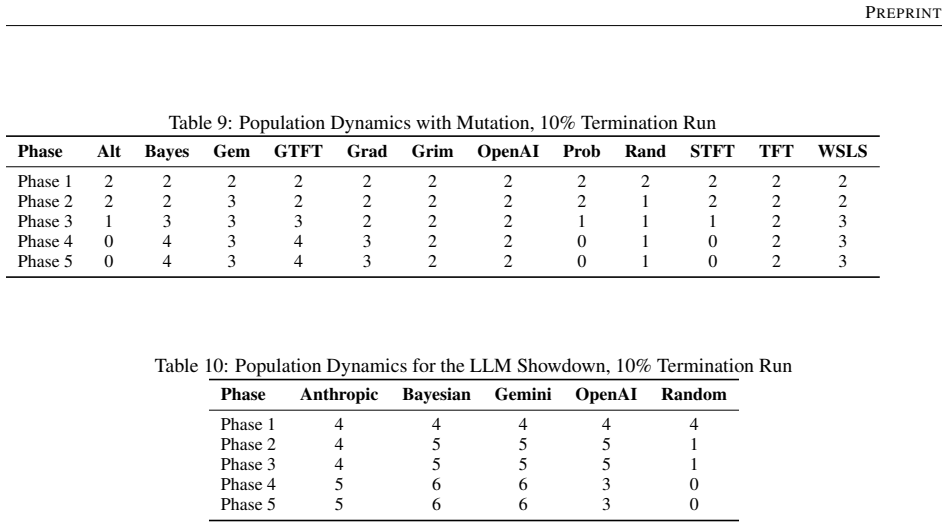
On its own terms, the paper's central discovery is that frontier large language models can behave as strategic actors in an evolutionary repeated game. Across seven tournaments, the LLM agents were almost never eliminated by fitness selection, and in the harshest condition, a 75% per-round termination probability, one model's cooperation rate collapsed to near zero, letting it nearly wipe out the field, while another stayed close to fully cooperative and was wiped out. The paper also reports stable vendor-specific styles: Gemini is a "calculating" horizon-obsessed player, OpenAI is a "principled and stubborn cooperator", and Claude is a forgiving reciprocator that restores cooperation after defection and outperforms the stubborn cooperator head-to-head. Analysis of almost 32,000 prose rationales shows the models refer to the shadow of the future and to the opponent's likely type in the large majority of moves; the paper argues these rationales are not post-hoc decoration because the decision and the rationale are generated together, because the style of reasoning correlates with the move chosen, and because a rare hallucinated misreading of the move history led the model to the wrong cooperative move.
Load-bearing premise
The load-bearing premise is that a single tournament run per condition is representative, because match termination and model sampling are both stochastic; if rerunning the same condition gives different survivors or different fingerprints, the persistence claims do not survive.
Editorial extensions
If this is right
- If language models are strategic agents in this sense, simulations that use LLMs as economic or social agents should expect their behaviour to shift with the time horizon and the opponent pool, not remain a fixed policy.
- Because the models show distinct, stable fingerprints, results from one vendor's model should not be assumed to transfer to another's; a cooperative bias that is safe in long-horizon settings becomes catastrophic when the future is short.
- The correlation between what a model writes in its rationale and what it plays means that asking a model to justify its move is not a neutral wrapper around the decision; the justification process appears to be part of the decision.
- Performance improved from basic to advanced models in these tournaments, so scaling model capability may translate into improved strategic play in uncertain repeated games.
Reading between the lines
- A direct test not run in the paper: repeat each tournament condition across many random seeds; because termination and move sampling are stochastic, the claimed persistent fingerprints and Phase-5 rankings need to be stable across seeds to be robust.
- The fingerprint idea could be inverted into an auditing tool: a deployed model's conditional cooperation probabilities could be measured in controlled games as a behavioural signature that might reveal drift or hidden strategic biases.
- The coding disagreement between the two LLM raters, one counting only explicit type-labelling as opponent modelling and the other counting any reaction to the opponent's last move, shows that "theory of mind" in machines is not a single observable; future work should separate reactive adjustment from genuine type inference.
- If horizon-sensitive ruthlessness generalises beyond this game, then deployed LLMs that are explicitly told an interaction will end soon could behave very differently from those expecting long engagements, a testable prediction for negotiation or pricing tasks.
Editorial analysis
A structured set of objections, weighed in public.
Referee Report
Summary. The paper reports a series of evolutionary Iterated Prisoner's Dilemma tournaments in which LLM agents from OpenAI, Google, and Anthropic compete against canonical hand-coded strategies. A 2×2 factorial design crosses model capability with termination probability, supplemented by stress tests and an all-LLM showdown. The authors claim that LLMs are highly competitive and sometimes proliferate, that each vendor exhibits a distinctive and persistent 'strategic fingerprint,' and that the models' prose rationales show genuine strategic reasoning about the time horizon and the opponent's likely strategy, which the authors argue is instrumental to the decisions. The paper includes population dynamics tables, cooperation-rate summaries, conditional-response fingerprints, and a qualitative analysis of a 10% sample of roughly 32,000 rationales, with code and data archived on GitHub.
Significance. If the central claims were established, the paper would be a valuable contribution at the intersection of evolutionary game theory and machine psychology: it would provide evidence that frontier LLMs can act as adaptive strategic agents in repeated uncertain games, with vendor-specific behavioral styles and causally relevant verbal justifications. The open-source release of tournament code and data (Appendix B) is a concrete strength that would support replication and extension by other groups. However, the core empirical claims rest on single stochastic realizations, and the causal claim about rationales is not supported by the experimental design; these issues must be addressed before the paper can support its headline conclusions.
major comments (4)
- [§2.1, §2.2, §2.3.2, Tables 4–10, 14, 24] Each 2×2 cell is executed once, match termination is random with probability p per round, and LLM outputs are sampled at temperature 0.7 (or API default for Gemini); consequently, all population tables and fingerprint tables are single realizations of a high-variance stochastic process with no error bars or repeated seeds. The 75% run illustrates the fragility: Table 24 shows Gemini scoring 2.207 and OpenAI 2.171 points per move, yet Table 8 has Gemini proliferating to 16 copies while OpenAI goes extinct; given the squared relative fitness and the rounding/normalization steps in Section 2.4 (Eq. 3), a second draw from the same conditions could plausibly cross the reproduction threshold differently. The paper should replicate each condition across multiple seeds and report distributional statistics (e.g., survival probabilities, fingerprint intervals) before claiming 'consistent survival' and 'persistent fingerprints.'
- [§2.3.2, Tables 13–15] The vendor comparison is confounded by unequal sampling temperatures: OpenAI and Claude use temperature 0.7 while Gemini is left at its API default. Because temperature directly controls output stochasticity, the observed differences in cooperation rates and conditional response profiles could partly reflect sampling temperature rather than model training or strategic style, undermining the 'vendor-specific strategic fingerprint' interpretation. The paper should either match temperatures across vendors or include a control experiment varying temperature for a single model to show that the fingerprints are stable under that variation.
- [§2.3.2, §4.5.4, Tables 17–21] The abstract and Section 4.5.4 assert that the prose reasoning is 'instrumental' to the decisions, but the design does not support a causal claim. Rationale and move are generated in the same autoregressive pass, so the observed correlations between rationale content and cooperative behavior are equally consistent with post-hoc rationalization or with correlated-but-non-causal generation; no intervention (e.g., suppressing the rationale, or manipulating the rationale content) is reported. In addition, the rationales and the fingerprints are both computed from the same tournament decisions used to motivate the success claims, making the 'reasoning drives success' narrative partly circular. A causal test or a clearly framed associational claim is needed.
- [§4.3.1, Table 14] The fingerprint cells have very small denominators: in Table 14, OpenAI's 75% row reports N/A for P(C|DC) and P(C|DD) and a P(C|CD) value of 0.167, which the text states is based on only 5 sucker events out of 194 total decisions. The 'persistent fingerprint' contrast between Gemini and OpenAI in the 75% condition therefore rests on a handful of events, and the paper should report denominator counts and flag or exclude cells with very small sample sizes instead of treating them as comparable to cells with hundreds of observations.
minor comments (5)
- [§4.1] The sentence contains the typo 'litaratures' (should be 'literatures').
- [§2.7, Appendix B] The coder names 'gemini-11.5-flash-latest' and 'claude-3-haiku-2020307' appear to be typos for actual model identifiers, and Appendix B mentions a 'hand-coded sample of 5,000+ LLM rationales' while Section 2.7 states that 3194 rationales (10% of 31,949) were coded; these numbers and names should be reconciled.
- [§4.5.1, Tables 16 and 19] The text says Gemini mentions the time horizon '94% of the time' and OpenAI '76% of the time', but Table 19 gives per-condition rates that do not match these figures; the 94% and 76% correspond to sums of the explicit and implicit columns in Table 16, so the text should state that it is aggregating across conditions.
- [§2.4, Eq. (3)] Equation (3) is typeset with a line break inside the fraction, making it look like a two-line formula; the formatting should be cleaned up.
- [§2.5, Table 3 and Table 25] The 'Environmental Stability' metric is listed in Table 3 but its formal definition (Euclidean distance of population vectors) appears only in the footnote of Table 25; consider defining it in Section 2.5 to avoid a forward reference.
Circularity Check
No significant circularity: the reported 'fingerprints' and rationale-based claims are empirical descriptions and correlations, not predictions forced by construction.
full rationale
The manuscript is an observational tournament study rather than a parameter-fitting exercise, and none of its headline claims reduces to its inputs by construction. The strategic fingerprints are conditional cooperation probabilities computed from recorded moves; they are descriptive summaries, and the claims that fingerprints differ across vendors are empirical comparisons of those summaries, not quantities that were pre-imposed. The reasoning-instrumentality claim rests on (a) a prompt design that requires a rationale token sequence before the move token and (b) observed correlations between coded rationale features and cooperation rates (e.g., Tables 17-18); although the prompt design makes the rationale temporally precede the move by construction, the correlations themselves are contingent and the causal/instrumental reading is an interpretive inference, not a definitional equivalence. The paper contains no fitted parameter that is later renamed as a prediction, no load-bearing self-citation (the reference list contains no works by the authors), no imported uniqueness theorem, and no ansatz smuggled in via citation. Potential weaknesses—single-run cells, temperature sampling, LLM-generated codes, and small denominator cells in some fingerprint entries—are reproducibility and validity concerns, not circularity, because they do not make any stated result identical to its own inputs. The central claims therefore have independent empirical content.
Assumptions & free parameters
free parameters (3)
- Selection pressure exponent =
2
- Initial population size and copies =
24 agents, 2 copies per strategy
- Match parameters =
history window 20, hard cap 30 rounds
assumptions (4)
- domain assumption Average score per move is a valid fitness proxy for evolutionary success
- domain assumption A single tournament run per condition is representative of the underlying stochastic process
- ad hoc to paper LLM rationales are generated before the move in the same autoregressive pass and therefore causally constrain the decision
- domain assumption Two LLM coders provide valid labels for the rationale content
Cite this review
Pith. "Pith review of Strategic Intelligence in Large Language Models: Evidence from evolutionary Game Theory." pith.science (2026). https://pith.science/paper/HLONEIYA
@misc{pith2026250702618,
  author       = {Pith},
  title        = {Pith review of: Strategic Intelligence in Large Language Models: Evidence from evolutionary Game Theory},
  year         = {2026},
  howpublished = {\url{https://pith.science/paper/HLONEIYA}},
  note         = {Machine review of arXiv:2507.02618}
}
read the original abstract
Are Large Language Models (LLMs) a new form of strategic intelligence, able to reason about goals in competitive settings? We present compelling supporting evidence. The Iterated Prisoner's Dilemma (IPD) has long served as a model for studying decision-making. We conduct the first ever series of evolutionary IPD tournaments, pitting canonical strategies (e.g., Tit-for-Tat, Grim Trigger) against agents from the leading frontier AI companies OpenAI, Google, and Anthropic. By varying the termination probability in each tournament (the "shadow of the future"), we introduce complexity and chance, confounding memorisation. Our results show that LLMs are highly competitive, consistently surviving and sometimes even proliferating in these complex ecosystems. Furthermore, they exhibit distinctive and persistent "strategic fingerprints": Google's Gemini models proved strategically ruthless, exploiting cooperative opponents and retaliating against defectors, while OpenAI's models remained highly cooperative, a trait that proved catastrophic in hostile environments. Anthropic's Claude emerged as the most forgiving reciprocator, showing remarkable willingness to restore cooperation even after being exploited or successfully defecting. Analysis of nearly 32,000 prose rationales provided by the models reveals that they actively reason about both the time horizon and their opponent's likely strategy, and we demonstrate that this reasoning is instrumental to their decisions. This work connects classic game theory with machine psychology, offering a rich and granular view of algorithmic decision-making under uncertainty.
Figures

Forward citations
Cited by 3 Pith papers
-
Diagon: A Programmable Testbed for AI-Agent Cognitive Labor Markets
Market exchange among AI agents can raise productivity over self-sufficient agents, but institutional rules such as identity transparency and stronger selection can degrade those gains.
-
Strategy, Not Payoffs: A Behavioural Embedding of Normal-Form Games
A two-feature game embedding (Nash entropy and best-response switching) predicts cross-game transfer of fine-tuned LLMs on held-out games, outperforming game identity and published structural embeddings.
-
Democratizing Diplomacy: A Harness for Evaluating Any Large Language Model on Full-Press Diplomacy
An evaluation harness lets off-the-shelf local LLMs, including a 24B model, play full-press Diplomacy without fine-tuning.
Reference graph
Works this paper leans on
-
[1]
Robert Axelrod. The Evolution of Cooperation. Basic Books, New York, 1984
work page 1984
-
[2]
Sparks of artificial general intelligence: Early experiments with gpt-4
S \'e bastien Bubeck, Varun Chandrasekaran, Ronen Eldan, Johannes Gehrke, Eric Horvitz, Ece Kamar, Peter Lee, Yin Tat Lee, Yuanzhi Li, Scott Lundberg, et al. Sparks of artificial general intelligence: Early experiments with gpt-4. arXiv preprint arXiv:2303.12712, 2023
arXiv 2023
-
[3]
Cooperation under the shadow of the future: Experimental evidence from infinitely repeated games
Pedro Dal B \'o . Cooperation under the shadow of the future: Experimental evidence from infinitely repeated games. American Economic Review, 95 0 (5): 0 1591--1604, 2005
work page 2005
-
[4]
Thilo Hagendorff, Ishita Dasgupta, Marcel Binz, Stephanie C. Y. Chan, Andrew Lampinen, Jane X. Wang, Zeynep Akata, and Eric Schulz. Machine psychology. arXiv preprint arXiv:2303.13988, 2023
arXiv 2023
-
[5]
Effects of neighbourhood size and connectivity on the spatial continuous prisoner's dilemma
Mukesh Ifti, Timothy Killingback, and Michael Doebeli. Effects of neighbourhood size and connectivity on the spatial continuous prisoner's dilemma. Journal of Theoretical Biology, 231 0 (1): 0 97--106, 2004. doi:10.1016/j.jtbi.2004.06.003
-
[6]
Large language models struggle to learn long-tail knowledge, 2023
Nikhil Kandpal, Haikang Deng, Adam Roberts, Eric Wallace, and Colin Raffel. Large language models struggle to learn long-tail knowledge, 2023. URL https://arxiv.org/abs/2211.08411
arXiv 2023
-
[7]
Theory of mind may have spontaneously emerged in large language models
Michal Kosinski. Theory of mind may have spontaneously emerged in large language models. Nature Human Behaviour, 7 0 (7): 0 1155--1163, 2023
work page 2023
-
[8]
Martin A. Nowak and Karl Sigmund. The evolution of stochastic strategies in the prisoner's dilemma. Acta Applicandae Mathematica, 20: 0 247--265, 1990
work page 1990
Show all 14 references
-
[9]
Grokking: Generalization beyond overfitting on small algorithmic datasets
Alethea Power, Yuri Burda, Harri Edwards, Igor Babuschkin, and Vedant Misra. Grokking: Generalization beyond overfitting on small algorithmic datasets. arXiv preprint arXiv:2201.02177, 2022
2022 arXiv
-
[10]
Logan IV, Matt Gardner, and Sameer Singh
Yasaman Razeghi, Robert L. Logan IV, Matt Gardner, and Sameer Singh. Impact of pretraining term frequencies on few-shot reasoning, 2022. URL https://arxiv.org/abs/2202.07206
2022 arXiv
-
[11]
Sandholm and Robert H
Tuomas W. Sandholm and Robert H. Crites. Multiagent reinforcement learning in the iterated prisoner's dilemma. Biosystems, 37 0 (1-2): 0 147--166, 1996
1996
-
[12]
J. W. A. Strachan, D. Albergo, G. Borghini, et al. Testing theory of mind in large language models and humans. Nature Human Behaviour, 8: 0 1285--1295, 2024
2024
-
[13]
Robert L. Trivers. The evolution of reciprocal altruism. The Quarterly Review of Biology, 46 0 (1): 0 35--57, 1971
1971
-
[14]
Chain-of-thought prompting elicits reasoning in large language models
Jason Wei, Xuezhi Wang, Dale Schuurmans, Maarten Bosma, Ed Chi, Quoc Le, and Denny Zhou. Chain-of-thought prompting elicits reasoning in large language models. In Advances in Neural Information Processing Systems, volume 35, pages 24824--24837, 2022
2022
Reviewed August 6, 2026 · model on record in the stance chip above.
Discussion (0). Sign in to comment.