REVIEW 3 major objections 6 minor 48 references
2.5D Object Detection for Intelligent Roadside Infrastructure
T0 review · 3 major / 6 minor · reviewed 2026-08-06 · deepseek-v4-flash
Pith's one-line read This paper claims that predicting a vehicle's ground-plane footprint as an image parallelogram—rather than 2D boxes with projection or full 3D cuboids—gives roadside cameras accurate, orientation-aware detections that generalize to unseen…
desk verdict Genuinely new regression head and solid engineering, but the parallelogram assumption is validated only on self-collected, similar-geometry data; still deserves peer review. read the letter →
The pith
A machine-rendered reading of the paper's core claim, the machinery that carries it, and where it could break.
The reading
What carries the argument
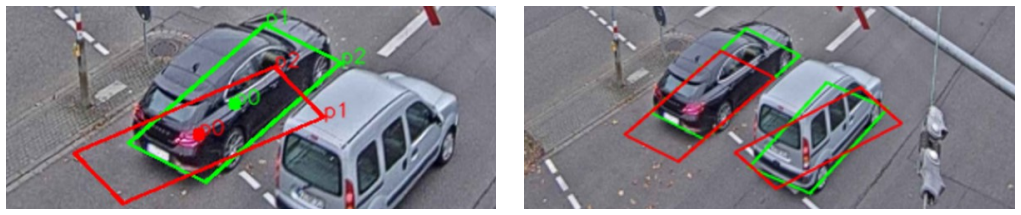
The load-bearing mechanism is a triangle-based regression representation: predict the center p0 and two adjacent corners p1 and p2 of the ground-plane parallelogram, then reflect p1 and p2 across p0 to obtain the full footprint. The regression head is YOLOv8's anchor-free head adapted so that each feature-map pixel is an anchor whose summed offsets give arbitrary triangle sizes and orientations; a tolerance eta keeps anchor points outside the triangle active for one-to-many label assignment. The loss combines mean squared error on the center with Chamfer distance on the unordered vertex pair, and non-maximum suppression uses axis-aligned rectangle IoU as a cheap approximation to parallelogram IoU.
What would settle it
Evaluate the detector on a roadside camera with a wide-angle lens where vehicles near the image edges show strong perspective convergence, and compare the predicted parallelogram footprints against quadrilaterals obtained by projecting the four bottom corners of 3D boxes; if the best-fit parallelogram deviates systematically at the edges, the affine approximation is the binding constraint.
Extended reading notes
Core claim
The central claim is that direct regression of a vehicle's ground-plane footprint as an image parallelogram is a better inductive bias for roadside cameras than either 2D boxes plus projection or full monocular 3D cuboids. The paper argues that object height adds little value for traffic-flow management and V2X perception, while planar position and heading are essential. Under an approximately affine projection, the footprint is a parallelogram, and a parallelogram is fully determined by three points: its center and two adjacent corners. The network therefore regresses six numbers, and the missing two corners are obtained by mirroring the predicted vertices across the center. Using a permutation-invariant Chamfer distance for the two corner vertices lets the model output them in either order, which matches the symmetry of the reconstruction. In the paper's comparison, the deployed model reaches 0.99 mean average precision at 50% IoU, 0.93 average intersection-over-union, and 1.2 degrees mean absolute orientation error on a video stream, where the earlier 2D-projection baseline reaches 0.90, 0.39, and 34.2 degrees.
Load-bearing premise
The load-bearing premise is that a vehicle's ground-plane footprint is well-approximated by a parallelogram under the camera's projection; if the lens is strongly perspective or the vehicle is not rectangular, the regression target itself is misspecified.
Editorial extensions
If this is right
- Roadside infrastructure can provide real-time vehicle position and orientation without camera calibration, road-layout priors, or trajectory tracking; inference runs at 39.2 ms per image on an NVIDIA T4.
- Training on synthetic CARLA data plus a small real dataset transfers to a completely unseen camera viewpoint and to night-rain conditions, mitigating the scarcity of roadside perception datasets.
- Direct ground-plane prediction yields substantially better localization and orientation than 2D projection: AIoU 0.93 versus 0.39 and mean absolute orientation error 1.2 versus 34.2 degrees in the paper's video comparison.
- Because object height is omitted, downstream 3D consumers can reattach a class-typical height to the parallelogram without losing position or heading information.
- The current method is limited to vehicles; pedestrian detection remains out of scope because pedestrian ground-plane footprints are not parallelogram-shaped.
Reading between the lines
- The parallelogram regression target should degrade on non-rectangular vehicles; a natural test is measuring AIoU separately for articulated trucks, where the trailer hinge breaks the single-parallelogram model.
- The same triangle-plus-mirror representation could be reused for any bilaterally symmetric ground object, though adapting it to pedestrians would require a different shape model such as an oriented ellipse.
- Because the method drops camera calibration entirely, it could enable plug-and-play roadside perception on arbitrarily placed cameras as long as the affine approximation holds; the held-out camera result is one data point in that direction.
- The comparison against the projection baseline is built on a single annotated video; a multi-site benchmark with varying lens distortion would reveal how far the affine assumption extends.
Signed reviews
Editorial analysis
A structured set of objections, weighed in public.
Referee Report
Summary. The paper proposes a 2.5D object detection framework for roadside traffic cameras. Instead of predicting 2D boxes or full 3D cuboids, the method regresses the vehicle's ground-plane footprint as a parallelogram in the image, represented by a center point and two adjacent corners (a triangle). This is implemented by modifying the regression head of YOLOv8, trained on a combination of real images (TAF-BW, TUMTraf) and a large CARLA synthetic set, under several initialization and finetuning strategies. The authors evaluate on three self-collected test sets (default conditions, a held-out camera, and night-rain conditions) and compare against a projection-based 2D detection baseline (TAF-v1). They report high mAP, localization, and orientation accuracy, and claim strong cross-viewpoint and adverse-weather generalization, with real-time inference on a T4 GPU.
Significance. If validated, the contribution is practically significant: a compact, calibration-free ground-plane representation is well suited to roadside perception, and the paper provides a reproducible training recipe that combines synthetic and real data with promising results. The controlled comparison against the projection-based TAF-v1 baseline shows a large improvement in the authors' setting, and the public release of model weights and inference code is a concrete asset for the community. However, the supporting evidence is limited to self-collected data, a self-implemented baseline, and single training runs, so the external validity of the central generalization claims remains unestablished. The parallelogram representation is the key conceptual novelty, but its geometric validity under perspective projection is asserted rather than demonstrated, and the evaluation metrics are computed under the same parallelogram assumption used to construct the labels.
major comments (3)
- [Section III and III.A] The parallelogram approximation is load-bearing but never validated. Under perspective projection, a ground rectangle projects to a general quadrilateral whose opposite edges converge to a vanishing point; it is a parallelogram only in the affine/orthographic limit. Section III states that the footprint appears as a parallelogram 'under an approximately affine projection, an assumption that holds for many roadside cameras,' but no quantitative evidence is provided (e.g., camera focal lengths, viewing angles, or per-object residual statistics). More importantly, the labels are constructed under the same assumption: real labels are manually drawn as parallelograms with the fourth corner inferred from parallelogram geometry, and synthetic labels are described as the four projected bottom vertices of CARLA 3D boxes, but the paper does not explain how a non-parallelogram projected quadrilateral is converted to the triangle (p0, p1, p2) used for regression. Consequently, the AIoU metric in Section IV.A measures overlap with the parallelogram proxy rather than with the true projected footprint, and the held-out camera test at the same site cannot expose a failure of the affine approximation because the projective geometry is similar. Please add a quantitative validation of the parallelogram model (e.g., on synthetic data, measure the distance between the reflected fourth vertex and the true projected bottom vertex as a function of camera position, focal length, and object depth) and evaluate on at least one genuinely different camera geometry or a public roadside dataset.
- [Section IV.A and Table II] The generalization claim rests on self-collected data and a self-implemented baseline, without independent or repeated evaluation. AIoU and mAOE are computed only over the set M of prediction–ground-truth pairs whose IoU exceeds 0.5, so these regression metrics exclude misses and false positives; mAP@50 is the only metric that captures detection quality, and Table II reports a single run with no variance. The comparison in Table III is against TAF-v1, which is 'similar to the model detailed in [8]' rather than the original method, and no external baseline (e.g., recent monocular 3D detectors or projection-based systems evaluated on a public dataset) is included. The conclusion that the method 'outperforms previous approaches' is therefore stronger than the evidence. Please provide results across multiple random seeds with standard deviations, specify the exact video/test split used for Table III, and, if possible, evaluate on a public benchmark such as Rope3D or release the test annotations so that independent re-implementation is possible. The final deployed model is also selected after inspecting the same test sets, which introduces selection bias; a separate validation set or cross-validation would help.
- [Abstract and Section IV.B] The claim that adverse weather was absent from training is not supported as stated. The paper only specifies that the real-world training images are daylight scenes; it does not state the weather and lighting configurations used in the CARLA synthetic pretraining set. Since CARLA can simulate rain and nighttime conditions and the synthetic set is 218k images, the Night-Rain test set may not be 'absent from the training set' if any synthetic images contain rain or darkness. Please specify the CARLA weather and lighting parameters used, and either exclude rain/night from all training data or revise the claim to 'absent from real-world training data.'
minor comments (6)
- [Section III.A] The annotation description 'the fourth corner is inferred by reflecting one point across the diagonal' is geometrically ambiguous; given three vertices of a parallelogram, the fourth is obtained by vector addition, and reflection across a diagonal is only valid in special cases. Clarify the construction and whether annotators verified alignment with the visible vehicle footprint.
- [Section IV.A] The mAOE formula uses the arctangent of slope differences and may be unstable when x2 = x1; use atan2 and report the angular error in modulo 180 degrees, with circular averaging over the test set.
- [Section IV.B and Table I] The text refers to 'the large-scale synthetic pretraining dataset (2 million images)', but Table I lists 218,223 CARLA images and 1,534,474 objects; reconcile the numbers.
- [Section III.B] The anchor tolerance eta is a free parameter introduced for training, but its value is never reported; report it for reproducibility.
- [Section III.D] The statement that the axis-aligned rectangle IoU approximation has an 'average discrepancy of 0.05' does not say over which set of detections this was computed; specify the evaluation set and whether the discrepancy is in absolute IoU.
- [Section IV.B] The 282 TUMTraf images are 'selected' without criteria; describe the selection rule (e.g., viewpoint diversity or annotation quality).
Circularity Check
No significant circularity: the parallelogram target is an explicit modeling assumption, and the main comparison is a controlled experiment; test-set model selection and shared label/assumption geometry are validity risks but not circular reductions.
full rationale
The derivation chain is not circular. Section III introduces the parallelogram representation as an explicit assumption ("this footprint appears as a parallelogram in the image under an approximately affine projection, an assumption that holds for many roadside cameras"), and the same assumption is used to construct real labels (three corners plus reflected fourth corner) and synthetic labels (four bottom vertices). The model regresses p0, p1, and p2 and reconstructs the parallelogram by reflection, so the prediction structure matches the label parameterization by design. This is the standard definition of a supervised detection target, not a reduction of the reported performance to the inputs: the model must still learn to localize vertices, and the held-out camera, night-rain, and video-stream evaluations are separate from the training data. The comparison with TAF-v1 is an annotated video experiment, not a tautology. The paper contains several self-citations (e.g., [8], [43], [42]), but none supplies a load-bearing premise, uniqueness theorem, or fitted value that is then renamed as a prediction. The deployment model is selected after inspecting the test sets, which risks selection bias but does not make the metrics equivalent to the fitted choices by construction. The main validity concern is that the parallelogram assumption is unquantified under perspective distortion, so the reported AIoU measures fit to a parallelogram proxy rather than the true projected footprint; that is a correctness/robustness limitation, not circularity.
Assumptions & free parameters
free parameters (3)
- Anchor tolerance eta =
not reported
- Confidence threshold =
0.1
- Loss weighting =
unweighted sum
assumptions (4)
- domain assumption Ground-plane footprint of a vehicle is approximately a parallelogram under roadside camera projection
- domain assumption Synthetic CARLA images are a valid proxy for real roadside imagery
- domain assumption Manual annotations using the L-shape triangle method are accurate enough
- domain assumption Standard YOLOv8 backbone and classification features transfer to roadside viewpoints
Cite this review
Pith. "Pith review of 2.5D Object Detection for Intelligent Roadside Infrastructure." pith.science (2026). https://pith.science/paper/MYN6MJJX
@misc{pith2026250703564,
  author       = {Pith},
  title        = {Pith review of: 2.5D Object Detection for Intelligent Roadside Infrastructure},
  year         = {2026},
  howpublished = {\url{https://pith.science/paper/MYN6MJJX}},
  note         = {Machine review of arXiv:2507.03564}
}
read the original abstract
On-board sensors of autonomous vehicles can be obstructed, occluded, or limited by restricted fields of view, complicating downstream driving decisions. Intelligent roadside infrastructure perception systems, installed at elevated vantage points, can provide wide, unobstructed intersection coverage, supplying a complementary information stream to autonomous vehicles via vehicle-to-everything (V2X) communication. However, conventional 3D object-detection algorithms struggle to generalize under the domain shift introduced by top-down perspectives and steep camera angles. We introduce a 2.5D object detection framework, tailored specifically for infrastructure roadside-mounted cameras. Unlike conventional 2D or 3D object detection, we employ a prediction approach to detect ground planes of vehicles as parallelograms in the image frame. The parallelogram preserves the planar position, size, and orientation of objects while omitting their height, which is unnecessary for most downstream applications. For training, a mix of real-world and synthetically generated scenes is leveraged. We evaluate generalizability on a held-out camera viewpoint and in adverse-weather scenarios absent from the training set. Our results show high detection accuracy, strong cross-viewpoint generalization, and robustness to diverse lighting and weather conditions. Model weights and inference code are provided at: https://gitlab.kit.edu/kit/aifb/ATKS/public/digit4taf/2.5d-object-detection
Figures


Figures from the paper (3 more)


Reference graph
Works this paper leans on
-
[8]
T. Fleck, K. Daaboul, M. Weber, P. Sch ¨orner, M. Wehmer, J. Doll, S. Orf, N. Sußmann, C. Hubschneider, M. R. Zofka et al., “Towards Large Scale Urban Traffic Reference Data: Smart Infrastructure in the Test Area Autonomous Driving Baden-W¨urttemberg,” in International Conference on Intelligent Autonomous Systems . Springer, 2019
work page 2019
-
[1]
P. Sch ¨orner, L. T ¨ottel, J. Doll, and J. M. Z ¨ollner, “Predictive Trajec- tory Planning in Situations with Hidden Road Users Using Partially Observable Markov Decision Processes,” in Intelligent Vehicles Sym- posium (IV). IEEE, 2019
work page 2019
-
[2]
DigiT4TAF–Bridging Physical and Digital Worlds for Future Trans- portation Systems,
M. Zipfl, P. Zwick, P. Schulz, M. R. Zofka, A. Schotschneider, H. Gremmelmaier, N. Polley, F. M ¨utsch, K. Simon, F. Gottselig et al., “DigiT4TAF–Bridging Physical and Digital Worlds for Future Trans- portation Systems,” in International Automated Vehicle Validation Conference (IAVVC). IEEE, 2025
work page 2025
-
[3]
A Unified Description of Proving Grounds and Test Areas for Automated and Connected Vehicles,
M. R. Zofka, T. Fleck, and J. M. Z ¨ollner, “A Unified Description of Proving Grounds and Test Areas for Automated and Connected Vehicles,” in Intelligent Vehicles Symposium (IV) . IEEE, 2022
work page 2022
-
[4]
TUMTraf V2X Cooperative Perception Dataset,
W. Zimmer, G. A. Wardana, S. Sritharan, X. Zhou, R. Song, and A. C. Knoll, “TUMTraf V2X Cooperative Perception Dataset,” in Conference on Computer Vision and Pattern Recognition (CVPR) , 2024
work page 2024
-
[5]
Are we ready for Autonomous Driving? The KITTI Vision Benchmark Suite,
A. Geiger, P. Lenz, and R. Urtasun, “Are we ready for Autonomous Driving? The KITTI Vision Benchmark Suite,” in Conference on Computer Vision and Pattern Recognition (CVPR) , 2012
2012
-
[6]
nuScenes: A multimodal dataset for autonomous driving,
H. Caesar, V . Bankiti, A. H. Lang, S. V ora, V . E. Liong, Q. Xu, A. Kr- ishnan, Y . Pan, G. Baldan, and O. Beijbom, “nuScenes: A multimodal dataset for autonomous driving,” in Conference on Computer Vision and Pattern Recognition (CVPR) , 2020
work page 2020
-
[7]
Scalability in Perception for Autonomous Driving: Waymo Open Dataset,
P. Sun, H. Kretzschmar, X. Dotiwalla, A. Chouard, V . Patnaik, P. Tsui, J. Guo, Y . Zhou, Y . Chai, B. Caine et al. , “Scalability in Perception for Autonomous Driving: Waymo Open Dataset,” in Conference on Computer Vision and Pattern Recognition (CVPR) . IEEE, 2020
work page 2020
Show all 48 references
-
[9]
Large-scale ex- traction of accurate vehicle trajectories for driving behavior learning,
A. Clausse, S. Benslimane, and A. de La Fortelle, “Large-scale ex- traction of accurate vehicle trajectories for driving behavior learning,” in 2019 IEEE Intelligent Vehicles Symposium (IV) . IEEE, 2019
2019
-
[10]
Kalman filtering aspects in camera and deep learning based tracking for traffic monitoring,
N. Kornfeld, A. Leich, and M. Roth, “Kalman filtering aspects in camera and deep learning based tracking for traffic monitoring,” in International Conference on Information Fusion (FUSION) . IEEE, 2024
2024
-
[11]
3D-Net: Monocular 3D object recognition for traffic monitoring,
M. Rezaei, M. Azarmi, and F. M. P. Mir, “3D-Net: Monocular 3D object recognition for traffic monitoring,” Expert Systems with Applications, vol. 227, 2023
2023
-
[12]
UrbanNet: Leveraging Urban Maps for Long Range 3D Object Detection,
J. Carrillo and S. Waslander, “UrbanNet: Leveraging Urban Maps for Long Range 3D Object Detection,” in International Conference on Intelligent Transportation Systems (ITSC) , 2021
2021
-
[13]
Monocular 3D Vehicle Detection Using Uncalibrated Traffic Cameras through Homography,
M. Zhu, S. Zhang, Y . Zhong, P. Lu, H. Peng, and J. Lenneman, “Monocular 3D Vehicle Detection Using Uncalibrated Traffic Cameras through Homography,” in International Conference on Intelligent Robots and Systems (IROS) , 2021
2021
-
[14]
FCOS3D: Fully Convolu- tional One-Stage Monocular 3D Object Detection,
T. Wang, X. Zhu, J. Pang, and D. Lin, “FCOS3D: Fully Convolu- tional One-Stage Monocular 3D Object Detection,” in International Conference on Computer Vision (ICCV) , 2021
2021
-
[15]
Microsoft COCO: Common objects in context,
T.-Y . Lin, M. Maire, S. Belongie et al., “Microsoft COCO: Common objects in context,” in European Conference on Computer Vision (ECCV). Springer, 2014
2014
-
[16]
End-to-End Object Detection with Transformers,
N. Carion, F. Massa, G. Synnaeve, N. Usunier, A. Kirillov, and S. Zagoruyko, “End-to-End Object Detection with Transformers,” in European Conference on Computer Vision (ECCV) . Springer, 2020
2020
-
[17]
DETRs with Collaborative Hybrid Assignments Training,
Z. Zong, G. Song, and Y . Liu, “DETRs with Collaborative Hybrid Assignments Training,” in International Conference on Computer Vision (ICCV), 2023
2023
-
[18]
DINO: DETR with Improved DeNoising Anchor Boxes for End-to-End Object Detection,
H. Zhang, F. Li, S. Liu, L. Zhang, H. Su, J. Zhu, L. M. Ni, and H.- Y . Shum, “DINO: DETR with Improved DeNoising Anchor Boxes for End-to-End Object Detection,” in International Conference on Learning Representations (ICLR) , 2023
2023
-
[19]
Group DETR: Fast DETR Training with Group-Wise One-to-Many Assignment,
Q. Chen, X. Chen, J. Wang, S. Zhang, K. Yao, H. Feng, J. Han, E. Ding, G. Zeng, and J. Wang, “Group DETR: Fast DETR Training with Group-Wise One-to-Many Assignment,” in International Confer- ence on Computer Vision (ICCV) , 2023
2023
-
[20]
You Only Look Once: Unified, Real-Time Object Detection,
J. Redmon, S. Divvala, R. Girshick, and A. Farhadi, “You Only Look Once: Unified, Real-Time Object Detection,” in Conference on Computer Vision and Pattern Recognition (CVPR) , 2016
2016
-
[21]
YOLOv3: An Incremental Improvement,
J. Redmon and A. Farhadi, “YOLOv3: An Incremental Improvement,” in arXiv preprint arXiv:1804.02767 , 2018
2018 arXiv
-
[22]
YOLOv7: Trainable Bag-of-Freebies Sets New State-of-the-Art for Real-Time Object De- tectors,
C. Wang, A. Bochkovskiy, and H. M. Liao, “YOLOv7: Trainable Bag-of-Freebies Sets New State-of-the-Art for Real-Time Object De- tectors,” in Conference on Computer Vision and Pattern Recognition (CVPR), 2023
2023
-
[23]
YOLO by Ultralytics (Version 8.0.0),
G. Jocher, A. Chaurasia, and J. Qiu, “YOLO by Ultralytics (Version 8.0.0),” 2023. [Online]. Available: https://github.com/ultralytics/ ultralytics
2023
-
[24]
YOLOv9: Learning What You Want to Learn Using Programmable Gradient Information,
C.-Y . Wang, I.-H. Yeh, and H.-Y . Mark Liao, “YOLOv9: Learning What You Want to Learn Using Programmable Gradient Information,” in European Conference on Computer Vision (ECCV). Springer, 2025
2025
-
[25]
YOLOv10: Real-Time End-to-End Object Detection,
A. Wang, H. Chen, L. Liu, K. Chen, Z. Lin, J. Han, and G. Ding, “YOLOv10: Real-Time End-to-End Object Detection,” in Advances in Neural Information Processing Systems (NIPS) , 2024
2024
-
[26]
Ultralytics YOLO11,
G. Jocher and J. Qiu, “Ultralytics YOLO11,” 2025. [Online]. Available: https://github.com/ultralytics/ultralytics
2025
-
[27]
YOLOv12: Attention-Centric Real- Time Object Detectors,
Y . Tian, Q. Ye, and D. Doermann, “YOLOv12: Attention-Centric Real- Time Object Detectors,” arXiv preprint arXiv:2502.12524 , 2025
2025 arXiv
-
[28]
DETRs Beat YOLOs on Real-time Object Detection,
Y . Zhao, W. Lv, S. Xu, J. Wei, G. Wang, Q. Dang, Y . Liu, and J. Chen, “DETRs Beat YOLOs on Real-time Object Detection,” in Conference on Computer Vision and Pattern Recognition (CVPR) , 2024
2024
-
[29]
RT- DETRv2: Improved Baseline with Bag-of-Freebies for Real-Time Detection Transformer,
W. Lv, Y . Zhao, Q. Chang, K. Huang, G. Wang, and Y . Liu, “RT- DETRv2: Improved Baseline with Bag-of-Freebies for Real-Time Detection Transformer,” arXiv preprint arXiv:2407.17140 , 2024
2024 arXiv
-
[30]
RT-DETRv3: Real-time End-to- End Object Detection with Hierarchical Dense Positive Supervision,
S. Wang, C. Xia, F. Lv, and Y . Shi, “RT-DETRv3: Real-time End-to- End Object Detection with Hierarchical Dense Positive Supervision,” in Winter Conference on Applications of Computer Vision (WACV) . IEEE, 2025
2025
-
[31]
3D Object Detection for Au- tonomous Driving: A Comprehensive Survey,
J. Mao, S. Shi, X. Wang, and H. Li, “3D Object Detection for Au- tonomous Driving: A Comprehensive Survey,” International Journal of Computer Vision , 2023
2023
-
[32]
M3D-RPN: Monocular 3D Region Proposal Network for Object Detection,
G. Brazil and X. Liu, “M3D-RPN: Monocular 3D Region Proposal Network for Object Detection,” in International Conference on Com- puter Vision (ICCV) , 2019
2019
-
[33]
FCOS: Fully convolutional one-stage object detection,
Z. Tian, C. Shen, H. Chen, and T. He, “FCOS: Fully convolutional one-stage object detection,” in International Conference on Computer Vision (ICCV), 2019
2019
-
[34]
Inverse perspective mapping simplifies optical flow computation and obstacle detection,
H. A. Mallot, H. H. B ¨ulthoff, J. J. Little, and S. Bohrer, “Inverse perspective mapping simplifies optical flow computation and obstacle detection,” Biological cybernetics, vol. 64, no. 3, 1991
1991
-
[35]
MIO-TCD: A New Benchmark Dataset for Vehicle Classification and Localization,
Z. Luo, F. Branchaud-Charron, C. Lemaire, J. Konrad, S. Li, A. Mishra, A. Achkar, J. Eichel, and P.-M. Jodoin, “MIO-TCD: A New Benchmark Dataset for Vehicle Classification and Localization,” IEEE Transactions on Image Processing , vol. 27, no. 10, 2018
2018
-
[36]
UA-DETRAC: A new benchmark and protocol for multi-object detection and tracking,
L. Wen, D. Du, Z. Cai, Z. Lei, M.-C. Chang, H. Qi, J. Lim, M.-H. Yang, and S. Lyu, “UA-DETRAC: A new benchmark and protocol for multi-object detection and tracking,” Computer Vision and Image Understanding, vol. 193, 2020
2020
-
[37]
Vehicle Tracking by Simul- taneous Detection and Viewpoint Estimation,
R. Guerrero-Gomez-Olmedo, R. J. Lopez-Sastre, S. Maldonado- Bascon, and A. Fernandez-Caballero, “Vehicle Tracking by Simul- taneous Detection and Viewpoint Estimation,” in International Work- Conference on the Interplay Between Natural and Artificial Compu- tation (IWINAC), 2013
2013
-
[38]
YOLOv7-3D: A Monocular 3D Traffic Object Detection Method from a Roadside Perspective,
Z. Ye, H. Zhang, J. Gu, and X. Li, “YOLOv7-3D: A Monocular 3D Traffic Object Detection Method from a Roadside Perspective,” Applied Sciences, vol. 13, no. 20, 2023
2023
-
[39]
Rope3D: The Roadside Perception Dataset for Autonomous Driving and Monocular 3D Object Detection Task,
X. Ye, M. Shu, H. Li, Y . Shi, Y . Li, G. Wang, X. Tan, and E. Ding, “Rope3D: The Roadside Perception Dataset for Autonomous Driving and Monocular 3D Object Detection Task,” in Conference on Com- puter Vision and Pattern Recognition (CVPR) , 2022
2022
-
[40]
Optimal traffic control at smart intersections: Automated network fundamental diagram,
M. Amirgholy, M. Nourinejad, and H. O. Gao, “Optimal traffic control at smart intersections: Automated network fundamental diagram,” Transportation Research Part B: Methodological , vol. 137, 2020
2020
-
[41]
TUMTraf Inter- section Dataset: All You Need for Urban 3D Camera-LiDAR Roadside Perception,
W. Zimmer, C. Creß, H. T. Nguyen, and A. C. Knoll, “TUMTraf Inter- section Dataset: All You Need for Urban 3D Camera-LiDAR Roadside Perception,” in International Conference on Intelligent Transportation Systems (ITSC). IEEE, 2023
2023
-
[42]
From Traffic Sensor Data To Semantic Traffic Descriptions: The Test Area Au- tonomous Driving Baden-W ¨urttemberg Dataset (TAF-BW Dataset),
M. Zipfl, T. Fleck, M. R. Zofka, and J. M. Z ¨ollner, “From Traffic Sensor Data To Semantic Traffic Descriptions: The Test Area Au- tonomous Driving Baden-W ¨urttemberg Dataset (TAF-BW Dataset),” in International Conference on Intelligent Transportation Systems (ITSC). IEEE, 2020
2020
-
[43]
Semi-Automatic Ground Truth Trajectory Estimation and Smoothing using Roadside Cameras,
T. Fleck, M. Zipfl, and J. M. Z ¨ollner, “Semi-Automatic Ground Truth Trajectory Estimation and Smoothing using Roadside Cameras,” in International Conference on Intelligent Transportation Systems (ITSC). IEEE, 2023
2023
-
[44]
Sekachev, N
B. Sekachev, N. Manovich, M. Zhiltsov, A. Zhavoronkov, D. Kalinin, B. Hoff, et al., “CV AT,” https://github.com/cvat-ai/cvat, 2025
2025
-
[45]
CARLA: An Open Urban Driving Simulator,
A. Dosovitskiy, G. Ros, F. Codevilla, A. Lopez, and V . Koltun, “CARLA: An Open Urban Driving Simulator,” inConference on Robot Learning, 2017
2017
-
[46]
Distance-IoU loss: Faster and better learning for bounding box regression,
Z. Zheng, P. Wang, W. Liu, J. Li, R. Ye, and D. Ren, “Distance-IoU loss: Faster and better learning for bounding box regression,” in AAAI Conference on Artificial Intelligence , 2020
2020
-
[47]
The Open Images Dataset V4: Unified image classification, object detection, and visual relationship detection at scale,
A. Kuznetsova, H. Rom, N. Alldrin, J. Uijlings, I. Krasin, J. Pont- Tuset, S. Kamali, S. Popov, M. Malloci, A. Kolesnikov, T. Duerig, and V . Ferrari, “The Open Images Dataset V4: Unified image classification, object detection, and visual relationship detection at scale,” IJCV, 2020
2020
-
[48]
Improving object detector training on synthetic data by starting with a strong baseline methodology,
F. A. Ruis, A. M. Liezenga, F. G. Heslinga, L. Ballan, T. A. Eker, R. J. den Hollander, M. C. van Leeuwen, J. Dijk, and W. Huizinga, “Improving object detector training on synthetic data by starting with a strong baseline methodology,” in Synthetic Data for Artificial Intel- l...
2024
Reviewed August 6, 2026 · model on record in the stance chip above.
Discussion (0). Continue with ORCID to comment.