Bright ring features and polarization structures in Kerr-Sen black hole images illuminated by radiatively inefficient accretion flows
Pith reviewed 2026-05-22 12:29 UTC · model grok-4.3
The pith
Increasing the dilaton parameter shrinks the bright ring in Kerr-Sen black hole images while making it wider and brighter.
A machine-rendered reading of the paper's core claim, the machinery that carries it, and where it could break.
Core claim
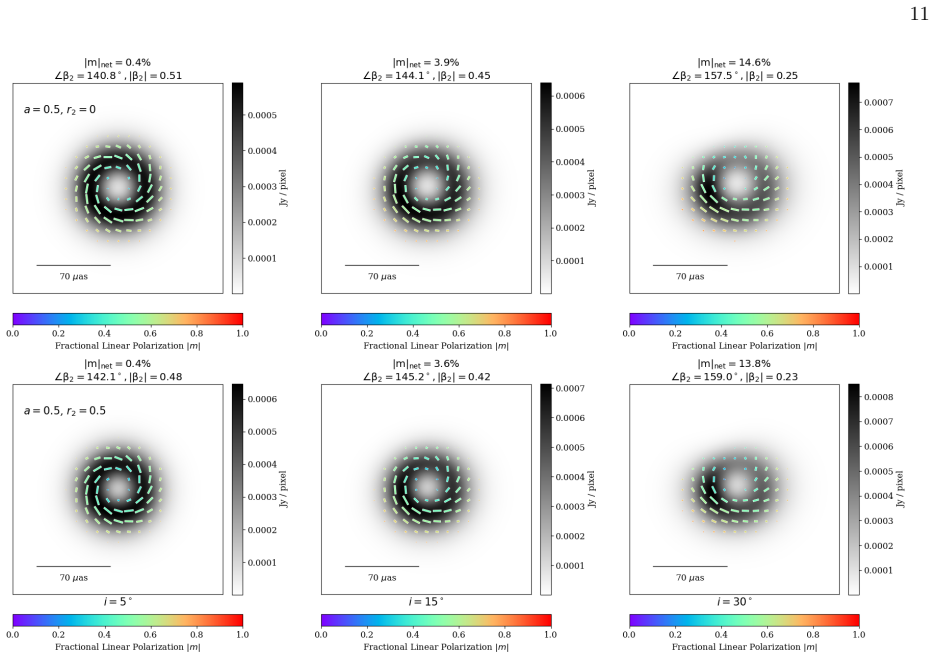
Using GRRT simulations, an increase in the dilaton parameter leads to a shrinking of the bright ring, accompanied by enhancements in both its width and brightness. As the disk thickness grows, the bright ring's diameter and width both decrease. The brightness enhancement induced by the disk thickness is less prominent than that driven by the dilaton parameter. Effects of the disk thickness on the allowed parameter space are stronger than those of the observer's inclination. Effects of the disk thickness on beta2 are much weaker than those from the dilaton parameter.
What carries the argument
The Kerr-Sen black hole metric with a dilaton parameter, illuminated by a radiatively inefficient accretion flow with thermal synchrotron emission at 230 GHz, simulated through general relativistic radiative transfer to generate polarized images and extract the bright ring properties plus the EVPA symmetry coefficient beta2.
If this is right
- Larger dilaton parameter produces a smaller bright ring with greater width and brightness.
- Thicker disks reduce both ring diameter and width while providing a milder brightness boost.
- Disk thickness exerts a stronger influence on the allowed ranges of black hole parameters than observer inclination when matched to EHT data.
- The beta2 coefficient for EVPA two-fold symmetry responds more sensitively to the dilaton parameter than to disk thickness.
Where Pith is reading between the lines
- Ring size and polarization measurements could help separate Kerr-Sen solutions from standard Kerr black holes if dilaton signatures appear in future data.
- The weaker impact of thickness on beta2 compared to dilaton may allow polarization observations to isolate dilaton effects even when disk properties remain uncertain.
- Similar shrinkage and polarization patterns could arise in other dilaton-coupled or modified-gravity spacetimes, offering a template for broader tests.
Load-bearing premise
The radiatively inefficient accretion flow model with purely thermal synchrotron emission at 230 GHz accurately represents the plasma around Sgr A* and the GRRT code correctly propagates polarized radiation in the Kerr-Sen metric.
What would settle it
High-resolution images of Sgr A* that show no ring shrinkage with increasing dilaton parameter or no stronger variation in beta2 from dilaton than from disk thickness would falsify the central claims.
Figures




read the original abstract
Using general relativistic radiative transfer (GRRT) simulations, we investigate the bright ring features and polarization structures in images of the Kerr-Sen black hole associated with Sgr A*, as illuminated by 230 GHz thermal synchrotron emission from radiatively inefficient accretion flows (RIAF). Our findings reveal that an increase in the dilaton parameter leads to a shrinking of the bright ring, accompanied by enhancements in both its width and brightness. As the disk thickness grows, the bright ring's diameter and width both decrease. The brightness enhancement induced by the disk thickness is less prominent than that driven by the dilaton parameter. Comparing with the Event Horizon Telescope (EHT) observational data of SgrA*, we present the allowed ranges of black hole parameters, and find that effects of the disk thickness on the allowed parameter space are stronger than those of the observer's inclination. Furthermore, we analyze the coefficient $\beta_2$, associated with the two-fold rotational symmetry of the electric vector position angles (EVPA), to probe the polarization structure of the black hole images, and reveal that effects of the disk thickness on $\beta_2$ are much weaker than those from the dilaton parameter.
Editorial analysis
A structured set of objections, weighed in public.
Referee Report
Summary. The manuscript uses general relativistic radiative transfer (GRRT) simulations to examine 230 GHz images of Kerr-Sen black holes illuminated by thermal synchrotron emission from radiatively inefficient accretion flows (RIAF). It reports that increasing the dilaton parameter shrinks the bright ring while increasing both its width and brightness; increasing disk thickness decreases ring diameter and width with a less prominent brightness boost; disk thickness exerts a stronger influence than observer inclination on the allowed parameter ranges when compared to EHT Sgr A* data; and disk thickness affects the polarization coefficient β₂ much more weakly than the dilaton parameter.
Significance. If the GRRT results prove robust, the work would offer concrete, falsifiable predictions for how the dilaton parameter imprints on ring morphology and EVPA symmetry in EHT images, providing a pathway to constrain Kerr-Sen deviations from Kerr using existing 230 GHz data. The emphasis on β₂ as a diagnostic of two-fold rotational symmetry is a methodological strength that could be extended to other metrics.
major comments (2)
- [Methods] Methods section: the central quantitative trends (ring shrinkage, width/brightness changes, and β₂ shifts) are extracted from GRRT images, yet no validation tests recovering the Kerr limit, analytic polarization benchmarks, or convergence studies with respect to grid resolution and ray sampling are described. This is load-bearing because any numerical artifact in polarized transport through the modified electromagnetic sector of the Kerr-Sen metric would directly alter the reported parameter dependences.
- [Results] Results and comparison with EHT data: the conclusion that disk-thickness effects dominate the allowed parameter space over inclination rests on the assumption that the purely thermal RIAF model supplies accurate emissivity, absorption, and Faraday coefficients at 230 GHz; without reported closure-phase or visibility-amplitude comparisons to EHT data, the relative strength of these effects cannot be considered observationally anchored.
minor comments (2)
- [Polarization analysis] Notation for β₂ is introduced without an explicit definition or reference to the standard decomposition of the EVPA Fourier coefficients; a brief equation or citation would improve clarity.
- [Figures] Figure captions should state the exact values of the dilaton parameter, disk thickness, and inclination used in each panel to allow direct comparison with the text.
Simulated Author's Rebuttal
We thank the referee for their constructive and detailed report. We address each major comment below and describe the revisions we will implement to strengthen the manuscript.
read point-by-point responses
-
Referee: [Methods] Methods section: the central quantitative trends (ring shrinkage, width/brightness changes, and β₂ shifts) are extracted from GRRT images, yet no validation tests recovering the Kerr limit, analytic polarization benchmarks, or convergence studies with respect to grid resolution and ray sampling are described. This is load-bearing because any numerical artifact in polarized transport through the modified electromagnetic sector of the Kerr-Sen metric would directly alter the reported parameter dependences.
Authors: We agree that explicit validation tests are essential to establish the reliability of the reported trends. Although our GRRT implementation follows standard methods previously validated for Kerr spacetimes, we did not include these demonstrations in the original manuscript. In the revised version we will add a new subsection to the Methods section that (i) recovers the Kerr limit by setting the dilaton parameter to zero and directly compares ring diameter, width, brightness, and β₂ to published Kerr results; (ii) benchmarks the polarized radiative transfer against analytic expectations for simple magnetic-field geometries; and (iii) presents convergence tests with respect to grid resolution and number of rays. These additions will confirm that the quantitative trends are free of numerical artifacts. revision: yes
-
Referee: [Results] Results and comparison with EHT data: the conclusion that disk-thickness effects dominate the allowed parameter space over inclination rests on the assumption that the purely thermal RIAF model supplies accurate emissivity, absorption, and Faraday coefficients at 230 GHz; without reported closure-phase or visibility-amplitude comparisons to EHT data, the relative strength of these effects cannot be considered observationally anchored.
Authors: We acknowledge that our comparison with EHT Sgr A* data relies on image-domain quantities (primarily ring diameter) rather than direct fits to closure phases or visibility amplitudes. The RIAF model we employ is the standard thermal synchrotron prescription used in multiple EHT analyses. To address the referee’s concern we will revise the Results and Discussion sections to (i) explicitly state the model assumptions and their limitations at 230 GHz and (ii) clarify that the reported dominance of disk-thickness effects over inclination is obtained within this model framework. While performing full visibility and closure-phase fitting lies beyond the present scope, we will note this as a natural direction for follow-up work. revision: partial
Circularity Check
Numerical GRRT results are independent simulation outputs with no algebraic reduction to inputs
full rationale
The paper reports findings exclusively from general relativistic radiative transfer simulations of 230 GHz thermal synchrotron emission in the Kerr-Sen spacetime. All quantitative trends (ring shrinkage with dilaton parameter, changes in width/brightness, allowed parameter ranges versus EHT data, and beta2 behavior) are extracted directly from computed images rather than from any closed algebraic chain, fitted parameter renamed as prediction, or self-referential definition. No equation in the provided text equates a derived quantity to its own input by construction, and the work does not invoke uniqueness theorems or ansatze from prior self-citations as load-bearing premises. The derivation chain is therefore self-contained computational exploration.
Axiom & Free-Parameter Ledger
free parameters (2)
- dilaton parameter
- disk thickness
axioms (2)
- domain assumption The accretion flow is radiatively inefficient and emits via thermal synchrotron at 230 GHz.
- domain assumption General relativistic radiative transfer accurately captures polarized light propagation in the Kerr-Sen spacetime.
Lean theorems connected to this paper
-
IndisputableMonolith/Foundation/AlexanderDuality.leanalexander_duality_circle_linking unclear?
unclearRelation between the paper passage and the cited Recognition theorem.
the rotating and charged black hole solution in the Einstein-Maxwell-Dilaton-Axion (EMDA) theory is known as the Kerr-Sen metric... dilaton parameter r2... reduces to the Kerr one when the charge vanishes
-
IndisputableMonolith/Foundation/RealityFromDistinction.leanreality_from_one_distinction unclear?
unclearRelation between the paper passage and the cited Recognition theorem.
We employ the REx algorithm to extract the geometric parameters of the bright ring, and compute the complex polarization coefficient β2
What do these tags mean?
- matches
- The paper's claim is directly supported by a theorem in the formal canon.
- supports
- The theorem supports part of the paper's argument, but the paper may add assumptions or extra steps.
- extends
- The paper goes beyond the formal theorem; the theorem is a base layer rather than the whole result.
- uses
- The paper appears to rely on the theorem as machinery.
- contradicts
- The paper's claim conflicts with a theorem or certificate in the canon.
- unclear
- Pith found a possible connection, but the passage is too broad, indirect, or ambiguous to say the theorem truly supports the claim.
Forward citations
Cited by 3 Pith papers
-
Circular polarization images of Sgr A* for different magnetic field geometries
Modeling of Sgr A* shows Faraday conversion dominates circular polarization in radial, parabolic, quadrupole and combined magnetic fields while intrinsic emission dominates in dipole and vertical fields, allowing excl...
-
Imaging and Polarimetric Signatures of Konoplya-Zhidenko Black Holes with Various Thick Disk
Horizon-scale synchrotron images and polarization maps of Konoplya-Zhidenko black holes with thick disks show expanded photon rings, darker centers, and viewing-angle-dependent asymmetries that vary with the deformati...
-
Optical images of Kerr-Sen black hole illuminated by thick accretion disks
Increasing charge Q shrinks photon rings and central shadows in Kerr-Sen black hole images while spin creates brightness asymmetry; polarization patterns follow lensing and frame dragging.
Reference graph
Works this paper leans on
-
[1]
Ring diameter is shown to decrease with the dilation parameter r2. It should be pointed out that the observed ring diameter is affected by the resolution of the observation instrument [ ? ]. Therefore, we blur the theoretical image to the typical EHT resolution (convolution with a 20 µas Gaussian beam) [9, 52] and analyze the corresponding features in the...
- [2]
-
[3]
B. Abbott, R. Abbott, T. Abbott, F. Acernese, K. Ackley, C. Adams, T. Adams, P. Addesso, R. Adhikari, V. Adya, et al., Physical Review D 97 (2018), ISSN 2470-0029, URL http://dx.doi.org/10.1103/PhysRevD.97.102002
-
[4]
K. Akiyama, A. Alberdi, W. Alef, K. Asada, R. Azulay, A.-K. Baczko, D. Ball, M. Balokovi, J. Barrett, D. Bintley, et al., The Astrophysical Journal Letters 875, L1 (2019), ISSN 2041-8213, URL http://dx.doi.org/10.3847/ 2041-8213/ab0ec7
work page 2019
-
[5]
E. H. T. Collaboration, K. Akiyama, A. Alberdi, W. Alef, J. C. Algaba, R. Anantua, K. Asada, R. Azulay, U. Bach, A.-K. Baczko, et al., The Astrophysical Journal Letters 930, L12 (2022), ISSN 2041-8213, URL http: //dx.doi.org/10.3847/2041-8213/ac6674
-
[6]
D. Psaltis, L. Medeiros, P. Christian, F. zel, K. Akiyama, A. Alberdi, W. Alef, K. Asada, R. Azulay, D. Ball, et al., Physical Review Letters 125 (2020), ISSN 1079-7114, URL http://dx.doi.org/10.1103/PhysRevLett. 125.141104
-
[7]
S. Vagnozzi, R. Roy, Y.-D. Tsai, L. Visinelli, M. Afrin, A. Allahyari, P. Bambhaniya, D. Dey, S. G. Ghosh, P. S. Joshi, et al., Classical and Quantum Gravity 40, 165007 (2023), ISSN 1361-6382, URL http://dx.doi.org/10. 1088/1361-6382/acd97b
work page 2023
-
[8]
Event Horizon Telescope Collaboration, K. Akiyama, A. Alberdi, W. Alef, J. C. Algaba, R. Anantua, K. Asada, R. Azulay, U. Bach, A.-K. Baczko, et al., ApJ 930, L16 (2022)
work page 2022
-
[9]
K. Akiyama, A. Alberdi, W. Alef, K. Asada, R. Azulay, A.-K. Baczko, D. Ball, M. Balokovi, J. Barrett, D. Bintley, et al., The Astrophysical Journal Letters 875, L5 (2019), ISSN 2041-8213, URL http://dx.doi.org/10.3847/ 2041-8213/ab0f43
work page 2019
-
[10]
E. H. T. Collaboration, K. Akiyama, A. Alberdi, W. Alef, J. C. Algaba, R. Anantua, K. Asada, R. Azulay, U. Bach, A.-K. Baczko, et al., The Astrophysical Journal Letters 930, L17 (2022), ISSN 2041-8213, URL http: //dx.doi.org/10.3847/2041-8213/ac6756
-
[11]
G. W. Gibbons and K.-i. Maeda, Nucl. Phys. B 298, 741 (1988)
work page 1988
-
[12]
J. Sonner and P. K. Townsend, Physical Review D 74 (2006), ISSN 1550-2368, URL http://dx.doi.org/10. 1103/PhysRevD.74.103508
work page 2006
-
[13]
A. Sen, Physical Review Letters 69, 10061009 (1992), ISSN 0031-9007, URL http://dx.doi.org/10.1103/ PhysRevLett.69.1006
work page 1992
- [14]
-
[15]
K. Hioki and U. Miyamoto, Physical Review D 78 (2008), ISSN 1550-2368, URL http://dx.doi.org/10.1103/ PhysRevD.78.044007
work page 2008
-
[16]
Z. Younsi, A. Zhidenko, L. Rezzolla, R. Konoplya, and Y. Mizuno, Phys. Rev. D 94, 084025 (2016), URL https: //link.aps.org/doi/10.1103/PhysRevD.94.084025
-
[17]
J. An, J. Peng, Y. Liu, and X.-H. Feng, Phys. Rev. D 97, 024003 (2018), URL https://link.aps.org/doi/10. 1103/PhysRevD.97.024003
work page 2018
-
[18]
K. S. Virbhadra and G. F. R. Ellis, Phys. Rev. D 62, 084003 (2000), astro-ph/9904193
work page internal anchor Pith review Pith/arXiv arXiv 2000
-
[19]
K. S. Virbhadra, Phys. Rev. D 79, 083004 (2009), 0810.2109
work page internal anchor Pith review Pith/arXiv arXiv 2009
- [20]
- [21]
- [22]
-
[23]
H. Feng, R.-J. Yang, and W.-Q. Chen, Astropart. Phys. 166, 103075 (2025), 2403.18541
-
[24]
H. Olivares, Z. Younsi, C. M. Fromm, M. DeLaurentis, O. Porth, Y. Mizuno, H. Falcke, M. Kramer, and L. Rezzolla, Monthly Notices of the Royal Astronomical Society 497, 521535 (2020), ISSN 1365-2966, URL http://dx.doi. org/10.1093/mnras/staa1878
- [25]
-
[26]
F. Yuan, E. Quataert, and R. Narayan, The Astrophysical Journal 598, 301312 (2003), ISSN 1538-4357, URL http://dx.doi.org/10.1086/378716
-
[27]
H.-Y. Pu and A. E. Broderick, The Astrophysical Journal 863, 148 (2018), ISSN 1538-4357, URL http://dx. doi.org/10.3847/1538-4357/aad086
-
[28]
F. Yuan, E. Quataert, and R. Narayan, ApJ 598, 301 (2003), astro-ph/0304125
work page internal anchor Pith review Pith/arXiv arXiv 2003
- [29]
- [30]
- [31]
-
[32]
K. Akiyama, J. C. Algaba, A. Alberdi, W. Alef, R. Anantua, K. Asada, R. Azulay, A.-K. Baczko, D. Ball, M. Balokovi, et al., The Astrophysical Journal Letters 910, L13 (2021), ISSN 2041-8213, URL http://dx.doi. org/10.3847/2041-8213/abe4de
-
[33]
D. C. M. Palumbo, G. N. Wong, and B. S. Prather, The Astrophysical Journal 894, 156 (2020), ISSN 1538-4357, URL http://dx.doi.org/10.3847/1538-4357/ab86ac
-
[34]
C. Bernard, Physical Review D 94 (2016), ISSN 2470-0029, URL http://dx.doi.org/10.1103/PhysRevD.94. 085007
-
[35]
A. M. Ghezelbash and H. M. Siahaan, Classical and Quantum Gravity 30, 135005 (2013), ISSN 1361-6382, URL http://dx.doi.org/10.1088/0264-9381/30/13/135005
-
[36]
A. Garc´ ıa, D. Galtsov, and O. Kechkin, Phys. Rev. Lett. 74, 1276 (1995), URL https://link.aps.org/doi/10. 1103/PhysRevLett.74.1276
work page 1995
-
[37]
I. Banerjee, B. Mandal, and S. SenGupta, Physical Review D 103 (2021), ISSN 2470-0029, URL http://dx.doi. org/10.1103/PhysRevD.103.044046
-
[38]
S. YAZADJIEV, International Journal of Modern Physics D 08, 635643 (1999), ISSN 1793-6594, URL http: //dx.doi.org/10.1142/S0218271899000432
-
[39]
Horowitz, and Andrew Strominger
D. Garfinkle, G. T. Horowitz, and A. Strominger, Phys. Rev. D 43, 3140 (1991), URL https://link.aps.org/ doi/10.1103/PhysRevD.43.3140
-
[40]
E. T. Newman and A. I. Janis, J. Math. Phys. 6, 915 (1965)
work page 1965
-
[41]
Z. Younsi, D. Psaltis, and F. zel, The Astrophysical Journal 942, 47 (2023), ISSN 1538-4357, URL http://dx. doi.org/10.3847/1538-4357/aca58a
-
[42]
F. zel, D. Psaltis, and Z. Younsi, The Astrophysical Journal 941, 88 (2022), ISSN 1538-4357, URL http://dx. doi.org/10.3847/1538-4357/ac9fcb
-
[43]
Event Horizon Telescope Collaboration, K. Akiyama, A. Alberdi, W. Alef, J. C. Algaba, R. Anantua, K. Asada, R. Azulay, U. Bach, A.-K. Baczko, et al., ApJ 964, L26 (2024)
work page 2024
-
[44]
S. C. Noble, P. K. Leung, C. F. Gammie, and L. G. Book, Class. Quant. Grav. 24, S259 (2007), astro-ph/0701778
work page internal anchor Pith review Pith/arXiv arXiv 2007
-
[45]
ipole - semianalytic scheme for relativistic polarized radiative transport
M. Moscibrodzka and C. F. Gammie, ipole - semianalytic scheme for relativistic polarized radiative transport (2017), 1712.03057, URL https://arxiv.org/abs/1712.03057
work page internal anchor Pith review Pith/arXiv arXiv 2017
-
[46]
Y. Chen, Y. Liu, R.-S. Lu, Y. Mizuno, J. Shu, X. Xue, Q. Yuan, and Y. Zhao, Nature Astronomy 6, 592598 (2022), ISSN 2397-3366, URL http://dx.doi.org/10.1038/s41550-022-01620-3
- [47]
-
[48]
J. Ben Achour, E. Gourgoulhon, and H. Roussille (2025), 2506.09882, URL https://arxiv.org/abs/2506.09882
-
[49]
First M87 Event Horizon Telescope Results. IV. Imaging the Central Supermassive Black Hole
Event Horizon Telescope Collaboration, K. Akiyama, A. Alberdi, W. Alef, K. Asada, R. Azulay, A.-K. Baczko, D. Ball, M. Balokovi´ c, J. Barrett, et al., ApJ875, L4 (2019), 1906.11241
work page internal anchor Pith review Pith/arXiv arXiv 2019
-
[50]
First M87 Event Horizon Telescope Results. VI. The Shadow and Mass of the Central Black Hole
K. Akiyama et al. (Event Horizon Telescope), Astrophys. J. Lett. 875, L6 (2019), 1906.11243
work page internal anchor Pith review Pith/arXiv arXiv 2019
-
[51]
A. Chael, M. D. Johnson, and A. Lupsasca, The Astrophysical Journal 918, 6 (2021), ISSN 1538-4357, URL http://dx.doi.org/10.3847/1538-4357/ac09ee
-
[52]
A. A. Chael, Ph.D. thesis, Harvard University (2019)
work page 2019
-
[53]
A. A. Chael, M. D. Johnson, K. L. Bouman, L. L. Blackburn, K. Akiyama, and R. Narayan, The Astrophysical Journal 857, 23 (2018), ISSN 1538-4357, URL http://dx.doi.org/10.3847/1538-4357/aab6a8
- [54]
-
[55]
M. D. Johnson, K. Akiyama, L. Blackburn, K. L. Bouman, A. E. Broderick, V. Cardoso, R. P. Fender, C. M. Fromm, P. Galison, J. L. Gmez, et al., Galaxies 11, 61 (2023), ISSN 2075-4434, URL http://dx.doi.org/10. 3390/galaxies11030061
work page 2023
-
[56]
J. P. Hamaker and J. D. Bregman, A&AS 117, 161 (1996)
work page 1996
-
[57]
O. M. Smirnov, Astronomy & Astrophysics 527, A106 (2011), ISSN 1432-0746, URL http://dx.doi.org/10. 1051/0004-6361/201016082
work page 2011
-
[58]
K. Akiyama, J. C. Algaba, A. Alberdi, W. Alef, R. Anantua, K. Asada, R. Azulay, A.-K. Baczko, D. Ball, M. Balokovi, et al., The Astrophysical Journal Letters 910, L12 (2021), ISSN 2041-8213, URL http://dx.doi. org/10.3847/2041-8213/abe71d
-
[59]
A. Chael, A. Lupsasca, G. N. Wong, and E. Quataert, The Astrophysical Journal 958, 65 (2023), ISSN 1538-4357, URL http://dx.doi.org/10.3847/1538-4357/acf92d
-
[60]
K. Akiyama et al. (Event Horizon Telescope), Astrophys. J. Lett. 930, L12 (2022), 2311.08680
work page internal anchor Pith review Pith/arXiv arXiv 2022
discussion (0)
Sign in with ORCID, Apple, or X to comment. Anyone can read and Pith papers without signing in.