REVIEW 2 major objections 4 minor 3 cited by
Observer complementarity for black holes and holography
T0 review · 2 major / 4 minor · reviewed 2026-08-06 · deepseek-v4-flash
Pith's one-line read This paper argues that a recently proposed rule for how observers enter quantum gravity makes black hole complementarity a precise, working framework: exterior and interior observers can hold incompatible but individually correct…
desk verdict Real calculations, but the alpha/beta asymmetry is partly chosen rather than derived; still worth a serious referee. read the letter →
The pith
A machine-rendered reading of the paper's core claim, the machinery that carries it, and where it could break.
The reading
What carries the argument
The load-bearing object is the observer rule (eqs. (3)-(4)): replace the ordinary inner product $\langle\phi|V^\dagger V|\psi\rangle$ with $\mathrm{Tr}[V C_{O_b}(|\psi\rangle\langle\phi|)V^\dagger]$, where $C_{O_b}$ is a quantum-to-classical channel that deletes off-diagonal components of operators in the observer's pointer basis. Combined with the non-isometric encoding maps for the black hole interior, which include a rank-one projection on closed-universe or baby-universe degrees of freedom, this channel makes encoded physics observer-dependent while preserving the inner product up to errors of order $e^{-S_{O_b}}$. The swap and decoupling calculations, performed by averaging over the orthogonal or Haar unitaries in the codes, show that this error estimate is exactly what lets both observers be right.
What would settle it
Compute the exact, non-averaged swap expectation values for an explicit finite-$S_\beta$ code with a fixed (non-random) unitary; if the discrepancy from the claimed interior result exceeds $O(e^{-S_\beta})$, the observer rule's error estimate is wrong. Alternatively, find a causal protocol by which an exterior and an interior observer can compare their results; the paper's third principle says any such protocol makes the answers agree, so a concrete realization that exhibits disagreement under causal contact would falsify the framework.
Extended reading notes
Core claim
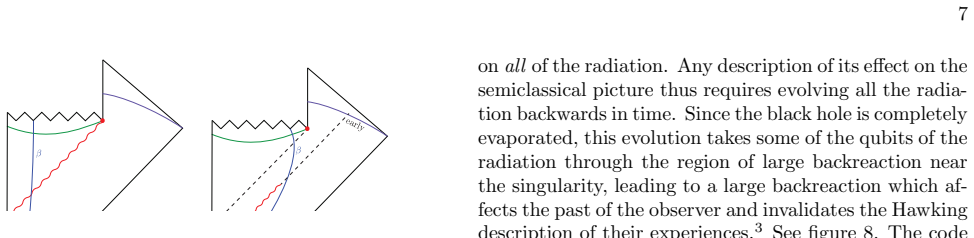
The central claim is that measurement outcomes are observer-dependent in a precise, calculable way. For an evaporating black hole, the swap expectation value that diagnoses whether the radiation is pure evaluates differently for an exterior observer $\alpha$ and an interior observer $\beta$: $\langle S_R\rangle_\alpha \approx \max(e^{-S_2(\chi_{\rm Hawk},R)}, 1/|B|)$ and $\langle S_R\rangle_\beta \approx \max(e^{-S_2(\chi_{\rm Hawk},R)}, e^{-S_2(\omega_\beta)}/|B|)$, up to corrections of order $e^{-S_\beta}$. In the completely evaporated limit $|B|\to 1$, $\alpha$ sees the radiation as pure while $\beta$ sees the semiclassical Hawking result $e^{-S_2(\chi_{\rm Hawk},R)}$, and both descriptions are accurate to within the error that $\beta$'s finite entropy allows. The same structure appears in the two-AdS-universes-plus-closed-universe configuration, where an observer in an AdS region deduces that the gas is pure while an observer in the baby universe deduces that it is entangled. Because the observers are causally disconnected, the disagreement is not a contradiction.
Load-bearing premise
Everything rests on the observer rule (eqs. (3)-(4)): observers have a pointer basis and are entangled with their environment to order $S_{O_b}$, and the quantum-to-classical channel deleting off-diagonal components reproduces physical inner products up to errors of order $e^{-S_{O_b}}$; if this rule or its error estimate is wrong, the complementarity results do not follow.
Editorial extensions
If this is right
- If the framework is right, a completely evaporated black hole has a consistent interior: an infalling observer continues to see the semiclassical Hawking state, and the deviations are of order $e^{-S_\beta}$, which by assumption they cannot detect.
- The monogamy-of-entanglement paradox is resolved by complexity: after complete evaporation, distilling a purification of a late Hawking mode is polynomial for an exterior observer but exponential in $S_\beta$ for an interior observer, so the two incompatible entanglement verifications cannot both be performed cheaply.
- In the two-AdS-universes-plus-closed-universe configuration, the bulk state becomes observer-dependent: a boundary or AdS observer sees the pure-gas state $|\psi_2\rangle$, while a baby-universe observer sees $|\psi_1\rangle$ up to errors of order $e^{-S_\beta}$.
- The paper proposes three general principles for holographic complementarity: exterior answers are consistent with unitarity, interior answers for observables of subexponential complexity are consistent with semiclassical physics when valid, and observers agree when they can causally communicate.
Reading between the lines
- The paper does not prove the three principles in full generality; a natural next step would be to test them in a concrete toy model with finite observer entropy and check the non-averaged corrections to the swap formulas.
- A sharp consequence the authors leave implicit: if the observer rule is exact, the 'state of the radiation' is not an absolute fact but a relative one, so any attempt to define a single observer-independent Hilbert space for interior and exterior simultaneously must fail.
- One could try to falsify the third principle by engineering a setup where exterior and interior observers can compare notes (for example through a traversable wormhole); the framework predicts the disagreement must vanish in that case, which is testable in holographic models.
Editorial analysis
A structured set of objections, weighed in public.
Referee Report
Summary. The paper argues that the observer rule of Harlow-Usatyuk-Zhao (arXiv:2501.02359), which replaces the usual encoded inner product with a quantum-to-classical channel for observers, gives a mathematical formulation of black hole complementarity. In the ASSR geometry, an exterior AdS observer alpha sees the AdS gas as pure (encoded swap expectation value 1), while a baby-universe observer beta sees the original mixed state up to errors of order e^{-S_beta}; the two cannot communicate. In the evaporating black hole, alpha sees the Page curve while beta sees the semiclassical Hawking result in the fully evaporated limit, again up to errors of order e^{-S_beta}. The paper also analyzes AMPS distillation and left-mover reconstruction, finding observer-dependent complexities, and proposes three general principles of complementarity based on these examples. The derivations in Appendix A are explicit and use the orthogonal integration technology of [14], with honest citations to [10,14,29].
Significance. If the framework is correct, this is a significant step: it gives a concrete, calculable realization of black hole complementarity that addresses the fully evaporated black hole and the closed-universe puzzle, and it makes falsifiable predictions summarized in Table I. The paper is transparent about what it assumes: the observer rule itself, the pointer-basis structure, and the entropy estimate e^{-S_Ob} are taken from [14] without derivation. The explicit swap and decoupling calculations in Appendix A are a strength, as is the clear separation of what is derived from what is conjectural. However, the central alpha/beta asymmetry is partly imposed by an excision choice in Appendix A, and the paper's three general principles are asserted as plausible rather than derived. These issues make the central claim conditional rather than fully established.
major comments (2)
- [Appendix A, Fig. 6 and Eqs. (13)-(14)] The alpha/beta asymmetry is injected by hand through the excision of the closed universe. The original V_alpha code does not preserve the inner product on the baby-universe degrees of freedom (Eq. (13)), and its raw swap expectation value contains extra terms (Eq. (14)). The paper then replaces V_alpha with V_HKLL by 'excising' the closed universe, obtaining exactly <eS_AdS>_alpha = 1, while for beta the global code is retained. The observer rule (3)-(4) by itself does not specify when excision is allowed; the paragraph beginning 'You may ask why we have not similarly excised...' offers only 'err on the side of a more global code' as a criterion. Because the black-hole results (9)-(10) inherit the same structure, the complementarity asymmetry is not yet a forced consequence of the observer rule. The paper should either derive a general excision principle from assumptions (1)-(3) or show explicitly that the predictions (7)-(10) are independent of the excision choice.
- [Towards a general formulation, principles (1)-(3)] The three general principles are asserted as plausible rather than derived from the observer rule. In particular, principle (3) — that observers agree when they can causally communicate — is not tested in any calculation in the paper, since alpha and beta are placed in causally disconnected components in both applications. If these principles are intended as a proposal for further work, that should be stated clearly and the basis for each principle should be identified in the explicit calculations; as written, the generalization goes beyond what the examples demonstrate.
minor comments (4)
- [General] There are several typos: 'pertubative' in Section 2 should be 'perturbative'; 'perserved' in Appendix A should be 'preserved'; and 'the the Todd Alworth Larson' in the Acknowledgments should be 'the Todd Alworth Larson'.
- [Eq. (12)] The notation Tr(ψ^2_{1,a}) and Tr(ω^2_β) is used without explicitly defining over which Hilbert space each trace is taken; please define these traces or add a sentence clarifying the convention.
- [Table I] In the row 'Left Mover Reconst.', the entry '∞ x' is unexplained; either define the symbol or remove it so that each entry in the table is self-contained.
- [After Eq. (8)] The sentence 'there is no way for α and β to argue about this' would be clearer as 'there is no way for α and β to communicate about this observation' or 'to compare their observations'.
Circularity Check
Alpha sees a pure state because the code is redefined to V_HKLL; the complementarity asymmetry is chosen, not derived.
-
self definitional
[Appendix A, around eqs. (13)-(14) and Fig. 6; main-text eq. (7)]
"We get a better code if we simply remove the closed universe, leading to a modified code ˆVα shown in figure 6. In this code the encoding map is just VHKLL , and we simply get ⟨ eSAdS⟩α = 1 on the nose since VHKLL is an isometry. ... You may ask why we have not similarly excised the AdS regions in the β code. Indeed we could have... We think it is better to err on the side of a 'more global' code, at least until this leads to a problem."
The raw V_alpha code gives (14) with additional terms inherited from baby-universe norm fluctuations. To obtain (7), the paper excises the closed universe and defines the modified encoding map to be V_HKLL. Since V_HKLL is an isometry, <eSAdS>_alpha = 1 follows immediately from the definition of the modified code, not from the observer rule. The paper explicitly acknowledges that the same excision could be applied to the beta code, which would change the asymmetry, and justifies not doing so only by 'err on the side of a more global code.' Thus the central complementarity asymmetry (alpha pure vs beta semiclassical) is inserted by hand rather than derived.
full rationale
The beta results (8), (10), (12), (16) are genuine calculations from the observer rule and the code definitions, and the decoupling bounds (11), (18) follow from the cited theorem of [10]. The alpha result, however, is not obtained by applying the observer rule to the original V_alpha: the raw computation (14) contains unwanted fluctuations, and the paper replaces the code by V_HKLL after excising the closed universe. Because V_HKLL is an isometry, <eSAdS>_alpha = 1 is then true by construction, not by the observer rule. The paper explicitly concedes that a symmetric excision of the AdS regions from the beta code would be 'arguably more in keeping with complementarity' and declines only on grounds of convenience. Hence the central complementarity asymmetry is a stipulated code choice, not a forced consequence of the stated principles. The observer rule of [14] is a stated input assumption by an overlapping author, but it does not itself contain the complementarity conclusion, so it is not counted as circular here; the circularity is the excision step. Overall: partial circularity, score 6.
Assumptions & free parameters
free parameters (2)
- S_alpha
- S_beta
assumptions (5)
- domain assumption The observer rule (3)-(4): encoded inner products are computed after applying a quantum-to-classical channel that deletes off-diagonal pointer-state components of the observer.
- domain assumption The holographic codes in figures 1-3, with a rank-one projection on the interior or baby universe and a Haar-random (or polynomial random) unitary U, correctly model the bulk-to-boundary map.
- domain assumption In the ASSR geometry, V|psi_1> is mostly supported on O(G^0)-energy states, so that a state |psi_2> exists satisfying (5).
- domain assumption The black hole S-matrix has polynomial complexity in the initial entropy (appendix B).
- domain assumption Gauging CRT symmetry implies the closed-universe Hilbert space is real, so the matrix O is orthogonal.
Cite this review
Pith. "Pith review of Observer complementarity for black holes and holography." pith.science (2026). https://pith.science/paper/263C3N6B
@misc{pith2026250706046,
  author       = {Pith},
  title        = {Pith review of: Observer complementarity for black holes and holography},
  year         = {2026},
  howpublished = {\url{https://pith.science/paper/263C3N6B}},
  note         = {Machine review of arXiv:2507.06046}
}
read the original abstract
We present a mathematical formulation of black hole complementarity based on recent rules for including the observer in quantum cosmology. We argue that this provides a self-consistent treatment of the interior of an evaporating black hole throughout its history, as well as the Antonini-Sasieta-Swingle-Rath configuration where a closed universe is entangled with a pair of AdS universes.
Figures


Figures from the paper (3 more)


Forward citations
Cited by 3 Pith papers
-
A de Sitter Anti-Scrambling Algebra
In a toy model of de Sitter quantum gravity, shockwave time advances break the KMS condition and prevent the Hartle-Hawking state from being a trace on the observer's crossed-product algebra.
-
The Baby Universe is Fine and the CFT Knows It: On Holography for Closed Universes
A closed universe in AdS/CFT is not ruled out by recent SWAP-test arguments; the one-dimensional Hilbert space seen from the CFT is external indistinguishability, and CFT data can reconstruct the closed universe's geometry.
-
On tests for baby universes in AdS/CFT
With a post-selected holographic map for the baby universe, the Engelhardt-Gesteau swap test cannot distinguish the two candidate bulk duals.
Reference graph
Works this paper leans on
-
[14]
Quantum Com- putation vs. Firewalls,
Daniel Harlow and Patrick Hayden, “Quantum Com- putation vs. Firewalls,” JHEP 1306, 085 (2013), arXiv:1301.4504 [hep-th]
arXiv 2013
-
[1]
The Stretched horizon and black hole complementar- ity,
Leonard Susskind, Larus Thorlacius, and John Uglum, “The Stretched horizon and black hole complementar- ity,” Phys. Rev. D 48, 3743–3761 (1993), arXiv:hep- th/9306069
-
[2]
Black Holes: Complementarity or Fire- walls?
Ahmed Almheiri, Donald Marolf, Joseph Polchinski, and James Sully, “Black Holes: Complementarity or Fire- walls?” JHEP 02, 062 (2013), arXiv:1207.3123 [hep-th]
arXiv 2013
-
[3]
Entanglement Wedge Reconstruc- tion and the Information Paradox,
Geoffrey Penington, “Entanglement Wedge Reconstruc- tion and the Information Paradox,” JHEP 09, 002 (2020), arXiv:1905.08255 [hep-th]
arXiv 2020
-
[4]
The entropy of bulk quantum fields and the entanglement wedge of an evaporating black hole,
Ahmed Almheiri, Netta Engelhardt, Donald Marolf, and Henry Maxfield, “The entropy of bulk quantum fields and the entanglement wedge of an evaporating black hole,” JHEP 12, 063 (2019), arXiv:1905.08762 [hep-th]
arXiv 2019
-
[5]
Black hole horizons and complementarity,
Youngjai Kiem, Herman L. Verlinde, and Erik P. Ver- linde, “Black hole horizons and complementarity,” Phys. Rev. D 52, 7053–7065 (1995), arXiv:hep-th/9502074
arXiv 1995
-
[6]
Black hole comple- mentarity versus locality,
David A. Lowe, Joseph Polchinski, Leonard Susskind, Larus Thorlacius, and John Uglum, “Black hole comple- mentarity versus locality,” Phys. Rev. D 52, 6997–7010 (1995), arXiv:hep-th/9506138
arXiv 1995
-
[7]
Quantum Ex- tremal Surfaces: Holographic Entanglement Entropy beyond the Classical Regime,
Netta Engelhardt and Aron C. Wall, “Quantum Ex- tremal Surfaces: Holographic Entanglement Entropy beyond the Classical Regime,” JHEP 01, 073 (2015), arXiv:1408.3203 [hep-th]
arXiv 2015
Show all 35 references
-
[8]
Replica wormholes and the black hole interior,
Geoff Penington, Stephen H. Shenker, Douglas Stanford, and Zhenbin Yang, “Replica wormholes and the black hole interior,” JHEP 03, 205 (2022), arXiv:1911.11977 [hep-th]. 3 We could try to circumvent this large backreaction by doing the reconstruction on just the early radiatio...
2022 arXiv
-
[9]
Replica Wormholes and the Entropy of Hawking Radiation,
Ahmed Almheiri, Thomas Hartman, Juan Maldacena, Edgar Shaghoulian, and Amirhossein Tajdini, “Replica Wormholes and the Entropy of Hawking Radiation,” JHEP 05, 013 (2020), arXiv:1911.12333 [hep-th]
2020 arXiv
-
[10]
straightened out
we have ||ρBα′,β′(W )−ρBα′,β′(W ′)||1 ≤ 2e−(S2(χHawk,R )−log |B|−Sβ )/2, (18) which confirms (11). Appendix B: Backreaction and reconstruction for the evaporated black hole The black hole codes in figures 1, 2 serve well to ad- dress questions that do not involve details of pa...
-
[11]
The black hole in- terior from non-isometric codes and complexity,
Chris Akers, Netta Engelhardt, Daniel Harlow, Geoff Penington, and Shreya Vardhan, “The black hole in- terior from non-isometric codes and complexity,” JHEP 06, 155 (2024), arXiv:2207.06536 [hep-th]
2024 arXiv
-
[12]
The Information paradox: A Ped- agogical introduction,
Samir D. Mathur, “The Information paradox: A Ped- agogical introduction,” Class.Quant.Grav. 26, 224001 (2009), arXiv:0909.1038 [hep-th]
2009 arXiv
-
[13]
Black hole entropy as entropy of entanglement, or it’s curtains for the equivalence princi- ple,
Samuel L. Braunstein, “Black hole entropy as entropy of entanglement, or it’s curtains for the equivalence princi- ple,” (2009), arXiv:0907.1190v1 [quant-ph]
2009 arXiv
-
[15]
Quantum mechanics and observers for gravity in a closed universe,
Daniel Harlow, Mykhaylo Usatyuk, and Ying Zhao, “Quantum mechanics and observers for gravity in a closed universe,” (2025), arXiv:2501.02359 [hep-th]
2025 arXiv
-
[16]
Firewalls From General Covariance,
Raphael Bousso, “Firewalls From General Covariance,” (2025), arXiv:2502.08724 [hep-th]
2025 arXiv
-
[17]
The gravitational path integral from an observer’s point of view,
Ahmed I. Abdalla, Stefano Antonini, Luca V. Iliesiu, and Adam Levine, “The gravitational path integral from an observer’s point of view,” (2025), arXiv:2501.02632 [hep- th]
2025 arXiv
-
[18]
The Page curve of Hawking radia- tion from semiclassical geometry,
Ahmed Almheiri, Raghu Mahajan, Juan Maldacena, and Ying Zhao, “The Page curve of Hawking radia- tion from semiclassical geometry,” JHEP 03, 149 (2020), arXiv:1908.10996 [hep-th]
2020 arXiv
-
[19]
Baby Uni- verses, Holography, and the Swampland,
Jacob McNamara and Cumrun Vafa, “Baby Uni- verses, Holography, and the Swampland,” (2020), arXiv:2004.06738 [hep-th]
2020 arXiv
-
[20]
Closed universes in two dimensional gravity,
Mykhaylo Usatyuk, Zi-Yue Wang, and Ying Zhao, “Closed universes in two dimensional gravity,” SciPost Phys. 17, 051 (2024), arXiv:2402.00098 [hep-th]
2024 arXiv
-
[21]
Further Evidence Against a Semiclassical Baby Universe in AdS/CFT,
Netta Engelhardt and Elliott Gesteau, “Further Evidence Against a Semiclassical Baby Universe in AdS/CFT,” (2025), arXiv:2504.14586 [hep-th]
2025 arXiv
-
[22]
Bulk Locality and Quantum Error Correction in AdS/CFT,
Ahmed Almheiri, Xi Dong, and Daniel Harlow, “Bulk Locality and Quantum Error Correction in AdS/CFT,” JHEP 04, 163 (2015), arXiv:1411.7041 [hep-th]
2015 arXiv
-
[23]
Holographic Quantum Error Correc- tion and the Projected Black Hole Interior,
Ahmed Almheiri, “Holographic Quantum Error Correc- tion and the Projected Black Hole Interior,” (2018), arXiv:1810.02055 [hep-th]
2018 arXiv
-
[24]
Transcending the ensemble: baby universes, spacetime wormholes, and the order and disorder of black hole information,
Donald Marolf and Henry Maxfield, “Transcending the ensemble: baby universes, spacetime wormholes, and the order and disorder of black hole information,” JHEP 08, 044 (2020), arXiv:2002.08950 [hep-th]
2020 arXiv
-
[25]
Quantum minimal surfaces from quantum error correction,
Chris Akers and Geoff Penington, “Quantum minimal surfaces from quantum error correction,” SciPost Phys. 12, 157 (2022), arXiv:2109.14618 [hep-th]
2022 arXiv
-
[26]
The Black Hole Final State,
Gary T. Horowitz and Juan Martin Maldacena, “The Black Hole Final State,” JHEP 0402, 008 (2004), arXiv:hep-th/0310281 [hep-th]
2004 arXiv
-
[27]
Measurements with probabilities in the final state proposal,
Ahmed Almheiri, “Measurements with probabilities in the final state proposal,” (2025), arXiv:2505.23664 [hep- th]
2025 arXiv
-
[28]
Decoherence, einselection, and the quantum origins of the classical,
Wojciech Hubert Zurek, “Decoherence, einselection, and the quantum origins of the classical,” Rev. Mod. Phys. 75, 715–775 (2003), arXiv:quant-ph/0105127
2003 arXiv
-
[29]
Cosmology from random entanglement,
Stefano Antonini, Martin Sasieta, and Brian Swingle, “Cosmology from random entanglement,” JHEP 11, 188 (2023), arXiv:2307.14416 [hep-th]
2023 arXiv
-
[30]
Do holographic CFT states have unique semiclassical bulk duals?
Stefano Antonini and Pratik Rath, “Do holographic CFT states have unique semiclassical bulk duals?” (2024), arXiv:2408.02720 [hep-th]
2024 arXiv
-
[31]
Local bulk operators in AdS/CFT: A Boundary view of horizons and locality,
Alex Hamilton, Daniel N. Kabat, Gilad Lifschytz, and David A. Lowe, “Local bulk operators in AdS/CFT: A Boundary view of horizons and locality,” Phys.Rev.D73, 086003 (2006), arXiv:hep-th/0506118 [hep-th]
2006 arXiv
-
[32]
Gauging spacetime inversions in quantum gravity,
Daniel Harlow and Tokiro Numasawa, “Gauging spacetime inversions in quantum gravity,” (2023), arXiv:2311.09978 [hep-th]
2023 arXiv
-
[33]
The Python’s Lunch: geomet- ric obstructions to decoding Hawking radiation,
Adam R. Brown, Hrant Gharibyan, Geoff Penington, and Leonard Susskind, “The Python’s Lunch: geomet- ric obstructions to decoding Hawking radiation,” JHEP 08, 121 (2020), arXiv:1912.00228 [hep-th]
2020 arXiv
-
[34]
Finding pythons in unexpected places,
Netta Engelhardt, Geoff Penington, and Arvin Shahbazi- Moghaddam, “Finding pythons in unexpected places,” Class. Quant. Grav. 39, 094002 (2022), arXiv:2105.09316 [hep-th]
2022 arXiv
-
[35]
Bulk and Transhorizon Measurements in AdS/CFT,
Idse Heemskerk, Donald Marolf, Joseph Polchinski, and James Sully, “Bulk and Transhorizon Measurements in AdS/CFT,” JHEP 10, 165 (2012), arXiv:1201.3664 [hep- th]
2012 arXiv
Reviewed August 6, 2026 · model on record in the stance chip above.
Discussion (0). Sign in to comment.