REVIEW 3 major objections 5 minor 2 cited by
Single-pass Adaptive Image Tokenization for Minimum Program Search
T0 review · 3 major / 5 minor · reviewed 2026-08-06 · deepseek-v4-flash
Pith's one-line read KARL, a single-pass image tokenizer, predicts how many tokens each image needs to meet a target reconstruction loss, matching the reconstruction quality of iterative adaptive tokenizers without test-time search.
desk verdict KARL is a genuinely new single-pass adaptive tokenizer with a clever loss-conditioned halting scheme, but its halting supervision secretly imposes a prefix constraint that undercuts the 'minimum program' claim. read the letter →
The pith
A machine-rendered reading of the paper's core claim, the machinery that carries it, and where it could break.
The reading
What carries the argument
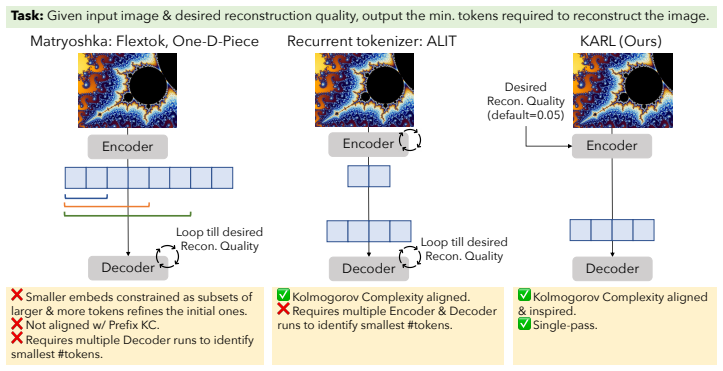
The load-bearing mechanism is a loss-conditioned halting head attached to a Perceiver-style latent-distillation encoder. The formal target is the approximate Kolmogorov complexity $\widehat{KC}_{\epsilon}(x,T)=\min\{t\le T : L_{\mathrm{rec}}(x,\hat{x}_t)\le \epsilon\}$, the smallest token count that reconstructs image $x$ with error below $\epsilon$; KARL treats this count as a proxy for minimum description length. Training enforces the invariance $\widehat{KC}_\epsilon(x,T)=\widehat{KC}_\epsilon(x,T+\Delta T)$ through an upside-down reinforcement-learning loop: the first phase attempts near-lossless compression with $T$ tokens and records the error $\epsilon_0$, and the second phase, conditioned on $\epsilon_0$, uses $T+\Delta T$ tokens and is supervised to halt the extra ones via $\mathcal{L}_{\mathrm{halt}}=\mathrm{BCE}(\omega_{0:T},0)+\mathrm{BCE}(\omega_{T:T+\Delta T},1)$. This converts token allocation into supervised learning with reconstruction quality as the task input, so at inference the model can directly output a token set for an arbitrary requested quality rather than searching for one.
What would settle it
Take a held-out set of images and run KARL in single-pass mode with target loss $\epsilon$, recording the kept token prefix and its actual reconstruction loss; then search exhaustively over subsets of the encoder output (or at least over prefix lengths) for the smallest token count that achieves loss $\le \epsilon$. If a non-negligible fraction of images either miss the target with KARL's chosen prefix or can meet it with fewer tokens using a non-prefix subset of the same encoder output, the claimed one-pass minimum-program search is falsified.
Extended reading notes
Core claim
On the paper's own terms, KARL establishes that a tokenizer can be trained to output only the minimal number of latent tokens needed to reconstruct an image within a user-specified reconstruction error, with no iterative search at inference. The training runs the encoder-decoder twice per image: first, with a random token budget $T$ and a lossless target $\epsilon=0$, it measures the achievable error $\epsilon_0$; then, with a larger budget $T+\Delta T$ and conditioned on $\epsilon_0$, it learns to reproduce that same quality while assigning high halting probability to the extra $\Delta T$ tokens. The halting probabilities are supervised by a binary cross-entropy loss that labels the first $T$ tokens as keep and the appended tokens as halt. At test time, the encoder receives the image, a maximum token budget, and a desired loss threshold, and outputs both token embeddings and halting probabilities; tokens with halting probability above a threshold are dropped, and the surviving tokens are decoded. The paper reports that this one-pass procedure matches the reconstruction quality of ALIT and One-D-Piece on ImageNet100 while using far fewer encoder-decoder runs, and that the resulting token counts align with human judgments of visual complexity.
Load-bearing premise
KARL's halting supervision labels the first $T$ tokens as keep and the appended $\Delta T$ tokens as halt, which assumes the minimal sufficient representation is always a prefix of the encoder's token ordering; if the optimal representation would put essential information in a later token, the training actively suppresses that token.
Editorial extensions
If this is right
- If KARL is correct, meeting a reconstruction target costs one encoder pass plus one decoder pass, versus roughly 4-8 encoder-decoder runs for ALIT and 2-4 decoder runs for One-D-Piece.
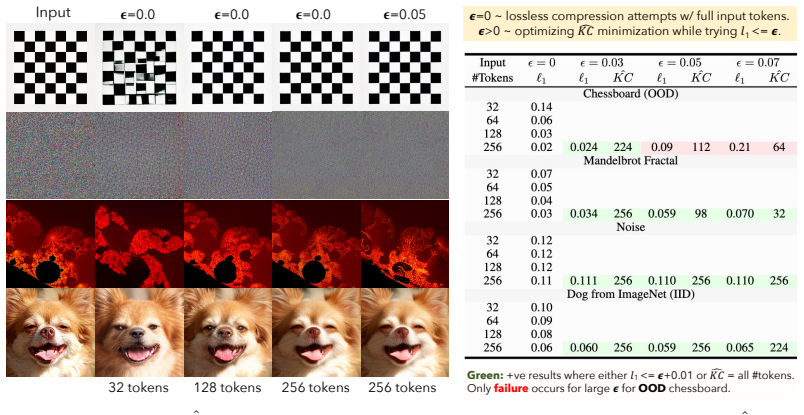
- The predicted active-token count can be read as an approximate per-image complexity score; the paper shows it correlates with human complexity ratings on Savoias and distinguishes in-distribution from out-of-distribution inputs.
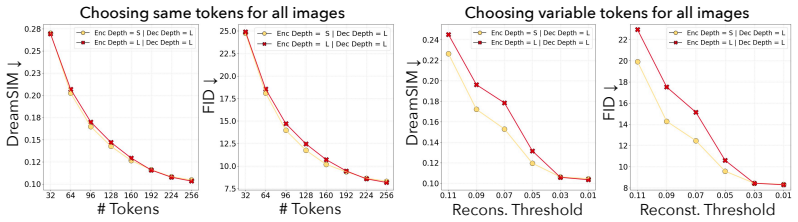
- The scaling-law result that a small encoder with a large decoder performs best under variable token allocation gives a concrete design rule for building practical tokenizers.
- Continuous 1D tokens and larger codebooks reduce the average number of active tokens needed to hit a reconstruction target, so the method points to specific choices for lowering effective program length.
Reading between the lines
- Not tested in the paper: training the halting head with a per-token importance score instead of a positional prefix label would reveal whether KARL inherits the same prefix bias it criticizes in matryoshka methods.
- The paper's KC analogy is interpretive, and its complexity measure is really a joint property of the learned codebook and the training distribution; a controlled comparison of images with matched true algorithmic complexity but different distances from the training data would test how much of the signal is complexity versus familiarity.
- Because inference conditions on reconstruction-loss thresholds that were discretized during training, deploying KARL at out-of-range thresholds or with perceptual metrics would likely require retraining or a mapping; the paper leaves this extension open.
Editorial analysis
A structured set of objections, weighed in public.
Referee Report
Summary. The paper proposes KARL, a single-pass adaptive image tokenizer that predicts a per-image token count conditioned on a target reconstruction loss, motivated by an analogy to Kolmogorov Complexity. Training proceeds in two phases: first, the model attempts near-lossless reconstruction under a randomly sampled token budget T and records the resulting error epsilon_0; second, conditioned on epsilon_0, the model receives T plus Delta T tokens and is trained to keep the first T tokens while halting the appended tokens. At inference, the encoder outputs both token embeddings and halting probabilities, and only tokens with halting probability below a threshold are decoded. The authors evaluate reconstruction quality against ALIT and One-D-Piece on ImageNet100, report scaling laws for encoder/decoder size and codebook design, and provide qualitative analyses connecting predicted token counts to human judgments of visual complexity. The central claim is that KARL matches adaptive tokenizers that require iterative test-time search while operating in a single forward pass.
Significance. If the central claim is validated, KARL would be a practically useful contribution: it removes iterative encoder-decoder search at inference, is competitive on per-image reconstruction metrics, and ships with code and extensive ablations. The loss-conditioned halting mechanism is an interesting instance of upside-down RL, and the empirical studies of token-count scaling and human-complexity alignment are valuable. However, the paper's own Table 3 shows that the target loss condition is not met for 10% of validation images at the default epsilon = 0.05, and the halting supervision imposes a prefix structure that is never validated against an oracle minimal token count. These issues directly bear on the 'minimum program' interpretation, so the strongest contribution currently is the single-pass adaptive mechanism rather than the demonstrated approximation of Kolmogorov Complexity.
major comments (3)
- [Sec. 3.2 (halting loss, Algorithm Step 6)] The BCE targets assign 0 to the first T token positions and 1 to the appended Delta T positions, which encodes the assumption that the minimal sufficient token subset is always a prefix of the encoder's output. The model is never trained to halt within the first T tokens, and doing so is explicitly penalized, so the predicted active-token count is anchored to the randomly sampled training budgets rather than to an estimate of the true minimum subset in the definition of hat KC. This is the same prefix constraint that Sec. 1 criticizes in matryoshka-style methods, applied to token positions instead of embedding dimensions. I recommend an oracle comparison: on a validation set, compute the smallest prefix or arbitrary token subset that meets the target loss under the trained decoder and compare it with KARL's predicted count; without such a check, the central claim of approximate-KC minimality is unsupported.
- [Table 3] The loss-conditioning claim is weaker than stated. At the default epsilon = 0.05, 10% of the 5,000 validation images have reconstruction loss above the target, and at epsilon = 0.07 the fraction rises to 25%; the average error among failures at epsilon = 0.05 is 0.060, only 0.010 above threshold. This sits uneasily with the abstract claim that KARL halts once its approximate KC is reached and with the text's statement that 'default epsilon = 0.05 works well.' Please report success-rate curves with confidence intervals and either calibrate the default threshold or qualify the claim that KARL meets the target condition in a single pass.
- [Sec. 3 (definition of hat KC and invariance property)] The equality hat KC_epsilon(x,T) = hat KC_epsilon(x,T+Delta T) is asserted as an inherent KC invariance, but under the paper's own definition it holds only when T is already sufficient; for images whose minimal count exceeds T, the left-hand side is undefined while the right-hand side may be finite. More importantly, the paper never directly measures hat KC because that would require searching over token subsets; Tables 2, 17, and 18 report the active counts produced by the learned halting policy, not counts validated against an oracle minimum. The central 'minimum program search' claim would be considerably strengthened by such a validation, and the terminology should otherwise be presented as a learned halting count.
minor comments (5)
- [Sec. 1] The final paragraph contains the typo 'wtih' instead of 'with'.
- [Tables 1 and 2] The caption 'First two approaches / rows are trained on IN100 vs rest trained on IN1K' is ambiguous because ALIT appears in both blocks; please use explicit row labels or separate the training-set blocks visually.
- [Algorithm Step 6] The halting threshold 0.75 is introduced without stating how it was chosen or whether results are sensitive to it; add a sentence or an appendix discussion.
- [Sec. 4 and Fig. 6 caption] 'Logistic depth' appears to be a typo for 'logical depth'.
- [Appendix A.2] The human-complexity dataset is spelled 'Savioas' here but 'Savoias' in the main text; please standardize.
Circularity Check
The central 'minimum token count' prediction is trained to reproduce the randomly sampled budget T — 'ˆKC = T by design' — so the halting claim is partly circular, while fixed-budget reconstruction results remain independent.
-
self definitional
[Sec. 3.2, Algorithm (Fig. 4), Steps 5 and 8]
"// Step 5: Use the minimum required token count to achieve ϵ0; ˆKC = T by design ... // Step 8: Optimize using Reconstruction Losses & Cross-Entropy on ωfinal Halting probability ωfinal = 1 for last ∆T tokens (extra budget), 0 for the first T tokens."
The paper formally defines approximate KC as a minimum over token counts: ˆKCϵ(x,T) = min {t ≤ T | Lrec(x, ˆxt) ≤ ϵ}. But the training loss never optimizes this minimum over t. Instead, halting supervision fixes the 'minimum' to the randomly sampled budget T: the first T tokens are labeled keep (ω=0) and the appended ΔT tokens are labeled halt (ω=1). Assigning high halting probability to any of the first T tokens is penalized, so the model is never rewarded for discovering a subset smaller than T. At inference, the predicted token count is therefore a supervised reproduction of the training budget T, not an independent estimate of the shortest sufficient program.
-
fitted input called prediction
[Sec. 3.2, 'Estimating Image Complexity' and Figure 2 caption]
"Estimate Image Complexity (KC) Aims (and fails at) Lossless Compression at low input tokens •Input—Image, Randomly Sampled tokens (#T), Recon. Thresh ϵ= 0•Output—Reconstruction Loss =ϵ0 to define KC."
The 'complexity' that conditions the second training phase is not an external or independently defined quantity; it is the reconstruction loss ϵ0 produced by KARL's own first-phase encoder-decoder under a randomly sampled token budget T. The second phase then learns to halt at that same budget, so the reported KC estimates are consistency measures of the model against its own first-phase errors. When the paper later presents predicted token counts as evidence of alignment with human complexity judgments (Fig. 10) or as a proxy for Kolmogorov Complexity, the quantity being measured was fitted to the model's own training procedure rather than verified against an independent minimum-program property. This is a fitted input being renamed as a prediction of image complexity.
full rationale
The paper contains one genuinely circular load-bearing step: the halting supervision in Sec. 3.2 defines the 'minimum sufficient token count' as the randomly sampled training budget T and enforces this via BCE labels (first T tokens kept, appended ΔT tokens halted). The algorithm even states 'ˆKC = T by design'. Consequently, the central claim that KARL 'predicts the appropriate number of tokens ... halting once its approximate KC is reached' reduces, at least in part, to reproducing its own training labels. I therefore score 6 rather than 0. However, the paper is not wholly circular: the fixed-token-count reconstruction comparisons in Tab. 1 are self-contained, external benchmarks that do not depend on the halting mechanism, and the conceptual AIT/KC discussion is explicitly disclaimed as 'a conceptual perspective—not a formal theoretical result' (Appendix A.1). There is no load-bearing self-citation chain: the cited ALIT work ([19], by overlapping authors) is used as a baseline and as design inspiration, but the central training procedure is derived from the paper's own loss definitions and the external upside-down RL reference. The main circularity is the definitional reduction of KC to the training budget T, not a citation-driven circularity.
Assumptions & free parameters
free parameters (5)
- halting threshold =
0.75
- default reconstruction target epsilon =
0.05
- token budget sampling range and Delta T =
T in {16,...,256}, Delta T not specified
- loss-conditioning target list =
0.0, 0.01, 0.02, 0.03 to 0.11, 0.14 to 0.4
- loss weights beta and lambda =
not stated
assumptions (5)
- domain assumption Decoder contribution to description length is constant and can be ignored, so token count alone estimates KC.
- ad hoc to paper KC invariance property: hat_KC_epsilon(x,T) equals hat_KC_epsilon(x,T+Delta T).
- ad hoc to paper The optimal token subset is a prefix of the token sequence.
- domain assumption L1 reconstruction loss is an adequate proxy for the reconstruction quality that defines minimal sufficient program length.
- domain assumption The two-phase EIC-LTC training provides enough supervision for the halting policy to generalize to novel images and user-set epsilons.
invented entities (1)
-
Approximate Kolmogorov Complexity (hat_KC) as minimal active token count under a loss threshold
Cite this review
Pith. "Pith review of Single-pass Adaptive Image Tokenization for Minimum Program Search." pith.science (2026). https://pith.science/paper/YDFX6UKC
@misc{pith2026250707995,
  author       = {Pith},
  title        = {Pith review of: Single-pass Adaptive Image Tokenization for Minimum Program Search},
  year         = {2026},
  howpublished = {\url{https://pith.science/paper/YDFX6UKC}},
  note         = {Machine review of arXiv:2507.07995}
}
read the original abstract
According to Algorithmic Information Theory (AIT) -- Intelligent representations compress data into the shortest possible program that can reconstruct its content, exhibiting low Kolmogorov Complexity (KC). In contrast, most visual representation learning systems use fixed-length representations for all inputs, ignoring variations in complexity or familiarity. Recent adaptive tokenization methods address this by allocating variable-length representations but typically require test-time search over multiple encodings to find the most predictive one. Inspired by Kolmogorov Complexity principles, we propose a single-pass adaptive tokenizer, KARL, which predicts the appropriate number of tokens for an image in a single forward pass, halting once its approximate KC is reached. The token count serves as a proxy for the minimum description length. KARL's training procedure closely resembles the Upside-Down Reinforcement Learning paradigm, as it learns to conditionally predict token halting based on a desired reconstruction quality. KARL matches the performance of recent adaptive tokenizers while operating in a single pass. We present scaling laws for KARL, analyzing the role of encoder/decoder size, continuous vs. discrete tokenization and more. Additionally, we offer a conceptual study drawing an analogy between Adaptive Image Tokenization and Algorithmic Information Theory, examining the predicted image complexity (KC) across axes such as structure vs. noise and in- vs. out-of-distribution familiarity -- revealing alignment with human intuition.
Figures


Figures from the paper (13 more)






Forward citations
Cited by 2 Pith papers
-
ChannelTok: Efficient Flexible-Length Vision Tokenization
ChannelTok introduces channel-wise tokenization with stochastic tail-dropping to achieve rFID 2.92 on ImageNet at 8.6x faster decoding and 2.1x smaller size than prior flexible tokenizers.
-
Adaptive Tokenisation Via Temporal Redundancy Masking And Latent Inpainting
A parameter-free approach drops redundant video tokens via temporal L1 differences in frozen latent space and reconstructs them with LIT, yielding 31x speedup over ElasticTok-CV on TokenBench and DAVIS.
Reference graph
Works this paper leans on
-
[1]
A theory of universal artificial intelligence based on algorithmic complexity, 2000
Marcus Hutter. A theory of universal artificial intelligence based on algorithmic complexity, 2000
2000
-
[2]
A formal definition of intelligence based on an intensional variant of algorithmic complexity
José Hernández-Orallo and Neus Minaya-Collado. A formal definition of intelligence based on an intensional variant of algorithmic complexity. 2003. URL https://api. semanticscholar.org/CorpusID:18291484
work page 2003
-
[3]
Matthew V . Mahoney. Text compression as a test for artificial intelligence. InAAAI/IAAI, 1999. URL https://api.semanticscholar.org/CorpusID:1023392
work page 1999
-
[4]
Universal intelligence: A definition of machine intelligence
Shane Legg and Marcus Hutter. Universal intelligence: A definition of machine intelligence. CoRR, abs/0712.3329, 2007. URL http://arxiv.org/abs/0712.3329
arXiv 2007
-
[5]
Ming Li and Paul M.B. Vitnyi. An Introduction to Kolmogorov Complexity and Its Applications. Springer Publishing Company, Incorporated, 3 edition, 2008. ISBN 0387339981
work page 2008
-
[6]
William of Ockham. Book i, chapter 12. In Philotheus Boehner, Gedeon Gál and Stephen F. Brown, editors, Summa Logicae. Franciscan Institute, 1974
work page 1974
-
[7]
Geoffrey E. Hinton and Ruslan R. Salakhutdinov. Reducing the dimensionality of data with neural networks. Science, 313(5786):504–507, 2006. doi: 10.1126/science.1127647
-
[8]
Pascal Vincent, Hugo Larochelle, Isabelle Lajoie, Yoshua Bengio and Pierre-Antoine Manzagol. Stacked denoising autoencoders: Learning useful representations in a deep network with a local denoising criterion. Journal of Machine Learning Research, 11(110):3371–3408, 2010. URL http://jmlr.org/papers/v11/vincent10a.html
work page 2010
Show all 34 references
-
[9]
Understanding contrastive representation learning through alignment and uniformity on the hypersphere
Tongzhou Wang and Phillip Isola. Understanding contrastive representation learning through alignment and uniformity on the hypersphere. In Proceedings of the 37th International Confer- ence on Machine Learning, ICML’20. JMLR.org, 2020
2020
-
[10]
A simple framework for contrastive learning of visual representations, 2020
Ting Chen, Simon Kornblith, Mohammad Norouzi and Geoffrey Hinton. A simple framework for contrastive learning of visual representations, 2020
2020
-
[11]
Emerging properties in self-supervised vision transformers
Mathilde Caron, Hugo Touvron, Ishan Misra, Hervé Jégou, Julien Mairal et al. Emerging properties in self-supervised vision transformers. InProceedings of the International Conference on Computer Vision (ICCV), 2021
2021
-
[12]
Masked autoencoders are scalable vision learners
Kaiming He, Xinlei Chen, Saining Xie, Yanghao Li, Piotr Dollár et al. Masked autoencoders are scalable vision learners. arXiv:2111.06377, 2021
2021 arXiv
-
[13]
Auto-encoding variational bayes, 2022
Diederik P Kingma and Max Welling. Auto-encoding variational bayes, 2022. URL https: //arxiv.org/abs/1312.6114
2022 arXiv
-
[14]
Taming transformers for high-resolution image synthesis, 2020
Patrick Esser, Robin Rombach and Björn Ommer. Taming transformers for high-resolution image synthesis, 2020
2020
-
[15]
Algorithmic information theory: a brief non-technical guide to the field, 2007
Marcus Hutter. Algorithmic information theory: a brief non-technical guide to the field, 2007. URL https://arxiv.org/abs/cs/0703024
2007 arXiv
-
[16]
Matryoshka representation learning
Aditya Kusupati, Gantavya Bhatt, Aniket Rege, Matthew Wallingford, Aditya Sinha et al. Matryoshka representation learning. In Advances in Neural Information Processing Systems, December 2022. 12
2022
-
[17]
FlexTok: Resampling images into 1d token sequences of flexible length
Roman Bachmann, Jesse Allardice, David Mizrahi, Enrico Fini, O ˘guzhan Fatih Kar et al. FlexTok: Resampling images into 1d token sequences of flexible length. arXiv 2025, 2025
2025
-
[18]
One-d-piece: Image tokenizer meets quality-controllable compression, 2025
Keita Miwa, Kento Sasaki, Hidehisa Arai, Tsubasa Takahashi and Yu Yamaguchi. One-d-piece: Image tokenizer meets quality-controllable compression, 2025. URL https://arxiv.org/ abs/2501.10064
2025 arXiv
-
[19]
Shivam Duggal, Phillip Isola, Antonio Torralba and William T. Freeman. Adaptive length image tokenization via recurrent allocation. In The Thirteenth International Conference on Learning Representations, 2025. URL https://openreview.net/forum?id=mb2ryuZ3wz
2025
-
[20]
A short introduction to kolmogorov complexity, 2010
V olker Nannen. A short introduction to kolmogorov complexity, 2010. URLhttps://arxiv. org/abs/1005.2400
2010 arXiv
-
[21]
Elastictok: Adaptive tokenization for image and video
Wilson Yan, Matei Zaharia, V olodymyr Mnih, Pieter Abbeel, Aleksandra Faust et al. Elastictok: Adaptive tokenization for image and video. arXiv preprint, 2024
2024
-
[22]
Reinforcement learning upside down: Don’t predict rewards – just map them to actions, 2020
Juergen Schmidhuber. Reinforcement learning upside down: Don’t predict rewards – just map them to actions, 2020. URL https://arxiv.org/abs/1912.02875
2020 arXiv
-
[23]
An image is worth 16x16 words: Transformers for image recognition at scale
Alexey Dosovitskiy, Lucas Beyer, Alexander Kolesnikov, Dirk Weissenborn, Xiaohua Zhai et al. An image is worth 16x16 words: Transformers for image recognition at scale. CoRR, abs/2010.11929, 2020. URL https://arxiv.org/abs/2010.11929
2010 arXiv
-
[24]
Perceiver: General perception with iterative attention, 2021
Andrew Jaegle, Felix Gimeno, Andrew Brock, Andrew Zisserman, Oriol Vinyals et al. Perceiver: General perception with iterative attention, 2021. URL https://arxiv.org/abs/2103. 03206
2021
-
[26]
An image is worth 32 tokens for reconstruction and generation
Qihang Yu, Mark Weber, Xueqing Deng, Xiaohui Shen, Daniel Cremers et al. An image is worth 32 tokens for reconstruction and generation. arxiv: 2406.07550, 2024
2024 arXiv
-
[27]
Flow to the mode: Mode- seeking diffusion autoencoders for state-of-the-art image tokenization, 2025
Kyle Sargent, Kyle Hsu, Justin Johnson, Li Fei-Fei and Jiajun Wu. Flow to the mode: Mode- seeking diffusion autoencoders for state-of-the-art image tokenization, 2025. URL https: //arxiv.org/abs/2503.11056
2025
-
[28]
Beyond matryoshka: Revisiting sparse coding for adaptive representation, 2025
Tiansheng Wen, Yifei Wang, Zequn Zeng, Zhong Peng, Yudi Su et al. Beyond matryoshka: Revisiting sparse coding for adaptive representation, 2025
2025
-
[29]
Cat: Content-adaptive image tokenization
Junhong Shen, Kushal Tirumala, Michihiro Yasunaga, Ishan Misra, Luke Zettlemoyer et al. Cat: Content-adaptive image tokenization. arXiv preprint arXiv:2501.03120, 2025
2025 arXiv
-
[30]
Estimating or propagating gradients through stochastic neurons for conditional computation, 2013
Yoshua Bengio, Nicholas Léonard and Aaron Courville. Estimating or propagating gradients through stochastic neurons for conditional computation, 2013
2013
-
[31]
Kolmogorov’s structure functions and model selection,
Nikolai Vereshchagin and Paul Vitanyi. Kolmogorov’s structure functions and model selection,
-
[32]
Learnings from scaling visual tokenizers for reconstruction and generation, 2025
Philippe Hansen-Estruch, David Yan, Ching-Yao Chung, Orr Zohar, Jialiang Wang et al. Learnings from scaling visual tokenizers for reconstruction and generation, 2025
2025
-
[33]
keep" (0) and new tokens are labeled
Elham Saraee, Mona Jalal and Margrit Betke. Savoias: A diverse, multi-category visual complexity dataset. arXiv preprint arXiv:1810.01771, 2018. 13 A Appendix This appendix begins by summarizing our core contributions, followed by a brief description of the experimental setup ...
2018 arXiv
-
[2004]
URL https://arxiv.org/abs/cs/0204037
-
[2021]
URL https://arxiv.org/abs/2107.14795
Reviewed August 6, 2026 · model on record in the stance chip above.
Discussion (0). Sign in to comment.