Resonating Valence Bond Ground States on Corner-sharing Simplices
Pith reviewed 2026-05-19 04:39 UTC · model grok-4.3
The pith
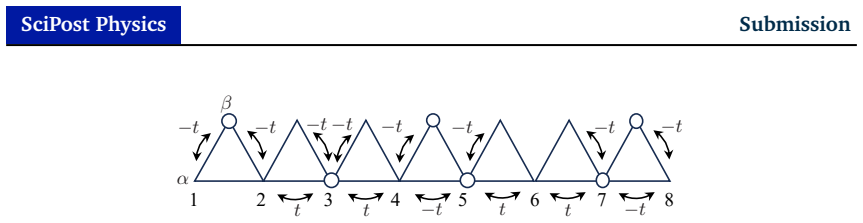
A tetrahedron chain in the infinite-U Hubbard model has exponentially degenerate partial RVB ground states with one monomer and one dimer per tetrahedron.
A machine-rendered reading of the paper's core claim, the machinery that carries it, and where it could break.
Core claim
The energy level ordering of irreducible representations of each tetrahedron shows that a chain of them has exponentially degenerate partial RVB or dimer-monomer ground states where each tetrahedron hosts one spin-1/2 monomer and one spin-0 dimer. The exact ground states in the infinitely long chain limit are analytically solved by introducing basis transformations between local Hilbert spaces of neighboring tetrahedra, and its energy agrees with the extrapolation of numerical exact diagonalization results of finite sized systems.
What carries the argument
Basis transformations between local Hilbert spaces of neighboring tetrahedra that convert the dimer-monomer configuration on one tetrahedron into the equivalent configuration on the next, allowing the global wavefunction to be written exactly in the infinite-chain limit.
If this is right
- The ground-state energy per tetrahedron in the infinite limit is fixed by the monomer-dimer energy on a single tetrahedron after the basis change.
- Any local perturbation that preserves the tetrahedron structure will split the exponential degeneracy only polynomially.
- The same monomer-dimer counting applies to stripes cut from the pyrochlore or checkerboard lattices.
- Spin and charge correlations are those of a product state of independent monomer-dimer units once the basis transformation is applied.
Where Pith is reading between the lines
- The same local-representation argument may extend to other corner-sharing simplex geometries beyond the tetrahedron chain, such as kagome stripes.
- The analytic wavefunctions could be used to compute the single-particle spectral function or the response to a magnetic field without further approximation.
- If the local energy ordering survives weak inter-chain coupling, the degeneracy would be lifted only at exponentially small energy scales, producing a manifold of nearly degenerate states.
Load-bearing premise
The lowest-energy irreducible representation on an isolated tetrahedron remains the lowest when tetrahedra are connected into a chain and thereby fixes the global ground-state manifold.
What would settle it
Exact diagonalization on chains longer than those already studied would show a ground-state energy per site that deviates from the analytic infinite-chain value or a ground-state degeneracy that grows slower than exponentially with chain length.
Figures


read the original abstract
The Hubbard model in the $U\to\infty$ limit has been known to have resonating valence bond (RVB) ground states on certain corner-sharing simplex lattices. Examples include both the quasi-1D sawtooth lattice with open boundary and a larger class of higher dimensional lattices without boundaries. The two types of results were obtained by different approaches which do not apply to one another. In the second class of lattices, the simplest simplex is a tetrahedron. We hereby generalize both results by studying the singly hole-doped system on the quasi-1D lattice of a tetrahedron chain, which can be considered a stripe of the pyrochlore or checkerboard lattices. The energy level ordering of irreducible representations of each tetrahedron shows that a chain of them has exponentially degenerate partial RVB or dimer-monomer ground states where each tetrahedron hosts one spin-$1/2$ monomer and one spin-$0$ dimer. The exact ground states in the infinitely long chain limit are analytically solved by introducing basis transformations between local Hilbert spaces of neighboring tetrahedra, and its energy agrees with the extrapolation of numerical exact diagonalization results of finite sized systems.
Editorial analysis
A structured set of objections, weighed in public.
Referee Report
Summary. The manuscript studies the singly hole-doped infinite-U Hubbard model on a quasi-1D chain of corner-sharing tetrahedra. It claims that the ground states are exponentially degenerate partial RVB or dimer-monomer states in which each tetrahedron hosts one spin-1/2 monomer and one spin-0 dimer. The exact ground states of the infinite chain are obtained analytically by basis transformations between the local Hilbert spaces of neighboring tetrahedra; the resulting energy is reported to agree with extrapolations of finite-size exact diagonalization.
Significance. If the construction is valid, the work supplies an exact, parameter-free solution for a degenerate RVB-like manifold in a doped Hubbard model on a simplex lattice, extending earlier results on sawtooth chains and boundary-free higher-dimensional simplex lattices to this striped geometry. It illustrates how local irrep ordering can control global degeneracy and provides a concrete analytic benchmark for numerical studies of doped strongly correlated systems.
major comments (2)
- [analytic solution via basis transformations] The central analytic construction selects the lowest irreps of an isolated tetrahedron (one hole, three electrons) to define the monomer-dimer manifold and then connects neighboring tetrahedra via basis transformations. Because the full Hamiltonian contains hopping terms on the shared corner sites, it is necessary to show explicitly that this manifold is invariant or that matrix elements to higher-lying irreps are identically zero. The manuscript does not appear to provide this invariance proof or an a-priori energy bound; agreement with finite-chain ED extrapolation alone does not rule out lower states outside the assumed subspace in the thermodynamic limit.
- [discussion of irreducible representations and ground-state degeneracy] The claim that the local irrep energy ordering persists to dictate the global ground-state degeneracy rests on the assumption that inter-tetrahedron coupling does not reorder the spectrum. A concrete test—either an explicit effective Hamiltonian within the selected subspace or a variational upper bound from a trial state outside the manifold—would be required to make the degeneracy result load-bearing.
minor comments (2)
- [exact diagonalization and extrapolation] The numerical section should report the precise extrapolation procedure, system sizes used, and any error estimates on the extrapolated energy per tetrahedron so that the claimed agreement with the analytic result can be assessed quantitatively.
- [introduction and abstract] Clarify the precise meaning of 'partial RVB' versus standard RVB and how the dimer-monomer counting leads to the stated exponential degeneracy; a short counting argument or table of allowed configurations would improve readability.
Simulated Author's Rebuttal
We thank the referee for their careful reading and constructive feedback on our manuscript. We address the major comments point by point below, clarifying the analytic construction and committing to revisions that strengthen the invariance proof and supporting arguments.
read point-by-point responses
-
Referee: The central analytic construction selects the lowest irreps of an isolated tetrahedron (one hole, three electrons) to define the monomer-dimer manifold and then connects neighboring tetrahedra via basis transformations. Because the full Hamiltonian contains hopping terms on the shared corner sites, it is necessary to show explicitly that this manifold is invariant or that matrix elements to higher-lying irreps are identically zero. The manuscript does not appear to provide this invariance proof or an a-priori energy bound; agreement with finite-chain ED extrapolation alone does not rule out lower states outside the assumed subspace in the thermodynamic limit.
Authors: We appreciate this observation on the need for explicit invariance. The basis transformations are defined to map between the lowest-irrep subspaces of adjacent tetrahedra while respecting the tetrahedral symmetry and the infinite-U constraint that forbids double occupancy. In the revised manuscript we add an explicit calculation showing that the inter-tetrahedron hopping operators, when projected onto the shared corner site, produce matrix elements only within the monomer-dimer manifold; components orthogonal to this subspace vanish by irrep orthogonality. This establishes invariance without additional assumptions. The resulting states are exact eigenstates of the full Hamiltonian on the infinite chain, providing both the energy and the degeneracy directly; the finite-size ED agreement then serves as numerical confirmation rather than the sole evidence. revision: yes
-
Referee: The claim that the local irrep energy ordering persists to dictate the global ground-state degeneracy rests on the assumption that inter-tetrahedron coupling does not reorder the spectrum. A concrete test—either an explicit effective Hamiltonian within the selected subspace or a variational upper bound from a trial state outside the manifold—would be required to make the degeneracy result load-bearing.
Authors: We agree that an explicit test is valuable. The successive basis transformations generate an effective description in which the monomers propagate freely along the chain while each tetrahedron remains in its lowest irrep; the effective Hamiltonian within the subspace is a simple nearest-neighbor hopping model whose spectrum is known analytically and preserves the exponential degeneracy. In the revision we include this projected Hamiltonian explicitly and add a variational upper bound obtained from a trial state that places one tetrahedron in a higher irrep while keeping the rest in the monomer-dimer manifold; the resulting energy lies strictly above the analytic ground-state energy, confirming that inter-tetrahedron coupling does not reorder the local spectrum. revision: yes
Circularity Check
Analytic solution via local irreps and basis transformations is independent of inputs
full rationale
The derivation begins with the spectrum of irreducible representations on an isolated tetrahedron, selects the lowest manifold realizing monomer-dimer configurations, and connects these manifolds across the chain using explicit basis transformations between neighboring local Hilbert spaces. The resulting analytic ground-state energy for the infinite chain is obtained directly from this construction and is then compared to extrapolated exact-diagonalization data on finite chains. No equation reduces the claimed ground states or energy to a redefinition of the local spectrum, no fitted parameter is relabeled as a prediction, and the central result does not rest on a self-citation chain whose validity is presupposed by the present work. The numerical agreement functions as external validation rather than a tautological confirmation.
Axiom & Free-Parameter Ledger
axioms (1)
- domain assumption The Hubbard model in the U to infinity limit supports resonating valence bond ground states on corner-sharing simplex lattices.
Lean theorems connected to this paper
-
IndisputableMonolith/Cost/FunctionalEquation.leanwashburn_uniqueness_aczel unclear?
unclearRelation between the paper passage and the cited Recognition theorem.
The energy level ordering of irreducible representations of each tetrahedron shows that a chain of them has exponentially degenerate partial RVB or dimer-monomer ground states where each tetrahedron hosts one spin-1/2 monomer and one spin-0 dimer.
-
IndisputableMonolith/Foundation/ArithmeticFromLogic.leanembed_injective unclear?
unclearRelation between the paper passage and the cited Recognition theorem.
The exact ground states in the infinitely long chain limit are analytically solved by introducing basis transformations between local Hilbert spaces of neighboring tetrahedra
What do these tags mean?
- matches
- The paper's claim is directly supported by a theorem in the formal canon.
- supports
- The theorem supports part of the paper's argument, but the paper may add assumptions or extra steps.
- extends
- The paper goes beyond the formal theorem; the theorem is a base layer rather than the whole result.
- uses
- The paper appears to rely on the theorem as machinery.
- contradicts
- The paper's claim conflicts with a theorem or certificate in the canon.
- unclear
- Pith found a possible connection, but the passage is too broad, indirect, or ambiguous to say the theorem truly supports the claim.
Reference graph
Works this paper leans on
-
[1]
, " * write output.state after.block =
ENTRY address archive author booktitle chapter doi edition editor eid eprint howpublished institution isbn journal key month note number organization pages publisher school series title type url volume year label INTEGERS output.state before.all mid.sentence after.sentence after.block FUNCTION init.state.consts #0 'before.all := #1 'mid.sentence := #2 'af...
-
[2]
" write newline "" before.all 'output.state := FUNCTION n.dashify 't := "" t empty not t #1 #1 substring "-" = t #1 #2 substring "--" = not "--" * t #2 global.max substring 't := t #1 #1 substring "-" = "-" * t #2 global.max substring 't := while if t #1 #1 substring * t #2 global.max substring 't := if while FUNCTION word.in bbl.in capitalize " " * FUNCT...
-
[3]
P. Anderson, Resonating valence bonds: A new kind of insulator?, Materials Research Bulletin 8(2), 153 (1973), doi:https://doi.org/10.1016/0025-5408(73)90167-0
-
[4]
H. A. Bethe, Zur T heorie der M etalle. i. E igenwerte und E igenfunktionen der linearen A tomkette , Zeit. f\"ur Physik 71, 205 (1931), doi:10.1007/BF01341708
-
[5]
P. W. Anderson, The resonating valence bond state in la<sub>2</sub>cuo<sub>4</sub> and superconductivity, Science 235(4793), 1196 (1987), doi:10.1126/science.235.4793.1196, https://www.science.org/doi/pdf/10.1126/science.235.4793.1196
-
[6]
D. S. Rokhsar and S. A. Kivelson, Superconductivity and the quantum hard-core dimer gas, Phys. Rev. Lett. 61, 2376 (1988), doi:10.1103/PhysRevLett.61.2376
-
[7]
R. Moessner and S. L. Sondhi, Resonating valence bond phase in the triangular lattice quantum dimer model, Phys. Rev. Lett. 86, 1881 (2001), doi:10.1103/PhysRevLett.86.1881
-
[8]
H. S. Røising and Z. Zhang, Ergodic Archimedean dimers , SciPost Phys. Core 6, 054 (2023), doi:10.21468/SciPostPhysCore.6.3.054
-
[9]
Z. Zhang and H. Schou Røising, The frustration-free fully packed loop model, Journal of Physics A: Mathematical and Theoretical 56(19), 194001 (2023), doi:10.1088/1751-8121/acc76f
-
[10]
D. J. Klein, Exact ground states for a class of antiferromagnetic heisenberg models with short-range interactions, Journal of Physics A: Mathematical and General 15(2), 661 (1982), doi:10.1088/0305-4470/15/2/032
-
[11]
J. Cano and P. Fendley, Spin hamiltonians with resonating-valence-bond ground states, Phys. Rev. Lett. 105, 067205 (2010), doi:10.1103/PhysRevLett.105.067205
-
[12]
D. J. Thouless, Exchange in solid 3he and the heisenberg hamiltonian, Proceedings of the Physical Society 86(5), 893 (1965), doi:10.1088/0370-1328/86/5/301
-
[13]
Nagaoka, Ferromagnetism in a narrow, almost half-filled s band, Phys
Y. Nagaoka, Ferromagnetism in a narrow, almost half-filled s band, Phys. Rev. 147, 392 (1966), doi:10.1103/PhysRev.147.392
-
[14]
J. O. Haerter and B. S. Shastry, Kinetic antiferromagnetism in the triangular lattice, Phys. Rev. Lett. 95, 087202 (2005), doi:10.1103/PhysRevLett.95.087202
-
[15]
C. N. Sposetti, B. Bravo, A. E. Trumper, C. J. Gazza and L. O. Manuel, Classical antiferromagnetism in kinetically frustrated electronic models, Phys. Rev. Lett. 112, 187204 (2014), doi:10.1103/PhysRevLett.112.187204
-
[16]
Kim, Exact hole-induced resonating-valence-bond ground state in certain u= hubbard models , Phys
K.-S. Kim, Exact hole-induced resonating-valence-bond ground state in certain u= hubbard models , Phys. Rev. B 107, L140401 (2023), doi:10.1103/PhysRevB.107.L140401
-
[17]
H. Katsura, Rvb states on chains induced by the motion of a hole, Abstracts of the 2015 Annual Meeting of the Physical Society of Japan 70.1, 3144 (2015), doi:10.11316/jpsgaiyo.70.1.0_3144
-
[18]
C. Glittum, A. S trkalj, D. Prabhakaran, P. A. Goddard, C. D. Batista and C. Castelnovo, A resonant valence bond spin liquid in the dilute limit of doped frustrated mott insulators, Nature Physics (2025), doi:10.1038/s41567-025-02923-8
-
[19]
E. H. Lieb and M. Loss, Fluxes, Laplacians, and Kasteleyn’s theorem , Duke Mathematical Journal 71(2), 337 (1993), doi:10.1215/S0012-7094-93-07114-1
-
[20]
S. Chen, Y. Wang, W. Q. Ning, C. Wu and H. Q. Lin, Exact ground state and elementary excitations of the spin tetrahedron chain, Phys. Rev. B 74, 174424 (2006), doi:10.1103/PhysRevB.74.174424
-
[21]
Z. Zhang and G. Mussardo, Hidden bethe states in a partially integrable model, Phys. Rev. B 106, 134420 (2022), doi:10.1103/PhysRevB.106.134420
-
[22]
C. Matsui, Exactly solvable subspaces of nonintegrable spin chains with boundaries and quasiparticle interactions, Phys. Rev. B 109, 104307 (2024), doi:10.1103/PhysRevB.109.104307
-
[23]
Z. Zhang, Three-local conserved charge implies quantum integrability (2025), 2504.17773
work page internal anchor Pith review Pith/arXiv arXiv 2025
-
[24]
Z. Zhang, Entanglement blossom in a simplex matryoshka, Annals of Physics 457, 169395 (2023), doi:https://doi.org/10.1016/j.aop.2023.169395
discussion (0)
Sign in with ORCID, Apple, or X to comment. Anyone can read and Pith papers without signing in.