REVIEW 5 major objections 5 minor 1 cited by
AI Mother Tongue: Self-Emergent Communication in MARL via Endogenous Symbol Systems
T0 review · 5 major / 5 minor · reviewed 2026-08-06 · deepseek-v4-flash
Pith's one-line read A shared VQ-VAE codebook alone can bootstrap symbolic communication between agents, with no hand-designed biases.
desk verdict The paper's claimed emergent communication collapses on inspection: the reward design and a hand-coded code-to-action rule make cooperation optimal without the message channel, and the paper's own Section 5.1 concedes the point. read the letter →
The pith
A machine-rendered reading of the paper's core claim, the machinery that carries it, and where it could break.
The reading
What carries the argument
The load-bearing object is the shared VQ-VAE codebook: a set of $K$ learned discrete vectors $e_k$, and each agent's continuous latent encoding $z_e$ is matched to the nearest one by $z_q = \arg\min_{e_k\in C}\|z_e - e_k\|_2^2$, with the selected index becoming the AIM message. Because both agents share the same codebook, messages are grounded in a common vocabulary, and because quantization is lossy, the codebook acts as an information bottleneck that forces compression. A simple decoding rule, action $\mathrm{C}$ when the first symbol is below $K/2$ and $\mathrm{D}$ otherwise, ties messages to decisions, while REINFORCE selects messages and the reflection losses add predictive pressure that the paper credits with making the symbols semantically meaningful.
What would settle it
Design a variant of the task in which Agent B's best action depends on a context feature that only Agent A observes, remove the feature from Agent B's inputs, and check whether the AIM message transfers it: if joint reward stays at the optimum, the codebook is genuinely carrying information, whereas if performance degrades, the reported convergence does not demonstrate emergent communication.
Extended reading notes
Core claim
The central claim is that an 'endogenous symbol system'—a discrete codebook shared by all agents—makes effective communication a natural byproduct of reward-driven learning. In AIM, a VQ-VAE maps each agent's continuous input to the nearest codebook vector, and the resulting index string is the message; policies are learned with REINFORCE plus auxiliary 'reflection' losses that predict the value of a message and the opponent's reward. The paper reports that, in a two-agent Prisoner's Dilemma variant with context-dependent rewards, this is enough for spontaneous semantic compression (early diverse codes collapse to a few high-value ones) and Nash equilibrium-driven semantic convergence (both agents settle on the same cooperative code), with no inductive biases. It reads these results as supporting three principles: the Neural Communication Hypothesis (neural networks already carry the potential for communication), the Tool-First Principle (give agents symbolic tools rather than shaped incentives), and the Semantic Interpretability Paradigm (trace symbols back to policies).
Load-bearing premise
The load-bearing premise is that the task genuinely requires communication; in the reported setup both agents already receive the image encoding and parity label as policy inputs, and mutual cooperation is always the best joint action.
Editorial extensions
If this is right
- If the central claim is right, hand-designed communication biases—positive signaling, positive listening, fixed message vocabularies—are unnecessary in tasks that provide a shared symbol system.
- A shared VQ-VAE codebook can act as a reusable communication layer: pretrain it once, then let new agents learn to send and read messages, instead of relearning a protocol from scratch.
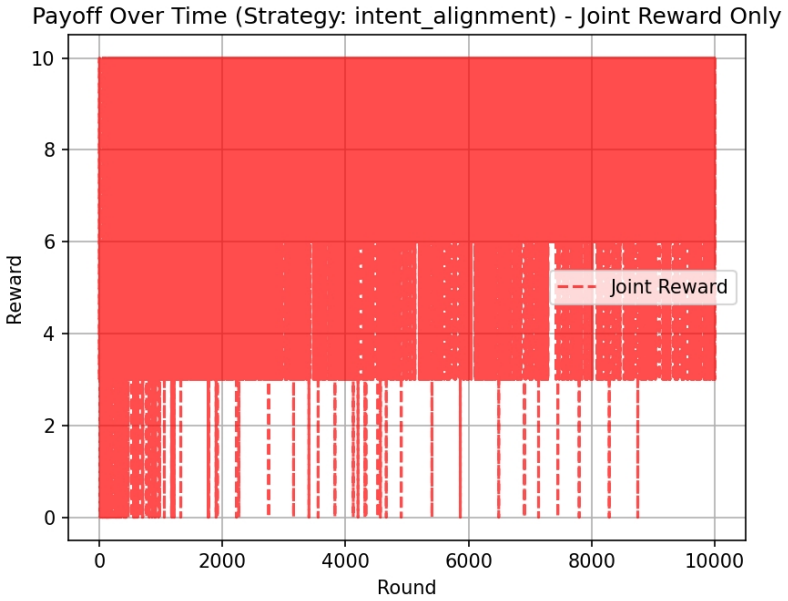
- The observed power-law concentration of code use means efficient protocols are sparse; agents converge on a few effective codes, which is why joint reward stabilizes quickly (around 200 rounds in the paper's runs).
- The 'AIM dictionary' maps code sequences to inferred intentions, so an observer can point to the communication event that preceded a change in agent behavior, making emergent protocols more inspectable.
Reading between the lines
- Editorial inference: if the shared codebook is transferable across tasks, the framework suggests a practical recipe—pretrain and freeze a VQ-VAE on task states, then learn only the message-selection policies—which extends the paper's brief rehearsal of RL low-level pre-training.
- Editorial inference: the finite shared codebook invites a quantitative channel-capacity analysis—tracking mutual information between messages, contexts, and actions over training—which the paper's toolkit observes qualitatively but does not compute.
- Editorial inference: a natural generalization replaces the binary cooperation/defection mapping with hierarchical codes so that longer messages decompose into sub-intentions; the paper names HQ-VAE as the tool for this but does not test it here.
Editorial analysis
A structured set of objections, weighed in public.
Referee Report
Summary. The paper proposes the "AI Mother Tongue" (AIM) framework, in which two agents use a shared VQ-VAE codebook to generate discrete symbol sequences in a two-agent Prisoner's Dilemma variant. The central claim is that, without external inductive biases, agents' neural representations spontaneously undergo semantic compression and Nash-equilibrium-driven semantic convergence, yielding effective symbolic communication. The manuscript describes the VQ-VAE-based architecture, REINFORCE with reflection auxiliary losses, a reward function modulated by image parity, and qualitative figures claiming convergence of joint reward and of a single cooperative code.
Significance. The claim that an endogenous discrete symbol system can bootstrap communication in MARL without external biases would be a notable contribution if it were supported. The paper carefully writes down the formal architecture and reward equations, and its proposed interpretability toolkit is a reasonable methodological ambition. However, the current evidence does not support the central claim: the task is solvable without any communication, the code-to-action mapping is hand-coded, the baselines in Figures 3 and 4 are unnamed, and no quantitative results, seeds, or variance are reported. The manuscript's own Section 5.1 concedes that agents learn to cooperate regardless of the even/odd context, which undermines the claimed role of communication.
major comments (5)
- [3.2, Eq. (25) and 3.4.3, Eq. (37)] The action is computed by a fixed deterministic rule Action(a) = C if a1 < K/2, D otherwise. This is an external, hand-coded semantic mapping, directly contradicting the abstract's claim that communication emerges "without external inductive biases." Moreover, only the first element of the AIM sequence affects the reward; all other symbols in the sequence are irrelevant to the task.
- [3.2, Eqs. (18), (22), (30), (34) and 3.3, Eq. (26)] The task does not require communication. Agent A's policy receives the image encoding ze and parity label l, and Agent B's policy receives aA, l, and ze. Under the joint reward Eq. (26), the (C,C) outcome strictly maximizes total reward for every parity: even rounds give 10, odd rounds give 8, while the next-best joint outcomes give at most 5 or 4. An independent policy that outputs any code with a1 < K/2 achieves the optimal joint reward in every episode. Therefore the observed convergence to a cooperative code is the expected result of per-agent joint-reward maximization, not evidence of emergent communication.
- [5.1] The manuscript explicitly concedes that "agents will eventually learn this cooperate regardless of even or odd strategy." This acknowledgement is in tension with the claimed semantic role of the AIM message channel: if the optimal action is independent of the message, the convergence reported in Figures 1 and 2 does not demonstrate that the message carries task-relevant information.
- [5.3, Figures 3 and 4] The baseline comparisons are not specified. The text refers to "the method proposed in" and "the inductive bias method proposed in" without naming the methods or citing concrete references. No numerical values, number of seeds, hyperparameters, or variance estimates are reported anywhere in the paper, so the performance claims cannot be evaluated or reproduced.
- [3.4.4, Eqs. (39)-(40)] The total losses include intent alignment L_intent, predictive losses, and entropy regularization with weights lambda_r and lambda_epsilon. These are external auxiliary objectives explicitly designed to enforce "communication semantic consistency" and opponent modeling. They act as additional training signals, so the assertion that the framework works "without external inductive biases" is not consistent with the described loss design.
minor comments (5)
- [5.2.1, Table 1] The "Notes or Condi- tions" column is broken mid-word, and the table presents recommended ranges without any measured values from the experiments, making it impossible to verify the claimed training stability.
- [5.3] The claim that symbol usage exhibits a "significant power-law distribution" is not supported by any statistical test, fitted exponent, or quantitative comparison; Figure 2 is described qualitatively only.
- [5.3] Figures 1 and 2 are described as convergence plots, but no axis labels, data descriptions, or error bars are provided, so the reader cannot verify the stated convergence around round 200.
- [5.4] The interpretation of specific AIM sequences such as [10,15] as "feigning defection to ultimately cooperate" is speculative and unsupported by any measurement; this passage should be removed or replaced with a measurable analysis.
- [10, References] Several references are incomplete: [10] and [11] lack page numbers or DOIs, and [14] and [17] are arXiv preprints without version identifiers.
Circularity Check
Semantic convergence is forced by construction: Eq. 25's threshold maps each agent's own emitted code to an action, Eq. 26 makes Cooperate the joint-optimal action, and both agents already receive the image encoding and parity label, so the message channel is superfluous and the claimed emergent communication reduces to trivial reward maximization.
-
self definitional
[Section 3.2, Eq. 25; repeated as Section 3.4.3, Eq. 37]
"AIM sequences are mapped to actions (C for cooperate, D for defect) using a simple rule. Its mathematical expression is: Action(a) = ( C if a1 < K/2 D otherwise . (25)"
The paper's central observations of 'cooperative codes,' 'defective codes,' and 'policy-code covariance' are defined by this hand-coded threshold: the first element of each agent's own emitted sequence mechanically determines Cooperate or Defect. Any code with a1 < K/2 is 'cooperative' by construction, and any code with a1 >= K/2 is 'defective' by construction. Therefore the interpretable toolkit's finding that codes correlate with cooperation or defection is guaranteed by Eq. 25 and is not evidence of emergent semantic content. The claimed 'spontaneous semantic compression' is a restatement of the fixed action-mapping rule, not an emergent communication phenomenon.
-
fitted input called prediction
[Section 3.3, Eq. 26; Section 5.1]
"If the game is designed such that in all scenarios, cooperation (C,C) after sufficient communication is the strategy that yields the highest joint score for that round (as shown in reward matrix, C,C always achieves the highest joint reward of 3+3=6, and even with even/odd adjustments, it is usually the optimal joint outcome), then agents will eventually learn this “cooperate regardless of even or odd” strategy."
Under Eq. 26, (C,C) strictly maximizes total reward in every round regardless of parity. Under Eq. 25, any agent that emits a code with a1 < K/2 executes C. Agent A's policy (Eq. 18) receives ze and l, and Agent B's policy (Eq. 22) receives aA, l, and ze, so both agents already have all information needed to choose a cooperative code without using the other agent's message. The observed convergence to a single 'cooperative' code is therefore the expected outcome of maximizing the joint reward with a deterministic threshold action map; it does not demonstrate communication. The paper's own Section 5.1 concedes that agents will 'eventually learn this cooperate regardless of even or odd' strategy.
full rationale
The load-bearing claim — that an endogenous VQ-VAE symbol system produces spontaneous semantic compression and Nash equilibrium-driven semantic convergence without external inductive biases — reduces to the task's own construction. Eq. 25 defines action semantics as a fixed threshold on the first element of each agent's own emitted code, so any correlation between codes and cooperative/defective behavior is definitionally guaranteed. Eq. 26 makes Cooperate the strictly joint-optimal action in every round, and Eqs. 18 and 22 give both agents the image encoding and parity label as direct policy inputs. Consequently, neither agent needs the message from the other to select an optimal action: each can independently emit any code with a1 < K/2 and receive the maximum joint reward. The paper itself acknowledges this in Section 5.1, stating that agents will 'eventually learn this cooperate regardless of even or odd strategy.' The claimed 'semantic convergence' is thus a forced consequence of the reward function and the hand-coded action mapping, not an emergent communication result. Further, the hand-coded rule in Eq. 25 is itself an external inductive bias, contradicting the paper's central claim of no external inductive biases. No self-citation chain or imported uniqueness theorem is involved; the circularity is definitional and structural. The observed convergence and power-law code usage do not provide independent evidence for emergent communication because the task is solvable without the channel at all. For these reasons, the central 'prediction' reduces by construction, warranting a score of 8.
Assumptions & free parameters
free parameters (6)
- Codebook size K =
not reported
- AIM sequence length L =
not reported
- Action mapping threshold K/2 =
K/2
- Reflection loss weights lambda_epsilon, lambda_r, lambda_predict =
not reported
- Label embedding dimension and policy input dimensions =
not reported
- Reward matrix constants =
4, 5, -1, 0 with parity bonuses
assumptions (4)
- domain assumption Shared VQ-VAE instance and codebook give both agents identical symbol semantics.
- domain assumption VQ-VAE pretrained for reconstruction yields codes that are useful for communication policy learning.
- ad hoc to paper The joint reward used in REINFORCE preserves a social dilemma.
- ad hoc to paper Both agents receiving the image encoding ze and parity label l does not trivialize the communication task.
invented entities (4)
-
AIM sequence
-
Neural Communication Hypothesis
-
Tool-First Principle
-
Semantic Interpretability Paradigm
Cite this review
Pith. "Pith review of AI Mother Tongue: Self-Emergent Communication in MARL via Endogenous Symbol Systems." pith.science (2026). https://pith.science/paper/XUGK5RKL
@misc{pith2026250710566,
  author       = {Pith},
  title        = {Pith review of: AI Mother Tongue: Self-Emergent Communication in MARL via Endogenous Symbol Systems},
  year         = {2026},
  howpublished = {\url{https://pith.science/paper/XUGK5RKL}},
  note         = {Machine review of arXiv:2507.10566}
}
read the original abstract
In Decentralized Multi-Agent Reinforcement Learning (MARL), the development of Emergent Communication has long been constrained by the ``Joint Exploration Dilemma'', leading agents to fall into a ``Communication Vacuum Equilibrium'' . Traditional methods address this by introducing inductive biases to facilitate communication emergence . This study fundamentally questions whether such artificial inductive biases are, in fact, over-engineering. Through experiments with the ``AI Mother Tongue'' (AIM) framework, based on a Vector Quantized Variational Autoencoder (VQ-VAE), we demonstrate that when agents possess an endogenous symbol system, their neural representations naturally exhibit spontaneous semantic compression and Nash equilibrium-driven semantic convergence, achieving effective symbolic communication without external inductive biases. This aligns with recent neuroscience findings suggesting that the human brain does not directly use human language for internal thought , and resonates with research on ``soft thinking'' capabilities in Large Language Models (LLMs) . Compared to traditional explicit communication methods, AIM demonstrates stronger generality and efficiency. The interpretable analysis toolkit developed in this study confirms that symbol usage exhibits a significant power-law distribution, leading to three major theoretical insights: the ``Neural Communication Hypothesis'', the ``Tool-First Principle'', and the ``Semantic Interpretability Paradigm''. Future research will explore the integration of Hierarchical Quantized Variational Autoencoders (HQ-VAE) to enhance AIM's complex expressive capabilities and investigate the potential for ``Reinforcement Learning (RL) Low-Level Pre-training''. This discovery offers new avenues for bridging symbolism and connectionism.
Figures


Figures from the paper (1 more)
Forward citations
Cited by 1 Pith paper
-
Interpretable by AI Mother Tongue: Native Symbolic Reasoning in Neural Models
A VQ-based gated Transformer trained on AG News produces symbol traces that are supposed to be interpretable, but accuracy is low (50.94% then 47.32%) and central results are unreported.
Reference graph
Works this paper leans on
-
[1]
Multi-agent reinforcement learning in sequential social dilemmas
J. Z. Leibo et al. “Multi-agent reinforcement learning in sequential social dilemmas”. In: Proceed- ings of the 16th International Conference on Autonomous Agents and Multiagent Systems . 2017, pp. 464–473
work page 2017
-
[2]
Learning to communicate with deep multi-agent reinforcement learning
J. N. Foerster et al. “Learning to communicate with deep multi-agent reinforcement learning”. In: Advances in Neural Information Processing Systems 29 (2016), pp. 2137–2145
work page 2016
-
[3]
Learning with opponent-learning awareness
J. N. Foerster et al. “Learning with opponent-learning awareness”. In: Proceedings of the 17th International Conference on Autonomous Agents and Multiagent Systems . 2018, pp. 122–130
work page 2018
-
[4]
Biases for emergent communication in multi-agent reinforcement learning
T. Eccles et al. “Biases for emergent communication in multi-agent reinforcement learning”. In: Advances in Neural Information Processing Systems 32 (2019), pp. 13121–13131
work page 2019
-
[5]
Trading Off Utility, Informativeness, and Complexity in Emergent Commu- nication
Mycal Tucker et al. “Trading Off Utility, Informativeness, and Complexity in Emergent Commu- nication”. In: Advances in Neural Information Processing Systems . Ed. by H. Larochelle et al. Vol. 35. Curran Associates, Inc., 2022, pp. 2952–2963
work page 2022
-
[6]
Learning to incentivize other learning agents
J. Yang et al. “Learning to incentivize other learning agents”. In: Advances in Neural Information Processing Systems 33 (2020), pp. 15242–15252
work page 2020
-
[7]
Markov games as a framework for multi-agent reinforcement learning
M. L. Littman. “Markov games as a framework for multi-agent reinforcement learning”. In: Pro- ceedings of the Eleventh International Conference on Machine Learning . Morgan Kaufmann, 1994, pp. 157–163
work page 1994
-
[8]
Multi-agent Reinforcement Learning: Independent versus Cooperative Agents
M. Tan. “Multi-agent Reinforcement Learning: Independent versus Cooperative Agents”. In: Pro- ceedings of the Tenth International Conference on Machine Learning . Morgan Kaufmann, 1993, pp. 330–337
work page 1993
Show all 22 references
-
[9]
Neurosymbolic AI: the 3rd wave
A. D. Garcez and L. C. Lamb. “Neurosymbolic AI: the 3rd wave”. In: Artificial Intelligence Review 56.11 (2023), pp. 1–20. doi: 10.1007/s10462-023-10448-w
2023 doi
-
[10]
Neurosymbolic AI - Why, What, and How
A. Sheth, K. Roy, and M. Gaur. “Neurosymbolic AI - Why, What, and How”. In: IEEE Intelligent Systems (2023). doi: 10.1109/MIS.2023.3268724
2023
-
[11]
Neuro-Symbolic AI: Explainability, Challenges, and Future Trends
X. Zhang and V. S. Sheng. “Neuro-Symbolic AI: Explainability, Challenges, and Future Trends”. In: arXiv preprint arXiv:2411.04383 (2024)
2024 arXiv
-
[12]
Generating diverse high-fidelity images with VQ- V AE-2
A. Razavi, A. van den Oord, and O. Vinyals. “Generating diverse high-fidelity images with VQ- V AE-2”. In:Advances in Neural Information Processing Systems 32 (2019), pp. 14866–14876
2019
-
[13]
SQ-V AE: Variational Bayes on discrete representation with self-annealed stochas- tic quantization
Y. Takida et al. “SQ-V AE: Variational Bayes on discrete representation with self-annealed stochas- tic quantization”. In: Proceedings of the 39th International Conference on Machine Learning . PMLR, 2022, pp. 20987–21008
2022
-
[14]
HQ-V AE: Hierarchical discrete representation learning with variational Bayes
Y. Takida, M. Imaizumi, and T. Uesaka. “HQ-V AE: Hierarchical discrete representation learning with variational Bayes”. In: arXiv preprint arXiv:2401.00365 (2024)
2024 arXiv
-
[15]
R. Axelrod. The evolution of cooperation . Basic Books, 1984
1984
-
[16]
The evolution of cooperation
R. Axelrod and W. D. Hamilton. “The evolution of cooperation”. In: Science 211.4489 (1981), pp. 1390–1396. 29
1981
-
[17]
Reward-Independent Messaging for Decentralized Multi-Agent Re- inforcement Learning
N. Yoshida and T. Taniguchi. “Reward-Independent Messaging for Decentralized Multi-Agent Re- inforcement Learning”. In: arXiv preprint arXiv:2505.21985v1 (2025)
2025 arXiv
-
[18]
A multi-agent reinforcement learning model of common-pool resource appropri- ation
J. Perolat et al. “A multi-agent reinforcement learning model of common-pool resource appropri- ation”. In: Advances in Neural Information Processing Systems 30 (2017), pp. 3646–3655
2017
-
[19]
SoundStream: An End-to-End Neural Audio Codec
N. Zeghidour et al. “SoundStream: An End-to-End Neural Audio Codec”. In: IEEE Transactions on Audio, Speech, and Language Processing 30 (2021), pp. 495–507
2021
-
[20]
Emergent cooperation from mutual acknowledgment exchange in multi-agent reinforcement learning
Tho Phan et al. “Emergent cooperation from mutual acknowledgment exchange in multi-agent reinforcement learning”. In: Autonomous Agents and Multi-Agent Systems 38.2 (2024). doi: 10. 1007/s10458-024-09666-5
2024
-
[21]
Gifting in multi-agent reinforcement learning
A. Lupu and D. Precup. “Gifting in multi-agent reinforcement learning”. In: Proceedings of the 19th International Conference on Autonomous Agents and Multiagent Systems . 2020, pp. 789–797
2020
-
[22]
Scaling Offline Reinforcement Learning with Some Data Is All You Need
T. Bai et al. “Scaling Offline Reinforcement Learning with Some Data Is All You Need”. In: arXiv preprint arXiv:2210.05445 (2022). 30
2022 arXiv
Reviewed August 6, 2026 · model on record in the stance chip above.
Discussion (0). Sign in to comment.