REVIEW 3 major objections 5 minor 24 references
Bulk viscosity and $n$-component fluids
T0 review · 3 major / 5 minor · reviewed 2026-08-06 · deepseek-v4-flash
Pith's one-line read A relativistic fluid with n chemical reactions has a bulk-viscosity equation that factorizes into n independent Israel-Stewart components, with transport coefficients fixed by equilibrium quantities.
desk verdict A useful general-n bulk-viscosity formalism with explicit low-n formulas; the derivation of the partial-viscosity split is sketchy, but the explicit n=2-4 checks are consistent and the alleged inconsistency in Eq. (32) does not survive close reading. read the letter →
The pith
A machine-rendered reading of the paper's core claim, the machinery that carries it, and where it could break.
The reading
What carries the argument
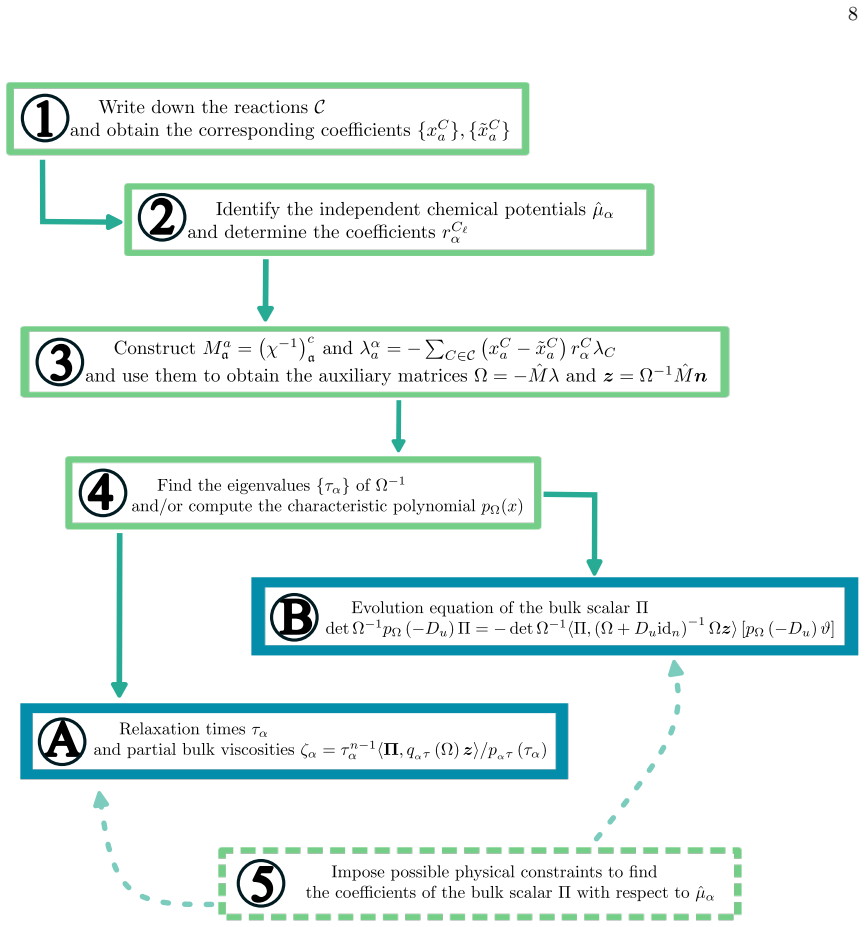
The matrix $\Omega = -\hat{M}\lambda$, assembled from the equilibrium inverse-susceptibility matrix $\hat{M}$ and the linearised reaction-rate matrix $\lambda$, is the object that carries the whole argument: its eigenvalues are the inverse relaxation times of the system, and its characteristic polynomial $p_\Omega(x)$ generates every transport coefficient. The Cayley-Hamilton theorem, $p_\Omega(\Omega)=0$, is used to express $\Omega^{-1}$ as a finite polynomial in $\Omega$, turning the coupled first-order system into a single nth-order differential equation. The auxiliary vector $z = \Omega^{-1}\hat{M}n$, with units of chemical potential squared, contracts with $\Pi$ to give the bulk viscous coefficients, while the coefficients $c_\alpha[\Omega]$ of the characteristic polynomial give the relaxation-time combinations $T_\alpha$.
What would settle it
Solve the original coupled equations (14) along a realistic neutron-star-merger fluid trajectory where $\Omega$ varies with temperature and density, and compare the resulting bulk scalar with the prediction of Eq. (23) using constant coefficients evaluated at the maximum-density point. If the mismatch exceeds the scale set by $[D_u, \Omega]$ relative to the relaxation rates, the exact $n$-exponential Green's function is falsified; if the mismatch stays small whenever that commutator is negligible, the central claim passes.
Extended reading notes
Core claim
The central discovery is that the coupled linear system $(\Omega^{-1}D_u + \mathrm{id}_n)\hat{\mu} = -z\vartheta$, where $\Omega$ is built from equilibrium rates, inverse susceptibilities, and densities, can be diagonalised by the Cayley-Hamilton theorem for any $n$. Contracting the diagonalised vector equation with the coefficient vector $\Pi$ of the bulk scalar gives Eq. (23): $\sum_{\alpha=1}^n T_\alpha D_u^\alpha \Pi + \Pi = -\sum_{\alpha=1}^n Z_\alpha D_u^{\alpha-1}\vartheta$, with the relaxation combinations $T_\alpha$ and bulk viscous coefficients $Z_\alpha$ expressed through the characteristic polynomial of $\Omega$. In the rest frame the Green's function is $\theta(t)\sum_{\alpha=1}^n (\zeta_\alpha/\tau_\alpha)e^{-t/\tau_\alpha}$, with the inverse relaxation times $\tau_\alpha^{-1}$ equal to the eigenvalues of $\Omega$ and the partial bulk viscosities $\zeta_\alpha$ given explicitly by Eq. (31). Hence the bulk pressure response is a Prony series of $n$ Israel-Stewart modes, and the $n=2$ quark-matter case reduces to the Burgers model studied earlier.
Load-bearing premise
The load-bearing premise is that the matrix $\Omega$, which packages equilibrium reaction rates, densities, and susceptibilities, is constant along the fluid flow and invertible; in a neutron star merger the equilibrium background varies in spacetime, and if that variation is significant the exact factorization into $n$ Israel-Stewart components breaks down.
Editorial extensions
If this is right
- For any $n$, the bulk viscous response of a dense relativistic fluid is determined by $2n$ equilibrium quantities, so numerical viscous hydrodynamics can use Eq. (23) directly instead of tracking the full coupled system of chemical potentials.
- The $n=2$ case reproduces the Burgers-model equation for quark matter, and the general result shows it is the first in a family: every $n$ corresponds to a generalised Maxwell model with $n$ relaxation times.
- The transport coefficients for $n=3$ and $n=4$ are now written down explicitly in terms of matrix invariants, giving concrete results for hadronic or multi-species matter where such coefficients were previously unwieldy or absent.
- In the Navier-Stokes regime, the bulk scalar splits into $n$ components, each obeying the Israel-Stewart equation with relaxation time $\tau_\alpha$ and partial bulk viscosity $\zeta_\alpha$ determined by the spectrum of $\Omega$.
Reading between the lines
- If $\Omega$ varies in spacetime, as it does in a realistic merger, the constant-coefficient factorization is only approximate; the natural next step is to allow $\tau_\alpha$ and $\zeta_\alpha$ to be slowly varying functions, with the validity controlled by how small $[D_u, \Omega]$ is compared with the relaxation rates.
- Because the Green's function is fixed by the spectrum of $\Omega$, a measurement of the bulk-viscosity response, for instance through the damping of density oscillations or the postmerger gravitational-wave signal, could in principle be inverted to extract information about equilibrium reaction rates.
- The diagonalisation only uses the linear structure of the equations, so the same Cayley-Hamilton reduction applies to any first-order linear relaxation system of the form $(\Omega^{-1}D_u + \mathrm{id}_n)x = -z\vartheta$, not only to chemical potentials in a fluid.
Editorial analysis
A structured set of objections, weighed in public.
Referee Report
Summary. The paper studies the bulk viscosity of a relativistic fluid with n independent chemical potentials driving the system back toward equilibrium. Starting from linearized reaction-rate equations, the author derives an nth-order differential equation for the bulk scalar Π in second-order hydrodynamics, Eq. (23), with 2n transport coefficients expressed in terms of equilibrium rates, densities, and susceptibilities. The paper further claims that in the fluid rest frame the Green's function is a Prony series, i.e., a sum of n exponentials, corresponding to n independent Israel-Stewart components, and provides explicit formulas for the partial bulk viscosities ζα, Eq. (31). Examples for n=2, 3, 4 are given in the appendix.
Significance. If the derivation is correct, this is a useful general framework: it removes the need to treat each particle-species set case-by-case, provides parameter-free transport coefficients from equilibrium data, and gives explicit matrix-invariant expressions that are easy to implement numerically. The paper is self-contained and builds on existing n=1,2 results (e.g., Refs. [9,15,20]), extending them to arbitrary n. A notable strength is that the final coefficients are expressed entirely in terms of equilibrium quantities with no fitted parameters, and the appendix gives concrete formulas for n=2,3,4 that allow direct verification. The central claim—that the linearized system decomposes into n Israel-Stewart modes—is plausible and supported by the explicit small-n results, provided the constant-background assumption is accepted.
major comments (3)
- [Section IV, Eq. (31)] The formula for the partial bulk viscosities ζα is stated without derivation. The text only says 'we find that' after Eq. (30), but these ζα are precisely the amplitudes in the Prony-series Green's function and hence underpin the central claim that the fluid is a superposition of n Israel-Stewart components. The appendix gives consistent results for n=2,3,4, but a general derivation (or at least a clear sketch showing how Eq. (31) follows from Eq. (30) and the definitions of Pα and pαT) is needed for the claim to be verifiable at arbitrary n.
- [Section III, Eqs. (21)-(23)] The reduction of the vector equation (21) to the scalar evolution equation (23) is overly compressed. In particular, the right-hand side of Eq. (21) contains the operator (D_u + Ω)^{-1} multiplied by p_Ω(-D_u) acting on ϑ; one must use the adjugate identity for (D_u + Ω)^{-1} to see that the product is in fact a polynomial of degree n-1 in D_u, yielding the sum ∑ Zα D^{α-1}ϑ. This step is load-bearing because it defines the Zα coefficients, but it is not shown explicitly. Please spell out this identity and the resulting expression for Zα.
- [Section III, assumption before Eq. (18)] The derivation assumes [D_u, Ω]=0, justified by the statement that 'Ω contains only equilibrium quantities.' In the motivating application to neutron-star mergers, the equilibrium background (temperature, densities, susceptibilities) evolves in time, so D_uΩ is generally nonzero. Since this commutativity is essential for the Cayley-Hamilton diagonalisation and for the factorization into n Israel-Stewart modes, the paper should either clearly restrict the claim to static or slowly-varying backgrounds or discuss the size of the corrections in the time-dependent setting. As written, the regime of validity is broader than the justification supports.
minor comments (5)
- [QM Example after Eq. (25)] Equation (25) is missing the D_uϑ factor on the second term of the right-hand side; it should read −τ+τ−⟨Π, Ωz⟩ D_uϑ, matching Eq. (A1).
- [QM Example before Eq. (32)] The labels T1 and T2 are swapped relative to Eq. (23): the coefficient of D^2_uΠ is T2=τ+τ− and the coefficient of D_uΠ is T1=τ++τ−, not the other way around.
- [Section IV, definition of Pα] The definition of Pα(y) is terse; a concrete example (e.g., P1=1, P2=∑ y_i, P3=∑_{i<j} y_i y_j) would help the reader parse Eq. (31) and its use in the appendix.
- [Appendix A.3, Eq. (A7)] The last term on the left-hand side of Eq. (A7) appears as '+ Π' without a coefficient, which is fine, but the preceding term involving (Tr^3Ω − 3Tr^2Ω TrΩ + 2TrΩ^3) is missing an explicit D_uΠ factor; the displayed equation is ambiguous as written.
- [Section IV, paragraph before Eq. (24)] The statement that 'the system is in a superposition of n separate fluid components' is a strong interpretation; what is actually shown is that the Green's function has the Prony form. The paper could soften this to 'the linearized response is equivalent to that of n Israel-Stewart components' to avoid implying a literal physical decomposition.
Circularity Check
No circularity: the derivation is a self-contained algebraic reduction from equilibrium rates, densities, and susceptibilities to the bulk-scalar evolution equation.
full rationale
The paper's derivation chain is self-contained. It starts from the linearized reaction equations, combines them with continuity and susceptibility relations to obtain Eq. (11), defines Omega and z from equilibrium quantities, rewrites the system as Eq. (14), and then applies the Cayley-Hamilton theorem (under [D_u, Omega]=0) to derive the nth-order bulk-scalar equation (23). The 2n transport coefficients T_alpha and Z_alpha, and the partial bulk viscosities zeta_alpha, are all expressed in terms of equilibrium rates, densities, and susceptibilities; no parameter is fitted and no target result is assumed at the outset. The citations to [9,15] set the starting evolution equation and the quark-matter example, but the essential steps are rederived in the text, and the self-citations are not used as external uniqueness constraints or as substitutes for the algebra. The algebraic inconsistency between Eq. (A2) and Eq. (A3) noted in the skeptical review is a correctness or consistency issue, not evidence that a prediction reduces to an input. Therefore there is no significant circularity.
Assumptions & free parameters
assumptions (4)
- domain assumption Near-equilibrium linearization: reaction chemical potentials hat_mu_C are small compared to equilibrium chemical potentials, and reaction rates are linearized with constant coefficients lambda_C.
- domain assumption Equilibrium background is homogeneous: the equilibrium chemical potentials mu^0_a carry no spacetime dependence, so that Omega, z, and Pi are constant and [D_u, Omega] = 0.
- domain assumption Omega is invertible, which requires nonvanishing reaction rates and non-degenerate thermodynamic susceptibilities.
- standard math The fluid variables are sufficiently smooth and, in the rest frame, theta is piecewise continuous on R, guaranteeing existence and uniqueness of solutions.
Cite this review
Pith. "Pith review of Bulk viscosity and $n$-component fluids." pith.science (2026). https://pith.science/paper/7ZQNU7N4
@misc{pith2026250712365,
  author       = {Pith},
  title        = {Pith review of: Bulk viscosity and $n$-component fluids},
  year         = {2026},
  howpublished = {\url{https://pith.science/paper/7ZQNU7N4}},
  note         = {Machine review of arXiv:2507.12365}
}
abstract
Understanding the hydrodynamics of out-of-equilibrium dense viscous fluids is of key importance to accurate descriptions of physical systems such as compact stars, particularly their mergers. We consider a near-equilibrium relativistic fluid with $n$ independent and small chemical potentials restoring the system back towards equilibrium. By diagonalising the evolution equation for the out-of-equilibrium chemical potentials, we construct an explicit evolution equation for the bulk scalar of the system in second-order hydrodynamics in terms of equilibrium quantities. We find expressions for the $2n$ transport quantities and show that in the rest frame of the fluid, the system admits a Green's function corresponding to an $n$-component fluid.
Figures
Reference graph
Works this paper leans on
-
[1]
n = 2 The results for n = 2 can be collected from the examples in the main text, but we list them all below. From pΩ(x) = x2 − TrΩx + DetΩ the evolution equation (23) becomes DetΩ−1D2 uΠ + DetΩ−1TrΩDuΠ + Π = −⟨Π, z⟩ϑ − DetΩ−1⟨Π, Ωz⟩Duϑ. (A1) For any n, the inverse relaxation times {τ −1 α }n α=1 are the eigenvalues of Ω. The bulk viscous coefficients are ...
-
[2]
n = 3 For n = 3 the equations are still very reasonable: The evolution equation is DetΩ−1D3 uΠ + DetΩ−1TrΩD2 uΠ + DetΩ−1 2 Tr2Ω − TrΩ2 DuΠ + Π = −⟨Π, z⟩ϑ − DetΩ−1 TrΩ⟨Π, Ωz⟩ − ⟨Π, Ω2z⟩ Duϑ − DetΩ−1⟨Π, Ωz⟩D2 uϑ. (A4) and the bulk viscous coefficients are Z1 = ζ1 + ζ2 + ζ3 = ⟨Π, z⟩ , Z2 = (τ2 + τ3) ζ1 + (τ1 + τ3) ζ2 + (τ1 + τ2) ζ3 = DetΩ−1 TrΩ⟨Π, Ωz⟩ − Π, Ω...
-
[3]
n = 4 Even for n = 4, which to the best of our knowledge has not been considered in this context even in specific simplifying cases, the results are simple enough to be written down in a relatively compact form, although in practice it would be less tedious to do it indirectly using the coefficients of the characteristic polynomial. The evolution equation...
-
[4]
B. P. Abbott et al. (LIGO Scientific, Virgo, Fermi GBM, INTEGRAL, IceCube, AstroSat Cadmium Zinc Telluride Imager Team, IPN, Insight-Hxmt, ANTARES, Swift, AGILE Team, 1M2H Team, Dark Energy Camera GW-EM, DES, DLT40, GRA WITA, Fermi-LAT, ATCA, ASKAP, Las Cumbres Ob- servatory Group, OzGrav, DWF (Deeper Wider Faster Program), AST3, CAASTRO, VINROUGE, MASTER...
arXiv 2017
-
[5]
B. P. Abbott et al. (LIGO Scientific, Virgo), GW170817: Observation of Gravitational Waves from a Binary Neutron Star Inspiral, Phys. Rev. Lett. 119, 161101 (2017), arXiv:1710.05832 [gr-qc]
arXiv 2017
-
[6]
L. Baiotti and L. Rezzolla, Binary neutron star mergers: a review of einstein’s richest laboratory, Rept. Prog. Phys. 80, 096901 (2017), arXiv:1607.03540 [gr-qc]
arXiv 2017
-
[7]
M. G. Alford, L. Bovard, M. Hanauske, L. Rezzolla, and K. Schwenzer, Viscous Dissipation and Heat Conduction in Binary Neutron-Star Mergers, Phys. Rev. Lett. 120, 041101 (2018), arXiv:1707.09475 [gr-qc]
arXiv 2018
-
[8]
E. R. Most, A. Haber, S. P. Harris, Z. Zhang, M. G. Alford, and J. Noronha, Emergence of microphys- ical bulk viscosity in binary neutron star postmerger dynamics, Astrophys. J. Lett. 967, L14 (2024), arXiv:2207.00442 [astro-ph.HE]
arXiv 2024
Show all 24 references
-
[9]
M. G. Alford, S. Han, and K. Schwenzer, Signatures for quark matter from multi-messenger observa- tions, J. Phys. G 46, 114001 (2019), arXiv:1904.05471 [nucl-th]
2019 arXiv
-
[10]
Chabanov and L
M. Chabanov and L. Rezzolla, Impact of bulk viscosity on the postmerger gravitational-wave signal from merging neutron stars, Phys. Rev. Lett. 134, 071402 (2025), arXiv:2307.10464 [gr-qc]
2025 arXiv
-
[11]
Chabanov and L
M. Chabanov and L. Rezzolla, Numerical modeling of bulk viscosity in neutron stars, Phys. Rev. D 111, 044074 (2025), arXiv:2311.13027 [gr-qc]
2025 arXiv
-
[12]
Cruz Rojas, T
J. Cruz Rojas, T. Gorda, C. Hoyos, N. Jokela, M. J¨ arvinen, A. Kurkela, R. Paatelainen, S. S¨ appi, and A. Vuorinen, Estimate for the bulk viscosity of strongly coupled quark matter using perturbative qcd and holography, Phys. Rev. Lett. 133, 071901 (2024), arXiv:2402.00621 [hep-ph]
2024 arXiv
-
[13]
J. L. Hernandez, C. Manuel, and L. Tolos, Damping of density oscillations from bulk viscosity in quark matter, Phys. Rev. D 109, 123022 (2024), arXiv:2402.06595 [hep-ph]
2024 arXiv
-
[14]
O. P. Jyothilakshmi, P. E. S. Krishnan, P. Thakur, V. Sreekanth, and T. K. Jha, Hyperon bulk viscosity and r-modes of neutron stars, Mon. Not. Roy. Astron. Soc. 516, 3381 (2022), arXiv:2208.14436 [astro- ph.HE]
2022 arXiv
-
[15]
Alford, A
M. Alford, A. Harutyunyan, and A. Sedrakian, Bulk Viscosity of Relativistic npe µ Matter in Neutron- Star Mergers, Particles 5, 361 (2022), arXiv:2209.04717 [astro-ph.HE]
2022 arXiv
-
[16]
Alford, A
M. Alford, A. Harutyunyan, and A. Sedrakian, Bulk viscosity of baryonic matter with trapped neu- trinos, Phys. Rev. D 100, 103021 (2019), arXiv:1907.04192 [astro-ph.HE]
2019 arXiv
-
[17]
S. P. Harris, B. Fore, and S. Reddy, Bulk viscosity of nuclear matter with pions in the neutrino-trapped regime, Phys. Rev. C 111, 015802 (2025), arXiv:2407.18890 [nucl-th]
2025 arXiv
-
[18]
J. L. Hernandez, C. Manuel, S. S¨ appi, and L. Tolos, Burgers equation for the bulk viscous pressure of quark matter (2025), arXiv:2507.00794 [hep-ph]. 12
2025
-
[19]
H. T. Banks, S. Hu, and Z. R. Kenz, A brief review of elasticity and viscoelasticity for solids, Advances in Applied Mathematics and Mechanics 3, 1–51 (2011)
2011
-
[20]
Park and R
S. Park and R. Schapery, Methods of interconversion between linear viscoelastic material functions. part i—a numerical method based on prony series, International journal of solids and structures 36, 1653 (1999)
1999
-
[21]
Schapery and S
R. Schapery and S. Park, Methods of interconversion between linear viscoelastic material functions. part ii—an approximate analytical method, International Journal of Solids and Structures 36, 1677 (1999)
1999
-
[22]
Park and Y
S. Park and Y. Kim, Fitting prony-series viscoelastic models with power-law presmoothing, Journal of materials in civil engineering 13, 26 (2001)
2001
-
[23]
Gavassino, Relativistic bulk viscous fluids of burgers type and their presence in neutron stars, Class
L. Gavassino, Relativistic bulk viscous fluids of burgers type and their presence in neutron stars, Class. Quant. Grav. 40, 165008 (2023), arXiv:2304.05455 [nucl-th]
2023 arXiv
-
[24]
Hou, Classroom note: A simple proof of the leverrier–faddeev characteristic polynomial algo- rithm, SIAM Review 40, 706 (1998)
S.-H. Hou, Classroom note: A simple proof of the leverrier–faddeev characteristic polynomial algo- rithm, SIAM Review 40, 706 (1998)
1998
Reviewed August 6, 2026 · model on record in the stance chip above.
Discussion (0). Sign in to comment.