REVIEW 4 major objections 5 minor 63 references
The equation of state and surface tension of QCD in the first order phase transition region
T0 review · 4 major / 5 minor · reviewed 2026-08-06 · deepseek-v4-flash
Pith's one-line read This paper claims that an Ising-type parametrization of the chiral and Polyakov-loop order parameters, placed into the quark propagator, yields the full QCD equation of state in the first-order transition region, including a surface…
desk verdict A usable extension of the Ising parametrization to the full first-order QCD region, with surface tension as a new output, but the quantitative numbers are model estimates until λ is fixed. read the letter →
The pith
A machine-rendered reading of the paper's core claim, the machinery that carries it, and where it could break.
The reading
What carries the argument
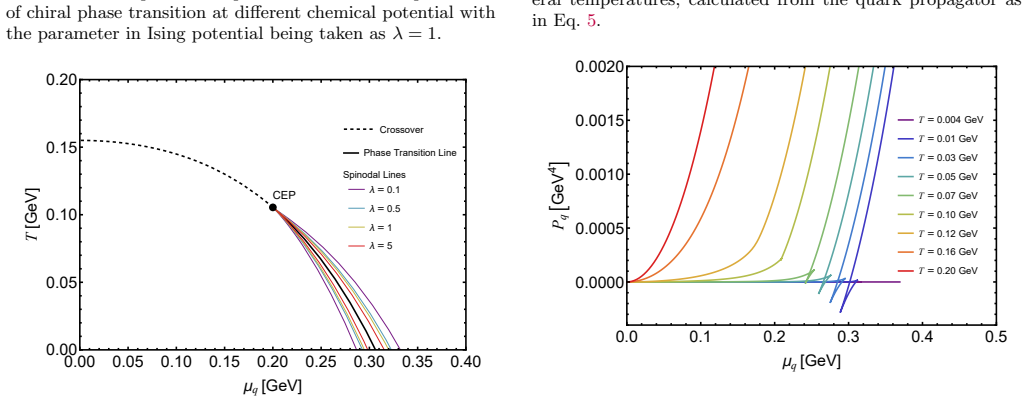
The load-bearing object is the Ising-type order-parameter potential $F(M_{\rm Ising},r,h)=-hM_{\rm Ising}+\tfrac12 r M_{\rm Ising}^2+\tfrac{\lambda}{6}M_{\rm Ising}^6$, whose coefficient $\lambda$ controls the width of the coexistence region and is set to unity. The Ising variables $(r,h)$ are mapped to $(T,\mu_B)$ through Eqs. (12)-(14) so that the chiral transition line follows the lattice and functional-QCD parametrization $T_c(\mu_B)/T_c(0)=1-\kappa(3\mu_q/T_c(0))^2-\kappa_2(3\mu_q/T_c(0))^4$. The resulting $M_q$ and Polyakov loop $\Phi$ enter the quark propagator $S_q^{-1}=i(\tilde\omega_n+gA_4)\gamma_4+i\gamma\cdot p+M_q$, giving the number density $n_q$ directly; pressure, free energy, and the surface tension $\gamma(T)=\int_{n_W}^{n_N}\sqrt{(C/2)\Delta F_T}\,dn_q$ then follow by integration and by comparison with the Maxwell construction.
What would settle it
A direct functional-QCD calculation of the chiral order parameter in the first-order region, at chemical potentials above the assumed critical endpoint, would determine the width of the multivalued $M_q(T,\mu_B)$ region and therefore the value of $\lambda$; if the resulting spinodal lines differ from Fig. 2, the coexistence boundaries and the predicted $\gamma(T)$ band of 20-140 MeV fm$^{-2}$ would move. Alternatively, a future lattice determination of the first-order transition line or of the surface tension at finite density would test the Maxwell-construction transition point directly.
Extended reading notes
Core claim
The paper's central claim is that the thermodynamics of QCD in the first-order phase transition region can be captured by treating the chiral condensate and the Polyakov loop as two order parameters governed by a 3D-Ising-type free-energy potential with a dominant $\phi^6$ term, mapped nonlinearly onto temperature and baryon chemical potential with the critical endpoint at $(T,\mu_B)=(106,600)$ MeV. Using those order parameters in the quark propagator, the authors compute the quark number density, then the pressure by integration, and then the free energy; the Maxwell construction from the pressure reproduces the input transition line and defines the coexistence region between the spinodal lines. The free-energy excess over the Maxwell construction, combined with a phenomenological inhomogeneous free-energy density whose interface thickness is taken from earlier hadron studies, yields a surface tension $\gamma(T)$ that runs from about 20 MeV fm$^{-2}$ on the phase transition line up to about 140 MeV fm$^{-2}$ at the spinodal lines. The paper thereby claims to provide a consistent description of the equation of state and interface properties across the entire first-order region.
Load-bearing premise
The computation sets the Ising potential coefficient $\lambda=1$ because no functional-QCD data in the first-order region are used to fix it, and it adopts an interface thickness $a=0.33$ fm from earlier hadron studies; if either value differs, the spinodal lines and the surface tension shift noticeably.
Editorial extensions
If this is right
- The first-order transition line obtained by Maxwell construction agrees with the input chiral transition line, so the equation of state is thermodynamically consistent.
- The density, pressure, and free energy are available for the Nambu and Wigner phases and for the unstable branch between them, which is the input needed for hydrodynamics and for descriptions of supercooling and superheating.
- The surface tension is smallest on the phase-transition line, about 20 MeV fm$^{-2}$, and grows toward the spinodal lines, about 140 MeV fm$^{-2}$, implying faster transitions in the deeply supercooled or superheated regime.
- With the trace anomaly and surface tension in hand, the framework can be used in cosmological studies where a first-order QCD transition shapes gravitational-wave signals.
Reading between the lines
- Because $\lambda$ is not anchored to functional-QCD data in the first-order region, the reported 20-140 MeV fm$^{-2}$ band should be read as the prediction of a one-parameter family; future first-order functional-QCD computations could calibrate $\lambda$ and rescale both the coexistence region and $\gamma(T)$.
- The same order-parameter-plus-propagator scheme could be extended to baryon-number susceptibilities and cumulants of net-baryon fluctuations, since higher derivatives of the pressure inherit the curvature of $M_q(T,\mu_B)$ and $\Phi(T,\mu_B)$.
- Cosmological bubble nucleation rates depend exponentially on $\gamma^3/\Delta p^2$, so a change in $\lambda$ or in the interface thickness $a$ by a factor of two would shift gravitational-wave spectra substantially, making both quantities measurable targets for QCD-informed nucleation studies.
Editorial analysis
A structured set of objections, weighed in public.
Referee Report
Summary. The manuscript constructs a parametrized description of the QCD chiral and deconfinement order parameters, using an Ising-type potential for the chiral condensate and a fitted Polyakov-loop function, and embeds them in a quark propagator to compute the number density, pressure, free energy, and surface tension in the first-order phase transition region. It reports spinodal boundaries, a Maxwell-construction cross-check of the transition line, and a surface tension in the range of roughly 20-140 MeV·fm-2 on the coexistence and spinodal lines.
Significance. The paper proposes a concrete, thermodynamically consistent framework that fills a gap where direct functional-QCD computations are currently unavailable. The thermodynamic identities (Eqs. 5, 7, 17) are standard, and the Maxwell construction is implemented as an explicit consistency check, which is a strength. However, the central quantitative outputs are not parameter-free QCD predictions: the coefficient λ of the Ising potential is set to 1 without fQCD input, the surface tension is proportional to the adopted interface thickness a, and one defining equation has a dimensional inconsistency. With these issues addressed, the framework could be useful as a phenomenological EoS for hydrodynamics and cosmological studies, but in its present form the reported quantitative estimates are conditional on several untested parameters.
major comments (4)
- [§III.C, Eq. (21)] The definition C = a^2 n_B^2 E_g is dimensionally inconsistent with Eq. (23). With a in fm, n_B in fm^-3, and E_g in GeV·fm^-3, C has units GeV·fm^-7; however, for the second equality in Eq. (23) to yield γ in MeV·fm^-2, C must have units GeV·fm^5. This implies the intended definition is likely C = a^2 E_g / n_B^2 (or an equivalent missing inverse power). The numerical γ values in Fig. 7 should be recomputed after correcting the formula.
- [§II.B, §III.C, Figs. 2 and 7] The surface tension and the coexistence boundaries depend strongly on the Ising-potential coefficient λ, which is set to λ=1 without functional-QCD input. The paper itself states that fixing λ requires fQCD data in the first-order region that are not yet available. As λ varies between 0.1 and 5, the spinodal lines in Fig. 2 change significantly, and through ΔF_T(n_q) in Eq. (23) this directly shifts γ. The quoted band 20-140 MeV·fm^-2 is therefore a model estimate conditioned on λ, not a QCD determination; a λ-dependence plot for γ is needed.
- [§III.C, Eq. (23)] The surface tension scales as sqrt(C) ∝ a, with a=0.33 fm taken from Refs. [61,62]. No evidence is given that this interface-thickness scale applies to the first-order chiral transition at the densities considered, even though the numerical results in Fig. 7 are directly proportional to a. Please provide a sensitivity study over a, or derive a from the free-energy functional of the modeled system.
- [§III.A and Abstract] The abstract's statement that the phase transition line is obtained using the Maxwell construction is misleading. In §III.A the transition line is directly read off from the parametrized order parameter, which is fixed by Eq. (8) after extending that parametrization to T=0, μ_B=930 MeV without a validation. The Maxwell construction in Fig. 5 is a consistency check, not an independent determination. This circularity should be stated explicitly, and the uncertainty in the input line (κ, κ2, CEP location) should be propagated into the reported EoS and γ.
minor comments (5)
- [Abstract] The word 'decompostion' should be 'decomposition'.
- [§III.C, Eq. (20)] The Maxwell-construction formula lacks parentheses; the slope should read (F_T(n_W) - F_T(n_N))/(n_W - n_N).
- [§II.B, Eq. (6)] The use of the same L for the quark and antiquark distribution functions should be stated as an approximation, since at finite μ_B the Polyakov loop and its conjugate generally differ.
- [§III.B] The text and figure axes use both n_q and n_B without a consistent notation; the conversion between them should be defined once and used throughout.
- [§IV] The sentence in the summary stating that 'the phase transition line can be determined through the Maxwell construction' conflicts with §III.A, where the line is read off from the parametrization; the wording should be aligned.
Circularity Check
The first-order phase-transition line is inserted via Eq. (8) and later 'determined' by Maxwell construction, so that headline result reduces to its own input; the surface-tension band is a transparent model estimate controlled by unconstrained λ and a.
-
self definitional
[Abstract; Sec. II.B, Eqs. (8)-(14); Sec. III.A; Sec. III.B; Sec. IV]
"In order to match the phase transition line Eq. (8) precisely, one can take a non-linear mapping from r, h to T, µB as: ... The function fP T(r) is chosen such that the mapping match the the chiral phase transition line. Hence, fP T(r) = ... ... In the parameterization of the order parameter, the phase transition line has already been incorporated. Therefore, the phase transition line can be directly read off from the chiral order parameter Mq ... Note that the phase transition line in the first order phase transition is directly from the parameterization of Eq."
Equation (8) is an input fixed by externally supplied coefficients (Tc(0)=155 MeV, κ=0.016, κ2=3.5e-4). The mapping in Eqs. (12)-(14) is explicitly constructed 'to match the phase transition line Eq. (8) precisely,' so Mq, and via Eq. (5) also nq, already contain that Tc(μB). The later Maxwell construction on Pq (Eq. (17)) and the claimed 'read off' from Mq therefore return the same input line; no independent thermodynamic information determines the first-order transition point. The abstract's phrase 'phase transition line using Maxwell construction ... determined' is thus a self-consistency check rather than an independent prediction, as the paper itself concedes in Sec. III.A.
full rationale
The derivation chain has one genuinely circular link: the first-order phase-transition line. Equation (8) fixes Tc(μB) from input coefficients, Eqs. (12)-(14) are explicitly designed to reproduce it, and Sec. III.A then says the line 'can be directly read off' and 'is directly from the parameterization of Eq. 8'. The Maxwell construction shown in Sec. III.B, Fig. 5 recovers this same line, so it is a consistency test, not an independent determination. This is the classic self-definitional pattern, and it makes the abstract's wording that the phase transition line is 'determined' by Maxwell construction circular, even though the paper is transparent about the input in Sec. III.A. The other quantitative caveats are not circular in the technical sense. The choice λ=1 is adopted in Sec. II.B because no functional-QCD data in the first-order region are yet available to fix it, and the interface-thickness scale a=0.33 fm is imported from Refs. [61,62] (which share authors with this paper). The surface-tension band therefore scales with these inputs, making it a model estimate rather than a parameter-free QCD prediction. However, λ and a are stated as chosen inputs and are not fitted to the surface tension or to any target quantity; the paper also shows sensitivity to λ in Fig. 2. The self-citation [44] used to argue that the Polyakov-loop contribution is subleading is a supporting estimate, not the load-bearing definition of a result. Thus the central EoS and surface-tension calculation retains independent content given its model inputs, but because one headline 'determined' quantity reduces by construction to Eq. (8), the partial-circularity score is 6.
Assumptions & free parameters
free parameters (5)
- λ (Ising potential coefficient) =
1
- a (interface thickness) =
0.33 fm
- M0 (light-quark mass scale) =
350 MeV
- CEP location (T, µ_B) =
(106, 600) MeV
- Ising mapping powers (ω, ρ) =
ω=1, ρ=2
assumptions (5)
- domain assumption The QCD free energy as a function of the chiral order parameter follows the phi^6 Ising form (Eq. 10).
- domain assumption The quark propagator can be approximated by momentum-independent, Z=1 dressing functions (Eq. 3).
- ad hoc to paper The chiral phase transition line parametrization (Eq. 8) remains valid when extended to T=0, µ_B=930 MeV.
- ad hoc to paper The Polyakov loop at finite chemical potential follows the shifted variable t_Phi of Eq. (16).
- domain assumption The inhomogeneous free energy takes the gradient form Eq. (21) with coefficient C = a^2 n_B^2 / E_g.
Cite this review
Pith. "Pith review of The equation of state and surface tension of QCD in the first order phase transition region." pith.science (2026). https://pith.science/paper/LPJGJQAZ
@misc{pith2026250713697,
  author       = {Pith},
  title        = {Pith review of: The equation of state and surface tension of QCD in the first order phase transition region},
  year         = {2026},
  howpublished = {\url{https://pith.science/paper/LPJGJQAZ}},
  note         = {Machine review of arXiv:2507.13697}
}
read the original abstract
We build up a complete description of QCD phase structure by applying the parametrization of the chiral and deconfinement order parameters upon the calculations from functional QCD approaches. In particular in the first order phase transition region at high chemical potential, both the phase transition line using Maxwell construction and the coexistence boundary lines from the spinodal decompostion are determined. We compute the thermodynamic quantities including the number density, the energy density, the pressure and also the free energy for both stable and unstable phases of QCD. Additionally, after applying a phenomenological description of the inhomogeneity of the QCD free energy, we obtain the surface tension of the first order phase transition of QCD.
Figures


Figures from the paper (1 more)

Reference graph
Works this paper leans on
-
[1]
G. Y. Shao, M. Di Toro, V. Greco, M. Colonna, S. Plumari, B. Liu, and Y. X. Liu, Phys. Rev. D 84, 034028 (2011), arXiv:1105.4528 [nucl-th]
work page Pith review arXiv 2011
-
[2]
X. Y. Xin, S. X. Qin, and Y. X. Liu, Phys. Rev. D 90, 076006 (2014), arXiv:2109.09935 [hep-ph]
arXiv 2014
- [3]
-
[4]
K. Chelabi, Z. Fang, M. Huang, D. Li, and Y.-L. Wu, JHEP 04, 036 (2016), arXiv:1512.06493 [hep-ph]
arXiv 2016
-
[5]
T. Kojo, D. Hou, J. Okafor, and H. Togashi, Phys. Rev. D 104, 063036 (2021), arXiv:2012.01650 [astro-ph.HE]
arXiv 2021
-
[6]
X. Chen, L. Zhang, D. Li, D. Hou, and M. Huang, JHEP 07, 132 (2021), arXiv:2010.14478 [hep-ph]
arXiv 2021
-
[7]
M. Hippert, J. Grefa, T. A. Manning, J. Noronha, J. Noronha-Hostler, I. Portillo Vazquez, C. Ratti, R. Rougemont, and M. Trujillo, (2023), arXiv:2309.00579 [nucl-th]
arXiv 2023
-
[8]
R. G. Cai, S. He, L. Li, and Y. X. Wang, Phys. Rev. D 106, L121902 (2022), arXiv:2201.02004 [hep-th]
arXiv 2022
Show all 63 references
-
[9]
X. Chen, D. Li, and M. Huang, Chin. Phys. C 43, 023105 (2019), arXiv:1810.02136 [hep-ph]
2019 arXiv
- [10]
-
[11]
Borsanyi, Z
S. Borsanyi, Z. Fodor, J. N. Guenther, R. Kara, S. D. Katz, P. Parotto, A. Pasztor, C. Ratti, and K. K. Szabo, Phys. Rev. Lett. 125, 052001 (2020), arXiv:2002.02821 [hep-lat]
2020 arXiv
-
[12]
Bazavov et al
A. Bazavov et al. (HotQCD), Phys. Lett. B 795, 15 (2019), arXiv:1812.08235 [hep-lat]
2019 arXiv
-
[13]
Bonati, M
C. Bonati, M. D’Elia, F. Negro, F. Sanfilippo, and K. Zambello, Phys. Rev. D 98, 054510 (2018), arXiv:1805.02960 [hep-lat]
2018 arXiv
-
[14]
S. X. Qin, L. Chang, H. Chen, Y. X. Liu, and C. D. Roberts, Phys. Rev. Lett. 106, 172301 (2011), arXiv:1011.2876 [nucl-th]
2011 arXiv
-
[15]
C. S. Fischer, J. Luecker, and C. A. Welzbacher, Phys. Rev. D 90, 034022 (2014), arXiv:1405.4762 [hep-ph]
2014 arXiv
-
[16]
Gao and Y
F. Gao and Y. X. Liu, Phys. Rev. D 94, 076009 (2016), arXiv:1607.01675 [hep-ph]
2016 arXiv
-
[17]
C. S. Fischer, Prog. Part. Nucl. Phys. 105, 1 (2019), arXiv:1810.12938 [hep-ph]
2019 arXiv
-
[18]
Gao and J
F. Gao and J. M. Pawlowski, Phys. Rev. D 102, 034027 (2020), arXiv:2002.07500 [hep-ph]
2020 arXiv
-
[19]
Gao and J
F. Gao and J. M. Pawlowski, Phys. Lett. B 820, 136584 (2021), arXiv:2010.13705 [hep-ph]
2021 arXiv
-
[20]
P. J. Gunkel and C. S. Fischer, Phys. Rev. D104, 054022 (2021), arXiv:2106.08356 [hep-ph]
2021 arXiv
-
[21]
W. J. Fu, J. M. Pawlowski, and F. Rennecke, Phys. Rev. D 101, 054032 (2020), arXiv:1909.02991 [hep-ph]
2020 arXiv
-
[22]
Dupuis, L
N. Dupuis, L. Canet, A. Eichhorn, W. Metzner, J. M. Pawlowski, M. Tissier, and N. Wschebor, Phys. Rept. 910, 1 (2021), arXiv:2006.04853 [cond-mat.stat-mech]
2021 arXiv
-
[23]
W. J. Fu, Commun. Theor. Phys. 74, 097304 (2022), arXiv:2205.00468 [hep-ph]
2022 arXiv
-
[24]
Akiba et al., (2015), arXiv:1502.02730 [nucl-ex]
Y. Akiba et al., (2015), arXiv:1502.02730 [nucl-ex]
2015 arXiv
- [25]
-
[26]
Adamczewski-Musch et al
J. Adamczewski-Musch et al. (HADES), Nature Phys. 15, 1040 (2019)
2019
-
[27]
Lovato et al., (2022), arXiv:2211.02224 [nucl-th]
A. Lovato et al., (2022), arXiv:2211.02224 [nucl-th]
2022 arXiv
-
[28]
Alizadehvandchali et al
N. Alizadehvandchali et al. (ALICE-USA), (2022), arXiv:2212.00512 [nucl-ex]
2022 arXiv
-
[29]
Arslandok et al., (2023), arXiv:2303.17254 [nucl-ex]
M. Arslandok et al., (2023), arXiv:2303.17254 [nucl-ex]
2023 arXiv
-
[30]
Ding, PoS LA TTICE2016, 022 (2017), arXiv:1702.00151 [hep-lat]
H.-T. Ding, PoS LA TTICE2016, 022 (2017), arXiv:1702.00151 [hep-lat]
2017 arXiv
-
[31]
J. N. Guenther, Eur. Phys. J. A 57, 136 (2021), arXiv:2010.15503 [hep-lat]
2021 arXiv
-
[32]
Monnai, B
A. Monnai, B. Schenke, and C. Shen, Int. J. Mod. Phys. A 36, 2130007 (2021), arXiv:2101.11591 [nucl-th]
2021 arXiv
-
[33]
Philipsen, Symmetry 13, 2079 (2021), arXiv:2111.03590 [hep-lat]
O. Philipsen, Symmetry 13, 2079 (2021), arXiv:2111.03590 [hep-lat]
2021 arXiv
- [34]
-
[35]
Ratti, Prog
C. Ratti, Prog. Part. Nucl. Phys. 129, 104007 (2023)
2023
-
[36]
Sorensen et al., (2023), arXiv:2301.13253 [nucl-th]
A. Sorensen et al., (2023), arXiv:2301.13253 [nucl-th]
2023 arXiv
-
[37]
Gao and I
F. Gao and I. M. Oldengott, Phys. Rev. Lett.128, 131301 (2022), arXiv:2106.11991 [hep-ph]
2022 arXiv
-
[38]
F. Gao, J. Harz, C. Hati, Y. Lu, I. M. Oldengott, and G. White, (2023), arXiv:2309.00672 [hep-ph]
2023 arXiv
-
[39]
F. Gao, J. Harz, C. Hati, Y. Lu, I. M. Oldengott, and G. White, (2024), arXiv:2407.17549 [hep-ph]
2024 arXiv
-
[40]
Zheng, F
H.-w. Zheng, F. Gao, L. Bian, S.-x. Qin, and Y.-x. Liu, Phys. Rev. D 111, L021303 (2025), arXiv:2407.03795 [hep-ph]
2025 arXiv
-
[41]
Reichert, F
M. Reichert, F. Sannino, Z.-W. Wang, and C. Zhang, JHEP 01, 003 (2022), arXiv:2109.11552 [hep-ph]
2022 arXiv
-
[42]
Pasechnik, M
R. Pasechnik, M. Reichert, F. Sannino, and Z.-W. Wang, JHEP 02, 159 (2024), arXiv:2309.16755 [hep-ph]
2024 arXiv
-
[43]
J. M. Cline and B. Laurent, (2025), arXiv:2502.12321 [hep-ph]
2025 arXiv
-
[44]
Y. Lu, F. Gao, Y.-x. Liu, and J. M. Pawlowski, (2025), arXiv:2504.05099 [hep-ph]
2025 arXiv
-
[45]
Parotto, M
P. Parotto, M. Bluhm, D. Mroczek, M. Nahrgang, J. Noronha-Hostler, K. Rajagopal, C. Ratti, T. Sch¨ afer, and M. Stephanov, Phys. Rev. C 101, 034901 (2020), arXiv:1805.05249 [hep-ph]
2020 arXiv
-
[46]
T. Dore, J. M. Karthein, I. Long, D. Mroczek, J. Noronha-Hostler, P. Parotto, C. Ratti, and Y. Yamauchi, Phys. Rev. D 106, 094024 (2022), arXiv:2207.04086 [nucl-th]
2022 arXiv
-
[47]
Y. Lu, F. Gao, B. Fu, H. Song, and Y.-X. Liu, Phys. Rev. D 109, 114031 (2024), arXiv:2310.16345 [hep-ph]
2024 arXiv
-
[48]
J. M. Karthein, V. Koch, and C. Ratti, Phys. Rev. D 111, 034013 (2025), arXiv:2409.13961 [nucl-th]
2025 arXiv
-
[49]
Fister and J
L. Fister and J. M. Pawlowski, Phys. Rev. D 88, 045010 (2013), arXiv:1301.4163 [hep-ph]
2013 arXiv
-
[50]
C. S. Fischer, L. Fister, J. Luecker, and J. M. Pawlowski, Phys. Lett. B 732, 273 (2014), arXiv:1306.6022 [hep-ph]
2014 arXiv
-
[51]
H. Chen, M. Baldo, G. F. Burgio, and H. J. Schulze, Phys. Rev. D 86, 045006 (2012), arXiv:1203.0158 [nucl- th]
2012 arXiv
-
[52]
Isserstedt, C
P. Isserstedt, C. S. Fischer, and T. Steinert, Phys. Rev. D 103, 054012 (2021), arXiv:2012.04991 [hep-ph]
2021 arXiv
-
[53]
W. J. Fu, X. Luo, J. M. Pawlowski, F. Rennecke, and S. Yin, (2023), arXiv:2308.15508 [hep-ph]. 8
2023 arXiv
-
[54]
F. Gao, Y. Lu, S.-x. Qin, Z. Bai, L. Chang, and Y.-x. Liu, (2025), arXiv:2504.00539 [nucl-th]
2025 arXiv
-
[55]
P. O. Bowman, U. M. Heller, D. B. Leinweber, M. B. Parappilly, A. G. Williams, and J.-b. Zhang, Phys. Rev. D 71, 054507 (2005), arXiv:hep-lat/0501019
2005 arXiv
-
[56]
Oliveira, A
O. Oliveira, A. Kızılersu, P. J. Silva, J.-I. Skullerud, A. Sternbeck, and A. G. Williams, Acta Phys. Polon. Supp. 9, 363 (2016), arXiv:1605.09632 [hep-lat]
2016 arXiv
-
[57]
F. Gao, J. Papavassiliou, and J. M. Pawlowski, Phys. Rev. D 103, 094013 (2021), arXiv:2102.13053 [hep-ph]
2021 arXiv
-
[58]
Braun et al., (2023), arXiv:2310.19853 [hep-ph]
J. Braun et al., (2023), arXiv:2310.19853 [hep-ph]
2023 arXiv
-
[59]
W. J. Fu and J. M. Pawlowski, Phys. Rev. D 92, 116006 (2015), arXiv:1508.06504 [hep-ph]
2015 arXiv
- [60]
-
[61]
Ke and Y.-x
W.-y. Ke and Y.-x. Liu, Phys. Rev. D 89, 074041 (2014), arXiv:1312.2295 [hep-ph]
2014 arXiv
-
[62]
Gao and Y.-x
F. Gao and Y.-x. Liu, Phys. Rev. D 94, 094030 (2016), arXiv:1609.08038 [hep-ph]
2016 arXiv
-
[63]
Braun, Y.-r
J. Braun, Y.-r. Chen, W. J. Fu, F. Gao, A. Geissel, J. Horak, C. Huang, F. Ihssen, Y. Lu, J. M. Pawlowski, F. Rennecke, F. Sattler, B. Schallmo, J. Stoll, Y.-y. Tan, S. T¨ opfel, J. Turnwald, R. Wen, J. Wessely, N. Wink, S. Yin, and N. Zorbach, (2023)
2023
Reviewed August 6, 2026 · model on record in the stance chip above.
Discussion (0). Sign in to comment.