REVIEW 4 major objections 5 minor 1 cited by
Ground and excited-state energies with analytic errors and short time evolution on a quantum computer
T0 review · 4 major / 5 minor · reviewed 2026-08-06 · deepseek-v4-flash
Pith's one-line read QPD reads ground and excited molecular energies from short autocorrelation signals at the Heisenberg limit.
desk verdict A salvageable hybrid algorithm whose headline scaling claims are mutually inconsistent and whose key error theorems live in the first author's preprints. read the letter →
The pith
A machine-rendered reading of the paper's core claim, the machinery that carries it, and where it could break.
The reading
What carries the argument
Prolate spheroidal wave functions $\{\xi_n\}$ — the eigenfunctions of the time-and-band-limiting operator $B_W D_T$, hence the functions that fit optimally in both a frequency band and a time window — carry the argument. Their eigenvalue parameters $\gamma_n(c)$ are the accuracy currency: every subspace error and every sampling error in PFD is controlled by $1-\gamma_M(c_f)$, which decays exponentially until $M$ approaches the essential dimension $2W_f T/\pi$ and then rises sharply. The sampled generalized eigenvalue problem is built from the prolate sampling formula applied twice to the matrix elements $C(\tau-t)\xi_l(t)$, and the resulting errors are propagated through the subspace-protocol master theorem with the help of the alternant matrix $F_M(\vec E)$ of filter Fourier transforms and the amplitude matrix $\Lambda(\vec a)$.
What would settle it
Take a molecular Hamiltonian with two near-degenerate eigenvalues inside the target band, run QPD with $m$ inferred from the weight-matrix spectrum using only the noise threshold, and compare the resulting errors with the Theorem 2.2 bound; a single case where the empirical error exceeds the bound, or where the fitted slope deviates from $\epsilon = O(T_{\max}^{-3})$, would show that the guarantees depend on reference-supplied dimensions rather than on end-to-end detection.
Extended reading notes
Core claim
On its own terms, the discovery is that the spectrum of a self-adjoint Hamiltonian is encoded in the autocorrelation function $C(t)$, and its frequencies can be recovered through the convolution eigenvalue problem $-i\partial_\tau (C*f_n)(\tau)=E_n (C*f_n)(\tau)$ on time-limited functions, merging spectral analysis and phase estimation into one framework. Restricting the filters to prolate spheroidal wave functions supported on $[-T,T]$ yields error bounds governed by $1-\gamma_M(c_f)$, the energy a prolate leaks outside its concentration region; because $\gamma_M$ drops sharply after about $2W_f T/\pi$ filters, accuracy stays high while the effective spectral density remains below $T/\pi$ and then degrades in a phase-transition-like way. Discretizing by the prolate sampling formula keeps the same bound, up to a sampling error with the same transition, and requires only $O(W_s T)$ equidistant autocorrelation samples. Generating those samples by the Hadamard test defines QPD; the paper's experiments on benzene, LiH, and H8 show errors below 1 mH and empirical scalings $\epsilon = O(T_{\mathrm{runtime}}^{-1})$ and $\epsilon = O(T_{\max}^{-3})$, the latter a cubic improvement over standard QPE's $O(T_{\max}^{-1})$.
Load-bearing premise
The analytic error bounds hold only if the algorithm already knows the exact number $m$ of frequencies inside the target band and the refined generalized eigenvalue problem satisfies the well-conditioning inequality $\lambda_m(B_m^M)>\|N^{(B)}_M\|$; in the paper's numerical tests, $m$ is taken from exact CASCI/FCI reference calculations rather than detected from the sampled data.
Editorial extensions
If this is right
- The same set of Hadamard-test shots estimates several low-lying energies simultaneously, so the per-state cost of spectroscopy on a quantum computer drops relative to sequential QPE runs.
- Total quantum runtime $T_{\mathrm{runtime}}=O(\epsilon^{-1})$ is Heisenberg-limited, meaning the shot-noise limit $\epsilon^{-2}$ is avoided by classical averaging of samples.
- Maximal evolution time $T_{\max}=O(\epsilon^{-1/3})$ in the demonstrated regime gives shallower circuits than standard QPE, for which $T_{\max}=O(\epsilon^{-1})$.
- The phase transition at effective spectral density $\delta_{\mathrm{eff}}\approx T/\pi$ provides a planning rule: use a cheap classical estimate of the in-band spectral density to set the observation time before running the quantum circuit.
Reading between the lines
- Editorial extension: the prolate sampling and spectral-transition machinery is a signal-processing formalism, so the same finite-sample frequency estimator could be applied to classical time-domain data such as NMR or molecular spectroscopy without a quantum computer; the paper's error bounds would carry over unchanged.
- Editorial extension: the speedup claim would be put to a stricter test by a protocol that detects $m$ from the noisy weight matrix, since Theorems 2.1 and 2.2 explicitly condition on $m$ coinciding with the true number of in-band frequencies, while the numerical sections supply this number from reference calculations.
- Editorial extension: near-degenerate in-band frequencies weaken the conditioning of the refined GEP, so the practical route to the cubic $T_{\max}$ scaling for dense spectra is adaptive band narrowing, which the paper mentions but does not analyze as a resource count.
Editorial analysis
A structured set of objections, weighed in public.
Referee Report
Summary. The manuscript proposes quantum prolate diagonalization (QPD), a hybrid classical-quantum algorithm that estimates multiple eigenvalues of a molecular Hamiltonian from samples of the autocorrelation function C(t)=⟨Ψ|e^{iHt}|Ψ⟩ obtained by a Hadamard test. The theoretical core is an approximation framework based on prolate spheroidal wave functions, leading to prolate filter diagonalization (PFD) and a sampled variant, with error bounds that separate subspace error from discretization error. Numerical experiments on benzene, LiH, and H8 report chemical accuracy for ground and excited states and claim Heisenberg-limited total runtime T_runtime=O(ε^{-1}) together with a cubic improvement in the maximum evolution time, ε=O(T_max^{-3}). The paper also studies the effect of initial-state quality on accuracy.
Significance. If the results were correct, QPD would be a notable advance: a single-ancilla, short-evolution algorithm for simultaneous ground- and excited-state energies with Heisenberg-limited precision, supported by a sharp prolate-based error analysis. The paper has several strengths: it clearly separates subspace and discretization errors, presents a substantial numerical campaign (more than a thousand QPD runs), and introduces prolate concentration inequalities and a sampling theorem that are of independent interest. However, the central scaling claims contain an internal contradiction under the paper's own runtime model, the numerical evidence relies on fixed-exponent fits rather than free fits, and the analytic guarantees rest on theorems imported from the first author's own unpublished preprints. These issues are load-bearing for the advertised quantum advantage, so the significance is conditional and, in the present form, not established.
major comments (4)
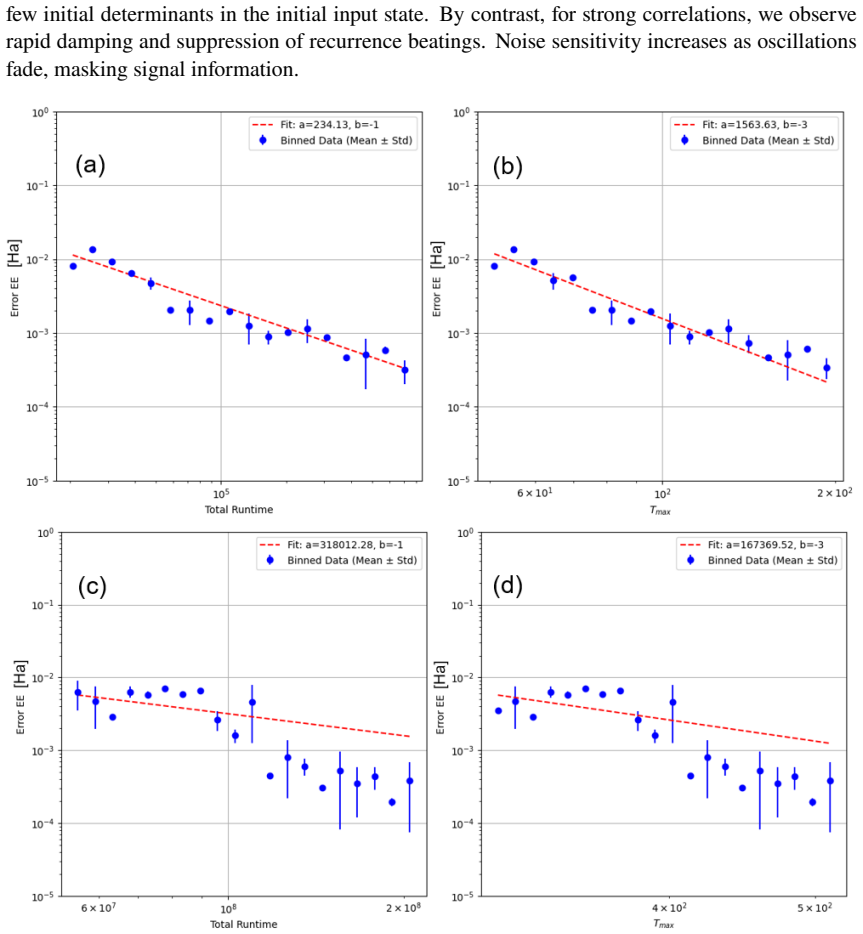
- [§3.1 and §3.3.1, Eqs. (57)–(59)] Under the paper's own runtime accounting, T_runtime = #shots Σ t_k with #shots = F sqrt(N_s log N_s) and N_s = W_s T_max/π, which gives T_runtime = Θ(T_max^{5/2} sqrt(log T_max)). Combining this with the claimed ε = O(T_max^{-3}) (Figs. 3b, 4b, 4d) gives ε = O(T_runtime^{-6/5} sqrt(log T_runtime)) asymptotically, which is strictly better than the Heisenberg limit ε = Ω(T_runtime^{-1}) that the paper claims to achieve. Since the Heisenberg limit is a lower bound for phase estimation with total evolution time, the two central claims cannot both hold. Moreover, the red dashed lines in Figs. 3 and 4 are not free fits: the exponents b are fixed to -1 and -3, so these plots do not validate either scaling law. The authors need to reconcile the runtime model with the claimed error scaling, or provide free-exponent fits with residuals and an explanation of how the Heisenberg limit is respected.
- [Appendices A, B, C; Theorems 2.1 and 2.2] The central analytic error guarantees, Theorems 2.1 and 2.2, follow from Theorem A.1, Theorem B.4, and Theorem C.1, none of which is proved in this manuscript. These theorems are restated from the first author's preprints Refs. [60] and [61]; the text states that Theorem B.4 is proven in Ref. [60, Chapter 2] and Theorem C.1 in Ref. [60, Chapter 3]. Because these results carry the full weight of the error bounds, the manuscript is not self-contained, and the correctness of the analytic claims cannot be verified from the submitted material. The authors should include complete proofs, or precise references to publicly available, peer-reviewed versions, of the claimed new prolate identities and sampling bounds.
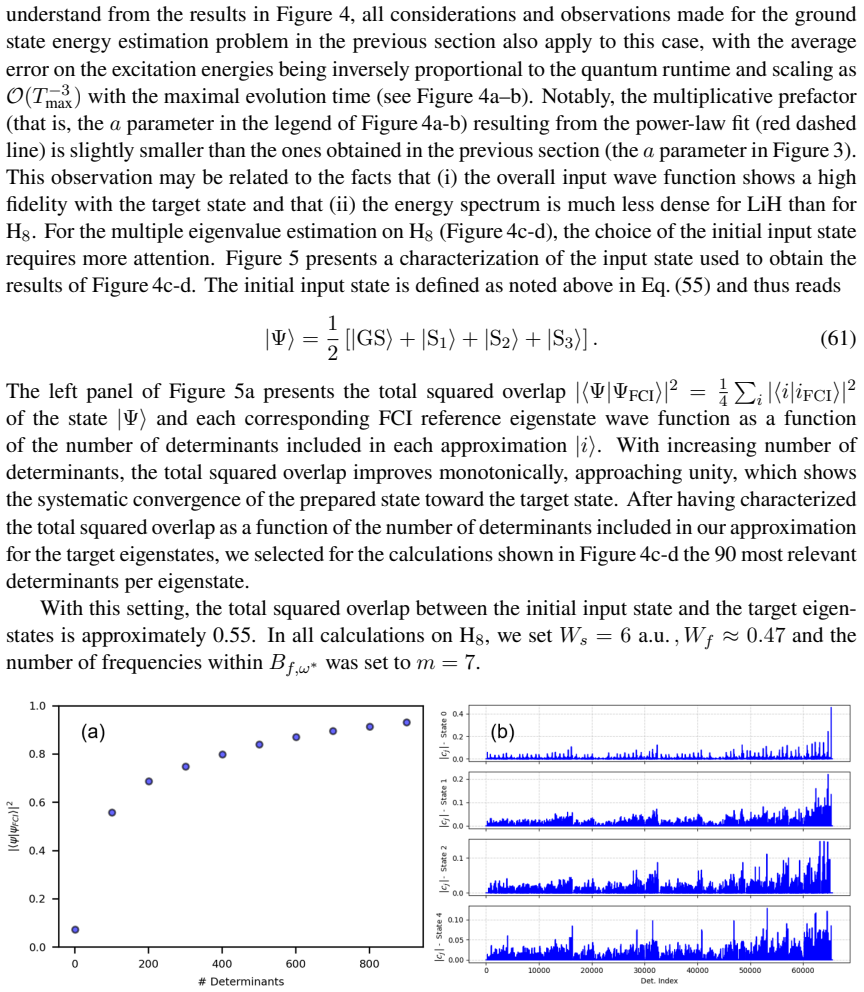
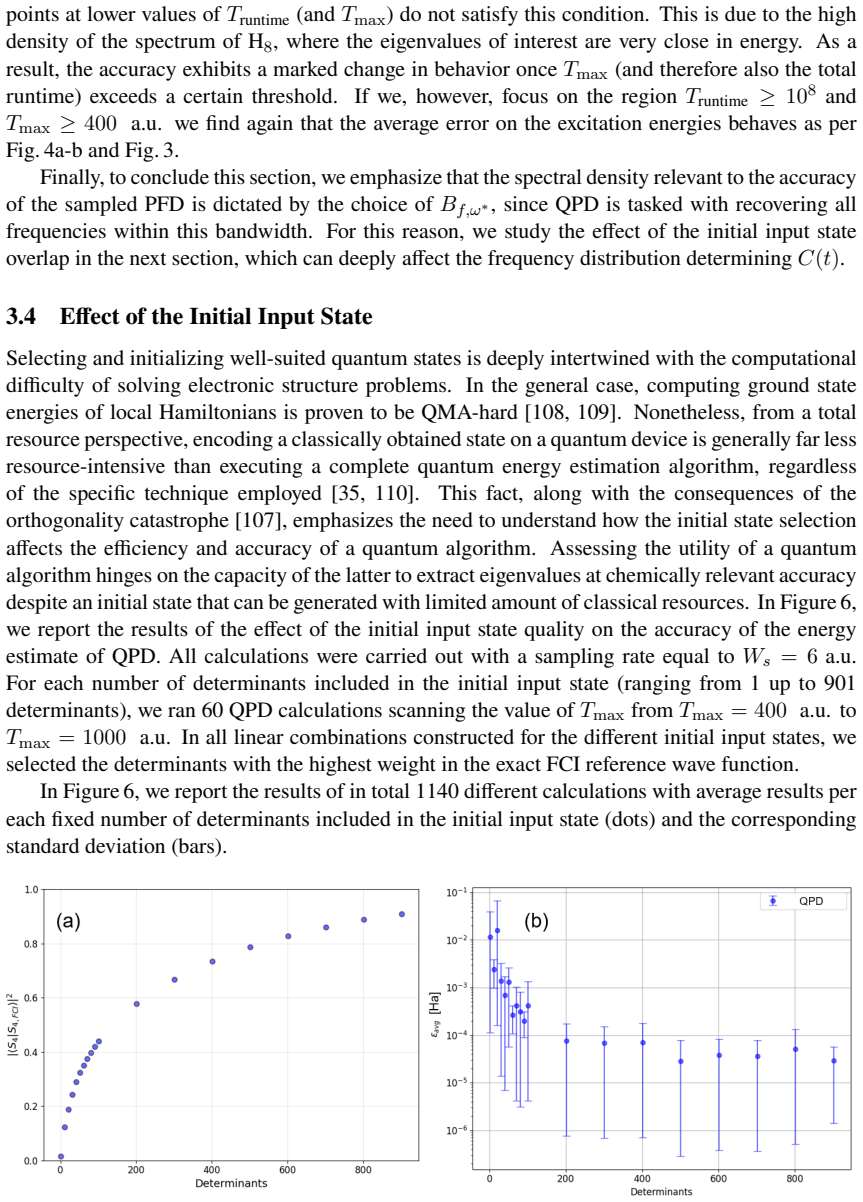
- [§3.2 and §3.3.2, Theorems 2.1–2.2] The numerical experiments do not verify the hypotheses of the error theorems. In §3.3.2, for H8 the dimension m=7 is set from the FCI/CASCI reference ('the number of frequencies within B_{f,ω*} was set to m=7'), rather than detected from the weight-matrix spectrum as in Algorithm 1. For benzene in §3.2, m=2 is read off the weight-matrix spectrum, but the noise threshold ε_th is not specified, and the conditioning assumption λ_m(B_m^M) > ||N^{(B)}_M|| is not quantitatively checked for the reported H8 and LiH runs. Consequently, the analytic error bounds of Theorems 2.1 and 2.2 cannot be invoked for these numerical results, and the reported errors are not covered by the paper's own error analysis.
- [§2.6 and §3.1, Eq. (54)] The shot count #shots = F sqrt(N_s log N_s) yields a per-sample standard deviation O(N_s^{-1/4}) for the Hadamard-test estimates. The paper does not analyze how this statistical noise propagates through the generalized eigenvalue problem; the δA and δB terms in Definition A.1 are never bounded for sampling noise, and Theorems 2.1 and 2.2 assume a noiseless or separately bounded error model. Thus the numerical accuracy obtained in Figs. 3–4, including the benzene run with only 13 shots per sample, is not supported by the analytic framework, and the effect of the shot allocation on the claimed Heisenberg scaling is left unexplained.
minor comments (5)
- [Eq. (41)] In the definition of B_sl, the second occurrence of ξ_{n1}(0) is likely meant to be ξ_{n2}(0); as written the two prolate factors at t=0 are identical, which appears to be a typographical error.
- [§3.3.1] The text describes T_runtime = O(T_max^{2.5} sqrt(log T_max)) as 'almost cubical'; the exponent is 2.5, not 3, so this wording is misleading.
- [Theorem 2.2] The statement contains a typo: 'coincidenceswithnumber' should read 'coincides with the number'.
- [References] Several citations contain placeholder question marks, e.g., '[69, 81 ?]' in §2.4 and '[115? ?]' in Appendix B.3; these should be resolved before publication.
- [§3.1] The manuscript states that the code 'StrawnoteSteward' will be made open source upon publication but provides no code or data repository in the current submission; given the central role of the numerical experiments, providing the code and raw data would materially improve reproducibility.
Circularity Check
Analytic error theorems are inherited from the first author's prior preprints; the numerical core is otherwise self-contained.
-
self citation load bearing
[Introduction; Section A (Theorem A.1); Section B.2 (Theorem B.4); Section C (Theorem C.1)]
"We make use of a new framework to characterize errors in the accuracy and dimensionality of subspace methods [60, 61] to derive tight error bounds for an improved version of the filter diagonalization method. ... In this section, we briefly review subspace-based methods and present key results adapted from Ref. [61]. ... Theorem B.4 presents our new inequalities, which are proven in Ref. [60, Chapter 2] ... A proof is given in Ref. [60, Chapter 3]."
The paper's central analytic guarantees, Theorems 2.1 and 2.2, are corollaries of the imported subspace-protocol master theorem (Theorem A.1, 'adapted from Ref. [61]') and of the prolate concentration and sampling estimates (Theorem B.4 and Theorem C.1), whose proofs are explicitly deferred to Ref. [60]. Both [60] and [61] are the first author's own preprints; they are not machine-checked, not reproduced in this manuscript, and not otherwise independently verified here. Thus the claimed rigorous error framework is not established by the present derivation but is inherited from an unverified self-citation chain. This is load-bearing because all analytic error bounds, including the Heisenberg-scaling narrative, depend on these imported theorems.
full rationale
The numerical QPD experiments are substantially self-contained: they implement sampled PFD, generate autocorrelation samples via a classically emulated Hadamard circuit, and compare the resulting energies against independent CASCI/FCI references. Those energy estimates are therefore not circular reductions. However, two support gaps should be weighed. First, the preconditions of Theorems 2.1 and 2.2 (detected dimension equals true in-band frequency count, and conditioning of the refined GEP) are not verified in the examples; in the H8 multi-eigenvalue calculation, 'the number of frequencies within B_{f,ω*} was set to m = 7' from the FCI/CASCI reference rather than detected, so the detection step is not validated. Second, the empirical scaling claims are based on fixed-exponent fits ('b values are kept fixed and set to b = −1 (−3)'), so the reported O(Tmax^-3) exponent is not inferred from the data; moreover, combining the stated Truntime = O(Tmax^2.5 sqrt(log Tmax)) with epsilon = O(Tmax^-3) would give Truntime = O(epsilon^-5/6 sqrt(log epsilon)), which is inconsistent with the separately claimed Heisenberg scaling Truntime = O(epsilon^-1). These are correctness and evidence concerns rather than additional circular reductions. The remaining circularity-adjacent issue is the load-bearing self-citation of the analytic error theorems, which warrants a moderate score of 4 rather than 0 or 2.
Assumptions & free parameters
free parameters (6)
- F =
2 (weak correlation), 10 (strong correlation)
- M (guess dimension) =
e.g., 16 for benzene, half of essential dimension
- W_s (sampling rate) =
3 a.u. or 6 a.u.
- W_f (filter width) =
1 (benzene), 0.47 (H8 multiple)
- m (number of in-band frequencies) =
2 (benzene), 7 (H8)
- omega* (filter center) =
6.3 (benzene)
assumptions (7)
- ad hoc to paper Theorem A.1 (master theorem for subspace protocols)
- ad hoc to paper Theorem B.4 (new prolate concentration identities)
- ad hoc to paper Theorem C.1 (truncated prolate sampling formula bound)
- standard math Standard prolate Fourier theory (2WT theorem, eigenvalue asymptotics)
- standard math Bochner's theorem and GNS construction
- domain assumption Finite bandwidth W_C of the signal
- domain assumption Well-conditioning of the refined GEP
Cite this review
Pith. "Pith review of Ground and excited-state energies with analytic errors and short time evolution on a quantum computer." pith.science (2026). https://pith.science/paper/VTKGOBUW
@misc{pith2026250715148,
  author       = {Pith},
  title        = {Pith review of: Ground and excited-state energies with analytic errors and short time evolution on a quantum computer},
  year         = {2026},
  howpublished = {\url{https://pith.science/paper/VTKGOBUW}},
  note         = {Machine review of arXiv:2507.15148}
}
read the original abstract
Accurately solving the Schr\"odinger equation remains a central challenge in computational physics, chemistry, and materials science. Here, we propose an alternative eigenvalue problem based on a system's autocorrelation function, avoiding direct reference to a wave function. In particular, we develop a rigorous approximation framework that enables precise frequency estimation from a finite number of signal samples. Our analysis builds on new results involving prolate spheroidal wave functions and yields error bounds that reveal a sharp accuracy transition governed by the observation time and spectral density of the signal. These results are very general and thus carry far. As one important example application we consider the quantum computation for molecular systems. By combining our spectral method with a quantum subroutine for signal generation, we define quantum prolate diagonalization (QPD) - a hybrid classical-quantum algorithm. QPD simultaneously estimates ground and excited state energies within chemical accuracy at the Heisenberg limit. An analysis of different input states demonstrates the robustness of the method, showing that high precision can be retained even under imperfect state preparation.
Figures


Figures from the paper (3 more)
Forward citations
Cited by 1 Pith paper
-
After 100 Years of Quantum Mechanics: Toward a Constructive Observation-Centered Perspective
Quantum mechanics should be rebuilt from an observation-centered viewpoint that starts with measurable signals and reconstructs wave functions only as needed to rationalize them.
Reference graph
Works this paper leans on
-
[60]
TimothyStroschein. Prolatespheroidalwavefunctionsandtheaccuracyanddimensionality of spectral analysis.arXiv preprint arXiv:2409.16584, 2024
arXiv 2024
-
[61]
Timothy Stroschein. An approximation framework for subspace-based methods in spectral analysis with accuracy guarantees.arXiv preprint arXiv:2505.07513, 2025
arXiv 2025
-
[1]
Langhoff and Ernest R
Stephen R. Langhoff and Ernest R. Davidson. Configuration interaction calculations on the nitrogen molecule.International Journal of Quantum Chemistry, 8(1):61–72, 1974
1974
-
[2]
IterativeKrylovMethodsforLargeLinearSystems ,volume13of Cam- bridge Monographs on Applied and Computational Mathematics
H.A.vanderVorst. IterativeKrylovMethodsforLargeLinearSystems ,volume13of Cam- bridge Monographs on Applied and Computational Mathematics. Cambridge University Press, Cambridge, UK, 2003
2003
-
[3]
Inflationarydynamicsformatrixeigenvalue problems
EricJHeller,LevKaplan,andFrankPollmann. Inflationarydynamicsformatrixeigenvalue problems. Proceedings of the National Academy of Sciences, 105(22):7631–7635, 2008
2008
-
[4]
Solution methods for eigenvalue problems in structural mechanics
Klaus-Jürgen Bathe and Edward L Wilson. Solution methods for eigenvalue problems in structural mechanics. International Journal for Numerical Methods in Engineering, 6(2):213–226, 1973
1973
-
[5]
Large scale quantum chemistry with tensor processing units.Journal of Chemical Theory and Computation, 19(1):25–32, 2022
RyanPederson,JohnKozlowski,RuyiSong,JacksonBeall,MartinGanahl,MarkusHauru, Adam GM Lewis, Yi Yao, Shrestha Basu Mallick, Volker Blum, and Guifre Vidal. Large scale quantum chemistry with tensor processing units.Journal of Chemical Theory and Computation, 19(1):25–32, 2022
2022
-
[6]
The anatomy of a large-scale hypertextual web search engine
Sergey Brin and Lawrence Page. The anatomy of a large-scale hypertextual web search engine. Computer Networks and ISDN Systems, 30(1-7):107–117, 1998
1998
Show all 119 references
-
[7]
Support from the relationship of genetic and geographic distance in human populations for a serial founder effect originating in Africa
Sohini Ramachandran, Omkar Deshpande, Charles C Roseman, Noah A Rosenberg, Mar- cus W Feldman, and L Luca Cavalli-Sforza. Support from the relationship of genetic and geographic distance in human populations for a serial founder effect originating in Africa. Proceedings of the...
2005
-
[8]
Derivative pricing using quantum signal pro- cessing
Nikitas Stamatopoulos and William J Zeng. Derivative pricing using quantum signal pro- cessing. Quantum, 8:1322, 2024
2024
-
[9]
Exponential quantum speedup in simulating coupled classical oscillators.Physical Review X, 13(4):041041, 2023
Ryan Babbush, Dominic W Berry, Robin Kothari, Rolando D Somma, and Nathan Wiebe. Exponential quantum speedup in simulating coupled classical oscillators.Physical Review X, 13(4):041041, 2023
2023
-
[10]
Quantum annealing versus classical machine learning applied to a simplified computational biology problem.NPJ Quantum Information, 4(1):14, 2018
Richard Y Li, Rosa Di Felice, Remo Rohs, and Daniel A Lidar. Quantum annealing versus classical machine learning applied to a simplified computational biology problem.NPJ Quantum Information, 4(1):14, 2018
2018
-
[11]
Quantum computing for classical problems: variational quantum eigensolver for activated processes.New Journal of Physics, 23(12):123045, 2021
Pierpaolo Pravatto, Davide Castaldo, Federico Gallina, Barbara Fresch, Stefano Corni, and Giorgio J Moro. Quantum computing for classical problems: variational quantum eigensolver for activated processes.New Journal of Physics, 23(12):123045, 2021. 31
2021
-
[12]
Paul Benioff. The computer as a physical system: A microscopic quantum mechanical Hamiltonian model of computers as represented by Turing machines.Journal of Statistical Physics, 22:563–591, 1980
1980
-
[13]
Quantum mechanical computers.Foundations of Physics, 16(6):507– 532, 1986
Richard P Feynman. Quantum mechanical computers.Foundations of Physics, 16(6):507– 532, 1986
1986
-
[14]
ChemBioChem, 24(13):e202300120, 2023
AlbertoBaiardi,MatthiasChristandl,andMarkusReiher.Quantumcomputingformolecular biology. ChemBioChem, 24(13):e202300120, 2023
2023
-
[15]
Quantum computational chemistry.Reviews of Modern Physics, 92(1):015003, 2020
Sam McArdle, Suguru Endo, Alán Aspuru-Guzik, Simon C Benjamin, and Xiao Yuan. Quantum computational chemistry.Reviews of Modern Physics, 92(1):015003, 2020
2020
-
[16]
Joshua J Goings, Alec White, Joonho Lee, Christofer S Tautermann, Matthias Deg- roote, Craig Gidney, Toru Shiozaki, Ryan Babbush, and Nicholas C Rubin. Reliably assessing the electronic structure of cytochrome p450 on today’s classical computers and tomorrow’s quantum computer...
2022
-
[17]
Quantum computing enhanced computational catalysis
Vera von Burg, Guang Hao Low, Thomas Häner, Damian S Steiger, Markus Reiher, Martin Roetteler, and Matthias Troyer. Quantum computing enhanced computational catalysis. Physical Review Research, 3(3):033055, 2021
2021
-
[18]
Quantumalgorithmsoftwareforcondensedmatterphysics
TFarajollahpour. Quantumalgorithmsoftwareforcondensedmatterphysics. arXivpreprint arXiv:2506.09308, 2025
2025 arXiv
-
[19]
MaterialsTheory, 6(1):11, 2022
Hongbin Liu, Guang Hao Low, Damian S Steiger, Thomas Häner, Markus Reiher, and MatthiasTroyer.Prospectsofquantumcomputingformolecularsciences. MaterialsTheory, 6(1):11, 2022
2022
-
[20]
Quantum algorithms forquantumchemistryandquantummaterialsscience
Bela Bauer, Sergey Bravyi, Mario Motta, and Garnet Kin-Lic Chan. Quantum algorithms forquantumchemistryandquantummaterialsscience. ChemicalReviews,120(22):12685– 12717, 2020
2020
-
[21]
Eluci- dating reaction mechanisms on quantum computers.Proceedings of the National Academy of Sciences, 114(29):7555–7560, 2017
Markus Reiher, Nathan Wiebe, Krysta M Svore, Dave Wecker, and Matthias Troyer. Eluci- dating reaction mechanisms on quantum computers.Proceedings of the National Academy of Sciences, 114(29):7555–7560, 2017
2017
-
[22]
Quantum error detection in qubit-resonator star architecture
Florian Vigneau, Sourav Majumder, Aniket Rath, Pedro Parrado-Rodríguez, Francisco Revson Fernandes Pereira, Stefan Pogorzalek, Tyler Jones, Nicola Wurz, Michael Renger, Jeroen Verjauw, Ping Yang, Hsiang-Sheng Ku, William Kindel, Frank Deppe, Johannes Heinsoo. Quantum error det...
2025
-
[23]
Fusion-basedquantumcomputation
Sara Bartolucci, Patrick Birchall, Hector Bombin, Hugo Cable, Chris Dawson, Mercedes Gimeno-Segovia, Eric Johnston, Konrad Kieling, Naomi Nickerson, Mihir Pant, Fernando Pastawski, TerryRudolph, andChrisSparrow. Fusion-basedquantumcomputation. Nature Communications, 14(1):912, 2023
2023
-
[24]
Aghaee Rad, T
H. Aghaee Rad, T. Ainsworth, R.N. Alexander, B. Altieri, M. F. Askarani, R. Baby, L. Banchi, B. Q. Baragiola, J. E. Bourassa, R. S. Chadwick, I. Charania, H. Chen, M. J. Collins, P. Contu, N. D’Arcy, G. Dauphinais, R. De Prins, D. Deschenes, I. Di Luch, S. Duque, P. Edke, S. E...
2025
-
[25]
Neyenhuis
Juan M Pino, Jennifer M Dreiling, Caroline Figgatt, John P Gaebler, Steven A Moses, MSAllman,CHBaldwin,MichaelFoss-Feig,DavidHayes,KarlMayer,C.Ryan-Anderson, and B. Neyenhuis. Demonstration of the trapped-ion quantum CCD computer architecture. Nature, 592(7853):209–213, 2021
2021
-
[26]
Cambridge University Press, 2013
Daniel A Lidar and Todd A Brun.Quantum error correction. Cambridge University Press, 2013
2013
-
[27]
Sur- face codes: Towards practical large-scale quantum computation
Austin G Fowler, Matteo Mariantoni, John M Martinis, and Andrew N Cleland. Sur- face codes: Towards practical large-scale quantum computation. Physical Review A, 86(3):032324, 2012
2012
-
[28]
Low-overhead magic state distillation with color codes
Seok-Hyung Lee, Felix Thomsen, Nicholas Fazio, Benjamin J Brown, and Stephen D Bartlett. Low-overhead magic state distillation with color codes. arXiv preprint arXiv:2409.07707, 2024
2024
-
[29]
Magic state cultivation: growing T states as cheap as CNOT gates.arXiv preprint arXiv:2409.17595, 2024
Craig Gidney, Noah Shutty, and Cody Jones. Magic state cultivation: growing T states as cheap as CNOT gates.arXiv preprint arXiv:2409.17595, 2024
2024 arXiv
-
[30]
Quantumalgorithms revisited
RichardCleve,ArturEkert,ChiaraMacchiavello,andMicheleMosca. Quantumalgorithms revisited. Proceedings of the Royal Society of London. Series A: Mathematical, Physical and Engineering Sciences, 454(1969):339–354, 1998
1969
-
[31]
Quantum metrology.Physical Review Letters, 96(1):010401, 2006
Vittorio Giovannetti, Seth Lloyd, and Lorenzo Maccone. Quantum metrology.Physical Review Letters, 96(1):010401, 2006
2006
-
[32]
Quantum algorithms: A survey of applications and end-to-end complexities
Alexander M Dalzell, Sam McArdle, Mario Berta, Przemyslaw Bienias, Chi-Fang Chen, András Gilyén, Connor T Hann, Michael J Kastoryano, Emil T Khabiboulline, Aleksander Kubica, et al. Quantum algorithms: A survey of applications and end-to-end complexities. arXiv preprint arXiv:...
-
[33]
Assessment of quantum phase estimation protocols for early fault-tolerant quantum computers.Physical Review A, 110(4):042420, 2024
Jacob S Nelson and Andrew D Baczewski. Assessment of quantum phase estimation protocols for early fault-tolerant quantum computers.Physical Review A, 110(4):042420, 2024
2024
-
[34]
Highgroundstateoverlapviaquantumembeddingmethods
Mihael Erakovic, Freek Witteveen, Dylan Harley, Jakob Günther, Moritz Bensberg, Oinam Romesh Meitei, Minsik Cho, Troy Van Voorhis, Markus Reiher, and Matthias Chri- standl. Highgroundstateoverlapviaquantumembeddingmethods. PRXLife,3(1):013003, 2025
2025
-
[35]
Initial state preparation for quantum chemistry on quantum computers
Stepan Fomichev, Kasra Hejazi, Modjtaba Shokrian Zini, Matthew Kiser, Joana Frax- anet, Pablo Antonio Moreno Casares, Alain Delgado, Joonsuk Huh, Arne-Christian Voigt, Jonathan E Mueller, et al. Initial state preparation for quantum chemistry on quantum computers. PRX Quantum,...
2024
-
[36]
Enhancing initial state overlap through orbital optimization for faster molecular electronic ground-state energy estimation.Physical Review Letters, 133(25):250601, 2024
Pauline J Ollitrault, Cristian L Cortes, Jérôme F Gonthier, Robert M Parrish, Dario Rocca, Gian-Luca Anselmetti, Matthias Degroote, Nikolaj Moll, Raffaele Santagati, and Michael Streif. Enhancing initial state overlap through orbital optimization for faster molecular electroni...
2024
-
[37]
Evaluating the evidence for exponential quantum advantage in ground-state quantum chemistry.Nature Communications, 14(1):1952, 2023
Seunghoon Lee, Joonho Lee, Huanchen Zhai, Yu Tong, Alexander M Dalzell, Ashutosh Kumar, Phillip Helms, Johnnie Gray, Zhi-Hao Cui, Wenyuan Liu, et al. Evaluating the evidence for exponential quantum advantage in ground-state quantum chemistry.Nature Communications, 14(1):1952, 2023
1952
-
[38]
Exponential improvement in precision for simulating sparse hamiltonians
DominicWBerry,AndrewMChilds,RichardCleve,RobinKothari,andRolandoDSomma. Exponential improvement in precision for simulating sparse hamiltonians. InProceedings of the forty-sixth annual ACM symposium on Theory of computing, pages 283–292, 2014
2014
-
[39]
Hamiltonian simulation by qubitization.Quantum, 3:163, 2019
Guang Hao Low and Isaac L Chuang. Hamiltonian simulation by qubitization.Quantum, 3:163, 2019
2019
-
[40]
Shadow hamiltonian simulation.Nature Communications, 16(1):2690, 2025
Rolando D Somma, Robbie King, Robin Kothari, Thomas E O’Brien, and Ryan Babbush. Shadow hamiltonian simulation.Nature Communications, 16(1):2690, 2025
2025
-
[41]
Quantumcomputations: algorithmsanderrorcorrection
AYuKitaev. Quantumcomputations: algorithmsanderrorcorrection. RussianMathemat- ical Surveys, 52(6):1191, 1997
1997
-
[42]
Even shorter quantum circuit for phase estimation on early fault-tolerantquantumcomputerswithapplicationstoground-stateenergyestimation
Zhiyan Ding and Lin Lin. Even shorter quantum circuit for phase estimation on early fault-tolerantquantumcomputerswithapplicationstoground-stateenergyestimation. PRX Quantum, 4(2):020331, 2023
2023
-
[43]
Simultaneousestimationofmultipleeigenvalueswithshort-depth quantum circuit on early fault-tolerant quantum computers.Quantum, 7:1136, 2023
ZhiyanDingandLinLin. Simultaneousestimationofmultipleeigenvalueswithshort-depth quantum circuit on early fault-tolerant quantum computers.Quantum, 7:1136, 2023
2023
-
[44]
Adaptive low-depth quantum algorithms for robust multiple-phase estimation.Physical Review A, 108(6):062408, 2023
Haoya Li, Hongkang Ni, and Lexing Ying. Adaptive low-depth quantum algorithms for robust multiple-phase estimation.Physical Review A, 108(6):062408, 2023
2023
-
[45]
M. E. Stroeks, Jonas Helsen, and B. M. Terhal. Spectral estimation for hamiltonians: a comparison between classical imaginary-time evolution and quantum real-time evolution. New Journal of Physics, 24(10):103024, 2022
2022
-
[46]
Quantum phase estimation by compressed sensing
Changhao Yi, Cunlu Zhou, and Jun Takahashi. Quantum phase estimation by compressed sensing. Quantum, 8:1579, 2024
2024
-
[47]
Phase estimation with partially randomized time evolution.arXiv preprint arXiv:2503.05647, 2025
Jakob Günther, Freek Witteveen, Alexander Schmidhuber, Marek Miller, Matthias Chris- tandl, and Aram Harrow. Phase estimation with partially randomized time evolution.arXiv preprint arXiv:2503.05647, 2025
2025 arXiv
-
[48]
Heisenberg-limitedquantum phase estimation of multiple eigenvalues with few control qubits.Quantum, 6:830, 2022
AlicjaDutkiewicz,BarbaraMTerhal,andThomasEO’Brien. Heisenberg-limitedquantum phase estimation of multiple eigenvalues with few control qubits.Quantum, 6:830, 2022
2022
-
[49]
Error mitigation and circuit division for early fault-tolerant quantum phase estimation.arXiv preprint arXiv:2410.05369, 2024
Alicja Dutkiewicz, Stefano Polla, Maximilian Scheurer, Christian Gogolin, William J Hug- gins, and Thomas E O’Brien. Error mitigation and circuit division for early fault-tolerant quantum phase estimation.arXiv preprint arXiv:2410.05369, 2024
-
[50]
Quantum multiple eigenvalue Gaussian filtered search: an efficient and versatile quantum phase estimation method.Quantum, 8:1487, 2024
ZhiyanDing,HaoyaLi,LinLin,HongKangNi,LexingYing,andRuizheZhang. Quantum multiple eigenvalue Gaussian filtered search: an efficient and versatile quantum phase estimation method.Quantum, 8:1487, 2024
2024
-
[51]
The Journal of Chemical Physics, 93(4):2611–2616, 1990
DanielNeuhauser.Boundstateeigenfunctionsfromwavepackets: Time →energyresolution. The Journal of Chemical Physics, 93(4):2611–2616, 1990
1990
-
[52]
Mandelshtam
V.A. Mandelshtam. FDM: the filter diagonalization method for data processing in NMR experiments.ProgressinNuclearMagneticResonanceSpectroscopy ,38(2):159–196,2001
2001
-
[53]
de Jong, and Norm M
Katherine Klymko, Carlos Mejuto-Zaera, Stephen J Cotton, Filip Wudarski, Miroslav Ur- banek, Diptarka Hait, Martin Head-Gordon, K Birgitta Whaley, Jonathan Moussa, Nathan Wiebe, Wibe A. de Jong, and Norm M. Tubman. Real-time evolution for ultracompact Hamiltonian eigenstates o...
2022
-
[54]
Real-time Krylov theory for quantum computing algorithms.Quantum, 7:1066, 2023
YizhiShen,KatherineKlymko,JamesSud,DavidBWilliams-Young,WibeAdeJong,and Norm M Tubman. Real-time Krylov theory for quantum computing algorithms.Quantum, 7:1066, 2023
2023
-
[55]
QuantumKrylovsubspacealgorithmsforground-and excited-state energy estimation.Physical Review A, 105(2):022417, 2022
CristianLCortesandStephenKGray. QuantumKrylovsubspacealgorithmsforground-and excited-state energy estimation.Physical Review A, 105(2):022417, 2022
2022
-
[56]
Quantum filter diagonalization: Quantum eigen- decomposition without full quantum phase estimation.arXiv preprint arXiv:1909.08925, 2019
Robert M Parrish and Peter L McMahon. Quantum filter diagonalization: Quantum eigen- decomposition without full quantum phase estimation.arXiv preprint arXiv:1909.08925, 2019
1909 arXiv
-
[57]
Quantum filter diagonalization with compressed double-factorized hamiltonians.PRX Quantum, 2(4):040352, 2021
Jeffrey Cohn, Mario Motta, and Robert M Parrish. Quantum filter diagonalization with compressed double-factorized hamiltonians.PRX Quantum, 2(4):040352, 2021
2021
-
[58]
A theory of quantum subspace diagonal- ization
Ethan N Epperly, Lin Lin, and Yuji Nakatsukasa. A theory of quantum subspace diagonal- ization. SIAM Journal on Matrix Analysis and Applications, 43(3):1263–1290, 2022
2022
-
[59]
Analysis of quantum Krylov algorithms with errors.Quantum, 8:1457, 2024
William Kirby. Analysis of quantum Krylov algorithms with errors.Quantum, 8:1457, 2024
2024
-
[62]
Slepian and H
D. Slepian and H. O. Pollak. Prolate spheroidal wave functions, Fourier analysis and uncertainty — I.The Bell System Technical Journal, 40(1):43–63, 1961
1961
-
[63]
H. J. Landau and H. O. Pollak. Prolate spheroidal wave functions, Fourier analysis and uncertainty — II.The Bell System Technical Journal, 40(1):65–84, 1961
1961
-
[64]
H. J. Landau and H. O. Pollak. Prolate spheroidal wave functions, Fourier analysis and uncertainty—III:Thedimensionofthespaceofessentiallytime-andband-limitedsignals. The Bell System Technical Journal, 41(4):1295–1336, 1962
1962
-
[65]
David Slepian. Prolate spheroidal wave functions, Fourier analysis and uncertainty — IV: Extensions to many dimensions; generalized prolate spheroidal functions.The Bell System Technical Journal, 43(6):3009–3057, 1964
1964
-
[66]
D. Slepian. Prolate spheroidal wave functions, fourier analysis, and uncertainty — V: The discrete case.The Bell System Technical Journal, 57(5):1371–1430, 1978
1978
-
[67]
D. Slepian. On bandwidth.Proceedings of the IEEE, 64(3):292–300, 1976
1976
-
[68]
Onthedensityofphase-spaceexpansions
H.J.Landau. Onthedensityofphase-spaceexpansions. IEEETransactionsonInformation Theory, 39(4):1152–1156, 1993
1993
-
[69]
Some comments on fourier analysis, uncertainty and modeling
David Slepian. Some comments on fourier analysis, uncertainty and modeling. SIAM Review, 25(3):379–393, 1983
1983
-
[70]
Levitina and E.J
T. Levitina and E.J. Brändas. Filter diagonalization: Filtering and postprocessing with prolates. Computer Physics Communications, 180(9):1448–1457, 2009
2009
-
[71]
Boisvert
Arnie Lee Van Buren and Jeffrey E. Boisvert. Accurate calculation of prolate spheroidal radialfunctionsofthefirstkindandtheirfirstderivatives. QuarterlyofAppliedMathematics , 60:589–599, 2002
2002
-
[72]
Sampling Theory in Signal and Image Processing, 2(1):25–52, 2003
GilbertG.WalterandXiaopingA.Shen.SamplingWithProlateSpheroidalWaveFunctions. Sampling Theory in Signal and Image Processing, 2(1):25–52, 2003. 35
2003
-
[73]
Mathematische Begründung der Quantenmechanik.Nachrichten von der Gesellschaft der Wissenschaften zu Göttingen, Mathematisch-Physikalische Klasse, pages 1–57, 1927
John von Neumann. Mathematische Begründung der Quantenmechanik.Nachrichten von der Gesellschaft der Wissenschaften zu Göttingen, Mathematisch-Physikalische Klasse, pages 1–57, 1927
1927
-
[74]
Wahrscheinlichkeitstheoretischer Aufbau der Quantenmechanik
John von Neumann. Wahrscheinlichkeitstheoretischer Aufbau der Quantenmechanik. Nachrichten von der Gesellschaft der Wissenschaften zu Göttingen, Mathematisch- Physikalische Klasse, pages 245–272, 1927
1927
-
[75]
Allgemeine Eigenwerttheorie Hermitischer Funktionaloperatoren
John von Neumann. Allgemeine Eigenwerttheorie Hermitischer Funktionaloperatoren. Mathematische Annalen, 102:49-131, 1930
1930
-
[76]
Lectures on Fourier Integrals
Salomon Bochner. Lectures on Fourier Integrals. Princeton University Press, Princeton, NJ, 1932
1932
-
[77]
FundamentalsoftheTheoryofOperatorAlgebras, Volume I: Elementary Theory, volume 15 ofGraduate Studies in Mathematics
RichardV.KadisonandJohnR.Ringrose. FundamentalsoftheTheoryofOperatorAlgebras, Volume I: Elementary Theory, volume 15 ofGraduate Studies in Mathematics. American Mathematical Society, Providence, RI, 1997
1997
-
[78]
The Journal of Chemical Physics, 102(20):8011–8022, May 1995
MichaelR.WallandDanielNeuhauser.Extraction,throughfilter-diagonalization,ofgeneral quantumeigenvaluesorclassicalnormalmodefrequenciesfromasmallnumberofresidues orashort-timesegmentofasignal.I.Theoryandapplicationtoaquantum-dynamicsmodel. The Journal of Chemical Physics, 102(20...
1995
-
[79]
Mandelshtam and Howard S
Vladimir A. Mandelshtam and Howard S. Taylor. Harmonic inversion of time signals and its applications.The Journal of Chemical Physics, 107(17):6756–6769, November 1997
1997
-
[80]
Matrix bispectrality and noncommutativealgebras: Beyondtheprolatespheroidals
Alberto Grunbaum, Brian Vasquez Campos, and Jorge Zubelli. Matrix bispectrality and noncommutativealgebras: Beyondtheprolatespheroidals. L’EnseignementMathématique, 69:335–351, 06 2023
2023
-
[81]
The uv prolate spectrum matches the zeros of zeta
Alain Connes and Henri Moscovici. The uv prolate spectrum matches the zeros of zeta. Proceedings of the National Academy of Sciences, 119(22):e2123174119, 2022
2022
-
[82]
Ontheeigenvaluesofanintegralequationarisinginthetheoryofband-limited signals
W.H.JFuchs. Ontheeigenvaluesofanintegralequationarisinginthetheoryofband-limited signals. Journal of Mathematical Analysis and Applications, 9(3):317–330, 1964
1964
-
[83]
Someasymptoticexpansionsforprolatespheroidalwavefunctions
DavidSlepian. Someasymptoticexpansionsforprolatespheroidalwavefunctions. Journal of Mathematics and Physics, 44(1-4):99–140, 1965
1965
-
[84]
Communicationinthepresenceofnoise
C.E.Shannon. Communicationinthepresenceofnoise. ProceedingsoftheIRE ,37(1):10– 21, 1949
1949
-
[85]
Simulatingphysicswithcomputers
RichardP.Feynman. Simulatingphysicswithcomputers. InternationalJournalofTheoret- ical Physics, 21(6):467–488, June 1982
1982
-
[86]
Universal quantum simulators.Science, 273(5278):1073–1078, 1996
Seth Lloyd. Universal quantum simulators.Science, 273(5278):1073–1078, 1996
1996
-
[87]
Pennylane: Automatic differentiation of hybrid quantum-classical computations
Ville Bergholm, Josh Izaac, Maria Schuld, Christian Gogolin, Shahnawaz Ahmed, Vishnu Ajith, M Sohaib Alam, Guillermo Alonso-Linaje, B AkashNarayanan, Ali Asadi, et al. Pennylane: Automatic differentiation of hybrid quantum-classical computations. arXiv preprint arXiv:1811.04968, 2018
2018 arXiv
-
[88]
Quantum chemistry exchange program, indiana university, no
WJ Hehre, WA Lathan, R Ditchfield, and MD Newton. Quantum chemistry exchange program, indiana university, no. 236, wj hehre, rf stewart, and ja pople.The Journal of Chemical Physics, 51:2657, 1969
1969
-
[89]
Overlapper
Fomichev Stepan, Hejazi Kasra, Fraxanet Joana, and Juan Miguel Arrazola. Overlapper. GitHub repository, https://github.com/XanaduAI/Overlapper, 2024. 36
2024
-
[90]
Recent developments in the pyscf program package.The Journal of Chemical Physics, 153(2), 2020
Qiming Sun, Xing Zhang, Samragni Banerjee, Peng Bao, Marc Barbry, Nick S Blunt, Nikolay A Bogdanov, George H Booth, Jia Chen, Zhi-Hao Cui, et al. Recent developments in the pyscf program package.The Journal of Chemical Physics, 153(2), 2020
2020
-
[91]
JAX: composable transformations of Python+NumPy programs, 2018
JamesBradbury,RoyFrostig,PeterHawkins,MatthewJamesJohnson,ChrisLeary,Dougal Maclaurin, George Necula, Adam Paszke, Jake VanderPlas, Skye Wanderman-Milne, and Qiao Zhang. JAX: composable transformations of Python+NumPy programs, 2018
2018
-
[92]
Theconfigurationinteractionmethod: Advances in highly correlated approaches
CDavidSherrillandHenryFSchaeferIII. Theconfigurationinteractionmethod: Advances in highly correlated approaches. InAdvances in Quantum Chemistry, volume 34, pages 143–269. Elsevier, 1999
1999
-
[93]
Ab initio excitation spectra and collective electronic response in atoms and clusters.Physical Review Letters, 82(9):1919, 1999
Igor Vasiliev, Serdar Öğüt, and James R Chelikowsky. Ab initio excitation spectra and collective electronic response in atoms and clusters.Physical Review Letters, 82(9):1919, 1999
1919
-
[94]
John Wiley & Sons, 2013
Trygve Helgaker, Poul Jorgensen, and Jeppe Olsen.Molecular electronic-structure theory. John Wiley & Sons, 2013
2013
-
[95]
Assessingthequerycomplexitylimitsofquantumphaseestimationusingsymmetry- aware spectral bounds.Physical Review A, 110(2):022420, 2024
Cristian L Cortes, Dario Rocca, Jérôme F Gonthier, Pauline J Ollitrault, Robert M Parrish, Gian-LucaRAnselmetti,MatthiasDegroote,NikolajMoll,RaffaeleSantagati,andMichael Streif. Assessingthequerycomplexitylimitsofquantumphaseestimationusingsymmetry- aware spectral bounds.Physi...
2024
-
[96]
Journal of Chemical Theory and Computation, 12(4):1760–1771, 2016
ChristopherJSteinandMarkusReiher.Automatedselectionofactiveorbitalspaces. Journal of Chemical Theory and Computation, 12(4):1760–1771, 2016
2016
-
[97]
Strong electronic correlation in the hydrogen chain: A variational monte carlo study.Physical Review B, 84(24):245117, 2011
Lorenzo Stella, Claudio Attaccalite, Sandro Sorella, and Angel Rubio. Strong electronic correlation in the hydrogen chain: A variational monte carlo study.Physical Review B, 84(24):245117, 2011
2011
-
[98]
Towards thesolutionofthemany-electronprobleminrealmaterials: Equationofstateofthehydrogen chain with state-of-the-art many-body methods.Physical Review X, 7(3):031059, 2017
Mario Motta, David M Ceperley, Garnet Kin-Lic Chan, John A Gomez, Emanuel Gull, Sheng Guo, Carlos A Jiménez-Hoyos, Tran Nguyen Lan, Jia Li, Fengjie Ma, et al. Towards thesolutionofthemany-electronprobleminrealmaterials: Equationofstateofthehydrogen chain with state-of-the-art ...
2017
-
[99]
Ground-state properties of the hydrogen chain: Dimerization, insulator-to-metal transition, and magnetic phases.Physical Review X, 10(3):031058, 2020
Mario Motta, Claudio Genovese, Fengjie Ma, Zhi-Hao Cui, Randy Sawaya, Garnet Kin- Lic Chan, Natalia Chepiga, Phillip Helms, Carlos Jiménez-Hoyos, Andrew J Millis, et al. Ground-state properties of the hydrogen chain: Dimerization, insulator-to-metal transition, and magnetic ph...
2020
-
[100]
Classificationofelectronicstructuresandstatepreparationforquantum computation of reaction chemistry.arXiv preprint arXiv:2409.08910, 2024
Maximilian Mörchen, Guang Hao Low, Thomas Weymuth, Hongbin Liu, Matthias Troyer, andMarkusReiher. Classificationofelectronicstructuresandstatepreparationforquantum computation of reaction chemistry.arXiv preprint arXiv:2409.08910, 2024
2024 arXiv
-
[101]
The esprit algorithm under high noise: Optimal error scaling and noisy super-resolution
Zhiyan Ding, Ethan N Epperly, Lin Lin, and Ruizhe Zhang. The esprit algorithm under high noise: Optimal error scaling and noisy super-resolution. In2024 IEEE 65th Annual Symposium on Foundations of Computer Science (FOCS), pages 2344–2366. IEEE, 2024
2024
-
[102]
Effects of cosine tapering window on quantum phase estimation.Physical Review D, 106(3):034503, 2022
Gumaro Rendon, Taku Izubuchi, and Yuta Kikuchi. Effects of cosine tapering window on quantum phase estimation.Physical Review D, 106(3):034503, 2022
2022
-
[103]
Emergingquantumcomputingalgorithmsforquantumchem- istry
MarioMottaandJuliaERice. Emergingquantumcomputingalgorithmsforquantumchem- istry. Wiley Interdisciplinary Reviews: Computational Molecular Science, 12(3):e1580, 2022
2022
-
[104]
Robust interpolation between weak-and strong-correlation regimes of quantum systems.The Journal of Chemical Physics, 136(4), 2012
Jerzy Cioslowski. Robust interpolation between weak-and strong-correlation regimes of quantum systems.The Journal of Chemical Physics, 136(4), 2012. 37
2012
-
[105]
Quantum information reveals that orbital-wise correlation is essentially classical in natural orbitals
Davide Materia, Leonardo Ratini, Celestino Angeli, and Leonardo Guidoni. Quantum information reveals that orbital-wise correlation is essentially classical in natural orbitals. The Journal of Chemical Physics, 161(24), 2024
2024
-
[106]
Environment-induced superselection rules
Wojciech H Zurek. Environment-induced superselection rules. Physical Review D, 26(8):1862, 1982
1982
-
[107]
Infrared catastrophe in fermi gases with local scattering potentials
Philip W Anderson. Infrared catastrophe in fermi gases with local scattering potentials. Physical Review Letters, 18(24):1049, 1967
1967
-
[108]
The complexity of the local hamiltonian problem
Julia Kempe, Alexei Kitaev, and Oded Regev. The complexity of the local hamiltonian problem. Siam Journal on Computing, 35(5):1070–1097, 2006
2006
-
[109]
Intractability of electronic structure in a fixed basis.PRX Quantum, 3(2):020322, 2022
Bryan O’Gorman, Sandy Irani, James Whitfield, and Bill Fefferman. Intractability of electronic structure in a fixed basis.PRX Quantum, 3(2):020322, 2022
2022
-
[110]
Early fault-tolerant quantum algorithms in practice: Application to ground-state energy estimation.Quantum, 9:1682, 2025
Oriel Kiss, Utkarsh Azad, Borja Requena, Alessandro Roggero, David Wakeham, and Juan Miguel Arrazola. Early fault-tolerant quantum algorithms in practice: Application to ground-state energy estimation.Quantum, 9:1682, 2025
2025
-
[111]
Analysis of a Differential Operator
Andrei Osipov, Vladimir Rokhlin, and Hong Xiao. Analysis of a Differential Operator. In Prolate Spheroidal Wave Functions of Order Zero: Mathematical Tools for Bandlimited Approximation, pages 73–133. Springer US, Boston, MA, 2013
2013
-
[112]
Efficient strategies forreducingsamplingerrorinquantumkrylovsubspacediagonalization
Gwonhak Lee, Seonghoon Choi, Joonsuk Huh, and Artur F Izmaylov. Efficient strategies forreducingsamplingerrorinquantumkrylovsubspacediagonalization. DigitalDiscovery, 4(4):954–969, 2025
2025
-
[113]
Eigenvaluedistributionoftimeandfrequencylimiting
H.JLandauandHWidom. Eigenvaluedistributionoftimeandfrequencylimiting. Journal of Mathematical Analysis and Applications, 77(2):469–481, October 1980
1980
-
[114]
F. A. Grünbaum and M. Yakimov. The prolate spheroidal phenomenon as a consequence of bispectrality. In Superintegrability in Classical and Quantum Systems, volume 37 of CRM Proceedings and Lecture Notes, pages 301–312. American Mathematical Society, Providence, RI, 2004
2004
-
[115]
Riley Casper, F
W. Riley Casper, F. Alberto Grünbaum, Milen Yakimov, and Ignacio Zurrián. Algebras of Commuting Differential Operators for Kernels of Airy Type. In Estelle Basor, Albrecht Böttcher, Torsten Ehrhardt, and Craig A. Tracy, editors,Toeplitz Operators and Random Matrices: InMemoryo...
2022
-
[116]
Matrixvalued discrete-continuous functions with the prolate spheroidal property and bispectrality.arXiv preprint arXiv:2302.05750, 2024
W.RileyCasper,F.AlbertoGrünbaum,MilenYakimov,andIgnacioZurrian. Matrixvalued discrete-continuous functions with the prolate spheroidal property and bispectrality.arXiv preprint arXiv:2302.05750, 2024
2024 arXiv
-
[117]
Reed and B
M. Reed and B. Simon.IV: Analysis of Operators. Methods of Modern Mathematical Physics. Elsevier Science, 1978
1978
-
[118]
H. Nyquist. Certain topics in telegraph transmission theory.Transactions of the American Institute of Electrical Engineers, 47(2):617–644, 1928
1928
-
[119]
Hogan and Joseph D
Jeffrey A. Hogan and Joseph D. Lakey.Duration and Bandwidth Limiting: Prolate Func- tions, Sampling, and Applications. Applied and Numerical Harmonic Analysis. Birkhäuser Boston, Boston, 2012. 38
2012
Reviewed August 6, 2026 · model on record in the stance chip above.
Discussion (0). Sign in to comment.