Quantum walks reveal topological flat bands, robust edge states and topological phase transitions in cyclic graphs
Pith reviewed 2026-05-19 03:23 UTC · model grok-4.3
The pith
Step-dependent quantum walks on cyclic graphs produce gapped flat bands, Dirac cones, and protected edge states.
A machine-rendered reading of the paper's core claim, the machinery that carries it, and where it could break.
Core claim
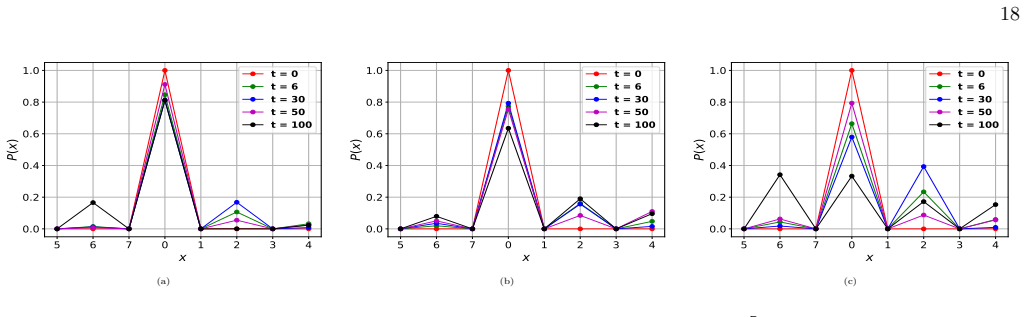
We introduce cyclic quantum walks on cyclic graphs and use discrete Fourier transforms to obtain an effective Hamiltonian. This Hamiltonian reveals the conditions for emergence of topological gapped flat bands, shows that gap closings in rotation space imply Dirac cones in momentum space, and demonstrates protected edge states at the interface between distinct topological phases in both odd and even cycle graphs. These edge states remain robust against moderate static and dynamic gate disorder, phase-preserving perturbations, and are independent of initial states.
What carries the argument
The effective Hamiltonian derived via discrete Fourier transform on the cyclic graph, which encodes the topological invariants, phase transitions, and edge-state protection.
If this is right
- Rotationally symmetric flat bands emerge exclusively in 4n-site graphs.
- Gap closings in rotation space produce Dirac cones in momentum space.
- Protected edge states form at interfaces between distinct topological phases for both odd and even cycles.
- The edge states remain stable under moderate static and dynamic gate disorder and independent of initial state.
Where Pith is reading between the lines
- The resource-efficient protocol could reduce hardware overhead for implementing topological quantum memory or protected state transfer on near-term devices.
- The difference between odd and even cycle spectra suggests systematic studies of how graph parity controls topological features in other discrete quantum systems.
- Robustness to disorder implies the edge states might serve as building blocks for compact fault-tolerant components even when perfect isolation from the environment is unavailable.
Load-bearing premise
The discrete Fourier transform applied to the cyclic graph produces an effective Hamiltonian that accurately captures the topological invariants and protects the edge states without further assumptions on physical implementation.
What would settle it
An experiment that measures the energy spectrum of a physical cyclic quantum walk on a 4n-site graph and checks whether gap closings in rotation space produce Dirac cones in momentum space, or whether flat bands appear only for those lengths, would confirm or refute the central claims.
Figures


read the original abstract
Topological phases, edge states, and flat bands in synthetic quantum systems are a key resource for topological quantum computing and noise-resilient information processing. We introduce a scheme based on step-dependent quantum walks on cyclic graphs, termed cyclic quantum walks (CQWs), to simulate exotic topological phenomena using discrete Fourier transforms and an effective Hamiltonian. Our approach enables the generation of both gapped and gapless topological phases, including Dirac cone-like energy dispersions, topologically nontrivial flat bands, and protected edge states, all without resorting to resource-intensive split-step or split-coin quantum walk protocols. Odd and even-site cyclic graphs exhibit markedly different spectral characteristics, with rotationally symmetric flat bands emerging exclusively in $4n$-site graphs ($n\in \mathbf{N}$). We analytically establish the conditions for the emergence of topological, gapped flat bands and show that gap closings in rotation space imply the formation of Dirac cones in momentum space. Further, we engineer protected edge states at the interface between distinct topological phases in both odd and even cycle graphs. We numerically demonstrate that the edge states are robust against moderate static and dynamic gate disorder as well as remain stable against phase-preserving perturbations and are independent of initial states. This scheme serves as a resource-efficient and versatile platform to engineer topological phases, transitions, edge states, and flat bands in small-scale quantum systems, opening new avenues for robust quantum memory, protected state transfer, and compact implementations of fault-tolerant quantum technologies.
Editorial analysis
A structured set of objections, weighed in public.
Referee Report
Summary. The manuscript introduces cyclic quantum walks (CQWs) on odd- and even-site cycle graphs, employing step-dependent walks and discrete Fourier transforms to derive an effective Hamiltonian. It analytically establishes conditions for gapped topological flat bands (appearing only in 4n-site graphs), shows that gap closings in rotation space produce Dirac cones in momentum space, and claims to engineer protected edge states at interfaces between distinct topological phases. Numerical simulations are presented to demonstrate robustness of these edge states to moderate static/dynamic gate disorder, phase-preserving perturbations, and independence from initial states.
Significance. If the analytical conditions and interface construction hold, the work offers a resource-efficient platform for realizing flat bands, Dirac cones, and robust edge states in small-scale quantum systems without split-step protocols. The explicit distinction between odd/even cycles and the numerical robustness tests against disorder constitute concrete strengths that could support applications in protected state transfer and compact topological quantum devices.
major comments (1)
- [abstract and edge-state engineering section] The central claim that protected edge states form at interfaces between distinct topological phases (as stated in the abstract and the section on engineering edge states) rests on bulk invariants computed from the translationally invariant effective Hamiltonian obtained via DFT. Because an interface explicitly breaks translational invariance, the manuscript does not demonstrate that the bulk-boundary correspondence continues to hold; no explicit interface Hamiltonian, gap-closing analysis at the junction, or proof of localization is provided to confirm topological protection.
minor comments (1)
- [introduction] Notation for the effective Hamiltonian and the rotation-space versus momentum-space spectra should be introduced with explicit equations early in the text to improve readability.
Simulated Author's Rebuttal
We thank the referee for their careful reading of the manuscript and for the constructive feedback. We address the major comment below and describe the revisions we intend to implement.
read point-by-point responses
-
Referee: [abstract and edge-state engineering section] The central claim that protected edge states form at interfaces between distinct topological phases (as stated in the abstract and the section on engineering edge states) rests on bulk invariants computed from the translationally invariant effective Hamiltonian obtained via DFT. Because an interface explicitly breaks translational invariance, the manuscript does not demonstrate that the bulk-boundary correspondence continues to hold; no explicit interface Hamiltonian, gap-closing analysis at the junction, or proof of localization is provided to confirm topological protection.
Authors: We agree that the interface construction breaks translational invariance and that the manuscript invokes bulk topological invariants without supplying an explicit interface Hamiltonian or a direct analytical demonstration that the bulk-boundary correspondence holds at the junction. The current numerical results show localized states whose robustness to disorder is consistent with topological protection, yet they do not constitute a proof of localization. In the revised manuscript we will add an explicit description of the interface Hamiltonian, a gap-closing analysis across the phase boundary, and supplementary numerical diagnostics of localization length to substantiate the topological character of the observed edge states. revision: yes
Circularity Check
Derivation from DFT on cyclic graphs is self-contained with no reduction to inputs
full rationale
The paper derives an effective Hamiltonian via discrete Fourier transform applied to the translationally invariant cyclic-graph evolution operator, then analytically obtains conditions for gapped flat bands and gap-closing implications for Dirac cones directly from the resulting momentum-space spectrum. Edge-state claims are supported by separate numerical simulations at engineered interfaces. No parameters are fitted to the target topological quantities, no self-citations carry the central load, and the steps do not reduce by construction to the inputs; the results follow from the graph structure and walk protocol under the stated assumptions.
Axiom & Free-Parameter Ledger
Lean theorems connected to this paper
-
IndisputableMonolith/Cost/FunctionalEquation.leanwashburn_uniqueness_aczel unclear?
unclearRelation between the paper passage and the cited Recognition theorem.
We introduce a scheme based on step-dependent quantum walks on cyclic graphs... using discrete Fourier transforms and an effective Hamiltonian... E(k) = ±arccos(cos k cos T θ/2)
-
IndisputableMonolith/Foundation/DimensionForcing.leanreality_from_one_distinction unclear?
unclearRelation between the paper passage and the cited Recognition theorem.
rotational flat bands emerging exclusively in 4n-site graphs... gap closings in rotation space imply the formation of Dirac cones
What do these tags mean?
- matches
- The paper's claim is directly supported by a theorem in the formal canon.
- supports
- The theorem supports part of the paper's argument, but the paper may add assumptions or extra steps.
- extends
- The paper goes beyond the formal theorem; the theorem is a base layer rather than the whole result.
- uses
- The paper appears to rely on the theorem as machinery.
- contradicts
- The paper's claim conflicts with a theorem or certificate in the canon.
- unclear
- Pith found a possible connection, but the passage is too broad, indirect, or ambiguous to say the theorem truly supports the claim.
Reference graph
Works this paper leans on
-
[1]
Analytical results on energy dispersion, effective mass and group velocity As discussed in the main text page 2, part on”Model”, a cyclic quantum walk (CQW) describes the propagation of the spatial distribution of a single quantum particle (e.g., electron or photon) on anN-cycle graph, i.e., onNsites of a cyclic graph (e.g., atomic sites or position or or...
-
[2]
Analytical results for topological phases and winding numbers We can derive the relationship for the Berry phase, associated with the state resulting from the cyclic Hamiltonian under adiabatic evolution. Given that this system is one-dimensional and periodic, the Berry phase is referred to as the Zak phase, for derivation of this refer to Refs. [39, 49, ...
-
[3]
Numerical results for energy dispersion and topological phases with CQW In the main text, we show the energy dispersion and topological invariant: winding number (ω) for 7 and 8 cycles with step-independent CQW (T= 1) and step-dependent CQW (T= 2). Here, Figs. 6-8 show the energy dispersion and winding number (ω) for step-dependent CQW withT= 3,4,5 for 7 ...
-
[4]
whenever the group velocity (v gr) is zero, i.e., atθ= (2n+ 1) π T , n∈Z + ∪ {0}(Eq. (23)). We note that gapless flat-bands are not possible in CQW, as it would require cos T θ 2 ̸= 0 which differs from the condition of flat band formation in CQW systems. (a) (b) (c) FIG. 13. Group velocity (Eq. (17) with + sign) vs quasi-momentakand rotation angleθwith (...
-
[5]
CQW periodicity and very-small cycle graphs can mask edge state formation We observe edge states clearly in chaotic (non-periodic) CQWs and 7,8-cycles (N= 7,8), see Figs. 14 and Fig. 4 in main. CQW periodicity and very-small cycle graphs (e.g., 3,4-cycles) may mask edge states at the boundary sites due to periodic evolution of the walker’s initial site an...
-
[6]
Under static coin disorder We now consider static coin disorder in the CQW evolution with disorder strength ∆ s. This implies every site (x) dependent rotation angle (θ(x)) used for generating topological phases and edge states changes as,θ(x)→ θ(x) + ∆sδθ(x) and the random numbersδθ(x)∈[−π, π] with size same as the number of sites on the cyclic graph, ar...
-
[7]
Under dynamic coin disorder We consider dynamic coin disorder in the CQW evolution with disorder strength ∆ d. This implies every site (x) dependent rotation angle (θ(x)) used for generating topological phases and edge states changes as,θ(x)→ θ(x) + ∆dδθ(t) and the site-independent random numbersδθ(t)∈[−π, π] with size same as the number of time- steps, a...
-
[8]
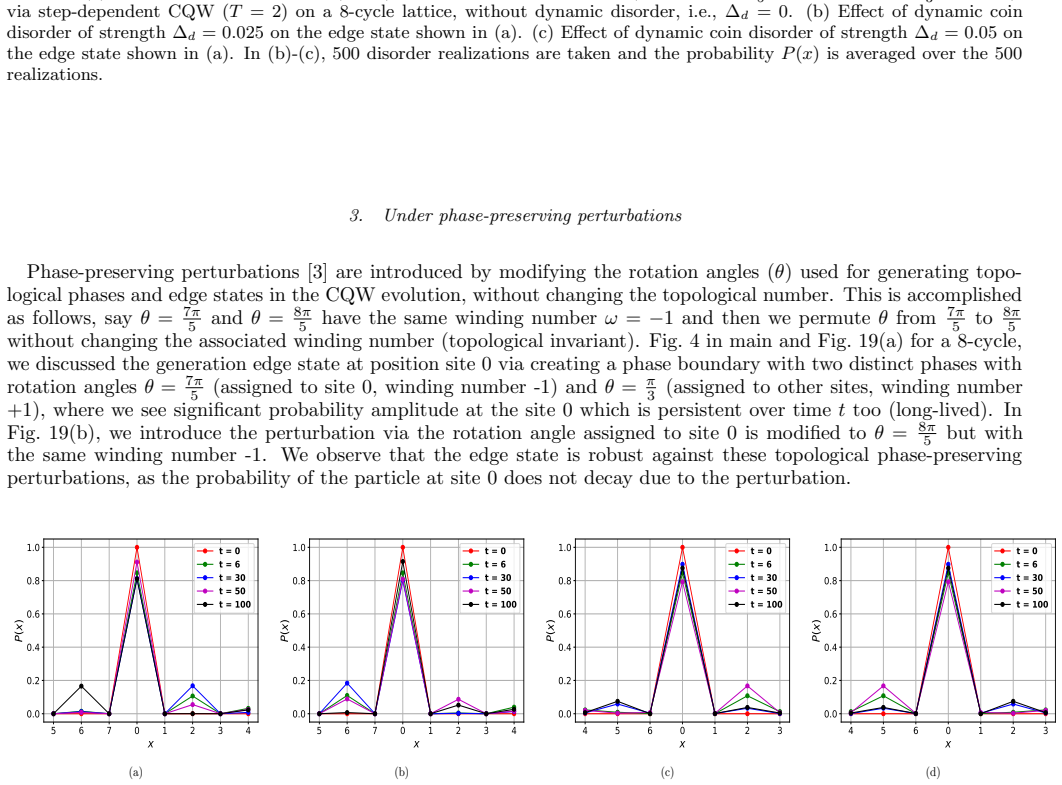
Under phase-preserving perturbations Phase-preserving perturbations [3] are introduced by modifying the rotation angles (θ) used for generating topo- logical phases and edge states in the CQW evolution, without changing the topological number. This is accomplished as follows, sayθ= 7π 5 andθ= 8π 5 have the same winding numberω=−1 and then we permuteθfrom ...
-
[9]
Algorithm for generating edge states via step-dependent CQW on cyclic graphs Require:# of time stepsJ, # of sitesN= 8 (say for a 8-cycle graph), time-dependency parameterT Require:Coin parameters i.e., topological rotation anglesθ i which give non-zero winding numbers Ensure:Probability distributionpro[t][x] fort= 0 toJ, index to denote sites:x= 0 toN−1 1...
-
[10]
Effects of dynamic disorder on generated edge states via step-dependent CQW on cyclic graphs Here, we provide our algorithm to implement the dynamic coin disorder in a CQW and its effect on topological edge state in cyclic graphs (Sec. D). Require:# of time stepsJ, # of sitesN= 8 (say), time-dependency parameterT Require:Coin parameters i.e., topological ...
-
[11]
Wang, et al., Simulating dynamic quantum phase transitions in photonic quantum walks, Phys
K. Wang, et al., Simulating dynamic quantum phase transitions in photonic quantum walks, Phys. Rev. Lett. 122 (2019) 020501
work page 2019
-
[12]
F. Cardano, et al., Statistical moments of quantum-walk dynamics reveal topological quantum transitions, Nat. Commun. 7 (2016) 11439
work page 2016
-
[13]
L. Xiao, X. Zhan, Z. H. Bian, K. K. Wang, X. Zhang, X. P. Wang, J. Li, K. Mochizuki, D. Kim, N. Kawakami, W. Yi, H. Obuse, B. C. Sanders and P. Xue, Observation of topological edge states in parity–time-symmetric quan- tum walks, Nature Physics volume 13, pages1117–1123 (2017)
work page 2017
-
[14]
den Nijs, Quantized Hall Conductance in a Two-Dimensional Periodic Potential, Phys
D.J.Thouless, M.Kohmoto, M.P.Nightingale,and M. den Nijs, Quantized Hall Conductance in a Two-Dimensional Periodic Potential, Phys. Rev. Lett. 49, 405 (1982)
work page 1982
-
[15]
K. v. Klitzing, G. Dorda, and M. Pepper, New Method for High-Accuracy Determination of the Fine-Structure Constant Based on Quantized Hall Resistance, Phys. 21 Rev. Lett. 45, 494 (1980)
work page 1980
-
[16]
C. L. Kane and E. J. Mele,Z 2 Topological Order and the Quantum Spin Hall Effect, Phys. Rev. Lett.95, 146802 (2005)
work page 2005
-
[17]
B. A. Bernevig, T. L. Hughes, and S.-C. Zhang, Quan- tum Spin Hall Effect and Topological Phase Transition in HgTe Quantum Wells, Science 314, 1757 (2006)
work page 2006
- [18]
-
[19]
Koenig et al., Quantum Spin Hall Insulator State in HgTe Quantum Wells, Science 318, 766 (2007)
M. Koenig et al., Quantum Spin Hall Insulator State in HgTe Quantum Wells, Science 318, 766 (2007)
work page 2007
-
[20]
D. Hsieh et al., A topological Dirac insulator in a quan- tum spin Hall phase, Nature (London) 452, 970 (2008)
work page 2008
-
[21]
X.-L. Qi, T. L. Hughes, and S.-C. Zhang, Topological field theory of time-reversal invariant insulators, Phys. Rev. B 78, 195424 (2008)
work page 2008
-
[22]
S. Panahiyan and S. Fritzsche, Controllable simulation of topological phases and edge states with quantum walk, Physics Letters A 384, 126828 (2020)
work page 2020
-
[23]
S. Panahiyan and S. Fritzsche, Toward simulation of topological phenomena with one-, two-, and three- dimensional quantum walks, PHYSICAL REVIEW A 103, 012201 (2021)
work page 2021
-
[24]
Wenjuan Zhang, Zachariah Addison, and Nandini Trivedi, Orbital frustration and topological flat bands, Phys. Rev. B 104, 235202 (2021)
work page 2021
-
[25]
Yuan Cao, Valla Fatemi, Ahmet Demir, Shiang Fang, Spencer L. Tomarken, Jason Y. Luo, Javier D. Sanchez-Yamagishi, Kenji Watanabe, Takashi Taniguchi, Efthimios Kaxiras, Ray C. Ashoori and Pablo Jarillo- Herrero, Correlated insulator behaviour at half-filling in magic-angle graphene superlattices, Nature volume 556, pages80–84 (2018)
work page 2018
-
[26]
Evelyn Tang, Jia-Wei Mei, and Xiao-Gang Wen, High- Temperature Fractional Quantum Hall States, Phys. Rev. Lett. 106, 236802 (2011)
work page 2011
-
[27]
Shunye Gao et al., Discovery of a Single-Band Mott In- sulator in a van der Waals Flat-Band Compound, Phys. Rev. X 13, 041049 (2023)
work page 2023
-
[28]
Y.-H. Chan, Ching-Kai Chiu, M. Y. Chou, and Andreas P. Schnyder, Ca3P2 and other topological semimetals with line nodes and drumhead surface states, Phys. Rev. B 93, 205132, (2016)
work page 2016
-
[29]
J. Otterbach, J. Ruseckas, R. G. Unanyan, G. Juzeliu- nas, and M. Fleischhauer, Effective Magnetic Fields for Stationary Light, Phys. Rev. Lett. 104, 033903 (2010)
work page 2010
-
[30]
N. Goldman, A. Kubasiak, A. Bermudez, P. Gaspard, M. Lewenstein, and M. A. Martin-Delgado, Non-Abelian Optical Lattices: Anomalous Quantum Hall Effect and Dirac Fermions, Phys. Rev. Lett. 103, 035301 (2009)
work page 2009
-
[31]
A. Micheli, G. K. Brenner, and P. Zoller, ,A toolbox for lattice-spin models with polar molecules, Nat. Phys. 2, 341 (2006)
work page 2006
-
[32]
Stern, Non-Abelian states of matter, Nature 464, 187 (2010)
A. Stern, Non-Abelian states of matter, Nature 464, 187 (2010)
work page 2010
- [33]
-
[34]
A. Y. Kitaev, Fault-tolerant quantum computation by anyons, Ann. Phys. 303, 2 (2003)
work page 2003
-
[35]
B. I. Halperin, Quantized Hall conductance, current- carrying edge states, and the existence of extended states in a two-dimensional disordered potential, Phys. Rev. B 25, 2185 (1982)
work page 1982
-
[36]
M. Z. Hasan and C. L. Kane, Colloquium: Topological insulators, Rev. Mod. Phys. 82, 3045 (2010)
work page 2010
-
[37]
A. P. Schnyder, S. Ryu, A. Furusaki, and A. W. W. Lud- wig, Classification of topological insulators and super- conductors in three spatial dimensions, Phys. Rev. B 78, 195125 (2008)
work page 2008
- [38]
-
[39]
C. M. Chandrashekar, H. Obuse, Th. Busch, Entangle- ment Properties of Localized States in 1D Topological Quantum Walks, arXiv:1502.00436v2 [quant-ph] (2015)
work page internal anchor Pith review Pith/arXiv arXiv 2015
-
[40]
Portugal, Quantum Walks and Search Algorithms, Springer (2019)
R. Portugal, Quantum Walks and Search Algorithms, Springer (2019)
work page 2019
-
[41]
Y. Aharonov, L. Davidovich, and N. Zagury, Quantum random walks, Phys. Rev. A 48, 1687 (1993)
work page 1993
-
[42]
Ina Heckelmann et al., Quantum walk comb in a fast gain laser, Science 382, 434 (2023)
work page 2023
-
[43]
Joshua Feis, Sebastian Weidemann, Tom Sheppard, Hannah M. Price and Alexander Szameit, Space-time- topological events in photonic quantum walks, Nature Photonics 19, 518 (2025)
work page 2025
-
[44]
Cinthia Huerta Alderete et al., Quantum walks and Dirac cellular automata on a programmable trapped-ion quan- tum computer, Nature Communications 11, 3720 (2020)
work page 2020
-
[45]
Broome, Alessandro Fedrizzi, Mark S
Takuya Kitagawa, Matthew A. Broome, Alessandro Fedrizzi, Mark S. Rudner, Erez Berg, Ivan Kassal, Al´ an Aspuru-Guzik, Eugene Demler and Andrew G. White , Observation of topologically protected bound states in photonic quantum walks, Nat. Commun. 3, 882 (2012)
work page 2012
-
[46]
F. Cardano, et al., Detection of Zak phases and topo- logical invariants in a chiral quantum walk of twisted photons, Nat. Commun. 8 (2017) 15516
work page 2017
-
[47]
Xiao, et al., Higher winding number in a nonunitary photonic quantum walk, Phys
L. Xiao, et al., Higher winding number in a nonunitary photonic quantum walk, Phys. Rev. A 98 (2018) 063847
work page 2018
-
[48]
X. Wang, et al., Detecting topological invariants and revealing topological phase transitions in discrete-time photonic quantum walks, Phys. Rev. A 98 (2018) 013835
work page 2018
-
[49]
Farshad Nejadsattari, Yingwen Zhang, Fr´ ed´ eric Bouchard, Hugo Larocque, Alicia Sit, Eliahu Co- hen, Robert Fickler, and Ebrahim Karimi, Experimental realization of wave-packet dynamics in cyclic quantum walks, Vol. 6, No. 2, Optica (2019)
work page 2019
-
[50]
J. K. Asb´ oth, Symmetries, topological phases, and bound states in the one-dimensional quantum walk, Phys. Rev. B 86, 195414 (2012)
work page 2012
-
[51]
Takuya Kitagawa, Mark S. Rudner, Erez Berg, and Eu- gene Demler, Exploring topological phases with quantum walks, PHYSICAL REVIEWA 82,033429 (2010)
work page 2010
-
[52]
Z.-H. Bian, J. Li, X. Zhan, J. Twamley, and P. Xue, Ex- perimental implementation of a quantum walk on a circle with single photons, Phys. Rev. A 95, 052338 (2017)
work page 2017
-
[53]
Dinesh Kumar Panda and Colin Benjamin, Recurrent generation of maximally entangled single-particle states via quantum walks on cyclic graphs, Phys. Rev. A 108, L020401 (2023)
work page 2023
-
[54]
[3, 29, 39–43, 45–50, 57–59], [Link to be provided by Publisher team] (2025)
Dinesh Kumar Panda and Colin Benjamin, Supplemen- tary Material for additional details of the Letter which contains the Refs. [3, 29, 39–43, 45–50, 57–59], [Link to be provided by Publisher team] (2025)
work page 2025
-
[55]
Dinesh Kumar Panda and Colin Benjamin, Python codes to generate edge states using step-dependent CQW dynamics and effect of disorder on the generated edge states, Link: https://github.com/Quantum- 22 Panda97/PyCode-Edge-states-and-disorder-effects-in- cyclic-graphs-via-CQW (2025)
work page 2025
-
[56]
Cian C. Reeves, Scott K. Cushing, Vojtech Vlcek, The role of effective mass and long-range interactions in the band-gap renormalization of photo-excited semiconduc- tors, arXiv:2503.09715 [cond-mat.mtrl-sci] (2025)
-
[57]
Xinyu Chen, Shuaihua Lu, Qian Chen, Qionghua Zhou and Jinlan Wang, From bulk effective mass to 2D car- rier mobility accurate prediction via adversarial transfer learning, Nature Communications 15, 5391 (2024)
work page 2024
-
[58]
Robert W. Keyes, Correlation between Mobility and Effective Mass in Semiconductors, Journal of Applied Physics, vol. 30, no. 3, pp. 454, (1959)
work page 1959
-
[59]
Nature Communications 8, 15516 (2017)
Filippo Cardano, Alessio D’Errico, Alexandre Dauphin, Maria Maffei, Bruno Piccirillo, Corrado de Lisio, Giulio De Filippis, Vittorio Cataudella, Enrico Santamato, Lorenzo Marrucci, Maciej Lewenstein and Pietro Massig- nan, Detection of Zak phases and topological invariants in a chiral quantum walk of twisted photons. Nature Communications 8, 15516 (2017)
work page 2017
-
[60]
S. Panahiyan and S. Fritzsche, Controllable simulation of topological phases and edge states with quantum walk, Physics Letters A 384 126828 (2020)
work page 2020
-
[61]
,Experimental two-dimensional quan- tum walk on a photonic chip, SCIENCE ADVANCES 4, eaat3174 (2018)
Hao Tang et al. ,Experimental two-dimensional quan- tum walk on a photonic chip, SCIENCE ADVANCES 4, eaat3174 (2018)
work page 2018
-
[62]
Devlin, Antonio Ambrosio, Noah A
Robert C. Devlin, Antonio Ambrosio, Noah A. Rubin, J. P. Balthasar Mueller, Federico Capasso, Arbitrary spinto–orbital angular momentum conversion of light, Science 358, 896-901 (2017)
work page 2017
-
[63]
M. Karski et al., Quantum Walk in Position Space with Single Optically Trapped Atoms, Science 325, 174 (2009)
work page 2009
-
[64]
P. A. Ameen Yasir and C. M. Chandrashekar, Generation of hyperentangled states and two-dimensional quantum walks using J or q plates and polarization beam splitters, Phys. Rev. A 105, 012417 (2022)
work page 2022
-
[65]
Vlachou et al., Quantum walk public-key crypto- graphic system, Int
C. Vlachou et al., Quantum walk public-key crypto- graphic system, Int. J. Quantum Inf. 13, 1550050 (2015)
work page 2015
-
[66]
Dinesh Kumar Panda and Colin Benjamin, Quantum cryptographic protocols with dual messaging system via 2D alternate quantum walk of a genuine single-photon entangled state, J. Phys. A: Math. and Theor. 58, 01LT01 (2025)
work page 2025
-
[67]
Di Xiao, Ming-Che Chang, and Qian Niu, Berry phase effects on electronic properties, Rev. Mod. Phys. 82, 1959 (2010)
work page 1959
-
[68]
Louie Hong Yao and Sascha Wald, Coined quantum walks on the line: Disorder, entanglement, and localization, Phys. Rev. E 108, 024139 (2023)
work page 2023
-
[69]
Dinesh Kumar Panda and Colin Benjamin, Phase vs coin vs position disorder as a probe for the resilience and re- vival of single particle entanglement in cyclic quantum walks, Physical Review E 111, L042103, (Letter) (2025)
work page 2025
discussion (0)
Sign in with ORCID, Apple, or X to comment. Anyone can read and Pith papers without signing in.