REVIEW 2 major objections 8 minor 56 references
Multistream Network for LiDAR and Camera-based 3D Object Detection in Outdoor Scenes
T0 review · 2 major / 8 minor · reviewed 2026-08-15 · deepseek-v4-flash
Pith's one-line read MuStD fuses LiDAR and camera data in three parallel streams—pillar features, height-compressed BEV features, and a UV-Polar multimodal stream—and reports state-of-the-art or highly competitive KITTI car detection at 50–67 ms inference.
desk verdict A competitive three-stream fusion detector with genuine KITTI server results, held back by an underspecified UV projection and an overstated SOTA claim. read the letter →
The pith
A machine-rendered reading of the paper's core claim, the machinery that carries it, and where it could break.
The reading
What carries the argument
The load-bearing mechanism is the UV-Polar block inside the 3D Multimodal stream. It takes hybrid points—LiDAR points plus pseudo points generated from RGB images by depth completion—applies 3D sparse convolution, then projects the features in parallel: a UV mapping $u = x/z$, $v = y/z$ that aligns them with the RGB image plane and carries texture information, and a polar transform $(r, \theta, \phi)$ that encodes radial distance, azimuth, and elevation and carries orientation and depth relationships. Each projected feature map is processed by 2D sparse convolutions and concatenated with the original 3D sparse features to form the stream output $F_{MM}$. The LiDAR-PillarNet stream contributes pillar-based 2D geometry and the LiDAR-Height Compression stream contributes compressed bird's-eye-view features, and the final fused map $F_H$ is fed to a region-proposal detection head.
What would settle it
Inspect the released code's projection step: if raw LiDAR coordinates are fed into $u = x/z$, $v = y/z$ without applying camera extrinsics and intrinsics first, then the RGB and LiDAR features cannot be pixel-aligned; rerunning the KITTI validation ablation with the correct calibration would change the measured contribution of the 3D Multimodal stream, and if it does not, the reported fusion mechanism does not match the equations.
Extended reading notes
Core claim
On the paper's own terms, the discovery is that a carefully fused multi-stream architecture, rather than a single fusion strategy, can align and exploit both modalities for 3D detection. The central result is the server-reported KITTI car performance: mean APs of 96.39 for 2D detection, 85.39 for 3D detection, 91.34 for BEV detection, and 96.22 for orientation, with the best scores among the compared methods on the Moderate and Hard splits for 2D and orientation and on Hard for 3D and BEV. The authors attribute these gains chiefly to the 3D Multimodal stream's UV-Polar block, which projects sparse 3D features onto both an image-aligned UV grid and a polar grid and then fuses them back with the original 3D features. Their validation-set ablation shows that removing this stream lowers car 3D AP from 92.95 to 80.50, a larger drop than removing either of the two LiDAR-only streams.
Load-bearing premise
The entire multimodal stream rests on the assumption that LiDAR points can be aligned with camera pixels by the simple division $u = x/z$, $v = y/z$, yet the paper never says how the LiDAR coordinates are transformed into the camera frame or what calibration is used, so a literal implementation would leave the two modalities misaligned.
Editorial extensions
If this is right
- If the reported KITTI test results are correct, MuStD sets a new best mean 2D car AP (96.39) and orientation AOS (96.22) among the compared methods while running at 50 ms, keeping it in the near-real-time range for autonomous driving.
- The ablation pattern implies that the multimodal stream is the largest single accuracy contributor, since removing it costs 12.45 points of mean 3D AP on the validation set, more than removing either LiDAR-only stream.
- The multi-class validation results suggest the fusion design transfers beyond cars, with mean 3D APs of 91.29 for cars, 68.32 for pedestrians, and 80.12 for cyclists on KITTI validation.
- Because the UV-Polar block is a modular unit repeated at multiple scales, the architecture could be paired with other detection heads or extended to other sensor configurations without redesigning the fusion mechanism.
Reading between the lines
- The paper's UV equation $u = x/z$, $v = y/z$ omits camera intrinsics and extrinsics; under a literal reading with raw LiDAR coordinates the projected features would not be pixel-aligned with the RGB image, so the real implementation almost certainly applies a calibration step that the text does not describe.
- Because about 80% of the generated pseudo points are discarded, the method may be operating far from the depth-completion frontier; testing lower retention rates could reveal a cheaper configuration with little accuracy loss.
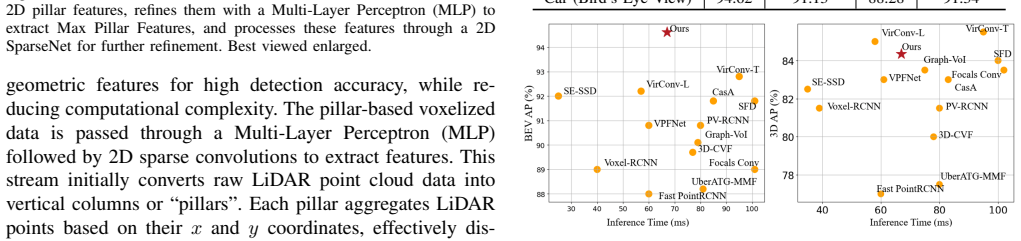
- The paper reports 50 ms inference for the full method in one table and 67 ms in another; until code is released, runtime comparisons should be treated as approximate.
- The fusion recipe—UV-mapped texture plus polar-coded geometry on shared sparse features—could carry over to other perception tasks that combine a sparse depth sensor with a dense camera, such as online mapping or lane detection, though the paper does not test those settings.
Signed reviews
Editorial analysis
A structured set of objections, weighed in public.
Referee Report
Summary. This manuscript proposes MuStD, a three-stream LiDAR-camera 3D object detection network. The streams are LiDAR-PillarNet, LiDAR-Height Compression, and a 3D Multimodal (MM) stream that fuses RGB and LiDAR via a proposed UV-Polar block. The authors report KITTI test-server results for car detection (2D, 3D, BEV, orientation), claiming state-of-the-art or highly competitive performance with 50-67 ms inference, and present a validation-set ablation study. The central novelty is the MM stream's combination of UV and polar/spherical feature indexing within sparse convolutions.
Significance. The KITTI test-server numbers are the paper's chief strength: they are externally generated, and the hard-category 3D AP of 80.78% and 2D mean AP of 96.39% are competitive with recent specialized methods. The architectural idea of combining UV and polar/spherical indexing inside a sparse 3D stream is a plausible and interesting contribution. The method, however, does not set a new state of the art in mean 3D AP (85.39% vs. VirConv-L's 85.56%), and the manuscript does not yet make the central fusion mechanism reproducible. The paper would be a useful addition if the projection details are supplied and the ablation is corrected.
major comments (2)
- [III.A, UV Mapping equation] The definition of the UV mapping as (u,v) = (x/z, y/z) is incomplete: it omits the camera intrinsic matrix (focal length, principal point), the rectification matrix, and the LiDAR-to-camera extrinsic transformation, and it does not state how continuous (u,v) values are placed into the 1600×600 feature grid. On the KITTI benchmark the standard projection is (u,v,1)^T ∝ P2 * R_rect * Tr_velo_to_cam * (x,y,z,1)^T; the formula given in the paper is normalized camera coordinates, not image pixel coordinates. Taken literally, this formula would not align LiDAR points with the RGB image, which would invalidate the multimodal fusion in the 3D MM stream. Since the UV-Polar block is the central innovation and the source of the reported performance, please provide the exact projection used, including all calibration matrices and the grid-assignment rule (e.g., integer rounding or bilinear interpolation).
- [IV.D, Table IV] The text in Section IV.D attributes the drop to mean 3D AP of 80.50% and 2D AP of 84.69% to 'Excluding the 3D MM Network.' However, the row in Table IV that contains these numbers has only two component checkmarks, meaning that additional components (in particular the LiDAR-PillarNet stream, and possibly the LiDAR/RGB inputs) are removed in the same configuration. As printed, the table does not support a leave-one-out interpretation, and the performance drop cannot be attributed to the 3D MM stream alone. Please present the ablation as a proper leave-one-out study over the full model, with each row removing exactly one component, and align the checkmarks with the column headers so that the configuration of each row is unambiguous.
minor comments (8)
- [III.A, Polar Transform] The transform described as the 'Polar Transform' is actually spherical coordinates (r, θ, φ); please rename it to avoid confusion with the polar indexing used elsewhere, or justify the terminology.
- [III.A, Hybrid Points Generation] The generation of pseudo points via depth completion and the retention of only 20% of them is stated without specifying the completion network, the subsampling rule, or whether the retention rate is a tuned hyperparameter; please provide these details for reproducibility.
- [III.A, UV-Polar block equation] In the UV-Polar block equation, the symbol W is used for both the 3D sparse convolution kernel and the 2D sparse convolution kernel, even though these act on tensors of different dimension; use distinct symbols (e.g., W3D and W2D) to make the operation unambiguous.
- [III.D, Feature Fusion] The fusion equation concatenates 2D BEV/Pillar features with 3D sparse features from the MM stream; the manuscript does not explain how the dimensional mismatch is resolved (e.g., by compressing the 3D features to BEV or by broadcasting). Please clarify the alignment and the exact operation denoted by ⊕.
- [IV.A, Table III] The inference time is reported as 50 ms in Section IV.A and Table II but as 67 ms in Table III; please state which number is the measured latency, the hardware used, and whether the depth-completion pseudo-point generation is included in the timing.
- [IV, Dataset description] In Section IV, the sentence 'This dataset comprises 7,481 training and 7,518 test samples... since it contains cars' is unclear; please specify the exact train/validation split used for the ablation and for the test submission (e.g., training on the 3,712-sample train split or on the full 7,481 training+validation set).
- [Table IV] The checkmark alignment in Table IV is difficult to read; please reformat the table (e.g., with dedicated columns and an explicit 'full model' row) so that the ablation configurations are immediately interpretable.
- [References] References [4] and [5] refer to the same paper ('Sparse Fuse Dense'); please merge them and use a single citation throughout.
Circularity Check
No significant circularity: benchmark claims are verified by the external KITTI server, and no prediction is a renamed fit.
full rationale
The paper's central claims are empirical results produced by the official KITTI online evaluation server, which is an external benchmark; no parameter is fitted to the test data and then relabeled as a prediction. The network's components are described by explicit operations (UV mapping as (x/z, y/z), polar transform as (r, theta, phi), pillar discretization, max-height compression, and concatenation-based fusion), and the claimed novelty is the architectural combination of these operations rather than an equation that reduces to its own input. No uniqueness theorem or theoretical result from the authors' own prior work is invoked to force the design; references that may share author names appear only as comparison baselines or background in the related-work discussion, not as load-bearing justifications. The omission of camera intrinsics and extrinsics for the UV mapping is a reproducibility or correctness concern, not circularity, because it concerns an input transformation rather than a fitted parameter being presented as an independent prediction. The derivation chain is therefore self-contained against the external benchmark, and no circular step can be exhibited from the paper's own equations.
Assumptions & free parameters
free parameters (4)
- Pseudo point retention rate =
20% retained (80% discarded)
- UV and polar grid resolution =
1600x600 cells
- Stream channel sizes =
16, 32, 64 (MM); 16, 32, 32, 64, 64 (LiDAR-HC)
- Height compression operator =
max over z
assumptions (4)
- domain assumption Depth completion method SFD [4] produces pseudo points reliable enough for fusion.
- domain assumption KITTI benchmark reflects real-world outdoor 3D detection performance.
- domain assumption The UV projection u=x/z, v=y/z aligns LiDAR features with RGB features without explicit camera intrinsics or extrinsics.
- domain assumption Spherical polar discretization captures object orientation and distance.
Cite this review
Pith. "Pith review of Multistream Network for LiDAR and Camera-based 3D Object Detection in Outdoor Scenes." pith.science (2026). https://pith.science/paper/3JFX4UKI
@misc{pith2026250719304,
  author       = {Pith},
  title        = {Pith review of: Multistream Network for LiDAR and Camera-based 3D Object Detection in Outdoor Scenes},
  year         = {2026},
  howpublished = {\url{https://pith.science/paper/3JFX4UKI}},
  note         = {Machine review of arXiv:2507.19304}
}
read the original abstract
Fusion of LiDAR and RGB data has the potential to enhance outdoor 3D object detection accuracy. To address real-world challenges in outdoor 3D object detection, fusion of LiDAR and RGB input has started gaining traction. However, effective integration of these modalities for precise object detection task still remains a largely open problem. To address that, we propose a MultiStream Detection (MuStD) network, that meticulously extracts task-relevant information from both data modalities. The network follows a three-stream structure. Its LiDAR-PillarNet stream extracts sparse 2D pillar features from the LiDAR input while the LiDAR-Height Compression stream computes Bird's-Eye View features. An additional 3D Multimodal stream combines RGB and LiDAR features using UV mapping and polar coordinate indexing. Eventually, the features containing comprehensive spatial, textural and geometric information are carefully fused and fed to a detection head for 3D object detection. Our extensive evaluation on the challenging KITTI Object Detection Benchmark using public testing server at https://www.cvlibs.net/datasets/kitti/eval_object_detail.php?&result=d162ec699d6992040e34314d19ab7f5c217075e0 establishes the efficacy of our method by achieving new state-of-the-art or highly competitive results in different categories while remaining among the most efficient methods. Our code will be released through MuStD GitHub repository at https://github.com/IbrahimUWA/MuStD.git
Figures


Figures from the paper (3 more)


Reference graph
Works this paper leans on
-
[1]
Multi-view 3d ob- ject detection network for autonomous driving,
X. Chen, H. Ma, J. Wan, B. Li, and T. Xia, “Multi-view 3d ob- ject detection network for autonomous driving,” in Proceedings of the IEEE Conference on Computer Vision and Pattern Recognition (CVPR), 2017, pp. 1907–1915
work page 2017
-
[2]
A survey on 3d object detection methods for autonomous driving applications,
E. Arnold, O. Y . Al-Jarrah, M. Dianati, S. Fallah, D. Oxtoby, and A. Mouzakitis, “A survey on 3d object detection methods for autonomous driving applications,” IEEE Transactions on Intelligent Transportation Systems, vol. 20, no. 10, pp. 3782–3795, 2019
work page 2019
-
[3]
Multi-modal fusion transformer for end-to-end autonomous driving,
A. Prakash, K. Chitta, and A. Geiger, “Multi-modal fusion transformer for end-to-end autonomous driving,” in CVPR, 2021, pp. 7077–7087
work page 2021
-
[4]
Sparse fuse dense: Towards high quality 3d detection with depth completion,
X. Wu, L. Peng, H. Yang, L. Xie, C. Huang, C. Deng, H. Liu, and D. Cai, “Sparse fuse dense: Towards high quality 3d detection with depth completion,” in CVPR, 2022
work page 2022
-
[5]
Sparse fuse dense: Towards high quality 3d detection with depth completion,
B. Wu, S. He, Z. Yan, W. Zeng, and L. Zhang, “Sparse fuse dense: Towards high quality 3d detection with depth completion,” in Proceedings of the IEEE/CVF Conference on Computer Vision and Pattern Recognition (CVPR), 2022, pp. 5412–5421
work page 2022
-
[6]
Virtual sparse con- volution for multimodal 3d object detection,
H. Wu, C. Wen, S. Shi, X. Li, and C. Wang, “Virtual sparse con- volution for multimodal 3d object detection,” in Proceedings of the IEEE/CVF Conference on Computer Vision and Pattern Recognition (CVPR), 2023, pp. 21 653–21 662
work page 2023
-
[7]
Vpfnet: Virtual point based feature fusion network for 3d object detection,
W. Wang, J. Shen, Z. Wu, T. He, J. Zhang, Z. Jiang, and G. H. Lee, “Vpfnet: Virtual point based feature fusion network for 3d object detection,” in IEEE Transactions on Multimedia , vol. 24, 2022, pp. 3487–3497
work page 2022
-
[8]
Graph-voi: Graph neural network based voxel information aggregation for 3d object detection,
Y . Yang, X. Sun, Z. Zhang, K. Jia, and W. Zeng, “Graph-voi: Graph neural network based voxel information aggregation for 3d object detection,” in Proceedings of the European Conference on Computer Vision (ECCV), 2022, pp. 678–695
work page 2022
Show all 56 references
-
[9]
Vpfnet: Improving 3d object detection with virtual point based lidar and stereo data fusion,
H. Zhu, J. Deng, Y . Zhang, J. Ji, Q. Mao, H. Li, and Y . Zhang, “Vpfnet: Improving 3d object detection with virtual point based lidar and stereo data fusion,” IEEE Transactions on Multimedia , vol. 25, 2023
2023
-
[10]
Transfusion: Robust lidar-camera fusion for 3d object detection with transformers,
X. Bai, Z. Hu, X. Zhu, Q. Huang, Y . Chen, H. Fu, and C.-L. Tai, “Transfusion: Robust lidar-camera fusion for 3d object detection with transformers,” in Proceedings of the IEEE/CVF Conference on Computer Vision and Pattern Recognition (CVPR) , 2022, pp. 1090– 1099
2022
-
[11]
M3detr: Multi-representation, multi-scale, mutual- relation 3d object detection with transformers,
T. Guan, J. Wang, S. Lan, R. Chandra, Z. Wu, L. Davis, and D. Manocha, “M3detr: Multi-representation, multi-scale, mutual- relation 3d object detection with transformers,” arXiv preprint arXiv:2104.11896, 2021
2021 arXiv
-
[12]
Efficient 3d object detection based on pseudo-lidar representation,
H. Meng, C. Li, G. Chen, L. Chen, and A. Knoll, “Efficient 3d object detection based on pseudo-lidar representation,” IEEE Transactions on Intelligent Vehicles, vol. 9, no. 1, pp. 1953–1964, 2024
1953
-
[13]
Acf-net: Asymmetric cascade fusion for 3d detection with lidar point clouds and images,
Y . Tian, X. Zhang, X. Wang, J. Xu, J. Wang, R. Ai, W. Gu, and W. Ding, “Acf-net: Asymmetric cascade fusion for 3d detection with lidar point clouds and images,” IEEE Transactions on Intelligent Vehicles, vol. 9, no. 2, 2023
2023
-
[14]
Multi-view 3d reconstruction with transformer,
D. Wang, X. Cui, X. Chen, Z. Zou, T. Shi, S. Salcudean, Z. J. Wang, and R. Ward, “Multi-view 3d reconstruction with transformer,” arXiv preprint arXiv:2103.12957, 2021
2021 arXiv
-
[15]
nuscenes: A multimodal dataset for autonomous driving,
H. Caesar, V . Bankiti, A. H. Lang, S. V ora, V . E. Liong, Q. Xu, A. Krishnan, Y . Pan, G. Baldan, and O. Beijbom, “nuscenes: A multimodal dataset for autonomous driving,” in CVPR, 2020, pp. 11 621–11 631
2020
-
[16]
Multi-scale point-wise convolutional neural networks for 3d object segmentation from lidar point clouds in large-scale environments,
L. Ma, Y . Li, J. Li, W. Tan, Y . Yu, and M. A. Chapman, “Multi-scale point-wise convolutional neural networks for 3d object segmentation from lidar point clouds in large-scale environments,” IEEE Transac- tions on Intelligent Transportation Systems , vol. 22, no. 2, pp. 821– ...
2021
-
[17]
Encode: a deep point cloud odometry network,
Y . Zhang, L. Wang, C. Fu, Y . Dai, and J. M. Dolan, “Encode: a deep point cloud odometry network,” in 2021 IEEE International Conference on Robotics and Automation (ICRA) , 2021, pp. 14 375– 14 381
2021
-
[18]
Object-centric stereo matching for 3d object detection,
A. D. Pon, J. Ku, C. Li, and S. L. Waslander, “Object-centric stereo matching for 3d object detection,” in 2020 IEEE International Conference on Robotics and Automation (ICRA) , 2020, pp. 8383– 8389
2020
-
[19]
Lidar-cs dataset: Lidar point cloud dataset with cross-sensors for 3d object detection,
J. Fang, D. Zhou, J. Zhao, C. Wu, C. Tang, C.-Z. Xu, and L. Zhang, “Lidar-cs dataset: Lidar point cloud dataset with cross-sensors for 3d object detection,” in 2024 IEEE International Conference on Robotics and Automation (ICRA) , 2024, pp. 14 822–14 829
2024
-
[20]
Frame fusion with vehicle motion prediction for 3d object detection,
X. Li, F. Wang, N. Wang, and C. Ma, “Frame fusion with vehicle motion prediction for 3d object detection,” in 2024 IEEE International Conference on Robotics and Automation (ICRA) , 2024, pp. 4252– 4258
2024
-
[21]
Offboard 3d object detection from point cloud sequences,
C. R. Qi, Y . Zhou, M. Najibi, P. Sun, K. V o, B. Deng, and D. Anguelov, “Offboard 3d object detection from point cloud sequences,” in Pro- ceedings of the IEEE/CVF Conference on Computer Vision and Pattern Recognition (CVPR), 2021, pp. 6134–6144
2021
-
[22]
Pointpillars: Fast encoders for object detection from point clouds,
A. H. Lang, S. V ora, H. Caesar, L. Zhou, J. Yang, and O. Beijbom, “Pointpillars: Fast encoders for object detection from point clouds,” in CVPR, 19, pp. 12 697–12 705
-
[23]
Second: Sparsely embedded convolutional detection,
Y . Yan, Y . Mao, and B. Li, “Second: Sparsely embedded convolutional detection,” in Sensors, vol. 18, no. 10, 2018, p. 3337
2018
-
[24]
Pv-rcnn: Point-voxel feature set abstraction for 3d object detection,
S. Shi, C. Guo, L. Jiang, Z. Wang, J. Shi, X. Wang, and H. Li, “Pv-rcnn: Point-voxel feature set abstraction for 3d object detection,” in Proceedings of the IEEE/CVF conference on computer vision and pattern recognition, 2020, pp. 10 529–10 538
2020
-
[25]
V oxel r- cnn: Towards high performance voxel-based 3d object detection,
J. Deng, S. Shi, P. Li, W. Zhou, Y . Zhang, and H. Li, “V oxel r- cnn: Towards high performance voxel-based 3d object detection,” in Proceedings of the AAAI conference on artificial intelligence , vol. 35, no. 2, 2021, pp. 1201–1209
2021
-
[26]
Vision-aided localization and navigation for au- tonomous vehicles,
T. Ji and L. Xie, “Vision-aided localization and navigation for au- tonomous vehicles,” in 2022 IEEE 17th International Conference on Control & Automation (ICCA) . IEEE, 2022, pp. 599–604
2022
-
[27]
Joint 3d proposal generation and object detection from view aggregation,
J. Ku, M. Mozifian, J. Lee, A. Harakeh, and S. Waslander, “Joint 3d proposal generation and object detection from view aggregation,” in Proceedings of the IEEE/RSJ International Conference on Intelligent Robots and Systems (IROS) , 2018, pp. 1–8
2018
-
[28]
3d- cvf: Generating joint camera and lidar features for robust 3d object detection,
J. Yoo, J. Kim, S. Lee, M. Roh, K. M. Choi, and T.-K. Choi, “3d- cvf: Generating joint camera and lidar features for robust 3d object detection,” in Proceedings of the European Conference on Computer Vision (ECCV), 2020, pp. 282–300
2020
-
[29]
Virtual convolution for lidar-based 3d object detection,
H. Wang, J. Li, K. Zhang, and Y .-X. Wang, “Virtual convolution for lidar-based 3d object detection,” in Proceedings of the IEEE/CVF Conference on Computer Vision and Pattern Recognition (CVPR) , 2023, pp. 13 511–13 520
2023
-
[30]
Multisensor fusion for vehicle- to-vehicle cooperative localization with object detection and point cloud matching,
L. Gao, H. Xiang, X. Xia, and J. Ma, “Multisensor fusion for vehicle- to-vehicle cooperative localization with object detection and point cloud matching,” IEEE Sensors Journal , vol. 24, no. 7, pp. 10 865– 10 877, 2024
2024
-
[31]
A survey on deep-learning-based lidar 3d object detection for autonomous driving,
S. Y . Alaba and J. E. Ball, “A survey on deep-learning-based lidar 3d object detection for autonomous driving,” Sensors, vol. 22, no. 24,
-
[32]
Nrconv: Noise- resistant convolution for point cloud processing,
H. Wang, B. Li, X. Song, H. Li, and M. Liu, “Nrconv: Noise- resistant convolution for point cloud processing,” in Proceedings of the IEEE/CVF Conference on Computer Vision and Pattern Recognition (CVPR), 2023, pp. 12 011–12 020
2023
-
[33]
2dpass: 2d priors assisted semantic segmentation of 3d scenes,
Y . Ye, Y . Wang, X. Yang, S. Wang, Z. Huang, B. Feng, and K. Jia, “2dpass: 2d priors assisted semantic segmentation of 3d scenes,” in Proceedings of the IEEE/CVF Conference on Computer Vision and Pattern Recognition (CVPR), 2021, pp. 1609–1618
2021
-
[34]
Ted: Transformation-equivariant 3d detector,
H. Zhou, X. Wang, L. Chen, X. Luo, H. Zhang, and K. Wu, “Ted: Transformation-equivariant 3d detector,” in Proceedings of the AAAI Conference on Artificial Intelligence (AAAI) , 2023, pp. 2434–2442
2023
-
[35]
Semantic segmentation of 3d lidar data using deep learning: a review of projection-based methods,
A. Jhaldiyal and N. Chaudhary, “Semantic segmentation of 3d lidar data using deep learning: a review of projection-based methods,” Applied Intelligence, vol. 53, pp. 6844–6855, 2023
2023
-
[36]
Tinypillarnet: Tiny pillar-based network for 3d point cloud object detection at edge,
Y . Li, Y . Zhang, and R. Lai, “Tinypillarnet: Tiny pillar-based network for 3d point cloud object detection at edge,” IEEE Transactions on Circuits and Systems for Video Technology , vol. 34, no. 3, 2023
2023
-
[37]
Multi-view reprojection architec- ture for orientation estimation,
H. M. Choi, H. Kang, and Y . Hyun, “Multi-view reprojection architec- ture for orientation estimation,” in The IEEE International Conference on Computer Vision (ICCV) Workshops , Oct 2019
2019
-
[38]
Clocs: Camera-lidar object candi- dates fusion for 3d object detection,
S. Pang, D. Morris, and H. Radha, “Clocs: Camera-lidar object candi- dates fusion for 3d object detection,” in 2020 IEEE/RSJ International Conference on Intelligent Robots and Systems (IROS) . IEEE, 2020
2020
-
[39]
Spanet: Spatial and part-aware aggregation network for 3d object detection,
Y . Ye, “Spanet: Spatial and part-aware aggregation network for 3d object detection,” in Pacific Rim International Conference on Artificial Intelligence. Springer, 2021, pp. 308–320
2021
-
[40]
V oxel transformer for 3d object detection,
J. Mao, Y . Xue, M. Niu, H. Bai, J. Feng, X. Liang, H. Xu, and C. Xu, “V oxel transformer for 3d object detection,” in ICCV, 2021
2021
-
[41]
Pyramid r-cnn: Towards better performance and adaptability for 3d object detection,
J. Mao, M. Niu, H. Bai, X. Liang, H. Xu, and C. Xu, “Pyramid r-cnn: Towards better performance and adaptability for 3d object detection,” in ICCV, 2021
2021
-
[42]
3d dual-fusion: Dual-domain dual-query camera-lidar fusion for 3d object detection,
Y . Kim, K. Park, M. Kim, D. Kum, and J. W. Choi, “3d dual-fusion: Dual-domain dual-query camera-lidar fusion for 3d object detection,” arXiv preprint arXiv:2211.13529 , 2022
2022 arXiv
-
[43]
Casa: A cascade attention network for 3d object detection from lidar point clouds,
H. Wu, J. Deng, C. Wen, X. Li, and C. Wang, “Casa: A cascade attention network for 3d object detection from lidar point clouds,” IEEE Transactions on Geoscience and Remote Sensing , 2022
2022
-
[44]
Graph r-cnn: Towards accurate 3d object detection with semantic-decorated local graph,
H. Yang, Z. Liu, X. Wu, W. Wang, W. Qian, X. He, and D. Cai, “Graph r-cnn: Towards accurate 3d object detection with semantic-decorated local graph,” in ECCV, 2022
2022
-
[45]
Dense voxel fusion for 3d object detection,
A. Mahmoud, J. S. Hu, and S. L. Waslander, “Dense voxel fusion for 3d object detection,” WACV, 2023
2023
-
[46]
Octr: Octree-based transformer for 3d object detection,
C. Zhou, Y . Zhang, J. Chen, and D. Huang, “Octr: Octree-based transformer for 3d object detection,” in CVPR, 2023
2023
-
[47]
Focal sparse convolu- tional networks for 3d object detection,
Y . Chen, Y . Li, X. Zhang, J. Sun, and J. Jia, “Focal sparse convolu- tional networks for 3d object detection,” in Proceedings of the IEEE Conference on Computer Vision and Pattern Recognition , 2022
2022
-
[48]
Transformation- equivariant 3d object detection for autonomous driving,
H. Wu, C. Wen, W. Li, R. Yang, and C. Wang, “Transformation- equivariant 3d object detection for autonomous driving,” in AAAI, 2023
2023
-
[49]
Mlf-det: Multi- level fusion for cross- modal 3d object detection,
Z. Lin, Y . Shen, S. Zhou, S. Chen, and N. Zheng, “Mlf-det: Multi- level fusion for cross- modal 3d object detection,” in International Conference on Artificial Neural Networks . Springer, 2023, pp. 136– 149
2023
-
[50]
Pvt-ssd: Single-stage 3d object detector with point-voxel transformer,
H. Yang, W. Wang, M. Chen, B. Lin, T. He, H. Chen, X. He, and W. Ouyang, “Pvt-ssd: Single-stage 3d object detector with point-voxel transformer,” in CVPR, 2023
2023
-
[51]
Are we ready for autonomous driving? the kitti vision benchmark suite,
A. Geiger, P. Lenz, and R. Urtasun, “Are we ready for autonomous driving? the kitti vision benchmark suite,” in Conference on Computer Vision and Pattern Recognition (CVPR) , 2012
2012
-
[52]
Improving 3d object detection with channel-wise transformer,
H. Sheng, S. Cai, Y . Liu, B. Deng, J. Huang, X.-S. Hua, and M.-J. Zhao, “Improving 3d object detection with channel-wise transformer,” in Proceedings of the IEEE/CVF International Conference on Com- puter Vision, 2021, pp. 2743–2752
2021
-
[53]
Se-ssd: Self-ensembling single-stage object detector from point cloud,
W. Zheng, W. Tang, L. Jiang, and C.-W. Fu, “Se-ssd: Self-ensembling single-stage object detector from point cloud,” in Proceedings of the IEEE/CVF conference on computer vision and pattern recognition , 2021, pp. 14 494–14 503
2021
-
[54]
Behind the curtain: Learning occluded shapes for 3d object detection,
Q. Xu, Y . Zhong, and U. Neumann, “Behind the curtain: Learning occluded shapes for 3d object detection,” in Proceedings of the AAAI Conference on Artificial Intelligence , vol. 36, no. 3, 2022, pp. 2893– 2901
2022
-
[55]
Multi-task multi-sensor fusion for 3d object detection,
M. Liang, B. Yang, Y . Chen, R. Hu, and R. Urtasun, “Multi-task multi-sensor fusion for 3d object detection,” in Proceedings of the IEEE/CVF conference on computer vision and pattern recognition , 2019, pp. 7345–7353
2019
-
[2022]
Available: https://www.mdpi.com/1424-8220/22/24/ 9577
[Online]. Available: https://www.mdpi.com/1424-8220/22/24/ 9577
Reviewed August 15, 2026 · model on record in the stance chip above.
Discussion (0). Continue with ORCID to comment.