High Energy Physics - Phenomenology · arXiv:2507.20309 v1 · submitted 27 Jul 2025 · 85 references
Thermal properties of the scalar glueballs from holography
The paper says
“Based on a machine learning holographic QCD model, we construct a systematical framework to investigate the properties of the scalar glueballs continuously from zero temperature to finite temperature.”
more of the abstract
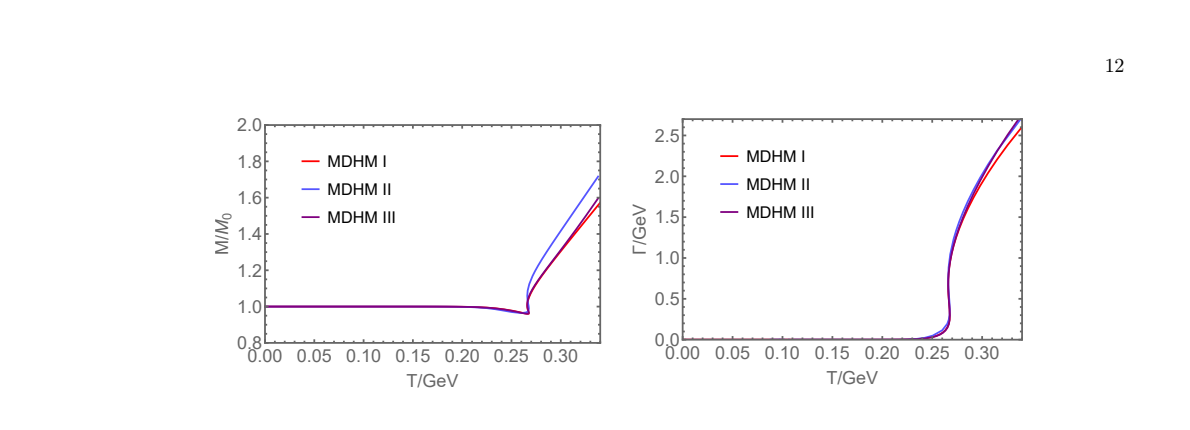
By using both the quasi-normal frequencies and the spectral functions, we extract the pole masses, thermal widths, screening masses and dispersion relation of the scalar glueballs in hot medium. It is shown that the pole masses almost remain the vacuum values at temperatures far below the critical temperature Tc , and then decrease with the increasing of temperature until a temperature lower than Tc. This result qualitatively agrees with earlier lattice simulations. While the pole masses increase monotonically above the critical temperature Tc, which agrees with recent lattice calculation. Meanwhile, it is shown that the thermal widths increase monotonically with temperature, which also agrees with the near Tc lattice simulations. The screening mass exhibits a similar temperature-dependent behavior to the pole mass, while the dispersion relation increasingly deviates from the relativistic one as the temperature rises. It is interesting to note that we obtain the imaginary corrections in the thermal correlators, which contains both the temperal and spatial information and might be helpful for the four-dimensional calculations. Furthermore, by comparing the quasi-normal modes and the spectral functions, we note that it requires more careful analysis when applying the spectral functions in studying thermal hadrons from holography, since there could be other types of quasi-normal modes which are not related with bound states while they may contribute to the peaks of the spectral functions.
from the abstract
Pith says
Machine review · deepseek-v4-flash · 15 Aug 2026 · what was read was not recorded · not checked by a person
It can be wrong. Challenge this review or reply to it.
Holds up, with conditions. Solid holographic QNM computation with a useful appendix, but the below-Tc mass trajectory rests on an unexamined metastable black-hole branch, so the central lattice comparison is not yet established. This line is wrong
3 major objections · 6 minor
How often objections from reviews like this one are right: not yet measured
Not checked: figures, code, what the 85 references say.
The paper says, at Sec. II and Sec. IIIB1, Table II and Fig. 5
The review did not quote this passage.
Pith says: Objection 1 of 3 · major
The pre-Tc part of the central claim is obtained entirely from QNMs of the black-hole solution, but the paper does not establish that this saddle is thermodynamically preferred below Tc. The authors state for the quadratic-dilaton model that the thermal-gas solution with f(z)=1 is dominant for T<Tmin, and no free-energy comparison is presented for the MDHM background used here.
more of objection 1
Because the reconstruction in Eq. (14) yields a temperature-dependent V(Phi,T), the saddle selection is not automatic. If, as in confining holographic models, the f=1 thermal gas is preferred below Tc, then the 'slight decrease before Tc' and the sharp jump at Tc in Table II are properties of a metastable black hole, not of the confined glueball, and the claimed discrimination between lattice scenarios [24-27] is not established. The authors should either compute the free energies of both saddles and justify using the black-hole QNMs below Tc, or compute the glueball spectrum on the f=1 background and restrict the claims accordingly.
The paper says, at Sec. IIIB3, Fig. 10 and Eq. (45)
The review did not quote this passage.
Pith says: Objection 2 of 3 · major
The fitted dispersion relation (45) yields u=1.136 at T=300 MeV and u=1.237 at T=400 MeV, while the text states that u is a velocity and is therefore constrained by u<1. The manuscript does not comment on this violation. Since Eq.
more of objection 2
(45) is presented as the dispersion relation of the glueball and the paper emphasizes deviations from the relativistic form, the authors should either revise the interpretation of u as an effective parameter that may exceed unity due to the thermal width and diffusion terms, or use a parametrization that respects the stated bound.
The paper says, at Sec. IIIB1, Table II
The review did not quote this passage.
Pith says: Objection 3 of 3 · major
The central quantitative statement is a decrease of the ground-state pole mass from 1.819 GeV at T=0.218 GeV to 1.755 GeV at T=0.265 GeV, a change of about 3.5%. No numerical uncertainties are reported for the QNM frequencies, nor is the propagation of the parameter uncertainties (a, b, d, G5, k, l, j) estimated.
more of objection 3
Since the differences at stake are at the 10-100 MeV level, the authors should estimate and report the numerical error of the shooting method and the sensitivity of the results to the fitted parameters; otherwise the 'slight decrease' claim cannot be robustly distinguished from numerical artifacts.
6 minor objections
The paper says, at Abstract
Pith says: minor objection 1 of 6
There is a typo: 'temperal' should be 'temporal' in the sentence about imaginary corrections in the thermal correlators.
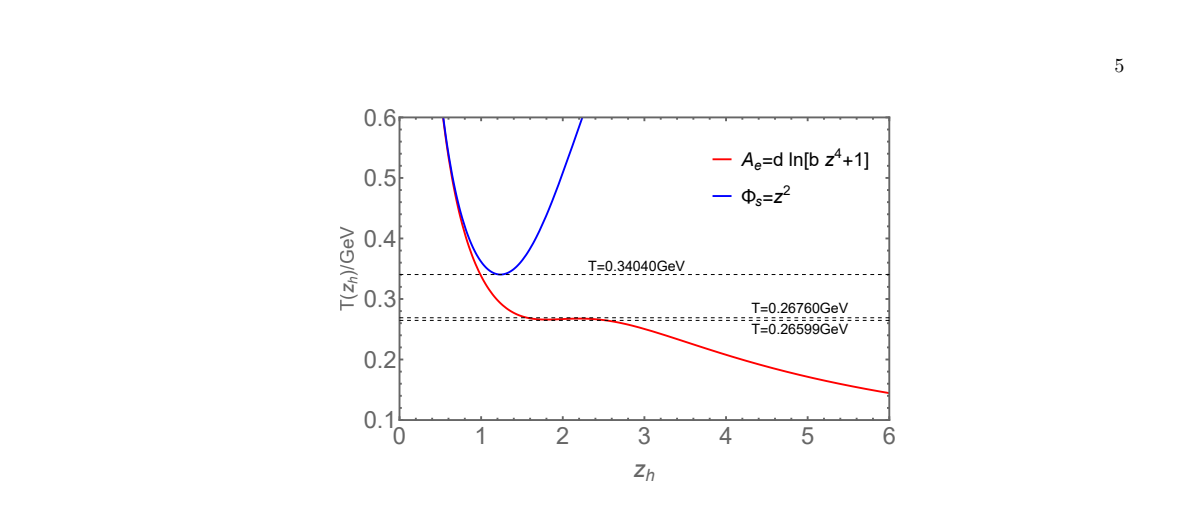
The paper says, at Sec. II, Eq. (15) and Fig. 1
Pith says: minor objection 2 of 6
The parameter a is set to zero, so the first logarithmic term in A(z) is irrelevant; the text says it is kept for future flavored systems, but the presentation would be clearer if this were stated explicitly before the ansatz is introduced.
show 4 more
The paper says, at Sec. II, Fig. 1 and surrounding text
Pith says: minor objection 3 of 6
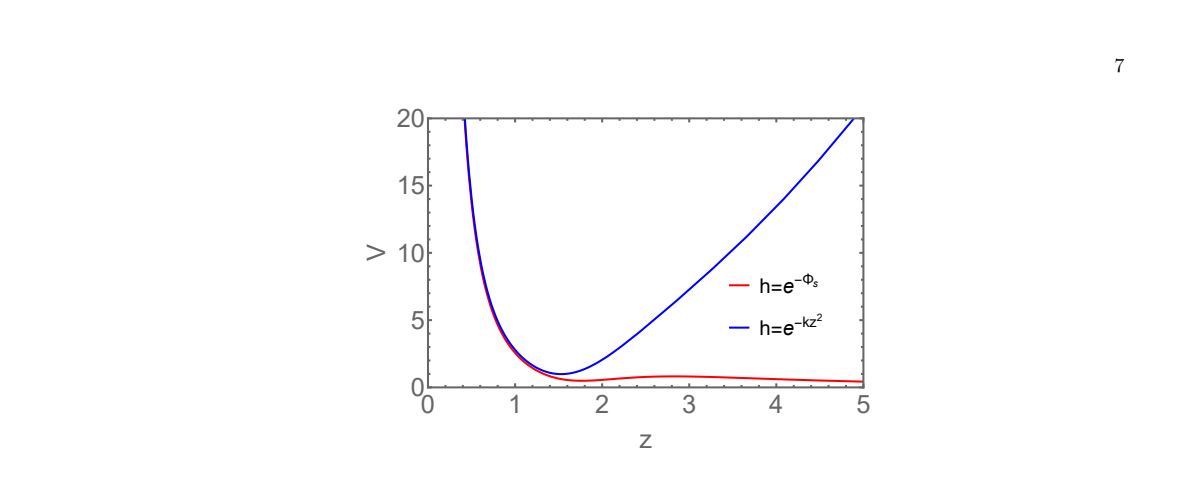
The blue curve is described both as obtained with Phi(z)=z^2 and as Phi=k z^2; the value of k (k=1 GeV^2 in Choice III) should be stated consistently when the comparison model is introduced.
The paper says, at Sec. IIIB1, Table II
Pith says: minor objection 4 of 6
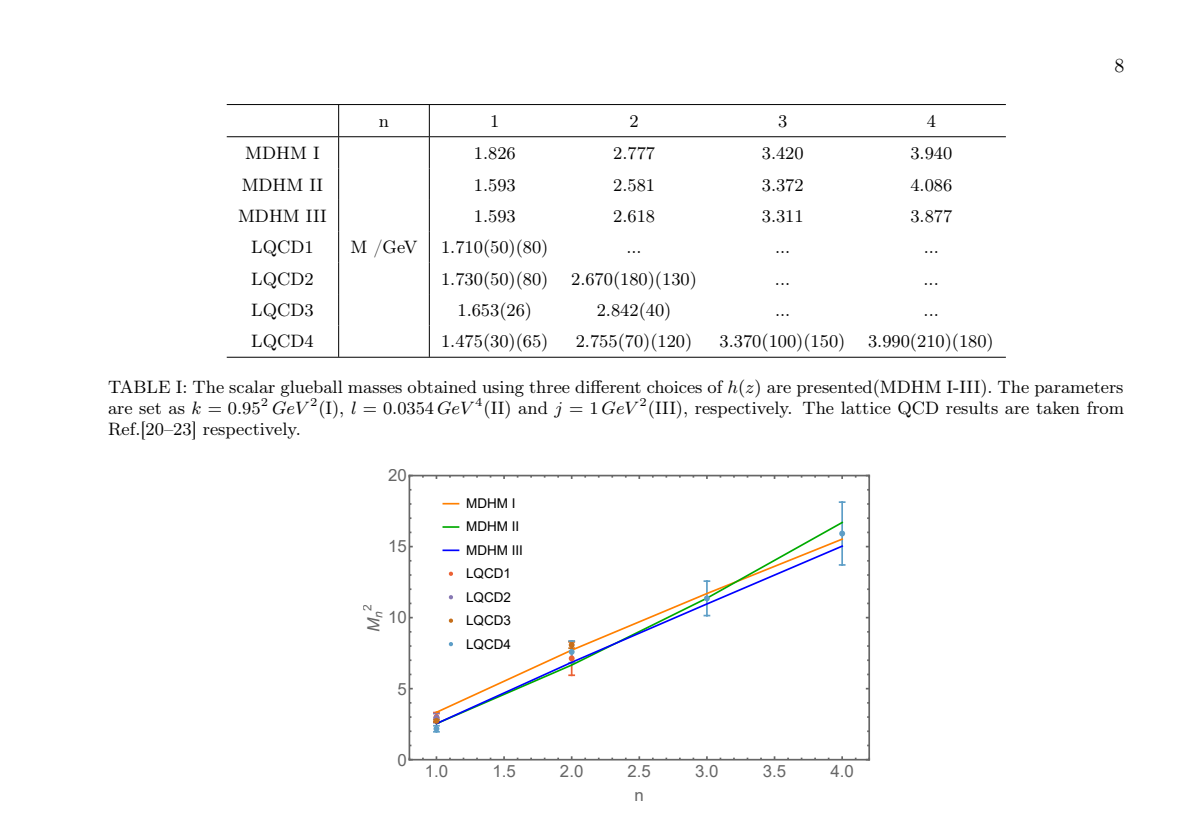
The symbols Tr, Ta, and Tw are defined in the text, but Tw is defined only in the table caption; the definitions should be given together in the main text for readability.
The paper says, at References
Pith says: minor objection 5 of 6
Ref. [12] and Ref. [71] are the same paper (Zhang, Chen, Chen, Huang) and should be merged into one citation.
The paper says, at Sec. IIIB3, Eq. (45)
Pith says: minor objection 6 of 6
The text states that at low temperatures the relation reduces to Eq. (44), but the condition under which the imaginary part can be neglected, and hence when the reduction is quantitatively valid, is not discussed; a short estimate of the size of Gamma and D relative to m would help.
What would settle it
Compute the Euclidean on-shell free energy of the two candidate saddles in the MDHM background—the f=1 thermal-gas solution and the black-hole branches with T(zh) from Eq. (18)—using the same T-dependent V(Φ,T) of Eq. (14), and determine which saddle has lower free energy for each 0<T<Tc. Then repeat the ground-state pole-mass extraction on the dominant saddle: for the f=1 saddle, solve the normal-mode equation with regular boundary conditions at z→∞ (no horizon) and identify the lowest mass as a function of the compact Euclidean time period. If the thermal gas is dominant but the recomputed T-dependence differs from Tab. II (e.g., mass constant with zero width), the below-Tc part of the claim is a metastable-saddle artifact; if the black hole remains dominant or the f=1 result matches Tab. II, the concern is refuted.
from the skeptic's reading
How the review went
4 readings by deepseek-v4-flash · 15 Aug 2026
- Reader holds up, with conditions
- Skeptic partly agrees
- Editor wrote the verdict above
- Referee major revision: 3 major objections, 6 minor
Not run on this paper: the simulated authors' defence.
Pith did not check this review's objections against the paper.
The review in full
The review in brief, machine-written
Dear [Colleague],
The stress-test note is right, and it matters. The paper extracts the glueball pole mass below Tc from QNMs of the black-hole saddle, but in a confining holographic model the thermal gas (f=1) is the thermodynamically preferred background below Tc. The authors themselves invoke that principle for the quadratic-dilaton model in Sec. II, and they never do the free-energy comparison for their own MDHM background, nor do they compute the glueball spectrum on the f=1 saddle. On the f=1 saddle, taken as the T=0 configuration with the same A(z), the glueball spectrum is just the zero-temperature spectrum with no thermal width, so the "slight decrease before Tc and sharp rise at Tc" that anchors the agreement with lattice is very likely an artifact of the metastable branch. The branch choice is even subtler because the reconstructed dilaton potential depends on T, so the two saddles are not solutions of the same action. This is the load-bearing point of the paper, and it is not a minor caveat.
What the paper does well: the QNM and spectral-function machinery is applied carefully, and the cross-check between the two methods is legitimate. Appendix A's warning, that spectral-function peaks can be generated by poles that are not zero-temperature bound states, is a genuinely useful caution for the holography community. The use of three h couplings to show robustness of the black-hole-branch results is also reasonable. Above Tc, where the black hole is the physical saddle, the model gives a linear mass rise with temperature that can be compared with recent lattice work.
The secondary weaknesses are as the reader listed: the glueball coupling h is fitted once at T=0, there are no numerical error bars, no code or data is released, and Eq. (45) is a fit to the same QNM data rather than an independent prediction. Those reduce the paper's strength but do not by themselves break the argument. The saddle selection is the one that does.
Net: this is a serious, technically competent holographic computation, and the appendix alone is worth a referee's time. But the central below-Tc claim is not currently supported, and the lattice comparison in Fig. 7 is premature without a free-energy analysis and the f=1 spectrum. A serious referee should engage with it; the fix is concrete: compute the free energy difference and either do the f=1 computation or explain why the black hole is the relevant saddle in this model. I would not cite the central claim as it stands. Send to peer review, but expect a major revision.
The strongest objection
The central claim is the temperature trajectory of the scalar-glueball pole mass: roughly constant below Tc, a slight dip, a sharp jump at Tc, and linear growth above. The paper obtains this trajectory for T<Tc from quasi-normal modes of the finite-temperature black-hole solution (Sec. IIIB1, Tab. II), using the same black-hole geometry for all temperatures down to T→0. In a confining holographic gauge theory, however, the thermodynamically preferred saddle below the deconfinement temperature is the thermal-gas solution with f(z)=1, not the black hole. The authors themselves state this principle for the quadratic-dilaton model in Sec. II: 'When T<Tmin, the thermal gas solution is considered to be dominant... f(z)=1.' The same logic should decide which background is used for the MDHM glueball QNM calculation below Tc, but the paper never performs the free-energy comparison for its MDHM background and never computes the glueball spectrum on the f=1 saddle. Because the background reconstruction in Eq. (14) produces a temperature-dependent dilaton potential V(Φ,T), the black-hole and thermal-gas saddles are solutions of slightly different actions, so this branch choice is even more delicate. If the thermal gas is the stable saddle below Tc, the slight pre-Tc decrease and the sharp jump across the transition in Tab. II are properties of a metastable black hole, not of the confined glueball, and the claimed discrimination between the lattice scenarios [24–26] and [27] is not established.
The reader's conditional verdict already captures the main fragility of the finite-temperature extension, but the specific load-bearing assumption I identify is not the probe coupling h(Φ_s) itself. Rather, it is the choice of background saddle used to read off the QNM pole masses below Tc. The paper's own discussion of the quadratic-dilaton model acknowledges that the thermal-gas solution dominates below Tmin, yet the MDHM glueball calculation uses black-hole QNMs all the way down to T→0. If the thermal gas dominates below Tc, then the 'slight decrease' before Tc and the 'sharp increase at Tc' are not predictions for the physical confined phase but artifacts of tracking a metastable black-hole branch. The free-energy comparison and the f=1 normal-mode calculation are concrete, doable checks that would settle this directly. I therefore do not move the verdict: the paper should remain CONDITIONAL, with the additional condition that the saddle dominance and the thermal-gas calculation be addressed before the qualitative below-Tc claim is trusted.
The referee's report
If the central claim is correct, the paper provides a single holographic framework that simultaneously describes the pure-glue equation of state and the thermal properties of scalar glueballs, including a qualitative discrimination between earlier lattice results and the more recent constant-term analysis. The use of three different forms of h(Phi_s) is a reasonable robustness check, and the comparison between QNM and spectral-function methods, including the appendix's warning about non-bound-state poles contaminating spectral peaks, is a useful methodological contribution. The manuscript is transparent in presenting numerical tables and the temperature dependence of all extracted quantities. The main value is as a model-building result with falsifiable qualitative predictions for glueball screening masses and dispersion relations.
Pith's reading of the paper (a machine's summary, not the authors')
Using a holographic QCD model whose background was fixed by machine-learning fits to lattice thermodynamics, the paper follows the scalar glueball continuously from zero temperature to above the deconfinement transition. It claims that the ground-state pole mass stays close to its vacuum value until $T\approx 0.23$ GeV, dips only slightly to $1.755$ GeV at $T_c=0.265$ GeV, then jumps sharply to $1.925$ GeV and grows linearly to about $3$ GeV at $T=0.35$ GeV. The same trend appears in excited states and in the screening mass, while the thermal width grows monotonically and rises sharply at $T_c$. If true, this qualitatively reconciles earlier lattice results showing a mass decrease before $T_c$ with recent results showing growth above it, and it gives a concrete momentum-dependent dispersion relation for glueballs in the quark-gluon plasma.
What carries the argument. The load-bearing object is the quasi-normal mode frequency: the characteristic complex oscillation frequency of the scalar glueball field on the black-hole background. Its real part is read as the pole mass and its imaginary part as the thermal width. These frequencies are computed for a probe scalar dual to the $\mathrm{Tr}(G^2)$ operator propagating on a background fixed by the warp factor $A(z)=d\ln(az^2+1)+d\ln(bz^4+1)$, with $a=0$, $b=0.072$, $d=-0.584$, and $T_c=0.265$ GeV obtained from machine-learning fits to lattice thermodynamics. The glueball-background coupling $h(\Phi_s)$ is fixed at zero temperature by fitting lattice glueball masses, and three functional forms are tested to show model-independence. The screening mass is extracted as the purely spatial pole at $\omega=0$, and the dispersion relation from the joint $(\omega,p)$ poles.
Core claim. The paper claims that in a holographic model of pure gluodynamics built from a machine-learned metric, the thermal properties of the scalar glueball can be followed continuously from $T=0$ to well above deconfinement. The central result is the temperature dependence of the ground-state pole mass: $\mathrm{Re}(\omega)=1.819$ GeV at $T=0.218$ GeV, a slight dip to $1.755$ GeV at $T_c=0.265$ GeV, then a sharp jump to $1.925$ GeV at $T=0.268$ GeV and linear growth to $2.993$ GeV at $T=0.350$ GeV. Excited states show the same pattern. The thermal width $-\mathrm{Im}(\omega)$ grows monotonically and rises sharply at $T_c$, and the screening mass follows the pole mass closely, exceeding it at most temperatures. At moderate temperatures the dispersion relation fits $\omega(p)=\sqrt{u^2p^2+m^2}-i(\Gamma+Dp^2)$, so the thermal correlator carries diffusion-like corrections; above about $300$ MeV the fit becomes nonlinear. The paper argues that these results qualitatively match lattice QCD, including the recent finding that the mass climbs above $T_c$, and that the pattern is robust across three different choices of the glueball-background coupling.
The premise it rests on. The calculation assumes the glueball's coupling to the hot medium is exactly the coupling fitted from zero-temperature lattice masses, and that the glueball is too dilute to alter the background spacetime; if the true coupling changes near or above $T_c$, the predicted mass jump and linear growth would be artifacts.
If the paper is right (Pith's inferences, not the authors')
Below $T_c$, the glueball mass is nearly frozen near its vacuum value, so models that predict a monotonic mass drop in the confined phase are not supported by this framework.
Above $T_c$, the mass and width both rise roughly linearly with temperature, so thermal glueballs become short-lived and their spectral peaks melt quickly after deconfinement.
The screening mass is larger than the pole mass at most temperatures, meaning spatial and temporal correlations in the hot gluon plasma are governed by different length scales.
At moderate temperatures the dispersion relation takes the form $\omega(p)=\sqrt{u^2p^2+m^2}-i(\Gamma+Dp^2)$, giving a concrete momentum-dependent width that can enter phenomenological estimates of in-medium glueball propagation.
Because three different coupling choices give similar thermal behavior, the temperature trends are model-independent within this class of holographic models.
If the probe-limit assumption is relaxed, backreaction of the glueball condensate could shift the location and size of the mass jump at $T_c$; a backreacted computation would test whether the jump is an artifact.
The same framework could be applied to tensor ($2^{++}$) glueballs and odderons; if the pattern holds, all glueball states would show the same flat-then-jump-then-linear mass trajectory.
The warning that non-bound-state quasi-normal modes can dominate spectral-function peaks generalizes beyond this model: spectral extractions from holographic or lattice correlators should be cross-checked against the full pole structure.
A lattice calculation isolating the constant contribution in the glueball correlator at $T\approx 0.8$–$1.0\,T_c$ would directly test whether the slight mass dip seen here is physical.
Check this review
Pith stored no record of this review's passes and took no fingerprint of it. Reviews made by code from 13 Nov 2026 on carry both.
How often reviews like this one are right
Reviews like this one: written by deepseek-v4-flash, where what was read was not recorded.
How often objections from reviews like this one are right: not yet measured
Reviews by people
This review was written by a machine. No person has reviewed this paper on Pith yet. A scientist listed on Pith can review it for a fee, and their review is published here whatever it concludes.
How Pith checks papers · The full audit of this paper · Review history (2 versions)
The paper
Abstract
Based on a machine learning holographic QCD model, we construct a systematical framework to investigate the properties of the scalar glueballs continuously from zero temperature to finite temperature. By using both the quasi-normal frequencies and the spectral functions, we extract the pole masses, thermal widths, screening masses and dispersion relation of the scalar glueballs in hot medium. It is shown that the pole masses almost remain the vacuum values at temperatures far below the critical temperature Tc , and then decrease with the increasing of temperature until a temperature lower than Tc. This result qualitatively agrees with earlier lattice simulations. While the pole masses increase monotonically above the critical temperature Tc, which agrees with recent lattice calculation. Meanwhile, it is shown that the thermal widths increase monotonically with temperature, which also agrees with the near Tc lattice simulations. The screening mass exhibits a similar temperature-dependent behavior to the pole mass, while the dispersion relation increasingly deviates from the relativistic one as the temperature rises. It is interesting to note that we obtain the imaginary corrections in the thermal correlators, which contains both the temperal and spatial information and might be helpful for the four-dimensional calculations. Furthermore, by comparing the quasi-normal modes and the spectral functions, we note that it requires more careful analysis when applying the spectral functions in studying thermal hadrons from holography, since there could be other types of quasi-normal modes which are not related with bound states while they may contribute to the peaks of the spectral functions.
The paper's own sentences, arranged, kept beside the review and separate from it. Each label is drawn from a closed vocabulary; the number beside it is the probability the classifier gave that label. No sentence in this record was written by a model.
abstract compiled · 2026-09-23
The authors' main claim, as the classifier picked it out 0.63
“It is shown that the pole masses almost remain the vacuum values at temperatures far below the critical temperature $T_c$ , and then decrease with the increasing of temperature until a temperature lower than $T_c$.”
How the main claim is stated: asserted 1.00
What the abstract itself states, as probabilities: claims first 0.03 · states limitation 0.90 · human participants 0.01 · controlled comparison 0.13 · randomized assignment 0.01 · states quantitative result 0.13 · compares with prior results 0.97 · mentions code or data availability 0.02
The abstract, sentence by sentence
This table labels the abstract only (arXiv listing abstract v1). The number is the probability the classifier gave the label.
| Sentence | Role | The authors' own work | States the main conclusion | Strength |
|---|---|---|---|---|
| Based on a machine learning holographic QCD model, we construct a systematical framework to investigate the properties of the scalar glueballs continuously from zero temperature to finite temperature. | contribution 0.83 | 0.94 | 0.06 | asserted 0.98 |
| By using both the quasi-normal frequencies and the spectral functions, we extract the pole masses, thermal widths, screening masses and dispersion relation of the scalar glueballs in hot medium. | method 0.98 | 0.96 | 0.06 | asserted 1.00 |
| It is shown that the pole masses almost remain the vacuum values at temperatures far below the critical temperature $T_c$ , and then decrease with the increasing of temperature until a temperature lower than $T_c$. | result 1.00 | 0.93 | 0.34 | asserted 1.00 |
| This result qualitatively agrees with earlier lattice simulations. | interpretation 0.75 | 0.20 | 0.07 | asserted 0.64 |
| While the pole masses increase monotonically above the critical temperature $T_c$, which agrees with recent lattice calculation. | result 0.99 | 0.83 | 0.15 | asserted 0.99 |
| Meanwhile, it is shown that the thermal widths increase monotonically with temperature, which also agrees with the near $T_c$ lattice simulations. | result 1.00 | 0.91 | 0.11 | asserted 1.00 |
| The screening mass exhibits a similar temperature-dependent behavior to the pole mass, while the dispersion relation increasingly deviates from the relativistic one as the temperature rises. | result 1.00 | 0.94 | 0.14 | asserted 1.00 |
| It is interesting to note that we obtain the imaginary corrections in the thermal correlators, which contains both the temperal and spatial information and might be helpful for the four-dimensional calculations. | result 0.79 | 0.95 | 0.06 | speculative 0.41 |
| Furthermore, by comparing the quasi-normal modes and the spectral functions, we note that it requires more careful analysis when applying the spectral functions in studying thermal hadrons from holography, since there could be other types of quasi-normal modes which are not related with bound states while they may contribute to the peaks of the spectral functions. | limitation 0.67 | 0.91 | 0.13 | hedged possibility 0.88 |
What kind of paper the classifier reports this is: simulation study 0.70 · evidence from simulation or computation 1.00
What was examined, and what was not
Sources read
- arXiv listing abstract v1
Not examined
- full text
- figures and tables
- references and citing sentences
- relations to other papers
Levels run
- P abstract
Not run
- S sections
- T body sentences
- C citations
- R cross-paper relations
How the labels were made
Compiled by classifier-1.13.0 via TypeSafe API, question bank abstract-p1-20260923, 2026-09-23: 1 request, 7,025 input tokens.
Every quoted sentence on this record is the authors'. Every label is from Pith's closed vocabulary, with the probability shown beside it. This record as JSON
Figures (13)





Figures are the authors', reproduced from the paper.
References (85)
- [69] Song He, Li Li, Zhibin Li, and Shao-Jiang Wang. Gravitational waves and primordial black hole productions from gluodynamics by holography.Sci. China Phys. Mech. Astron., 67(4):240411, 2024 on Pith
- [1] Pole mass and thermal width As mentioned at the beginning of this section, under the condition that boundary condition Eq.(34) withp= 0is satisfied, the values ofωthat makeS(ω,0) = 0correspond to the complex frequencies of the QNMs. The real part of ωrepresents the glueball po... on Pith
- [2] Spectral function In this section, we will use the procedure outlined above to calculate the spectral function of the glueball in order to cross-validate the temperature-dependent behavior of the glueball mass and width obtained in the previous section, but we will follow the ... on Pith
- [3] Screening mass and dispersion relations If we setω= 0in Eq.(34) and solve for the value of|p|that satisfies this boundary conditions along withS(p= imScreen,0) = 0, we can then compute the pole of the spatial correlation function and obtain the screening mass mScreen. The resu... on Pith
- [4] Colin J. Morningstar and Mike J. Peardon. The Glueball spectrum from an anisotropic lattice study.Phys. Rev. D, 60:034509, 1999 on Pith
- [5] Y. Chen et al. Glueball spectrum and matrix elements on anisotropic lattices.Phys. Rev. D, 73:014516, 2006 on Pith
- [6] E. Gregory, A. Irving, B. Lucini, C. McNeile, A. Rago, C. Richards, and E. Rinaldi. Towards the glueball spectrum from unquenched lattice QCD.JHEP, 10:170, 2012 on Pith
- [7] J. I. Latorre, Stephan Narison, and S. Paban. 0++ TRIGLUONIUM SUM RULES.Phys. Lett. B, 191:437–441, 1987 on Pith
- [8] Tao Huang, Hong-Ying Jin, and Ai-Lin Zhang. Determination of the scalar glueball mass in QCD sum rules.Phys. Rev. D, 59:034026, 1999 on Pith
- [9] Cong-Feng Qiao and Liang Tang. Finding the0−− Glueball. Phys. Rev. Lett., 113(22):221601, 2014 on Pith
- [10] Hua-Xing Chen, Wei Chen, and Shi-Lin Zhu. Toward the existence of the odderon as a three-gluon bound state.Phys. Rev. D, 103(9):L091503, 2021 on Pith
- [11] P. Colangelo, F. De Fazio, F. Jugeau, and S. Nicotri. On the light glueball spectrum in a holographic description of QCD. Phys. Lett. B, 652:73–78, 2007 on Pith
- [12] Danning Li and Mei Huang. Dynamical holographic qcd model for glueball and light meson spectra.JOURNAL OF HIGH ENERGY PHYSICS, 2013(11):88, Nov 2013 on Pith
- [13] Eduardo Folco Capossoli, Danning Li, and Henrique Boschi-Filho. Pomeron and Odderon Regge Trajectories from a Dynamical Holographic Model.Phys. Lett. B, 760:101–105, 2016 on Pith
- [14] Yidian Chen and Mei Huang. Two-gluon and trigluon glueballs from dynamical holography QCD. Chin. Phys. C, 40(12):123101, 2016 on Pith
- [15] Lin Zhang, Chutian Chen, Yidian Chen, and Mei Huang. Spectra of glueballs and oddballs and the equation of state from holographic QCD. Phys. Rev. D, 105(2):026020, 2022 on Pith
- [16] Josef Leutgeb and Anton Rebhan. Witten-Veneziano mechanism and pseudoscalar glueball-meson mixing in holographic QCD. Phys. Rev. D, 101(1):014006, 2020 on Pith
- [17] Frederic Brünner, Josef Leutgeb, and Anton Rebhan. A broad pseudovector glueball from holographic QCD.Phys. Lett. B, 788:431–435, 2019. 21 on Pith
- [18] Frederic Brünner and Anton Rebhan. Constraints on theηη′ decay rate of a scalar glueball from gauge/gravity duality. Phys. Rev. D, 92(12):121902, 2015 on Pith
- [19] V. Crede and C. A. Meyer. The Experimental Status of Glueballs.Prog. Part. Nucl. Phys., 63:74–116, 2009 on Pith
show 65 more
- [20] V. M. Abazov et al. Odderon Exchange from Elastic Scattering Differences betweenppandp¯pData at 1.96 TeV and from pp Forward Scattering Measurements.Phys. Rev. Lett., 127(6):062003, 2021 on Pith
- [21] M. Ablikim et al. Confirmation of theX(1835)and observation of the resonancesX(2120)andX(2370)inJ/ψ→γπ+π−η′. Phys. Rev. Lett., 106:072002, 2011 on Pith
- [22] Beijiang Liu. Discovery of a Glueball-like particle X(2370) at BESIII.PoS, ICHEP2024:490, 2025 on Pith
- [23] Colin J. Morningstar and Mike Peardon. Glueball spectrum from an anisotropic lattice study.Phys. Rev. D, 60:034509, Jul 1999 on Pith
- [24] Y. Chen, A. Alexandru, S. J. Dong, T. Draper, I. Horváth, F. X. Lee, K. F. Liu, N. Mathur, C. Morningstar, M. Peardon, S. Tamhankar, B. L. Young, and J. B. Zhang. Glueball spectrum and matrix elements on anisotropic lattices.Phys. Rev. D, 73:014516, Jan 2006 on Pith
- [25] Andreas Athenodorou and Michael Teper. The glueball spectrum of su(3) gauge theory in 3 + 1 dimensions.JHEP, 2020(11):172, Nov 2020 on Pith
- [26] Harvey B. Meyer.Glueball Regge Trajectories. Phd thesis, University of Oxford, 2004 on Pith
- [27] Noriyoshi Ishii, Hideo Suganuma, and Hideo Matsufuru. Scalar glueball mass reduction at finite temperature in SU(3) anisotropic lattice QCD.Phys. Rev. D, 66:014507, 2002 on Pith
- [28] Noriyoshi Ishii, Hideo Suganuma, and Hideo Matsufuru. Glueball properties at finite temperature in SU(3) anisotropic lattice QCD. Phys. Rev. D, 66:094506, 2002 on Pith
- [29] Xiang-Fei Meng, Gang Li, Ying Chen, Chuan Liu, Yu-Bin Liu, Jian-Ping Ma, and Jian-Bo Zhang. Glueballs at finite temperature in SU (3) Yang-Mills theory.Phys. Rev. D, 80:114502, 2009 on Pith
- [30] Toshizo Arikawa, Keita Sakai, and Shoichi Sasaki. Glueball mass spectrum at finite temperature revisited: Constant contribution in glueball correlators in the deconfinement phase. 4 2025 on Pith
- [31] Juan Martin Maldacena. The Large N limit of superconformal field theories and supergravity.Adv. Theor. Math. Phys., 2:231–252, 1998 on Pith
- [32] S. S. Gubser, Igor R. Klebanov, and Alexander M. Polyakov. Gauge theory correlators from noncritical string theory. Phys. Lett. B, 428:105–114, 1998 on Pith
- [33] Edward Witten. Anti-de Sitter space and holography.Adv. Theor. Math. Phys., 2:253–291, 1998 on Pith
- [34] G. Policastro, Dan T. Son, and Andrei O. Starinets. The Shear viscosity of strongly coupled N=4 supersymmetric Yang- Mills plasma. Phys. Rev. Lett., 87:081601, 2001 on Pith
- [35] Alex Buchel and James T. Liu. Universality of the shear viscosity in supergravity.Phys. Rev. Lett., 93:090602, 2004 on Pith
- [36] P. Kovtun, Dan T. Son, and Andrei O. Starinets. Viscosity in strongly interacting quantum field theories from black hole physics. Phys. Rev. Lett., 94:111601, 2005 on Pith
- [37] D. Teaney, J. Lauret, and Edward V. Shuryak. Flow at the SPS and RHIC as a quark gluon plasma signature.Phys. Rev. Lett., 86:4783–4786, 2001 on Pith
- [38] P. Huovinen, P. F. Kolb, Ulrich W. Heinz, P. V. Ruuskanen, and S. A. Voloshin. Radial and elliptic flow at RHIC: Further predictions. Phys. Lett. B, 503:58–64, 2001 on Pith
- [39] Tetsufumi Hirano, Ulrich W. Heinz, Dmitri Kharzeev, Roy Lacey, and Yasushi Nara. Hadronic dissipative effects on elliptic flow in ultrarelativistic heavy-ion collisions.Phys. Lett. B, 636:299–304, 2006 on Pith
- [40] Paul Romatschke and Ulrike Romatschke. Viscosity Information from Relativistic Nuclear Collisions: How Perfect is the Fluid Observed at RHIC?Phys. Rev. Lett., 99:172301, 2007 on Pith
- [41] Joshua Erlich, Emanuel Katz, Dam T. Son, and Mikhail A. Stephanov. QCD and a holographic model of hadrons.Phys. Rev. Lett., 95:261602, 2005 on Pith
- [42] Andreas Karch, Emanuel Katz, Dam T. Son, and Mikhail A. Stephanov. Linear confinement and AdS/QCD.Phys. Rev. D, 74:015005, 2006 on Pith
- [43] Umut Gursoy, Matti Jarvinen, and Govert Nijs. Holographic QCD in the Veneziano Limit at a Finite Magnetic Field and Chemical Potential.Phys. Rev. Lett., 120(24):242002, 2018 on Pith
- [44] Stanley J. Brodsky, Guy F. de Téramond, Hans Günter Dosch, and Joshua Erlich. Light-front holographic qcd and emerging confinement. Physics Reports, 584:1–105, 2015. Light-front holographic QCD and emerging confinement on Pith
- [45] Kazuo Ghoroku, Nobuhito Maru, Motoi Tachibana, and Masanobu Yahiro. Holographic model for hadrons in deformed AdS(5) background.Phys. Lett. B, 633:602–606, 2006 on Pith
- [46] Tony Gherghetta, Joseph I. Kapusta, and Thomas M. Kelley. Chiral symmetry breaking in the soft-wall AdS/QCD model. Phys. Rev. D, 79:076003, 2009 on Pith
- [47] Yan-Qin Sui, Yue-Liang Wu, Zhi-Feng Xie, and Yi-Bo Yang. Prediction for the Mass Spectra of Resonance Mesons in the Soft-Wall AdS/QCD with a Modified 5D Metric.Phys. Rev. D, 81:014024, 2010 on Pith
- [48] Henrique Boschi-Filho, Nelson R. F. Braga, and Hector L. Carrion. Glueball Regge trajectories from gauge/string duality and the Pomeron.Phys. Rev. D, 73:047901, 2006 on Pith
- [49] Eduardo Folco Capossoli and Henrique Boschi-Filho. Odd spin glueball masses and the Odderon Regge trajectories from the holographic hardwall model.Phys. Rev. D, 88(2):026010, 2013 on Pith
- [50] Eduardo Folco Capossoli, Danning Li, and Henrique Boschi-Filho. Dynamical corrections to the anomalous holographic soft-wall model: the pomeron and the odderon.Eur. Phys. J. C, 76(6):320, 2016 on Pith
- [51] Pietro Colangelo, Floriana Giannuzzi, and Stefano Nicotri. Holographic Approach to Finite Temperature QCD: The Case of Scalar Glueballs and Scalar Mesons.Phys. Rev. D, 80:094019, 2009. 22 on Pith
- [52] Alex S. Miranda, C.A. Ballon Bayona, Henrique Boschi-Filho, and Nelson R.F. Braga. Black-hole quasinormal modes and scalar glueballs in a finite-temperature ads/qcd model.Journal of High Energy Physics, 2009(11):119, nov 2009 on Pith
- [53] UmutGursoy, EliasKiritsis, LiubaMazzanti, andFrancescoNitti. DeconfinementandGluonPlasmaDynamicsinImproved Holographic QCD. Phys. Rev. Lett., 101:181601, 2008 on Pith
- [54] Steven S. Gubser and Abhinav Nellore. Mimicking the QCD equation of state with a dual black hole.Phys. Rev. D, 78:086007, 2008 on Pith
- [55] Oliver DeWolfe, Steven S. Gubser, and Christopher Rosen. A holographic critical point.Phys. Rev. D, 83:086005, 2011 on Pith
- [56] Song He, Shang-Yu Wu, Yi Yang, and Pei-Hung Yuan. Phase Structure in a Dynamical Soft-Wall Holographic QCD Model. JHEP, 04:093, 2013 on Pith
- [57] Yi Yang and Pei-Hung Yuan. A Refined Holographic QCD Model and QCD Phase Structure.JHEP, 11:149, 2014 on Pith
- [58] Yi Yang and Pei-Hung Yuan. Confinement-deconfinement phase transition for heavy quarks in a soft wall holographic QCD model. JHEP, 12:161, 2015 on Pith
- [59] David Dudal and Subhash Mahapatra. Thermal entropy of a quark-antiquark pair above and below deconfinement from a dynamical holographic QCD model.Phys. Rev. D, 96(12):126010, 2017 on Pith
- [60] David Dudal and Subhash Mahapatra. Interplay between the holographic QCD phase diagram and entanglement entropy. JHEP, 07:120, 2018 on Pith
- [61] Zhen Fang, Song He, and Danning Li. Chiral and Deconfining Phase Transitions from Holographic QCD Study.Nucl. Phys. B, 907:187–207, 2016 on Pith
- [62] Danning Li, Song He, Mei Huang, and Qi-Shu Yan. Thermodynamics of deformed AdS5 model with a positive/negative quadratic correction in graviton-dilaton system.JHEP, 09:041, 2011 on Pith
- [63] Ying-Ying Li, Xing-Lin Liu, Xin-Yi Liu, and Zhen Fang. Correlations between the deconfining and chiral transitions in holographic QCD. Phys. Rev. D, 105(3):034019, 2022 on Pith
- [64] RenatoCritelli, JorgeNoronha, JacquelynNoronha-Hostler, IsraelPortillo, ClaudiaRatti, andRomuloRougemont. Critical point in the phase diagram of primordial quark-gluon matter from black hole physics.Phys. Rev. D, 96(9):096026, 2017 on Pith
- [65] Joaquin Grefa, Jorge Noronha, Jacquelyn Noronha-Hostler, Israel Portillo, Claudia Ratti, and Romulo Rougemont. Hot and dense quark-gluon plasma thermodynamics from holographic black holes.Phys. Rev. D, 104(3):034002, 2021 on Pith
- [66] Irina Ya. Aref’eva, Kristina Rannu, and Pavel Slepov. Holographic model for heavy quarks in anisotropic hot dense QGP with external magnetic field.JHEP, 07:161, 2021 on Pith
- [67] Xun Chen, Danning Li, and Mei Huang. Criticality of QCD in a holographic QCD model with critical end point.Chin. Phys. C, 43(2):023105, 2019 on Pith
- [68] Xun Chen, Lin Zhang, Danning Li, Defu Hou, and Mei Huang. Gluodynamics and deconfinement phase transition under rotation from holography.JHEP, 07:132, 2021 on Pith
- [70] Jing Zhou, Xun Chen, Yan-Qing Zhao, and Jialun Ping. Thermodynamics of heavy quarkonium in a magnetic field background. Phys. Rev. D, 102(8):086020, 2020 on Pith
- [71] Koji Hashimoto, Keisuke Ohashi, and Takayuki Sumimoto. Deriving the dilaton potential in improved holographic QCD from the chiral condensate.PTEP, 2023(3):033B01, 2023 on Pith
- [72] Xun Chen and Mei Huang. Machine learning holographic black hole from lattice qcd equation of state.Phys. Rev. D, 109(5):L051902, Mar 2024 on Pith
- [73] U. Gürsoy, E. Kiritsis, L. Mazzanti, and F. Nitti. Holography and thermodynamics of 5d dilaton-gravity.JOURNAL OF HIGH ENERGY PHYSICS, 2009(05):033, May 2009 on Pith
- [74] Lin Zhang, Chutian Chen, Yidian Chen, and Mei Huang. Spectra of glueballs and oddballs and the equation of state from holographic qcd. Phys. Rev. D, 105(2):026020, Jan 2022 on Pith
- [75] Xun Chen, Yidian Chen, and Kai Zhou. Data-Driven Einstein-Dilaton Model for Pure Yang-Mills Thermodynamics and Glueball Spectrum. 7 2025 on Pith
- [76] Andreas Karch, Emanuel Katz, Dam T. Son, and Mikhail A. Stephanov. Linear confinement and ads/qcd.Phys. Rev. D, 74(1):015005, Jul 2006 on Pith
- [77] Dam T. Son and Andrei O. Starinets. Minkowski-space correlators in ads/cft correspondence: recipe and applications. Journal of High Energy Physics, 2002(09):042, Oct 2002 on Pith
- [78] Noriyoshi Ishii, Hideo Suganuma, and Hideo Matsufuru. Glueball properties at finite temperature in su(3) anisotropic lattice qcd. Phys. Rev. D, 66:094506, Nov 2002 on Pith
- [79] Xiang-Fei Meng, Gang Li, Yuan-Jiang Zhang, Ying Chen, Chuan Liu, Yu-Bin Liu, Jian-Ping Ma, and Jian-Bo Zhang. Glueballs at finite temperature insu(3)yang-mills theory.Phys. Rev. D, 80:114502, Dec 2009 on Pith
- [80] Toshizo Arikawa, Keita Sakai, and Shoichi Sasaki. Glueball mass spectrum at finite temperature revisited: Constant contribution in glueball correlators in the deconfinement phase, 2025 on Pith
- [81] Nabil Iqbal and Hong Liu. Universality of the hydrodynamic limit in ads/cft and the membrane paradigm.Phys. Rev. D, 79(2):025023, Jan 2009 on Pith
- [82] P. Colangelo, F. De Fazio, Floriana Giannuzzi, F. Jugeau, and S. Nicotri. Light scalar mesons in the soft-wall model of AdS/QCD. Phys. Rev. D, 78:055009, 2008 on Pith
- [83] Miguel Angel Martin Contreras, Alfredo Vega, and Saulo Diles. Heavy quarkonia spectroscopy at zero and finite temperature in bottom-up ads/qcd.Phys. Rev. D, 103(8):086008, Apr 2021 on Pith
- [84] Xuanmin Cao, Songyu Qiu, Hui Liu, and Danning Li. Thermal properties of light mesons from holography.JOURNAL OF HIGH ENERGY PHYSICS, 2021(8):5, Aug 2021. 23 on Pith
- [85] E. V. Shuryak. Physics of the pion liquid.Phys. Rev. D, 42:1764–1776, Sep 1990 on Pith
Cited by 2 Pith papers
Reviewed papers on Pith that cite this one. The full citation record
How the literature uses it
1 arXiv paper cite this in 2 sentences
Papers citing it
Contests it 1 paper
-
However, Ref. [ref] showed that the model does not reproduce the observed meson spectrum when the warp factor $A_e$ in Eq. [ref] is used as the EMD input.
Medium effect on spin alignment of strange and charm vector mesons · Vector-meson multiplets in the holographic model · contest 0.72
Uses its method or tool 1 paper
-
Following Ref. [ref] , we choose $g(Φ(z))=e^-μ_g^2z^2$, which is equivalent to setting $Φ_m(z)=μ_g^2z^2$.
Medium effect on spin alignment of strange and charm vector mesons · Vector-meson multiplets in the holographic model · 0.83
Challenges and discussion
Disagree with the review, or know something it missed? Leave a comment, or challenge this review formally: a challenge becomes a permanent entry in this paper's record, and its decision is published here.
Come back by email
A short list of the week's newly reviewed papers. Nothing is sent until you confirm from your inbox, and every email has a link that stops it. No account.
No comments yet.
Sign in to comment