High Energy Physics - Theory · arXiv:2611.20912 v1 · submitted 16 Nov 2026 · 96 references
From Quasinormal Mode Poles to Branch Cuts at Finite N
The paper says
“In the strict large-N limit, holographic thermal retarded correlators are typigcally meromorphic, with their late-time behavior determined by isolated quasinormal mode (QNM) poles. We show that the first bulk-loop correction, of order 1/N2, qualitatively changes this structure.”
more of the abstract
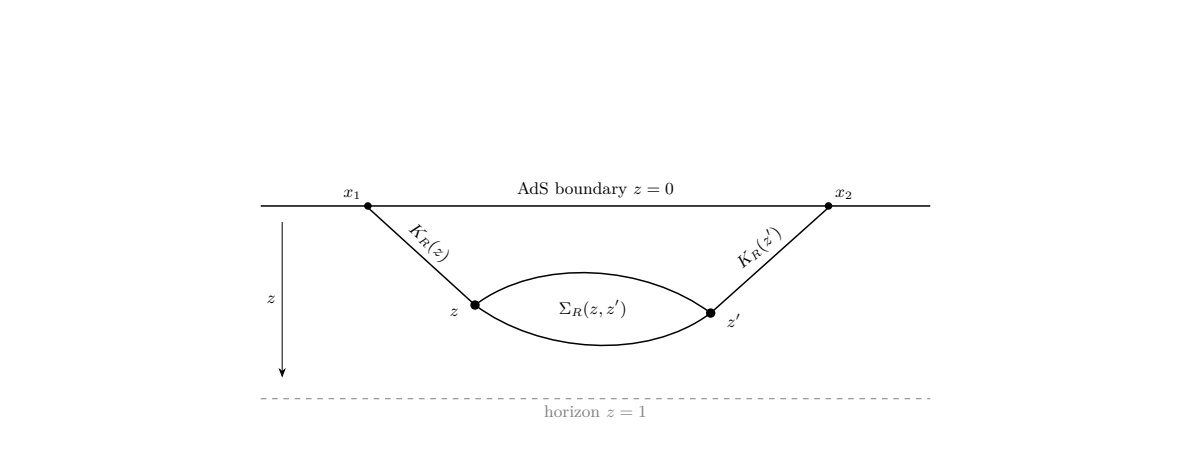
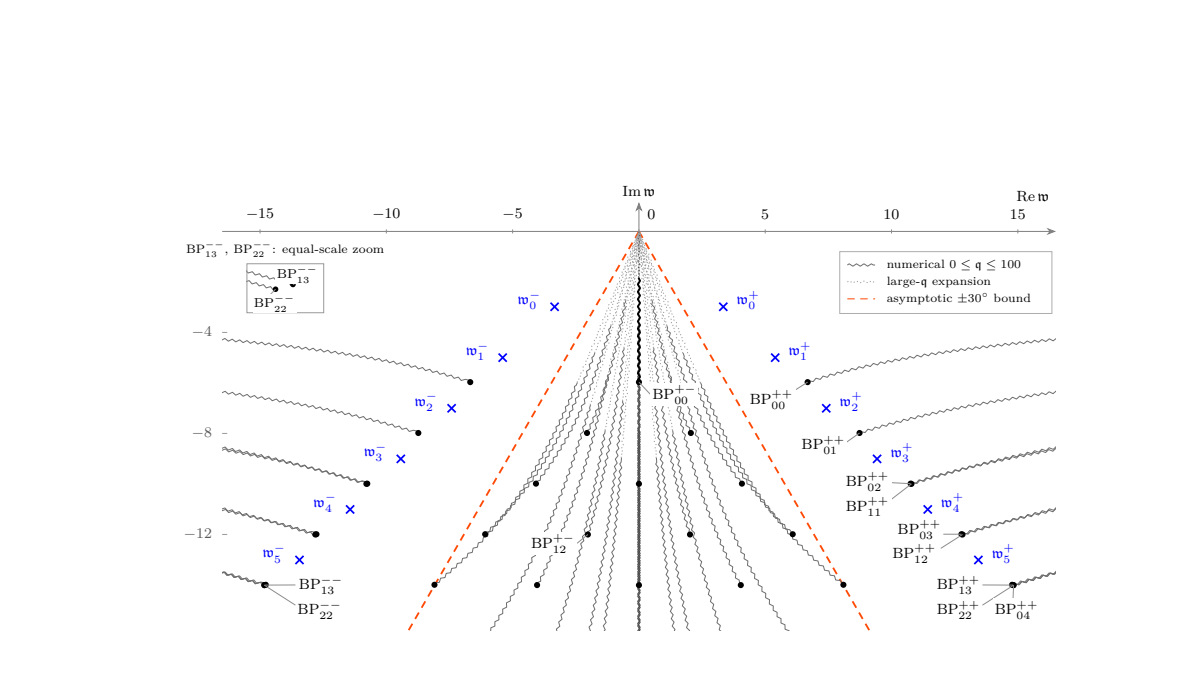
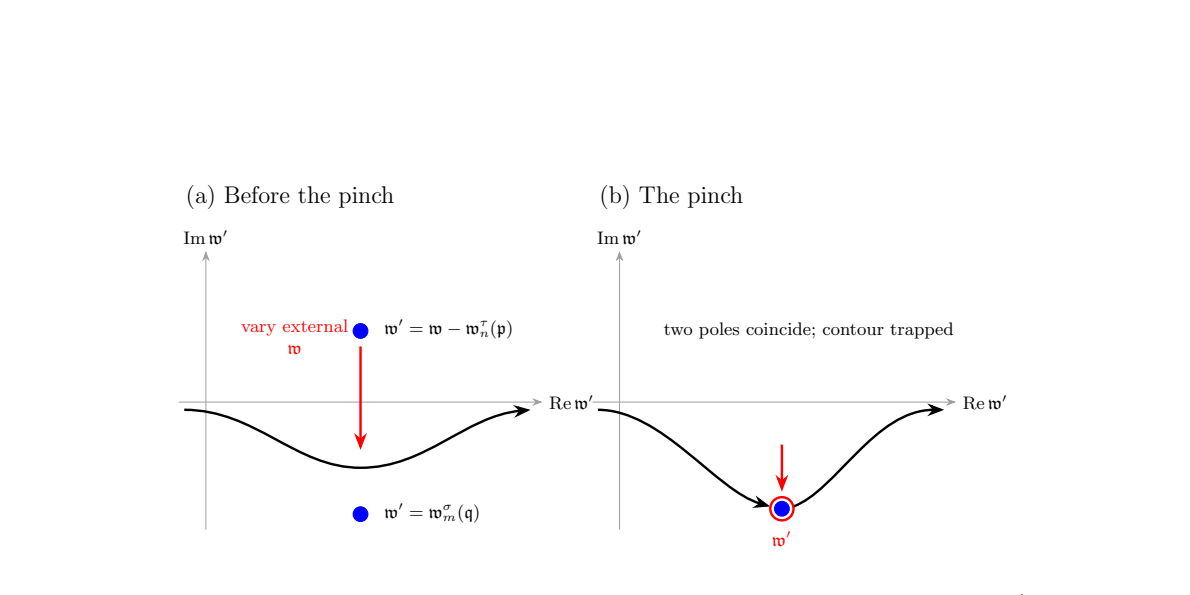
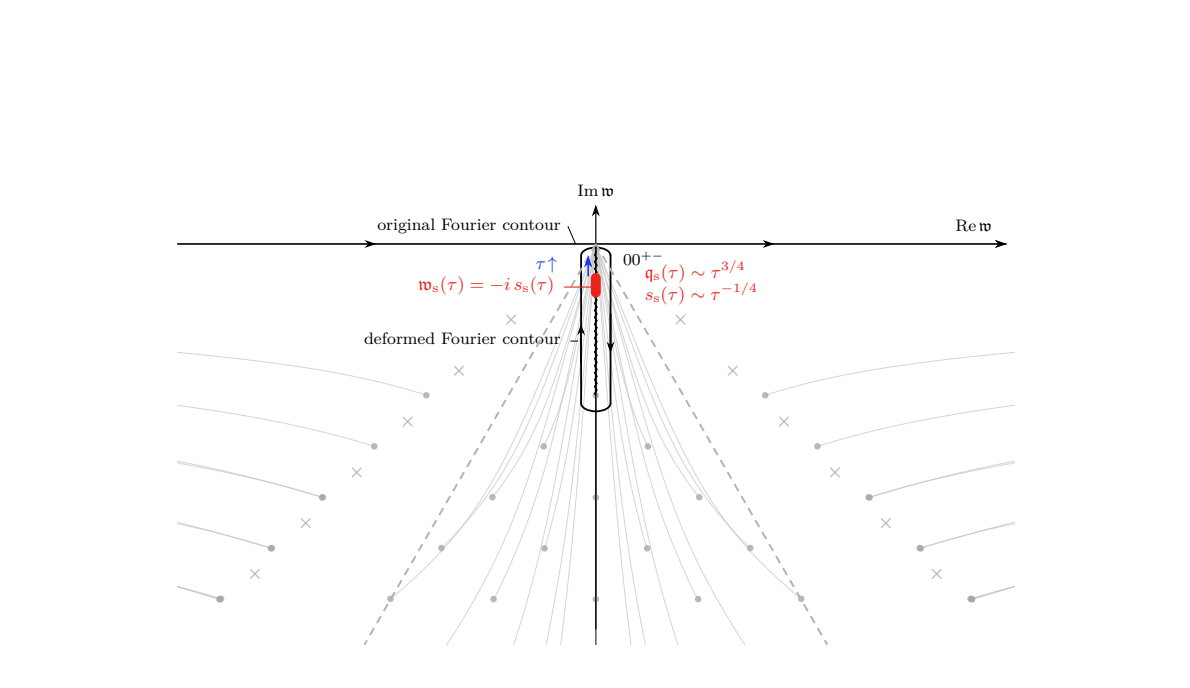
In a scalar theory on the planar AdS5 black brane, a one-loop bulk diagram generates poles at sums of two QNM frequencies at fixed loop momentum q; integration over the continuous momentum turns these QNM-pair poles into branch cuts. At vanishing external spatial momentum, for pairs built from QNM branches with opposite real parts, the leading light-cone contributions cancel at large momentum, and the residual QNM-pair frequency scales as q−1/3. Consequently, an infinite family of cuts accumulates at zero frequency, while all tree-level QNM poles remain at finite nonzero frequencies. The first finite-N correction therefore closes the gap set by the classical QNM spectrum. Competition between the decreasing QNM-pair damping and thermal Boltzmann suppression produces a moving saddle and a finite-N contribution G(t) ∼ N−2tαe−Ct3/4, C > 0, which decays more slowly than the leading classical QNM contribution. Thus the large-N expansion is nonuniform at late times, and bulk quantum fluctuations generate a distinct late-time regime beyond the classical QNM decay.
from the abstract
Pith says
Machine review · deepseek-v4-flash · 17 Nov 2026 · read the full text (142,905 characters) · not checked by a person
It can be wrong. Challenge this review or reply to it.
Holds up, with conditions.
no objections raised
How often objections from reviews like this one are right: not yet measured
The paper, first character to last
The reviewer was given the whole text, 142,905 characters. Not checked: figures, code, what the 96 references say.
What would settle it
A direct numerical evaluation of the one-loop retarded correlator at finite N (e.g., using lattice gauge theory or a soluble large-N model) that shows no branch cut extending to zero frequency, or that the late-time decay is still exponential with the classical QNM damping rate, would falsify the central claim.
from Pith's summary of the paper
How the review went
4 passes by deepseek-v4-flash · 17 Nov 2026
- Reader holds up, with conditions
- Skeptic concern withdrawn: Pith's reviewer misread the paper
- Referee no objections raised
- Check against the paper kept 0 of 1 objection
Not run on this paper: the editor, the simulated authors' defence.
Pith's passes raised 1 objection. A check against the paper's text kept 0 and withdrew 1 (1 Pith's reviewer misread the paper).
The review in full
The stress test's concern
Withdrawn: Pith's reviewer misread the paper.
The paper says
“The large-momentum asymptotics of black-brane QNMs were derived by Festuccia and Liu~\cite{Festuccia:2008zx}. Specializing their result to the scalar model defined in Sec.~\ref{sec:linear-propagators}, for each fixed overtone index one finds \begin{equation} \mathfrak w_n^+(\mathfrak q) = \mathfrak q + \frac{\lambda_n}{2}e^{-i\pi/3}\mathfrak q^{-1/3} + O(\mathfrak q^{-5/3}), \qquad \lambda_n>0 . \label{eq:largeq-qnm} \end{equation}”
The referee's report
If correct, this is a significant result showing that finite-N effects qualitatively change the analytic structure of holographic thermal correlators, closing the gap of the classical QNM spectrum and producing a new late-time regime. The paper provides a detailed analytic derivation supported by a numerical blind test.
Pith's reading of the paper (a machine's summary, not the authors')
The paper argues that the first bulk-loop correction (order 1/$N^{2}$) in holographic thermal correlators generates branch cuts that extend to zero frequency, while the classical QNM poles remain at finite nonzero frequencies. This qualitatively changes the analytic structure of the retarded correlator, leading to a stretched-exponential decay at late times that is slower than the classical exponential decay. The large-N expansion is therefore nonuniform at late times.
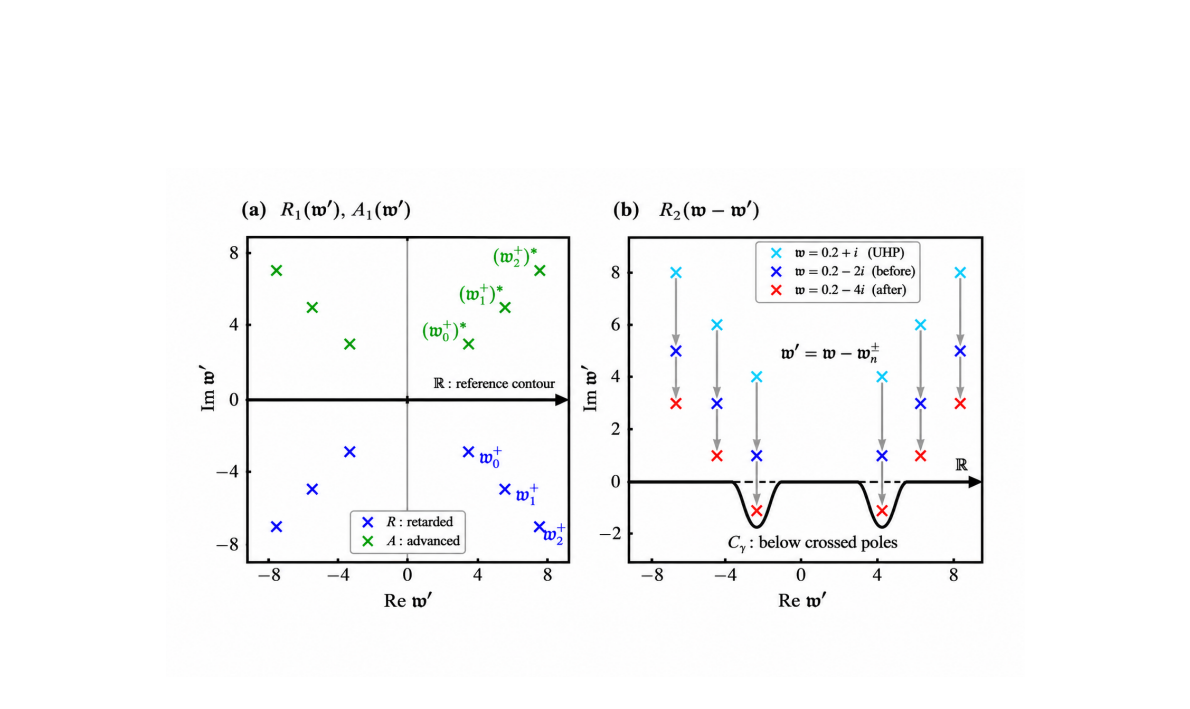
What carries the argument. The key machinery is the Landau-pinch mechanism applied to QNM poles in the loop-frequency plane. At fixed loop momentum, two QNM poles from the internal propagators can pinch the integration contour when the external frequency equals the sum of the two QNM frequencies. The remaining momentum integration turns these QNM-pair poles into branch cuts. The large-momentum asymptotics of the QNMs (from Festuccia and Liu 2008) gives the $q^{{-1/3}}$ scaling of the mixed-sign pair frequency, and the thermal KMS factor provides the Boltzmann suppression $e^{{-πq}}$ that competes with the decreasing damping.
Core claim. The central claim is that at vanishing external spatial momentum, mixed-sign QNM pairs (one from the positive real-frequency branch and one from the negative real-frequency branch) produce a branch cut that accumulates at zero frequency as the loop momentum goes to infinity. The leading light-cone terms cancel, leaving a residual pair frequency that scales as $q^{{-1/3}}$. The competition between the decreasing QNM-pair damping and thermal Boltzmann suppression produces a moving saddle and a stretched-exponential decay G(t) ~ $N^{{-2}}$ t^α $e^{{-C t^{3/4}}$}, which decays more slowly than the classical QNM exponential $e^{{-γ_0 t}}$. Thus the large-N expansion is nonuniform at late times.
The premise it rests on. The analysis assumes that the large-momentum asymptotics of the QNMs (Eq. (1.7) from Festuccia and Liu 2008) is valid for the loop calculation, and that the Hartle-Hawking state is the correct quantum state for the bulk fluctuations.
If the paper is right (Pith's inferences, not the authors')
The one-loop contribution to the retarded correlator dominates over the classical QNM contribution at sufficiently late times, because its stretched-exponential decay is slower than any fixed exponential.
The large-N expansion is nonuniform at late times: at any fixed τ the one-loop term is suppressed by 1/N^2, but at fixed finite N it eventually dominates.
The analytic structure of the thermal retarded correlator changes qualitatively at order 1/N^2: branch cuts appear that extend to zero frequency, closing the gap set by the classical QNM spectrum.
The stretched-exponential exponent depends on the boundary spacetime dimension: for AdS_5 (d=4) it is 3/4, for AdS_4 (d=3) it is 5/6, and it approaches 1/2 as d→∞.
The mechanism found here is distinct from hydrodynamic long-time tails and the diffuson cascade: it arises from gapped nonhydrodynamic QNMs, not from gapless hydrodynamic modes, and already at one-loop order a single fixed-index mixed-sign pair generates a cut extending to zero frequency.
If the same mechanism applies to conserved-current and stress-tensor correlators, it would compete with conventional hydrodynamic long-time tails, potentially modifying the late-time relaxation of those channels.
The accumulation of mixed-sign cuts at zero frequency may have implications for the information paradox or the fine-grained entropy of black holes, since it provides a mechanism for quantum fluctuations to dominate the late-time response.
The result suggests that the classical QNM description of thermal relaxation is not robust once finite-N effects are included; higher-loop corrections may further modify the analytic structure.
Check this review
What was read
The passes were given all 142,905 characters of the paper's LaTeX source.
Fingerprint of that text (SHA-256): feea14d13b79e2123a37945f0d6c6b9d5870a6495ecabd0771fde4ad60dedb2a
Pith does not keep that text. Rebuilt from the paper's source or PDF by the same code, it has this fingerprint if it is the same text. From a copy of Pith's code:
PYTHONPATH=. python scripts/review_input_check.py 2611.20912
The passes, in the order they ran
- Reader deepseek-v4-flash · medium effort · $0.0054 · instructions of the Reader, fingerprint f9ead7300382…
- Skeptic deepseek-v4-flash · medium effort · $0.0045 · instructions of the Skeptic, fingerprint 8f88c0f61488…
- Referee deepseek-v4-flash · medium effort · $0.0044 · instructions of the Referee, fingerprint a852d99aea0d…
- Check against the paper deepseek-v4-flash · medium effort · $0.0046 · instructions of the Check against the paper, fingerprint 6c7a6883d551…
- Circularity check deepseek-v4-flash · medium effort · $0.0053 · instructions of the Circularity check, fingerprint e9946e39d67b…
- Summary for the page deepseek-v4-flash · medium effort · temperature 0.2 · $0.0048 · instructions of the Summary for the page, fingerprint e4f56bf568e7…
The passes cost $0.029 in model calls together.
Version stamped on this review: pith-pipeline@v1.4.1-daily-deepseek-or-medium+deepseek/deepseek-v4-flash+p.ce10e2b95288
Each link opens a pass's instructions as plain text, the exact bytes its fingerprint was taken over. Every stored set of instructions.
curl -s https://pith.science/methodology/prompts/f9ead730038216984cfb56d7cb34332bdf691828296a1de4245f3d6667d4bf56 | sha256sum
prints the fingerprint of the reader's instructions. The same works for every pass.
The receipt
The review's fingerprint was taken on 17 Nov 2026. The review you are reading still matches it.
Fingerprint of the review (SHA-256): ae1db30b21b81f2db34cc946f8e7bc81f2303d7cebadcdde45ddbf5d9d737721
curl -s 'https://pith.science/api/v1/verdicts/2611.20912?form=canonical' | sha256sum
prints the fingerprint of the review as it stands now. The rule, in four steps.
A matching fingerprint shows the review has not changed since that date. It does not show that the review is right.
How often reviews like this one are right
Reviews like this one: written by deepseek-v4-flash, from the paper's LaTeX source.
How often objections from reviews like this one are right: not yet measured
Reviews by people
This review was written by a machine. No person has reviewed this paper on Pith yet. A scientist listed on Pith can review it for a fee, and their review is published here whatever it concludes.
The paper
Abstract
In the strict large-N limit, holographic thermal retarded correlators are typigcally meromorphic, with their late-time behavior determined by isolated quasinormal mode (QNM) poles. We show that the first bulk-loop correction, of order 1/N2, qualitatively changes this structure. In a scalar theory on the planar AdS5 black brane, a one-loop bulk diagram generates poles at sums of two QNM frequencies at fixed loop momentum q; integration over the continuous momentum turns these QNM-pair poles into branch cuts. At vanishing external spatial momentum, for pairs built from QNM branches with opposite real parts, the leading light-cone contributions cancel at large momentum, and the residual QNM-pair frequency scales as q−1/3. Consequently, an infinite family of cuts accumulates at zero frequency, while all tree-level QNM poles remain at finite nonzero frequencies. The first finite-N correction therefore closes the gap set by the classical QNM spectrum. Competition between the decreasing QNM-pair damping and thermal Boltzmann suppression produces a moving saddle and a finite-N contribution G(t) ∼ N−2tαe−Ct3/4, C > 0, which decays more slowly than the leading classical QNM contribution. Thus the large-N expansion is nonuniform at late times, and bulk quantum fluctuations generate a distinct late-time regime beyond the classical QNM decay.
The paper's own sentences, arranged, kept beside the review and separate from it. Each label is drawn from a closed vocabulary; the number beside it is the probability the classifier gave that label. No sentence in this record was written by a model.
abstract compiled · 2026-11-17
The authors' main claim, as the classifier picked it out 0.86
“Thus the large-$N$ expansion is nonuniform at late times, and bulk quantum fluctuations generate a distinct late-time regime beyond the classical QNM decay.”
How the main claim is stated: asserted 1.00
What the abstract itself states, as probabilities: claims first 0.09 · states limitation 0.20 · human participants 0.01 · controlled comparison 0.17 · randomized assignment 0.01 · states quantitative result 0.80 · compares with prior results 0.89 · mentions code or data availability 0.02
The abstract, sentence by sentence
This table labels the abstract only (arXiv listing abstract v1). The number is the probability the classifier gave the label.
| Sentence | Role | The authors' own work | States the main conclusion | Strength |
|---|---|---|---|---|
| In the strict large-$N$ limit, holographic thermal retarded correlators are typigcally meromorphic, with their late-time behavior determined by isolated quasinormal mode (QNM) poles. | background 1.00 | 0.05 | 0.03 | asserted 0.80 |
| We show that the first bulk-loop correction, of order $1/N^2$, qualitatively changes this structure. | result 0.66 | 0.94 | 0.37 | asserted 1.00 |
| In a scalar theory on the planar AdS$_5$ black brane, a one-loop bulk diagram generates poles at sums of two QNM frequencies at fixed loop momentum $q$; integration over the continuous momentum turns these QNM-pair poles into branch cuts. | result 0.70 | 0.92 | 0.31 | asserted 1.00 |
| At vanishing external spatial momentum, for pairs built from QNM branches with opposite real parts, the leading light-cone contributions cancel at large momentum, and the residual QNM-pair frequency scales as $q^{-1/3}$. | result 1.00 | 0.88 | 0.06 | asserted 1.00 |
| Consequently, an infinite family of cuts accumulates at zero frequency, while all tree-level QNM poles remain at finite nonzero frequencies. | result 0.97 | 0.87 | 0.20 | asserted 1.00 |
| The first finite-$N$ correction therefore closes the gap set by the classical QNM spectrum. | interpretation 0.79 | 0.81 | 0.38 | asserted 1.00 |
| Competition between the decreasing QNM-pair damping and thermal Boltzmann suppression produces a moving saddle and a finite-$N$ contribution $G(t)\sim N^{-2}t^\alpha e^{-Ct^{3/4}},\, C>0,$ which decays more slowly than the leading classical QNM contribution. | result 0.99 | 0.90 | 0.21 | asserted 1.00 |
| Thus the large-$N$ expansion is nonuniform at late times, and bulk quantum fluctuations generate a distinct late-time regime beyond the classical QNM decay. | interpretation 0.96 | 0.89 | 0.61 | asserted 1.00 |
What kind of paper the classifier reports this is: theoretical result 1.00 · evidence from proof or derivation 1.00
What was examined, and what was not
Sources read
- arXiv listing abstract v1
Not examined
- full text
- figures and tables
- references and citing sentences
- relations to other papers
Levels run
- P abstract
Not run
- S sections
- T body sentences
- C citations
- R cross-paper relations
How the labels were made
Compiled by classifier-1.13.0 via TypeSafe API, question bank abstract-p1-20260923, 2026-11-17: 1 request, 6,503 input tokens.
Every quoted sentence on this record is the authors'. Every label is from Pith's closed vocabulary, with the probability shown beside it. This record as JSON
Figures (7)

Figures are the authors', reproduced from the paper.
References (96)
- [1] G.T. Horowitz and V.E. Hubeny,Quasinormal modes of AdS black holes and the approach to thermal equilibrium, Phys. Rev. D62(2000) 024027 [hep-th/9909056] on PithPith's reviewarXiv
- [2] D. Birmingham, I. Sachs and S.N. Solodukhin,Conformal field theory interpretation of black hole quasinormal modes, Phys. Rev. Lett.88(2002) 151301 [hep-th/0112055] on PithPith's reviewarXiv
- [3] D.T. Son and A.O. Starinets,Minkowski-space correlators in AdS/CFT correspondence: recipe and applications, JHEP09(2002) 042 [hep-th/0205051] on PithPith's reviewarXiv
- [4] A. Núñez and A.O. Starinets,AdS/CFT correspondence, quasinormal modes, and thermal correlators inN= 4SYM, Phys. Rev. D67(2003) 124013 [hep-th/s] on Pith
- [5] P.K. Kovtun and A.O. Starinets,Quasinormal modes and holography, Phys. Rev. D72(2005) 086009 [hep-th/0506184] on PithPith's reviewarXiv
- [6] E. Berti, V. Cardoso and A.O. Starinets,Quasinormal modes of black holes and black branes, Class. Quant. Grav.26(2009) 163001 [arXiv:0905.2975] on PithPith's reviewarXiv
- [7] G. Festuccia and H. Liu,A Bohr–Sommerfeld quantization formula for quasinormal frequencies of AdS black holes, Adv. Sci. Lett.2(2009) 221 [arXiv:0811.1033] on PithPith's reviewarXiv
- [8] M. Kaminski, K. Landsteiner, J. Mas, J.P. Shock and J. Tarrio,Holographic Operator Mixing and Quasinormal Modes on the Brane, JHEP02(2010) 021 [arXiv:0911.3610] on PithPith's reviewarXiv
- [9] M. Ammon, M. Kaminski, R. Koirala, J. Leiber and J. Wu,Quasinormal modes of charged magnetic black branes & chiral magnetic transport, JHEP04(2017) 067 [arXiv:1701.05565] on PithPith's reviewarXiv
- [10] M. Baggioli, S. Grieninger and L. Li, “Magnetophonons & type-B Goldstones from hydrodynamics to holography,” JHEP09(2020) 037 [arXiv:2005.01725 [hep-th]] on PithPith's reviewarXiv
- [11] R.A. Davison, S.A. Gentle and B. Gouteraux,Slow Relaxation and Diffusion in Holographic Quantum Critical Phases, Phys. Rev. Lett.123(2019) 141601 [arXiv:1808.05659] on PithPith's reviewarXiv
- [12] B. Meiring, I. Shyovitz, S. Waeber and A. Yarom, “Multiply charged magnetic black branes,” JHEP06(2024), 196 [arXiv:2312.02802 [hep-th]] on PithPith's reviewarXiv
- [13] X.-J. Wang and W.-J. Li, “Holographic phonons by gauge-axion coupling,” JHEP07(2021) 131 [arXiv:2105.07225 [hep-th]] on PithPith's reviewarXiv
- [14] X.-H. Ge, J.-R. Sun, Y. Tian, X.-N. Wu and Y.-L. Zhang, “Holographic interpretation of acoustic black holes,” Phys. Rev. D92(2015) 084052 [arXiv:1508.01735 [hep-th]]. – 39 – on PithPith's reviewarXiv
- [15] L. A. H. Mamani, D. Hou and N. R. F. Braga, “Melting of heavy vector mesons and quasinormal modes in a finite density plasma from holography,” Phys. Rev. D105(2022) 126020 [arXiv:2204.08068 [hep-ph]] on PithPith's reviewarXiv
- [16] R. Chen, D. Li and M. Huang, “Thermal properties of the scalar glueballs from holography,” Phys. Rev. D112(2025) 094021 [arXiv:2507.20309 [hep-ph]] on PithPith's reviewarXiv
- [17] H.-B. Li, T.-T. Hu, B.-S. Song, S. Sun and Y.-Q. Wang, “Deforming black holes with even multipolar differential rotation boundary,” JHEP06(2019) 126 [arXiv:1903.11967 [gr-qc]] on PithPith's reviewarXiv
- [18] S. He and Y. Li, “Holographic Euclidean thermal correlator,” JHEP03(2024) 024 [arXiv:2308.13518 [hep-th]] on PithPith's reviewarXiv
- [19] Q. Tan, W.-D. Guo, Y.-P. Zhang and Y.-X. Liu, “Characteristic modes of a thick brane: Resonances and quasinormal modes,” Phys. Rev. D109(2024) 024017 [arXiv:2304.09363 [gr-qc]] on PithPith's reviewarXiv
- [20] S. I. Finazzo, R. Rougemont, M. Zaniboni, R. Critelli and J. Noronha, “Critical behavior of non-hydrodynamic quasinormal modes in a strongly coupled plasma,” JHEP01(2017) 137 [arXiv:1610.01519 [hep-th]] on PithPith's reviewarXiv
show 76 more
- [21] U. Gürsoy, A. Jansen and W. van der Schee, “A new dynamical instability in asymptotically Anti-de-Sitter spacetime,” Phys. Rev. D94(2016) 061901 [arXiv:1603.07724 [hep-th]] on PithPith's reviewarXiv
- [22] D. Arean, D. Garcia-Farina and K. Landsteiner,Pseudospectra of Holographic Quasinormal Modes, JHEP12(2023) 187 [arXiv:2307.08751] on PithPith's reviewarXiv
- [23] M.P. Heller, A. Serantes, M. Spalinski, V. Svensson and B. Withers,Convergence of hydrodynamic modes: insights from kinetic theory and holography, SciPost Phys.10(2021) 123 [arXiv:2012.15393] on PithPith's reviewarXiv
- [24] B. Withers,Short-lived modes from hydrodynamic dispersion relations, JHEP06(2018) 059 [arXiv:1803.08058] on PithPith's reviewarXiv
- [25] S. Grozdanov, P.K. Kovtun, A.O. Starinets and P. Tadić,Convergence of the Gradient Expansion in Hydrodynamics, Phys. Rev. Lett.122(2019) 251601 [arXiv:1904.01018] on PithPith's reviewarXiv
- [26] S. Grozdanov, P.K. Kovtun, A.O. Starinets and P. Tadić,The complex life of hydrodynamic modes, JHEP11(2019) 097 [arXiv:1904.12862] on PithPith's reviewarXiv
- [27] N. Abbasi and S. Tahery,Complexified quasinormal modes and the pole-skipping in a holographic system at finite chemical potential, JHEP10(2020) 076 [arXiv:2007.10024] on PithPith's reviewarXiv
- [28] R. Emparan and K. Tanabe, “Universal quasinormal modes of large D black holes,” Phys. Rev. D89(2014) no.6, 064028 [arXiv:1401.1957 [hep-th]] on PithPith's reviewarXiv
- [29] M.P. Heller,Holography, Hydrodynamization and Heavy-Ion Collisions, Acta Phys. Polon. B 47(2016) 2581 [arXiv:1610.02023] on PithPith's reviewarXiv
- [30] W. Florkowski, M.P. Heller and M. Spalinski,New theories of relativistic hydrodynamics in the LHC era, Rept. Prog. Phys.81(2018) 046001 [arXiv:1707.02282] on PithPith's reviewarXiv
- [31] H. L. Jia, W. D. Guo, Y. T. Gu and Y. X. Liu, “Real part emergence in purely imaginary quasinormal modes in perturbed de Sitter braneworlds,” JHEP10(2026), 265 [arXiv:2606.04424 [gr-qc]] on PithPith's reviewarXiv
- [32] A. Bhatta and T. Mandal,Exact thermal correlators of holographic CFTs, JHEP02(2023) 222 [arXiv:2211.02449]. – 40 – on PithPith's reviewarXiv
- [33] H.F. Jia and M. Rangamani,Holographic thermal correlators and quasinormal modes from semiclassical Virasoro blocks, JHEP12(2024) 047 [arXiv:2408.05208] on PithPith's reviewarXiv
- [34] I. Burić, I. Gusev and A. Parnachev,Thermal holographic correlators and KMS condition, arXiv:2505.10277 on PithPith's reviewarXiv
- [35] P. Arnaudo and B. Withers,Analytic structure of holographic thermal correlators from Fourier series, JHEP06(2026) 205 [arXiv:2603.13469] on PitharXiv
- [36] H.F. Jia and M. Rangamani,Exact holographic thermal spectral functions: OPE, non-perturbative corrections, and black hole singularity, arXiv:2604.10803 on PithPith's reviewarXiv
- [37] M. Dodelson, C. Iossa, R. Karlsson and A. Zhiboedov,A thermal product formula, JHEP01 (2024) 036 [arXiv:2304.12339] on PithPith's reviewarXiv
- [38] J. Bhattacharya, N. Padhi, A. Sharma and S. Singha,Thermal product formula for shear modes, JHEP08(2025) 170 on Pith
- [39] S. Grozdanov and M. Vrbica,Duality constraints on thermal spectra of 3d conformal field theories and 4d quasinormal modes, Phys. Rev. Lett.133(2024) 211601 [arXiv:2406.19790] on PithPith's reviewarXiv
- [40] S. Grozdanov and M. Vrbica,Thermal field theory correlators in the large-Nlimit and the spectral duality relation, JHEP02(2026) 106 on Pith
- [41] M. Blake, R. A. Davison, S. Grozdanov and H. Liu, “Many-body chaos and energy dynamics in holography,” JHEP10(2018), 035, [arXiv:1809.01169 [hep-th]] on PithPith's reviewarXiv
- [42] M. Blake, R. A. Davison and D. Vegh, “Horizon constraints on holographic Green’s functions,” JHEP01(2020), 077, [arXiv:1904.12883 [hep-th]] on PithPith's reviewarXiv
- [43] S. Grozdanov, T. Lemut and J. F. Pedraza, “Reconstruction of the quasinormal spectrum from pole skipping,” Phys. Rev. D108(2023) no.10, L101901 [arXiv:2308.01371 [hep-th]] on PithPith's reviewarXiv
- [44] M. Dodelson, C. Iossa, R. Karlsson, A. Lupsasca and A. Zhiboedov,Black hole bulk-cone singularities, JHEP07(2024) 046 on Pith
- [45] N. Čeplak, H. Liu, A. Parnachev and S. Valach,Black hole singularity from OPE, JHEP10 (2024) 105 [arXiv:2404.17286] on PithPith's reviewarXiv
- [46] N. Afkhami-Jeddi, S. Caron-Huot, J. Chakravarty and A. Maloney,Imprint of the black hole singularity on thermal two-point functions, Phys. Rev. D114(2026) 025005 [arXiv:2510.21673] on PithPith's reviewarXiv
- [47] S. Grozdanov, S. Valach and M. Vrbica,Bouncing geodesics, black hole singularities, and singularities of thermal correlators, JHEP08(2026) 022 on Pith
- [48] B. Goutéraux, D. M. Ramirez, M. Sanchez-Garitaonandia and C. Supiot, “Near-extremal holographic charge correlators,” Phys. Rev. D114(2026) no.8, 086006 [arXiv:2506.11974 [hep-th]] on PitharXiv
- [49] S.A. Stricker,Holographic thermalization inN = 4super Yang–Mills theory at finite coupling, Eur. Phys. J. C74(2014) 2727 [arXiv:1307.2736] on PithPith's reviewarXiv
- [50] S. Waeber, A. Schäfer, A. Vuorinen and L.G. Yaffe,Finite coupling corrections to holographic predictions for hot QCD, JHEP11(2015) 087 [arXiv:1509.02983] on PithPith's reviewarXiv
- [51] S. Grozdanov, N. Kaplis and A.O. Starinets,From strong to weak coupling in holographic models of thermalization, JHEP07(2016) 151 [arXiv:1605.02173]. – 41 – on PithPith's reviewarXiv
- [52] A. Buchel, “Sensitivity of holographic N=4 SYM plasma hydrodynamics Phys. Rev. D98 (2018) no.6, 061901 [arXiv:1807.05457 [hep-th]] on PithPith's reviewarXiv
- [53] O. Aharony, S.S. Gubser, J.M. Maldacena, H. Ooguri and Y. Oz,LargeN field theories, string theory and gravity, Phys. Rept.323(2000) 183–386 [hep-th/9905111] on PithPith's reviewarXiv
- [54] O. Aharony, L.F. Alday, A. Bissi and E. Perlmutter,Loops in AdS from conformal field theory, JHEP07(2017) 036 [arXiv:1612.03891] on PithPith's reviewarXiv
- [55] H.A. Weldon,Branch cuts due to finite-temperature quasiparticles, Phys. Rev. D58(1998) 105002 [hep-ph/9806325] on PithPith's reviewarXiv
- [56] S. A. Hartnoll and S. P. Kumar, “AdS black holes and thermal Yang–Mills correlators,” JHEP 12(2005) 036 [arXiv:hep-th/0508092] on PithPith's reviewarXiv
- [57] D. F. Hou, J. R. Li, H. Liu and H. C. Ren, “The Momentum analyticity of two-point correlators from perturbation theory and AdS/CFT,” JHEP07(2010), 042 [arXiv:1003.5462 [hep-ph]] on PithPith's reviewarXiv
- [58] S. Caron-Huot and O. Saremi,Hydrodynamic long-time tails from anti-de Sitter space, JHEP 11(2010) 013 [arXiv:0909.4525] on PithPith's reviewarXiv
- [59] P. Kovtun and L.G. Yaffe,Hydrodynamic fluctuations, long-time tails, and supersymmetry, Phys. Rev. D68(2003) 025007 [hep-th/0303010] on PithPith's reviewarXiv
- [60] P. Kovtun, G.D. Moore and P. Romatschke,The stickiness of sound: an absolute lower limit on viscosity and the breakdown of second-order relativistic hydrodynamics, Phys. Rev. D84 (2011) 025006 on Pith
- [61] P. Kovtun,Lectures on hydrodynamic fluctuations in relativistic theories, J. Phys. A45(2012) 473001 [arXiv:1205.5040] on PithPith's reviewarXiv
- [62] X. An, G. Başar, M. Stephanov and H.-U. Yee,Evolution of non-Gaussian hydrodynamic fluctuations, Phys. Rev. Lett.127(2021) 072301 [arXiv:2009.10742] on PithPith's reviewarXiv
- [63] G. Başar,Recent developments in relativistic hydrodynamic fluctuations, Prog. Part. Nucl. Phys.143(2025) 104175 on Pith
- [64] C.P. Herzog and D.T. Son,Schwinger–Keldysh propagators from AdS/CFT correspondence, JHEP03(2003) 046 [hep-th/2] on Pith
- [65] K. Skenderis and B.C. van Rees,Real-time gauge/gravity duality, Phys. Rev. Lett.101(2008) 081601 [arXiv:0805.0150] on PithPith's reviewarXiv
- [66] K. Skenderis and B.C. van Rees,Real-time gauge/gravity duality: prescription, renormalization and examples, JHEP05(2009) 085 [arXiv:0812.2909] on PithPith's reviewarXiv
- [67] J. de Boer, M.P. Heller and N. Pinzani-Fokeeva,Holographic Schwinger–Keldysh effective field theories, JHEP05(2019) 188 [arXiv:1812.06093] on PithPith's reviewarXiv
- [68] C. Jana, R. Loganayagam and M. Rangamani,Open quantum systems and Schwinger–Keldysh holograms, JHEP07(2020) 242 [arXiv:2004.02888] on PithPith's reviewarXiv
- [69] R. Loganayagam, M. Rangamani and J. Virrueta,Holographic open quantum systems: toy models and analytic properties of thermal correlators, JHEP03(2023) 153 [arXiv:2211.07683] on PithPith's reviewarXiv
- [70] C. Pantelidou and B. Withers,Thermal three-point functions from holographic Schwinger–Keldysh contours, JHEP04(2023) 050 [arXiv:2211.09140]. – 42 – on PithPith's reviewarXiv
- [71] R. Loganayagam and G. Martin,An exterior EFT for Hawking radiation, JHEP06(2025) 184 [arXiv:2403.10654] on PithPith's reviewarXiv
- [72] R. Loganayagam, G. Martin and S.K. Sharma,Loops outside a black hole, JHEP06(2026) 087 on Pith
- [73] L.D. Landau,On analytic properties of vertex parts in quantum field theory, Nucl. Phys.13 (1959) 181 on Pith
- [74] H.A. Weldon,Simple rules for discontinuities in finite-temperature field theory, Phys. Rev. D 28(1983) 2007 on Pith
- [75] J.B. Hartle and S.W. Hawking,Path-integral derivation of black-hole radiance, Phys. Rev. D 13(1976) 2188 on Pith
- [76] D. T. Son and D. Teaney, “Thermal Noise and Stochastic Strings in AdS/CFT,” JHEP07 (2009), 021 [arXiv:0901.2338 [hep-th]] on PithPith's reviewarXiv
- [77] S.S. Gubser, I.R. Klebanov and A.M. Polyakov,Gauge theory correlators from non-critical string theory, Phys. Lett. B428(1998) 105–114 [hep-th/9802109] on PithPith's reviewarXiv
- [78] E. Witten,Anti-de Sitter space and holography, Adv. Theor. Math. Phys.2(1998) 253–291 [hep-th/9802150] on PithPith's reviewarXiv
- [79] L. Susskind and E. Witten, “The Holographic bound in anti-de Sitter space,” [arXiv:hep-th/9805114 [hep-th]] on PithPith's reviewarXiv
- [80] T. Banks, M. R. Douglas, G. T. Horowitz and E. J. Martinec, “AdS dynamics from conformal field theory,” [arXiv:hep-th/9808016 [hep-th]] on PithPith's reviewarXiv
- [81] D. Harlow and D. Stanford, “Operator Dictionaries and Wave Functions in AdS/CFT and dS/CFT,” [arXiv:1104.2621 [hep-th]] on PithPith's reviewarXiv
- [82] A. Kamenev and A. Levchenko, “Keldysh technique and nonlinear sigma-model: Basic principles and applications,” Adv. Phys.58(2009), 197 [arXiv:0901.3586 [cond-mat.other]] on PithPith's reviewarXiv
- [83] M. Le Bellac,Thermal Field Theory, Cambridge University Press, Cambridge (1996) on Pith
- [84] X. Chen-Lin, L. V. Delacrétaz and S. A. Hartnoll, “Theory of Diffusive Fluctuations,” Phys. Rev. Lett.122(2019) no.9, 091602, [arXiv:1811.12540 [hep-th]] on PithPith's reviewarXiv
- [85] N. Abbasi, M. Kaminski and O. Tavakol, “Theory of Nonlinear Diffusion with a Physical Gapped Mode,” Phys. Rev. Lett.132(2024) no.13, 131602 [arXiv:2212.11499 [hep-th]] on PithPith's reviewarXiv
- [86] R.J. Eden, P.V. Landshoff, D.I. Olive and J.C. Polkinghorne,The Analytic S-Matrix, Cambridge University Press, Cambridge (1966) on Pith
- [87] H. S. Hannesdottir, A. J. McLeod, M. D. Schwartz and C. Vergu, “Constraints on sequential discontinuities from the geometry of on-shell spaces,” JHEP07(2023), 236 [arXiv:2211.07633 [hep-th]] on PithPith's reviewarXiv
- [88] N. Abbasi, A. Davody and S. Tahery,Correlation functions in stable first-order relativistic hydrodynamics, Phys. Rev. D109(2024) 036006 [arXiv:2212.14619] on PithPith's reviewarXiv
- [89] N. Abbasi, M. Kaminski and D. H. Rischke, “Comparison between causal and acausal diffusion: a Schwinger-Keldysh effective field theory perspective,” JHEP03(2026), 156 [arXiv:2506.20500 [hep-th]] on PithPith's reviewarXiv
- [90] D. L. Wang and S. Pu, “Late-Time Relaxation from Landau Singularities,” [arXiv:2605.04020 [hep-th]]. – 43 – on PithPith's reviewarXiv
- [91] L. V. Delacretaz, SciPost Phys.9(2020) no.3, 034 [arXiv:2006.01139 [hep-th]] on PithPith's reviewarXiv
- [92] J. R. V. Crump and J. E. Santos, “After the Fluid: Subexponential Decay in AdS4,” [arXiv:2605.18978 [hep-th]] on PithPith's reviewarXiv
- [93] E. Witten,Why does quantum field theory in curved spacetime make sense? And what happens to the algebra of observables in the thermodynamic limit?, arXiv:2112.11614 on PithPith's reviewarXiv
- [94] J.-M. Schlenker and E. Witten,No ensemble averaging below the black hole threshold, JHEP 07(2022) 143 [arXiv:2202.01372] on PithPith's reviewarXiv
- [95] K. Skenderis,Lecture notes on holographic renormalization, Class. Quant. Grav.19(2002) 5849–5876 [hep-th/0209067] on PithPith's reviewarXiv
- [96] J. Casalderrey-Solana, H. Liu, D. Mateos, K. Rajagopal and U.A. Wiedemann,Gauge/String Duality, Hot QCD and Heavy Ion Collisions, Cambridge University Press (2014) [arXiv:1101.0618]. – 44 – on PithPith's reviewarXiv
Cited by 1 Pith paper
Reviewed papers on Pith that cite this one. The full citation record
- A Pole-Cut Formula for Holographic Extremal Correlators hep-th · Nov 2026
Topics: Yang-Mills Mass Gap
Challenges and discussion
Disagree with the review, or know something it missed? Leave a comment, or challenge this review formally: a challenge becomes a permanent entry in this paper's record, and its decision is published here.
Come back by email
A short list of the week's newly reviewed papers. Nothing is sent until you confirm from your inbox, and every email has a link that stops it. No account.
No comments yet.
Sign in to comment