High Energy Physics - Theory · arXiv:2611.34824 v1 · submitted 25 Nov 2026 · 64 references
A Pole-Cut Formula for Holographic Extremal Correlators
The paper says
“We show that the holographic spectral function of a neutral massless scalar on the extremal Reissner-Nordstrom black brane in AdS5 admits an elegant formula in terms of the quasi-normal modes (QNMs) and branch-cut data.”
more of the abstract
In the extremal case, the spectral data comprises the zeros of the boundary source function, i.e. the QNMs, as well as its phase discontinuity across the branch cut on the negative imaginary axis of the complex frequency plane. This formula neatly factorizes into an infinite product over the QNM poles and a factor encoding the branch cut discontinuity. We derive this pole-cut formula as the zero-temperature limit of the QNM product formula for holographic thermal correlators, with the branch-cut contribution arising from the coalescence of the QNMs on the negative imaginary axis. We also clarify the role of the near-horizon AdS2 region in this context. Consistency with the OPE of the boundary correlator provides extremal sum-rules involving both the QNMs as well as the phase discontinuity function. We also find that this holographic consistency forces the asymptotic form of the QNMs to be related to the asymptotics of the phase discontinuity function. We verify our formula and these OPE constraints numerically. We also demonstrate that, in the time domain, the pole and cut factors each produce complex-time singularities, whose location is determined by the optical distance between the boundary and the black-brane singularity. We expect the pole-cut factorization structure of spectral functions to hold for more general fluctuations of extremal black branes.
from the abstract
Pith says
Machine review · deepseek-v4-flash · 26 Nov 2026 · read the full text (172,970 characters) · not checked by a person
It can be wrong. Challenge this review or reply to it.
Holds up. This paper derives a pole-cut formula for the holographic spectral function of a neutral massless scalar on an extremal Reissner-Nordström black brane in AdS5, factorizing the correlator into QNM poles and a branch-cut contribution, and verifies it numerically. This line is wrong
4 minor
How often objections from reviews like this one are right: not yet measured
The paper, first character to last
The reviewer was given the whole text, 172,970 characters. Not checked: figures, code, what the 64 references say.
4 minor objections
The paper says, at §3.1
Pith says: minor objection 1 of 4
The reference frequency 𝔴 is introduced in Eq. (3.1) but its role as a normalization point is not explained until the following paragraph. A brief remark at first use would help the reader.
The paper says, at §1
Pith says: minor objection 2 of 4
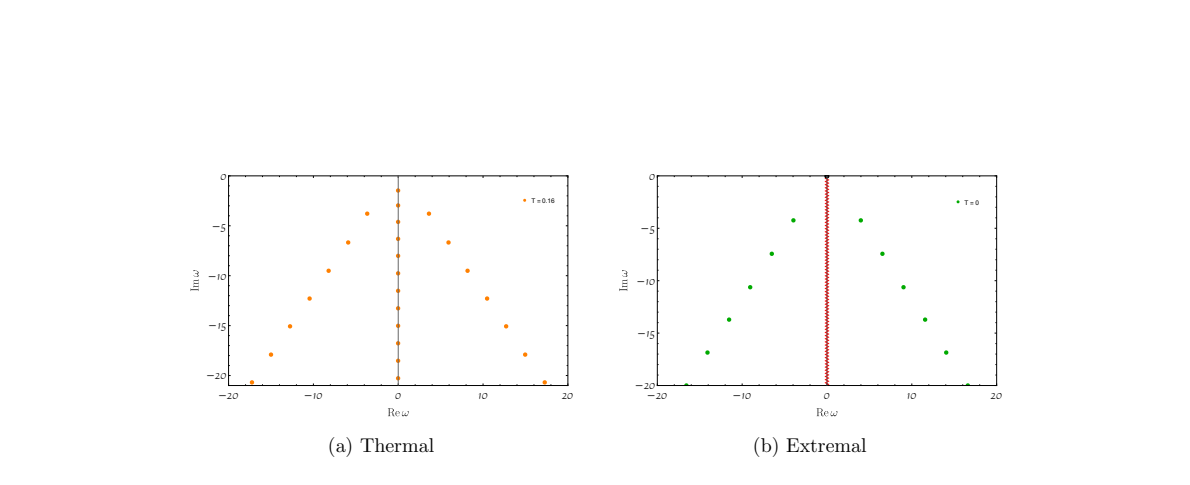
The term 'Christmas tree' to describe the QNM pattern is informal. Consider a more descriptive phrase or a reference to the figure.
show 2 more
The paper says, at §4.3
Pith says: minor objection 3 of 4
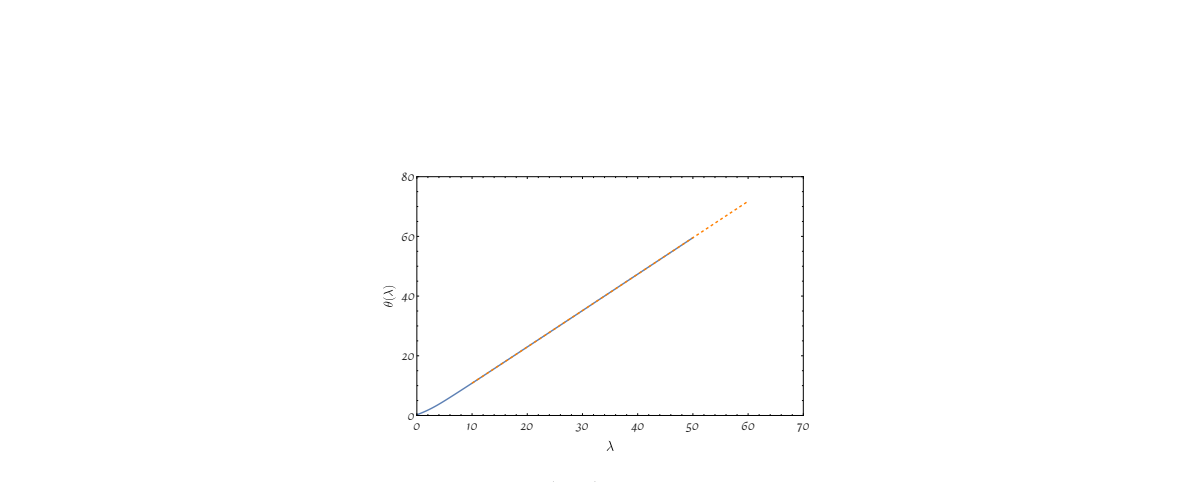
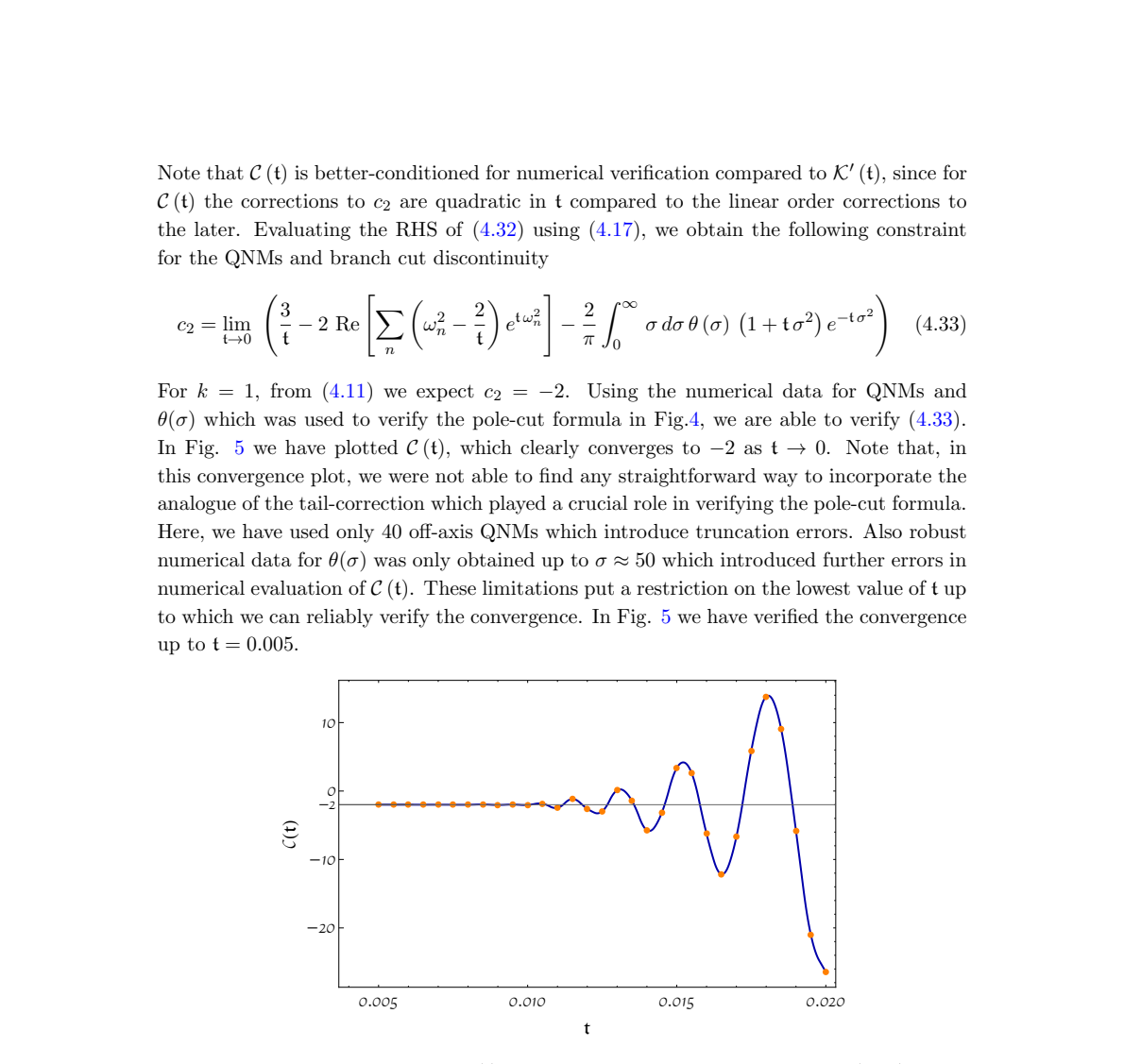
The numerical verification of the sum rule in Fig. 12 uses only 40 QNMs and $θ(σ)$ up to $σ=50$, as the authors note. The convergence plot is shown only down to $t=0.005$. A brief comment on how the extrapolation uncertainty affects the result would strengthen the presentation.
The paper says, at §1
Pith says: minor objection 4 of 4
The paper uses the notation $θ(σ)$ for the phase discontinuity, but the variable $σ$ is introduced only later. A short definition when first mentioned in §1 would improve readability.
What would settle it
Compute the spectral function using the pole-cut formula with θ(σ) obtained from a direct numerical solution of the Jost function on the branch cut for σ up to, say, 200, without relying on the fitted ansatz beyond σ=50, and compare with the direct computation of Im G_R from the bulk equation. If the agreement holds within numerical accuracy, the concern about the extrapolation is resolved.
from the skeptic's reading
How the review went
5 passes by deepseek-v4-flash · 26 Nov 2026
- Reader holds up
- Skeptic partly agrees
- Referee 4 minor
- Check against the paper
- Editor wrote the verdict above
Not run on this paper: the simulated authors' defence.
Pith checked this review's objections against the text of the paper it read.
The review in full
The review in brief, machine-written
The paper presents a clean factorization of the extremal holographic spectral function into a product over off-axis QNMs and a branch-cut factor determined by the phase discontinuity of the source function. This is a natural zero-temperature extension of the thermal product formula, and the derivation is logically presented. The numerical verification for k=1 and k=2 is convincing, and the agreement between the pole-cut reconstruction and the direct computation of Im GR is good over a wide frequency range. The paper also derives sum rules that relate the QNMs to the branch-cut data, and shows that both the pole and cut contributions produce complex-time singularities at the optical distance. The work is well-organized, and the appendices provide necessary technical details, including a WKB derivation of the asymptotic QNM parameters and a careful numerical procedure for extracting the phase discontinuity across the branch cut. The soft spots are minor and acknowledged by the authors: the numerical verification relies on extrapolating the phase discontinuity beyond sigma=50 using a fitted ansatz, and the sum-rule convergence plot uses only 40 off-axis QNMs with truncation errors. The derivation assumes the validity of the thermal product formula, which is a reasonable starting point. Overall, this is a solid contribution that will be of interest to holographers and those studying black hole correlators. It deserves a serious referee.
The strongest objection
The paper provides a clear derivation of the pole-cut formula as the extremal limit of the thermal product formula, supported by numerical verification and consistency with OPE constraints. The derivation is plausible and the numerical checks are convincing. The weakest assumption identified by the reader—the extrapolation of θ(σ) beyond σ=50—is a numerical limitation that does not undermine the central claim, as the formula is derived analytically and the numerical verification covers a wide range of ω. No internal inconsistency or logical gap was found. The paper acknowledges the limitation and the extrapolation is consistent with the asymptotic predictions from the OPE. Therefore, no load-bearing concern is identified.
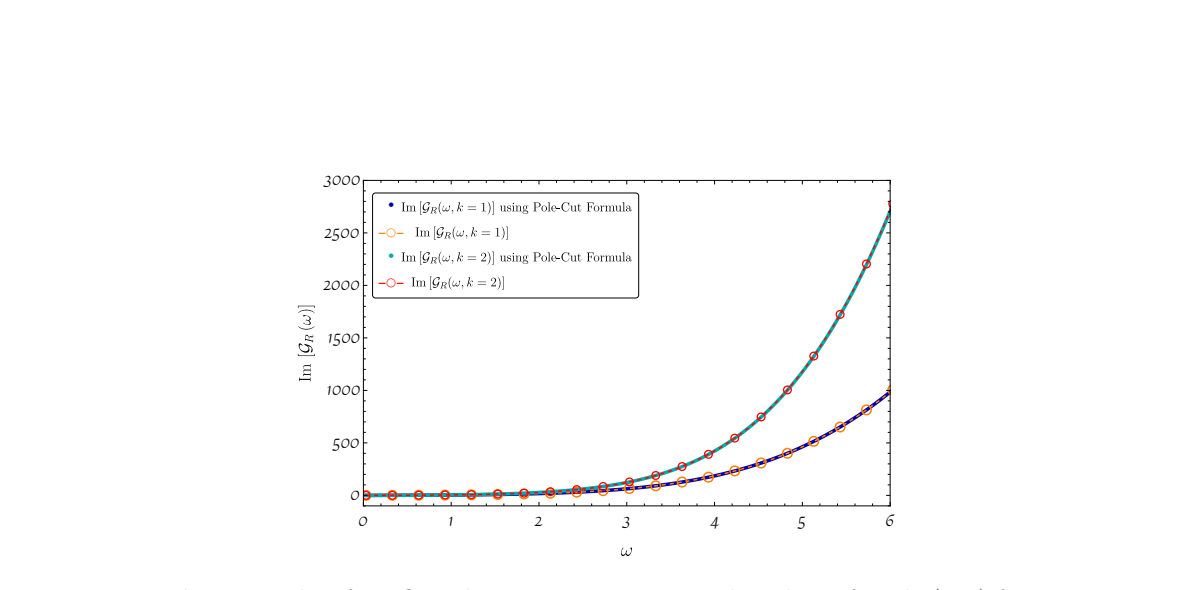
The paper's central claim is the pole-cut formula for the holographic spectral function of a neutral massless scalar on an extremal Reissner-Nordström black brane in AdS5. The derivation starts from the thermal product formula (Dodelson et al., 2023) and takes the zero-temperature limit, where on-axis QNMs and Matsubara zeros coalesce into a branch cut. The mathematical steps are clearly laid out: the product over on-axis poles and Matsubara frequencies is converted into an integral over a counting function, and the extremal limit yields an integral over the phase discontinuity θ(σ). The paper verifies the formula numerically by independently computing Im G_R from the bulk and reconstructing it from the pole-cut formula, showing excellent agreement for k=1 and k=2. Additional checks include OPE sum rules and complex-time singularities, which further support the consistency. The reader's concern about the extrapolation of θ(σ) beyond σ=50 is acknowledged, but the numerical verification does not rely solely on that extrapolation; the direct computation of Im G_R is independent. Moreover, the asymptotic form of θ(σ) is predicted by the OPE and matches the fitted parameters, providing a cross-check. No logical flaw or missing step was found. The paper is well-structured and the arguments are sound.
The referee's report
The paper derives a clean factorization of the holographic spectral function for an extremal black brane into a product over off-axis QNMs and an exponential factor encoding the branch cut, which arises from the condensation of on-axis QNMs and Matsubara zeros. This extends the thermal product formula to zero temperature and clarifies the role of the near-horizon AdS$_2$ region. The consistency with the OPE yields nontrivial sum rules that relate the asymptotic forms of the QNMs and the branch-cut discontinuity, and these are verified numerically. The results are likely to generalize to other fluctuations and black branes, making the paper a valuable contribution to the analytic structure of holographic correlators.
Pith's reading of the paper (a machine's summary, not the authors')
The paper aims to establish that the holographic spectral function of a neutral massless scalar on an extremal Reissner–Nordström black brane in AdS$_5$ can be written as a product over off-axis quasinormal modes times an exponential factor that encodes the branch cut on the negative imaginary axis. This pole-cut formula is derived as the zero-temperature limit of the thermal product formula, where on-axis QNMs and Matsubara zeros condense into a branch cut. The formula is verified numerically for momenta $k=1,2$ and leads to sum rules that relate the QNMs to the branch-cut discontinuity. It also explains complex-time singularities in terms of the optical distance to the black-brane singularity.
What carries the argument. The central object is the pole-cut formula (Eq. (1.2) or (3.24)): $ρ(ω) = ̃𝒢₀ ω exp(H_{cut}(ω)) ∏_n (1 - ω²/ω_n²)^{-1}$ (with conjugates), where $H_{cut}(ω) = - (2/π) ∫₀^∞ σ dσ θ(σ) (1/(σ²+ω²) - 1/(σ²+𝔴²))$. The function $θ(σ)$ is the phase discontinuity of the Jost function $A(ω)$ across the branch cut on the negative imaginary axis. The derivation takes the extremal limit of the thermal product formula of Dodelson et al., where the on-axis QNMs and Matsubara zeros condense into the branch cut, and the cancellation of divergences is handled via an integral representation.
Core claim. The paper claims that the holographic spectral function $ρ(ω)$ for a neutral massless scalar on the extremal Reissner–Nordström black brane in AdS$_5$ admits a factorization into a product over off-axis quasinormal modes (QNMs) and an exponential factor encoding the branch cut on the negative imaginary axis. The formula is $ρ(ω) = ̃𝒢₀ ω exp(H_{cut}(ω)) ∏_n (1 - ω²/ω_n²)^{-1}$ (with conjugate poles), where $H_{cut}(ω)$ is determined by an integral over the phase discontinuity $θ(σ)$ of the Jost function across the branch cut. This structure emerges as the zero-temperature limit of the thermal product formula of Dodelson et al., with the on-axis QNMs and Matsubara zeros condensing into the branch cut.
The premise it rests on. The derivation assumes the validity of the thermal product formula (Dodelson et al.) and that the on-axis QNMs and Matsubara zeros condense into a branch cut in the extremal limit. The numerical verification relies on extrapolating θ(σ) beyond σ=50 using a fitted ansatz.
If the paper is right (Pith's inferences, not the authors')
The spectral function is completely determined by the off-axis QNMs and the phase discontinuity function $θ(σ)$.
Consistency with the OPE yields extremal sum rules that relate the asymptotic forms of QNMs and $θ$, with the coefficient $c_2 = -2k^2$ verified numerically.
Complex-time singularities of the retarded correlator arise separately from the pole and cut contributions, both located at the optical distance from the boundary to the black-brane singularity.
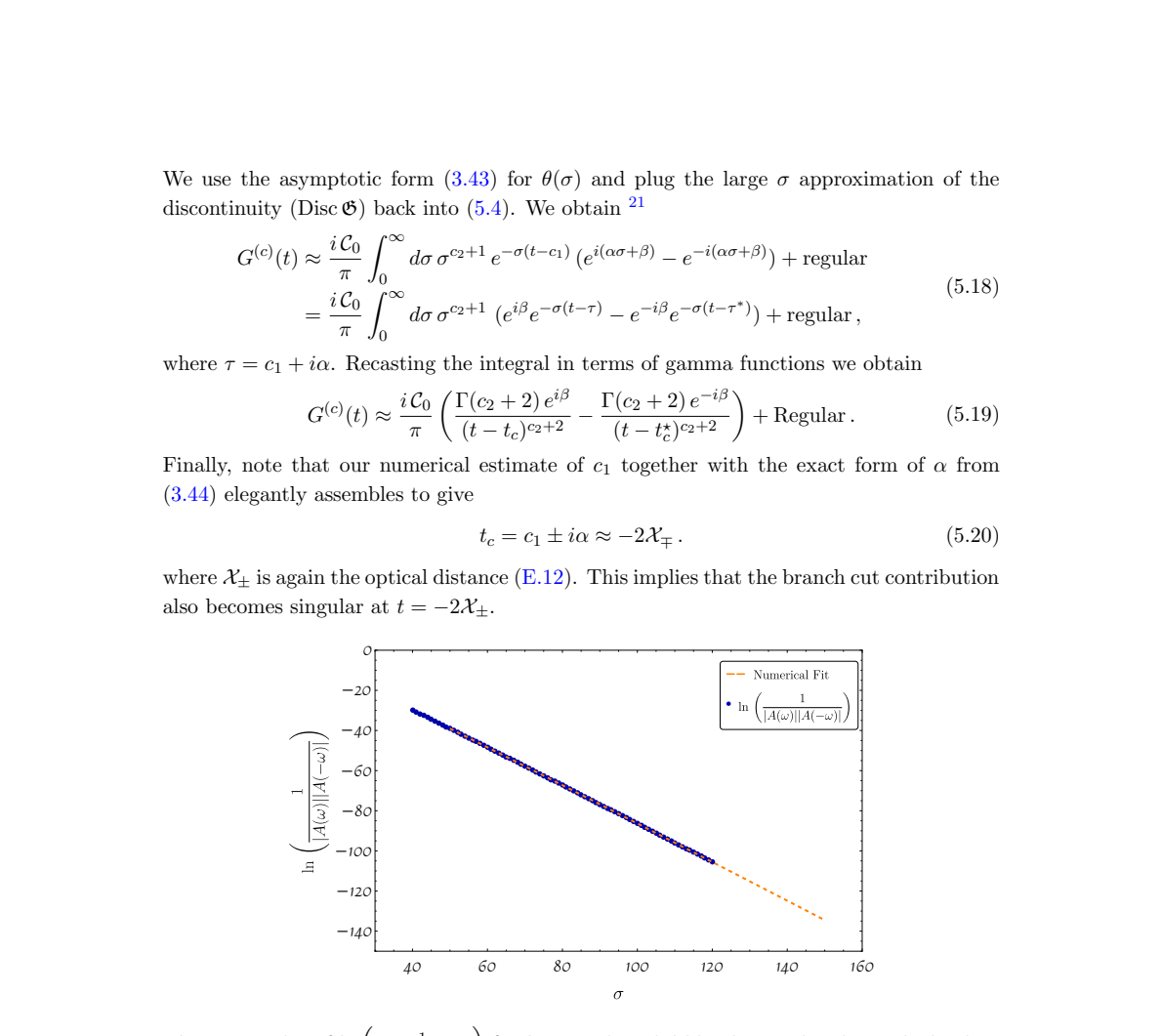
The asymptotic parameters of the QNMs ($a$, $q$) and of $θ$ ($α$, $β$) are linked by the OPE, with $α = 7π/18$ and $β = -π/2$ predicted and matched numerically.
The pole-cut factorization is expected to hold for more general fluctuations of extremal black branes, extending beyond the neutral massless scalar case.
The relationship between QNMs and branch-cut data may allow a bootstrap of the spectral function from asymptotic data alone, without solving the full bulk equations.
The pole-cut structure might extend to asymptotically flat black holes, providing a similar factorization for greybody factors.
The cancellation of divergences between Matsubara zeros and on-axis QNMs in the extremal limit suggests a deeper analytic structure that could be explored in near-extremal regimes.
Check this review
What was read
The passes were given all 172,970 characters of the paper's LaTeX source.
Fingerprint of that text (SHA-256): 48174e7416f3d71cae132df2123a9242ab4e8969515cb8993fb0cbc6ca398376
Pith does not keep that text. Rebuilt from the paper's source or PDF by the same code, it has this fingerprint if it is the same text. From a copy of Pith's code:
PYTHONPATH=. python scripts/review_input_check.py 2611.34824
The passes, in the order they ran
- Reader deepseek-v4-flash · medium effort · $0.0055 · instructions of the Reader, fingerprint f9ead7300382…
- Skeptic deepseek-v4-flash · medium effort · $0.0052 · instructions of the Skeptic, fingerprint 8f88c0f61488…
- Referee deepseek-v4-flash · medium effort · $0.0051 · instructions of the Referee, fingerprint a852d99aea0d…
- Editor deepseek-v4-flash · medium effort · $0.0048 · instructions of the Editor, fingerprint e7211f6a3d27…
- Circularity check deepseek-v4-flash · medium effort · $0.0049 · instructions of the Circularity check, fingerprint e9946e39d67b…
- Summary for the page deepseek-v4-flash · medium effort · temperature 0.2 · $0.0051 · instructions of the Summary for the page, fingerprint e4f56bf568e7…
The passes cost $0.031 in model calls together.
Version stamped on this review: pith-pipeline@v1.4.1-daily-deepseek-or-medium+deepseek/deepseek-v4-flash+p.505d180dcaef
Each link opens a pass's instructions as plain text, the exact bytes its fingerprint was taken over. Every stored set of instructions.
curl -s https://pith.science/methodology/prompts/f9ead730038216984cfb56d7cb34332bdf691828296a1de4245f3d6667d4bf56 | sha256sum
prints the fingerprint of the reader's instructions. The same works for every pass.
The receipt
The review's fingerprint was taken on 26 Nov 2026. The review you are reading still matches it.
Fingerprint of the review (SHA-256): 9becdae3651428d8063dd311c57ec7efaf9793e47853de87894bfc07198cab3e
curl -s 'https://pith.science/api/v1/verdicts/2611.34824?form=canonical' | sha256sum
prints the fingerprint of the review as it stands now. The rule, in four steps.
A matching fingerprint shows the review has not changed since that date. It does not show that the review is right.
How often reviews like this one are right
Reviews like this one: written by deepseek-v4-flash, from the paper's LaTeX source.
How often objections from reviews like this one are right: not yet measured
Reviews by people
This review was written by a machine. No person has reviewed this paper on Pith yet. A scientist listed on Pith can review it for a fee, and their review is published here whatever it concludes.
The paper
Abstract
We show that the holographic spectral function of a neutral massless scalar on the extremal Reissner-Nordstrom black brane in AdS5 admits an elegant formula in terms of the quasi-normal modes (QNMs) and branch-cut data. In the extremal case, the spectral data comprises the zeros of the boundary source function, i.e. the QNMs, as well as its phase discontinuity across the branch cut on the negative imaginary axis of the complex frequency plane. This formula neatly factorizes into an infinite product over the QNM poles and a factor encoding the branch cut discontinuity. We derive this pole-cut formula as the zero-temperature limit of the QNM product formula for holographic thermal correlators, with the branch-cut contribution arising from the coalescence of the QNMs on the negative imaginary axis. We also clarify the role of the near-horizon AdS2 region in this context. Consistency with the OPE of the boundary correlator provides extremal sum-rules involving both the QNMs as well as the phase discontinuity function. We also find that this holographic consistency forces the asymptotic form of the QNMs to be related to the asymptotics of the phase discontinuity function. We verify our formula and these OPE constraints numerically. We also demonstrate that, in the time domain, the pole and cut factors each produce complex-time singularities, whose location is determined by the optical distance between the boundary and the black-brane singularity. We expect the pole-cut factorization structure of spectral functions to hold for more general fluctuations of extremal black branes.
The paper's own sentences, arranged, kept beside the review and separate from it. Each label is drawn from a closed vocabulary; the number beside it is the probability the classifier gave that label. No sentence in this record was written by a model.
abstract compiled · 2026-11-26
The authors' main claim, as the classifier picked it out 0.99
“We show that the holographic spectral function of a neutral massless scalar on the extremal Reissner-Nordstrom black brane in $AdS_5$ admits an elegant formula in terms of the quasi-normal modes (QNMs) and branch-cut data.”
How the main claim is stated: asserted 1.00
What the abstract itself states, as probabilities: claims first 0.05 · states limitation 0.25 · human participants 0.01 · controlled comparison 0.02 · randomized assignment 0.01 · states quantitative result 0.08 · compares with prior results 0.52 · mentions code or data availability 0.02
The abstract, sentence by sentence
This table labels the abstract only (arXiv listing abstract v1). The number is the probability the classifier gave the label.
| Sentence | Role | The authors' own work | States the main conclusion | Strength |
|---|---|---|---|---|
| We show that the holographic spectral function of a neutral massless scalar on the extremal Reissner-Nordstrom black brane in $AdS_5$ admits an elegant formula in terms of the quasi-normal modes (QNMs) and branch-cut data. | result 0.64 | 0.96 | 0.88 | asserted 1.00 |
| In the extremal case, the spectral data comprises the zeros of the boundary source function, i.e. the QNMs, as well as its phase discontinuity across the branch cut on the negative imaginary axis of the complex frequency plane. | result 0.70 | 0.53 | 0.12 | asserted 1.00 |
| This formula neatly factorizes into an infinite product over the QNM poles and a factor encoding the branch cut discontinuity. | result 0.96 | 0.80 | 0.41 | asserted 1.00 |
| We derive this pole-cut formula as the zero-temperature limit of the QNM product formula for holographic thermal correlators, with the branch-cut contribution arising from the coalescence of the QNMs on the negative imaginary axis. | method 0.77 | 0.96 | 0.16 | asserted 1.00 |
| We also clarify the role of the near-horizon $AdS_2$ region in this context. | contribution 0.85 | 0.74 | 0.03 | asserted 0.79 |
| Consistency with the OPE of the boundary correlator provides extremal sum-rules involving both the QNMs as well as the phase discontinuity function. | result 0.92 | 0.79 | 0.09 | asserted 0.70 |
| We also find that this holographic consistency forces the asymptotic form of the QNMs to be related to the asymptotics of the phase discontinuity function. | result 0.94 | 0.94 | 0.07 | asserted 1.00 |
| We verify our formula and these OPE constraints numerically. | method 0.61 | 0.97 | 0.05 | asserted 1.00 |
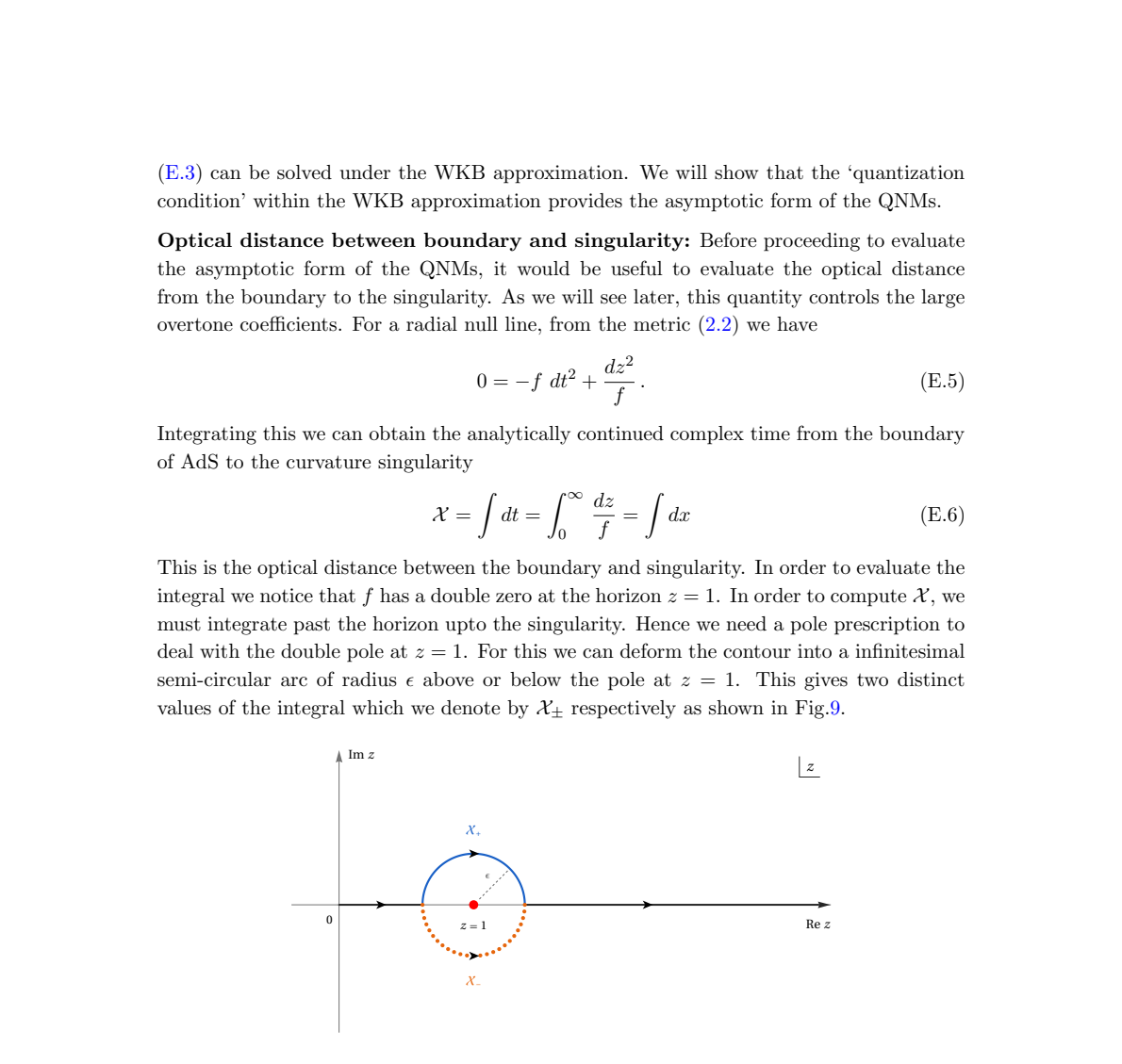
| We also demonstrate that, in the time domain, the pole and cut factors each produce complex-time singularities, whose location is determined by the optical distance between the boundary and the black-brane singularity. | result 0.97 | 0.96 | 0.06 | asserted 1.00 |
| We expect the pole-cut factorization structure of spectral functions to hold for more general fluctuations of extremal black branes. | future work 0.68 | 0.36 | 0.12 | hedged possibility 0.57 |
What kind of paper the classifier reports this is: theoretical result 1.00 · evidence from proof or derivation 1.00
What was examined, and what was not
Sources read
- arXiv listing abstract v1
Not examined
- full text
- figures and tables
- references and citing sentences
- relations to other papers
Levels run
- P abstract
Not run
- S sections
- T body sentences
- C citations
- R cross-paper relations
How the labels were made
Compiled by classifier-1.13.0 via TypeSafe API, question bank abstract-p1-20260923, 2026-11-26: 1 request, 7,777 input tokens.
Every quoted sentence on this record is the authors'. Every label is from Pith's closed vocabulary, with the probability shown beside it. This record as JSON
Figures (10)
Figures are the authors', reproduced from the paper.
References (64)
- [1] E. Witten,Anti de Sitter space and holography,Adv. Theor. Math. Phys.2(1998) 253 [hep-th/9802150] on PithPith's reviewarXiv
- [2] S. S. Gubser, I. R. Klebanov and A. M. Polyakov,Gauge theory correlators from noncritical string theory,Phys. Lett. B428(1998) 105 [hep-th/9802109] on PithPith's reviewarXiv
- [3] D. T. Son and A. O. Starinets,Minkowski space correlators in AdS / CFT correspondence: Recipe and applications,JHEP09(2002) 042 [hep-th/0205051] on PithPith's reviewarXiv
- [4] P. Kovtun, D. T. Son and A. O. Starinets,Viscosity in strongly interacting quantum field theories from black hole physics,Phys. Rev. Lett.94(2005) 111601 [hep-th/0405231] on PithPith's reviewarXiv
- [5] J. R. David and L. Schwarze,Light-like retarded correlators and the horizon,2607.24242 on PithPith's reviewarXiv
- [6] M. Dodelson, C. Iossa, R. Karlsson and A. Zhiboedov,A thermal product formula,JHEP01 (2024) 036 [2304.12339]. – 46 – on PithPith's reviewarXiv
- [7] J. Bhattacharya, N. Padhi, A. Sharma and S. Singha,Thermal product formula for shear modes,JHEP08(2025) 170 [2504.17781] on PitharXiv
- [8] S. Grozdanov and M. Vrbica,Duality and four-dimensional black holes: Gravitational waves, algebraically special solutions, pole skipping, and the spectral duality relation in holographic thermal CFTs,Phys. Rev. D112(2025) 066019 [2505.14229] on PitharXiv
- [9] S. Grozdanov and M. Vrbica,Thermal field theory correlators in the large-N limit and the spectral duality relation,JHEP02(2026) 106 [2509.18074] on PithPith's reviewarXiv
- [10] G. T. Horowitz, H. Leung, L. Queimada and Y. Zhao,Boundary signature of singularity in the presence of a shock wave,SciPost Phys.16(2024) 060 [2310.03076] on PithPith's reviewarXiv
- [11] M. Vrbica,Spectral duality relation for thermal dynamics in holographic field theories, Ph.D. thesis, Edinburgh U., 2026. 10.7488/era/7450 on Pithdoi:10.7488/era/7450
- [12] M. Dodelson,Ringdown in the SYK model,SciPost Phys.19(2025) 081 [2408.05790] on PitharXiv
- [13] S. Demulder, M. Knysh and A. Rolph,Krylov exponents and power spectra for maximal quantum chaos: an eft approach,JHEP04(2026) 059 [2508.05444] on PitharXiv
- [14] T. Faulkner, H. Liu, J. McGreevy and D. Vegh,Emergent quantum criticality, Fermi surfaces, and AdS(2),Phys. Rev. D83(2011) 125002 [0907.2694] on PithPith's reviewarXiv
- [15] N. Iqbal, H. Liu and M. Mezei,Semi-local quantum liquids,JHEP04(2012) 086 [1105.4621] on PithPith's reviewarXiv
- [16] M. Edalati, J. I. Jottar and R. G. Leigh,Shear Modes, Criticality and Extremal Black Holes, JHEP04(2010) 075 [1001.0779] on PithPith's reviewarXiv
- [17] M. Edalati, J. I. Jottar and R. G. Leigh,Holography and the sound of criticality,JHEP10 (2010) 058 [1005.4075] on PithPith's reviewarXiv
- [18] P. Arnaudo and B. Withers,Exact low-temperature Green’s functions in AdS/CFT: From the Heun equation to the confluent Heun equation,Phys. Rev. D111(2025) L121903 [2412.01923] on PithPith's reviewarXiv
- [19] E. Pr´ eau,Near-extremal hydrodynamics and the holographic product formula,JHEP08 (2026) 171 [2512.19330] on PithPith's reviewarXiv
- [20] L. Fidkowski, V. Hubeny, M. Kleban and S. Shenker,The Black hole singularity in AdS / CFT,JHEP02(2004) 014 [hep-th/0306170] on PithPith's reviewarXiv
show 44 more
- [21] G. Festuccia and H. Liu,Excursions beyond the horizon: Black hole singularities in Yang-Mills theories. I.,JHEP04(2006) 044 [hep-th/0506202] on PithPith's reviewarXiv
- [22] E. Parisini, K. Skenderis and B. Withers,The ambient space formalism,JHEP05(2024) 296 [2312.03820] on PithPith's reviewarXiv
- [23] N. ˇCeplak, H. Liu, A. Parnachev and S. Valach,Black hole singularity from OPE,JHEP10 (2024) 105 [2404.17286] on PithPith's reviewarXiv
- [24] I. Buri´ c, I. Gusev and A. Parnachev,Thermal holographic correlators and KMS condition, JHEP09(2025) 053 [2505.10277] on PithPith's reviewarXiv
- [25] I. Buri´ c, I. Gusev and A. Parnachev,Holographic correlators from thermal bootstrap,JHEP 05(2026) 059 [2508.08373] on PithPith's reviewarXiv
- [26] J. Barrat, D. N. Bozkurt, E. Marchetto, A. Miscioscia and E. Pomoni,Analytic thermal bootstrap meets holography,JHEP05(2026) 180 [2510.20894]. – 47 – on PitharXiv
- [27] N. Afkhami-Jeddi, S. Caron-Huot, J. Chakravarty and A. Maloney,Imprint of the black hole singularity on thermal two-point functions,Phys. Rev. D114(2026) 025005 [2510.21673] on PithPith's reviewarXiv
- [28] M. Dodelson, C. Iossa and R. Karlsson,Bouncing off a stringy singularity,JHEP07(2026) 161 [2511.09616] on PitharXiv
- [29] N. ˇCeplak, H. Liu, A. Parnachev and S. Valach,Fooling the censor: going beyond inner horizons with the OPE,JHEP05(2026) 001 [2511.09638] on PitharXiv
- [30] H. F. Jia and M. Rangamani,Thermal spectral function asymptotics and black hole singularity in holography,Phys. Rev. D114(2026) 046025 [2512.15114] on PithPith's reviewarXiv
- [31] S. Ali Ahmad, A. Almheiri and S. Lin,Continuing past the inner horizon using WKB, 2601.02354 on PitharXiv
- [32] S. Giombi, Y.-Z. Li and J. Shan,Bouncing singularities and thermal correlators on line defects,JHEP07(2026) 170 [2603.11012] on PithPith's reviewarXiv
- [33] P. Arnaudo and B. Withers,Analytic structure of holographic thermal correlators from Fourier series,JHEP06(2026) 205 [2603.13469] on PitharXiv
- [34] S. Grozdanov, S. Valach and M. Vrbica,Bouncing geodesics, black hole singularities, and singularities of thermal correlators,JHEP08(2026) 022 [2603.15598] on PithPith's reviewarXiv
- [35] H. F. Jia and M. Rangamani,Exact holographic thermal spectral functions: OPE, non-perturbative corrections, and black hole singularity,2604.10803 on PithPith's reviewarXiv
- [36] P. Arnaudo and B. Withers,Bouncing singularities in Schwarzschild: a geometric origin of the QNM convergence region,2605.16489 on PithPith's reviewarXiv
- [37] S. Grozdanov, V. Movrin and S. Valach,Bouncing Geodesics, Singularities, and the Cavity Thermal Product Formula in Asymptotically Flat and de Sitter Black Holes,2606.11297 on PithPith's reviewarXiv
- [38] I. Buri´ c, C.-M. Chang, I. Gusev, E. Helfenberger, A. Parnachev and M. Rangamani,Thermal two-point functions in SYK and complex-time singularities,2607.05258 on PithPith's reviewarXiv
- [39] Z. Komargodski,Fate of Bouncing Singularities at FiniteG N ,2609.31309 on PithPith's reviewarXiv
- [40] M. Liu and S.-M. Ruan,Smoothing the bouncing-geodesic singularity in ads/cft,2611.03347 on PithPith's reviewarXiv
- [41] J. Chakravarty,Imprint of black hole interior on thermal four-point correlators,JHEP09 (2026) 034 [2512.10912] on PithPith's reviewarXiv
- [42] S. A. Hartnoll and A. Zhiboedov,Can one hear the shape of a black hole singularity?, 2609.07514 on PithPith's reviewarXiv
- [43] N. ˇCeplak and S. Valach,Where’s Kasner? OPE Signature of Kasner Exponents, 2609.23776 on PithPith's reviewarXiv
- [44] L.-L. Gao, Y. Liu and H.-D. Lyu,Critical Kasner scaling from Cauchy-horizon collapse near holographic phase transitions,2609.24227 on PithPith's reviewarXiv
- [45] Z.-H. Li and R.-Q. Yang,Constraints on Kasner Exponents from Holography and Energy Conditions,2609.16980 on PithPith's reviewarXiv
- [46] Z.-Q. Xiao, J. Nian and L. Li,Channel-Resolved High-Overtone Quasinormal Modes Decode Kasner Scaling inside Black Holes,2609.17426 on PithPith's reviewarXiv
- [47] C. Coviello, A. Gupta, R. A. Hennigar, K. Shi and A. Svesko,Quasinormal modes and quantum black hole interiors,2609.26724. – 48 – on PithPith's reviewarXiv
- [48] F. Denef, S. A. Hartnoll and S. Sachdev,Quantum oscillations and black hole ringing,Phys. Rev. D80(2009) 126016 [0908.1788] on PithPith's reviewarXiv
- [49] T. Faulkner, N. Iqbal, H. Liu, J. McGreevy and D. Vegh,From Black Holes to Strange Metals,1003.1728 on PithPith's reviewarXiv
- [50] T. Faulkner and J. Polchinski,Semi-Holographic Fermi Liquids,JHEP06(2011) 012 [1001.5049] on PithPith's reviewarXiv
- [51] A. Jansen,Overdamped modes in Schwarzschild-de Sitter and a Mathematica package for the numerical computation of quasinormal modes,Eur. Phys. J. Plus132(2017) 546 [1709.09178] on PithPith's reviewarXiv
- [52] I. Buri´ c, I. Gusev and A. Parnachev,Stringy resolution of bouncing singularities, 2610.12311 on PithPith's reviewarXiv
- [53] P. Arnaudo, C. Iossa, R. Karlsson and B. Withers,OPE = QNM,2607.24909 on PithPith's reviewarXiv
- [54] J. Barrat, D. N. Bozkurt, E. Marchetto, A. Miscioscia and E. Pomoni,The analytic bootstrap at finite temperature,JHEP05(2026) 104 [2506.06422] on PithPith's reviewarXiv
- [55] N. Abbasi,From quasinormal mode poles to branch cuts at finiteN,2611.20912 on PithPith's reviewarXiv
- [56] J. Bhattacharya, A. Mishra, A. Sharma and S. Singha,A spectral formula for Greybody factors,To appear[2612.xxxxx] on Pith
- [57] N. Iqbal and H. Liu,Universality of the hydrodynamic limit in AdS/CFT and the membrane paradigm,Phys. Rev. D79(2009) 025023 [0809.3808] on PithPith's reviewarXiv
- [58] L. Motl and A. Neitzke,Asymptotic black hole quasinormal frequencies,Adv. Theor. Math. Phys.7(2003) 307 [hep-th/0301173] on PithPith's reviewarXiv
- [59] E. Berti, V. Cardoso and A. O. Starinets,Quasinormal modes of black holes and black branes,Class. Quant. Grav.26(2009) 163001 [0905.2975] on PithPith's reviewarXiv
- [60] V. Cardoso, J. Natario and R. Schiappa,Asymptotic quasinormal frequencies for black holes in nonasymptotically flat space-times,J. Math. Phys.45(2004) 4698 [hep-th/0403132] on PithPith's reviewarXiv
- [61] J. Natario and R. Schiappa,On the classification of asymptotic quasinormal frequencies for d-dimensional black holes and quantum gravity,Adv. Theor. Math. Phys.8(2004) 1001 [hep-th/0411267] on PithPith's reviewarXiv
- [62] H. F. Jia and M. Rangamani,Expiscating the black hole singularity in holography, 2611.13261 on PithPith's reviewarXiv
- [63] S. Valach and M. Vrbica,The spectral anatomy of complex-time singularities,2611.18520 on PithPith's reviewarXiv
- [64] R. Emparan, S. Murthy and S. Trezzi,The Relaxation of Quantum Near-Extremal Black Holes. (I) Microcanonical States, Pruning of Quasinormal Modes, and the Aretakis Instability,2611.31459. – 49 – on PithPith's reviewarXiv
Challenges and discussion
Disagree with the review, or know something it missed? Leave a comment, or challenge this review formally: a challenge becomes a permanent entry in this paper's record, and its decision is published here.
Come back by email
A short list of the week's newly reviewed papers. Nothing is sent until you confirm from your inbox, and every email has a link that stops it. No account.
No comments yet.
Sign in to comment