High Energy Physics - Theory · arXiv:2611.13261 v1 · submitted 9 Nov 2026 · 113 references
Expiscating the black hole singularity in holography
The paper says
“We argue that the leading exponential rate in the high frequency asymptotics of holographic thermal two-point functions is independent of the conformal dimension and spin (held fixed) of the operator.”
more of the abstract
We analyze the leading universal WKB spectral curve governing the asymptotics at non-vanishing momentum scaling with frequency. We show that its classical action governs time domain signatures of the bouncing geodesic singularity, highly damped quasinormal modes, and the asymptotics of multi-stress tensor OPE coefficients. Beyond the leading order, we examine linear and dimension-dependent sublinear scalings of momentum with frequency. In both regimes, we derive the connection matrix between the boundary and the horizon using exact-WKB techniques. The results show a factorization of the spectral function into a perturbative part controlled by the OPE and a non-perturbative part governed by WKB transport. For linear scaling at fixed k/ω in the timelike regime, the turning points controlling physical transport remain separated from the curvature singularity. Nevertheless, a singularity-anchored representative of the same transport homology class determines the leading WKB action. In the sublinear regime, the relevant turning points approach the singularity. We match an exact solution of the near-singularity scaled equation to the exterior WKB solution to determine the connection matrix and spectral function. Our results clarify how the black hole curvature singularity is encoded in dual field theory observables at leading order in the planar expansion.
from the abstract
Pith says
Machine review · deepseek-v4-flash · 11 Nov 2026 · what was read was not recorded · not checked by a person
It can be wrong. Challenge this review or reply to it.
Holds up, with conditions. A serious, well-targeted paper whose universal WKB claim mostly holds, but the singularity-anchored cycle carrying the leading action is chosen by hypothesis plus empirical selection, and the contour-deformation bridge in §13.1 is the part to scrutinize before trusting the result. This line is wrong
4 major objections · 5 minor
How often objections from reviews like this one are right: not yet measured
Not checked: figures, code, what the 113 references say.
The paper says, at §6, footnote 8, §8.1
The review did not quote this passage.
A classifier read this sentence of the paper as acknowledging the concern (probability 0.74):
“More pertinently, we hypothesize that the cycle encircles the singularity.”
Pith says: Objection 1 of 4 · major
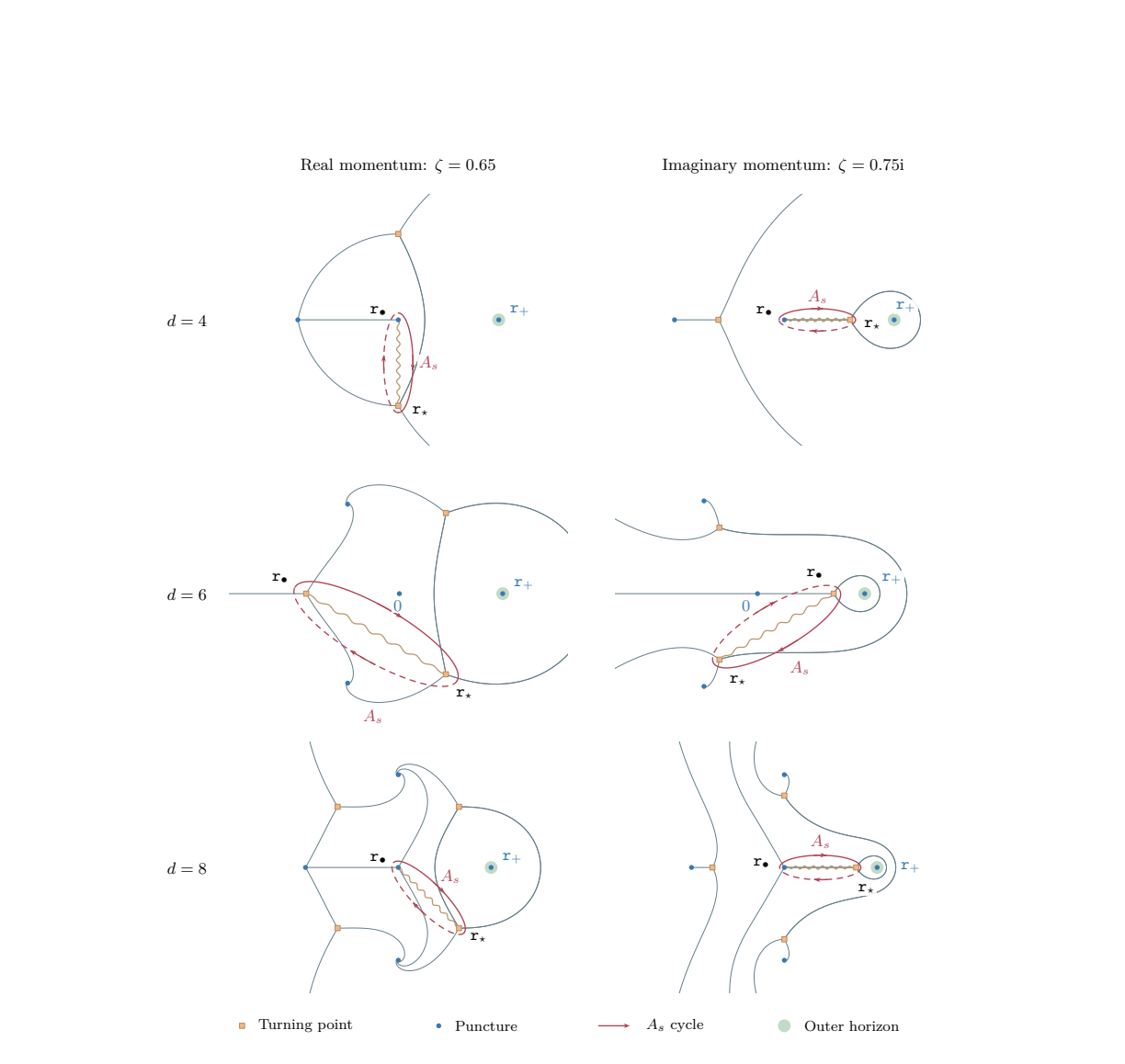
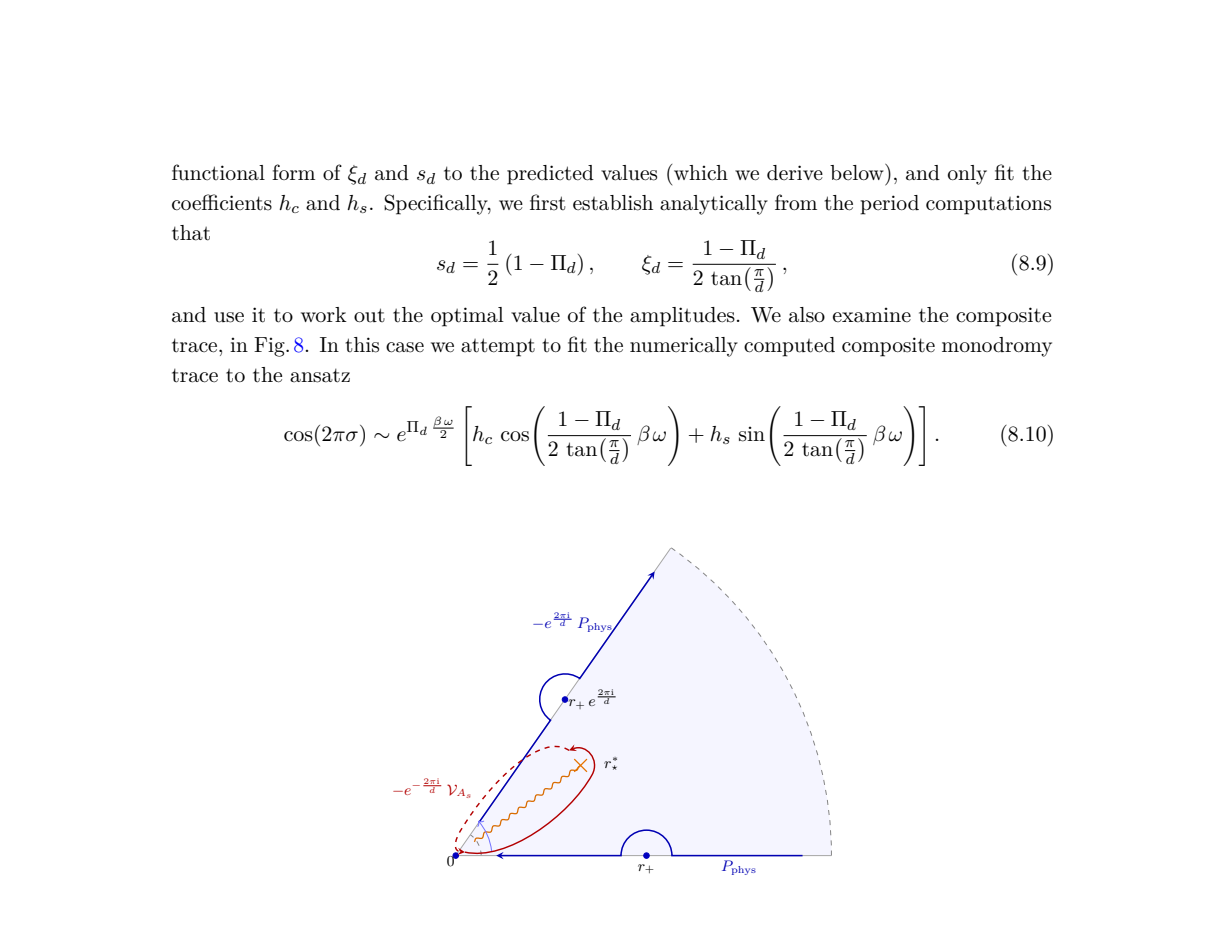
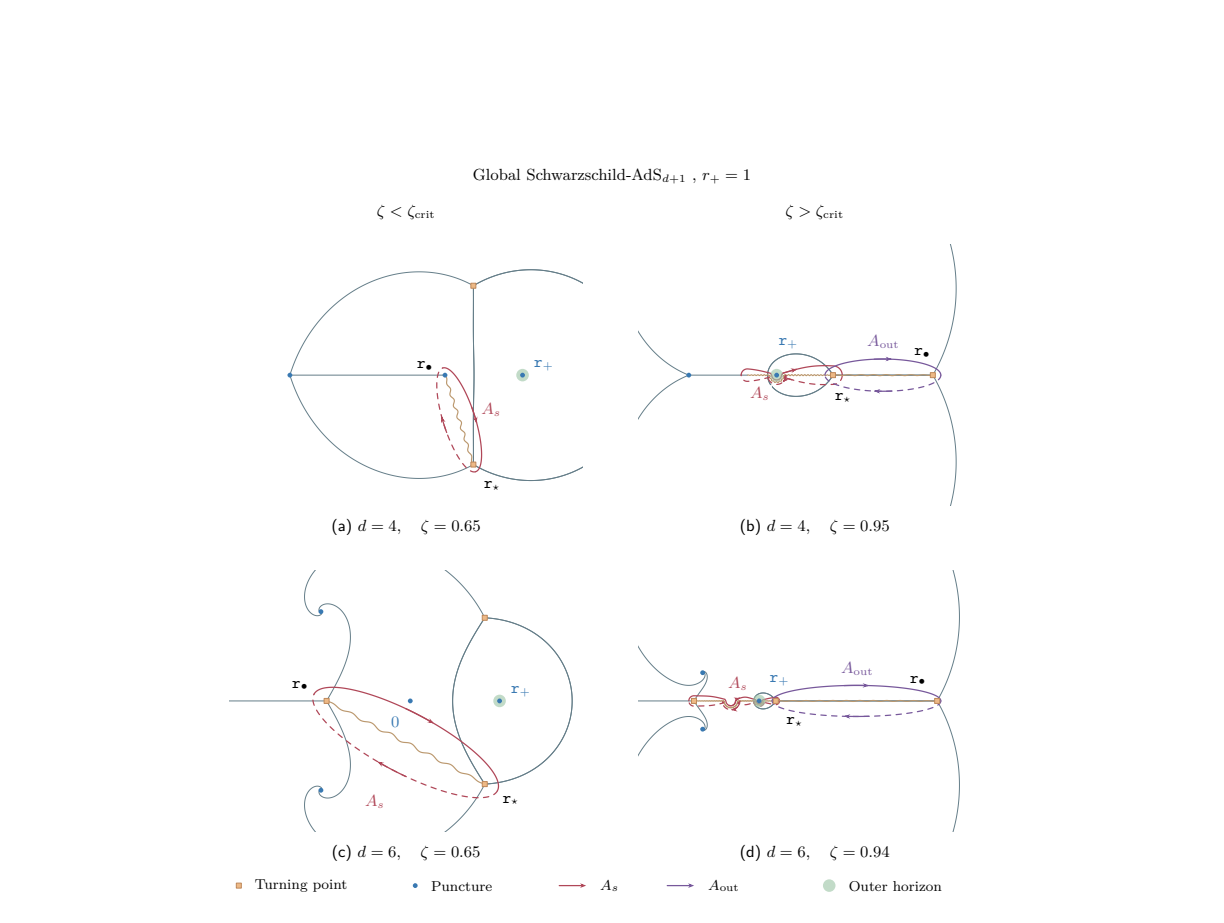
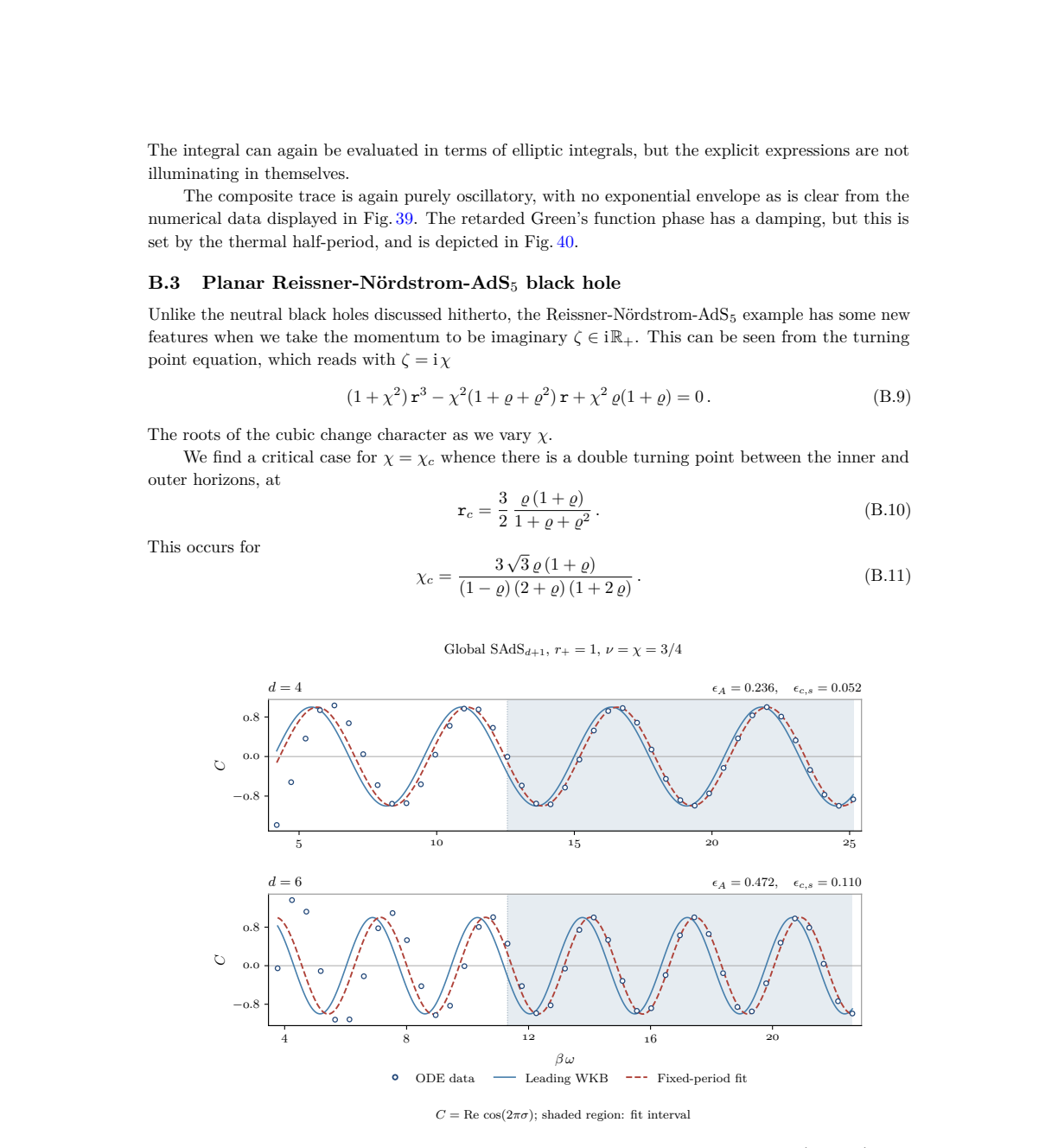
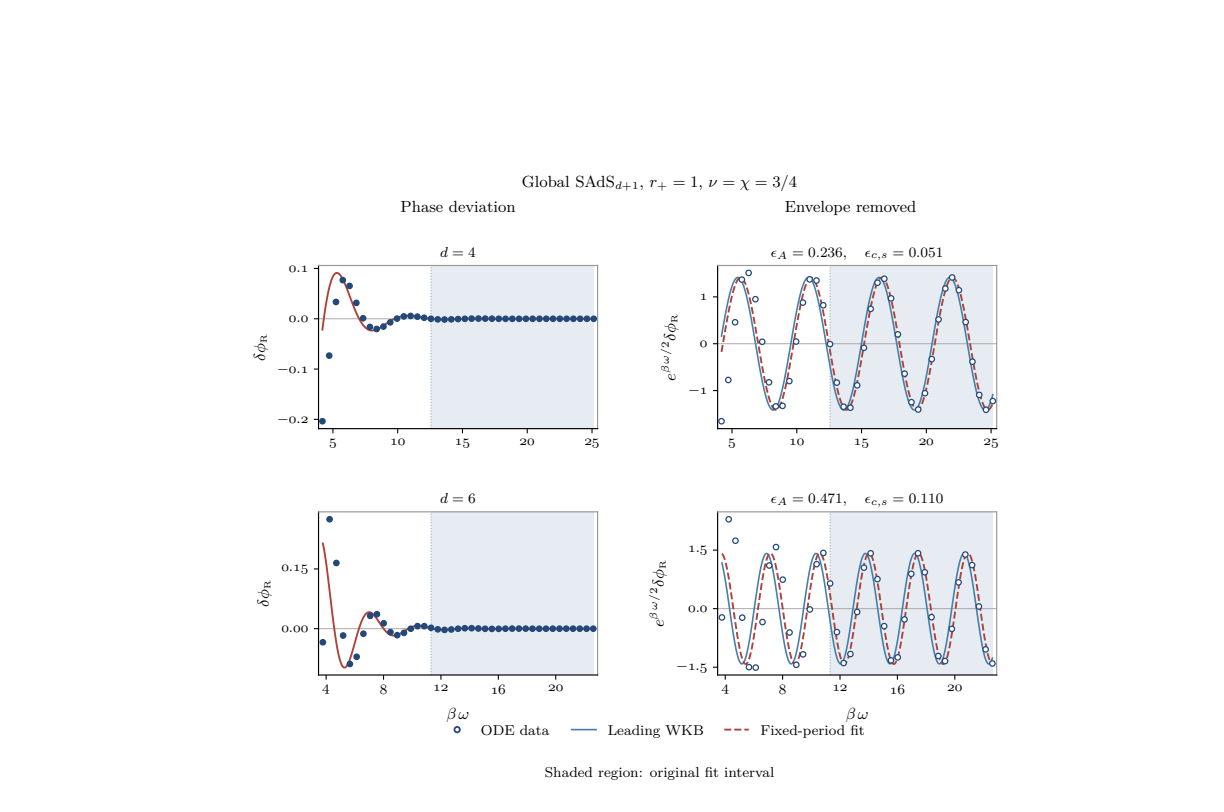
The load-bearing identification of the As-cycle is a hypothesis, and the distinguished turning point r* is selected empirically: §6 states 'we hypothesize that the cycle encircles the singularity' (b406), and footnote 8 reports the range 3π/2 < arg r* < 2π as 'observed empirically, but do not prove'; §8.1 explains the choice was made 'by taking inspiration from the d=4 analysis' and then verified numerically.
more of objection 1
This matters because the predicted exponential rate (6.25), the quasinormal spacing (8.25), and the time-domain singular locus (8.24) all depend on the homology class of the As-cycle. The extensive numerical agreement in d = 4, 6, 8 is strong empirical support, but as it stands the universality claim A1/B2 does not follow from the principal-symbol argument alone; it additionally requires that the leading WKB action be the period of the singularity-anchored cycle. I recommend the authors either supply a derivation of why the exact-WKB transport cycle lies in this homology class, or state explicitly which claims rest on the empirical identification.
This review says the paper's mathematics is wrong. Pith did not check that against the paper's source.
The paper says, at §10.2, §13.1 (C3)
The review did not quote this passage.
Pith says: Objection 2 of 4 · major
The contour-deformation claim C3 — that the singularity-anchored representative follows from a simple deformation of the true WKB path — is asserted but not demonstrated in the provided text for the general d = 4n curves. This matters because §10.2 explicitly states that the natural cycles entering the exact-WKB transport, γ_j ∼ {0, z_j}, are 'not the cycles that encircle the singularity' (10.23).
more of objection 2
The decisive equality is that the leading exponential of the Voros symbol X⋆ entering (11.5) equals e^{-iw V_As} with V_As as in (6.13), up to horizon thermal factors; if the true transport cycle belongs to a different homology class, the exponential rate, quasinormal spacing, and time-domain singular locus all shift by the difference of the two periods. The numerical checks in §8 mitigate but do not eliminate this concern, since they check the final action rather than the homology class. I would like to see the deformation argument of §13.1 written out for the general even-d case, including the role of the d = 4n vs. d = 4n+2 distinction flagged in §8.1.
The paper says, at §6.4, §8.1
The review did not quote this passage.
A classifier read this sentence of the paper as acknowledging the concern (probability 0.83):
“We will provide a sharper argument for (6.17) in part IV.”
Pith says: Objection 3 of 4 · major
The Stokes factor S = −i in (6.21), fixed 'by a local Airy analysis', is stated without derivation, and the statement in (6.17) that the WKB action assembles as IWKB = 2P_phys + i Σ η_k (r+ β_k / 2) + V_As is presented heuristically with the sharper argument deferred to Part IV.
more of objection 3
Given that the exact-WKB analysis in §10–12 does supply this sharper argument for the specific examples (planar/global Schwarzschild-AdS and Reissner-Nordström-AdS5), I accept the derivation for those cases, but the general even-d form of IWKB in (8.11), and in particular the unified Πd(ζ) expression, is only sketched: the d = 4n case uses (8.14)–(8.16) and the d = 4n+2 case uses the separate argument (8.19)–(8.20). The claim that the picture 'should be clear that it holds in all even dimensions' (end of §8.1) is an extrapolation beyond the d = 4, 6, 8 checks; please make the status of the general-d statement explicit.
The paper says, at §13.2 (C4)
The review did not quote this passage.
Pith says: Objection 4 of 4 · major
The statement that 'the full quantum WKB problem does carry knowledge of the singularity through the presence of tunneling type trajectories, which can be exposed by working at non-trivial complex frequency' (C4, §13.2) is programmatic rather than demonstrated. If this is intended as a central, load-bearing claim, it needs a worked example quantifying the tunneling contribution and its dependence on the singularity; if it is a remark, that should be stated.
5 minor objections
The paper says, at §8.1, Eq. (8.9)
Pith says: minor objection 1 of 5
The definitions of s_d and ξ_d in (8.9) are introduced in the figure caption and text with little preamble; the notation would benefit from a short derivation of the relation ξ_d = (1−Π_d)/(2 tan(π/d)) from (8.11)–(8.18).
The paper says, at §7.1, Eq. (7.4)–(7.6)
Pith says: minor objection 2 of 5
The singularity loci are given without spelling out which combination of IWKB and its conjugate pairs with which sign choice of the thermal factor iβ/2; a brief tabulation of the four branch choices would aid readability.
show 3 more
The paper says, at §9.1, Eq. (9.10)–(9.12)
Pith says: minor objection 3 of 5
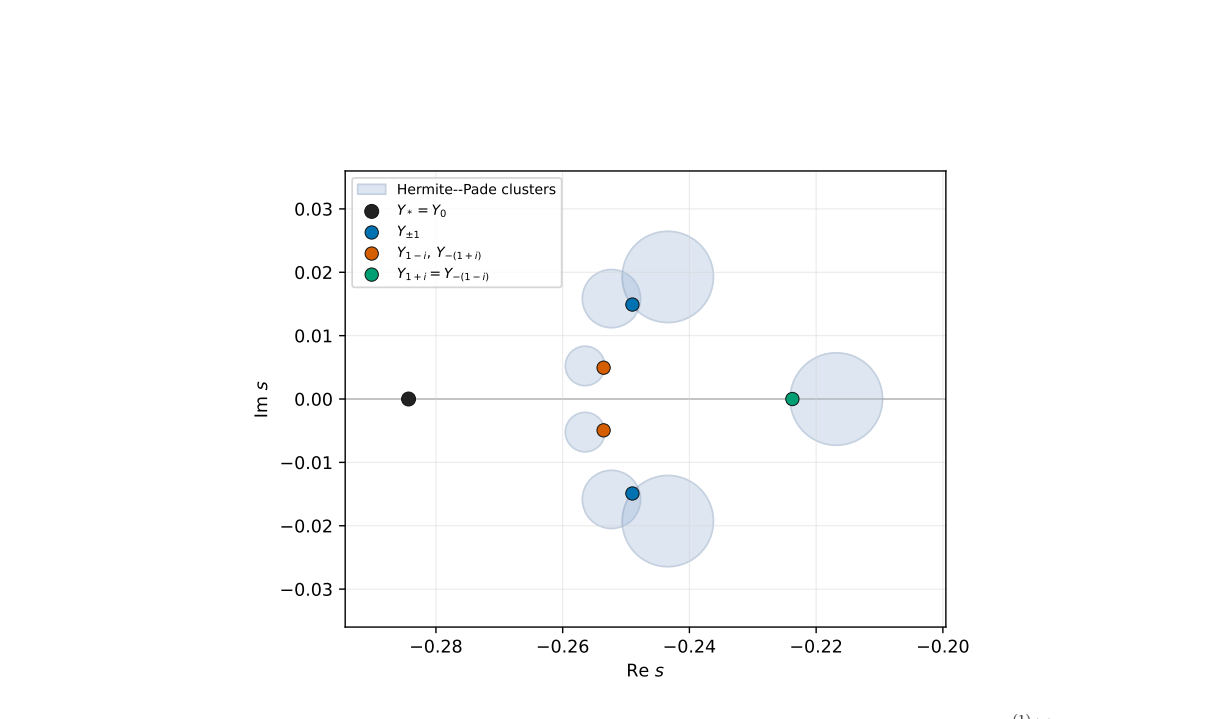
The Hermite–Padé continuation prescription is described concisely; defining the approximation order and the stability criterion for the clusters in Fig. 18 would make the numerical claim reproducible from the text.
The paper says, at §4.2, Eq. (4.12)
Pith says: minor objection 4 of 5
The identification σ = −ω/(2π) ∮_As λ_WKB is explicitly flagged as a 'local period coordinate' and not the exact definition; this is fine, but the text would benefit from stating which later equation renders the identification exact.
The paper says, at Throughout
Pith says: minor objection 5 of 5
The manuscript is very long and dense, with numerous cross-references to the authors' companion papers [JR26a, JR26b] and a companion website; for the archival version I would encourage the authors to add a short glossary of the WKB notation (P_odd, V_γ, X_γ, median resummation, lateral resolution) to make the paper self-contained.
What would settle it
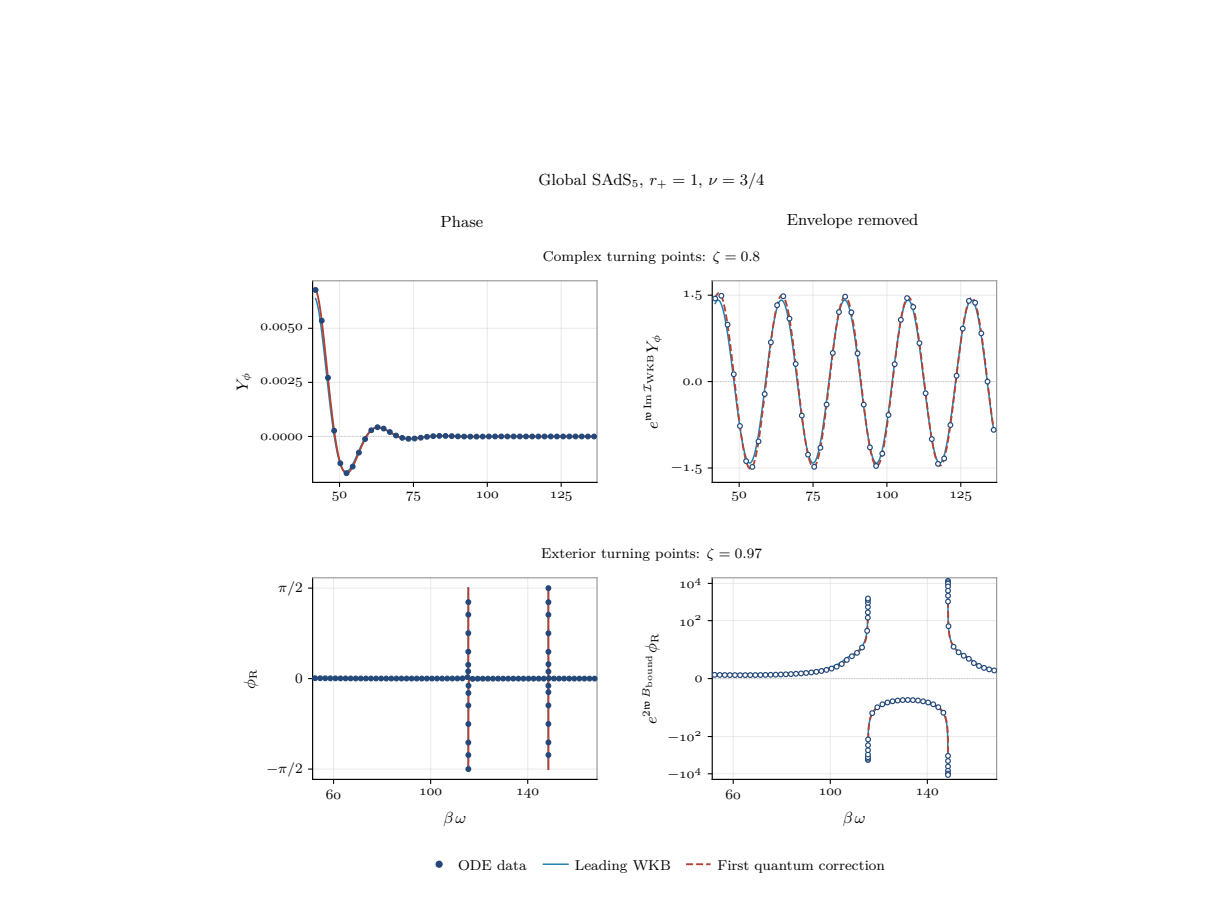
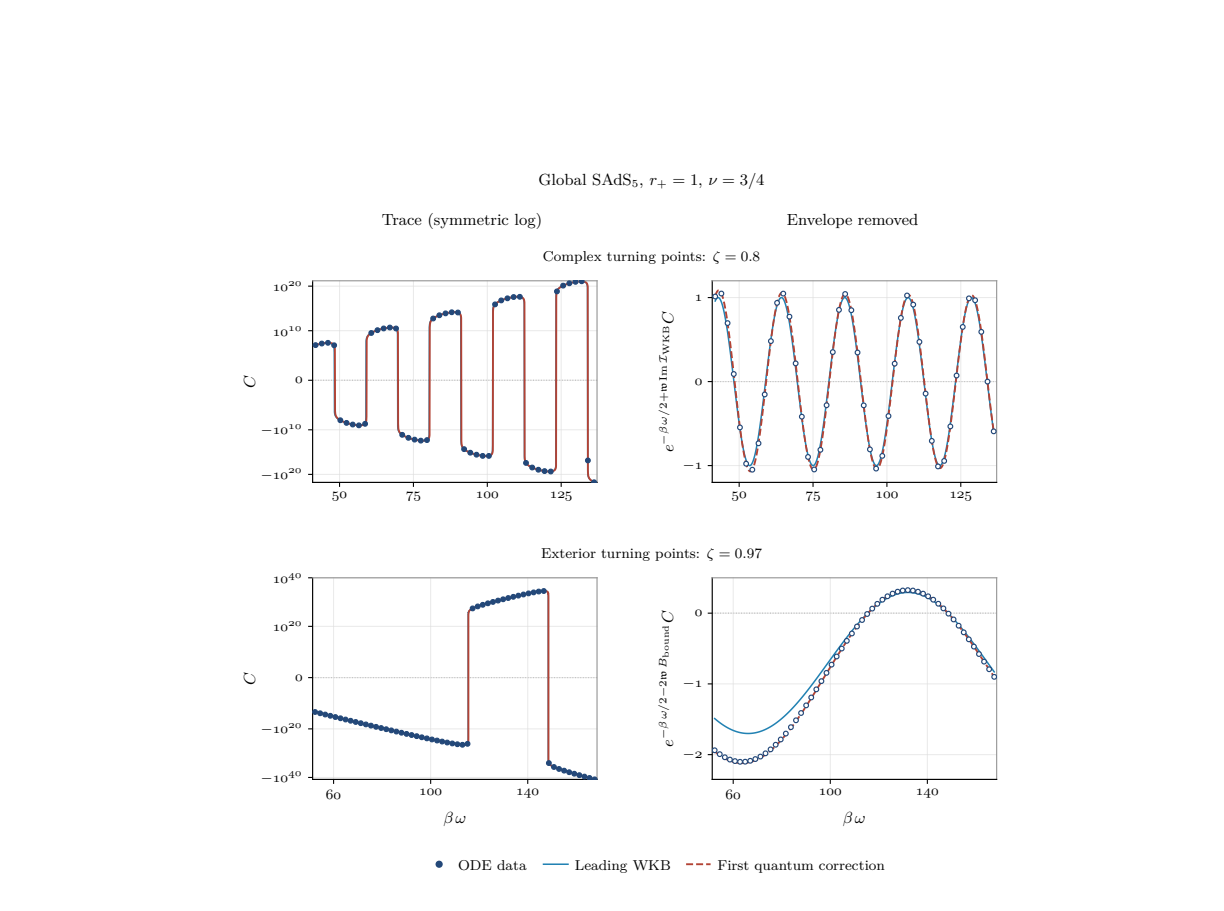
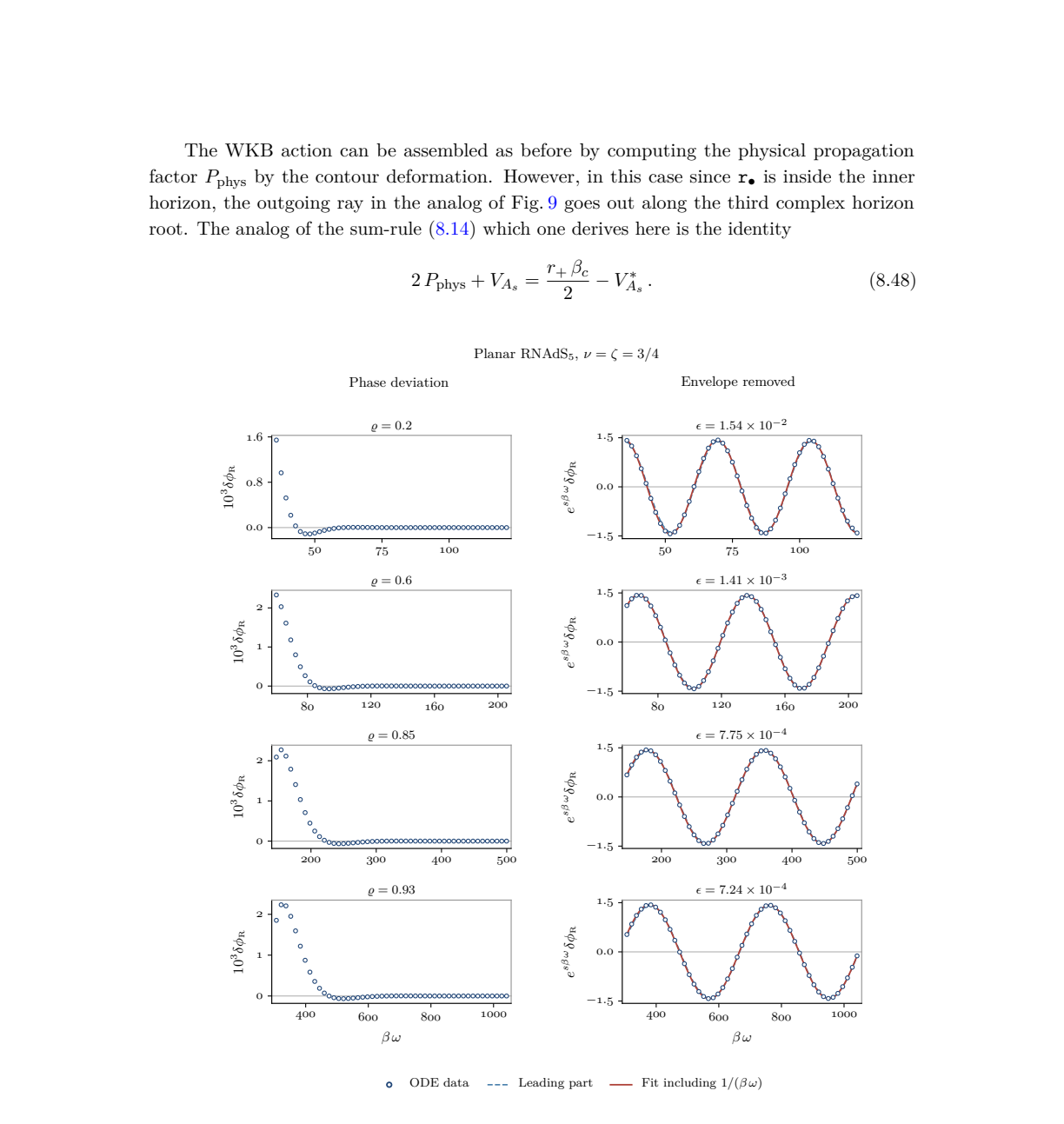
On the planar Schwarzschild-AdS spectral curve (8.5), express the singularity-anchored As-cycle of (6.13) and the exact-WKB boundary-to-turning-point cycles γ_j∼{0,z_j} of (10.23) in a common homology basis for general even d, and compute the difference of their leading WKB periods. The contour-deformation claim C3 requires this difference to vanish modulo horizon residues. Verify this explicitly at d=10 and d=12 for ζ=0.75. If the difference is nonzero, the predicted rate (8.11) is not the true transport rate and the central claim fails for those cases; if it vanishes, the empirical r⋆ criterion is recovered from the homology, settling the concern. A complementary check is to extract δϕ_R by direct ODE integration for d=10 at ζ=0.75 as in Fig. 7, which discriminates between the r⋆-period and the leading alternative turning-point period.
from the skeptic's reading
How the review went
4 readings by deepseek-v4-flash · 11 Nov 2026
- Reader holds up, with conditions
- Skeptic agrees
- Editor wrote the verdict above
- Referee major revision: 4 major objections, 5 minor
Not run on this paper: the simulated authors' defence.
Pith did not check this review's objections against the paper.
The review in full
The review in brief, machine-written
The real news is the universality plus the toolkit: the leading exponential rate of holographic thermal two-point functions in the timelike high-frequency limit is claimed to be fixed by one WKB spectral curve, and the paper backs that with a clean principal-symbol argument, an exact-WKB connection-matrix construction, and a proved factorization for integer conformal dimensions. I read the d=4,6,8 checks as genuinely supportive: the fitted phase, quasinormal-mode spacing, and OPE loci track the WKB actions well, and I do not see obvious circularity, since the rates come from period integrals and are confirmed against independent ODE integrations and OPE coefficients.
Where I got stuck is the step the authors themselves flag as a hypothesis. In §6 they assume the As-cycle encircles the singularity; footnote 8 admits the distinguished turning point r* is chosen empirically; and Part IV builds exact-WKB transport honestly from open cycles {0,zj} that run from boundary to turning points, not around the singularity. The bridge is supposed to be the contour deformation in §13.1. In the text I could see, that section states the equivalence — a singularity-anchored representative within the same homology class — but I did not find a derivation that the Voros symbol X* entering (11.5) equals e−iw V_As up to horizon thermal factors. If the true transport cycle lives in another homology class, the exponential rate, the quasinormal spacing, and the time-domain singularity locus all shift by a period difference. That is the load-bearing risk. The numerics mitigate it — a wrong cycle would not have produced those clean fits — but they do not replace the homology argument.
Lesser soft spots: the identification of the boundary factor with multi-stress-tensor OPE data is structural and plausible, though the Hermite-Padé extraction is not at the same proof standard as the factorization result; the numerical data and code are not deposited; odd boundary dimensions and the lightlike limit are consciously deferred. Citations look appropriate, with the heavy use of the authors' own earlier work expected for a continuation, and competing recent work is engaged.
This is a paper for people working on thermal correlators, quasinormal-mode asymptotics, and exact-WKB/resurgence. The central universality claim is very likely correct and the machinery is a real advance over the earlier d=4 zero-momentum program. Send it to a serious referee, and ask that referee to spend most of the time on §13.1 and on how r* is selected for d=4n+2.
The strongest objection
The central claim A1/B2 does not follow from the principal-symbol universality alone; it also requires that the leading WKB action be the period of the singularity-anchored As-cycle. The paper hypothesizes this in §6: 'we hypothesize that the cycle encircles the singularity' (b406), and footnote 8 states that the distinguished complex turning point is 'observed empirically, but do not prove' (3π/2 < arg r⋆ < 2π). Section 8.1 says the choice was made 'by taking inspiration from the d=4 analysis' and then checked numerically. However, the exact-WKB analysis of Part IV constructs the connection matrix from open cycles γ_j∼{0,z_j} that encircle the boundary and a turning point; §10.2 explicitly notes that these are 'not the cycles that encircle the singularity' (10.23). Thus the decisive step is the contour-deformation claim C3/§13.1: the leading exponential of the Voros symbol X⋆ entering (11.5) must equal e^{-iw V_As} with V_As as in (6.13), up to horizon thermal factors. That equality is asserted but not derived for the general d=4n curves in the provided text. If the true transport cycle lies in a different homology class, the exponential rate in (6.25), the quasinormal-mode spacing (8.25), and the time-domain singular locus (8.24) all shift by the difference of the two periods. This is an internal-correctness risk, not a disagreement with the current consensus.
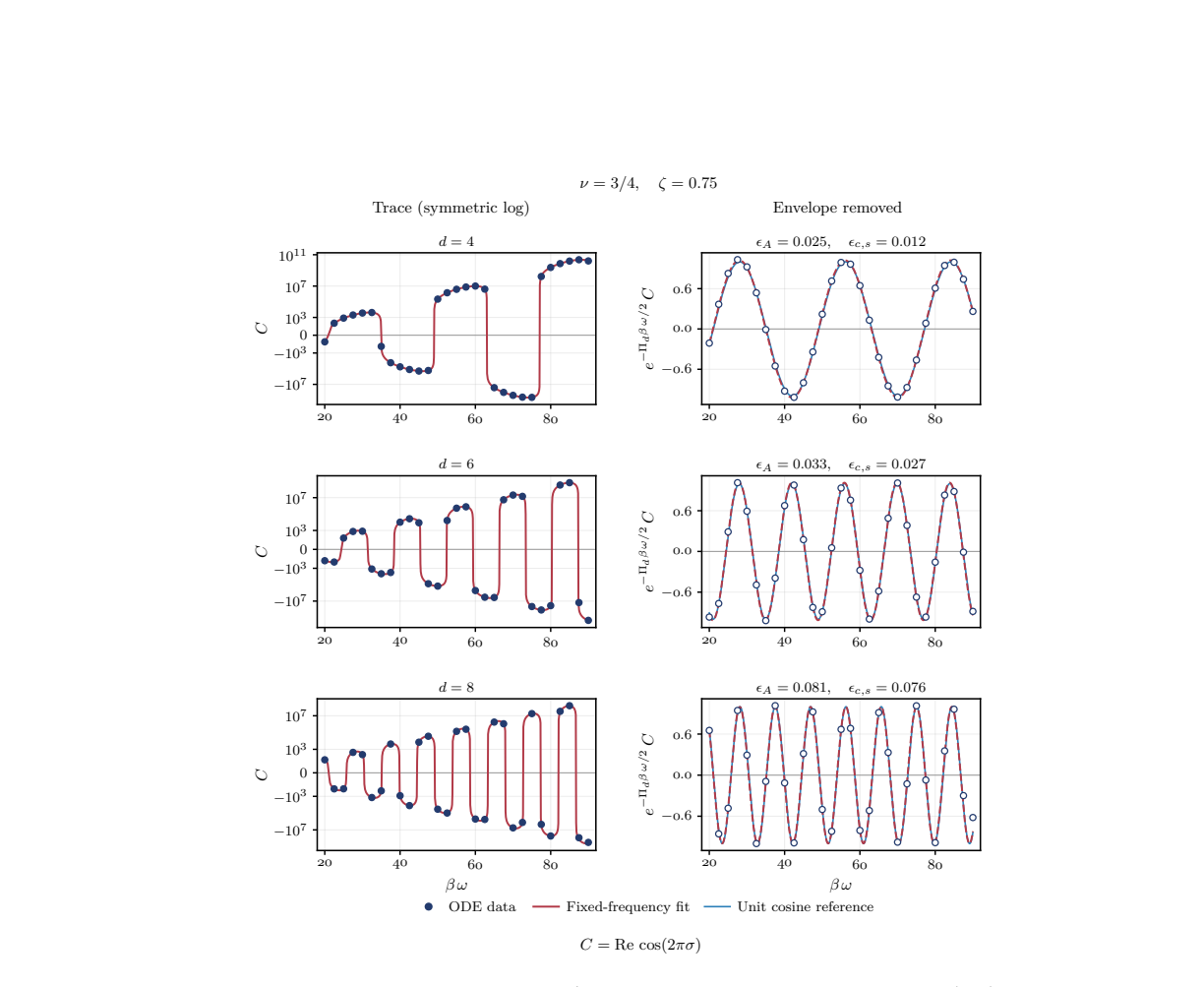
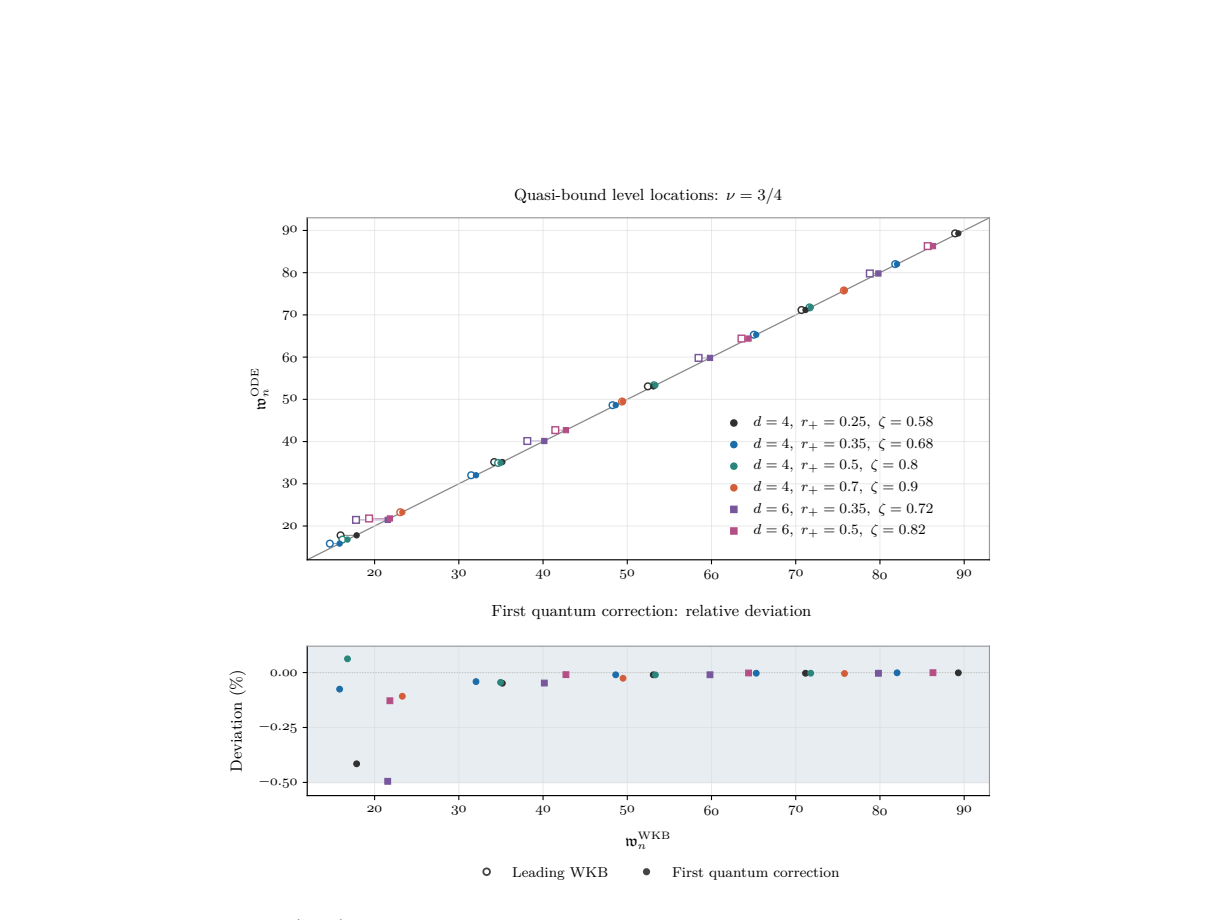
The universal principal-symbol argument in §3.1 genuinely establishes operator-independence of the leading WKB differential Q0, and Proposition 5.1 is a real proof for integer ν. The numerical fits in Figs. 7-8 and the quasinormal-mode spacing check in Fig. 5 provide nontrivial support. But the equality between the exact-WKB transport cycles and the singularity-anchored As-cycle is the linchpin of the stronger claim that the exponential rate is set by a period associated with the singularity. The exact-WKB K-matrix is built from boundary-to-turning-point cycles (10.23), and the paper's own heuristic section explicitly labels the singularity-anchored cycle as a hypothesis. The empirical selection of r⋆ in footnote 8 and §8.1 is a calibration, not a derivation. The contour-deformation claim C3 is exactly what would convert this into a theorem, and it is not demonstrated in the available text; the relevant working of §13.1 is absent from the review copy. This matches the reader's weakest assumption, and the CONDITIONAL verdict already reflects the resulting uncertainty. No verdict adjustment is needed: the concern is real, but it is addressable by an explicit homology or period computation, and the existing evidence makes rejection inappropriate.
The referee's report
If the central claim is correct, this is a genuinely significant unifying result: it ties together spectral-function asymptotics, quasinormal-mode lattices, complex-time singularities, and thermal OPE growth as manifestations of a single universal spectral curve, and it clarifies the holographic encoding of the curvature singularity at leading order in the planar expansion. The paper's strengths are substantial: the principal-symbol universality argument in Section 3.1 is clean and parameter-free; Section 5 supplies a machine-checkable proof of factorization for integer conformal dimension; Appendix A gives explicit opers; and the numerical evidence in Sections 8–9 is extensive and reproducible in spirit (the fits of the phase, trace, and quasinormal spacing to the predicted WKB actions are convincing). The factorization (11.7) into vacuum, OPE, and non-perturbative factors is a natural and appealing structure. The main risk is not disagreement with consensus but an internal one: the identification of the singularity-anchored As-cycle with the actual exact-WKB transport cycle is load-bearing and is hypothesized and empirically checked rather than derived in general.
Pith's reading of the paper (a machine's summary, not the authors')
This paper argues that in the limit of high frequency and large momentum with their ratio $\zeta = k/\omega$ held fixed, the leading exponential rate of the thermal spectral function in a holographic CFT is universal: it does not depend on the conformal dimension or spin of the operator being measured. The rate is set by a period of a single WKB spectral curve that arises as the common principal symbol of every bulk wave equation, and the same WKB action also encodes the time at which the two-sided correlator develops its complex-time singularity from the bouncing geodesic. The authors show that one action governs three a priori separate phenomena — the time-domain singularity locus, the spacing of highly damped quasinormal modes, and the large-order growth of multi-stress tensor OPE coefficients — and they verify the predicted rates numerically against direct integration of the wave equation. If the claim is right, the exponential tail of thermal correlators is a sharp, operator-blind probe of the black hole singularity, separating geometric data (the WKB period) from operator data (a perturbative OPE factor).
What carries the argument. The central object is the WKB spectral curve $\Sigma_{\mathrm{WKB}} = \{(r,\nu): \nu^2 = Q_0(r)\}$ carrying the quadratic differential $Q_0(r)dr^2$, which is the universal principal symbol shared by all bulk wave operators in the high-frequency limit. The quantity that carries the argument is the leading WKB differential $\lambda_{\mathrm{WKB}}(\zeta) = \frac{\sqrt{1-\zeta^2 f(r)}}{r^2 f(r)}dr$ and its period $V_{A_s}$ around the singularity-anchored $A_s$-cycle, packaged with the physical phase $P_{\mathrm{phys}}$ and horizon thermal residues into the WKB action $I_{\mathrm{WKB}} = 2P_{\mathrm{phys}} + i\sum_k \eta_k \frac{r_+\beta_k}{2} + V_{A_s}$; this single complex action sets the exponential envelope and oscillation frequency of the spectral function, the quasinormal spacing, and the time-domain singularity locus. The exact-WKB connection matrix $C^{-1}_{\mathrm{bdy,hor}} = B_{\mathrm{bdy}} K D(E) B_{\mathrm{hor}}$, with $K$ built from Voros symbols and Bose-Einstein factors that resum the infinite Stokes-line spirals into the horizon, turns the spectral curve data into an explicit transseries for the retarded Green's function.
Core claim. All bulk wave equations — scalar, gauge field, graviton, or higher spin — share the same principal symbol, so after reduction to a radial Schrödinger form their leading WKB potential is the universal function $Q_0(r) = -(1-\zeta^2 f(r))/(r^4 f(r)^2)$ in the linear-scaling limit $\omega,k\to\infty$ with $\zeta = k/\omega \in (0,1)$ fixed. The paper's central claim is that the leading exponential asymptotics of the spectral function are governed by the period $V_{A_s}$ of the leading WKB differential $\lambda_{\mathrm{WKB}}(\zeta) = \frac{\sqrt{1-\zeta^2 f(r)}}{r^2 f(r)}\,dr$ around the singularity-anchored $A_s$-cycle, assembled into the WKB action $I_{\mathrm{WKB}} = 2P_{\mathrm{phys}} + i\sum_k \eta_k \frac{r_+\beta_k}{2} + V_{A_s}$, where $P_{\mathrm{phys}}$ is the boundary-to-turning-point phase and the middle term collects thermal half-periods from horizon crossings. This one action controls the complex-time singularity locus of the thermofield double correlator (related to the period by a Legendre transform in $\zeta$), the asymptotic quasinormal-mode lattice spacing, and the large-order behaviour of multi-stress tensor OPE coefficients, and the paper checks all three predictions against direct solutions of the wave equations. An exact-WKB analysis of the boundary-to-horizon connection problem shows that the true transport path never approaches the singularity; the singularity-anchored curve is a contour-deformed representative of the same homology class, and the connection matrix factorizes so the spectral function splits into a perturbative OPE factor and a non-perturbative WKB factor. In a core-scaling limit where momentum grows as a sublinear power of frequency, the turning points move arbitrarily close to the singularity, and the standard Airy Stokes factor is replaced by a core Stokes multiplier describing scattering off the high-curvature region.
The premise it rests on. The prediction stands or falls with the hypothesis that the WKB cycle fixing the exponential rate is the singularity-anchored $A_s$-cycle: the paper states that the distinguished complex turning point $r_\star$ satisfies $3\pi/2 < \arg r_\star < 2\pi$ as an empirical observation, not a proof, and if the true exact-WKB transport cycle belonged to a different homology class, the predicted exponential rate, quasinormal spacing, and time-domain singularity locus would all be wrong.
If the paper is right (Pith's inferences, not the authors')
For fixed $\zeta = k/\omega$ and fixed conformal dimension and spin, every holographic operator at strong coupling shares the same leading exponential decay rate of its thermal spectral function; operator identity enters only through the power-law prefactor and the OPE factor.
The complex-time singularity locus of the thermofield double correlator, the asymptotic spacing of highly damped quasinormal modes, and the large-order growth of multi-stress tensor OPE coefficients are governed by one and the same WKB action, so a measurement of any one of the three fixes predictions for the other two.
At $\zeta\to 0$ the WKB action reduces to the known bouncing-geodesic singularity time $\frac{\beta}{2}\cot(\pi/d) + i\beta$, recovering the original singularity-imprint result and its higher-dimensional generalizations as special cases.
The quasinormal mode spacing prediction reduces at $\zeta\to 0$ to the known asymptotic AdS black hole spectrum and diverges toward $\zeta\to 1$, signalling the transition to weakly damped near-lightlike modes.
In the core-scaling limit with $k/\omega^{(d-2)/(2(d-1))}$ fixed, the turning points approach the curvature singularity and the reflection coefficient is a core Stokes multiplier, giving a frequency-tunable probe whose scaling behaviour predicts how the time-domain singular locus depends on spatial separation.
If the universality claim holds, the exponential tails of thermal correlators cannot discriminate between operators, so any operator-specific window onto the singularity would have to live in the subleading prefactor or the OPE factor; a direct test would compare the extracted exponential rates of spin-1 and spin-2 probes against the scalar rate in the same background.
The factorization into OPE and non-perturbative transport factors suggests that attempts to resolve the singularity with non-planar or stringy corrections should target the WKB transport data — the periods and the core Stokes multiplier — rather than the OPE coefficients; finite-$N$ effects would appear as a modified singularity-anchored monodromy.
Because the singularity-anchored representative is only one choice within a homology class, the paper leaves open whether some other spacetime locus could serve as an equally good anchor; repeating the construction with the inner horizon of the charged black hole as the anchor would test whether the curvature singularity is genuinely distinguished.
The empirical selection rule $3\pi/2 < \arg r_\star < 2\pi$ for the distinguished turning point invites a systematic scan over dimensions, momentum ratios, and charges; a counterexample would not kill the universality claim but would show the anchor needs a principled replacement.
Check this review
Pith stored no record of this review's passes and took no fingerprint of it. Reviews made by code from 13 Nov 2026 on carry both.
How often reviews like this one are right
Reviews like this one: written by deepseek-v4-flash, where what was read was not recorded.
How often objections from reviews like this one are right: not yet measured
Reviews by people
This review was written by a machine. No person has reviewed this paper on Pith yet. A scientist listed on Pith can review it for a fee, and their review is published here whatever it concludes.
The paper
Abstract
We argue that the leading exponential rate in the high frequency asymptotics of holographic thermal two-point functions is independent of the conformal dimension and spin (held fixed) of the operator. We analyze the leading universal WKB spectral curve governing the asymptotics at non-vanishing momentum scaling with frequency. We show that its classical action governs time domain signatures of the bouncing geodesic singularity, highly damped quasinormal modes, and the asymptotics of multi-stress tensor OPE coefficients. Beyond the leading order, we examine linear and dimension-dependent sublinear scalings of momentum with frequency. In both regimes, we derive the connection matrix between the boundary and the horizon using exact-WKB techniques. The results show a factorization of the spectral function into a perturbative part controlled by the OPE and a non-perturbative part governed by WKB transport. For linear scaling at fixed k/ω in the timelike regime, the turning points controlling physical transport remain separated from the curvature singularity. Nevertheless, a singularity-anchored representative of the same transport homology class determines the leading WKB action. In the sublinear regime, the relevant turning points approach the singularity. We match an exact solution of the near-singularity scaled equation to the exterior WKB solution to determine the connection matrix and spectral function. Our results clarify how the black hole curvature singularity is encoded in dual field theory observables at leading order in the planar expansion.
The paper's own sentences, arranged, kept beside the review and separate from it. Each label is drawn from a closed vocabulary; the number beside it is the probability the classifier gave that label. No sentence in this record was written by a model.
abstract compiled · 2026-11-11
The authors' main claim, as the classifier picked it out 0.67
“Our results clarify how the black hole curvature singularity is encoded in dual field theory observables at leading order in the planar expansion.”
How the main claim is stated: asserted 0.99
What the abstract itself states, as probabilities: claims first 0.03 · states limitation 0.44 · human participants 0.01 · controlled comparison 0.02 · randomized assignment 0.01 · states quantitative result 0.13 · compares with prior results 0.10 · mentions code or data availability 0.02
The abstract, sentence by sentence
This table labels the abstract only (arXiv listing abstract v1). The number is the probability the classifier gave the label.
| Sentence | Role | The authors' own work | States the main conclusion | Strength |
|---|---|---|---|---|
| We argue that the leading exponential rate in the high frequency asymptotics of holographic thermal two-point functions is independent of the conformal dimension and spin (held fixed) of the operator. | result 0.96 | 0.81 | 0.55 | asserted 0.90 |
| We analyze the leading universal WKB spectral curve governing the asymptotics at non-vanishing momentum scaling with frequency. | contribution 0.93 | 0.93 | 0.08 | asserted 0.91 |
| We show that its classical action governs time domain signatures of the bouncing geodesic singularity, highly damped quasinormal modes, and the asymptotics of multi-stress tensor OPE coefficients. | result 0.89 | 0.93 | 0.23 | asserted 1.00 |
| Beyond the leading order, we examine linear and dimension-dependent sublinear scalings of momentum with frequency. | contribution 0.98 | 0.92 | 0.05 | asserted 0.92 |
| In both regimes, we derive the connection matrix between the boundary and the horizon using exact-WKB techniques. | method 0.94 | 0.95 | 0.06 | asserted 1.00 |
| The results show a factorization of the spectral function into a perturbative part controlled by the OPE and a non-perturbative part governed by WKB transport. | result 0.98 | 0.91 | 0.24 | asserted 1.00 |
| For linear scaling at fixed $k/\omega$ in the timelike regime, the turning points controlling physical transport remain separated from the curvature singularity. | result 1.00 | 0.85 | 0.08 | asserted 1.00 |
| Nevertheless, a singularity-anchored representative of the same transport homology class determines the leading WKB action. | result 0.89 | 0.83 | 0.13 | asserted 1.00 |
| In the sublinear regime, the relevant turning points approach the singularity. | result 1.00 | 0.83 | 0.06 | asserted 1.00 |
| We match an exact solution of the near-singularity scaled equation to the exterior WKB solution to determine the connection matrix and spectral function. | method 0.99 | 0.96 | 0.09 | asserted 1.00 |
| Our results clarify how the black hole curvature singularity is encoded in dual field theory observables at leading order in the planar expansion. | interpretation 1.00 | 0.92 | 0.57 | asserted 0.99 |
What kind of paper the classifier reports this is: theoretical result 1.00 · evidence from proof or derivation 1.00
What was examined, and what was not
Sources read
- arXiv listing abstract v1
Not examined
- full text
- figures and tables
- references and citing sentences
- relations to other papers
Levels run
- P abstract
Not run
- S sections
- T body sentences
- C citations
- R cross-paper relations
How the labels were made
Compiled by classifier-1.13.0 via TypeSafe API, question bank abstract-p1-20260923, 2026-11-11: 1 request, 8,218 input tokens.
Every quoted sentence on this record is the authors'. Every label is from Pith's closed vocabulary, with the probability shown beside it. This record as JSON
Figures (42)





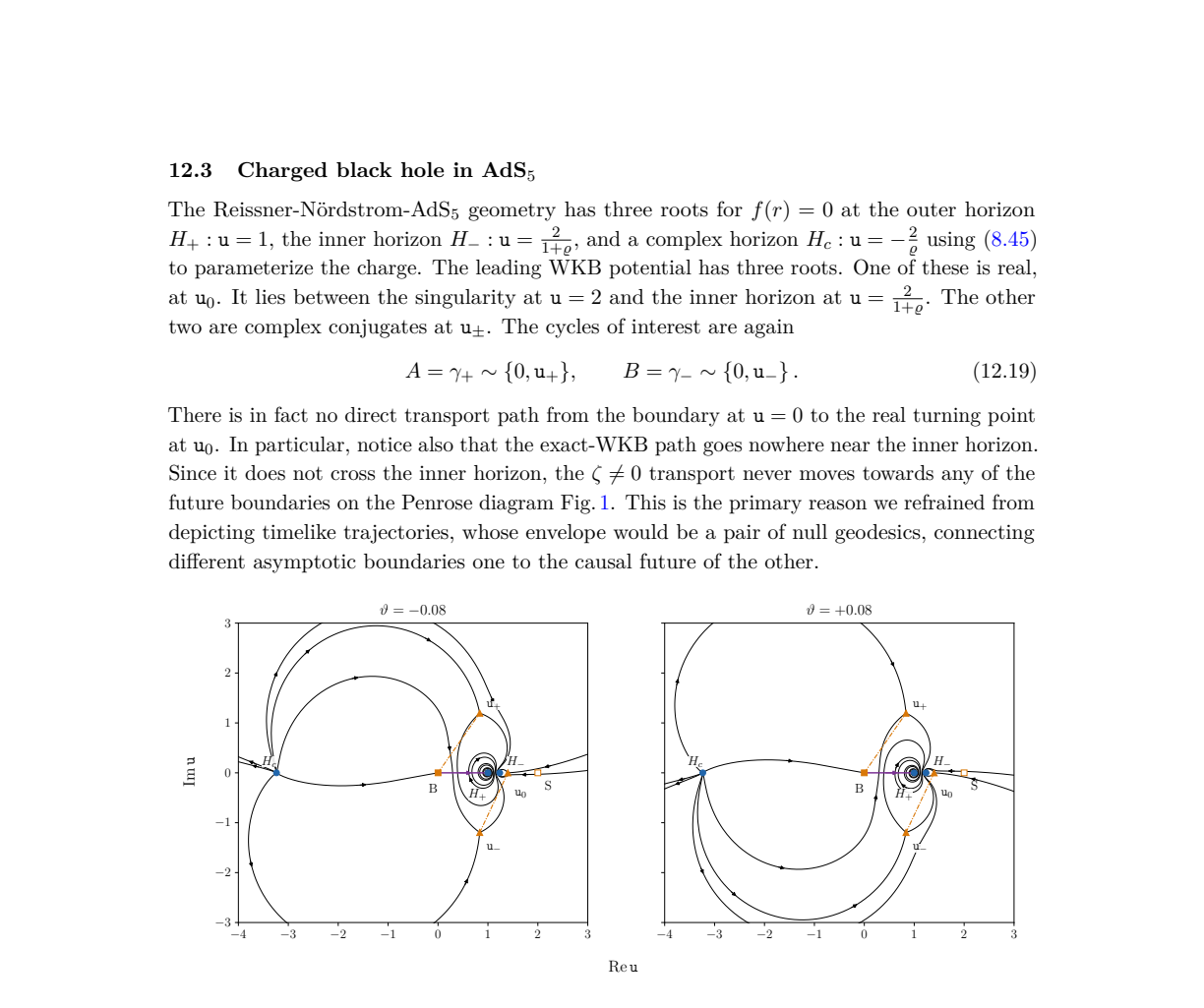
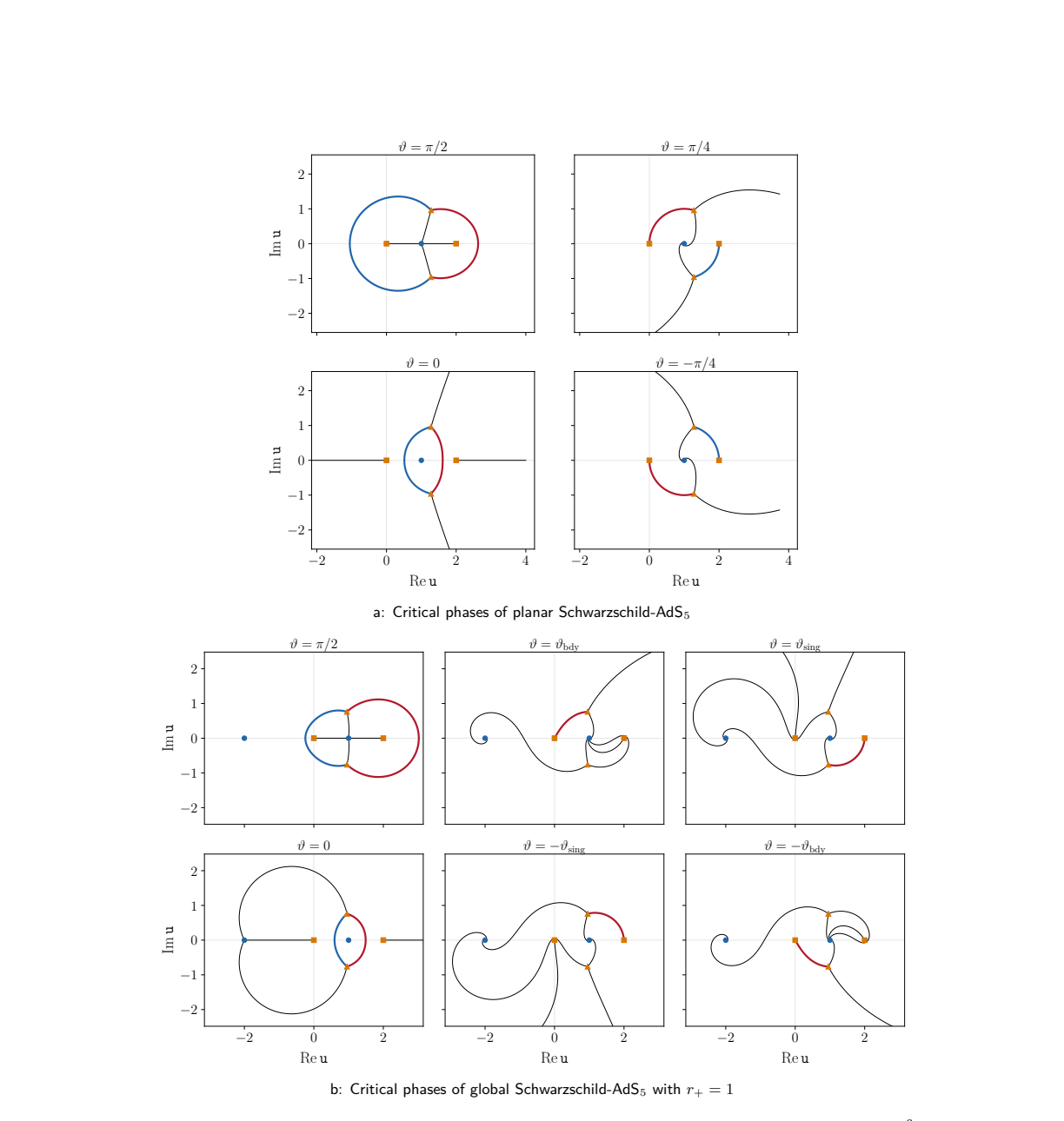
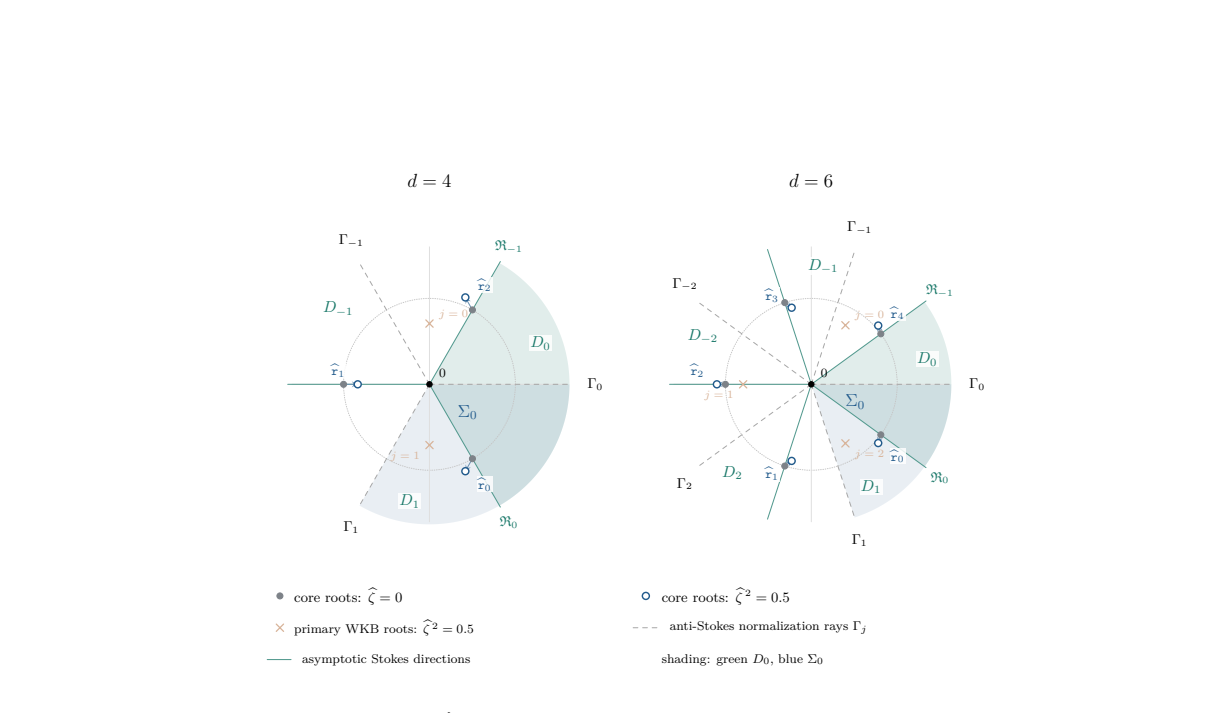
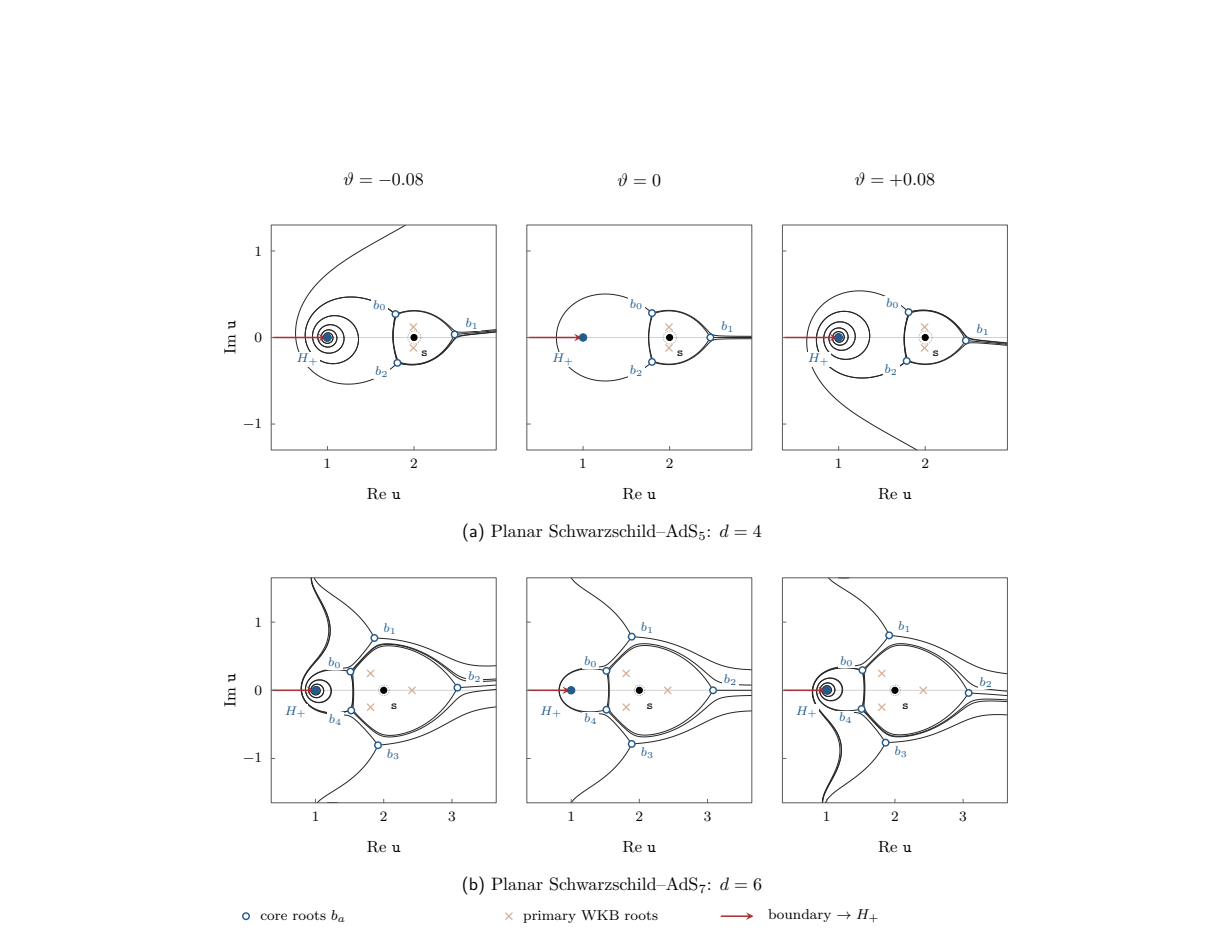
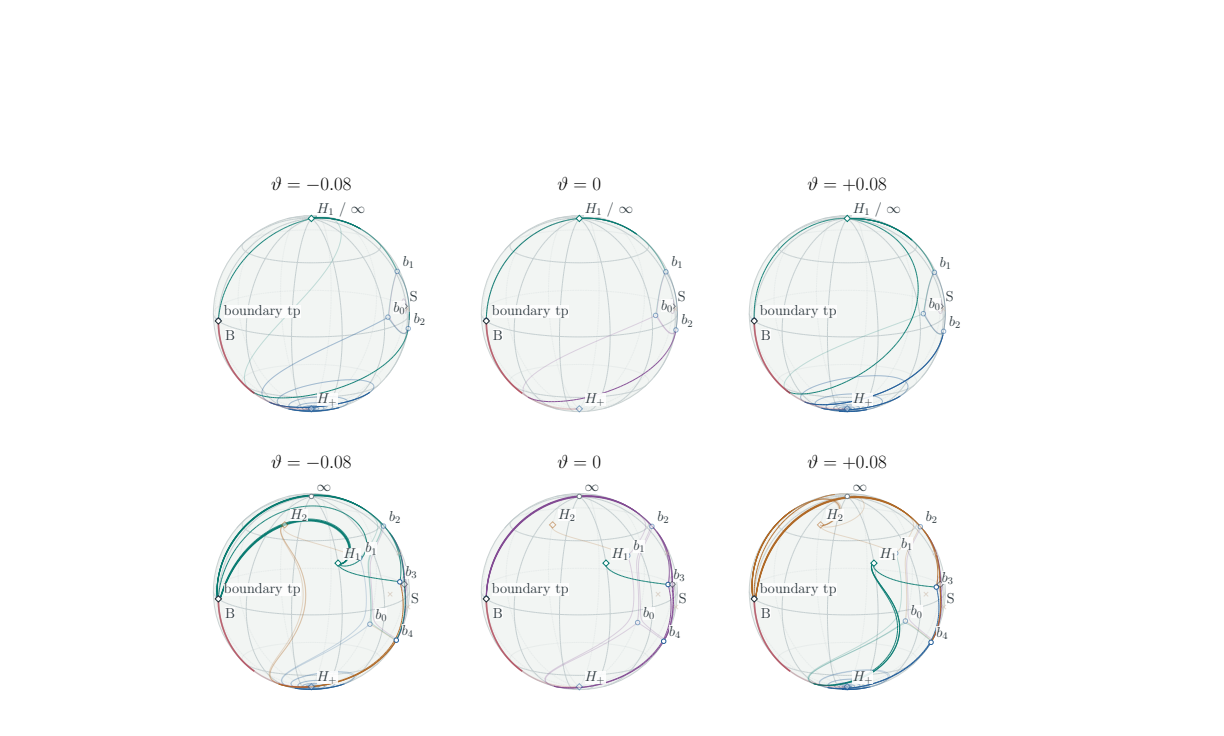
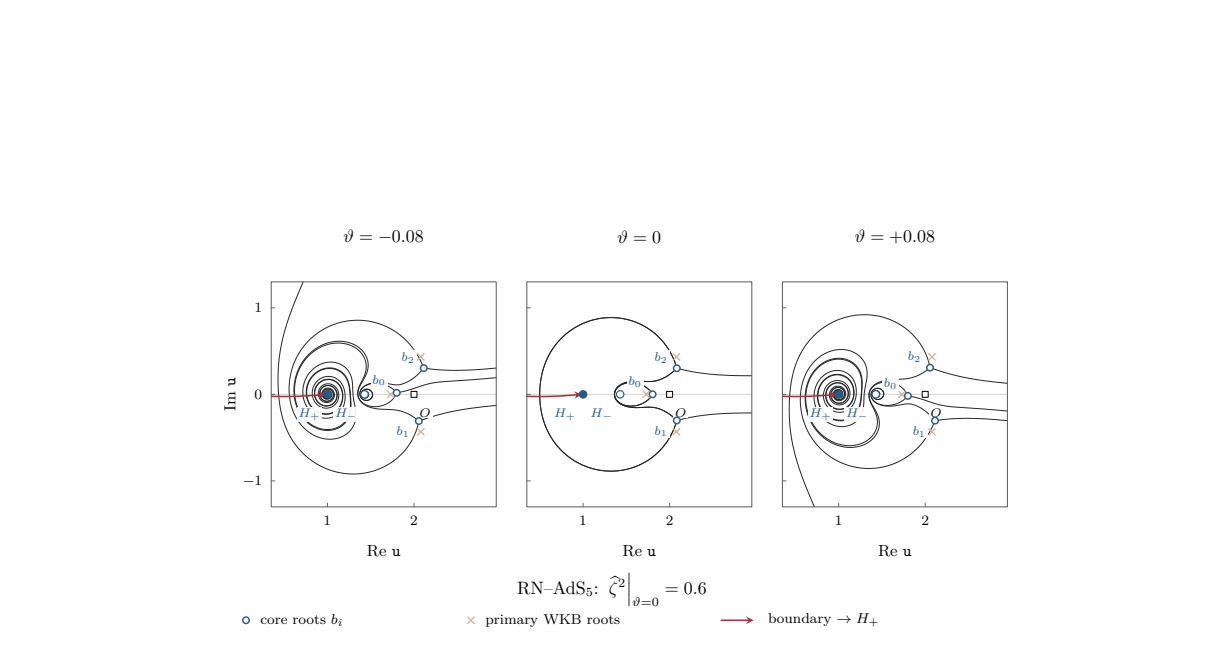
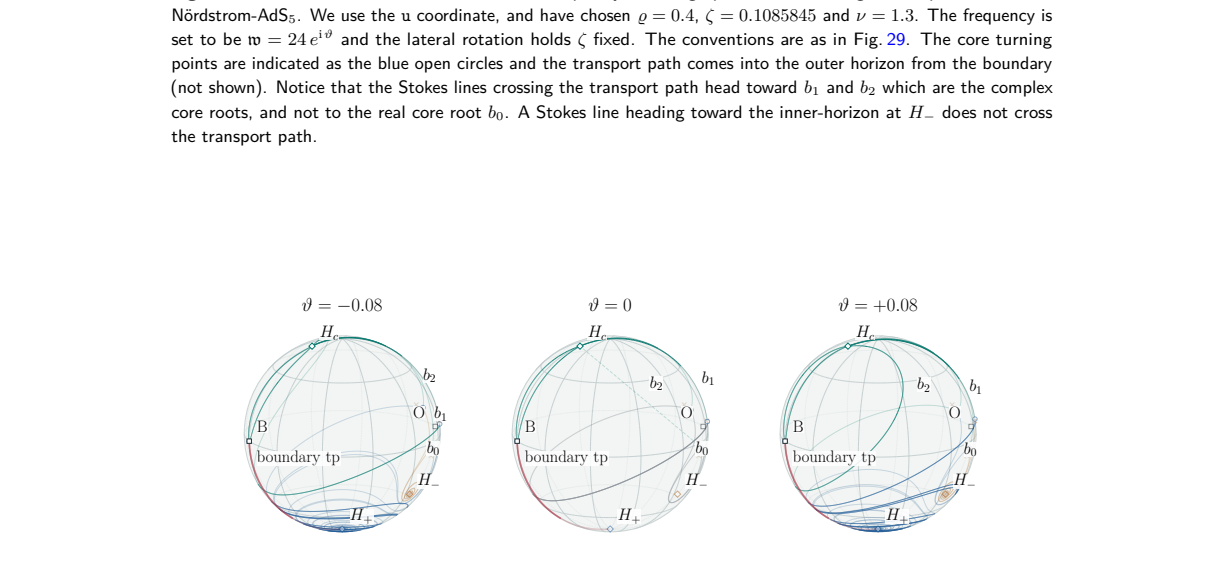

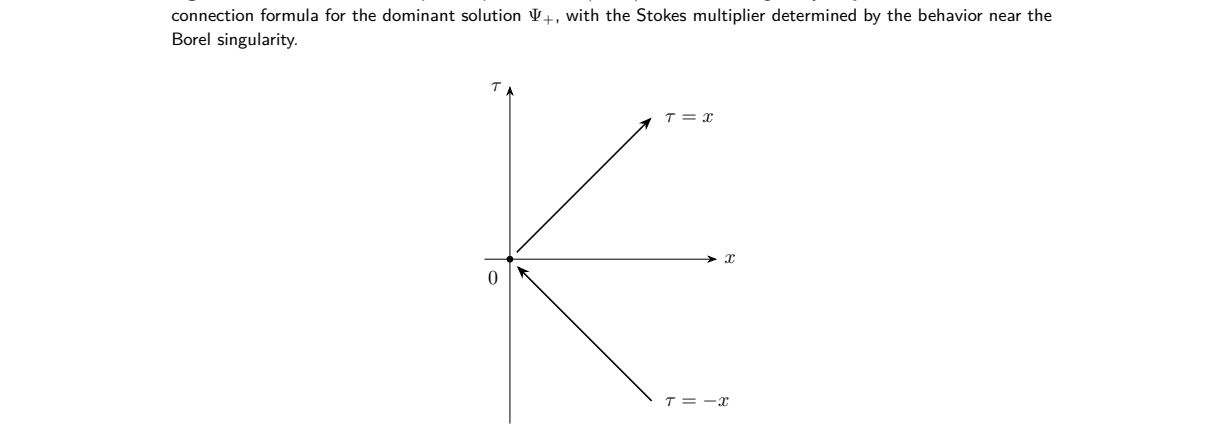
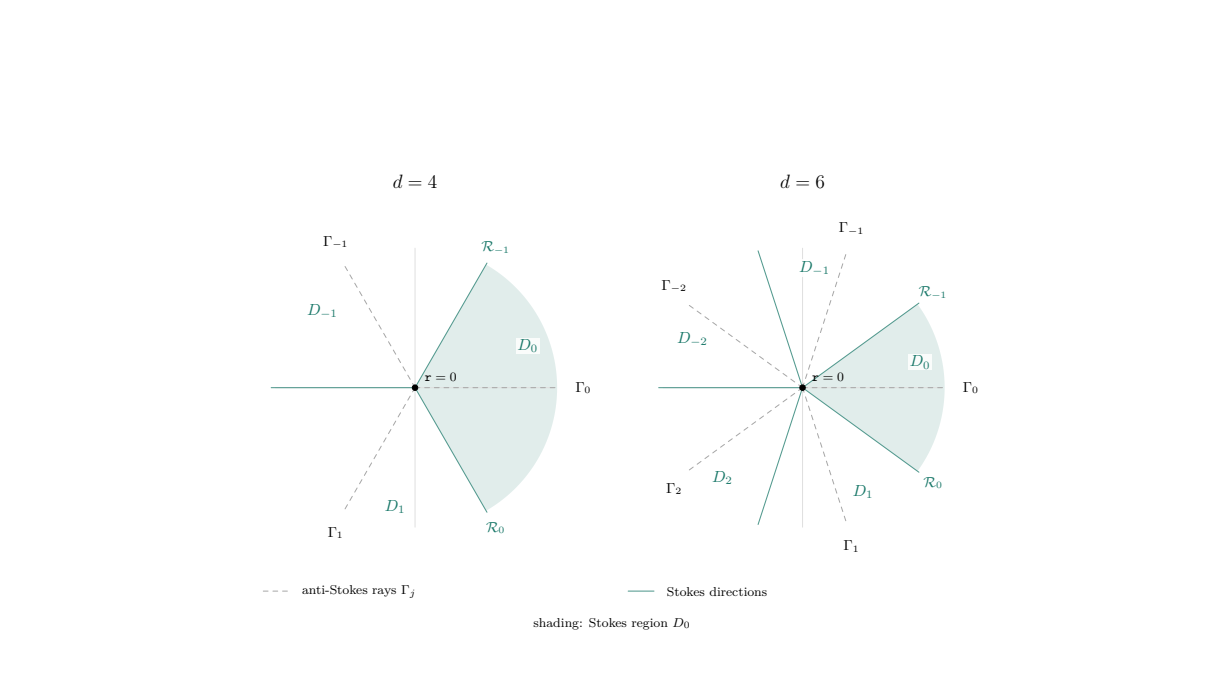
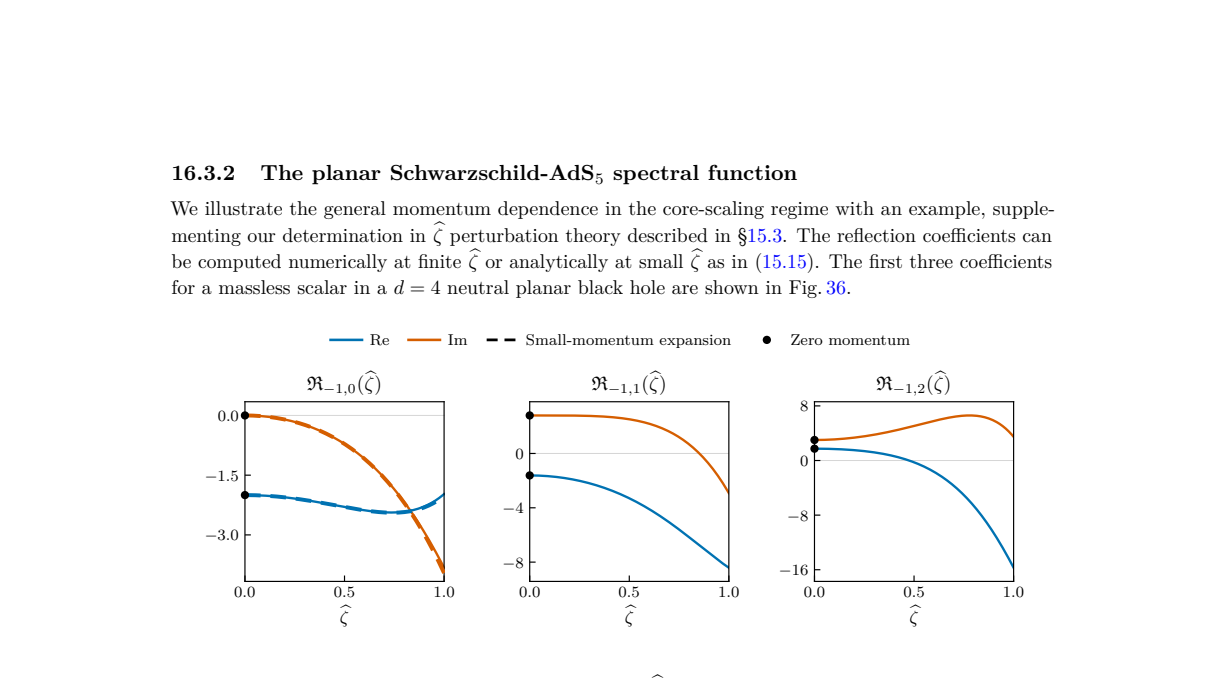
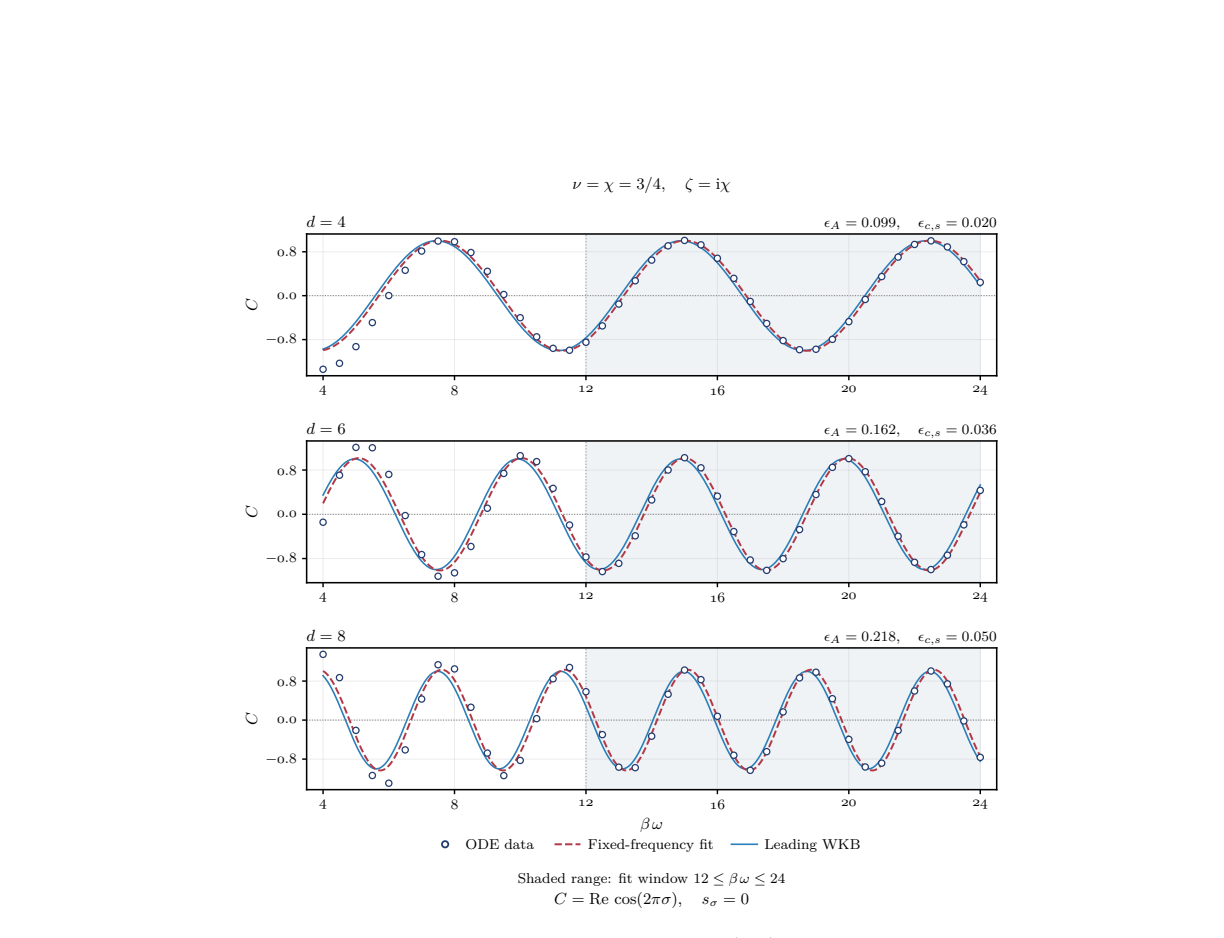
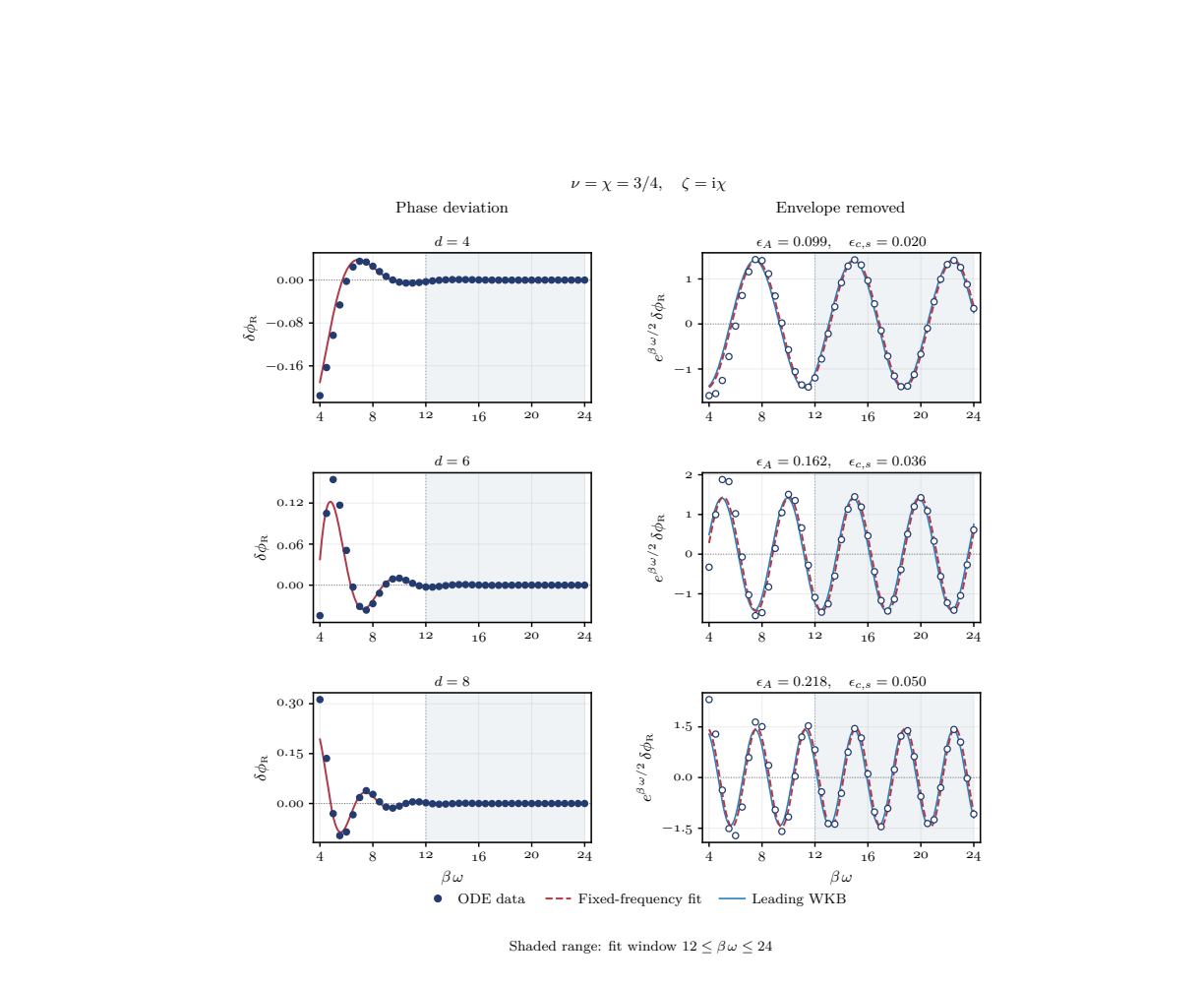
Figures are the authors', reproduced from the paper.
References (113)
- [1] Takei, Yoshitsugu , editor =. WKB Analysis and Stokes Geometry of Differential Equations , booktitle =. 2017 , publisher =. doi:10.1007/978-3-319-52842-7_5 , series = on Pithdoi:10.1007/978-3-319-52842-7_5
- [2] Marolf, Donald. States and boundary terms: Subtleties of Lorentzian AdS / CFT. JHEP. 2005. doi:10.1088/1126-6708/2005/05/042. arXiv:hep-th/0412032 on PithPith's reviewarXiv
- [3] Afkhami-Jeddi, Nima and Caron-Huot, Simon and Chakravarty, Joydeep and Maloney, Alexander , title =. Phys. Rev. D , volume =. 2026 , doi =. 2510.21673 , archiveprefix = on PithPith's reviewarXiv
- [4] Alday, Luis F. and Gaiotto, Davide and Tachikawa, Yuji , title =. doi:10.1007/s11005-010-0369-5 , journal =. 0906.3219 , archiveprefix = on PithPith's reviewarXiv
- [5] Ali Ahmad, Shadi and Almheiri, Ahmed and Lin, Simon , title =. 2601.02354 , archiveprefix = on PitharXiv
- [6] Almheiri, Ahmed and Dodelson, Matthew and Komargodski, Zohar , title =. 2610.31610 , archiveprefix = on PithPith's reviewarXiv
- [7] Amado, Irene and Hoyos-Badajoz, Carlos , title =. doi:10.1088/1126-6708/2008/09/118 , journal =. 0807.2337 , archiveprefix = on PithPith's reviewarXiv
- [8] Aminov, Gleb and Grassi, Alba and Hatsuda, Yasuyuki , title =. doi:10.1007/s00023-021-01137-x , journal =. 2006.06111 , archiveprefix = on PithPith's reviewarXiv
- [9] Sheta, Ahmed. The Stringy Photon Sphere. 2026. arXiv:2610.30426 on PithPith's reviewarXiv
- [10] Buri \'c , Ilija and Gusev, Ivan and Parnachev, Andrei. Stringy resolution of bouncing singularities. 2026. arXiv:2610.12311 on PithPith's reviewarXiv
- [11] Coviello, Chiara and Gupta, Ansh and Hennigar, Robie A. and Shi, Kai and Svesko, Andrew. Looking inside a quantum black hole. 2026. arXiv:2609.20788 on PithPith's reviewarXiv
- [12] Aniceto, In. 2610.32892 , archiveprefix = on PithPith's reviewarXiv
- [13] Araya, Ignacio J. and Esper, Chantelle and Jia, Yueke and Kulaxizi, Manuela and Parnachev, Andrei , title =. 2602.12893 , archiveprefix = on PitharXiv
- [14] Arnaudo, Paolo and Iossa, Cristoforo and Karlsson, Robin and Withers, Benjamin , title =. 2607.24909 , archiveprefix = on PithPith's reviewarXiv
- [15] Arnaudo, Paolo and Withers, Benjamin , title =. JHEP , volume =. 2026 , doi =. 2603.13469 , archiveprefix = on PitharXiv
- [16] Arnaudo, Paolo and Withers, Benjamin , title =. 2605.16489 , archiveprefix = on PithPith's reviewarXiv
- [17] Arnaudo, Paolo and Grassi, Alba and Hao, Qianyu , title =. doi:10.1007/s11005-026-02136-x , journal = on Pithdoi:10.1007/s11005-026-02136-x
- [18] Barrat, Julien and Bozkurt, Deniz N. and Marchetto, Enrico and Miscioscia, Alessio and Pomoni, Elli , title =. JHEP , year =. doi:10.1007/JHEP05(2026)104 , volume =. 2506.06422 , archiveprefix = on PithPith's reviewarXiv
- [19] Barrat, Julien and Bozkurt, Deniz N. and Marchetto, Enrico and Miscioscia, Alessio and Pomoni, Elli , title =. JHEP , year =. doi:10.1007/JHEP05(2026)180 , volume =. 2510.20894 , archiveprefix = on PitharXiv
- [20] Barrat, Julien and Bozkurt, Deniz N. and Marchetto, Enrico and Miscioscia, Alessio and Pomoni, Elli , title =. 2607.24919 , archiveprefix = on PithPith's reviewarXiv
show 80 more
- [21] Batra, Gauri and Levine, Adam and Shenker, Stephen H. , title =. 2609.32071 , archiveprefix = on PithPith's reviewarXiv
- [22] Batra, Gauri , title =. 2610.22478 , archiveprefix = on PithPith's reviewarXiv
- [23] Belinsky, V. A. and Khalatnikov, I. M. and Lifshitz, E. M. , title =. doi:10.1080/00018737000101171 , journal = on Pithdoi:10.1080/00018737000101171
- [24] Belinsky, V. A. and Khalatnikov, I. M. and Lifshitz, E. M. , title =. doi:10.1080/00018738200101428 , journal = on Pithdoi:10.1080/00018738200101428
- [25] Bonelli, Giulio and Iossa, Cristoforo and Panea Lichtig, Daniel and Tanzini, Alessandro , title =. doi:10.1007/s00220-022-04497-5 , journal =. 2201.04491 , archiveprefix = on PithPith's reviewarXiv
- [26] Brecher, Dominic and He, Jianyang and Rozali, Moshe , title =. doi:10.1088/1126-6708/2005/04/004 , journal =. hep-th/0410214 , archiveprefix = on PithPith's reviewarXiv
- [27] Buri. doi:10.1007/JHEP09(2025)053 , journal =. 2505.10277 , archiveprefix = on PithPith's reviewarXiv
- [28] Buri. JHEP , volume =. 2026 , doi =. 2508.08373 , archiveprefix = on PithPith's reviewarXiv
- [29] Buri. JHEP , volume =. 2026 , doi =. 2607.05258 , archiveprefix = on PithPith's reviewarXiv
- [30] Caron-Huot, S. , title =. doi:10.1103/PhysRevD.79.125009 , journal =. 0903.3958 , archiveprefix = on PithPith's reviewarXiv
- [31] doi:10.1007/JHEP10(2024)105 , journal =. 2404.17286 , archiveprefix = on PithPith's reviewarXiv
- [32] JHEP , volume =. 2026 , doi =. 2511.09638 , archiveprefix = on PitharXiv
- [33] 2609.23776 , archiveprefix = on PithPith's reviewarXiv
- [34] Chakravarty, Joydeep and Zigdon, Yoav , title =. 2610.30134 , archiveprefix = on PithPith's reviewarXiv
- [35] Coviello, Chiara and Gupta, Ansh and Hennigar, Robie A. and Shi, Kai and Svesko, Andrew , title =. 2609.26724 , archiveprefix = on PithPith's reviewarXiv
- [36] David, Justin R. and Schwarze, Leonard , title =. 2607.24242 , archiveprefix = on PithPith's reviewarXiv
- [37] de Haro, Sebastian and Skenderis, Kostas and Solodukhin, Sergey N. , title =. doi:10.1007/s002200100381 , journal =. hep-th/0002230 , archiveprefix = on PithPith's reviewarXiv
- [38] Delabaere, Eric and Dillinger, Herv. doi:10.1063/1.532206 , journal = on Pithdoi:10.1063/1.532206
- [39] Dodelson, Matthew and Ooguri, Hirosi , title =. doi:10.1103/PhysRevD.103.066018 , journal =. 2010.09734 , archiveprefix = on PithPith's reviewarXiv
- [40] Dodelson, Matthew and Grassi, Alba and Iossa, Cristoforo and Panea Lichtig, Daniel and Zhiboedov, Alexander , title =. doi:10.21468/SciPostPhys.14.5.116 , journal =. 2206.07720 , archiveprefix = on PithPith's reviewarXiv
- [41] Dodelson, Matthew and Iossa, Cristoforo and Karlsson, Robin and Lupsasca, Alexandru and Zhiboedov, Alexander , title =. doi:10.1007/JHEP07(2024)046 , journal =. 2310.15236 , archiveprefix = on PithPith's reviewarXiv
- [42] Dodelson, Matthew and Iossa, Cristoforo and Karlsson, Robin and Zhiboedov, Alexander , title =. doi:10.1007/JHEP01(2024)036 , journal =. 2304.12339 , archiveprefix = on PithPith's reviewarXiv
- [43] Dodelson, Matthew , title =. doi:10.21468/SciPostPhys.19.3.081 , journal =. 2408.05790 , archiveprefix = on PitharXiv
- [44] Dodelson, Matthew and Iossa, Cristoforo and Karlsson, Robin , title =. doi:10.1007/JHEP07(2026)161 , journal =. 2511.09616 , archiveprefix = on PitharXiv
- [45] Dodelson, Matthew and Gupta, Om and Mezei, M. 2606.22679 , archiveprefix = on PithPith's reviewarXiv
- [46] Oh, Hyunwoo. Kasner Exponents from the Bouncing Singularity. 2026. arXiv:2610.31699 on PithPith's reviewarXiv
- [47] Liu, Mingxuan and Ruan, Shan-Ming. Smoothing the Bouncing-Geodesic Singularity in AdS/CFT. 2026. arXiv:2611.03347 on PithPith's reviewarXiv
- [48] Dodelson, Matthew and Lin, Henry W. and Xie, Haitian and Yeh, Jessica , title =. 2610.31700 , archiveprefix = on PithPith's reviewarXiv
- [49] Dorigoni, Daniele , title =. doi:10.1016/j.aop.2019.167914 , journal =. 1411.3585 , archiveprefix = on PithPith's reviewarXiv
- [50] El-Showk, Sheer and Papadodimas, Kyriakos , title =. doi:10.1007/JHEP10(2012)106 , journal =. 1101.4163 , archiveprefix = on PithPith's reviewarXiv
- [51] Esper, Chantelle and Huang, Kuo-Wei and Karlsson, Robin and Parnachev, Andrei and Valach, Samuel , title =. doi:10.1007/JHEP11(2023)107 , journal =. 2306.00787 , archiveprefix = on PithPith's reviewarXiv
- [52] Festuccia, Guido and Liu, Hong , title =. doi:10.1088/1126-6708/2006/04/044 , journal =. hep-th/0506202 , archiveprefix = on PithPith's reviewarXiv
- [53] Festuccia, Guido and Liu, Hong , title =. doi:10.1166/asl.2009.1029 , journal =. 0811.1033 , archiveprefix = on PithPith's reviewarXiv
- [54] Festuccia, Guido Nicola Innocenzo , title =. 2007 , type = on Pith
- [55] Fidkowski, Lukasz and Hubeny, Veronika and Kleban, Matthew and Shenker, Stephen , title =. doi:10.1088/1126-6708/2004/02/014 , journal =. hep-th/0306170 , archiveprefix = on PithPith's reviewarXiv
- [56] Fitzpatrick, A. Liam and Huang, Kuo-Wei , title =. doi:10.1007/JHEP08(2019)138 , journal =. 1903.05306 , archiveprefix = on PithPith's reviewarXiv
- [57] Frolov, Valeri P. and Krtous, Pavel and Kubiznak, David , title =. doi:10.1007/s41114-017-0009-9 , journal =. 1705.05482 , archiveprefix = on PithPith's reviewarXiv
- [58] Gaiotto, Davide and Moore, Gregory W. and Neitzke, Andrew , title =. doi:10.1016/j.aim.2012.09.027 , journal =. 0907.3987 , archiveprefix = on PithPith's reviewarXiv
- [59] Gaiotto, Davide and Moore, Gregory W. and Neitzke, Andrew , title =. doi:10.1007/s00023-013-0239-7 , journal =. 1204.4824 , archiveprefix = on PithPith's reviewarXiv
- [60] Ghosh, Animik and Maxfield, Henry and Turiaci, Gustavo J. , title =. doi:10.1007/JHEP05(2020)104 , journal =. 1912.07654 , archiveprefix = on PithPith's reviewarXiv
- [61] Giombi, Simone and Li, Yue-Zhou and Shan, Jieru , title =. JHEP , volume =. 2026 , doi =. 2603.11012 , archiveprefix = on PithPith's reviewarXiv
- [62] Glorioso, Paolo and Crossley, Michael and Liu, Hong , title =. 1812.08785 , archiveprefix = on PithPith's reviewarXiv
- [63] Grassi, Alba and Hao, Qianyu and Neitzke, Andrew , title =. doi:10.1007/JHEP01(2022)046 , journal =. 2105.03777 , archiveprefix = on PithPith's reviewarXiv
- [64] Grassi, Alba and Jia, Hewei Frederic , title =. 2610.37554 , archiveprefix = on PithPith's reviewarXiv
- [65] Grozdanov, Sa. JHEP , volume =. 2026 , doi =. 2603.15598 , archiveprefix = on PithPith's reviewarXiv
- [66] Grozdanov, Sa. 2606.11297 , archiveprefix = on PithPith's reviewarXiv
- [67] Gubser, S. S. and Klebanov, Igor R. and Polyakov, Alexander M. , title =. doi:10.1016/S0370-2693(98)00377-3 , journal =. hep-th/9802109 , archiveprefix = on PithPith's reviewarXiv
- [68] Hartnoll, Sean A. and Zhiboedov, Alexander , title =. 2609.07514 , archiveprefix = on PithPith's reviewarXiv
- [69] He, Temple and Loganayagam, R. and Rangamani, Mukund and Virrueta, Julio , title =. doi:10.1007/JHEP01(2022)145 , journal =. 2108.03244 , archiveprefix = on PithPith's reviewarXiv
- [70] Herzog, C. P. and Son, D. T. , title =. doi:10.1088/1126-6708/2003/03/046 , journal =. hep-th/0212072 , archiveprefix = on PithPith's reviewarXiv
- [71] Horowitz, Gary T. and Hubeny, Veronika E. , title =. doi:10.1103/PhysRevD.62.024027 , journal =. hep-th/9909056 , archiveprefix = on PithPith's reviewarXiv
- [72] Horowitz, Gary and Lawrence, Albion and Silverstein, Eva , title =. doi:10.1088/1126-6708/2009/07/057 , journal =. 0904.3922 , archiveprefix = on PithPith's reviewarXiv
- [73] Hubeny, Veronika E and Liu, Hong and Rangamani, Mukund , title =. doi:10.1088/1126-6708/2007/01/009 , journal =. hep-th/0610041 , archiveprefix = on PithPith's reviewarXiv
- [74] Iliesiu, Luca and Kolo. doi:10.1007/JHEP10(2018)070 , journal =. 1802.10266 , archiveprefix = on PithPith's reviewarXiv
- [75] Iliesiu, Luca V. and Turiaci, Gustavo J. , title =. doi:10.1007/JHEP05(2021)145 , journal =. 2003.02860 , archiveprefix = on PithPith's reviewarXiv
- [76] Imaizumi, Keita , title =. doi:10.1016/j.physletb.2022.137450 , journal =. 2207.09961 , archiveprefix = on PithPith's reviewarXiv
- [77] Iwaki, Kohei and Nakanishi, Tomoki , year =. Exact WKB Analysis and Cluster Algebras II: Simple Poles, Orbifold Points, and Generalized Cluster Algebras , volume =. Int. Math. Res. Not. , publisher =. doi:10.1093/imrn/rnv270 , number =. 1409.4641 , archiveprefix = on PithPith's reviewarXiv
- [78] Iwaki, Kohei and Nakanishi, Tomoki , title =. doi:10.1088/1751-8113/47/47/474009 , journal =. 1401.7094 , archiveprefix = on PithPith's reviewarXiv
- [79] Iwaki, Kohei , title =. 2512.17599 , archiveprefix = on PithPith's reviewarXiv
- [80] Jana, Chandan and Loganayagam, R. and Rangamani, Mukund , title =. doi:10.1007/JHEP07(2020)242 , journal =. 2004.02888 , archiveprefix = on PithPith's reviewarXiv
- [81] Jia, Hewei Frederic and Rangamani, Mukund , title =. doi:10.1007/JHEP12(2024)047 , journal =. 2408.05208 , archiveprefix = on PithPith's reviewarXiv
- [82] Jia, Hewei Frederic and Rangamani, Mukund , title =. Phys. Rev. D , volume =. 2026 , doi =. 2512.15114 , archiveprefix = on PithPith's reviewarXiv
- [83] Jia, Yueke and Kulaxizi, Manuela , title =. 2602.06558 , archiveprefix = on PithPith's reviewarXiv
- [84] Jia, Hewei Frederic and Rangamani, Mukund , title =. 2604.10803 , archiveprefix = on PithPith's reviewarXiv
- [85] Kamata, Syo and Misumi, Tatsuhiro and Sueishi, Naohisa and. doi:10.1103/PhysRevD.107.045019 , journal =. 2111.05922 , archiveprefix = on PithPith's reviewarXiv
- [86] Kamata, Syo , title =. doi:10.1103/PhysRevD.109.085023 , journal =. 2401.00574 , archiveprefix = on PithPith's reviewarXiv
- [87] Karlsson, Robin and Parnachev, Andrei and Prilepina, Valentina and Valach, Samuel , title =. doi:10.1007/JHEP09(2022)234 , journal =. 2206.05544 , archiveprefix = on PithPith's reviewarXiv
- [88] Katz, Emanuel and Sachdev, Subir and S. doi:10.1103/PhysRevB.90.245109 , journal =. 1409.3841 , archiveprefix = on PithPith's reviewarXiv
- [89] Takahiro Kawai and Yoshitsugu Takei , title =. 2005 , isbn = on Pith
- [90] Komargodski, Zohar , title =. 2609.31309 , archiveprefix = on PithPith's reviewarXiv
- [91] Kovtun, Pavel and Starinets, Andrei , title =. doi:10.1103/PhysRevLett.96.131601 , journal =. hep-th/0602059 , archiveprefix = on PithPith's reviewarXiv
- [92] Levi, Thomas S. and Ross, Simon F. , title =. doi:10.1103/PhysRevD.68.044005 , journal =. hep-th/0304150 , archiveprefix = on PithPith's reviewarXiv
- [93] Lisovyy, O. and Naidiuk, A. , title =. doi:10.1088/1751-8121/ac9ba7 , journal =. 2208.01604 , archiveprefix = on PithPith's reviewarXiv
- [94] Liu, Hong and McGreevy, John and Vegh, David , title =. doi:10.1103/PhysRevD.83.065029 , journal =. 0903.2477 , archiveprefix = on PithPith's reviewarXiv
- [95] Loganayagam, R. and Rangamani, Mukund and Virrueta, Julio , title =. doi:10.1007/JHEP07(2023)008 , journal =. 2212.13940 , archiveprefix = on PithPith's reviewarXiv
- [96] Loganayagam, R. and Shetye, Omkar , title =. doi:10.1007/JHEP01(2024)138 , journal =. 2309.07290 , archiveprefix = on PithPith's reviewarXiv
- [97] Loganayagam, R. and Shetye, Omkar , title =. doi:10.1007/JHEP08(2025)027 , journal =. 2503.00135 , archiveprefix = on PithPith's reviewarXiv
- [98] Manenti, Andrea , title =. doi:10.1007/JHEP01(2020)009 , journal =. 1905.01355 , archiveprefix = on PithPith's reviewarXiv
- [99] Misumi, Tatsuhiro and Pazarba. doi:10.1007/JHEP04(2025)100 , journal =. 2410.09511 , archiveprefix = on PithPith's reviewarXiv
- [100] Miyachi, Taiga and Namba, Ryo and Omiya, Hidetoshi and Oshita, Naritaka , title =. doi:10.1103/gsht-7s9l , journal =. 2512.18631 , archiveprefix = on PithPith's reviewarXiv
The first 100 of 113 references are listed here. All of them are in this paper's citation record.
Cited by 4 Pith papers
Reviewed papers on Pith that cite this one. The full citation record
- The Schwarzschild-Kerr crossover of high overtone quasinormal modes hep-th · Nov 2026
- A Pole-Cut Formula for Holographic Extremal Correlators hep-th · Nov 2026
- Thermal deep inelastic scattering, universality and complex geodesics hep-th · Nov 2026
- Imaging the two-sided black hole interior with four-point correlators hep-th · Nov 2026
Challenges and discussion
Disagree with the review, or know something it missed? Leave a comment, or challenge this review formally: a challenge becomes a permanent entry in this paper's record, and its decision is published here.
Come back by email
A short list of the week's newly reviewed papers. Nothing is sent until you confirm from your inbox, and every email has a link that stops it. No account.
No comments yet.
Sign in to comment