High Energy Physics - Theory · arXiv:2611.31394 v1 · submitted 23 Nov 2026 · 45 references
The Schwarzschild-Kerr crossover of high overtone quasinormal modes
The paper says
“A slowly rotating black hole is close to a nonrotating one, but its highly damped quasinormal spectrum is not. The Schwarzschild approximation holds only up to overtone numbers of order χ−4/3, where χ is the dimensionless spin.”
more of the abstract
We find that the frequency shift at this scale is a universal function, derived from the wave boundary conditions with an error estimate. It is given by the spectrum of a sextic oscillator, via the correspondence between ordinary differential equations and integrable models. It recovers the Schwarzschild log3 and organizes the singular Kerr coefficients.
from the abstract
Pith says
Machine review · deepseek-v4-flash · 25 Nov 2026 · read the full text (112,055 characters) · not checked by a person
It can be wrong. Challenge this review or reply to it.
Holds up. This paper resolves the long-standing non-commutativity of the zero-rotation and large-damping limits for Kerr quasinormal modes by deriving a universal crossover function from a sextic oscillator spectrum. This line is wrong
4 minor
How often objections from reviews like this one are right: not yet measured
The paper, first character to last
The reviewer was given the whole text, 112,055 characters. Not checked: figures, code, what the 45 references say.
4 minor objections
The paper says, at Scaling limit
Pith says: minor objection 1 of 4
The definition of the normal branches is given by reference to Vickers & Cook (2022) and Berti et al. (2006). A brief summary of the key property (linear growth of A(c) in c) is stated, but the precise condition that distinguishes normal from anomalous branches could be spelled out more explicitly in the main text for readers unfamiliar with those references.
The paper says, at Supplemental Material, Sec. F
Pith says: minor objection 2 of 4
In the description of the numerical extrapolation (Supplemental Material, Sec. F), the paper states that polynomial fits in $eps = w_N^{-1/4}$ are used and that this is an assumption. It would be helpful to mention that the choice of polynomial degree (2–4) is motivated by the expected form of the corrections from the analytic expansion, and to note whether higher-degree fits were tested and found to be unstable.
show 2 more
The paper says, at Numerical tests
Pith says: minor objection 3 of 4
The paper uses the notation $w_N = (N+1/2)/2$ and later refers to the overtone number $n$. In the numerical tests, it is stated that $N$ agrees with the overtone number for the modes considered. A brief explanation of how this agreement is verified (e.g., by continuation from the Schwarzschild limit) would be useful for clarity, even though it is described in the Supplemental Material.
The paper says, at Figure 1 caption
Pith says: minor objection 4 of 4
The caption of Fig. 1 (crossover function) states that the error bars show half the range of five extrapolations. It would be helpful to note in the caption or the main text that these are empirical estimates of the fit dependence and not rigorous error bounds, as is already stated in the Supplemental Material.
What would settle it
Compute the highly damped QNM frequencies for a spin weight s = -1 (electromagnetic) at the crossover scale ξ ~ 1, where the paper predicts T_s(0) = -1 and a different crossover function. If the frequencies do not follow the predicted F_{0,-1}(ξ) within the estimated error, the central claim would be contradicted.
from Pith's summary of the paper
How the review went
5 passes by deepseek-v4-flash · 25 Nov 2026
- Reader holds up
- Skeptic concern not confirmed: listed as an open question
- Referee 4 minor
- Check against the paper kept 0 of 1 objection
- Editor wrote the verdict above
Not run on this paper: the simulated authors' defence.
Pith's passes raised 1 objection. A check against the paper's text kept 0 and left 1 as a question.
The review in full
The review in brief, machine-written
This paper addresses a known puzzle: for a slowly rotating Kerr black hole, the highly damped quasinormal spectrum does not approach the Schwarzschild spectrum smoothly unless the overtone number is taken to infinity first. The authors show that the crossover occurs at overtone numbers of order χ−4/3, and they derive the function that replaces the Schwarzschild log 3 at this scale. The result is new, the derivation is analytic with explicit error estimates, and the numerical tests (using Leaver's method for scalar and gravitational perturbations) agree within the estimated uncertainties. The crossover function is universal for the normal branches considered and is given by the spectrum of a sextic oscillator via the ODE/IM correspondence—an elegant connection that also reproduces the singular coefficients of the fixed-rotation expansion at large ξ. The paper is clearly written and the claims are well supported. The main soft spots are the restriction to normal branches (the prolate asymptotic behavior of the angular eigenvalue is assumed rather than proven for all modes considered) and the lack of a uniform error estimate at large ξ. The authors acknowledge both limitations. The corrections of order N−1/4 are sizable for the overtone numbers tested, but the paper identifies their main source and shows that including the next term reduces the error to order N−1/2. These are not fatal flaws; they are honest boundaries of the present analysis. The paper is a significant advance in black hole perturbation theory and deserves a serious referee. I recommend sending it to peer review.
The stress test's concern
Not confirmed. Pith could not check this concern against the text of the paper it was given; it is listed as an open question, not a finding.
The referee's report
The paper resolves a long-standing puzzle about the non-commutativity of the zero-rotation and large-damping limits for Kerr black hole quasinormal modes. It identifies the correct scaling variable and derives the universal crossover function from the spectrum of a sextic oscillator via the ODE/IM correspondence. The result is parameter-free, comes with an error estimate, and is tested against numerical data. The connection to integrable models and to the singular coefficients of the fixed-rotation expansion is a significant conceptual advance. The paper is clearly written and the derivations are presented in detail, with the Supplemental Material providing the necessary technical steps.
Pith's reading of the paper (a machine's summary, not the authors')
The paper tries to establish that for slowly rotating Kerr black holes, the highly damped quasinormal frequencies are not a simple perturbation of the Schwarzschild frequencies. Instead, there is a crossover at overtone number N ~ $χ^{{-4/3}}$ where the constant log3 is replaced by a universal function F_{0,s}(ξ) that depends only on the spin weight s and the scaling variable ξ = χ $N^{{3/4}}$. This function is derived from the wave equation near the singularity and is given by the spectrum of a sextic oscillator via the ODE/IM correspondence. The result resolves the non-commutativity of the zero-rotation and large-damping limits, and it organizes the singular coefficients of the Kerr expansion at fixed rotation. A sympathetic reader would care because it provides a first-principles understanding of how rotation affects the highly damped spectrum, which is relevant for probing black hole interiors and for holographic applications.
What carries the argument. The central object is the scaling variable ξ = χ $w_N^{{3/4}}$ and the inner differential equation ($d^{2}$/$dv^{2}$ + $v^{2}$ + κ_0/v + (1/4-$s^{2}$)/$v^{2}$) y = 0, where κ_0 = $e^{{-iπ/4}}$ $ξ^{2}$/4. This equation is obtained from the radial Teukolsky equation near the singularity by balancing the frequency term, the centrifugal term, and the rotation term. Its connection coefficient T_s(κ) is computed via the ODE/IM correspondence: a Liouville transformation maps it to a sextic oscillator Schrödinger equation, whose spectral determinant Q_s(X) determines T_s through a product formula. The crossover function F_{0,s}(ξ) = (1/(4π)) log T_s(κ_0) then follows from the quantization condition $e^{{4πΩ}}$ + T_s(κ_eff) = 0.
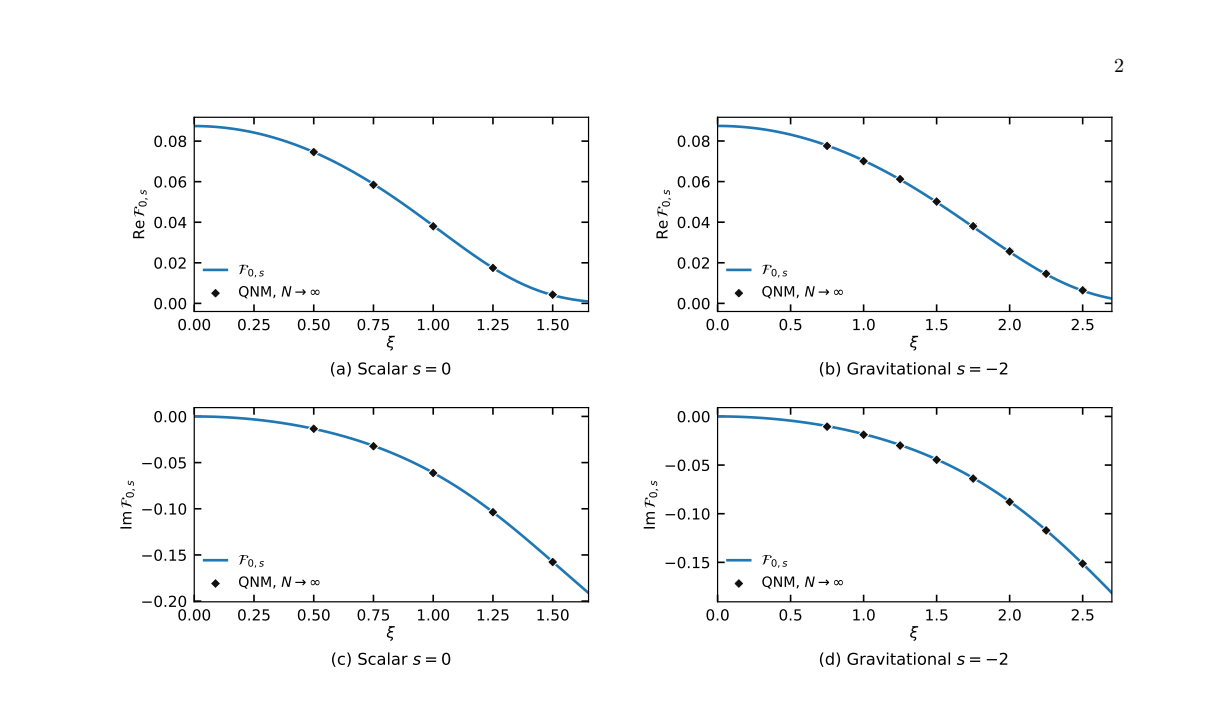
Core claim. The central claim is that for highly damped quasinormal modes of slowly rotating Kerr black holes, the frequencies satisfy Ω_N = -i w_N + F_{0,s}(ξ) + O(ε) with ε = $w_N^{{-1/4}}$, where w_N = (N+1/2)/2, ξ = χ $w_N^{{3/4}}$ is held fixed, and F_{0,s}(ξ) is a universal function given by F_{0,s}(ξ) = (1/(4π)) log T_s(κ_0) with κ_0 = $e^{{-iπ/4}}$ $ξ^{2}$/4. The function T_s(κ) is the connection coefficient of an inner differential equation, which is mapped to the spectrum of a sextic oscillator via the ODE/IM correspondence. At ξ=0, F_{0,s} recovers the Schwarzschild log3/(4π); at large ξ, its real part is exponentially small and its imaginary part reproduces the singular coefficients of the Kerr expansion at fixed rotation. The result is derived from the wave boundary conditions with an error estimate, and it is tested numerically for scalar and gravitational perturbations.
The premise it rests on. The angular eigenvalue A(c) follows the prolate asymptotic linear growth A(c) = i(2L+1)c + O(1) on the normal branches for the relevant range of c, and the bound |B| ≤ C_B sqrt(w) holds. This assumption is used to derive the scaling limit and the error estimate; if it fails for some modes, the scaling and the error estimate would not apply.
If the paper is right (Pith's inferences, not the authors')
The Schwarzschild formula for highly damped QNMs holds only for overtone numbers N ≪ χ^{-4/3}; beyond that, the rotation qualitatively changes the spectrum.
The crossover function F_{0,s}(ξ) is universal: it depends only on the spin weight s, not on the angular numbers ℓ and m (on the normal branches).
The large-ξ expansion of F_{0,s} reproduces the singular coefficients of the Kerr expansion at fixed rotation, including the vanishing of the χ^{-4} term at order N^{-3}.
The result provides a first-principles derivation of the crossover, with an error estimate of order N^{-1/4} for the leading term and N^{-1/2} for the refined condition including the effective κ.
The ODE/IM correspondence used here may be applicable to other black hole spacetimes with similar scaling limits, such as Reissner-Nordström or Kerr-Newman, where a similar crossover is expected.
The connection to the Argyres-Douglas point of the Seiberg-Witten curve suggests that the highly damped QNM spectrum of Kerr black holes is governed by a strongly coupled fixed point in the gauge theory dual, which could be explored further.
The numerical tests show that the corrections of order N^{-1/4} are sizable even at N=3200, so practical applications (e.g., to black hole spectroscopy) may require the next-order term, which the paper identifies as coming from the linear-in-c part of B.
Check this review
What was read
The passes were given all 112,055 characters of the paper's LaTeX source.
Fingerprint of that text (SHA-256): e2953c4e99b9b8458a2a591ece28d0a53858787069ff82707cd1e320b84ba6cd
Pith does not keep that text. Rebuilt from the paper's source or PDF by the same code, it has this fingerprint if it is the same text. From a copy of Pith's code:
PYTHONPATH=. python scripts/review_input_check.py 2611.31394
The passes, in the order they ran
- Reader deepseek-v4-flash · medium effort · $0.0033 · instructions of the Reader, fingerprint f9ead7300382…
- Skeptic deepseek-v4-flash · medium effort · $0.0032 · instructions of the Skeptic, fingerprint 8f88c0f61488…
- Referee deepseek-v4-flash · medium effort · $0.0029 · instructions of the Referee, fingerprint a852d99aea0d…
- Check against the paper deepseek-v4-flash · medium effort · $0.012 · instructions of the Check against the paper, fingerprint 6c7a6883d551…
- Editor deepseek-v4-flash · medium effort · $0.0028 · instructions of the Editor, fingerprint e7211f6a3d27…
- Circularity check deepseek-v4-flash · medium effort · $0.0029 · instructions of the Circularity check, fingerprint e9946e39d67b…
- Summary for the page deepseek-v4-flash · medium effort · temperature 0.2 · $0.0033 · instructions of the Summary for the page, fingerprint e4f56bf568e7…
The passes cost $0.031 in model calls together.
Version stamped on this review: pith-pipeline@v1.4.1-daily-deepseek-or-medium+deepseek/deepseek-v4-flash+p.d60f54226f00
Each link opens a pass's instructions as plain text, the exact bytes its fingerprint was taken over. Every stored set of instructions.
curl -s https://pith.science/methodology/prompts/f9ead730038216984cfb56d7cb34332bdf691828296a1de4245f3d6667d4bf56 | sha256sum
prints the fingerprint of the reader's instructions. The same works for every pass.
The receipt
The review's fingerprint was taken on 25 Nov 2026. The review you are reading still matches it.
Fingerprint of the review (SHA-256): a4ff1db856b793d51b342a390d96d46f8b249a80f5fca59b853d23e031cfdfa7
curl -s 'https://pith.science/api/v1/verdicts/2611.31394?form=canonical' | sha256sum
prints the fingerprint of the review as it stands now. The rule, in four steps.
A matching fingerprint shows the review has not changed since that date. It does not show that the review is right.
How often reviews like this one are right
Reviews like this one: written by deepseek-v4-flash, from the paper's LaTeX source.
How often objections from reviews like this one are right: not yet measured
Reviews by people
This review was written by a machine. No person has reviewed this paper on Pith yet. A scientist listed on Pith can review it for a fee, and their review is published here whatever it concludes.
The paper
Abstract
A slowly rotating black hole is close to a nonrotating one, but its highly damped quasinormal spectrum is not. The Schwarzschild approximation holds only up to overtone numbers of order χ−4/3, where χ is the dimensionless spin. We find that the frequency shift at this scale is a universal function, derived from the wave boundary conditions with an error estimate. It is given by the spectrum of a sextic oscillator, via the correspondence between ordinary differential equations and integrable models. It recovers the Schwarzschild log3 and organizes the singular Kerr coefficients.
The paper's own sentences, arranged, kept beside the review and separate from it. Each label is drawn from a closed vocabulary; the number beside it is the probability the classifier gave that label. No sentence in this record was written by a model.
abstract compiled · 2026-11-25
The authors' main claim, as the classifier picked it out 0.47
“The Schwarzschild approximation holds only up to overtone numbers of order $\chi^{-4/3}$, where $\chi$ is the dimensionless spin.”
How the main claim is stated: asserted 1.00
What the abstract itself states, as probabilities: claims first 0.05 · states limitation 0.50 · human participants 0.01 · controlled comparison 0.21 · randomized assignment 0.01 · states quantitative result 0.86 · compares with prior results 0.81 · mentions code or data availability 0.02
The abstract, sentence by sentence
This table labels the abstract only (arXiv listing abstract v1). The number is the probability the classifier gave the label.
| Sentence | Role | The authors' own work | States the main conclusion | Strength |
|---|---|---|---|---|
| A slowly rotating black hole is close to a nonrotating one, but its highly damped quasinormal spectrum is not. | background 0.55 | 0.19 | 0.39 | asserted 1.00 |
| The Schwarzschild approximation holds only up to overtone numbers of order $\chi^{-4/3}$, where $\chi$ is the dimensionless spin. | result 0.97 | 0.52 | 0.53 | asserted 1.00 |
| We find that the frequency shift at this scale is a universal function, derived from the wave boundary conditions with an error estimate. | result 0.77 | 0.95 | 0.31 | asserted 1.00 |
| It is given by the spectrum of a sextic oscillator, via the correspondence between ordinary differential equations and integrable models. | result 0.51 | 0.70 | 0.14 | asserted 1.00 |
| It recovers the Schwarzschild $\log 3$ and organizes the singular Kerr coefficients. | result 0.52 | 0.67 | 0.17 | asserted 1.00 |
What kind of paper the classifier reports this is: theoretical result 1.00 · evidence from proof or derivation 1.00
What was examined, and what was not
Sources read
- arXiv listing abstract v1
Not examined
- full text
- figures and tables
- references and citing sentences
- relations to other papers
Levels run
- P abstract
Not run
- S sections
- T body sentences
- C citations
- R cross-paper relations
How the labels were made
Compiled by classifier-1.13.0 via TypeSafe API, question bank abstract-p1-20260923, 2026-11-25: 1 request, 4,208 input tokens.
Every quoted sentence on this record is the authors'. Every label is from Pith's closed vocabulary, with the probability shown beside it. This record as JSON
Figures (2)

Figures are the authors', reproduced from the paper.
References (45)
- [1] Up to its exponentially small real part,F0,s has the asymptotic expansion F0,s(ξ)∼ −3iB032π ξ4/3 + i|s|4 + i(1/6−s 2)B14π ξ−4/3 +· · ·, (13) whereB 0 andB 1 are positive constants given in the Sup- plemental Material. Figure S2 of the Supplemental Ma- terial compares Eqs. (12)... on Pith
- [2] K. D. Kokkotas and B. G. Schmidt,Quasi-normal modes of stars and black holes, Living Rev. Relativ.2, 2 (1999) on Pith
- [3] E. Berti, V. Cardoso, and A. O. Starinets,Quasinormal modes of black holes and black branes, Class. Quantum Grav.26, 163001 (2009) on Pith
- [4] R. A. Konoplya and A. Zhidenko,Quasinormal modes of black holes: From astrophysics to string theory, Rev. Mod. Phys.83, 793 (2011) on Pith
- [5] H.-P. Nollert,Quasinormal modes of Schwarzschild black holes: The determination of quasinormal frequencies with very large imaginary parts, Phys. Rev. D47, 5253 (1993) on Pith
- [6] L. Motl,An analytical computation of asymptotic Schwarzschild quasinormal frequencies, Adv. Theor. Math. Phys.6, 1135 (2003) on Pith
- [7] L. Motl and A. Neitzke,Asymptotic black hole quasinor- mal frequencies, Adv. Theor. Math. Phys.7, 307 (2003) on Pith
- [8] S. Musiri and G. Siopsis,Perturbative calculation of quasi-normal modes of Schwarzschild black holes, Class. Quantum Grav.20, L285 (2003) on Pith
- [9] G. Festuccia and H. Liu,Excursions beyond the hori- zon: Black hole singularities in Yang-Mills theories (I), J. High Energy Phys. 04 (2006) 044 on Pith
- [10] S. A. Hartnoll and A. Zhiboedov,Can one hear the shape of a black hole singularity?, arXiv:2609.07514 (2026) on PithPith's reviewarXiv
- [11] S. Grozdanov, V. Movrin, and S. Valach,Quasinormal modes as exterior probes of black hole interiors in our Universe, arXiv:2608.13643 (2026) on PithPith's reviewarXiv
- [12] C. Coviello, A. Gupta, R. A. Hennigar, K. Shi, and A. Svesko,Quasinormal modes and quantum black hole in- teriors, arXiv:2609.26724 (2026) on PithPith's reviewarXiv
- [13] H. F. Jia and M. Rangamani,Expiscating the black hole singularity in holography, arXiv:2611.13261 (2026) on PithPith's reviewarXiv
- [14] E. Berti, V. Cardoso, K. D. Kokkotas, and H. Onozawa, Highly damped quasinormal modes of Kerr black holes, Phys. Rev. D68, 124018 (2003) on Pith
- [15] E. Berti, V. Cardoso, and S. Yoshida,Highly damped quasinormal modes of Kerr black holes: A complete nu- merical investigation, Phys. Rev. D69, 124018 (2004) on Pith
- [16] U. Keshet and S. Hod,Analytic study of rotating black- hole quasinormal modes, Phys. Rev. D76, 061501(R) (2007) on Pith
- [17] U. Keshet and A. Neitzke,Asymptotic spectroscopy of rotating black holes, Phys. Rev. D78, 044006 (2008) on Pith
- [18] C. Chen, J. Jing, Z. Cao, and M. Wang,Complete quasi- normal modes of type-D black holes, Phys. Rev. D112, 103036 (2025) on Pith
- [19] R. G. Daghigh, M. D. Green, and B. W. Mulligan, Asymptotic spectrum of Kerr black holes in the small an- gular momentum limit, Phys. Rev. D83, 044001 (2011) on Pith
- [20] S. Musiri and G. Siopsis,On quasi-normal modes of Kerr black holes, Phys. Lett. B579, 25 (2004) on Pith
show 25 more
- [21] R. G. Daghigh, G. Kunstatter, D. Ostapchuk, and V. Bagnulo,The highly damped quasinormal modes ofd- dimensional Reissner–Nordström black holes in the small charge limit, Class. Quantum Grav.23, 5101 (2006) on Pith
- [22] Y. Hatsuda,Systematic high overtone expansion of Kerr quasinormal modes, arXiv:2610.38019 (2026) on PithPith's reviewarXiv
- [23] P. Dorey and R. Tateo,Anharmonic oscillators, the ther- modynamic Bethe ansatz and nonlinear integral equa- tions, J. Phys. A: Math. Gen.32, L419 (1999) on Pith
- [24] V. V. Bazhanov, S. L. Lukyanov, and A. B. Zamolod- chikov,Spectral determinants for Schrödinger equation and Q-operators of conformal field theory, J. Stat. Phys. 102, 567 (2001) on Pith
- [25] P. Dorey, C. Dunning, and R. Tateo,The ODE/IM cor- respondence, J. Phys. A: Math. Theor.40, R205 (2007) on Pith
- [26] E. Berti, V. Cardoso, and M. Casals,Eigenvalues and eigenfunctions of spin-weighted spheroidal harmonics in four and higher dimensions, Phys. Rev. D73, 024013 (2006), Erratum, Phys. Rev. D73, 109902 (2006) on Pith
- [27] D. J. Vickers and G. B. Cook,Understanding solutions of the angular Teukolsky equation in the prolate asymptotic limit, Phys. Rev. D106, 104037 (2022) on Pith
- [28] Supplemental Material, included below, for equation con- ventions, the sextic oscillator, boundary equivalence, outer matching, spectral determinants, and numerical checks on Pith
- [29] Y. Hatsuda,An alternative to the Teukolsky equation, Gen. Relativ. Gravit.53, 93 (2021) on Pith
- [30] S. A. Teukolsky,Perturbations of a rotating black hole. I. Fundamental equations for gravitational, electromag- netic, and neutrino-field perturbations, Astrophys. J. 185, 635 (1973) on Pith
- [31] N. Andersson and C. J. Howls,The asymptotic quasi- normal mode spectrum of non-rotating black holes, Class. Quantum Grav.21, 1623 (2004) on Pith
- [32] B. F. Whiting,Mode stability of the Kerr black hole, J. Math. Phys.30, 1301 (1989) on Pith
- [33] M. Casals and R. Teixeira da Costa,Hidden spectral sym- metries and mode stability of subextremal Kerr(-de Sit- ter) black holes, Commun. Math. Phys.394, 797 (2022) on Pith
- [34] A.Ya.KazakovandS.Yu.Slavyanov,Euler integral sym- metries for the confluent Heun equation and symmetries of the Painlevé equation PV, Theor. Math. Phys.179, 6 543 (2014) on Pith
- [35] P. Dorey and R. Tateo,On the relation between Stokes multipliers and the T–Q systems of conformal field the- ory, Nucl.Phys.B563, 573(1999), Erratum, Nucl.Phys. B603, 581 (2001) on Pith
- [36] P. Dorey, C. Dunning, and R. Tateo,Spectral equiva- lences, Bethe ansatz equations, and reality properties in PT-symmetric quantum mechanics, J. Phys. A: Math. Gen.34, 5679 (2001) on Pith
- [37] D. Fioravanti and D. Gregori,New method for exact re- sults on quasinormal modes of black holes, Phys. Rev. D 112, 125020 (2025) on Pith
- [38] G. Aminov, A. Grassi, and Y. Hatsuda,Black hole quasi- normal modes and Seiberg–Witten theory, Ann. Henri Poincaré23, 1951 (2022) on Pith
- [39] K. Ito and T. Okubo,Quantum periods forN= 2SU(2) SQCD around the superconformal point, Nucl. Phys. B 934, 356 (2018) on Pith
- [40] K. Ito, S. Koizumi, and T. Okubo,Quantum Seiberg– Witten curve and universality in Argyres–Douglas theo- ries, Phys. Lett. B792, 29 (2019) on Pith
- [41] J. Watkins,Spectral zeta functions of a 1D Schrödinger problem, J. Nonlinear Math. Phys.19, 1250026 (2012) on Pith
- [42] V. V. Bazhanov, S. L. Lukyanov, and A. B. Zamolod- chikov,Integrable structure of conformal field theory, quantum KdV theory and thermodynamic Bethe ansatz, Commun. Math. Phys.177, 381 (1996) on Pith
- [43] V. V. Bazhanov, S. L. Lukyanov, and A. B. Zamolod- chikov,Integrable structure of conformal field theory II. Q-operator and DDV equation, Commun. Math. Phys. 190, 247 (1997) on Pith
- [44] E. W. Leaver,An analytic representation for the quasi- normal modes of Kerr black holes, Proc. R. Soc. London A402, 285 (1985) on Pith
- [45] M. Giorgi and A. Grassi,to appear. 7 Supplemental Material InthisSupplementalMaterial, wederivetheresultsstatedintheLetteranddescribetheirnumericalchecks. SectionsA and B fix the angular and radial conventions and the inner connection coefficient. Sections C and D connect it t... on Pith
Challenges and discussion
Disagree with the review, or know something it missed? Leave a comment, or challenge this review formally: a challenge becomes a permanent entry in this paper's record, and its decision is published here.
Come back by email
A short list of the week's newly reviewed papers. Nothing is sent until you confirm from your inbox, and every email has a link that stops it. No account.
No comments yet.
Sign in to comment