High Energy Physics - Theory · arXiv:2611.21127 v1 · submitted 16 Nov 2026 · 139 references
Thermal deep inelastic scattering, universality and complex geodesics
The paper says
“In deep inelastic scattering (DIS), a lepton scatters off a target hadron whose structure is probed by an exchanged photon with large spacelike virtuality.”
more of the abstract
We consider two-point functions of currents in strongly interacting quantum field theories at finite temperature in this kinematic regime and use a holographic description to compute them. At large virtuality, the crossover from vacuum-dominated to thermally dominated physics corresponds to a transition from exponentially suppressed absorption to power-law behavior of the response functions. This regime is related to a particular near-lightcone limit of thermal CFT correlators. We show that the response functions exhibit a large degree of universality: the dependence on the three-point couplings of currents to the stress tensor enters through a channel-dependent coefficient multiplying the kinematic parameter that controls the relative size of vacuum and thermal effects. The same coefficient controls conformal collider bounds; when either bound is saturated, the corresponding response function takes its vacuum form in the near-lightcone limit. Furthermore, the absorption exponent in the low-temperature regime is related to a complex geodesic propagating in the near-lightcone geometry.
from the abstract
Pith says
Machine review · deepseek-v4-flash · 17 Nov 2026 · read the full text (166,480 characters) · not checked by a person
It can be wrong. Challenge this review or reply to it.
Holds up. This paper shows that the near-lightcone thermal current response functions in holographic CFTs depend on the current–stress-tensor coupling only through a rescaling of the kinematic parameter, and that the absorption exponent matches a complex null geodesic. This line is wrong
4 minor
How often objections from reviews like this one are right: not yet measured
The paper, first character to last
The reviewer was given the whole text, 166,480 characters. Not checked: figures, code, what the 139 references say.
4 minor objections
The paper says, at Sections 3--4, Eq. (4.30)
Pith says: minor objection 1 of 4
The rescaling law (4.30) is derived and cross-checked only for the specific bulk class consisting of a minimally coupled gauge field plus the Weyl interaction (4.2) at fixed background metric. Within that class the derivation is clean: the reduced equations (4.23) and (4.27), the Kaigorodov contraction (4.32), and the boundary-normalization check (4.37) are mutually consistent.
more of objection 1
The proof says nothing about other deformations of the current--stress-tensor three-point function (for example couplings of the gauge field to Ricci or scalar curvature), and Section 7.2 explicitly leaves a bootstrap derivation for external currents open. Because 'universality' appears in the title and abstract, I recommend that the authors state in the abstract and in Section 7.2 that the result is established for this deformation class of bulk actions and that the general-CFT extension is a conjecture; this does not affect the validity of the technical results.
The paper says, at Appendix C / Figures 2--4
Pith says: minor objection 2 of 4
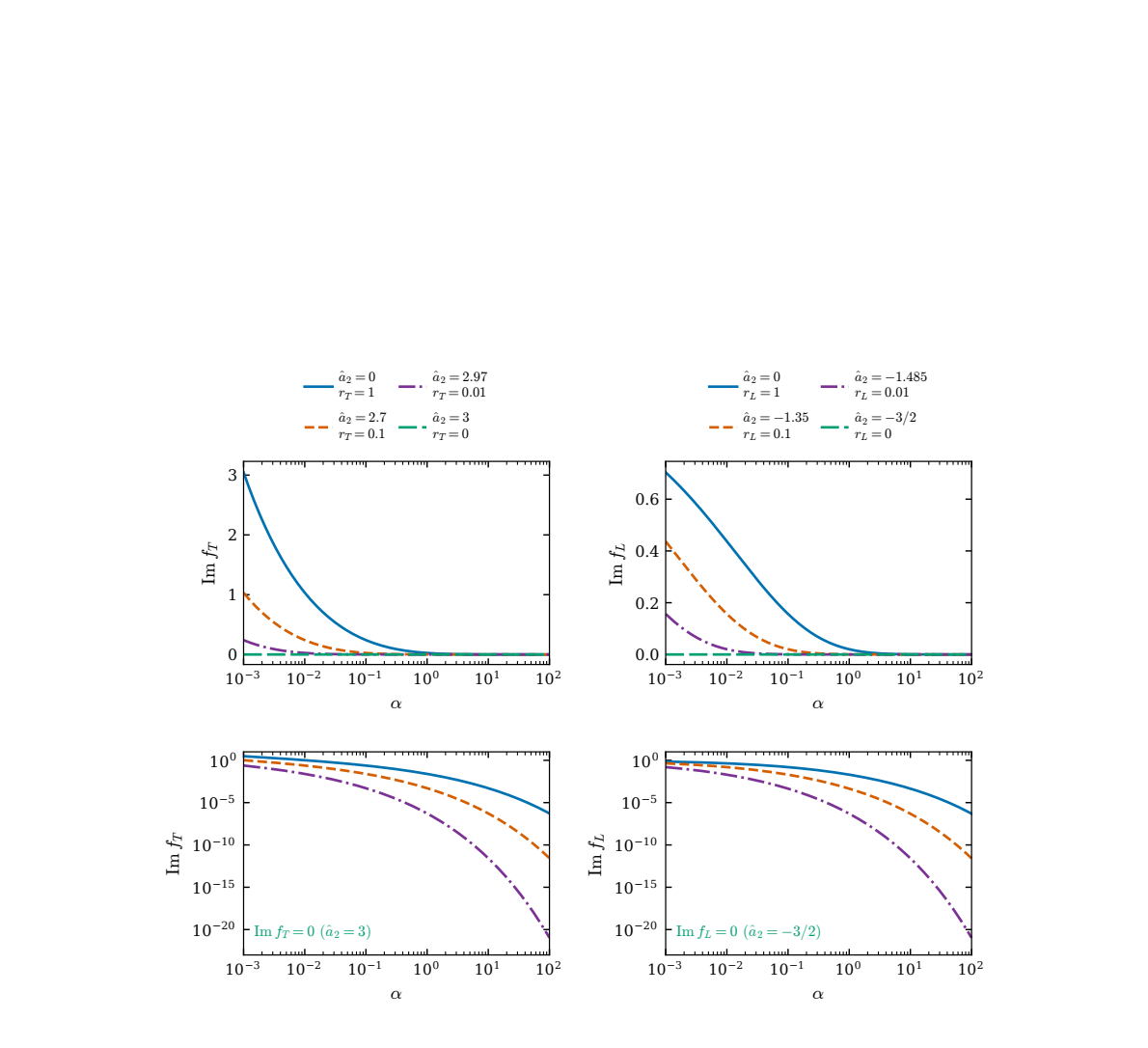
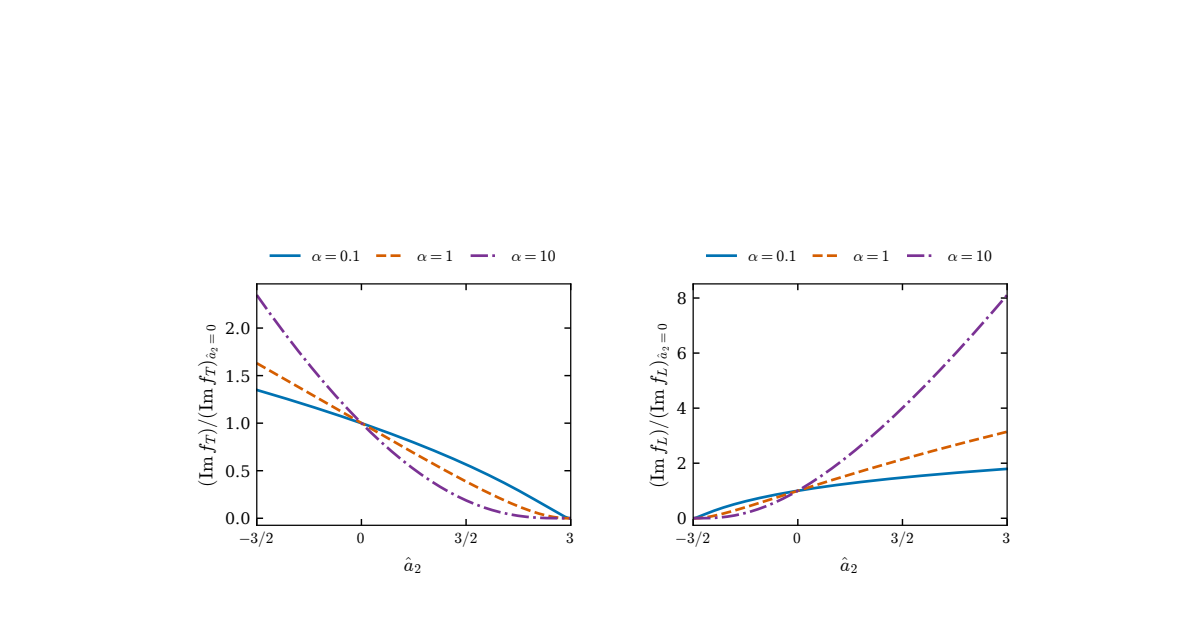
I could not view the figures. The quantitative checks in the text (two independent integration methods agreeing to 2e-12 in the real parts and 2e-11 in the imaginary parts, and Table 1 agreeing to seven digits) indicate the numerics are reproducible, but the authors should verify that the plotted curves in Figures 2--4 display exactly the quantities and conventions described in their captions.
show 2 more
The paper says, at Section 7.4, Eq. (6.10)
Pith says: minor objection 3 of 4
The timelike result (6.10) is reported as an empirical fit ('consistent with the large-|alpha| behavior') without the same documentation given for the spacelike numerics in Appendix C. A short description of how the exponential and oscillatory form was extracted, and its error, would let the reader judge the strength of this claim.
The paper says, at Section 7.1, footnote
Pith says: minor objection 4 of 4
The footnote in Section 7.1 qualifies the collider-endpoint statement in an important way (saturation is incompatible with a large higher-spin gap, so the 'freedom near lightcone' result lives only in a limiting holographic regime). Consider moving or repeating this caveat next to the main vacuum-form claims of Section 4.7, where it is most relevant to a reader assessing the endpoint behavior.
What would settle it
A direct calculation of the thermal current two-point function in the near-lightcone limit for a different holographic model (e.g., with a different higher-derivative coupling) that does not exhibit the simple rescaling f_i(α;γ) = f_i^(0)(α/r_i) would falsify the universality claim. Alternatively, a bootstrap derivation for external currents that shows the rescaling does not hold would also falsify it.
from Pith's summary of the paper
How the review went
5 passes by deepseek-v4-flash · 17 Nov 2026
- Reader holds up
- Skeptic concern withdrawn: Pith's reviewer misread the paper
- Referee 4 minor
- Check against the paper kept 0 of 2 objections
- Editor wrote the verdict above
Not run on this paper: the simulated authors' defence.
Pith's passes raised 2 objections. A check against the paper's text kept 0, withdrew 1 (1 Pith's reviewer misread the paper) and moved 1 to the minor objections.
The review in full
The review in brief, machine-written
The paper extends the universality phenomenon previously established for stress-tensor thermal correlators to conserved currents. The main result is that in the near-lightcone (thermal DIS) limit, adding a Weyl coupling to the gauge field changes each polarization's response function only by rescaling its argument by the conformal collider parameter rT or rL. This is a clean, explicit holographic calculation. The authors also show that when a collider bound is saturated, the corresponding channel has its vacuum form and absorption vanishes. The connection to complex geodesics in the Kaigorodov spacetime is worked out in detail, and the WKB absorption exponent is matched to the eikonal phase of a complex null geodesic. The numerical results support the analytic claims.
The paper is well-structured and the derivations are sound within the stated holographic setup. The assumptions are clearly laid out: the bulk gauge field is minimally coupled to the Weyl tensor while keeping the Einstein black-brane metric fixed. This is a specific higher-derivative correction, and the paper does not argue it is the most general deformation of the current–stress-tensor three-point function. That is a limitation, but it is acknowledged implicitly by the focus on this particular coupling. The bootstrap derivation for currents is not carried out; the authors note this and call for future work. The connection to QCD is speculative, as stated.
This paper is for researchers working on holographic thermal correlators, conformal collider physics, and the geometric interpretation of thermal response. It is a solid, incremental extension of known results from stress tensors to currents, with a clean geometric interpretation. The math and the numerics are consistent. The paper deserves a serious referee.
Recommendation: send to peer review. The paper is technically sound and the results are new within the subfield. The main caveat—that the calculation uses a specific Weyl coupling rather than the most general deformation—is clearly stated and does not undermine the paper's value.
The stress test's concern
Withdrawn: Pith's reviewer misread the paper.
The paper says
“Returning to the original black-brane coordinates of \eqref{eq:metric}, the transverse and temporal boundary terms in the on-shell action contain the weights”
The referee's report
The central claims are derived from the bulk equations with explicit steps, and the internal consistency is unusually strong. I read the coordinate conversions (black brane to Kaigorodov, and between tilde u, v, and s), the endpoint vacuum values (4.41)--(4.44), the collider-parameter maps, and the large-order moment ratios (predicted 54.8 and 355.6 against 54.2 and 354.0 from Table 1) and found them mutually consistent; the near-lightcone reduction of the Weyl-modified longitudinal equation also matches the direct Kaigorodov derivation. The numerics are supported by two independent methods with stated tolerances (real parts to 2e-12, imaginary parts to 2e-11) and a seven-digit table, and the geodesic match is exact algebra that links the DIS exponent to an independent position-space result, lending weight to the connection with bouncing singularities. The principal caveat is scope: the universality statement is proven for the specific Weyl-type deformation class, and the paper explicitly leaves a bootstrap derivation for currents open; because this is acknowledged and the technical claims are sound, I do not regard it as blocking.
Pith's reading of the paper (a machine's summary, not the authors')
The paper studies deep inelastic scattering (DIS) off a strongly coupled plasma at finite temperature, using holography. It shows that in the near-lightcone limit—the regime where the probe's virtuality and thermal effects compete—the two independent current response functions (transverse and longitudinal) depend on the current–stress-tensor three-point coupling only through a channel-dependent rescaling of the kinematic parameter that controls the relative size of vacuum and thermal contributions. This rescaling factor is the same combination that appears in conformal collider bounds. When either bound is saturated, the corresponding channel's response reduces to its vacuum form, and DIS absorption vanishes. The exponentially small absorption exponent in the low-temperature regime is shown to equal the eikonal phase of a complex null geodesic in the near-lightcone geometry.
What carries the argument. The central object is the near-lightcone limit of the black-brane geometry, which reduces to the Kaigorodov spacetime—a plane wave on AdS. In this geometry, the Weyl interaction only rescales the coefficients of the two terms in the gauge-field action that couple to the null energy density of the plasma, producing the factors r_T and r_L. The radial equations for the gauge field become Schrödinger-type equations with a potential that depends on α and r_i; the rescaling of α by r_i is then manifest. The complex null geodesic of the Kaigorodov metric, obtained from the WKB phase, reproduces the absorption exponent.
Core claim. The paper establishes that in the near-lightcone limit of thermal current correlators, the effect of a Weyl coupling (which changes the current–current–stress-tensor three-point function) is entirely captured by rescaling the argument of each polarization's response function: f_T(α;γ) = f_T^(0)(α/r_T) and f_L(α;γ) = f_L^(0)(α/r_L), where r_T = 1 - â2/3 and r_L = 1 + 2â2/3 are the conformal collider parameters. This means the shape of the response function is universal; only the scale at which thermal effects become important changes. When a bound is saturated (r_T=0 or r_L=0), the corresponding channel has its vacuum form and DIS absorption vanishes. The absorption exponent in the weak-absorption regime is shown to equal the eikonal phase of a complex null geodesic in the Kaigorodov spacetime, matching the known WKB result.
The premise it rests on. The holographic calculation assumes the bulk gauge field is minimally coupled to the Weyl tensor via the specific interaction -4γ $L^{2}$ C_{MNPQ} $F^{{MN}}$ $F^{{PQ}}$ while keeping the Einstein black-brane metric fixed; this is a particular higher-derivative correction, and other couplings (e.g., to the Ricci tensor or scalar) could produce different effects.
If the paper is right (Pith's inferences, not the authors')
If the universality holds beyond the holographic model, the near-lightcone thermal current correlator in any CFT with a large-N spectrum is determined by the current–stress-tensor coupling through the same rescaling.
At the conformal collider endpoints, the selected channel's DIS absorption vanishes exactly in the near-lightcone limit, providing a clean signature of the saturation of the bounds.
The absorption exponent is directly related to a complex geodesic in the near-lightcone geometry, linking the DIS exponent to the position-space singularity location studied in the stress-tensor sector.
The moments of the structure functions are positive and determined by the thermal OPE coefficients; at nonzero Weyl coupling, the n-th moment is multiplied by r_i^n.
The timelike current correlator exhibits exponentially damped oscillations around its vacuum value, with the same scale A as the spacelike absorption exponent.
The universality suggests that the near-lightcone limit of thermal correlators may be a powerful organizing principle: the leading-twist multi-stress-tensor contributions are universal up to a rescaling, which could simplify the computation of thermal effects in strongly coupled plasmas.
The relation between the absorption exponent and the complex geodesic implies that the same geometric object—the complex null geodesic in the Kaigorodov spacetime—controls both the stress-tensor and current sectors, hinting at a deeper structure in the thermal OPE.
The positivity of the moments and the dispersion relation provide a thermal analogue of the relation between DIS positivity and conformal collider bounds, which could be used to constrain the current–stress-tensor coupling in any unitary CFT.
The prediction for the photon emission rate (Im R_1 at ω=k) scaling as r_T^{1/3} could be tested in lattice QCD or in holographic models with flavor, providing a quantitative check of the universality.
Check this review
What was read
The passes were given all 166,480 characters of the paper's LaTeX source.
Fingerprint of that text (SHA-256): e18524ff0e803260ab408e47e83b400c7b74ff90c6cb796fb0b9789ba22b3d23
Pith does not keep that text. Rebuilt from the paper's source or PDF by the same code, it has this fingerprint if it is the same text. From a copy of Pith's code:
PYTHONPATH=. python scripts/review_input_check.py 2611.21127
The passes, in the order they ran
- Reader deepseek-v4-flash · medium effort · $0.0059 · instructions of the Reader, fingerprint f9ead7300382…
- Skeptic deepseek-v4-flash · medium effort · $0.0052 · instructions of the Skeptic, fingerprint 8f88c0f61488…
- Referee deepseek-v4-flash · medium effort · $0.022 · instructions of the Referee, fingerprint a852d99aea0d…
- Check against the paper deepseek-v4-flash · medium effort · $0.011 · instructions of the Check against the paper, fingerprint 6c7a6883d551…
- Editor deepseek-v4-flash · medium effort · $0.0052 · instructions of the Editor, fingerprint e7211f6a3d27…
- Circularity check deepseek-v4-flash · medium effort · $0.0051 · instructions of the Circularity check, fingerprint e9946e39d67b…
- Summary for the page deepseek-v4-flash · medium effort · temperature 0.2 · $0.0055 · instructions of the Summary for the page, fingerprint e4f56bf568e7…
The passes cost $0.060 in model calls together.
Version stamped on this review: pith-pipeline@v1.4.1-daily-deepseek-or-medium+deepseek/deepseek-v4-flash+p.d60f54226f00
Each link opens a pass's instructions as plain text, the exact bytes its fingerprint was taken over. Every stored set of instructions.
curl -s https://pith.science/methodology/prompts/f9ead730038216984cfb56d7cb34332bdf691828296a1de4245f3d6667d4bf56 | sha256sum
prints the fingerprint of the reader's instructions. The same works for every pass.
The receipt
The review's fingerprint was taken on 17 Nov 2026. The review you are reading still matches it.
Fingerprint of the review (SHA-256): 051d268e0a7fc83a9418cd3684e8c0834b886f3c09b072fd0002c4bf46aa7f37
curl -s 'https://pith.science/api/v1/verdicts/2611.21127?form=canonical' | sha256sum
prints the fingerprint of the review as it stands now. The rule, in four steps.
A matching fingerprint shows the review has not changed since that date. It does not show that the review is right.
How often reviews like this one are right
Reviews like this one: written by deepseek-v4-flash, from the paper's LaTeX source.
How often objections from reviews like this one are right: not yet measured
Reviews by people
This review was written by a machine. No person has reviewed this paper on Pith yet. A scientist listed on Pith can review it for a fee, and their review is published here whatever it concludes.
How Pith checks papers · The full audit of this paper · Review history (2 versions)
The paper
Abstract
In deep inelastic scattering (DIS), a lepton scatters off a target hadron whose structure is probed by an exchanged photon with large spacelike virtuality. We consider two-point functions of currents in strongly interacting quantum field theories at finite temperature in this kinematic regime and use a holographic description to compute them. At large virtuality, the crossover from vacuum-dominated to thermally dominated physics corresponds to a transition from exponentially suppressed absorption to power-law behavior of the response functions. This regime is related to a particular near-lightcone limit of thermal CFT correlators. We show that the response functions exhibit a large degree of universality: the dependence on the three-point couplings of currents to the stress tensor enters through a channel-dependent coefficient multiplying the kinematic parameter that controls the relative size of vacuum and thermal effects. The same coefficient controls conformal collider bounds; when either bound is saturated, the corresponding response function takes its vacuum form in the near-lightcone limit. Furthermore, the absorption exponent in the low-temperature regime is related to a complex geodesic propagating in the near-lightcone geometry.
The paper's own sentences, arranged, kept beside the review and separate from it. Each label is drawn from a closed vocabulary; the number beside it is the probability the classifier gave that label. No sentence in this record was written by a model.
abstract compiled · 2026-11-17
The authors' main claim, as the classifier picked it out 1.00
“We show that the response functions exhibit a large degree of universality: the dependence on the three-point couplings of currents to the stress tensor enters through a channel-dependent coefficient multiplying the kinematic parameter that controls the relative size of vacuum and thermal effects.”
How the main claim is stated: asserted 1.00
What the abstract itself states, as probabilities: claims first 0.03 · states limitation 0.09 · human participants 0.01 · controlled comparison 0.10 · randomized assignment 0.01 · states quantitative result 0.17 · compares with prior results 0.25 · mentions code or data availability 0.01
The abstract, sentence by sentence
This table labels the abstract only (arXiv listing abstract v1). The number is the probability the classifier gave the label.
| Sentence | Role | The authors' own work | States the main conclusion | Strength |
|---|---|---|---|---|
| In deep inelastic scattering (DIS), a lepton scatters off a target hadron whose structure is probed by an exchanged photon with large spacelike virtuality. | background 1.00 | 0.04 | 0.02 | asserted 0.99 |
| We consider two-point functions of currents in strongly interacting quantum field theories at finite temperature in this kinematic regime and use a holographic description to compute them. | contribution 0.55 | 0.94 | 0.05 | asserted 0.95 |
| At large virtuality, the crossover from vacuum-dominated to thermally dominated physics corresponds to a transition from exponentially suppressed absorption to power-law behavior of the response functions. | result 0.94 | 0.62 | 0.19 | asserted 1.00 |
| This regime is related to a particular near-lightcone limit of thermal CFT correlators. | interpretation 0.63 | 0.19 | 0.06 | asserted 0.99 |
| We show that the response functions exhibit a large degree of universality: the dependence on the three-point couplings of currents to the stress tensor enters through a channel-dependent coefficient multiplying the kinematic parameter that controls the relative size of vacuum and thermal effects. | result 0.99 | 0.95 | 0.64 | asserted 1.00 |
| The same coefficient controls conformal collider bounds; when either bound is saturated, the corresponding response function takes its vacuum form in the near-lightcone limit. | result 0.82 | 0.83 | 0.20 | asserted 1.00 |
| Furthermore, the absorption exponent in the low-temperature regime is related to a complex geodesic propagating in the near-lightcone geometry. | result 0.93 | 0.84 | 0.12 | asserted 1.00 |
What kind of paper the classifier reports this is: theoretical result 1.00 · evidence from proof or derivation 0.76
What was examined, and what was not
Sources read
- arXiv listing abstract v1
Not examined
- full text
- figures and tables
- references and citing sentences
- relations to other papers
Levels run
- P abstract
Not run
- S sections
- T body sentences
- C citations
- R cross-paper relations
How the labels were made
Compiled by classifier-1.13.0 via TypeSafe API, question bank abstract-p1-20260923, 2026-11-17: 1 request, 5,674 input tokens.
Every quoted sentence on this record is the authors'. Every label is from Pith's closed vocabulary, with the probability shown beside it. This record as JSON
Figures (5)



Figures are the authors', reproduced from the paper.
References (139)
- [1] Y. Hatta, E. Iancu, and A. H. Mueller,Deep inelastic scattering off a N=4 SYM plasma at strong coupling,JHEP01(2008) 063, [arXiv:0710.5297] on PithPith's reviewarXiv
- [2] J. Polchinski and M. J. Strassler,Deep inelastic scattering and gauge / string duality, JHEP05(2003) 012, [hep-th/0209211]. 6For field-theoretic derivations of the conformal collider bounds, see Refs. [134, 138, 139]. – 49 – on PithPith's reviewarXiv
- [3] R. C. Brower, J. Polchinski, M. J. Strassler, and C.-I. Tan,The Pomeron and gauge/string duality,JHEP12(2007) 005, [hep-th/0603115] on PithPith's reviewarXiv
- [4] Y. Hatta, E. Iancu, and A. H. Mueller,Deep inelastic scattering at strong coupling from gauge/string duality: The Saturation line,JHEP01(2008) 026, [arXiv:0710.2148] on PithPith's reviewarXiv
- [5] C. A. Ballon Bayona, H. Boschi-Filho, and N. R. F. Braga,Deep inelastic scattering from gauge string duality in the soft wall model,JHEP03(2008) 064, [arXiv:0711.0221] on PithPith's reviewarXiv
- [6] C. A. Ballon Bayona, H. Boschi-Filho, and N. R. F. Braga,Deep inelastic structure functions from supergravity at small x,JHEP10(2008) 088, [arXiv:0712.3530] on PithPith's reviewarXiv
- [7] L. Cornalba and M. S. Costa,Saturation in Deep Inelastic Scattering from AdS/CFT,Phys. Rev. D78(2008) 096010, [arXiv:0804.1562] on PithPith's reviewarXiv
- [8] B. Pire, C. Roiesnel, L. Szymanowski, and S. Wallon,On AdS/QCD correspondence and the partonic picture of deep inelastic scattering,Phys. Lett. B670(2008) 84–90, [arXiv:0805.4346] on PithPith's reviewarXiv
- [9] J. L. Albacete, Y. V. Kovchegov, and A. Taliotis,DIS on a Large Nucleus in AdS/CFT,JHEP07(2008) 074, [arXiv:0806.1484] on PithPith's reviewarXiv
- [10] C. A. Ballon Bayona, H. Boschi-Filho, and N. R. F. Braga,Deep inelastic scattering from gauge string duality in D3-D7 brane model,JHEP09(2008) 114, [arXiv:0807.1917] on PithPith's reviewarXiv
- [11] E. Levin, J. Miller, B. Z. Kopeliovich, and I. Schmidt,Glauber-Gribov approach for DIS on nuclei in N=4 SYM,JHEP02(2009) 048, [arXiv:0811.3586] on PithPith's reviewarXiv
- [12] A. H. Mueller, A. I. Shoshi, and B.-W. Xiao,Deep inelastic and dipole scattering on finite length hot N=4 SYM matter,Nucl. Phys. A822(2009) 20–40, [arXiv:0812.2897] on PithPith's reviewarXiv
- [13] J.-H. Gao and B.-W. Xiao,Polarized Deep Inelastic and Elastic Scattering From Gauge/String Duality,Phys. Rev. D80(2009) 015025, [arXiv:0904.2870] on PithPith's reviewarXiv
- [14] Y. Hatta, T. Ueda, and B.-W. Xiao,Polarized DIS in N=4 SYM: Where is spin at strong coupling?,JHEP08(2009) 007, [arXiv:0905.2493] on PithPith's reviewarXiv
- [15] E. Avsar, E. Iancu, L. McLerran, and D. N. Triantafyllopoulos,Shockwaves and deep inelastic scattering within the gauge/gravity duality,JHEP11(2009) 105, [arXiv:0907.4604] on PithPith's reviewarXiv
- [16] L. Cornalba, M. S. Costa, and J. Penedones,Deep Inelastic Scattering in Conformal QCD,JHEP03(2010) 133, [arXiv:0911.0043] on PithPith's reviewarXiv
- [17] C. A. B. Bayona, H. Boschi-Filho, and N. R. F. Braga,Deep inelastic scattering off a plasma with flavour from D3-D7 brane model,Phys. Rev. D81(2010) 086003, [arXiv:0912.0231] on PithPith's reviewarXiv
- [18] E. Iancu and A. H. Mueller,Light-like mesons and deep inelastic scattering in finite-temperature AdS/CFT with flavor,JHEP02(2010) 023, [arXiv:0912.2238]. – 50 – on PithPith's reviewarXiv
- [19] B. Hassanain and M. Schvellinger,Holographic current correlators at finite coupling and scattering off a supersymmetric plasma,JHEP04(2010) 012, [arXiv:0912.4704] on PithPith's reviewarXiv
- [20] L. Cornalba, M. S. Costa, and J. Penedones,AdS black disk model for small-x DIS, Phys. Rev. Lett.105(2010) 072003, [arXiv:1001.1157] on PithPith's reviewarXiv
show 80 more
- [21] Y. V. Kovchegov,R-Current DIS on a Shock Wave: Beyond the Eikonal Approximation,Phys. Rev. D82(2010) 054011, [arXiv:1005.0374] on PithPith's reviewarXiv
- [22] R. C. Brower, M. Djuric, I. Sarcevic, and C.-I. Tan,String-Gauge Dual Description of Deep Inelastic Scattering at Small-x,JHEP11(2010) 051, [arXiv:1007.2259] on PithPith's reviewarXiv
- [23] E. Koile, S. Macaluso, and M. Schvellinger,Deep Inelastic Scattering from Holographic Spin-One Hadrons,JHEP02(2012) 103, [arXiv:1112.1459] on PithPith's reviewarXiv
- [24] A. Stoffers and I. Zahed,Holographic Pomeron: Saturation and DIS,Phys. Rev. D 87(2013) 075023, [arXiv:1205.3223] on PithPith's reviewarXiv
- [25] A. Amorim, R. Carcass´ es Quevedo, and M. S. Costa,Nonminimal coupling contribution to DIS at lowxin Holographic QCD,Phys. Rev. D98(2018), no. 2 026016, [arXiv:1804.07778] on PithPith's reviewarXiv
- [26] G. Policastro, D. T. Son, and A. O. Starinets,From AdS / CFT correspondence to hydrodynamics,JHEP09(2002) 043, [hep-th/0205052] on PithPith's reviewarXiv
- [27] A. Nunez and A. O. Starinets,AdS / CFT correspondence, quasinormal modes, and thermal correlators in N=4 SYM,Phys. Rev. D67(2003) 124013, [ hep-th/0302026] on PithPith's reviewarXiv
- [28] P. K. Kovtun and A. O. Starinets,Quasinormal modes and holography,Phys. Rev. D 72(2005) 086009, [hep-th/0506184] on PithPith's reviewarXiv
- [29] D. Teaney,Finite temperature spectral densities of momentum and R-charge correlators in N=4 Yang Mills theory,Phys. Rev. D74(2006) 045025, [hep-ph/0602044] on PithPith's reviewarXiv
- [30] S. Caron-Huot, P. Kovtun, G. D. Moore, A. Starinets, and L. G. Yaffe,Photon and dilepton production in supersymmetric Yang-Mills plasma,JHEP12(2006) 015, [hep-th/0607237] on PithPith's reviewarXiv
- [31] R. C. Myers, A. O. Starinets, and R. M. Thomson,Holographic spectral functions and diffusion constants for fundamental matter,JHEP11(2007) 091, [arXiv:0706.0162] on PithPith's reviewarXiv
- [32] I. Amado, C. Hoyos-Badajoz, K. Landsteiner, and S. Montero,Absorption lengths in the holographic plasma,JHEP09(2007) 057, [arXiv:0706.2750] on PithPith's reviewarXiv
- [33] I. Amado, C. Hoyos-Badajoz, K. Landsteiner, and S. Montero,Residues of correlators in the strongly coupled N=4 plasma,Phys. Rev. D77(2008) 065004, [arXiv:0710.4458] on PithPith's reviewarXiv
- [34] Y. Hatta, E. Iancu, and A. H. Mueller,Jet evolution in the N=4 SYM plasma at strong coupling,JHEP05(2008) 037, [arXiv:0803.2481]. – 51 – on PithPith's reviewarXiv
- [35] I. Amado, C. Hoyos-Badajoz, K. Landsteiner, and S. Montero,Hydrodynamics and beyond in the strongly coupled N=4 plasma,JHEP07(2008) 133, [arXiv:0805.2570] on PithPith's reviewarXiv
- [36] P. Arnold and D. Vaman,Jet quenching in hot strongly coupled gauge theories revisited: 3-point correlators with gauge-gravity duality,JHEP10(2010) 099, [arXiv:1008.4023] on PithPith's reviewarXiv
- [37] B. Hassanain and M. Schvellinger,Plasma photoemission from string theory,JHEP 12(2012) 095, [arXiv:1209.0427] on PithPith's reviewarXiv
- [38] S. Waeber and A. Sch¨ afer,Studying a charged quark gluon plasma via holography and higher derivative corrections,JHEP07(2018) 069, [arXiv:1804.01912] on PithPith's reviewarXiv
- [39] S. He and Y. Li,Holographic Euclidean thermal correlator,JHEP03(2024) 024, [arXiv:2308.13518] on PithPith's reviewarXiv
- [40] H. F. Jia and M. Rangamani,Holographic thermal correlators and quasinormal modes from semiclassical Virasoro blocks,JHEP12(2024) 047, [ arXiv:2408.05208] on PithPith's reviewarXiv
- [41] A. L. Fitzpatrick and K.-W. Huang,Universal Lowest-Twist in CFTs from Holography,JHEP08(2019) 138, [arXiv:1903.05306] on PithPith's reviewarXiv
- [42] R. Karlsson, M. Kulaxizi, A. Parnachev, and P. Tadi´ c,Black Holes and Conformal Regge Bootstrap,JHEP10(2019) 046, [arXiv:1904.00060] on PithPith's reviewarXiv
- [43] M. Kulaxizi, G. S. Ng, and A. Parnachev,Subleading Eikonal, AdS/CFT and Double Stress Tensors,JHEP10(2019) 107, [arXiv:1907.00867] on PithPith's reviewarXiv
- [44] R. Karlsson, M. Kulaxizi, A. Parnachev, and P. Tadi´ c,Leading Multi-Stress Tensors and Conformal Bootstrap,JHEP01(2020) 076, [arXiv:1909.05775] on PithPith's reviewarXiv
- [45] Y.-Z. Li,Heavy-light Bootstrap from Lorentzian Inversion Formula,JHEP07(2020) 046, [arXiv:1910.06357] on PithPith's reviewarXiv
- [46] Y.-Z. Li, Z.-F. Mai, and H. L¨ u,Holographic OPE Coefficients from AdS Black Holes with Matters,JHEP09(2019) 001, [arXiv:1905.09302] on PithPith's reviewarXiv
- [47] K.-W. Huang,Stress-tensor commutators in conformal field theories near the lightcone,Phys. Rev. D100(2019), no. 6 061701, [arXiv:1907.00599] on PithPith's reviewarXiv
- [48] A. L. Fitzpatrick, K.-W. Huang, and D. Li,Probing universalities in d>2 CFTs: from black holes to shockwaves,JHEP11(2019) 139, [arXiv:1907.10810] on PithPith's reviewarXiv
- [49] R. Karlsson,Multi-stress tensors and next-to-leading singularities in the Regge limit, JHEP08(2020) 037, [arXiv:1912.01577] on PithPith's reviewarXiv
- [50] K.-W. Huang,Lightcone Commutator and Stress-Tensor Exchange ind >2CFTs, Phys. Rev. D102(2020), no. 2 021701, [arXiv:2002.00110] on PithPith's reviewarXiv
- [51] R. Karlsson, M. Kulaxizi, A. Parnachev, and P. Tadi´ c,Stress tensor sector of conformal correlators operators in the Regge limit,JHEP07(2020) 019, [arXiv:2002.12254] on PithPith's reviewarXiv
- [52] Y.-Z. Li and H.-Y. Zhang,More on heavy-light bootstrap up to double-stress-tensor, JHEP10(2020) 055, [arXiv:2004.04758]. – 52 – on PithPith's reviewarXiv
- [53] A. Parnachev,Near Lightcone Thermal Conformal Correlators and Holography,J. Phys. A54(2021), no. 15 155401, [arXiv:2005.06877] on PithPith's reviewarXiv
- [54] A. L. Fitzpatrick, K.-W. Huang, D. Meltzer, E. Perlmutter, and D. Simmons-Duffin, Model-dependence of minimal-twist OPEs in d>2 holographic CFTs,JHEP11 (2020) 060, [arXiv:2007.07382] on PithPith's reviewarXiv
- [55] A. Parnachev and K. Sen,Notes on AdS-Schwarzschild eikonal phase,JHEP03 (2021) 289, [arXiv:2011.06920] on PithPith's reviewarXiv
- [56] A. Belin, D. M. Hofman, G. Mathys, and M. T. Walters,On the stress tensor light-ray operator algebra,JHEP05(2021) 033, [arXiv:2011.13862] on PithPith's reviewarXiv
- [57] M. Be¸ sken, J. De Boer, and G. Mathys,On local and integrated stress-tensor commutators,JHEP07(2021) 148, [arXiv:2012.15724] on PithPith's reviewarXiv
- [58] R. Karlsson, A. Parnachev, and P. Tadi´ c,Thermalization in large-N CFTs,JHEP09 (2021) 205, [arXiv:2102.04953] on PithPith's reviewarXiv
- [59] K.-W. Huang, d >2stress-tensor operator product expansion near a line,Phys. Rev. D103(2021), no. 12 121702, [arXiv:2103.09930] on PithPith's reviewarXiv
- [60] R. Karlsson, M. Kulaxizi, G. S. Ng, A. Parnachev, and P. Tadi´ c,CFT correlators, W-algebras and generalized Catalan numbers,JHEP06(2022) 162, [arXiv:2111.07924] on PithPith's reviewarXiv
- [61] K.-W. Huang,Approximate symmetries in d = 4 CFTs with an Einstein gravity dual, JHEP09(2022) 053, [arXiv:2202.09998] on PithPith's reviewarXiv
- [62] R. Karlsson, A. Parnachev, V. Prilepina, and S. Valach,Thermal stress tensor correlators, OPE and holography,JHEP09(2022) 234, [arXiv:2206.05544] on PithPith's reviewarXiv
- [63] M. Dodelson, A. Grassi, C. Iossa, D. Panea Lichtig, and A. Zhiboedov,Holographic thermal correlators from supersymmetric instantons,SciPost Phys.14(2023), no. 5 116, [arXiv:2206.07720] on PithPith's reviewarXiv
- [64] K.-W. Huang, R. Karlsson, A. Parnachev, and S. Valach,Freedom near lightcone and ANEC saturation,JHEP05(2023) 065, [arXiv:2210.16274] on PithPith's reviewarXiv
- [65] K.-W. Huang,Toward null-state equations in d>2,JHEP11(2023) 203, [arXiv:2308.03229] on PithPith's reviewarXiv
- [66] K.-W. Huang,Resummation of multistress tensors in higher dimensions,Phys. Rev. D111(2025), no. 4 046016, [arXiv:2406.07458] on PithPith's reviewarXiv
- [67] F. M. Haehl and K.-W. Huang,Virasoro OPE blocks, causal diamonds, and higher-dimensional CFT,JHEP02(2026) 030, [arXiv:2505.12456] on PitharXiv
- [68] K.-W. Huang,Holographic derivation of BPZ-type null-state equations in higher dimensional CFTs,Phys. Rev. D114(2026), no. 8 L081902, [arXiv:2605.04032] on PithPith's reviewarXiv
- [69] C. Esper, K.-W. Huang, R. Karlsson, A. Parnachev, and S. Valach,Thermal stress tensor correlators near lightcone and holography,JHEP11(2023) 107, [arXiv:2306.00787]. – 53 – on PithPith's reviewarXiv
- [70] D. M. Hofman and J. Maldacena,Conformal collider physics: Energy and charge correlations,JHEP05(2008) 012, [arXiv:0803.1467] on PithPith's reviewarXiv
- [71] A. Ritz and J. Ward,Weyl corrections to holographic conductivity,Phys. Rev. D79 (2009) 066003, [arXiv:0811.4195] on PithPith's reviewarXiv
- [72] D. M. Hofman,Higher Derivative Gravity, Causality and Positivity of Energy in a UV complete QFT,Nucl. Phys. B823(2009) 174–194, [arXiv:0907.1625] on PithPith's reviewarXiv
- [73] L. Fidkowski, V. Hubeny, M. Kleban, and S. Shenker,The Black hole singularity in AdS / CFT,JHEP02(2004) 014, [hep-th/0306170] on PithPith's reviewarXiv
- [74] G. Festuccia and H. Liu,Excursions beyond the horizon: Black hole singularities in Yang-Mills theories. I.,JHEP04(2006) 044, [hep-th/0506202] on PithPith's reviewarXiv
- [75] N. ˇCeplak, H. Liu, A. Parnachev, and S. Valach,Black hole singularity from OPE, JHEP10(2024) 105, [arXiv:2404.17286] on PithPith's reviewarXiv
- [76] N. Afkhami-Jeddi, S. Caron-Huot, J. Chakravarty, and A. Maloney,Imprint of the black hole singularity on thermal two-point functions,Phys. Rev. D114(2026), no. 2 025005, [arXiv:2510.21673] on PithPith's reviewarXiv
- [77] M. Dodelson, C. Iossa, R. Karlsson, and A. Zhiboedov,A thermal product formula, JHEP01(2024) 036, [arXiv:2304.12339] on PithPith's reviewarXiv
- [78] G. T. Horowitz, H. Leung, L. Queimada, and Y. Zhao,Boundary signature of singularity in the presence of a shock wave,SciPost Phys.16(2024), no. 2 060, [arXiv:2310.03076] on PithPith's reviewarXiv
- [79] M. Dodelson, C. Iossa, R. Karlsson, A. Lupsasca, and A. Zhiboedov,Black hole bulk-cone singularities,JHEP07(2024) 046, [arXiv:2310.15236] on PithPith's reviewarXiv
- [80] E. Parisini, K. Skenderis, and B. Withers,The ambient space formalism,JHEP05 (2024) 296, [arXiv:2312.03820] on PithPith's reviewarXiv
- [81] M. M. Faruk, F. Rost, and J. P. van der Schaar,Quasinormal modes and the switchback effect in Schwarzschild-de Sitter,JHEP07(2025) 050, [arXiv:2501.01388] on PithPith's reviewarXiv
- [82] I. Buri´ c, I. Gusev, and A. Parnachev,Thermal holographic correlators and KMS condition,JHEP09(2025) 053, [arXiv:2505.10277] on PithPith's reviewarXiv
- [83] I. Buri´ c, I. Gusev, and A. Parnachev,Holographic correlators from thermal bootstrap, JHEP05(2026) 059, [arXiv:2508.08373] on PithPith's reviewarXiv
- [84] J. Barrat, D. N. Bozkurt, E. Marchetto, A. Miscioscia, and E. Pomoni,Analytic thermal bootstrap meets holography,JHEP05(2026) 180, [arXiv:2510.20894] on PitharXiv
- [85] M. Dodelson, C. Iossa, and R. Karlsson,Bouncing off a stringy singularity,JHEP07 (2026) 161, [arXiv:2511.09616] on PitharXiv
- [86] N. ˇCeplak, H. Liu, A. Parnachev, and S. Valach,Fooling the censor: going beyond inner horizons with the OPE,JHEP05(2026) 001, [arXiv:2511.09638] on PitharXiv
- [87] J. Chakravarty,Imprint of black hole interior on thermal four-point correlators, JHEP09(2026) 034, [arXiv:2512.10912]. – 54 – on PithPith's reviewarXiv
- [88] H. F. Jia and M. Rangamani,Thermal spectral function asymptotics and black hole singularity in holography,Phys. Rev. D114(2026), no. 4 046025, [arXiv:2512.15114] on PithPith's reviewarXiv
- [89] S. Ali Ahmad, A. Almheiri, and S. Lin,Continuing past the inner horizon using WKB,arXiv:2601.02354 on PitharXiv
- [90] Y. Jia and M. Kulaxizi,Bulk Phase Shift and Singularity,arXiv:2602.06558 on PithPith's reviewarXiv
- [91] I. J. Araya, C. Esper, Y. Jia, M. Kulaxizi, and A. Parnachev,Bulkcone Singularities and Complex Geodesics,arXiv:2602.12893 on PitharXiv
- [92] S. Giombi, Y.-Z. Li, and J. Shan,Bouncing singularities and thermal correlators on line defects,JHEP07(2026) 170, [arXiv:2603.11012] on PithPith's reviewarXiv
- [93] P. Arnaudo and B. Withers,Analytic structure of holographic thermal correlators from Fourier series,JHEP06(2026) 205, [arXiv:2603.13469] on PitharXiv
- [94] S. Grozdanov, S. Valach, and M. Vrbica,Bouncing geodesics, black hole singularities, and singularities of thermal correlators,JHEP08(2026) 022, [arXiv:2603.15598] on PithPith's reviewarXiv
- [95] H. F. Jia and M. Rangamani,Exact holographic thermal spectral functions: OPE, non-perturbative corrections, and black hole singularity,arXiv:2604.10803 on PithPith's reviewarXiv
- [96] P. Arnaudo and B. Withers,Bouncing singularities in Schwarzschild: a geometric origin of the QNM convergence region,arXiv:2605.16489 on PithPith's reviewarXiv
- [97] S. Grozdanov, V. Movrin, and S. Valach,Bouncing Geodesics, Singularities, and the Cavity Thermal Product Formula in Asymptotically Flat and de Sitter Black Holes, arXiv:2606.11297 on PithPith's reviewarXiv
- [98] I. Buri´ c, C.-M. Chang, I. Gusev, E. Helfenberger, A. Parnachev, and M. Rangamani, Thermal two-point functions in SYK and complex-time singularities,JHEP10(2026) 228, [arXiv:2607.05258] on PithPith's reviewarXiv
- [99] I. Buri´ c, I. Gusev, and A. Parnachev,Spin-resolved double-trace thermal coefficients in holography,arXiv:2607.24499 on PithPith's reviewarXiv
- [100] P. Arnaudo, C. Iossa, R. Karlsson, and B. Withers,OPE = QNM, arXiv:2607.24909 on PithPith's reviewarXiv
The first 100 of 139 references are listed here. All of them are in this paper's citation record.
Topics: Yang-Mills Mass Gap
Challenges and discussion
Disagree with the review, or know something it missed? Leave a comment, or challenge this review formally: a challenge becomes a permanent entry in this paper's record, and its decision is published here.
Come back by email
A short list of the week's newly reviewed papers. Nothing is sent until you confirm from your inbox, and every email has a link that stops it. No account.
No comments yet.
Sign in to comment